The health benefits of climbing stairs are well known and I’ve talked about them before. However, you haven’t really seen stair climbing in action until you’ve watched Sena ascend the stairs in our hotel.
There are 4 flights of 10 steps each. Doing it just once can puff you out. The keyword for this is “excelsior” which is Latin for “ever upward.”
Have a little sympathy for the cameraman who had to walk backward up the stairs, which is no small feat.
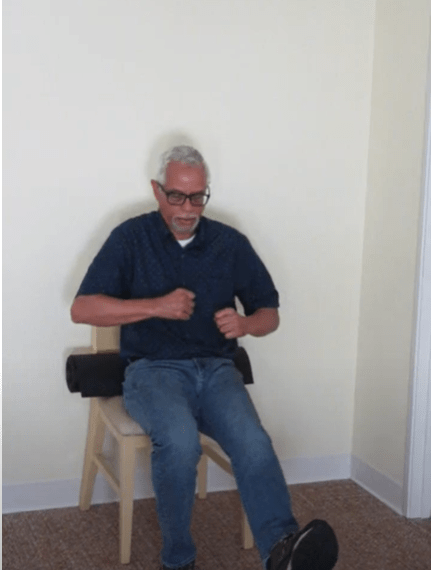
Well, we’ve been working on the single leg sit to stand exercise. After I did a little more reading about it, I think it’s really an exercise for runners. We don’t run, but this seems more like a game when you do it together.
It’s a lot easier to do if you find a seat level higher than a regular chair. We found out that our hotel bed is high enough for us to come closer to doing this with one leg raised off the floor.
We’ve got a new challenge and it’s the single leg sit to stand exercise. It strengthens the glutes, quads, hamstrings, and your resolve to never exercise again.
You remember the one leg stand, which Sena and I can do. The single leg sit to stand is a different thing altogether. You can cheat by using one leg braked against the floor, which helps you lift off on one leg.
The challenge when you try it with just one leg is a deal breaker. One thing you can do is start off sitting from a higher level.
We both noticed that sitting toward the front of the chair works better than sitting near the back. This exercise takes practice and if we get any better at it, we’ll post an update.
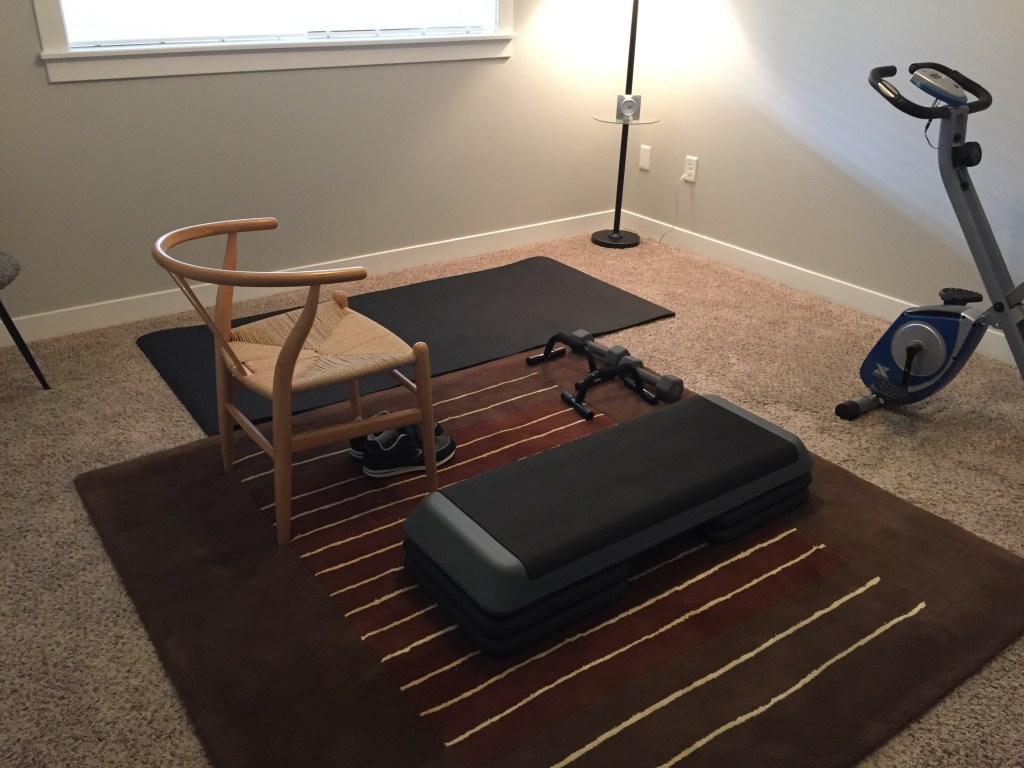
We’re camping out in a hotel while our new house is being built. We tried out the exercise equipment. It has been tough to exercise what with all the chores of showing and selling the house, moving all our stuff into storage, and now adjusting to living in a hotel (which will be for a couple of months).
The hotel has a Peloton bicycle. We tried it. One of the foot straps was missing, and we didn’t try the free workout offer.
As some of you know, I wrote a blog post about the Peloton machine a while back, comparing it to my anti-Peloton bike. The title is “The Anti-Peloton Exercise Bicycle.” As part of the moving process, we donated the old bike to charity.
We’re not planning to invest in a Peloton any time soon.
There is yet another study showing that climbing stairs is great exercise and could help you live longer. It’s not yet published in a peer-reviewed journal, but it was presented at the recent scientific congress of the European Society of Cardiology (ESC) Preventive Cardiology.
Conclusions were that, compared with not climbing stairs, doing so was associated with a 24% reduced risk of dying from any cause. There was a 39% reduced risk from dying of a cardiovascular disease.
One news story about this finding linked to an American Council of Exercise (ACE) article on an international sport called tower running. I’ve never heard of it before.
This could help get you ready for chasing extraterrestrials as shown in the famous fitness documentary Men in Black. Officer Edwards may have had “a real problem with authority” (ironic since he was a New York City cop). But as Agent K pointed out, “So do I. But this kid ran down a cephalopoid on foot, boss. That’s got to be tough enough.”
The point being: if you really know what’s good for you—you’ll take the stairs.
“Conclusions: Any amount of daily steps above the referent 2200 steps/day was associated with lower mortality and incident CVD risk, for low and high sedentary time. Accruing 9000–10 500 steps/day was associated with the lowest mortality risk independent of sedentary time. For a roughly equivalent number of steps/day, the risk of incident CVD was lower for low sedentary time compared with high sedentary time.”
Reference:
Ahmadi MN, Rezende LFM, Ferrari G, et al. Do the associations of daily steps with mortality and incident cardiovascular disease differ by sedentary time levels? A device-based cohort study. British Journal of Sports Medicine 2024;58:261-268.
I figure I’m in the low sedentary category. This is somewhat reassuring to me because so far, my step counter averages (over 3 days) about 2500 steps during my usual daily exercise periods. Of course, this doesn’t count trips to the bathroom. I guess I can relax now.
Since we got this little step counter, I’ve been paying more attention to how I exercise. The step counter will even track steps when I juggle—probably because I drop balls often enough to chase after them a lot.
And then I ran across the 10,000 steps as a benchmark for walking to keep healthy. I get about 3,000 steps during a typical 30-minute exercise session, which I do at least 5 days a week. Most people probably know that the CDC recommends that older adults spend 150 minutes as week (5 days a week for about 30 minutes a day) of moderate-intensity exercise.
That includes walking, jogging, wrestling Bigfoot, things like that. Muscle strengthening and balance are also important.
The 10,000-step thing (or 4,000-6,000 steps for older adults) puzzled me a little. The 10,000-step goal has an interesting story behind it. It turns out that around the time of the 1964 Tokyo Olympic games, that 10,000 steps goal had no scientific basis and was a marketing gimmick for selling the early pedometers.
In fact, if you really use your imagination, you might see how the Japanese character for 10,000 looks a little like a man walking—a stick man. The meter was called a Manpo-kei which literally translates to 10,000 steps.
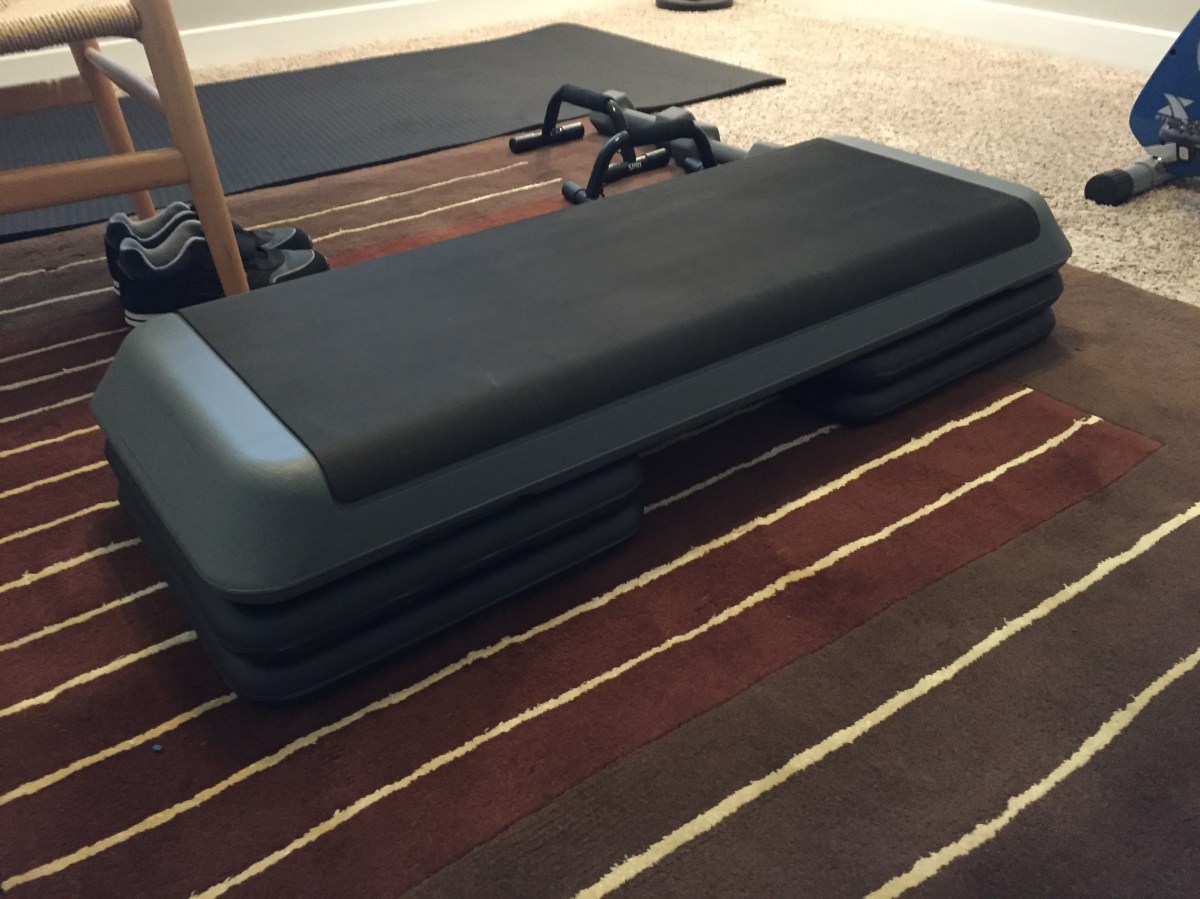
Just walking 10,000 steps a day as a health goal probably doesn’t have a lot of scientific support. But you can increase the intensity of walking to get more benefit, such as walking up stairs or using a step platform, which I use nowadays. As a consultation-liaison psychiatrist, I walked all over an 8-floor hospital. I would usually use the stairs, often well over 20 flights pretty much every day.
I think the other way to make walking a more vigorous exercise is to develop and practice the well-known technique of silly walking, documented in the Ministry of Silly Walks documentary.
Since we added the step platform, I’ve been wondering how to count steps when I use it because for some reason my smartphone step counter won’t count steps when I try to use it on the platform.
Sena got a handy step counter and it works! It works if you have it in your pocket or wear it on neck with a lanyard.
I usually practice juggling patterns as a warm up to exercising. I’m still working on the shower pattern. Progress is slow.
My exercise routine takes a half hour. Following that I sit for mindfulness meditation for 30 minutes. We are still using our anti-Peloton exercise bike. I do one leg stands for a minute on each leg. I still do floor yoga, body weight squats, planks, and dumbbells. I still count my own steps on the platform: 50 steps alternating right and left leg four times (200 steps). The counter number varies between 170-200 or so.
As a review, a recently published study found that climbing 5 flights of stairs (approximately 50 steps) was associated with a lower risk of ASCVD types independent of disease susceptibility (Song et al, see reference below). There was a threshold effect of stair climbing in the study, meaning the benefit was lost if you went over a certain number of “floors.” Going over 15 or 20 didn’t gain much for subjects. A flight was 10 stair steps.
Step up!
Reference:
Song Z, Wan L, Wang W, Li Y, Zhao Y, Zhuang Z, Dong X, Xiao W, Huang N, Xu M, Clarke R, Qi L, Huang T, Daily stair climbing, disease susceptibility, and risk of atherosclerotic cardiovascular disease: A prospective cohort study, Atherosclerosis (2023)
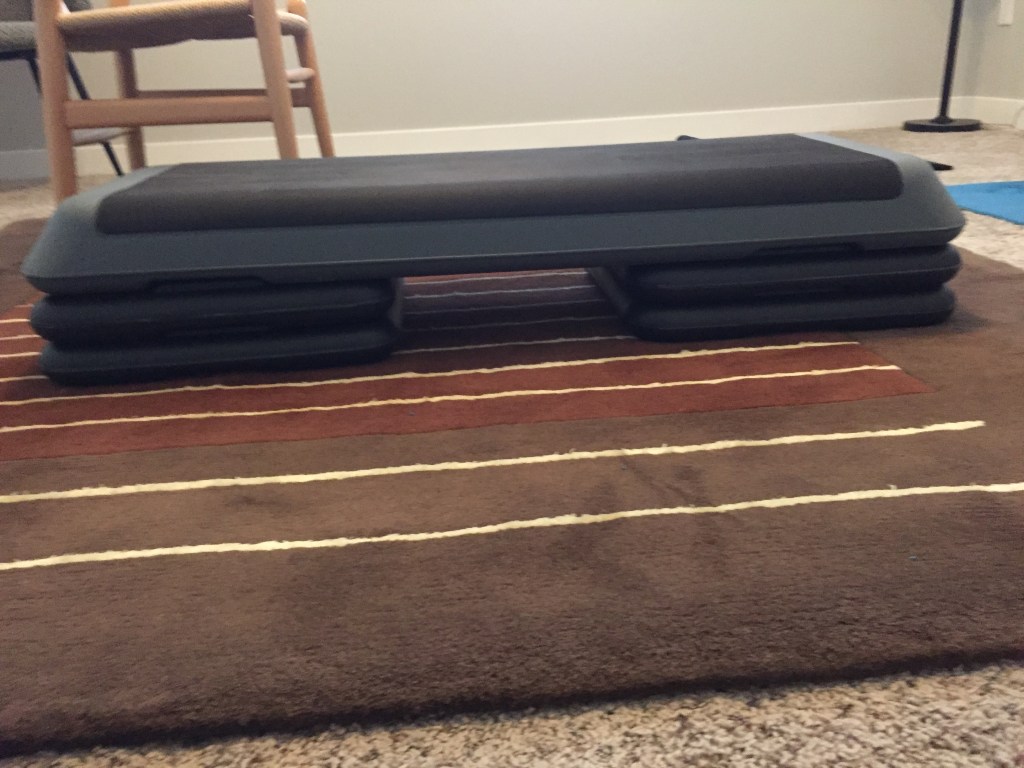
Yesterday we got the new aerobic step platform for cardiovascular health enhancement exercise. As I reported in October, climbing stairs can be very helpful in promoting cardiovascular health. This article summarizes the findings. At least 5 flights (around 50 steps of 10 stair steps) is said to be beneficial.
I climbed a lot of stairs in my career as a consulting psychiatrist in an 800-bed hospital. I don’t do anything close to that now, but I exercise pretty much daily. It limits my wardrobe.
My step counter app will track my stair step climbing on regular stairs in our house. However, it won’t count the steps I do on the step platform. It doesn’t really matter. I count everything else I do when I exercise, even on my anti-Peloton stationary bike, since the digital computer for monitoring my fitness level never worked. I also count the number of throws when I practice the 3-ball cascade juggling pattern (a hundred, often with 2 or 3 different sets of balls).
You can adjust the height on the platform by using risers, which can go up to 8 inches. That’s the usual height of the risers on regular stairs.
It’s not a Stairmaster by any means—but then it doesn’t cost $3,000 either.
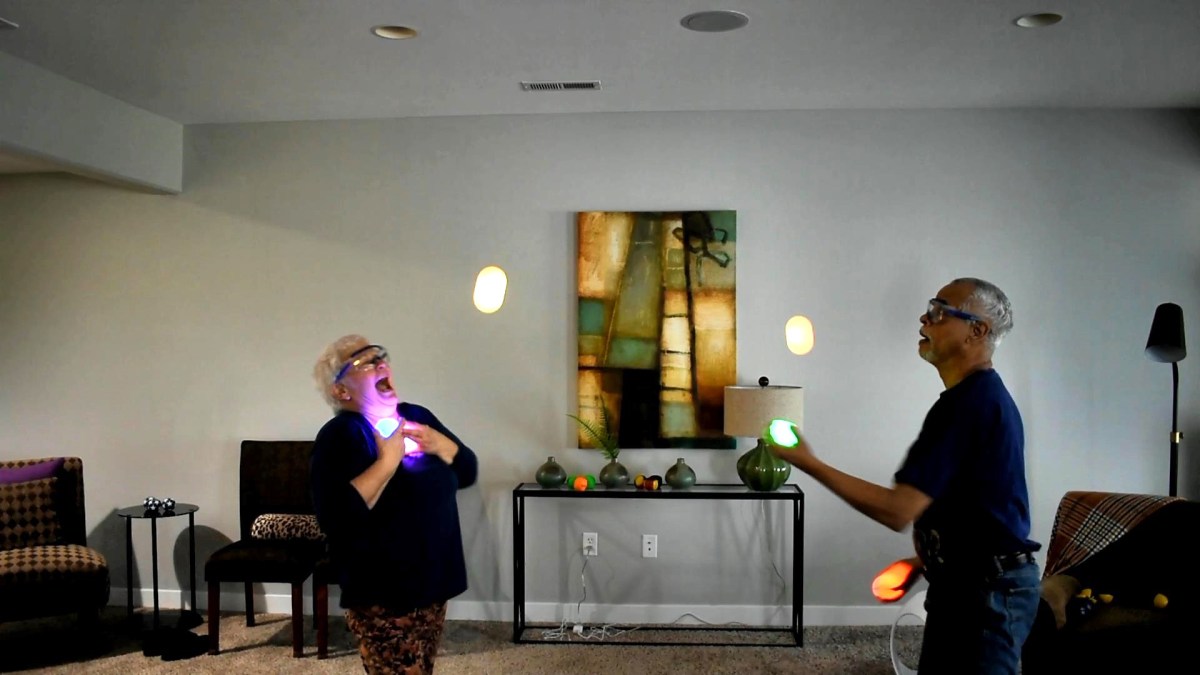
Guess what we did on our anniversary yesterday? We juggled! We got another set of 3 glow balls so we could try the 2-person 6 ball pass juggling trick.
The glow balls are plastic and filled with plastic pellets. They are uniform in size and weight and have 20 different colored light modes and patterns. They are USB rechargeable. The manufacturer says they are “made to take a beating—without being too hard.”
That said, we still suggest you consider wearing safety goggles.
This is a challenging juggling trick because you have to be almost perfectly synchronized with your partner. We drop the balls a lot, but we’ve improved even since the first time we practiced. We still jitterbug around a lot and we work hard at keeping up the “1, 2, Pass” count.
You have to be pretty solid juggling the 3-ball cascade. We get a lot of practice because it’s hilarious.









 Go Retire Psychiatrist