


We just got a couple of books by Ray Bradbury, and I’m pretty excited. Some of the stories I recognize, but there will be some, perhaps many, that will be new to me.
Category: books
Writing is Dope

I learned a new slang word from Houston White, the guy who makes that specialty coffee in Minneapolis I blogged about yesterday: Brown Sugar Banana (I’m not a fan, but I admire him just the same). The word is “dope.” That used to be an insult or an illicit drug when I was growing up. Now it means “very good.”
I guess writing, at least for me, is dope.
The further I get in time away from the day I retired from practicing consultation psychiatry, the more I reflect about how I became a psychiatrist. I’m a first-generation doctor in my family, so what follows is one way to write about it.
What has helped me get through life was this writing habit along with a sense of humor. When I was little, I wrote short stories for my mother. I was the “number one son” in the words of my father, which meant only that I was the first born. My younger brother came second only in order of birth. He was the track star. I was the paperboy. Our parents separated early on. Sena and I have been married for 47 years.
I have been writing my whole life. I used a very old typewriter. I wrote poetry for a while, eons ago. Like many aspiring writers, I tried to sell them to publishers. The only publisher I remember ever responding sent me a hand-scrawled note on a small sheet of paper. He told this really short, nearly incoherent story about his son, who had apparently died shortly before. His son had a “tough road.” It wasn’t clear exactly how he died, but I remember wondering whether it was suicide. It was very sad.
In the 1970s, while I was a student at one of the Historically Black Colleges and Universities (Huston-Tillotson College, now a university) in Austin, Texas, I submitted a poem to the school’s annual contest and for entry into the college’s collection, called Habari Gabani (which means “what’s going on” in Swahili). It was rejected. Years later, I finally was able to track down a digital copy of Habari Gani.

Habari Gani from Huston-Tillotson College
Eventually, thank goodness for everyone’s sake, I gave up writing poetry. It was as bad as Vogon poetry. You’ll have to read Douglas Adam’s book “A Hitchhiker’s Guide to the Galaxy,” for background on that. The Vogons were extraterrestrials who destroyed Earth in order to build an intergalactic bypass for a hyperspace expressway. Vogon poetry is frightfully bad; it’s the waterboarding torture of literature.
I wrote a short Halloween story for my hometown newspaper contest once. It got honorable mention, but I can’t recall what it was about, thank goodness.
I wrote a feature story in a journalism class taught by a nice old guy who made a long speech to the class about the unfortunate tendency for young writers to use flowery, polysyllabic words in their prose. He made it clear that journalists shouldn’t write like that. Although I didn’t consciously do the opposite to annoy him, I did it anyway. I even tossed the word “Brobdingnagian” in it, which might have referred to some high bluffs somewhere in Iowa. Despite being infested with Vogonisms, my teacher tolerated it, sparing my feelings. I must have passed the course although how I did it remains a mystery.
I wrote and co-edited a book with the chairman of the University of Iowa Healthcare Dept of Psychiatry, Dr. Robert G. Robinson, MD. It was “Psychosomatic Medicine: An Introduction to Consultation-Liaison Psychiatry”. There were several contributors. Many of them were my colleagues. It was published in 2010, and prior to that, I’d written an unpublished manual that I wrote for the residents.


There wasn’t any humor in either book, because they were supposed to be evidence of scholarly productivity from a clinical track academic psychiatrist. But I used humor and non-scientific verbiage in my lectures, albeit sparingly. I remember one visiting scientist remarked after one of my Grand Rounds presentations, “You are so—poetic” and I detected a faint disparaging note in his tone…probably a reaction to a latent Vogonism. It’s not impossible to monkey-wrench those into a PowerPoint slide or two.
I used to write a former blog called The Practical Psychosomaticist, later changed to The Practical CL Psychiatrist when The Academy of Psychosomatic Medicine changed their name back to The Academy of Consult-Liaison Psychiatry back in 2017. I wrote The Practical CL Psychiatrist for a little over 7 years. I stopped, but then missed blogging so much I went back to it in 2019 after only 8 months. I guess I was in withdrawal from writing.
That’s because writing is dope.
Hearing an Old Song

I have to admit that I’ve been mis-hearing some of the lyrics of one of my favorite songs, “Lean on Me” for the past fifty-odd years since Bill Withers wrote it. It stayed on the top of the charts for more than 3 weeks back in 1972. That was a special time in my life; and not an easy one.
Back then, you couldn’t just look up song lyrics or anything else for that matter on the world wide web. It didn’t exist yet. I’ve always been prone to mondegreens and I finally found out that I was hearing something different in the verse:
“Please swallow your pride
if I have things (faith?) you need to borrow
For no one can fill
those of your needs
That you won’t let show”
Just to let you know, I found lyrics in one YouTube that substituted the word “faith” for “things”. Think about that one. I don’t know how to settle it, so if anybody knows which word is right, please comment. Anyway, it’s a little embarrassing and revelatory that I heard “…if I have pain…” instead of “…if I have things (or faith)…” And I never really heard “…That you won’t let show.”
Yet I lived it.
Years later, after I’d finished college, medical school, residency in psychiatry, and had taught residents and medical students at the University of Iowa for a number of years, one of my colleagues, Scott, a brilliant psychologist and writer, stopped by my office one day. This was years ago.
His name is Scott and he suggested that it would be nice to get together sometime soon to catch up. I deferred and I remembered he replied while looking off down the hallway, “I’m 70.” I wonder if he meant he didn’t know how much more time he had left.
Scott and I had taken similar paths in the middle of our careers at Iowa. I wanted to try private practice and left for Madison, Wisconsin. Scott got the same idea and left for a position in Hershey, Pennsylvania. We both regretted it and soon after returned to Iowa. I swallowed my pride and came back because I loved teaching. I think he returned for the same reason. We were both grateful that the UIHC Psychiatry Dept. Chair, Bob Robinson, welcomed both us of back.


I touched base with Scott a little while ago. We’re both retired. I was trying to find out how to contact Bob about messages I was getting from the publisher of our consult psychiatry handbook. Neither Scott or I could find out what was going on with Bob, who retired several years ago and moved back East. It turned out he had died. Sometimes we all have sorrow.
Scott is my friend, and I leaned on him a long time ago. I’m unsure if I let it show. I’m 70 and I’m grateful to him.
On that note, I’m finding out that I can’t walk all the way to the mall and back anymore. On the other hand, I can walk about half that distance. It’s about a mile and a half out to the Clear Creek Trail and back. There’s a lot of uphill and downhill stretches along the way. I can manage that.
And Sena bought me a couple of pairs of new shoes that I’m breaking in that will probably be easier on my feet and my calves. They’re Skecher slip-ons, not to be confused with the no hands slip-ins. I’m used to slip-ons. I tried one pair out today, in fact. Before I left, I took a few pictures of Sena’s new garden. As usual, she’s planting new flowers. The dogwood tree looks great. She’s even excited about the wild phlox. I can’t keep track of everything else out there. She makes the beauty out there.
And I lean on her for that.


Further Thoughts on Ray Bradbury’s Short Story, “I See You Never”

This is an update to my post from lasts night on Ray Bradbury’s short story, “I See You Never.” My wife, Sena, happened to mention the naturalization process in the U.S. today.
In fact, we both saw the televised naturalization ceremony at the Iowa State Fair of 2024. During that ceremony, 47 children became citizens. In fact, the U.S. Citizenship and Immigration Services has held a celebratory naturalization ceremony at the Iowa State Fair for at least the last ten years.
There was just such a ceremony last month of 69 immigrants at the University of Northern Iowa.
I had a quick peek at the U.S. citizenship and civics test questions and I’m pretty sure I would have a lot of trouble passing it. I’d probably get shipped back to Mars—which Ray Bradbury wrote a lot about.
The naturalization process isn’t easy. Under federal law, you have to live here in the U.S. at least five years as a lawful permanent resident to be eligible for naturalization, three years if you’re the spouse of a U.S. citizen. You have to learn the language. Many other countries have a similar naturalization process.
There’s no exact number of the USCIS naturalization ceremonies per year, but 818,500 took part in 2024.
Many of those who go through the naturalization process think it’s unfair for others to bypass it by getting into the country by other means.
So, I guess that’s the other side of the short story—the one Ray Bradbury probably didn’t write.
Do We See Each Other?
I know that what I’m writing here this evening is going to sound foolishly sentimental and maybe even a little spooky, but I was struck by this weird experience I had tonight. It was just a little odd and too fortuitous. I’m not going to talk at any length about the politics of it, just the strangeness.
We have these two books by Ray Bradbury, and when I was a kid, I loved his science fiction stories. I read many of them, but never like the one I read tonight.
The way this started was I was looking for something to do. I thought about watching old reruns of The Red Green Show on YouTube, which always struck me as funny when I watched them long ago. I still do, but couldn’t get into it tonight.
I turned on the TV and flipped through the channels which, as always, were reruns. I was not even interested in the X-Files reruns and I’m a fan. And I couldn’t stand the thought of seeing any more in-your-face commercials about total body deodorant.
So, I picked up the hefty paperback of a big collection of a hundred of Ray Bradbury’s short stories, entitled oddly enough, “Bradbury Stories.” I just opened up the book with no particular story in mind and it fell open right to one I’d never read before, “I See you Never.”
It’s all of 3 pages long and it’s about a Mexican immigrant named Mr. Ramirez. He’s been brought by the police to the front door of the rooming house where he’s been living on a temporary visa, which has been revoked. He’s just there to say goodbye to his landlady. He’s being deported and has this sad conversation with her on the doorstep. He just keeps telling her in broken English, “I see you never.” The landlady, Mrs. O’Brian (no accident she has an Irish name, of course) just says repeatedly that he’s been a good tenant and that she’s sorry. Then he leaves with the police. She goes back inside and can’t finish her dinner with her family and realizes she’ll never see Mr. Ramirez again.
There’s a much better summary and analysis than mine written by a professional reviewer. This story was published back in 1947 and is set in the historical context of post WWII America.
I hate politics, and I’m not going to say anything specific about how this little story struck me with its irony given what’s going on this country right now. I was just looking for a little science fiction distraction and instead got irony. I didn’t go looking for this and I’ll be brutally frank—I actively avoid political news and I hate like hell to get reminded of it every day. All I did was open a damn book. I wish I had never seen this story.
I guess maybe that’s what I get for my avoidant approach to certain things. How’s that for a Mental Health Awareness month event?
Three Photos to Share for Mental Health Awareness Month

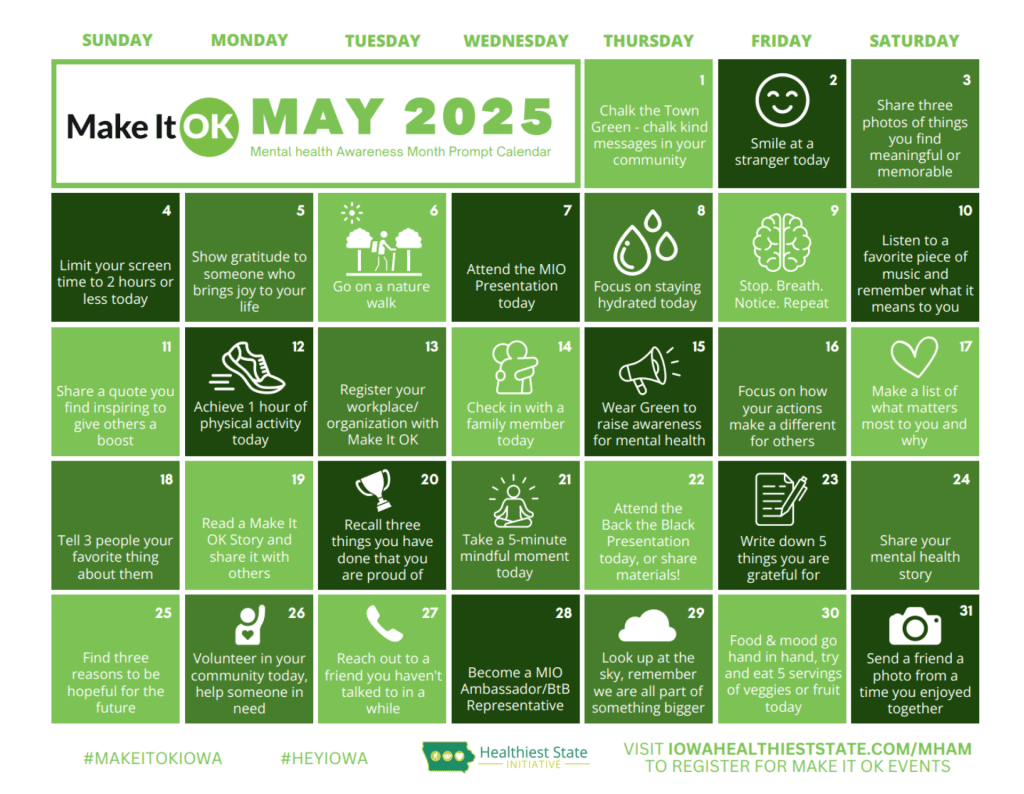
So, I have to hurry up and get these 3 photos posted for today because it’s getting pretty late. Recall the Iowa Healthiest State Initiative calendar along with my photos to share:


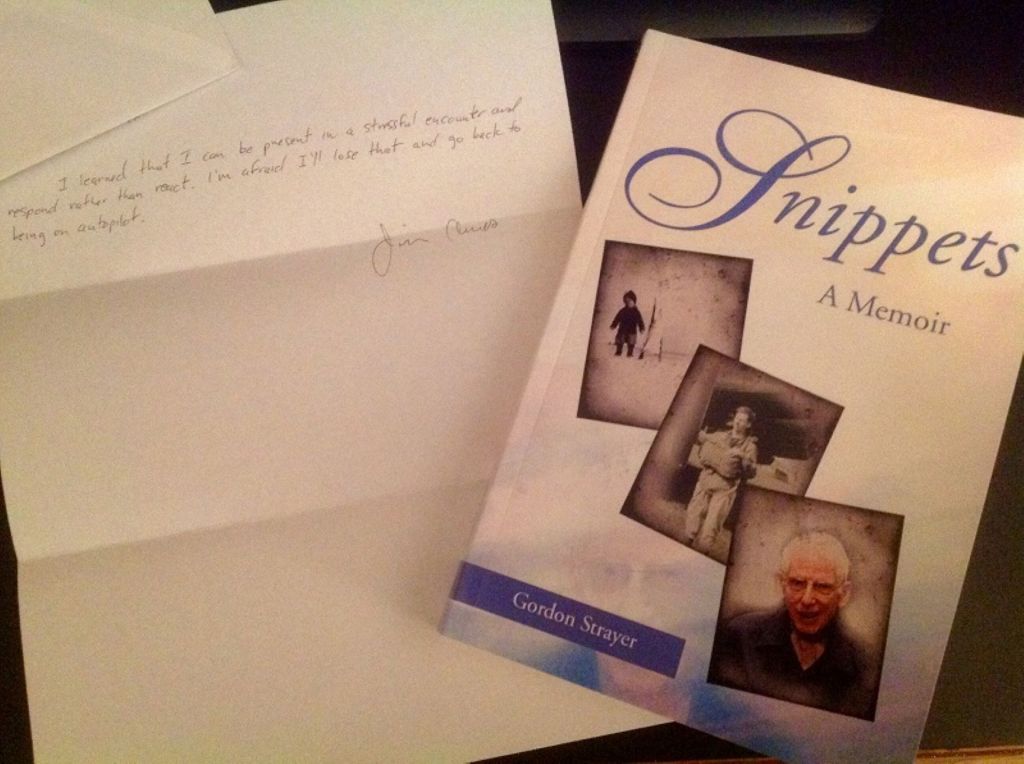
The images are important features of events in my life or my sense of humor.
I’m a birdwatcher and many different species of birds visited the fountain. The fountain attracted bluebirds who splashed and even swam in it. That fountain was very heavy. We couldn’t leave it out all winter. In the fall I had to lift the bowls off and move them somewhere else. Moving them entailed lifting them onto bags of mulch so as to reduce the work of hefting them a small distance at a time. The birds were beautiful to watch.
The letter was a class assignment our Mindfulness Based Stress Reduction (MBSR) teacher had us write at the beginning of the class. After we graduated, she mailed us those letters shortly thereafter. We were to write something connected with what we thought we had gained or what we thought might happen after taking the MBSR class. The book might seem out of place, and while I can’t talk much about Gordon Strayer, I did meet him and read his book (which is now long gone; probably lost in a move). I admired him. I don’t think he feared death.
The Chrysler Building reminds me of the Men in Black (MIB) 3 movie, and I included it because my sense of humor is very important to me. In the movie, Agent J and Jeffrey Price have this funny conversation about time travel back to an era that was not the greatest for black people. I know because I lived through it. Agent J is about to use the time travel device which involves jumping off a tall building (it’s a “time jump!”). Agent J is preparing to travel back in time to M.I.B.’s early days in 1969 to stop an alien from assassinating his friend Agent K and changing history. They have this short conversation:
Jeffrey Price: Do not lose that time device or you will be stuck in 1969! It wasn’t the best time for your people. I’m just saying. It’s like a lot cooler now.
Agent J: How will I know if it works?
Jeffrey Price: You’ll either know…or you won’t.
All Jokes Aside, What Do I think About the Book “Caste: The Origins of Our Discontents?”

I just finished reading Isabel Wilkerson’s book, “Caste: The Origins of Our Discontents.” It was a painful read because it talks about racism in America, which is a part of my lived experience. Wilkerson’s compares it to the Nazi persecution of the Jews and the caste organization in India. The chapter on the pillars of caste make sense to me.
When I reached the last section (not at all “final” by any means), which is called “Awakening,” I was not surprised that there were no prescriptions or outlines or action plans for how to eliminate caste in any culture. It turns out that we’re all responsible for becoming aware of how we all are complicit in some way with maintaining caste divisions in society. And the word Wilkerson used for how to begin is “empathy,” or somehow becoming conscious of that tendency and to replace it with understanding.
As Wilkerson emphasizes, empathy isn’t sympathy or pity. Empathy is walking a mile in someone else’s shoes, as the song goes. But she goes a step further and uses the term “radical empathy.” It’s difficult to define concretely. It goes beyond trying to imagine how another person feels, going the extra mile and learning about what the other person’s experience. It’s not about my perspective; it’s about yours. It’s not clear exactly how to make that deep connection. She uses terms like “spirit” which may or may not resonate with a reader searching for a recipe or a cure.
Politics turns up in the book. How could it not? I’m going to just admit that I wanted to make this post humorous somehow, especially after I saw Dr. H. Steven Moffic’s article in Psychiatric Times about whether psychiatrists are to act in the role of “bystanders” or “upstanders” in the present era of political and social turmoil. He specifically mentioned the Goldwater Rule, which is the American Psychiatric Association Ethics Annotation barring psychiatrists from making public statements of a diagnostic opinion about any individual (often a politician) absent a formal examination or authorization to make any statements. The allusion to a specific person is unmistakable.
But, as a retired psychiatrist, I’m aware that my sense of humor could be deployed as a defense mechanism and it would certainly backfire in today’s highly charged political context. I’m not sure whether I’m a bystander or an upstander.
Sena and I had a spirited debate about whether America has a caste system or not. I think it’s self-evident and is nothing new to me. I suspect that calling racism (which certainly exists in the United States) a form of casteism would not be altogether wrong. Wilkerson mentions a psychiatrist, Sushrut Jadhav, who is mentioned in the Acknowledgments section of her book. Jadhav is a survivor of the caste system in India. I found some of insights on caste and racism in web article, “Caste, culture and clinic” which is the text of an interview with him.
His answers to two questions were interesting. On the question of whether there is a difference between the experience of racism and caste humiliation, he said “None on the surface” but added that more research was needed to answer the question adequately. And to the question of whether it’s possible to forget caste, he said you have to truly remember it before you can forget it—and it’s important to consider who might be asking you to forget it.
This reminded me of the speech in the movie “Guess Who’s Coming to Dinner,” said by John Prentice (played by Sidney Poitier) to his father:
“You’ve said what you had to say. You listen to me. You say you don’t want to tell me how to live my life? So, what do you think you’ve been doing? You tell me what rights I’ve got or haven’t got, and what I owe to you for what you’ve done for me. Let me tell you something. I owe you nothing! If you carried that bag a million miles, you did what you were supposed to do because you brought me into this world, and from that day you owed me everything you could ever do for me, like I will owe my son if I ever have another. But you don’t own me! You can’t tell me when or where I’m out of line, or try to get me to live my life according to your rules. You don’t even know what I am, Dad. You don’t know who I am. You don’t know how I feel, what I think. And if I tried to explain it the rest of your life, you will never understand. You are 30 years older than I am. You and your whole lousy generation believes the way it was for you is the way it’s got to be. And not until your whole generation has lain down and died will the deadweight of you be off our backs! You understand? You’ve got to get off my back! Dad. Dad. You’re my father. I’m your son. I love you. I always have and I always will. But you think of yourself as a colored man. I think of myself as a man. Hmm? Now, I’ve got a decision to make, hmm? And I’ve got to make it alone. And I gotta make it in a hurry. So, would you go out there and see after my mother?”
And there was this dialogue that Sena found on the web, which was similar to that of John Prentice. It was a YouTube fragment of a 60 minutes interview in 2005 between actor Morgan Freeman and Mike Wallace. Wallace asked Freeman what he thought about Black History Month. Freeman’s answer stunned a lot of people because he said he didn’t want Black History Month and said black history is American history. He said the way to get rid of racism was to simply stop talking about it. His replies to questions about racism implied he thought everyone should be color blind. John Prentice’s remarks to his father are in the same vein.
I grew up thinking of myself as a black person. I don’t think there was any part of my world that encouraged me to think I was anything different. I think Wilkerson’s book is saying that society can’t be colorblind, but that people can try to walk a mile in each other’s shoes.
Keep Hope Alive

Just a reminder, Isabel Wilkerson will be giving her presentation, ” “Caste: How the hierarchy we have inherited restricts our humanity” from noon to 1 p.m. Wednesday, Feb. 5, in Prem Sahai Auditorium (room 1110) in the Medical Education and Research Facility.
I’m about halfway through her book, “Caste: The Origins of Our Discontents.” It’s a very difficult read, as I anticipated. It’s full of horrendous descriptions of what those in lower castes suffered, whether from the time of the Nazis, India, or America. I can read it only for a short while and then I have to put the book down and take a break. I get so I feel like I need an inspirational lift.
And it just happened the other night. I heard a poem on TV I’ve heard before, “I am Somebody.” Although it was written in the 1950s by Reverend William Holmes Borders, a civil rights activist and senior pastor at Wheat Street Baptist Church, it was recited by Reverend Jesse Jackson in 1963.
I remember seeing Reverend Jackson cry the night Barack Obama was elected President in 2008. I never heard the original speech Reverend Jackson gave in 1988, during the second time he was running for President himself.
I think it was probably because I was focused on starting medical school at The University of Iowa. I began my studies in August of 1988 in what was then the summer enrichment program for minority students.
One of Reverend Jackson’s speeches contained the other memorable cry, “Keep hope alive!” You can hear it and read the transcript.
You must not surrender! You may or may not get there but just know that you’re qualified! And you hold on and hold out! We must never surrender!! America will get better and better.
Keep hope alive. Keep hope alive! Keep hope alive! On tomorrow night and beyond, keep hope alive! I love you very much. I love you very much. —Rev. Jesse Jackson, 1988.
Just Got Isabel Wilkerson’s Book: “Caste: The Origins of Our Discontents”
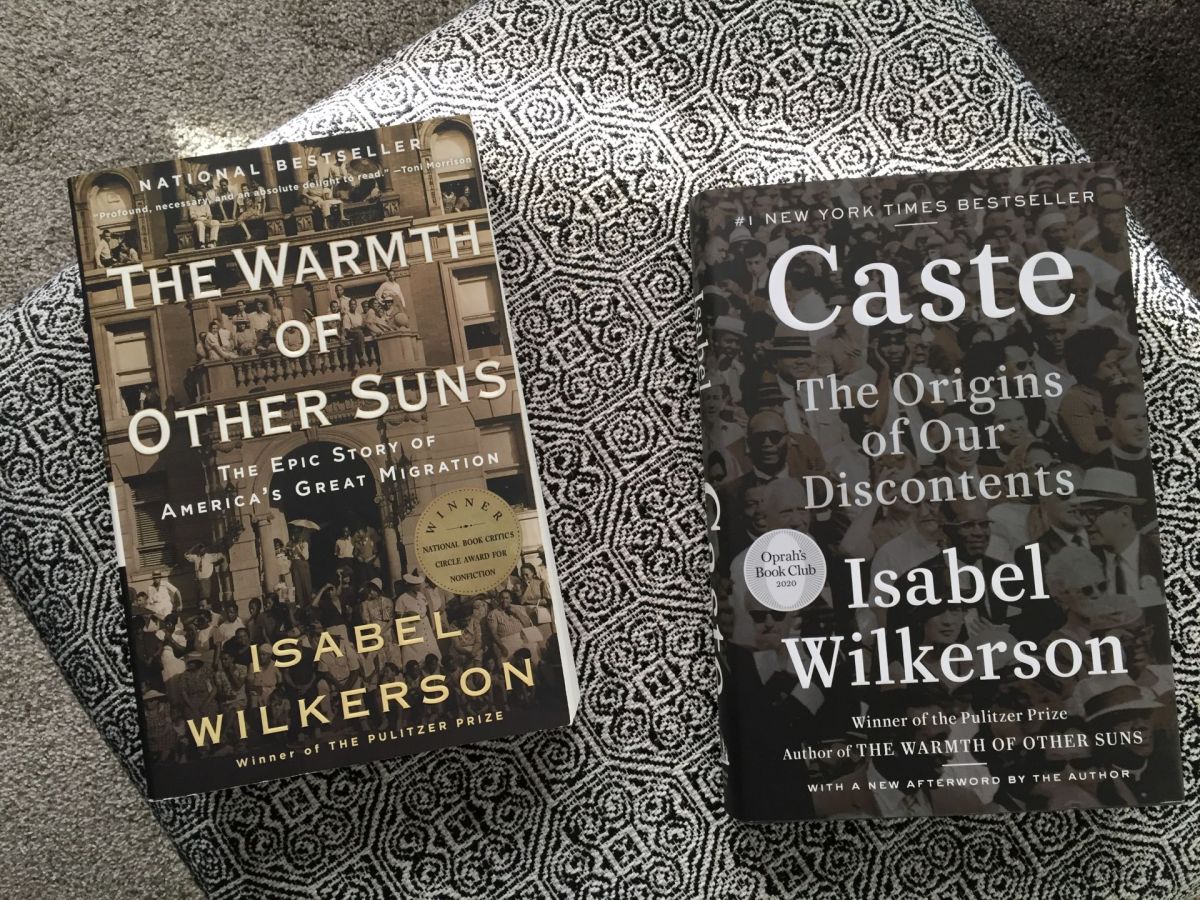
I just got a copy of Isabel Wilkerson’s book “Caste: The Origins of Our Discontents.” I read her other book, “The Warmth of Other Suns” years ago. It won a Pulitzer Prize.
I read the first section, “Toxins In The Permafrost And Heat Rising All Around.” It brought back memories of the 2016 Presidential Election, which I won’t discuss in any detail. It does seem ironic now.
I have no doubt that “Caste” will be an uncomfortable read, like Wilkerson’s first one and like Michele Norris’s book, “Our Hidden Conversations.”
Just a reminder, Isabel Wilkerson is scheduled to speak as part of Dr. Martin Luther King, Jr. events on February 5, 2025 at the University of Iowa Medical Education and Research Facility (MERF); Prem Sahai Auditorium. General admission is free although it’s a ticketed event, more information here.
Could Artificial Intelligence Help Clinicians Conduct Suicide Risk Assessments?

I found an article in JAMA Network (Medical News & Perspectives) the other day which discussed a recent study on the use of Artificial Intelligence (AI) in suicide risk assessment (Hswen Y, Abbasi J. How AI Could Help Clinicians Identify American Indian Patients at Risk for Suicide. JAMA. Published online January 10, 2025. doi:10.1001/jama.2024.24063).
I’ve published several posts expressing my objections to AI in medicine. On the other hand, I did a lot of suicide risk assessments during my career as a psychiatric consultant in the general hospital. I appreciated the comments made by one of the co-authors, Emily E. Haroz, PhD (see link above).
Dr. Haroz preferred the term “risk assessment” rather than “prediction” referring to the study (Haroz EE, Rebman P, Goklish N, et al. Performance of Machine Learning Suicide Risk Models in an American Indian Population. JAMA Netw Open. 2024;7(10):e2439269. doi:10.1001/jamanetworkopen.2024.39269).
The model used for the AI input used data available to clinicians in patient charts. The charts can be very large and it makes sense to apply computers to search them for the variables that can be linked to suicide risk. What impressed me most was the admission that AI alone can’t solve the problem of suicide risk assessment. Clinicians, administrators, and community case managers all have to be involved.
The answer to the question “How do you know when someone’s at high risk?” was that the patient was crying. Dr. Haroz points out that AI probably can’t detect that.
That reminded me of Dr. Igor Galynker, who has published a lot about how to assess for high risk of suicide. His work on the suicide crisis syndrome is well known and you can check out his website at the Icahn School of Medicine at Mount Sinai. I still remember my first “encounter” with him, which you can read about here.
His checklist for the suicide crisis syndrome is available on his website and he’s published a book about as well, “The Suicidal Crisis: Clinical Guide to the Assessment of Imminent Suicide Risk 2nd Edition”. There is also a free access article about it on the World Psychiatry journal website.
Although I have reservations about the involvement of AI in medicine, I have to admit that computers can do some things better than humans. There may be a role for AI in suicide risk assessment, and I wonder if Dr. Galynker’s work could be part of the process used to teach AI about it.
 Go Retire Psychiatrist