The Incredible Shrinking Headshrinker

Last week we saw the 1957 movie “The Incredible Shrinking Man” on the Svengoolie show on the MeTV channel. We’ve never seen it before and it actually got pretty good reviews back in the day. The main character, Scott Carey, was played by Grant Williams. You can watch the movie for free on the Internet Archive.

According to some interpretations, the story uses the metaphor of diminishing size to highlight the diminishing role of masculinity in American society in the 1950s or human notions in general about one’s self-worth in society.

It got me thinking about how the challenges of adjusting to retirement as a process has been (and still is to some degree) for me. I started out with gradual reduction of my work schedule in the form of a phased retirement contract. It was difficult.

I was reminded of how difficult it was to slow down, especially as a teacher of residents and other health care trainees, when I was going through some old papers after the recent move to our new house. They included teaching awards I’d received over the years.

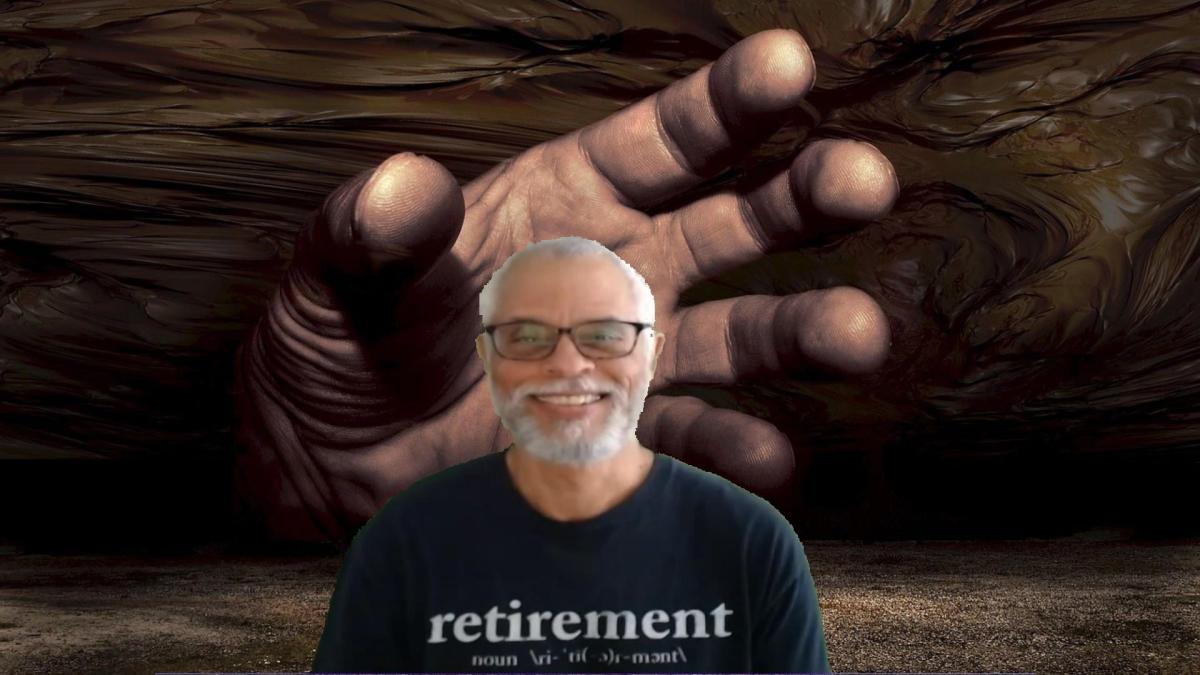
I was struck by how small my self-perceived role in psychiatry and medicine has gradually become in the last few years. I’ve been shrinking, similar to Scott Carey. In fact, I’m a shrinking headshrinker.

I don’t want to spend too much time ruminating about what retirement means to me. I think it’s a very common response to perceive the world gets smaller when you retire.

It doesn’t help much to intellectualize about shrinking in this way. Scott Carey eventually accepted his diminishing stature, even to the point of disappearance. Grief about this kind of loss is normal, although I’m realizing that grief might never completely disappear.

Back to the Roller Window Shades?

I just heard about the new regulation banning cords on window shades. I didn’t know that window cords were so dangerous.

We recently moved into our new house and need window coverings. We’ve had corded window coverings (mostly blinds) for years wherever we moved. I guess we’ll have to consider other options.

This reminds me of the old roller shades we used to have. I couldn’t find a free picture of them on pixabay, no matter how I worded the search term. The ones I remember were white and had a mechanism in the roller which retracted the shade—if you had just the right wrist motion.

Many times, the shade ended up in a heap at your feet. You could injure yourself by tripping over the shade, or sometimes by the shade suddenly snapping upwards and smacking you in the face.

There are newer versions of roller shades and they’re all expensive. You can still get old-fashioned roller shades, but I think they cost a lot more.

There’s an old photograph of a room with several roller shades on this web page.

Thoughts on the Homeless Mentally Ill

The homeless man who lives on the sidewalk outside our hotel reminds me of a couple of things. One is Dr. Gerard Clancy, MD who is University of Iowa Health Care Professor of Psychiatry, Professor of Emergency Medicine, and Senior Associate Dean of External Affairs.

I remember Gerry, who was in the department of psychiatry when I was a resident. I saw his picture in the newspaper and hearing about him riding a bicycle around Iowa City doing a sort of outreach to the homeless mentally ill.

I found an archived article mentioning him published in 1995 in the Daily Iowan. The story starts on the bottom of the front page, entitled “I.C. opens new doors for area’s mentally ill.” It continues on page 9A.

The story mentions Dr. Clancy and what was called then the Clinical Outreach Services and the Emergency Housing Program (EHP). The challenges then sound a lot like what they are now: long waiting lists for psychiatric evaluation and treatment, a lack of funding for the treatment of mental illness, and a lack of preventive care. The most common mental illnesses in the homeless mentally ill are chronic schizophrenia, schizoaffective disorder, and bipolar disorder. The idea of reaching out to them “on their own turf” as Clancy was quoted, was to help them feel more comfortable talking about their mental illness.

The housing situation for this population of those struggling with mental illness was dismal then and it’s still dismal.

The homeless guy I’ve been calling Bob lives on the sidewalk next to a busy street. It’s just my opinion that he’s mentally ill based on my observations of his behavior. I’ve never tried to talk to him. However, Bob gets visits from people who obviously have differing views about the way he lives.

Some of them do talk to him and, although I can’t hear their conversations, the actions tell me important things. Some bring him what I call “care packages,” often food, water, and other items. They may start by acting kind, although may get impatient with him. Others try to clean up his sidewalk, and may criticize him. The police occasionally visit and have so far not taken him into custody.

It looks like things have not changed much since 1995 regarding the homeless mentally ill based on what I write here about my observations. In fact, it’s easy to find current news stories that say things are getting worse.

At the beginning of this post, I said I found a couple of things. The other thing was a very thorough teaching presentation about the current state of formal outreach to this population. It’s available on the web as a power point presentation by another University of Iowa faculty, Dr. Victoria Tann, MD, entitled “Assertive Community Treatment 101.”

Dr. Tann is currently an IMPACT Team psychiatrist. It’s an excellent source of background on the history of this effort at outreach to the homeless mentally ill. It also summarizes what’s happening with the program now.

Back to the Stanley Museum of Art

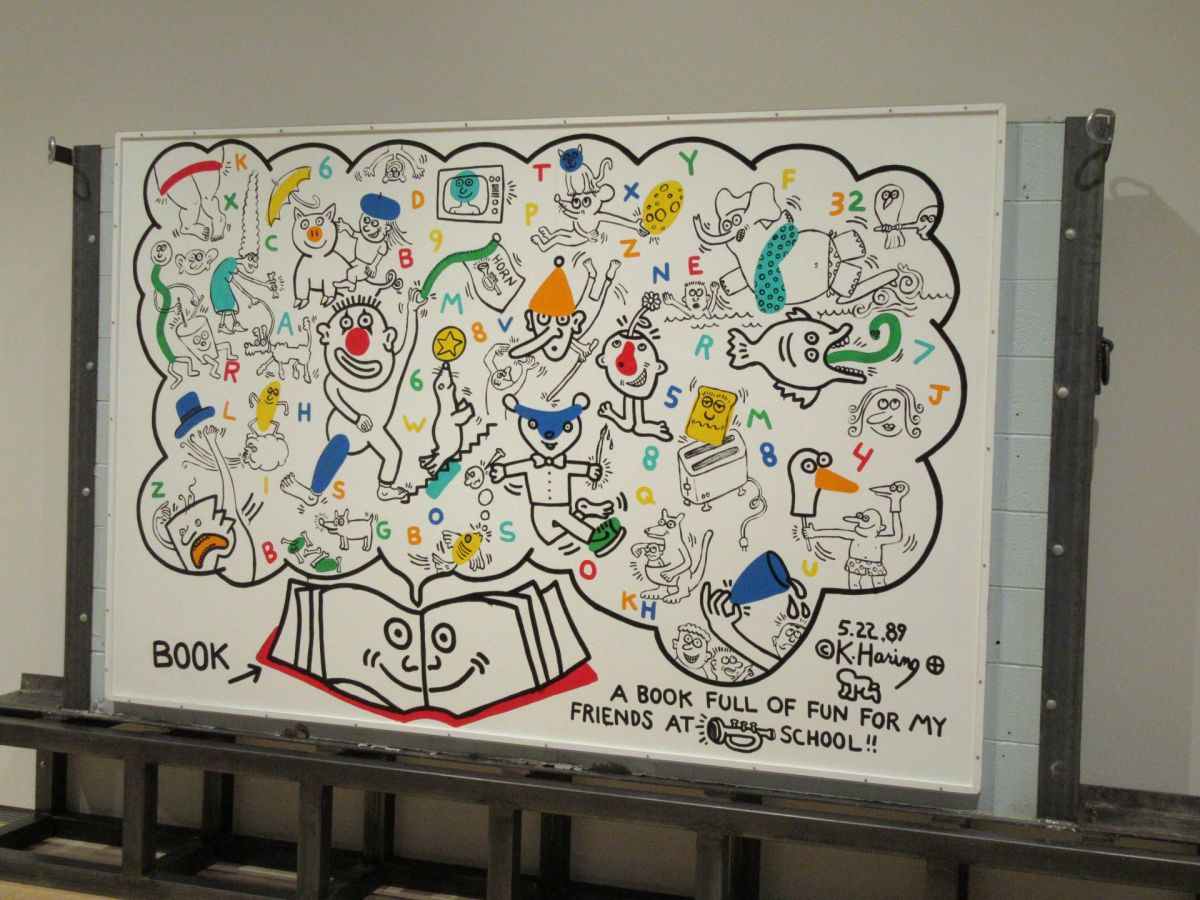
We went for a return visit to the Stanley Museum of Art the other day. It’s been a couple of years. There were a couple of head sculptures outside in the front of the building. They were in honor of one of my former medical school teachers, Dr. Richard Kerber. And the Keith Haring exhibit is excellent. He visited Horn Elementary School in 1989.

Thoughts on Hobos and Homelessness

We can see the man from our hotel window. We assume he’s homeless. He has a small area where he sits on the curb next to the street.  He does this most of the day. He has a blanket and a few other loose items which sometimes are strewn on the sidewalk or the grass.

Even in 90-plus heat, he’s out there, sometimes standing beneath a small tree, presumably for shade although it’s inadequate. He waves his arms around in what looks like a futile attempt to cool himself. He might just be restless. Other times he sits on his blanket. Occasionally, people stop their cars and seem to be trying to communicate with him. He most often ignores them.

One of the hotel residents approaches him sometimes. It looked like he gives him something (probably a cigarette). Once, the homeless man left his station by the street and walked over to the front of the hotel, waving his arms, seemingly because the hotel resident was speaking to him. We couldn’t see what happened after that, but when he returned to the street, he lit a cigarette. We also saw he accepted fluid, maybe a can of soda.

Later, some people in a car gave him something they bought in a nearby drive-up fast-food joint. He threw out the ice from his drink, which he didn’t consume and sprinkled the fluid on his arms. The people left and returned later with several items they gave him. Some of it looked like more water, which he again poured on his arms. There was a backpack or something like it. He didn’t seem to know what to do with it.

He couldn’t ignore them when they try to help him (water, food, etc.). One person tried to help him clean up his little camp by picking up his trash. The police came out to check on him. We couldn’t hear the short conversation. After she left, he continued to toss his water bottles and other items into the parking lot. He sleeps on the pavement.

This reminded me of a couple of times when I’ve seen hobos. I don’t see the homeless man as a hobo. The term “hobo” is not synonymous with homeless, vagrant, or tramp. Hobos prefer not to have a home, travel around to find work, may still ride the rails to get around, and don’t see themselves as tramps.

As a young man, I worked for consulting engineers as a draftsman and survey crew worker in Mason City. This was in the 1970s. We traveled to outlying cities. One day, we went to Britt for a job. It was during the Britt Hobo Days Convention. It was not the first time I ever heard of it.

Funny thing, I thought I recognized one of the hobos in the café where we got coffee. He was wolfing down a big breakfast. When he was finished, he left in a hurry. I just assumed he was a hobo in town for the festivities. But he looked so familiar.

And suddenly it dawned on me. He had been a kindergarten classmate of mine. I couldn’t recall his name, but it was him.

Another memory that occurred to me was much later in my life, when I was a psychiatrist and co-attending on the medical-psychiatry unit in University Hospital in Iowa City. We admitted a patient who had been found walking around and around in a circle in the street, and seemed confused. Evidently the patient had an acute medical problem and no diagnosable psychiatric illness.

The patient identified as a hobo and was proud of it. The person was polite, grateful, and cooperative. The person refused any help from us beyond help for the acute medical problem. We discharged the person to the street.

Hobo life is different nowadays, I gather. Many have cars and phones. If you look carefully at their photos on the Britt Hobo Days web site, they don’t make me think of homelessness or mental illness. They have made a choice.

On the other hand, homelessness is often not a choice and severe mental illness is not uncommon. There is a homeless shelter in Iowa City, and the resources include a supportive community living program for those who struggle with mental illness. One member of the board of directors is a psychiatrist. Not every homeless person wants to go there. The University of Iowa Health Care has an Integrated Multidisciplinary Program of Assertive Community Treatment (IMPACT).

Thoughts as Train Cars Visualization in Mindfulness Meditation

The Iowa Interstate Railroad train rumbles past our hotel a few times a day and it reminds me of the Mindfulness Based Stress Reduction (MBSR) course I took 10 years ago. One of the exercises the instructor mentioned was the train visualization mindfulness exercise. I don’t know if I remember what our instructor actually said about it, probably something like what the instructor says in a mindfulness video.

One thing I do remember is that it’s OK to notice my thoughts as train cars running through my head. The other thing is the train cars can sort of hijack me and off I go on a tangent, like a hobo hopping a freight car. And, what if also I notice the spaces between the train cars? What would that be like?

The side of my nose itches.

My left eye is tearing up.

What can I do about anything?

Are we all alone in the universe?

Why is David Attenborough’s voice so calming?

Why do I joke around so much?

Even after 10 years of mindfulness practice, I still notice my thoughts jumping around. I’m still hopping from box car to box car.

Dirty Laundromania

Because we’re staying in a hotel waiting for our house to be built, we have to take a different approach with our laundry. There are laundry facilities at the hotel, but there aren’t many machines. Sena usually takes it to a place called Laundromania. The motto is “We Never Clothes.”

I went with her the other day for the first time. There are a lot of machines. As it turns out, there’s also a lot of history at Laundromania. Back in 2008, Iowa City suffered a major flood and Laundromania was under water for a while. There’s even a picture inside of the water line painted on one of the windows. We remember that time. What a mess. You can see a very dirty sign that was framed and which describes the flood.

Laundromania is a modern facility. You can put your cash into a machine which pushes out a sort of debit card-which can only be used in Laundromania. You want to be careful with that. Depending on how long you live in the neighborhood, it could be either a good or a bad thing.

Even though it’s a modern facility, Laundromania does have some quirks. The day we were there, we tried to use a dryer which turned out to have a broken door latch. We lost a little money in it. Sena put one of the Out of Service signs on it. There’s no on-site manager there but, coincidentally, shortly after she put the sign on the dryer, the service guy showed up. I guessed he fixed it.

For a short time, I tried to keep track of the dryer time using the old analog clock on the wall. Two things wrong with that: the clock doesn’t work and all the machines have digital timers on them anyway.

You can buy laundry detergent and other stuff there from a vending machine, but they’re pretty expensive.

There are a couple of old grade school desks that bring back memories. One of them is pretty dirty.

If you’re ever in Iowa City and you need to do your dirty laundry, try Laundromania.

Verbal De-escalation Education Videos

I was looking at the Academy of Consultation-Liaison Psychiatry (ACLP) and discovered a free online video educational series on verbal de-escalation of agitated patients. It reminded me of my own early attempts to educate trainees about this very important topic (see my post “A Little Too Exuberant”).

The Simpson et al presentation includes 5 free online videos. The first one is below.

Simpson, Scott & Sakai, Joseph & Rylander, Melanie. (2019). A Free Online Video Series Teaching Verbal De-escalation for Agitated Patients. Academic Psychiatry. 44. 10.1007/s40596-019-01155-2.

Flora and Fauna Under the Hot Iowa Sun

The other day we walked the Terry Trueblood Trail (when do we not do that?) and saw interesting sights. I finally got a video clip of a goldfinch! And a male northern cardinal either sang to us or cussed us out. It was hard to tell.

It was a scorcher out there. We started out looking for a walking trail a guy gave us directions to a week or so ago. It’s a great place for birding. We found it, but here was no parking anywhere close. He told us that we could park in a farmer’s field, but we saw the farmer out there and decided not to chance it.

While we were out doing that, we drove by a cornfield, which really impressed Sena because we could drive right up close to it. She’s never detasseled corn. I have and I don’t think she missed anything. I walked the rows with fellow detasselers and we yanked them. We were in rows right next to each other. We could hear each other collapse from time to time from exhaustion. When you pulled the tassels out, they sort of squeaked. You could hear us: Squeak, squeak, squeak, thud.

On the other hand, we had a pretty good day birding out at Trueblood. I got a better video clip of a dickcissel.  We saw a couple of geese scare a turtle off a rock in Sand Lake. We didn’t notice it at the time, but saw it on the video clip after we got home (which is still the hotel, by the way).

We saw several dickcissels. We still don’t think they sound like they’re singing “dick, dick, dick.” I think that’s a load of squeak, squeak, squeak. They are pretty birds, though.

Big Mo Pod Show Theme “Limitation Brings Innovation”

Last Friday night, the Big Mo Blues Show was recorded. I found the podcast, which had the theme “Limitation Brings Innovation.” The idea behind that was that sometimes when musicians lack the resources to, say, put together a big band sound, they often innovate to create a sound that’s new and surprisingly fresh and rivals the production of bigger and better funded orchestras.

Along those lines, Big Mo played Seasick Steve’s song “Backbone Slip.” It’s a rocker. On the other hand, my favorite from him is “You Can’t Teach an Old Dog New Tricks.” Seasick Steve did a live version of it about 13 years ago. He played a homemade guitar made of a broomstick and a couple of hub caps.

I guess you call that limitation leading to innovation. It could be the anthem for old retired guys.