Today, in honor of Debunking Day, which is held on March 11 annually (starting in 2005) I thought I’d introduce a new word. It’s Para-Debunking and you won’t find it in the dictionary, at least not in our brand-new hardcover Merriam-Webster’s Collegiate Dictionary, Eleventh Edition. It was just delivered yesterday. We needed at least one physical dictionary for when we play Scrabble. We’re also waiting for an official Scrabble Dictionary, also on order. The heft of a real dictionary feels really good, by the way.
Anyway, the definition of “debunk” is “to expose the sham or falseness of” something.
Before I give you my definition of para-debunking, I should say that it’s a spinoff of the word “paranormal.” I know it doesn’t really make sense, but hang on, I’m getting to that.
You’ll never guess how I even found out it was Debunking Day today. Sena found out yesterday that a radio DJ was planning to observe the holiday by looking up something on MythBusters, another TV show we used to watch a lot.
That led to Sena finding a couple of X-Files episodes (a big-time paranormal TV show in the not-so-distant past): Sunshine Days and The Rain King.
If you can pick any topic to find debunkers always ranting about, the paranormal would be one of them. I’m not out to actually debunk it, so you can put your guns down. But the two X-Files episodes made me think of maybe something more important than just garden variety debunking.
Sunshine Days, an episode in the 9th season, originally aired in 2002, with Agents Doggett, Reyes, and Scully investigating two murders at a house that is off and on tricked out as the Brady Bunch house. This is the accidental result of the staggering psychokinetic powers of the homeowner, Anthony, whose psychic talents were studied when he was a child by a parapsychologist, Dr. Rietz. Anthony developed an attachment to Dr. Rietz and created doubles of the Brady Bunch (gaaahhhh!) because his family life was bad.
The agents take Anthony to FBI headquarters in Washington, D.C. and convince Assistant Director Skinner and a scientist that Anthony’s powers could change the world. But as Anthony demonstrates his powers by levitating things, including Skinner, the strain of it makes him deathly sick. Skinner is no lightweight.
As he lay dying in the hospital, Dr. Rietz realizes that Anthony loves him like a father and that relationship is more important than using him for his paranormal powers to change the world since it would kill him. Paranormal power is not debunked, but the real power is the power of love. That’s para-debunking, which doesn’t have a holiday but should.
The other X-Files episode is The Rain King, which aired in the 6th season in 1999 and features Agents Mulder and Scully investigating a guy named Daryl in Kansas, who claims he can make it rain whenever he wants, thereby controlling the awful drought that has plagued the area for months. I think it’s important that this is set in Kansas. As usual, Mulder believes that somebody is making it rain, but maybe not Daryl. Scully is skeptical as usual and tries to debunk the whole thing.
It turns out that the local weatherman, Holman, is responsible for the crazy weather because he’s been in love for decades with Sheila (who had been engaged to Daryl but he was not down with the plan). But Holman just can’t work up the nerve to tell her. He even creates a tornado that tosses a cow through Mulder’s hotel room ceiling. Holman finally convinces Sheila that he really loves her, which brings back the sunshine. The moral of the story is that we should be nice to each other because you never know when somebody will direct their paranormal ability at the skies and clobber us with flying cattle.
Just kidding. The idea is the same as it was for the Sunshine Days episode. It’s more important to feel our feelings and share them with others as long as that doesn’t involve hurling livestock at each other.
Get the idea? The paranormal is not debunked, but para-debunked in favor of focusing on the important stuff humans can achieve on earth without paranormal involvement. Maybe we can treasure what we already are capable of doing.
OK, let’s vote. Who wants to add Para-Debunking Day to our long list of holidays?
I’ve been looking at my About Me page and see that it needs revising. I’m way past the stage of being in phased retirement and I’m pretty sure I can’t do without this blog—or at least some way to keep writing. I notice I said that I was not sure how long I’d keep blogging.
I recently updated my YouTube trailer. It’s my first attempt at an elevator pitch in years. It’s a 48 second video, probably the shortest video I’ve ever done. According to some experts, it’s 3 seconds too long. If you want to read the long version, it’s on this blog, “Elevator Pitch for a Very Slow Elevator.”
Anyway, I’ve been retired from psychiatry since June 30, 2020 (there was a minor clerical glitch in the exact date). My wife, Sena and I have gotten all of our Covid-19 vaccines—until they come up with more. We have made Iowa City our home for over thirty years.
We play cribbage. One of the most fun cribbage games we played was the game on the Iowa state map board. That was a blast. The video of it was over 10 times longer than most YouTube videos I make. That’s because the main reason for the game was to talk up Iowa. You really ought to visit, maybe even move here. You can get used to snow. I keep reading articles on the web telling me I’ve got to stop shoveling at my age. I’ll think it over.
We also like going for walks. One of our favorite places to walk is on the Terry Trueblood Trail. Sometimes you can see Bald Eagles out there.
I have not yet mentioned Consultation-Liaison Psychiatry, even once. That’s a big difference from the old About Me page. It was the first thing I mentioned then, because it was just about the most important role I had in life.
It took a long time before I began to question that once I retired—about a year or so. It was a lot like being a firefighter. In fact, my pager was the bell, and I even had a firefighter’s helmet, a gift from a family medicine resident who rotated through the psychiatry consult service. I didn’t wear it when I interviewed patients. It would have alarmed them.
I also carried around a little camp stool. It was because there were never enough chairs in patient rooms to accommodate me, the trainees, and visiting family. Often, I sent a medical student to find me a chair from out in the hall—until I got the stool. I slung it over my shoulder and away I went. I was sort of like the guy on that old Have Gun—Will Travel (paladin) TV show (a 1950s-1960s relic with a gunslinger called Paladin). Have Stool—Will Travel. A surgeon, who also doubled as a palliative care medicine consultant, gave me the little chair as a gift. I passed it on to a resident who took it with good grace.
I miss work a lot less now than I did when I left. I think I must have loved my work. Maybe I loved it too much, because leaving it was hard. There are different kinds of love. I love writing. I love long walks and watching the birds. And most of all I love Sena.
Love
I’m gradually replacing work with something else I love, which is writing. Mindfulness meditation and exercise also help. And let’s not forget, I change electrical outlets. I think I’ve changed just about every outlet (and many toggle switches) in the house. They ought to do away with those bargain bin plugs. Just because they’re cheap doesn’t mean they’re any good.
I’m not sure yet how I’ll edit the About Me page. Maybe I’ll just call the first one Chapter One and this one Chapter Two.
This is a follow up to yesterday’s post about elevator pitches. I’m using one of the standard formats below. The first step is to find a really slow elevator.
Who am I?
I’m a retired consultation psychiatrist, slowly evolving beyond that backwards in time to something else I’ve always been. I’ve been a writer since I was a child. My favorite place was the public library. I walked there from my house. I stayed there as long as I could. It was place of tall windows where I could look out and see trees which swayed like peaceful giants. I borrowed as many books as I could carry in my skinny arms and walked all the way back home. Then I picked up a pencil. I wrote short stories which I bound in construction paper. I read them to my mother, who always praised them and called me gifted whether I deserved it or not. I lived inside my head. My inner world was my whole world.
What problem am I trying to solve?
The problem was that I forgot who I was as I got older. I forgot for a long time about being a writer. I evolved into the outer world, adopting other forms. I put down the pencil, but never for very long. I changed what I did and made, but I always lived in my head. People told me “Get out of your head.” I tried, but didn’t know how. I wrote less and less. When I did write, I realized that I was no genius, not gifted—but still driven to write. I was so busy in college, medical school, residency, and in the practice of consultation psychiatry, I didn’t write for a long time. But later I returned to it as the main way to teach students. I even co-edited and published a book, Psychosomatic Medicine: An Introduction to Consultation-Liaison Psychiatry, with my former department chair, Dr. Robert G. Robinson. On the Psychiatry Department web page, in the Books by Faculty section, the book is in the subsection “Classic.” Inside the cover of my personal copy is a loose page with the quote:
A classic is something that everybody wants to have read and nobody wants to read.
Mark Twain
I’m pretty sure I put it there. Part of the preface was my idea because of my admiration for Will Strunk, who I learned about in an essay by E.B. White (“Will Strunk,” Essays of E.B White, New York, Harper Row, 1977). We informally called the work The Little Book of Psychosomatic Psychiatry:
The name comes from Will Strunk’s book, The Elements of Style, which was, as White says, “Will Strunk’s parvum opus, his attempt to cut the vast tangle of English rhetoric down to size and write its rules and principles on the head of a pin. Will himself hung the title “little” on his book and referred to it sardonically and with secret pride as “the little book,” always giving the word “little” a special twist, as though he were putting a spin on a ball.”
I guess our little book was, in a way, my own parvum opus.
Obviously, I don’t write the way Strunk would have wanted. But it’s my way, and I’m finding my way back to it, back to the path I was on in the beginning of my life, back to who I am.
What solution do I propose?
Almost two years ago, my solution to the challenge of rediscovering who I am, I suppose, was interrupting my medical career, but that would be dishonest. I did it because of my chronological age or least that was what I told myself. Burnout was the other reason. That said, despite my love of teaching students, I missed something else. And I knew if I kept working as a firefighter, which is what a general hospital consultation psychiatrist really is, I might lose what I loved best, which was writing for its own sake and for sharing it with others. It sounds so simple when I say it. Why has this been so hard, then? Obviously, I’m not going to recommend to those who are writers at heart lock themselves in a garret and do nothing but write. We would starve.
I think this is where mindfulness helped me. I couldn’t ignore my love of writing. I was better off just accepting it. But until I learned mindfulness in 2014 as a part of a Mindfulness Based Stress Reduction (MBSR), which I took mainly because I was struggling with burnout, I would either just ruminate or act on autopilot. I still do those things, just less often. Mindfulness is not miraculous. It’s not for everyone. It can be a part of transitioning to a healthier life. I exercise too. I don’t rigidly always without fail adhere to my schedule. I miss some days. I accept that and just go back and try again.
What is the benefit of my solution?
I think the benefit of adopting mindfulness and other healthy practices, at least for me, is that sooner or later (in my case much later), I made a sort of uneven peace with the loss of my professional routines, my professional identity, my work, as the single most important way to live. I still have a lot to learn, including how to be more patient, how to listen to others, how to get out of my head for what I know will be only a short time. Most of all, I’ve reintegrated writing into my life and it brings me joy. If you’re going through anything like that, then maybe seeing my struggle, my wins and losses, will help you keep going. It gets better.
This elevator pitch is way longer than 45 seconds.
I got up early this morning, partly because I knew I wanted to shovel the snowdrifts from last night, and partly because I heard my neighbor’s snowblower, shortly after 5:00 a.m.
I don’t have a snowblower. I’d rather shovel. It was the wet, heavy stuff. It was still coming down when I charged outside without breakfast, not even coffee.
While I was slogging away at the snow, I kept thinking about how to update my YouTube trailer. It’s been about a couple of years since I made the last trailer. I’m evolving since my retirement from the hospital where I worked as a consulting psychiatrist. I guess it’s time to update my About page on this blog as well.
The further I get in time away from work, the more I wonder what I’m evolving into. Work is not my focus. Sena and I got a big kick out of doing the Iowa cribbage board video. It brought back memories of our travels in Iowa.
I noticed my YouTube trailer is long by usual standards. It’s about 2 minutes. I found instructions for making it on YouTube. It’s supposed to be no longer than 30-45 seconds. Technically it’s supposed to be sort of like an elevator pitch.
I tried to develop elevator pitches back when I was working. There’s all kind of guidance for them on the web.
The framework is designed for those who are job seekers and students and salesmen. I tried googling “elevator pitches for retirees” and didn’t get any real hits.
I’m not trying to sell anything. I’m not competing for a job. The basic format for an elevator pitch could include:
Who are you?
What problem are you trying to solve?
What’s your proposed solution?
What’s the benefit of your solution?
I guess the answer to the first one is that I’m a retired psychiatric consultant. I’m not sure who in his right mind would be interested in that. If I shorten it to just “retiree,” that doesn’t seem to gain much traction.
The second one is even harder. Frankly, the problem I’m trying to solve is deeply personal although arguably could be applied to any retiree. I’ve been trying to adjust to no longer having a professional identity. I know George Dawson, MD remarked that he had little trouble with the meaningfulness issues with which one could wrestle after retiring from one’s profession, some after several decades of work.
I’m actually still wrestling with it and I would say it’s normal, at least for me. The loss of my professional identity was a real struggle for at least a year after my last day of work on June 30, 2020. I often failed to cover it up with a sense of humor, although I never fully lost that trait.
I don’t have a solution, and therefore can’t propose one. I have discovered other interests, which have gradually overtaken the one which kept my mind on the hospital most of the time, even when I was not at the hospital. I know I never really seriously considered the solution of going back to work in my former role. Some of my colleagues did, though. I hope they were happier when they did.
Since I don’t have a solution to the problem of adapting to retirement, I can’t really talk about the benefit. On the other hand, I notice I’m changing very slowly from being the firefighter psychiatric consultant to whatever I am now.
I think mindfulness meditation has been helpful, which I started in 2014 mainly as a way to cope with burnout. I was in a class with several others who had various reasons for being in the Mindfulness Based Stress Reduction (MBSR) class at the hospital. The class is no longer given there, and my teacher, Bev Klug, retired. However, resources for it are available elsewhere on the University of Iowa campus.
Maybe I have the beginnings for an elevator pitch after all.
I remember Dr. Mady Gray. I met her wen I was a student at the HBCU, Huston-Tillotson College (now Huston-Tillotson University) in Austin, Texas. This was way back in the mid-1970s. She died in 2014 and a legacy entry is all I can find about her on the web.
She was one of the kindest persons I ever met. She taught the Intensive English course to the international students. It was a tough job. Many came from politically complicated areas of the world, including Iran. I remember hearing many heated diatribes against the Shah. Mady took it in stride.
I don’t remember calling her Dr. Gray. Dr. Jenny Lind Porter called her by her first name, Mady. I think that’s what I called her.
She invited me to her home to meet her family. Her husband cultivated a hydroponic tomato garden in the house. He was very devoted to it.
Mady was very patient with the international students. They loved her. All of us did.
Mady performed music in the annual faculty talent show, held in the Agard-Lovinggood Chapel (now Agard-Lovinggood Auditorium). I can’t remember much about it. She sang a song and accompanied herself on the guitar. The song had something to do with how many flags she has been under, which included Texas, the United States of America, Indonesia, and there must have been several others because her introduction to the song made a reference to Six Flags Over Texas, but she had even more “Flags over me.” She was funny and endearing during the performance.
I think Mady Gray deserves special mention for Women’s History Month.
The other day, I got to thinking about a previous interest in my early youth in learning to speak Esperanto. I couldn’t stick with it. It’s a constructed language, invented out of Russian, Polish, German, French, and English by a Polish ophthalmologist named Zamenhof in the late 19th century. It was supposed to be a universal second language for international communication. In that sense it was supposed to be the new language of diplomacy, a distinction held for a long time by French, although some would say that English has replaced French as the lingua franca. Don’t ask me why.
Diplomacy is a big thing today, given the recent Russian invasion of Ukraine and other forms of aggression around the world. The art of diplomacy used to include rare skills like respect, restraint, civility and the like, which are in short supply all over the planet.
Esperanto is said to be relatively easy to learn and there’s even a free Google translator available.
I need to give a shout-out to somebody who has given a very even-handed description of the benefits and limitations of Esperanto, Jakub Marian. Although Jakub notes that Esperanto is the most widely spoken constructed language, it’s still spoken by too few people to be recommended as a practical means of communication. Jakub also doubts that it could be the new lingua franca, although there are many who would disagree. Interlingua might be a candidate for that. There’s a Wikipedia article about it, but I can’t read it because it’s in Interlingua.
Moving right along, I might be embarking on one of my famous tangents here, but I noticed from a web search that of my favorite undergraduate college professors, Dr. Jenny Lind Porter-Scott (who died in 2020), was honored in October of 2021 with a poetry reading of her work in Texas.
The Texas Poets’ Corner sponsored A Virtual Evening with Jenny Lind Porter where she was honored by the appearance of Professor Cyrus Cassells, 2021 Poet Laureate of Texas.
Dr. Porter was a benefactor and patron of the Texas Poets’ Corner. In May of 2021, West Texas A&M University (WTAMU) announced a $2.8 million gift from her estate. She was appointed Poet Laureate of Texas, appointed in 1964 by then Governor John Connally. In 1979, she became the only woman to receive the Distinguished Diploma of Honor from Pepperdine University. She’s also in the Texas Women’s Hall of Fame.
She also taught English Literature at an HBCU, Huston-Tillotson University, where I learned a lot from her back in the mid-1970s. She’s a fit person to remember and honor during Women’s History Month.
Why is this relevant to Esperanto? Esperanto translates into “one who hopes.” It suggests hope for a better world, which we all should do if we want the human race to survive. Dr. Porter embodied that.
There has been talk of nuclear weapons and World War III lately, connected with the Russian invasion of Ukraine. A couple of Dr. Porter’s poems in her book, The Lantern of Diogenes and Other Poems, published in 1954, probably speak to this menace, albeit in classical language that might sound a little formal nowadays.
I have an old copy of this volume. A Texas bookseller sold it to me with a handwritten message, which I have kept:
Thanks for your purchase! It’s rare to find a book of this age that when you open the pages it creaks like it is unread. I guess someone liked the way it looked on their bookshelf! Haha. Enjoy the book and Happy New Year.
The two poems in the volume which probably are relevant to the present-day crisis in Ukraine are “Atomic Age 1953″ and ‘Atomic Age 2000.”
The first one sounds like it was written during the early 1950s when there was a lot of anxiety about atomic bombs.
The second one was puzzling to me until I looked at a timeline of the Nuclear Age. It sounds just as full of fear as the first, although it’s set much later in time, in the year 2000, about the time when the dismantling of Russian nuclear weapons was happening. But as time passes, uncertainty grows about the threat of nuclear war.
D-ro Porter skribis ambaŭ pecojn kaj ŝajnas, ke ŝi havis vizion de ĝena estonteco. Ni ne povas lasi ĉi tiun libron sidi nelegita sur la breto. Ni bezonas diplomation, ĉu ĝi estas en la formo de nova lingua franca aŭ simple simpla angla. English translation of Esperanto below:
Dr. Porter wrote both pieces and it seems like she had a vision of a troubling future. We can’t let this book sit unread on the shelf. We need diplomacy, whether it’s in the form of Esperanto, another new lingua franca, or just plain English.
I read an interesting article in Clinical Psychiatry News the other day, written by Dinah Miller, MD in the Shrink Rap News column, “Psychiatry and semantics.” Dr. Miller’s point was that it’s sometimes hard to define terms when discussing mental illness and stress.
Can stress be defined as a mental illness? What the heck is the definition of mental illness? What does it mean to say that someone is depressed?
Way back in 2006, when I was an Associate Professor in psychiatry, I wrote an introductory article for a series of articles about stress for Psychiatric Times. The title was “Stress and the Psychiatrist: An Introduction.” I had a tough time defining stress also. In fact, the first 2 paragraphs of my article say it all:
“Defining “stress” and how it is expressed and managed in both psychiatrists and patients is a difficult proposition. This Special Report focuses on stress and the middle ground between the impulse to say there is no such thing as “stress” and the tendency to describe many explicit addressable issues under the monolithic term, “stress.”
I remember what my ward supervisor once told me about stress when I was a resident in psychiatry. I was presenting a case about a patient who was depressed and complaining about all the stress in her life. At that point, he barked testily, “There’s no such thing as stress!” He went on to direct me to be more specific in my interviewing techniques in an effort to identify the concrete problems that my patient was experiencing, instead of substituting a sort of shorthand (i.e., “lazy”) method of indicating the source of her depression. In his view, the term “stress” was being overused and it had become virtually meaningless.”
At the time I wrote that article, there was surprisingly little data about stress in psychiatrists. On the other hand, it was well known that psychiatrists are prone to stress, burnout, and suicide.
As I read my own article, I was surprised at how little things have changed over the years. In fact, they have gotten much worse. There is a lot of talk about The Great Resignation. Health care workers are leaving their jobs in droves, often due to the pressures of the pandemic.
I was and still am a fan of Stephen Covey’s wisdom:
Covey disparages the “Great Jackass” theory of management, in which the carrot-and-stick style of leadership dominates. Adopting a principle-centered leadership paradigm entails a commitment to change at the individual level, working from the inside out. This means building self-awareness, identifying one’s own vitally important goals, and creating a balance that includes a devotion to living, loving, learning, and leaving a legacy. In turn, this might lead to identifying a personal mission and a vision for an organization that empowers others to find their own motivation to service. Many of the problems that Covey finds in big business exist in the mental health care sector-low trust, low productivity, and environments in which the cultures of blame and victimization, political gamesmanship, and apathy spread. These are often the issues that get subsumed under the name of “stress” in academic departments, community mental health centers, and private practice groups.
Of course, despite how wise I sounded back then, I still ended up with burnout. It took a lot out of me, but it didn’t destroy me. According to some figures, about 40%-60% of physicians are burned out.
The interviewer for that article, Dr. Awais Aftab, MD asked George what he thought about the system that psychiatrists must work in which tends to discount the effect of social adversity, poverty, and trauma on the psychiatric distress of their patients, yet corner them into a pill-prescribing role.
George replied, “I heard repeated stories about how child psychiatrists and pediatricians were expected to provide a miracle medical cure to address complex psychosocial problems.
As the number of prescriptions increased there was concern that children were being overmedicated and treated with inappropriate prescriptions like atypical antipsychotics. At that point a consultation line with a child psychiatrist was provided for these prescribers to discuss the prescriptions. At no point were the psychosocial parameters addressed and they still have not been addressed to this day.”
In response to Dr. Aftab’s question about George’s recommendations for how to address this situation:
“I have been writing and speaking about this in various capacities for the past 30 years. During this time very few physicians have been interested in a political fight. The only major figure in psychiatry I can recall is Harold Eist, MD, when he was the president of the American Psychiatric Association. Practically all other professional organizations are silent about managed care and pharmacy benefit managers as malignant forces. There is a lot written about burnout and how these companies waste physician time to the tune of billions of dollars a year. Nobody seems to talk much about all the free work physicians have to do to support the conflict-of-interest-driven decisions these companies make. There is some current interest in the Maintenance of Certification (MOC) issue that professional organizations have also ignored. But in general, nothing will happen until many more physicians get activated and unite. There is still the escapist dream out there that “I can still do private practice,” but that is vanishing fast.
After decades of elaborate planning and recommendations, I am back to the beginning. The course of action at this point is fairly simple. There has to be united agreement on the fact that managed care companies and pharmaceutical benefit managers work against the best interests of physicians and their patients. Once that recognition is there, a rational course of action may follow. But it does take physician professional organizations taking a clear stand against these business practices.
I do think there is a lot to be said for specialty clinics that are outside of the administrative scope of managed care companies. The first groups I noticed were radiologists and anesthesiologists. They were followed by surgical specialists. I do not see many large free-standing psychiatric practices. I think it is possible to practice with a group of like-minded psychiatrists and provide excellent care based on an agreed upon practice style that will result in greater degree of professional satisfaction than is possible as an employee of a managed care company. The required business expertise and planning is a deterrent to most but knowing what I know about the landscape today I would have tried it much earlier in my career.”
George announced his retirement in January this year. But he’s not done.
Dr. Miller suggests that we come up with a lingo that’s more precise to clarify what mental illness and mental health are and what our positions as practitioners and patients ought to be—and what we should do.
So that naturally led me to Allen Frances, MD, who wrote the book on the subject several years ago, “Essentials of Psychiatric Diagnosis: Responding to the Challenge of DSM-5.” Dr. Frances was also interviewed by Dr. Awais Aftab, MD, leading to the article “Conversations in Critical Psychiatry: Allen Frances, MD, published in May of 2019.
Dr. Frances says this about what he believes is “among the noblest of professions”:
“I fear that too many psychiatrists are now reduced to pill pushing, with far too little time to really know their patients well and to apply the rounded biopsychosocial model that is absolutely essential to good care. We also have done far too little to educate the primary care doctors who prescribe 80% of psychiatric meds on the principles of cautious prescribing, proper indications, full consideration of risks, and the value of watchful waiting and tincture of time.
I despair the diagnostic inflation that results from a too loose diagnostic system, aggressive drug company marketing, careless assessment, and insurance company pressure to rush to judgement. Diagnoses should be written in pencil, and under-diagnosis is almost always safer and more accurate than over-diagnosis. And, finally, I object to the National Institute of Mental Health (NIMH) research agenda that is narrowly brain reductionistic; it has achieved great intellectual masterpieces, but so far has not yet helped a single patient. So, in sum, I have loved being a psychiatrist, but wish we were better organized to end psychiatric suffering.”
He rejects the dichotomy that mental illnesses are either diseases or problems in living as far too simplistic. He deplores the tendency of the DSM 5 to confuse mental disorder with “everyday sadness, anxiety, grief, disappointments, and stress responses that are an inescapable part of the human condition.” He says the DSM should be only a tool to help guide clinicians’ judgment, not replace it.
So, let’s stop stressing ourselves out looking in the dictionary for definitions of mental health and mental illness.
The final presentation of the series night before last, Uncovering Hawkeye History in honor of the 175th anniversary of the University of Iowa was a fascinating review of the changes in architecture of the campus, how local and national politics influenced the university and vice versa, as well as the expansion of the role of philanthropy to support its mission over the years. A YouTube video of the recorded presentation will be posted here at a later date.
There was not enough time to do much more than briefly mention the new trails being blazed by three leading programs. However, you can read more about them in Iowa Magazine.
Craig Kletzing is the principal investigator for NASA’s TRACERS mission. He’s a UI physics and astronomy professor who secured the largest research grant in the history of The University of Iowa in 2019 to study the interactions of the magnetic fields of the sun and the Earth.
Christopher Merrill is the director of the International Writing Program and professor of English. Merrill has made cultural diplomacy mission to over 50 countries. He once served on the U.S. National Commission for UNESCO and the National Council on the Humanities.
Dr. Patricia Winokur, the executive dean of the Roy J. and Lucille A. Carver College of Medicine, physician and professor of internal medicine—infectious diseases, and leader of Iowa’s Covid-19 vaccine clinical trials. Dr. Winokur is a nationally recognized leader in the field of infectious diseases. She created the UI Vaccine and Treatment Evaluation Unit, one of the top vaccine research programs in the country and one of only nine nationwide funded by the National Institute of Allergy and Infectious Diseases.
At the end of the presentations, university archivist David McCartney announced that he will be retiring as soon as next week. He wished everyone well and the presenters I’m sure all wish him well.
He has held the archivist position since 2001. He has led a very interesting and varied life. A story posted in The Academic Archivist on November 12, 2020 by Katie Nash, MLIS, CA reveals he got his undergraduate degree in journalism from the University of Wisconsin-Madison. He received his MA in history and MLS (master’s degree in library and information studies) in 1998, both from the University of Maryland at College Park.
He also was a reporter for radio stations in Alaska and the Midwest. I’ll bet that was interesting. He was between warehouse jobs in the summer of 1992 when he drove around the Midwest, researching Carrie Chapman Catt, the woman suffrage leader and founder of the League of Women Voters. It turns out Catt grew up near David’s hometown. That work led to publishing a collection of Catt’s papers in a catalog.
David has done a great many things. He believes that his profession’s worth and legitimacy are being challenged, and that the value of the work he and others do is often unrecognized. He firmly believes that institutions and corporations have to understand their responsibility to maintain a strong archives and records management program. He’s very motivated to advocate for his profession.
I probably would not have looked for any further information about David McCartney had he not announced his retirement at the close of the final presentation of this series. He made his point simply and humbly, saying the challenges of keeping up with the technology demands of his job were part of the reason for his retirement.
He even said he hoped he would see the presenters in the Ped Mall (officially named City Plaza), a pedestrian mall in downtown Iowa City near the UI campus, built in 1979 as the centerpiece of the city’s urban renewal project. It’s a popular gathering place for students and locals. There are concerts, jazz festivals, and art shows.
As a relatively recent retiree myself in June 2020 (19 months or 86 weeks or 606 days ago but who’s counting?), I can relate to David on this issue. Many of those I worked with were sad to see me go. I think many will be sad to see David go.
I wrote most of this post while waiting for our internet service to reconnect, which it finally did. I’m pretty sure the wintry mix ice caused the outage night before last.
Despite the icy conditions yesterday, our Iowa State map cribbage board was delivered. One of the first things Sena said about it was, “I thought it would be bigger.”
This triggered a couple of memories. When we were on one of the tours around New York City in 2017, someone remarked on the size of the Ball in Times Square that drops on New Year’s Eve, saying it was smaller than she thought it would be. Apparently, this was the tour guide’s cue to deliver a few well-rehearsed jokes about size that all related to a man’s penis size—which I am not in the least sensitive about at all in any way, shape, form or size. Can we talk about the weather, please?
The other memory is the Men in Black II scene in which Agents K and J are grilling Frank the talking alien Pug about the whereabouts of The Galaxy (which is the best source of subatomic energy in the universe), which was small enough to fit inside a thumbnail-size jewel attached to the collar of a cat. While shaking Frank vigorously, Agent K demands that Frank tell him where The Galaxy is.
Anyway, the Iowa map cribbage board is smaller than our Jumbo board, but it’s a little bigger than the 29 board.
It’s made by D&D Custom Laser Designs. The name is lasered on a little cover which fits over the storage hole for the 4 wooden cribbage pegs. Below the name is “Custom Made & Designed in Randall MN, USA; In Loving Memory of Kevin Deick, Creator and Co-founder.”
I saw one review of the board on the web in which the reviewer expressed doubt that the maker knew anything about cribbage because the description indicates that it includes a pre-installed hanger so it can be used as a wall hanging. The hanger doesn’t interfere with it being used to play cribbage and the board even has small rounded feet in all four corners so you can set it on a table. And it does include pegs.
You can see the names of major and even small cities, the Mississippi and Missouri Rivers, and major highways. It reminds me of places we’ve been and what we did in those places. We haven’t played a game on it yet, but we plan to make a video of that in the near future and post it on YouTube.
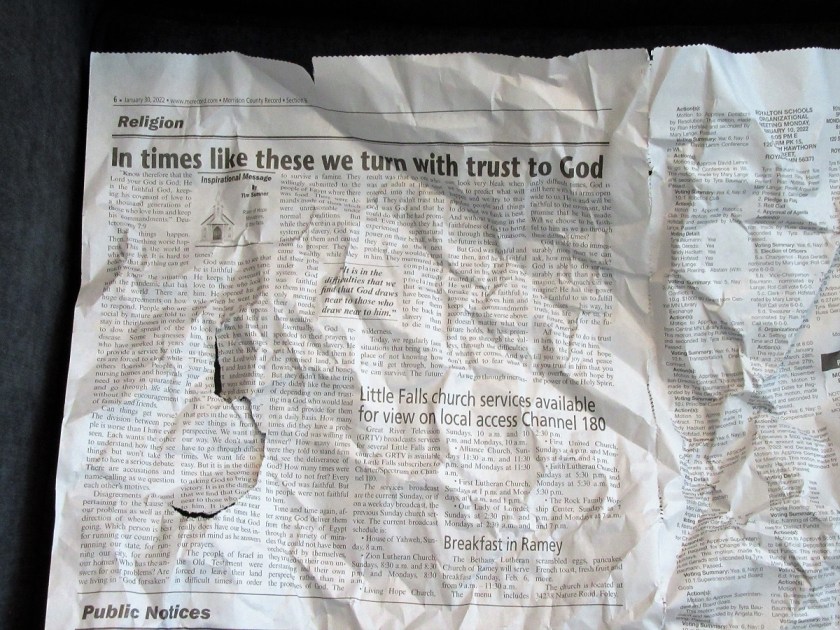
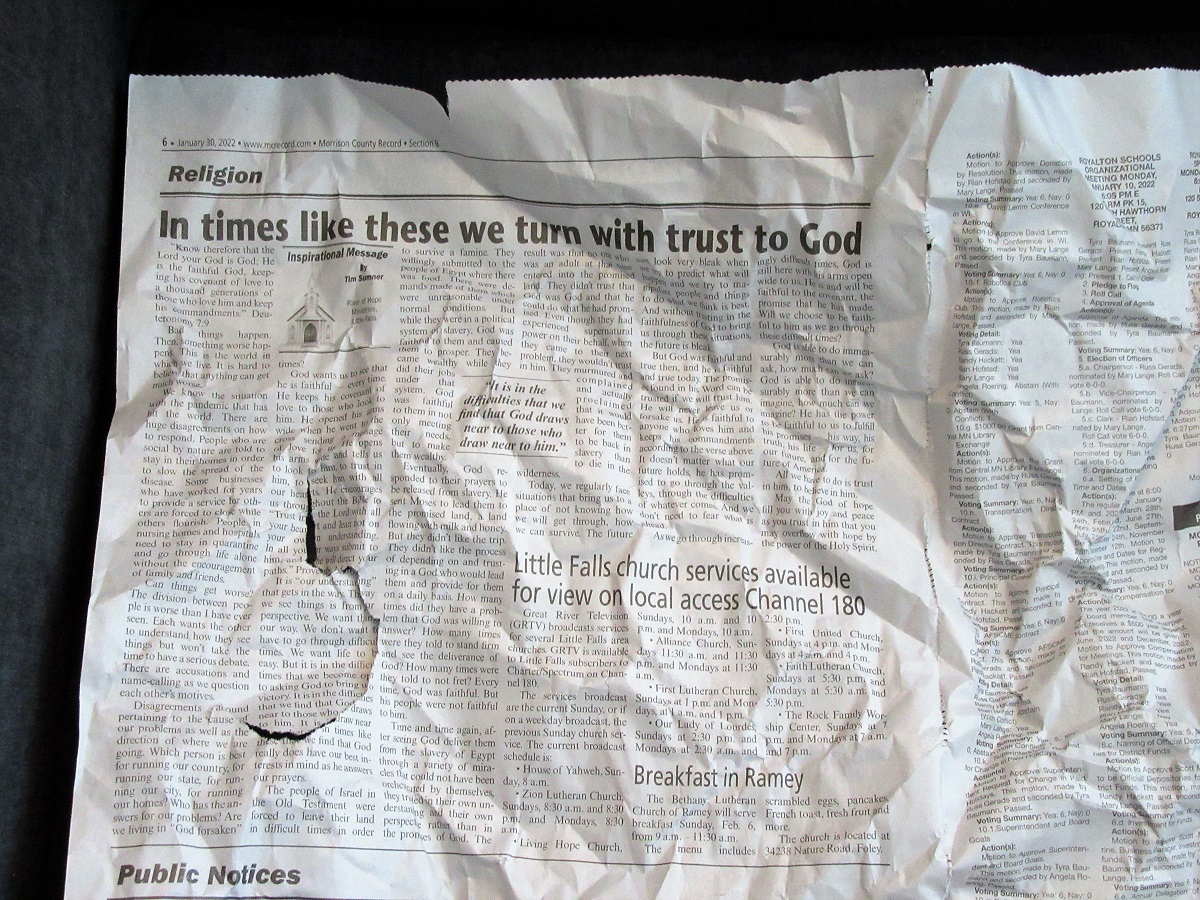
The Iowa cribbage board came wrapped in something we usually don’t see. It was a crumpled-up issue of a local newspaper in Minnesota. The board itself is made in Randall, Minnesota. The newspaper is the January 30, 2022 issue of the Morrison County Record.
I haven’t read a regular newspaper in a long time. The Morrison County Record has a lot of the features I remember from several newspapers like the Des Moines Register and the Globe Gazette (Mason City). I noticed a large column in a section titled “Religion.” I can’t remember the last time I saw a newspaper column like that. The title of the column was “In times like these we turn with trust to God,” with the caption Inspirational Message with a small drawing of a church and the byline was Tim Sumner, evidently the pastor of River of Hope Ministries, Little Falls. So, this newspaper was published in a place called Little Falls in Minnesota.
Little Falls is about 10 miles southeast of Randall.
Anyway, Pastor Sumner (I don’t know if that’s his title, but I’m hoping it’s safe to assume that) wrote what could be given as a Sunday sermon. Because this issue of the Morrison County Record was used as wrapping paper, I had to hold the ripped pieces of it together to read it. The link to the whole sermon on the web is here.
One quote from Sumner:
Today, we regularly face situations that bring us to a place of not knowing how we will get through, how we can survive. The future can look very bleak when we try to predict what will happen and we try to manipulate people and things to do what we think is best. And without trusting in the faithfulness of God to bring us through these situations, the future is bleak.
I have not thought about God in a very long time, but when I was a child, I read the Bible a lot. And I remember the pastor of our church, Reverend Glen Bandel, who was my family’s hero when he took care of mother when she was very sick, and welcomed us in their home when times were bad. Mason City’s local newspaper, the Globe Gazette ran a brief story about his life and ministry when he turned 90 years old a few years ago. You can read it once before the web site requires you to subscribe. It won’t tell you even a tenth of what I and most people feel about his kindness, courage, and wisdom. He has a heart the size of a galaxy.
The population of Randall, Minnesota is 625, and the population of Little Falls is 8,664 (as of 2019). Just because they’re small doesn’t mean they’re not important.
I got up at around 3:30 AM this morning, unable to get back to sleep. It was mainly because of the current crisis in Ukraine. Russia has invaded Ukraine. I wonder if many of us will remember where we were and what we were doing when we found out that Russia invaded Ukraine? For us, it was sometime around 9:30 last night. I was listening to the light classical music channel on TV in our living room when Sena came up from downstairs where she had been watching the news and told me about it.
I switched to the TV news and saw two reporters, one based in the U.S. connected as part of the broadcast with another in Kyiv reporting on the shelling of the city. The reporter in Ukraine kept looking back over her shoulder at the city. She seemed distracted and distressed. The other reporter, based in the U.S., asked irritably, “What do the bombs sound like?” as though he were unhappy with her account of what was going on. She replied, just as irritably, “They’re loud!” I think she wanted to also say (as I did in my mind), “They sound like bombs and they’re scary; what do you think bombs sound like?”
I listend to various reporters talk about the attack. One of them commented that President Biden had said there would be no American soldiers actively engaging in combat in Ukraine. If they did, it would be “World War III.”
I thought of the other post I’d written for today. It’s just about a cribbage board in the shape of the state of Iowa that we got from Minnesota the day before yesterday. It came wrapped in a newspaper, probably the whole issue published about a month ago by the Morrison County Record in a town called Little Falls.
We just thought it was unusual that the cribbage board was shipped wrapped in newspaper; usually it’s those Styrofoam packing peanuts or bubble wrap. But this was like getting something from a friend or a family member who used the only thing handy to pack a gift.
I didn’t just toss the newspaper wrapping in the garbage, mainly because I enjoy reading actual printed material including books and newspapers. I was curious about it and so I found the article “In times like these” which I also described in the other post today, which is partly about a cribbage board in the shape of the state of Iowa. The article is a sermon, written by a local clergyman, Tim Sumner.
In it he talks about how difficult things are nowadays, that people are more divisive than he has ever seen. He mentioned the pandemic as a major contributor, but it’s easy to see how it could be applied more broadly now that major world powers seem to be moving toward war to feed what seems to be a hunger for empire-building.
Sumner, in accordance with his role as a clergyman, counsels us to turn to God. In view of the talk of World War III, it’s hard to disagree. Sumner asks, “Can things get worse?” It looks like it can.
I could find a lot of cribbage boards in the shape of single states in America. I could even find one of Middle Earth, believe it or not. But I couldn’t find one in the shape of the whole United States of America. Why?
Sumner writes,
It is “our understanding” that gets in the way. The way we see things is from our perspective. We want things our way. We don’t want to have to go through difficult times. We want life to be easy.
Maybe that’s true. He says trusting God is the way to respond to this. We could do that. And while we’re waiting for God to respond to us, what else could we do?














 Go Retire Psychiatrist