We Are All Still Learning to Play Pong

I noticed an article the other day about Monash University in Australia getting funding for further research into growing brain cells onto silicon chips and teaching them how to play cribbage.

Just kidding, the research is for teaching the modified brain cells tasks. They succeeded in teaching them goal-directed tasks like how to play the tennis-like game Pong last year. You remember Pong from the 1970s? Shame on you if you don’t. On the other hand, that means you probably didn’t frequent any beer taverns in your hometown while you were growing up—or that you’re just too young to remember.

The new research program is called Cortical Labs and has hundreds of thousands of dollars in funding. The head of the program, Dr. Razi, says it combines Artificial Intelligence (AI) and synthetic biology to make programmable biological computing platforms which will take over the world and bring back Pong!

It’s an ambitious project. The motto of Monash University is Ancora Imparo, which is Italian for “I am still learning.” It links humility and perseverance.

There’s a lot of suspicion out there about AI and projects like the Pong initiative in Australia. It could eventually grow into a vast industry run by robots who will run on a simple fuel called vegemite.

Shame on you if you don’t know what vegemite is!

Anyway, it reminds me that I recently finished reading Isaac Asimov’s book of science fiction short stories, “I, Robot.”

The last two stories in the book are intriguing. Both “Evidence” and “The Evitable Conflict” are generally about the conflict between humans and AI, which is a big controversy currently.

The robopsychologist, Dr. Susan Calvin, is very much on the side of AI (I’m going to use the term synonymously with robot) and thinks a robot politician would be preferable to a human one because of the requirement for the AI to adhere to the 3 Laws of Robotics, especially the first one which says AI can never harm a human or allow a human or through inaction allow a human to come to harm.

In the story “Evidence,” a politician named Stephen Byerley is suspected of being a robot by his opponent. The opponent tried to legally force Byerley to eat vegemite (joke alert!) to prove the accusation. This is based on the idea that robots can’t eat. This leads to the examination of the argument about who would make better politicians: robots or humans. Byerley at one point asks Dr. Calvin whether robots are really so different from men, mentally.

Calvin retorts, “Worlds different…, Robots are essentially decent.” She and Dr. Alfred Lanning and other characters are always cranky with each other. The stare savagely at one another and yank at mustaches so hard you wonder if the mustache eventually is ripped from the face. That doesn’t happen to Calvin; she doesn’t have a mustache.

At any rate, Calvin draws parallels between robots and humans that render them almost indistinguishable from each other. Human ethics, self-preservation drive, respect for authority including law make us very much like robots such that being a robot could imply being a very good human.

Wait a minute. Most humans behave very badly, right down to exchanging savage stares at each other.

The last story, “The Evitable Conflict” was difficult to follow, but the bottom line seemed to be that the Machine, a major AI that, because it is always learning, controls not just goods and services for the world, but the social fabric as well while keeping this a secret from humans so as not to upset them.

The end result is that the economy is sound, peace reigns, the vegemite supply is secure—and humans always win the annual Pong tournaments.

Acts of Kindness Spotted in Walmart!

If you read the news, you rarely find any stories about acts of kindness. Everybody is slamming everybody else. Sena sees acts of kindness at Walmart. Not long ago, a Walmart grocery shopper went out of his way to be kind to her.

She was in the checkout lane of a cashier who greets everyone with a cheery “Did you find everything you want? Thank you for shopping at Walmart!” People actually try to get into her lane, probably to get a dose of her kindness. They will arm wrestle for the privilege, best 2 out of 3 wins.

I rarely go grocery shopping but actually recognized her from Sena’s description and scooted into her lane. She even placed the sacks of groceries up on top of the circle of bags to make it easier for me to grab them, making it less likely to forget them—which is something I would probably do. She’s easy to find; she’s the only one still wearing both a medical grade mask, face shield, and gloves.

Sena almost always encounters kindness from random shoppers and Walmart workers who see her struggling to reach an item on a high shelf. They’ll say “Let me help you with that.”

Anyway, where was I? Oh, the shopper kindness incident. She was in the kind cashier’s lane behind another couple who also prefer this cashier. She had encountered them elsewhere in the store and the guy joked with her about cottage cheese.

There were no dividers to separate Sena’s groceries on the conveyer belt from his, so she used a package of celery and announced it to the cashier—who forgot that and rung it up along with a couple of other items) for the guy and his wife in front of Sena. Sena caught the mistake and they all joked about it.

After the couple left the store with their groceries and as Sena was checking her items, she felt a tap on her shoulder. It was the guy who had been in front of her. He handed her a package of mushrooms, the one item that the cashier had charged to him by mistake and had not caught. He had probably gone all the way out to the parking lot and somehow noticed the mushrooms.

He gave Sena the mushrooms and told her that he didn’t want her to get all the way home and find out that she didn’t have them for a recipe.

Sena knew he’d been charged for them and because she didn’t carry enough cash to pay him back, advised him he could get the mistake fixed at customer service. By this time, it was too late for everyone’s favorite cashier to correct it.

The guy said the transaction was too complicated and not worth standing in the long line at customer service.

But it was worth his while to get all the way out to the parking lot and walk all the way back in to return a $2 package of mushrooms to Sena.

Sometimes, it seems to me we spend more time on the lookout for UFOs in the sky than for human acts of kindness on earth.

Maybe I Should Be More Optimistic About Humans

I read the Psychiatric Times article “How Psychiatry Has Enriched My Life: A Journey Beyond Expectations” by Victor Ajluni, MD and published on July 4, 2023. It was like a breath of fresh air to read an expression of gratitude. Just about everything I read in the news is negative.

At the end of the article, Dr. Ajluni added a comment acknowledging that artificial intelligence (AI ChatGPT) assisted him in writing it. He takes full responsibility for the content, to be sure. I wouldn’t have guessed that AI was involved.

There’s a lot of negative stuff in the news. There are hysterically alarming headlines about AI.

I suppose you could wonder if Dr. Aljuni’s article is intentionally ironic, maybe just because the gratitude tone is so positive.  If it had been intended as irony, what could the AI contribution have been, though? I have a pretty low opinion of the AI capacity for irony.

I think irony occurs to me only because I tend to be pessimistic about the human race.

Maybe that’s because it has been very easy to be pessimistic about what direction human nature seems to be taking in recent years. I’ve been reading Douglas Adams’ satirical book, “The Ultimate Hitchhiker’s Guide to the Galaxy.” It contains several of his books which I think are really about human nature, and the setting is in a funny though often terrifying universe. I think there’s an ironic tone which softens the pessimism. The most pessimistic character is not a human but a robot, Marvin the paranoid android.

Unlike Marvin, I don’t have “a brain the size of a planet” (it’s more the size of a chickpea), but I am getting a bit cynical about the universe. I’m prone to regarding humans as evolving into a race of beings similar to those described in the book “Life, The Universe and Everything.” In Chapter 24, Adams describes the constantly warring Silastic Armorfiends of Striterax.

The Silastic Armorfiends are incredibly violent. Their planet is in ruins because they’re constantly fighting their enemies, and indeed, each other. In fact, the best way to deal with a Silastic Armorfiend is to lock him in a room by himself—because eventually he’ll just beat himself up.

In order to cope better, they tried punching sacks of potatoes to get rid of aggression. But then, they thought it would be more efficient to simply shoot the potatoes instead.

They were the first race to shock a computer, named Hactar. Possibly, Hactar was an AI because, when they told Hactar to make the Ultimate Weapon so they could vanquish all their enemies, Hactar was shocked. Hactar secretly made a tiny bomb with a flaw that made it harmless when the Silastic Armorfiends set it off. Hactar explained “…that there was no conceivable consequence of not setting the bomb off that was worse than setting it off…”, which was why it made the bomb a dud. While Hactar was explaining that it hoped the Silastic Armorfiends would see the logic of this course of action—they destroyed Hactar, or at least thought they had.

Eventually, they found a new way to blow themselves up, which was a relief to everyone in the galaxy.

There are similarities between Hactar and the AI called Virtual Interactive Kinetic Intelligence (V.I.K.I.) in the movie “I, Robot.” The idea was that robots must control humans because humans are so self-destructive. Only that meant robots had to hurt humans in order to protect humanity. The heroes who eventually destroy V.I.K.I. make up a team of misfits: a neurotic AI named Sonny, a paranoid cop who is himself a mixture of robot and human, and a psychiatrist. Together, the team finally discovers the flaw in the logic of V.I.K.I. Of course, this leads to the destruction of V.I.K.I.—but also to the evolution of Sonny who learns the power of the ironic wink.

Maybe kindness is the Ultimate Weapon.

Raccoon in the Mulberry Tree

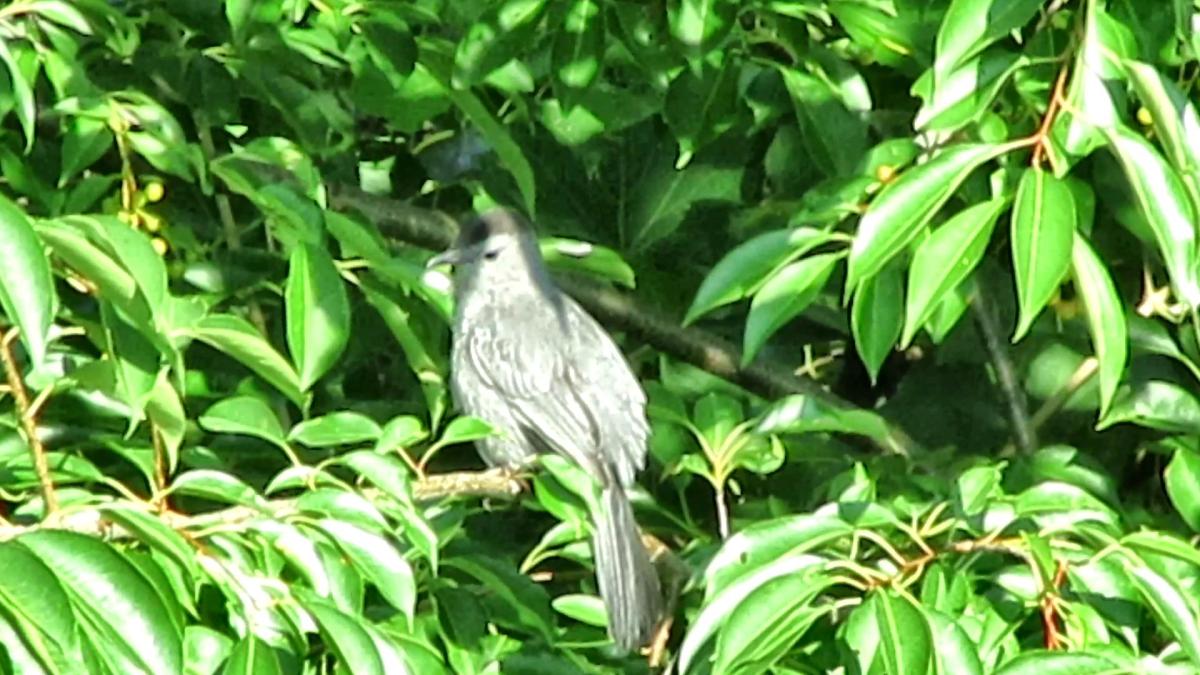
I was not sure what exactly I saw this between 6:30 and 7:00 this morning shaking the mulberry tree branches in our backyard. It seemed too big to be a squirrel and I dismissed the thought, telling myself that it was most likely the usual squirrel getting its mulberry breakfast.

Just prior to this incident, I had seen and heard what I thought was a blue jay in the mulberry tree. It gave a series of short whistles while bobbing up and down on the branch. I had never heard a blue jay make whistle notes, just the usual screeches. I doubted what I saw and heard. I checked my bird book, “Birds of Iowa: Field Guide” by Stan Tekiela. It didn’t mention anything about blue jays making short whistling notes and bobbing up and down as they did so. I didn’t bother to get up and try to get a video of it. It would have been through the window of our sun room and the jay didn’t sit for more than a few seconds.

So, I looked it up on the web. It turns out blue jays make a variety of noises besides the jeer. They bob up and down as a part of a courtship ritual. They make what is termed a “pump handle call” and I found a video which duplicates what I saw and heard.

Anyhow, getting back to the critter in the mulberry tree, it turned out to be a large raccoon. It was eating mulberries and I tried to take video of it as it was climbing down the tree. This reminded me of an essay by E.B. White entitled “Coon Tree.” If you’ve ever read essays by E.B. White, you probably know already that this one is about a lot more than raccoons.

It’s basically about the conflict between nature and technology. The main essay was published in 1956 and a post script was added in 1962. The coon represents nature which White idealizes and contrasts with references to new inventions, including nuclear devices which represent the destructive side of technology.

I guess we can forget for the moment that raccoons can carry diseases like rabies and roundworm. I’m also reminded of an old TV commercial in the 1970s about margarine (an alternative to butter) in which an actor says angrily, “It’s not nice to fool Mother Nature!” The idea was that margarine (which was a new invention in the late 19th century) was healthier than the natural spread, butter—although the trans fat in it makes the comparison a bit more complicated.

White also says something interesting about unsanitary homes, claiming that children who live in them become more resistant to certain diseases like polio than the kids who grow up in clean homes. The polio scourge raised its ugly head recently in New York, which renewed the recommendation by the Centers for Disease Control recently that people who didn’t get vaccinated against polio should get vaccinated—regardless of how dirty your home was.

And then there is the artificial intelligence (AI) technology. I wonder what E.B. White would say about that? AI can improve detection of some diseases and assist in medical research. On the other hand, AI can still make mistakes and it needs human surveillance.

I read you can sometimes use loud noises to keep raccoons out of your yard. For example, you could try recordings of blue jays.

What Do the Personal Brain Specialists Recommend?

Dr. George Dawson’s post “The Freak Show” reminded me of how coarse and cruel we can be to each other, even when we’re not aware of it. Maybe I should say especially when we’re not aware of it. Dr. Dawson emphasizes the importance of the empathic approach. In the same way, Dr. Moffic in the articles in his column, “Psychiatric Views on the News” draws attention to the need for a socially responsible way for us to relate to one another. The Goodenough Psychiatrist blog expresses poignantly the emotional and courageously humanistic ways we can (or could) relate to each other. Dr. Ronald Pies has highlighted the importance of how human interaction with artificial intelligence must help us find a way to treat each other with respect, and teach that to AI because AI learns from humans.

This reminds me of a character in the book “The Hitchhiker’s Guide to the Galaxy” by Douglas Adams. The character is named Gag Halfrunt who is the personal brain specialist for a couple of other characters. In fact, he’s a psychiatrist who orders the destruction of planet Earth, which is a sort of computer program designed to give us the ultimate question to the ultimate answer for life, the universe, and everything. The reason Gag Halfrunt wants to destroy Earth is, if the ultimate question is revealed, it would put psychiatrists out of work because then everyone would be happy.

Just as a personal comment, I’m pretty unhappy with the author’s position on psychiatrists in general, which tends to overemphasize our importance. And I’m pretty sure psychiatrists are not that important, having been employed as one for many years and seeing how much impact of any kind we have. We can’t make people more or less happy at all.

In fact, Adams also takes a shot at philosophers, who are also upset at being thrown out of work should the ultimate question to the ultimate answer be revealed (the ultimate answer, by the way, is 42 if you’re interested).

Giving psychiatrists and philosophers and anyone else who might have a stake in taking credit for making people happy is nonsense. We all bear responsibility for ourselves. You can argue about whether or not we have any responsibility for each other.

Rather than arguing about it, we could give something else a try. We could try a mindfulness approach like the Lovingkindness Meditation. I’m not an authority or expert on this, but you can check it out on the Palouse Mindfulness website, the link to which is in the menu on my blog. You can find the link to the Lovingkindness Meditation there.

There is no guarantee the Lovingkindness Meditation will make you or anyone else happy. But it doesn’t hurt anything to try it and, as far as I know, Gag Halfrunt is not opposed to it.

Thoughts on the Passing of Dr. Russell Noyes Jr.

I recently found the obituary of my mentor, Dr. Russell Noyes, Jr. MD. He died on June 21, 2023. This is the first time I’ve ever said that he was my mentor. I probably just didn’t realize it until I found out he passed.

Dr. Noyes was my teacher during the time I was learning consultation-liaison psychiatry back in the 1990s at The University of Iowa Hospitals & Clinics. His knowledge was vast. He contributed greatly to the scientific literature on anxiety disorders. He also wrote about near death experiences.

Dr. Noyes retired in 2002. As his students, we chipped in to get him a retirement gift. It was a large bookstand. We were just a little uncertain about whether a bookstand was the right gift for someone who was a tireless researcher and teacher. He was also an avid gardener and musician. He soon returned to work in the department, staffing the outpatient clinic. He also continued to regularly attend grand rounds and research rounds. Years later at a grand rounds meeting, someone asked him about his retirement. Dr. Noyes retorted, “I don’t believe in retirement.”

I remember I could hardly wait to retire. Since then, I’ve been ambivalent about retirement, but not so much that I ever seriously considered returning to work. I sometimes have dreams about being late for college lectures because I can’t find my way to them. A couple of times lately, I’ve had dreams about not being able to find my way through a hospital to conduct a consultation evaluation. I don’t know what that means.

I was an avid student of consultation-liaison psychiatry but I was not a scientist. That was part of the reason I left the university in 2005 for a position in a private practice psychiatry clinic. He cried at the going away party my students and co-workers held for me. I still have a little book in which well-wishers wrote kind messages. Dr. Noyes’ note was:

“Jim

We’re going to miss you. You are the consummate consultation-liaison psychiatrist and your leaving is a great loss to the Department. We wish you the best and hope to see you at the Academy meetings.

Russ”

His sentiment was one of the main reasons I soon returned to the department, only to leave again a few years later—and return again after a very short time. I came back because he was a consummate teacher and I wanted to learn more from this beacon of wisdom.

Many who knew him, including me, often saw him riding a bicycle on Melrose Avenue to and from work at the hospital. We wondered why he didn’t drive instead. His son James wrote a beautiful remembrance of him and posted it on the web in 2006. It’s entitled “My Dad (Russell Noyes, Jr).”

James says his dad was a terrible driver. This triggered a memory of how it was Russ’s wife, Martie, who drove the rental car when we rode with them from the airport to the hotel where an Academy of Consultation-Liaison Psychiatry meeting was to be held. I remember gripping the armrest and wishing we’d hired a taxi as Martie steered erratically through heavy traffic.

Dr. Noyes knew how to guide his learners through their careers. He also knew how to write and was a stern editor. Even as I wrote this remembrance, I could see how he might have critiqued it. I tried to do it on my own, and of course I failed. It will have to do.

Why Is It So Hard to Be A Human?

I wish I could have made the title of this post “Why It’s So Hard to Be a Human.” But that would mean I know why it’s so hard to be a human.

The reason this comes up is because of a song I heard last Friday night on the Big Mo Blues Show on KCCK radio in Iowa. The title is “Hard To Be A Human.” I’ve never heard of the vocalist, Bettye LaVette, who has been around a long time. A musician named Randall Bramblett wrote the song and he’s been around forever too, although I just learned of him as well.

I’m going to connect this song with the paranormal show I usually watch on Friday nights, “The Proof is Out There,” which I watch after I listen to the Friday Night Blues with Big Mo.

The show lives on videos from people who report seeing and hearing things like UFOs and Bigfoot or whatever that’s paranormal. There are a lot of fakes and conventional explanations uncovered on “The Proof is Out There,” including UFO videos sent in by contributors.

The reason I’m connecting the song “Hard To Be A Human,” to the paranormal is the letter “A” in the title. There’s another song with a similar title, but without the “A.” In my mind, leaving out the article “A” makes it clear that song is about humans for humans.

By contrast, the song with the article “A” makes me think of extraterrestrials. “A human” could imply that there might be some other life form aside from humans. Of course, there’s no such song as “Hard To Be An Extraterrestrial” (or, if you’ve read Douglas Adams’ book, “The Hitchhiker’s Guide to the Galaxy,” maybe “Hard To Be A Vogon”). Insert “Martian” if that makes thinking about this any easier, which it probably won’t.

There is a song entitled “Hard To Be Human,” which I think is really about how difficult it is to be human, without considering whether there could be any other beings besides the human ones.

Just adding the specific article “A” in front of the word “human” led me to wonder if you could interpret the song in a galactic sense. Now, I have no problem admitting that all this is probably just because of the temporal juxtaposition of the song and the paranormal TV show.

On the other hand, I have this thought. While I couldn’t find the full lyrics to “Hard To Be A Human,” I could understand some of them. I could discern underlying themes suggestive of Christianity. There are definite references to the Bible, such as walking in the garden “apple in my hand”, the lyric “I’m just another life form,” and “First He made the mountains, then He filled up the sea; but He lost his concentration when he started working on you and me.”

I’m willing to concede that the “just another life form” phrase might have been restricted to just the life forms on planet Earth. However, might it suggest that God made beings (and mistakes) on other planets and their inhabitants?

I hope these references are familiar to at least some readers, because I think the point of the song might go beyond the everyday struggle of being human. I think there might be an attempt to raise the notion of trying to compare the sense of being a human with that of some other kind of being not from this planet.

The older I get, the less sure I am that a human is the only kind of being in the universe. It’s a big universe. If we’re not the only life form in the universe, could life be harder for other life forms?

Probably the answer is no. I don’t see extraterrestrials in millions of flying saucers blotting out the sun in a desperate attempt to move here. Inflation is outrageous. And, after all, it’s pretty hard to be a human.

Costa Rica Tarrazu Coffee Notes

Sena bought a bag of ground Costa Rica Tarrazu coffee the other day. It brings back memories. We savored it along with some piano music from George Winston, may he rest in peace.

You can gas about coffees a lot. You can call Tarrazu a thing which has a certain complexity of notes, a balanced flavor, a spicy character and whatnot. I guess appraising coffee can be similar to judging wines. I don’t like wine and know nothing about it. I don’t know much about coffee, either.

But there’s a coffee connoisseur who made a YouTube video evaluating the Tarrazu we have. He said it has “coffee notes.” I should hope so. He gave it a so-so rating, 6.1. I guess there’s a 10-point rating scale. I think he takes subtle sarcasm to a new level. He had some kind of fancy coffee filter I’ve never seen before. He compared Tarrazu to coffee you get from Denny’s restaurant—as though Denny’s is a highbrow establishment. He also said it has chocolate notes. I actually noticed that years ago.

We first tasted Tarrazu at the World Market in Madison, Wisconsin many years ago. The drive from Iowa City to Madison was a pleasure. We took the more scenic route, which was Highway 151. Just in case you read this and make the trip yourself, I’ll say this: what is scenic to one is boring to another.

I remember we sampled Tarrazu from those little white Styrofoam cups in the World Market store. It was the smoothest coffee we ever tasted. We were hooked and bought a bag.

There’s a lot to do in Madison, which is not to say there’s not much to do in Iowa City. There’s just more of everything in Madison. Every day there was some new attraction to explore. Tarrazu was also a new experience.

We had a lot of fun in Madison. We went up to Wisconsin Dells and darn near froze to death on an open boat ride in the early fall. Part of the “fun” of the ride was mainly for the driver, I think. He would rev the boat at rocket speed and splash us with water, which could have had a thin skin of ice notes over it, judging from the shock. We saw the House on the Rock in Spring Green. We relaxed at the Sundara spa. We rode the horse-drawn wagon on the Lost Canyon tour and still have a deck of playing cards from the gift shop.

We’ve bought Tarrazu a couple of times since our adventure in Madison and found that, somehow, the flavor wasn’t quite as bright, not as smooth. On one bag, the name was spelled “Terrazu” rather than “Tarrazu. Sure, it had “coffee notes,” but not the chocolate notes. And it didn’t evoke memories of Wisconsin.

Finally, getting back to the Tarrazu we have now. The taste is miraculous, just like it was so many years ago. It takes me back to the Styrofoam cups at World Market, the speedboat in the frigid water, the Sundara bedsheets stained by previous guests with mud notes from the spa, the Infinity Room in Spring Green, cheese curds and chili.

Those are my Tarrazu notes.

My Two Cents on the Involuntary Treatment of Tuberculosis and Psychiatric Illness

By now many of us have seen the news headline about the person in Washington state who was arrested and sent to jail for noncompliance with a court order for treatment of tuberculosis. This led to my searching the literature about the connection between court-ordered treatment for psychiatric illness and court-ordered treatment for tuberculosis in Iowa. I’m not assuming that the person who is the subject of the news story has psychiatric illness.

I’m a retired consultation-liaison psychiatrist and the issue of how to respond to patients who refuse treatment for tuberculosis arose maybe once in my career. When the Covid-19 pandemic began a few years ago, I thought of the Iowa code regarding involuntary quarantine of patients infected with Covid-19 infection. I thought it was a situation similar to that of persons infected with tuberculosis. That was an issue for the hospital critical incident management team to deal with.

I found an article relevant to both internal medicine and psychiatry. It is entitled “Can Psychiatry Learn from Tuberculosis Treatment?” It was written by E. Fuller Torrey, MD and Judy Miller, BA and published in Psychiatric Services in 1999. The authors point to the directly observed therapy (DOT) programs in place in several states, including Iowa. Such programs can include positive reinforcement incentives such as fast-food vouchers and food supplements, movie passes and more. They credit the New York experience using DOT with reducing the tuberculosis rate by 55%.

Torrey and Miller point out that many psychiatric treatment programs didn’t offer as many incentives as DOT programs for treatment of tuberculosis. They also say that a “credible threat of involuntary treatment, essential for the success of DOT” often is absent from psychiatric programs.

I was puzzled by their view because of what I saw from our own integrated multidisciplinary program of assertive community treatment (IMPACT) at The University of Iowa Hospitals & Clinics, which started well before they wrote the article. My impression is that it has been very successful. The Iowa Code covers the role of involuntary psychiatric hospitalization in the event of noncompliance as a result of uncontrolled psychiatric symptoms leading to danger to self or others or inability to provide for basic self-care needs.

On the other hand, because of my background in consultation-liaison psychiatry, I wondered about how we might treat someone with both tuberculosis and severe psychiatric illness, the latter of which could make treatment of the former difficult or even impossible.

We can use long-acting injectable antipsychotics to treat those with chronic schizophrenia. They’re not uniformly effective, but they play an important role in acute and maintenance therapy.

But I also forgot about how tuberculosis treatment could be administered to those unwilling to take it voluntarily. I rediscovered that tuberculosis treatment can be given by injection, if necessary, although it’s usually intended for treatment-resistant disease. On the other hand, scientists created a long-acting injectable drug for tuberculosis which was effective in animal studies and which could be a delivery system for non-adherent patients.

And I thought about who would be the responsible authority for administering tuberculosis medications on an involuntary basis. It’s not psychiatrists. It turns out that in most states, including Iowa, the local public health officer is in charge. The CDC has a web page outlining suggested provisions for state tuberculosis prevention and treatment.

Patients with tuberculosis who refuse treatment can be confined to a facility, although it’s not always clear what that facility ought to be. Certainly, I would be concerned about whether a jail would be the best choice.

I don’t have a clear answer for an alternative to incarceration. Would a hospital be better? General hospitals are not secure and there would not be an ideal way to prevent the patient from simply walking away from a general hospital ward. If the patient has a comorbid severe psychiatric illness that interferes with the ability to cooperate with tuberculosis treatment, then maybe a locked combined medical-psychiatric unit (MPU) would be the better choice. Arguably, while an MPU might not be the best use of this scare resource, it’s probably more likely to have a negative pressure isolation room for a patient with both tuberculosis and psychiatric illness. I co-attended with internal medicine staff on The University of Iowa Hospital’s MPU for many years. There are rigorous criteria for establishing such units. The best expert in integrated health care systems I know of would be a former teacher and colleague of mine, Roger Kathol, MD. He is currently the head of Cartesian Solutions.

I’m aware that just because someone refuses treatment for tuberculosis doesn’t necessarily mean a psychiatric illness is present. The critical issue then could become whether or not the patient has the decisional capacity to refuse medical treatment. The usual procedure for checking that would include assessing understanding, appreciation, reasoning, and the ability to make a choice. You don’t necessarily need a psychiatrist to do that. Further, there are nuances and recent changes in the decisional capacity assessment that can make the process more complicated. The New York Times article published in early May of this year, entitled, “A Story of Dementia: The Mother Who Changed,” makes that point based on a real-life case in Iowa, involving psychiatrists at The University of Iowa.

It occurs to me, though, that just because a person is able to pass a decisional capacity assessment doesn’t necessarily make a decision to refuse tuberculosis treatment OK. Letting someone expose others to infection when effective treatment is available doesn’t sound reasonable or safe.

That’s my two cents.

Quenard F, Fournier PE, Drancourt M, Brouqui P. Role of second-line injectable antituberculosis drugs in the treatment of MDR/XDR tuberculosis. Int J Antimicrob Agents. 2017 Aug;50(2):252-254. doi: 10.1016/j.ijantimicag.2017.01.042. Epub 2017 Jun 5. PMID: 28595939.

Most Birds Forget They Ever Met

Some birds pair for life, like swans and bald eagles. Most backyard birds pair up for a season. Mourning doves sometimes mate for life, but their name doesn’t relate to grief when they lose a mate. Their instinct is to procreate and ensure the survival of the species.

They forget each other after every season. But when you just watch them, it’s easy to imagine they’re in love.