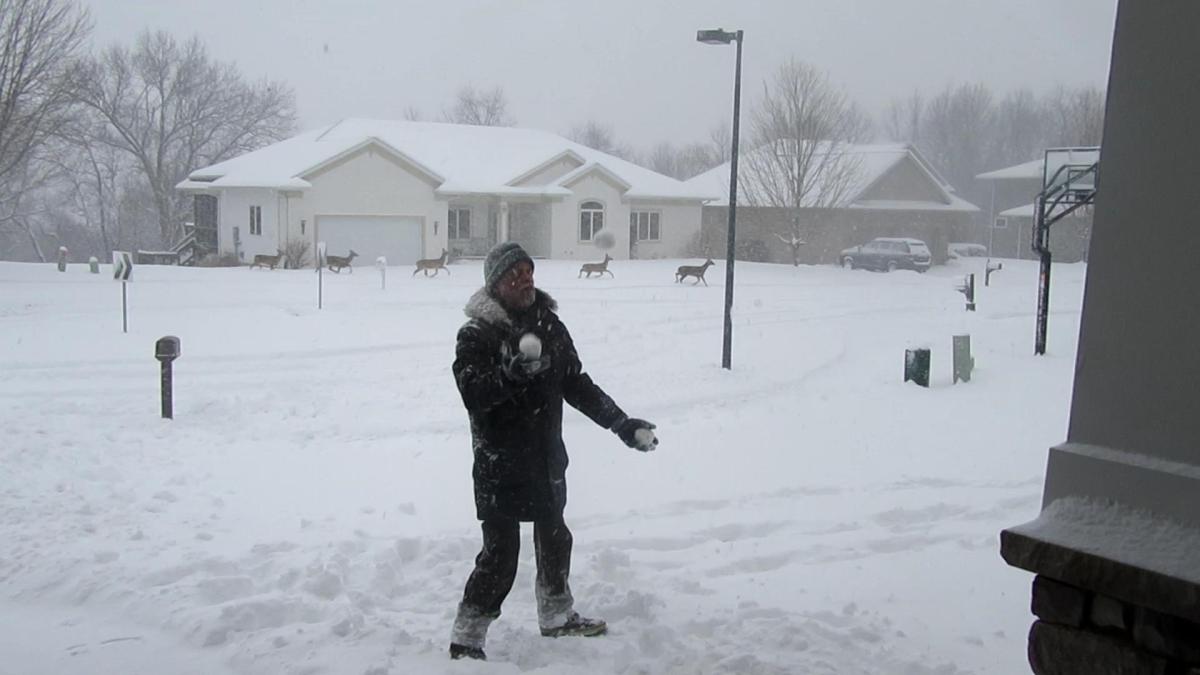
Today we got a fair amount of snow dumped on us. It gave the deer the zoomies. They ran around in it like they were having a lot of fun.
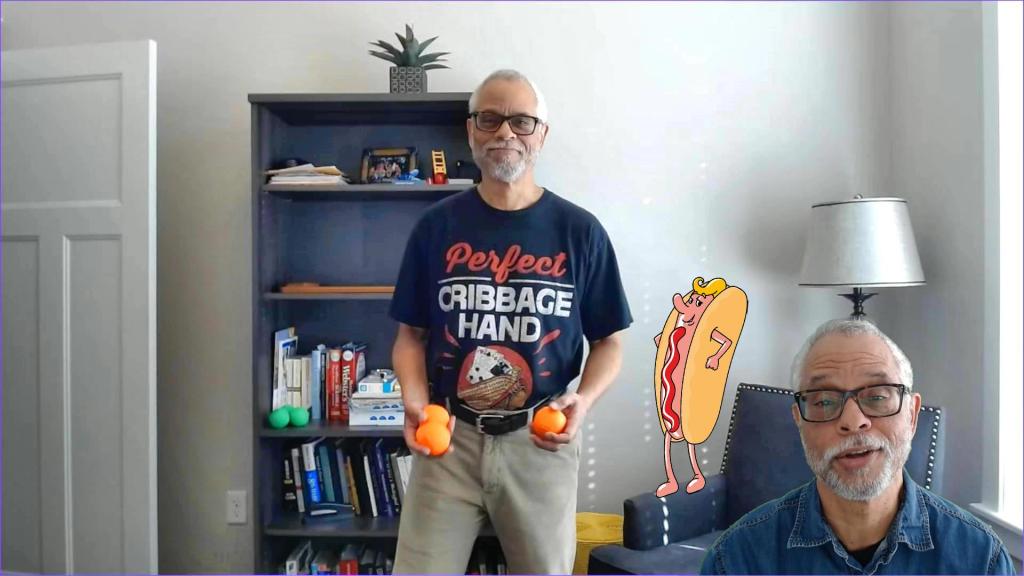
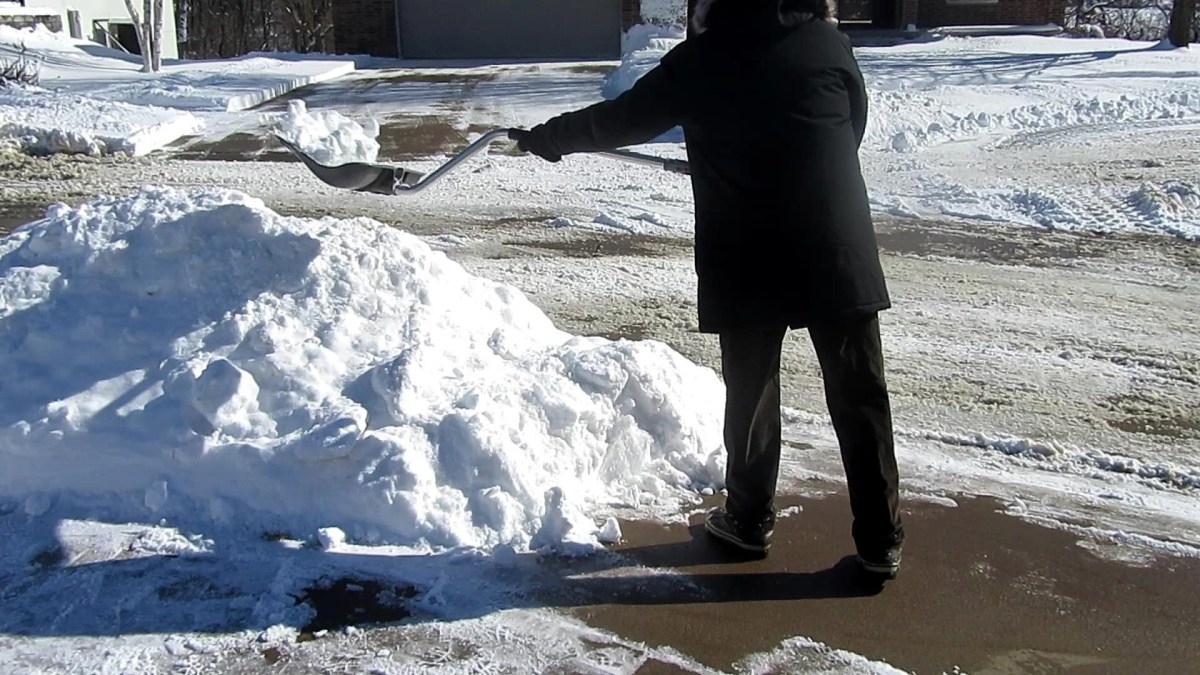
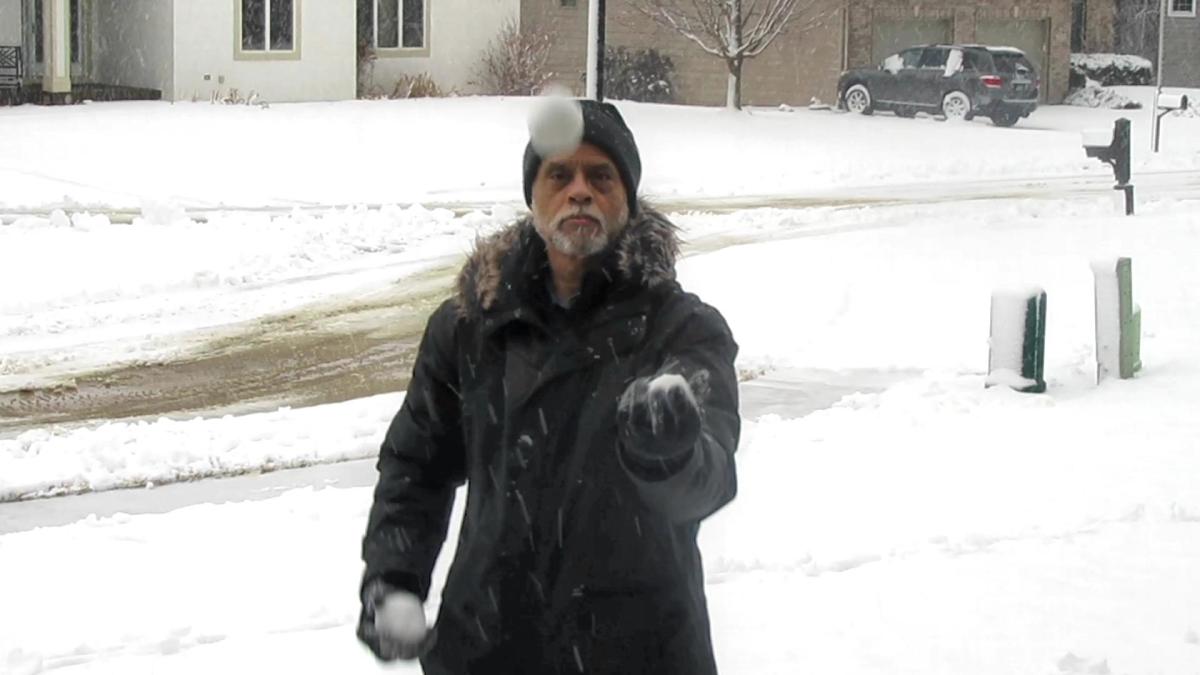
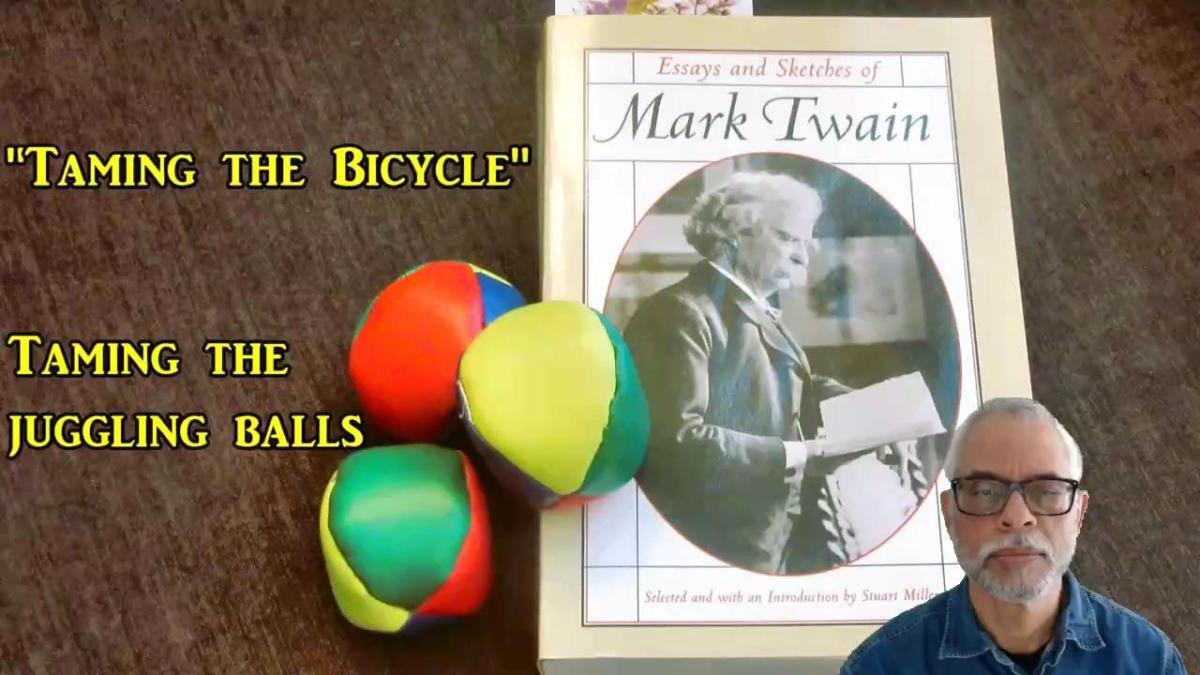
It was a heavy, wet snow. So, we took some time out from shoveling so I could make some snowballs and try juggling them. It didn’t work so well about a month ago when the snow was in brittle clumps. Today it worked pretty well, after I got the hang of shaping the snowballs.
Today, I was thinking of a guy named Al Martin, who was one of the few African American role models for me when I was a teenager in Mason City, Iowa. I thought of him a couple of years ago, googled his name and couldn’t find him. I mentioned him anyway in a blog post at that time, “Snow Moon Reflections.” A major topic was black male role models.
Today, for some reason I thought of him again. I googled his name once more and found an obituary for a man named Allen Henry Martin. This particular Martin was a black man who was 83 years old when he died just this last November of 2022. The obituary stated that he was a talented artist, just as I recall. Despite the many decades gone by, his photograph looked familiar to me.
He was a sculptor and photographer as well as a painter. He worked several different jobs. He had a great sense of humor. He worked as a land surveyor for several years, which I connect with because I did that for a while when I was young.
I’m not absolutely certain that Allen Henry Martin is the same Al Martin who I looked up to when I was at a tender age. But for now, I’m going to assume they were one and the same.
One time, Al Martin took me to an art show where he set up many of his pictures. It was a brisk autumn day. We drank a lot of coffee, partly to keep warm. I remember how uncomfortable I felt because of my full bladder. The wind was cold.
I don’t know why I remember this, but Al one time spoke of his children and he happened to mention what he did when they felt sick to the stomach. It sounds gross, but he made the story comical and said something like, “Many a time I caught vomit in my hands!” It was disgusting—but funny at the same time, the way he told that little story. You really had to be there to get it.
As I read this, I catch myself thinking I should have something more solemn and dignified to say about Al.
But this is not an obituary. These are just my memories of Al Martin which are fading the older I get, and I’m entitled to them. Al Martin was a great guy.
I was thinking about what to write for the first day of Black History Month, which starts today on February 1, 2023.
As usual, I started to reminisce about my time at Iowa State University (ISU) in Ames, Iowa. I usually don’t talk about my undergraduate days. In fact, I had a little trouble finding my diploma. It was in storage in the first place I should have looked. I graduated from ISU in 1985.
The Iowa State Daily ran a story, “Black scientists from Iowa State,” published on February 4, 2021, obviously in honor of Black History Month. Of course, it featured ISU’s most illustrious graduate, George Washington Carver, who earned his graduate degree in 1894. Carver also loved poetry and painting, which I didn’t know.
This work is in the public domain in the United States because it was published (or registered with the U.S. Copyright Office) before January 1, 1928
Carver was a scientist and put it to practical use. It fits with the ISU motto, which was short and to the point: “Science with Practice.”
I transferred credit to ISU in the mid-1970s from one of the country’s Historically Black Colleges and Universities (HBCUs), Huston-Tillotson College (now Huston-Tillotson University). I submitted a poem to the college’s annual student poetry contest sponsored by one of the English Professors, Dr. Jenny Lind Porter-Scott. My poem didn’t make the cut, but many students got their work published in the little book, Habari Gani (Swahili for “What’s Going On”), which published the best poems.
Part of the reason I went to ISU was the encouragement I got from my bosses at WHKS &Co, consulting engineers. I was a surveyor’s assistant and drafter. I was the only African-American employee working there.
The idea behind going to ISU initially was to pursue a degree in engineering. That didn’t happen because frankly, I didn’t have a head for the mathematics. On the other hand, I got interested in biology, chemistry, and zoology and finally ended up in medical school at The University of Iowa in Iowa City. The rest is history, as they say, which allows the usual cover up of a multitude of sins.
At the time Sena and moved to Ames in the early 1980s, it was a quiet little town, except during VEISHEA, an annual spring celebration on campus. The event got out of hand many times and it was finally banned in 2014.
Back in the days of George Washington Carver, African American students were not allowed to room with other students who did not have black skin on campus. By the time we moved to Ames, the most uncomfortable racial incident I can recall personally was being the butt of a “nigger” joke at a barbershop. I had to find another place to get my hair cut.
I still had a lot of science to digest at ISU after switching my major from engineering to the life sciences. I remember a chemistry professor who looked like the typical hippie who demonstrated how electrons get excited by stacking chairs on top of the counter in front of the chalkboard (which teachers were still using) and climbing to the top and nervously doing a shaky little dance showing what an excited electron he was. I think all of us collectively held our breath, waiting for him to tumble to the floor.
I really had a tough time learning organic chemistry. You had to draw diagrams showing how the molecules and atoms connected after each reaction. I will never forget an Asian Teacher’s Assistant who patiently tutored me, despite my having a very bad cold and a bad attitude to boot.
I graduated and then returned to get more credits to try getting into medical school after finding it very difficult to find employment with my Bachelor of Science degree. It took about 9 months before I finally landed a job in the clinical lab at one of the hospitals in Des Moines. The lab director worked there for a very short time while I was there, and then left to go to medical school.
That was my cue. I think it worked out for the best. By the way, the engraved crystal in the featured image is an appreciation gift from The University of Iowa for my years of service.
And I guess that’s about enough reminiscence for now.
There’s been enough bad news. How about some good news? Have a look at the Dare to Discover campaign at The University of Iowa. It shines a light on young researchers who dream big. And that’s great for all of us!
The FDA VRBPAC 178th annual meeting on future Covid-19 vaccine regimens includes two main discussion topics:
“Future periodic vaccination campaigns: Simplification of COVID-19 vaccine use:
Immunization schedule: Please discuss and provide input on simplifying the immunization schedule to authorize or approve a two-dose series in certain young children, and in older adults and persons with compromised immunity, and only one dose in all other individuals. Periodic update to COVID-19 vaccines:
Vaccine composition: Please discuss and provide input on the consideration of periodic updates to COVID-19 vaccine composition, including to the currently authorized or approved vaccines to be available for use in the U.S. in the fall of 2023.”
Among the members attending the web conference is University of Iowa Professor Stanley Perlman, MD, PhD, Departments of Microbiology and Immunology, Professor of Pediatrics, Mark Stinski Chair in Virology.
The meeting is today from 8:30 AM to 5:30 PM ET.
Update: Dr. Stanley Perlman MD, PhD from the University of Iowa will be the acting voting chairman of today’s meeting.
Update: Dr. Jerry Weir gave a clarifying and practical bird’s eye view of the issue at hand which began at 2:30 PM on the live play today (the meeting is being recorded). The questions and comments for Dr. Weir by Offit, Levy, and Chatterjee were also helpful to hear.
Update: Voting Question is:
“VRBPAC Voting question Simplification of current COVID-19 vaccine use:
Vaccine composition: Does the committee recommend harmonizing the vaccine strain composition of primary series and booster doses in the U.S. to a single composition, e.g., the composition for all vaccines administered currently would be a bivalent vaccine (Original plus Omicron BA.4/BA.5)?”
As we were listening to the Mike Waters Wake Up Call radio show on KOKZ, we were disoriented when he gave the temperature as “83” degrees and that it’s “Wednesday evening”. The more he talked, the more bizarre he began to sound and I wondered if KOKZ was for whatever reason broadcasting a past recording of his show.
Then he announced that it’s National Opposite Day, which occurs on January 25th annually. It’s not a holiday on any calendar, and when I looked it up on the internet, I found out it arose from a kids game. It dates way back to the turn of the 20th century.
You get the idea. What would be opposite goal of a game of tag? You’d have to try to catch each other, of course!
This holiday creates a paradox for itself. You’re supposed to declare that it’s Opposite Day, but that would imply you would have to not observe it. Huh?
We had pot pie for breakfast today. Does that count?
We always thought of Robins as birds who are the harbingers of spring. On the other hand, we’ve seen Robins in the middle of winter. We saw them today.
I realize that you technically can’t call a Robin a Sunbird. There is a species of Sunbird. It’s a small tropical forest bird. And you could call a person who travels from hot, humid parts of the country to cooler parts a sunbird—sort of the opposite of snowbirds; those who migrate from the cold north to the warm south in the winter months.
And so, I think you could call the Robin a sunbird—sort of. They’ll stick around all winter as long as the berries hold out.
Back in November 2022, while on our way to the Stanley Museum of Art, we saw the two murals on the East Burlington Street Parking Ramp. It was the first time we saw them in person although photos were available last fall. The Little Village article published an article about them on September 30, 2021. It’s the Oracles of Iowa mural project, conceived by Public Space and the Center for Afrofuturist Studies partnered with the artists, Antoine Williams and Donte K. Hayes. The artists sought to stimulate a conversation in the community about how black and white people relate to each other.
The murals are painted on parking ramp at two locations along East Burlington Street. One says “Black Joy Needs No Permission” and the other says “Weaponize Your Privilege to Save Black Bodies.”
The Little Village article points out that a survey of public perception of the murals revealed that 64 percent of white respondents supported the murals while only 40-50 percent of minority respondents supported them. The stickler for minorities was the use of the word “weaponize” and the phrase “Black bodies,” which were thought to raise impressions of “violence” and dehumanization.
Because I’m a writer, retired psychiatrist, and a writer, the word “weaponize” made me wonder what other word might have been chosen in this context. The only definition of “weaponize” that I can find which makes sense to me is from Merriam-Webster: “to adapt for use as a weapon of war.”
I’m a retired physician, so I have a perspective on the “privilege” to “save” lives, and by extension to enhance health and well-being. I’m also Black. I grew up in Iowa and I can recall getting bullied and being called a “nigger.” I can remember my psychiatry residency days, which includes a memory of a patient saying “I don’t want no nigger doctor.” I didn’t have the option to switch patients with another resident. When I saw the patient on rounds, I did my best and every time the “nigger” word erupted, I left the room. It was one of a few episodes which were marked by frank racist attitudes.
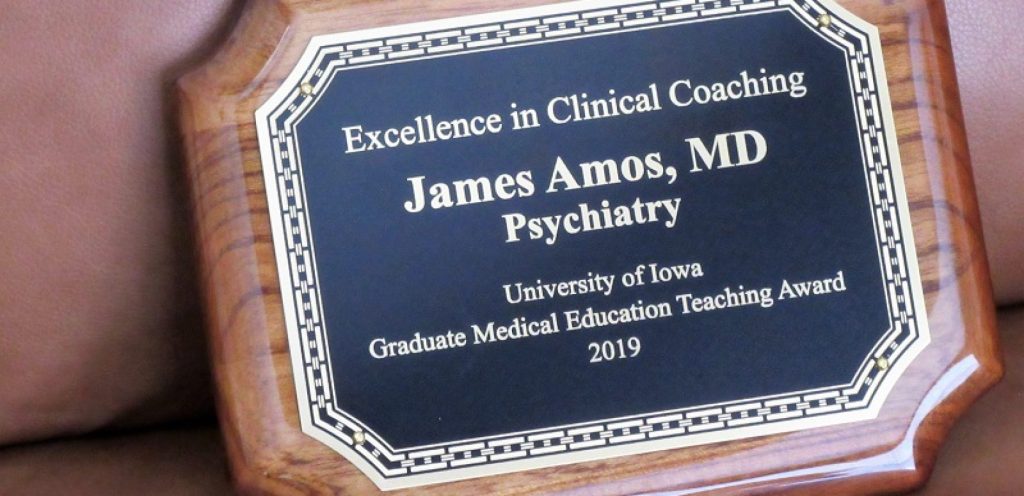
I was given the University of Iowa Graduate Medical Education Excellence in Clinical Coaching Award in 2019, one of several esteemed colleagues to be honored in this way. Many of those who nominated me were white. It was one of many joyful experiences I had before my retirement in 2020, when the pandemic and other upheavals in society occurred, including the murder of Black persons, resulting in many consequences prompting the creation of the murals.
I have other memories. I was privileged to be given a scholarship to attend one of the Historically Black Colleges and Universities (HBCU) in this country, Huston-Tillotson College (now Huston-Tillotson University). It’s one of the oldest schools and is the oldest in Austin, Texas. The scholarship was supported by one of the local churches in my home town of Mason City. I don’t think it had any black members. Although I didn’t take my undergraduate degree from H-TU, it was one of the most valuable learning experiences in my life. It was the first time I was ever not the only Black student in the class. It was marked by both joy and a struggle to learn where I belonged.
The murals did for me what the artists hoped it would do. It stimulated me to reflect on the meaning of racializing life. They stir me to seek perspective on whether joy has any color and why anyone needs permission for it. And I believe I would rather exercise my privilege to respect and care for others than to weaponize anything, including my sense of humor.
I noticed Dr. H. Steven Moffic, MD had written another article in Psychiatric Times asking whether it’s time for psychiatrists to consider going on strike. Often the issue triggering discussions about this is the rising prevalence of physician burnout. I’ve already given my personal opinion about physicians going on strike and the short answer is “no.”
One of my colleagues, Dr. Michael Flaum, MD, recently delivered a Grand Rounds presentation about physician burnout. The title is “Everyone Wins—The Link Between Real Patient-Centered Care and Clinician Well-Being.”
Fortunately, I and other are able to hear the substance of his talk on the forum Rounding@Iowa. During these recorded presentations (for which CME can be obtained), Dr. Gerry Clancy, MD interviews clinicians on topics that are of special interest to medical professionals, but which can be educational for general listeners as well.
I remember meeting Dr. Flaum when I was a medical student. At the time, he was very involved in schizophrenia research. He’s been a very busy clinician ever since. As he says, while he may be Professor Emeritus now, he’s definitely not “retired.” He’s still very active clinically.
Dr. Flaum identifies both systems challenges and physician characteristics as important in the physician burnout issue. Interestingly, he bluntly calls the systems challenges as virtually unchangeable and focuses on bolstering the physician response to the system as the main controllable factor. His main tool is Motivational Interviewing, which is more of an interview style than a separate kind of psychotherapy.
I think the kind of approach that Dr. Flaum recommends, which you can hear about in the Rounding@Iowa presentation, is what most psychiatrists would prefer rather than going on strike. See what you think.