Behind the Mask Policy

Tomorrow I’ll get to see how the new Covid-19 face mask policy works at the University of Iowa Hospital & Clinics. It goes into effect today. I’m going to see the dentist, as I have periodically for years, even during the Covid-19 pandemic. Of course, the idea of masked dental patients is ironic.

The rule change about masks being sort of optional is a little confusing.

It’s sort of optional because it looks like it’s not optional for unvaccinated health care employees. They still have to wear masks.

I wrote about this back in May of 2021, “Unmasked Means Fully Vaccinated?” That was back when bandanas were acceptable as face coverings.

So does being masked mean “not vaccinated?” It’s confusing because if masking is optional for patients and visitors, why are health care workers the exception? I’m not sure how anyone would enforce the policy.

If you can wear a mask just because you want to do that, how does that separate you from the unvaccinated person?

If masks are optional, then why are the entrance and exit policies not changing, including screening of patients, visitors, and staff? I didn’t see the guidance about what to do if anyone says they are symptomatic or unvaccinated and prefers not to wear a mask, other than to offer a mask (which is free!).

If it’s disrespectful to ask a patient or visitor to put on a face mask, why is it not disrespectful to require an unvaccinated health care worker to do so? There is one bullet point in the question-and-answer section about whether you can ask anyone to wear a face mask which says you can’t ask anyone, including “employee, colleague, patient, visitor, etc.” In the same section is the statement: “Whether or not to wear a mask is a personal decision that each person must make for themselves and for their own reasons.” Does that apply to getting a Covid-19 vaccine as well?

That said, I’m a staunch supporter of everyone getting a Covid-19 vaccine, if they don’t have medical or other exemptions. They don’t make you magnetic!

And I don’t think the recent Cochrane Review results on face masks really means they’re useless, which some news stories tend to convey. I think the Cochrane review does what most such reviews do, which is point out the problems with some controlled studies. And the reviews themselves may have unintended biases.

What’s the most important part of all this? Well, maybe the predicted snowstorm coming to Iowa tomorrow will prevent my dentist from getting to the clinic. And if that doesn’t work, maybe I could just exercise my right and privilege to wear my mask as a barrier to any nefarious procedures.

More On Taming the Juggling Balls

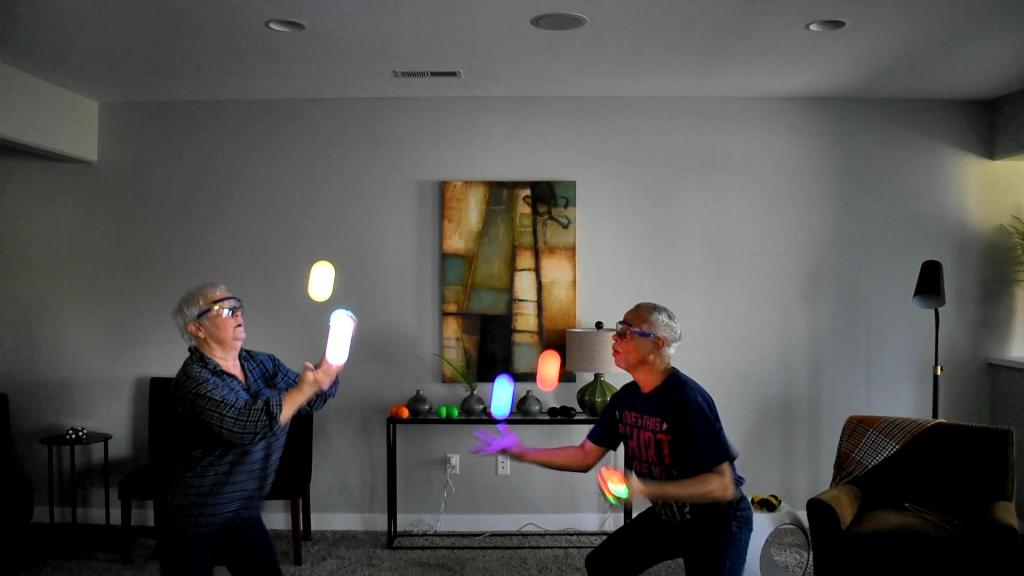
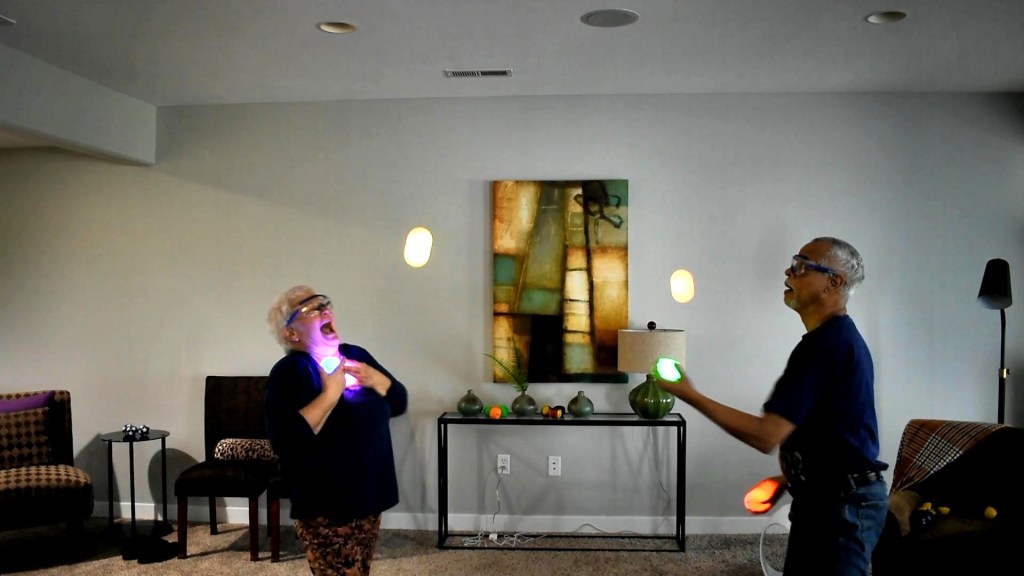
I’ve been juggling for about 5 months now and reflecting on my progress. I think I’m doing OK for a geezer. Sena would call me a hot dog although I would still call it ugly juggling by any standard.

What’s striking, at least to me, is the little bit of science I can find on the web about juggling. I hear the term “muscle memory” when it comes to learning juggling. Actually, there’s some truth to that. There are different kinds of memory. For example, most of us know about declarative memory, which about memorizing facts, because we use it to prepare for exams. Those of us who went to medical school remember the agony of taking tests for the basic sciences.

But so-called muscle memory, or the memory for learning new skills like juggling, takes place in the brain. There was a study published in 2009 which found changes in both gray and white matter of subjects before and after learning to juggle (Scholz J, Klein MC, Behrens TE, Johansen-Berg H. Training induces changes in white-matter architecture. Nat Neurosci. 2009;12(11):1370-1371. doi:10.1038/nn.2412).

The study about correlation of the inability to stand on one leg for 10 seconds with higher mortality in older patients, which I relate to the ability to do the under the leg juggling trick, was published last year (Araujo CG, de Souza e Silva CG, Laukkanen JA, et al. Successful 10-second one-legged stance performance predicts survival in middle-aged and older individuals. British Journal of Sports Medicine 2022; 56:975-980.)

I talk a lot about juggling as though I’m a teacher. I’m not a juggling instructor by any means. You can find better juggling teachers on the web. But my approach to talking about juggling in terms of it being a hobby for me is really not different from how I talked about consultation-liaison psychiatry before and after I retired. I’m still a teacher—just evolving in retirement.

However, you can find much better resources for learning how to juggle at the following websites:

https://www.renegadejuggling.com/

Have fun!

Why Does My iPhone Not Ring?

This post is squarely in the “Duh” category. For the last several days now, I’ve been wondering why my iPhone doesn’t have a ring tone. Before this, I haven’t thought about it, probably for years. I’m not sure why it came up.

I looked on the web for solutions to the silent ring problem.

The solution is clear, which is to slide the ring/silent switch so that the orange color doesn’t show. That turns the ringer on. The switch is just above the volume up/down buttons on the side of the phone.

But I couldn’t see the switch. Then yesterday, for some reason I thought to look at my Otter box protector flaps. That was the “Duh” moment. It doesn’t belong in the “Eureka” category for obvious reasons. “Eureka” is for geniuses, “Duh” is for dummies.

The problem was I couldn’t see the switch because the Otter box protector tab covers it. It may have been that way for years because I’ve had my iPhone for a long time and might have switched it off so that it wouldn’t audibly ring during meetings.

The other possibility is that I might have accidentally switched it off just by wrestling with the Otter box cover to get it wrapped around the phone.

In either case, I just stopped seeing the Otter box tab which covers the ring/silent switch. It’s not an out of sight, out of mind thing. It’s more like out of mind, out of sight.

Which makes me wonder, if “pareidolia” means seeing patterns in random data including visual information (in other words seeing things that aren’t really there), then what is not seeing obvious objects in the setting of normal vision?

Could that be inattentional blindness, sort of like the invisible gorilla test, in which subjects were asked to keep track of the number of times a basketball is passed in a video of a basketball game, and then half of the subjects failing to notice a woman dressed in a gorilla suit walking on to the court and thumping her chest, then walking away?

Is that similar to the oft repeated statement, “not seeing the forest for the trees” or “missing the elephant in the room?”

Don’t mind me; I’m just trying to salvage what’s left of my ego.

Teaching an Old Dog New Tricks

While we were out for a walk yesterday, we ran into someone walking her chocolate Labrador retriever. His name is Hunter and he had a tree branch longer than him in his jaws. He looked like he was having a great time gnawing on it and swinging it around.

I didn’t envy his owner when it came time to going home and taking it away from him.

Mostly younger dogs like to chew on old sticks and some say it might be a good idea to bring a chew toy along with you when you take a dog outside for a walk. It can be tough to persuade a dog to just let the stick go.

As a retired consultation-liaison psychiatrist, I sometimes compare myself to a dog who latches on to a stick and is reluctant to let it go. I’m an old dog that way and, as I’ve mentioned before, it’s a little hard to teach an old dog new tricks.

There are examples of this issue. I rarely go grocery shopping and I still have a lot to learn. I was not good about grocery shopping and other non-work-related chores when I was a doctor for about 28 years, counting residency. Medical school kept me pretty busy too.

Anyway, I went grocery shopping yesterday and I thought I did OK although I had to wander around quite a bit to find everything on my list. Sena doesn’t need a list. She pointed out that I got the unsalted butter—which she never buys. I wondered how I managed to pick up unsalted butter. I thought I was doing good to get the Great Value brand rather than the more expensive brand.

The package was blue instead of red. You mean I have to read the package?

I got a package of chicken breasts and congratulated myself on that. Sena said they were really thin and noticed that they included rib meat—which she normally doesn’t buy. That slipped by me.

I bought a lot of items that we needed; you know, things like milk, eggs, bread, nuclear weapons, etc. But I really didn’t get anything that you could actually make a bona fide meal out of in the sense of cooking something.

Well, I did get a couple of frozen pizzas. This brought the total of frozen pizzas in our freezer to a number I’m not willing to divulge at this time.

I had to maneuver around several shoppers who were filling orders for customers who ordered their groceries on line. I tried that a very few times and it’s more difficult than I thought.

When I got up to the cashier, I just stood there while she rang up my purchases, bagged them—and then she started to put the bags in my cart. She didn’t say anything but a tiny bell in my brain rang somewhere and it occurred to me that I was supposed to put the bags in the cart. I apologized and got to work right away when I noticed. I recalled that it was probably just that mistake that led to my leaving an item at the store the last time I shopped.

Sena went to the grocery store after I got home and returned with items that could be used in menus. I think that is called meal planning.

But I did make dinner last night, meaning I reheated left-over chili and chopped up some vegetables for salads. Oh, and I got the saltines out for the bread group.

Sena is still trying to coax me to let go of the stick.

About Those Stages of Retirement

We got our new wall clock on the wall the other day. It got me to thinking about how I view time and other matters now that I’ve been retired for about two and a half years.

I actually tried to ease into retirement by getting a 3-year phased retirement contract. I thought that might help me get adjusted to not being a fire fighter as a consultation-liaison psychiatrist. I don’t know how helpful that was.

So, I looked up the stages of retirement on the web. There are slightly different versions but most of them have 5 stages:

  • Realization
  • Honeymoon
  • Disenchantment
  • Reorientation
  • Stability

I guess I’m somewhere at the tail end of disenchantment and the beginning of reorientation. I have to point out a few things about me and the clock on the wall to help get my point across.

When I was running around the hospital, I used to pay a lot of attention to the clock. One example is how I helped medical nurses and doctors diagnose and manage catatonia. That’s a complicated and potentially life-threatening condition linked to a lot of medical and psychiatric disorders. It can make people afflicted with it look like they have a primary mental illness and they can look and act spooky.

Most people with catatonia are mute and immobile. They could also have wild, purposeless agitation but the mute and immobile type is more common. I would recommend administering injectable medicine in the class of benzodiazepines, often lorazepam.

Often the catatonic person would wake up and start answering questions after being like a statue only minutes before the injection. I watched the clock very closely, and the nurse and I watched the vital signs even more closely.

The recovery from a catatonic state looks like a miracle, which often made me look like a hero—despite the fact I could not explain exactly the mechanism of how catatonic states begin or how injectable benzodiazepines work to reverse the state. In most situations, on the general medical and surgery wards, the cause was not infrequently a medical emergency.

That made retirement difficult. I often didn’t notice time passing when I was working. In fact, my job as a C-L psychiatrist was marked by a series of emergencies, hence the fire fighter feel the job held for me.

Somehow, interrupting my schedule (if you can call firefighting a schedule), didn’t help me very much in my adjustment to retirement.

Right from the start, I noticed I missed being a hero. By the time I got to the first stage, Realization, I was already part of the way into the Disenchantment stage. I don’t really recall the Honeymoon stage.

Time passed slowly after full retirement for me. Not even the phased retirement schedule prepared me for it. It was excruciating. I have never slept very well, but my insomnia got worse after retirement.

I had fleeting thoughts about returning to work, and that’s the surprising thing. You’d think I would have just dropped the whole retirement thing and get right back in the fire truck.

But I didn’t. Part of me knew that the job consumed me and burnout was a consequence. My focus on work did not help me be a good husband. On the other hand, retirement by itself didn’t help either.

It’s still hard, but not as difficult as it was at first. I would say that I’m somewhere between the latter part of Disenchantment and the beginning of Reorientation. I’m not anywhere near Stability.

I have replaced my schedule to some degree. Most days, I exercise and practice mindfulness meditation. I have also recently taken up juggling, as many of my readers know.

But any YouTube videos of me “cooking” are bogus. Sena takes video of me messing around making pizza and whatnot as if I know what I’m doing—but she’s giving me cues every step of the way. I’m allergic to kitchens and I probably always will be.

Anyway, I have a different relationship with the clock nowadays. I’m still hoping that I’ll evolve into somebody who knows how to manage not just retirement better, but a whole lot of things in a more adaptive way.

I sure hope so. According to some statistics, at my age I’ve got a limited time to improve. So, I need to get busy.

Lost Juggling Ball Found!

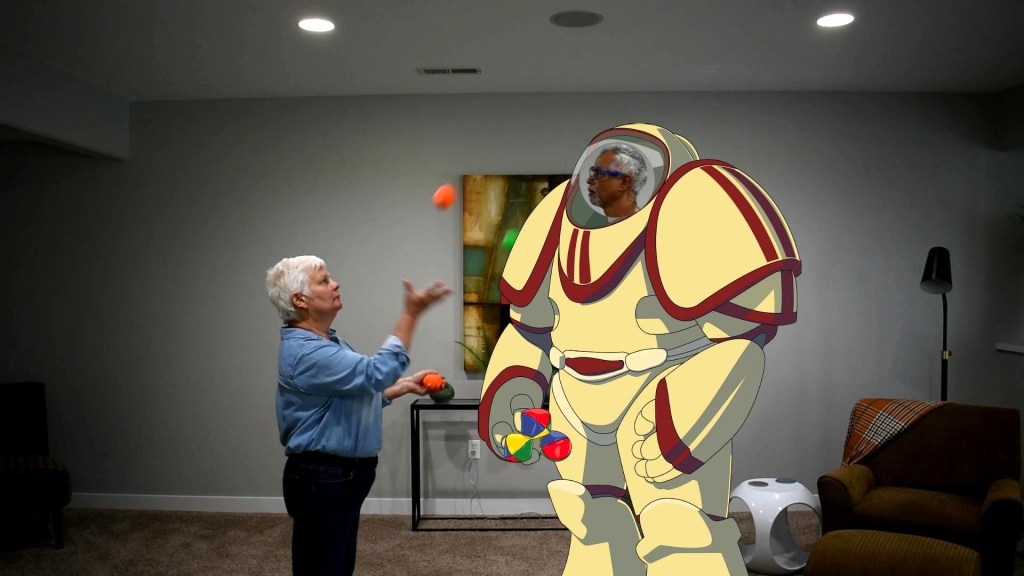
I lost one of my new juggling balls temporarily this morning while trying the behind the back throw. OK, so I dramatized the video a little. That’s because I got interrupted in the search to help Sena hang our new wall clock.

I had no idea where that ball was. I even considered a wormhole vortex opened up in my office—briefly.

But the place I finally found it was just where I’ve dropped juggling balls before—on one of my bookshelves.

New 12 Panel Juggling Balls!

I got one of the two new sets of juggling balls today. They are the Zeekio 12 panel, 67 mm, 130 gm balls, which are noticeably heavier and a little harder to do certain tricks with-like the behind the back throw.

I dropped them several times, so they are getting broken in very well!

Terry Trueblood Outing Today or How to Find Hearts Needing a Home

We had enough of bad news on the web, so we went out to Terry Trueblood Recreation Area today. Good things are happening around here, including what we found at Trueblood. Sena ordered some items last week. One is a clock, which we’ll hang somewhere and then not look at. Another is a chair that I will put together, and which will probably give me a reason to use up at least some of the oversupply of band aids.

The best deliveries, in my humble opinion, will be a couple of brand-new sets of juggling balls. One reason for buying them is that my other juggling balls are already starting to leak their millet fillings.

Millet is bird seed. I first noticed it on my hands, and then saw it on book shelves and my chair. I practice juggling every day, and see to it that they get banged up as much as possible, even if that happens to involve impacts with my head. Many juggling balls are stuffed with something: plastic pellets, sand, dandruff from extraterrestrials—no reason to avoid millet.

The new juggling balls will be bigger and heavier: a little over 2.5 inches in diameter and around 130 grams. I’ll probably knock myself unconscious dropping them on my head. One set of 3 will be as close to Iowa Hawkeye colors as I can get: black and yellow (which is what black and gold usually look like to me). The other set will be multicolored and have 12 panels. Balls covered with leather or other material have to be sewn shut and some say that the more panels, the more the impact will be spread, possibly reducing the risk for breakage. On the other hand, I can’t help wondering if there are more seams, wouldn’t it be more likely they’d be split when (not if) I drop them?

I’ll think about that later. We had the best time today at Trueblood. In fact, a lot of people were having a great time out there. The weather was fantastic; the temperature was in the fifties. One trail walker claimed she saw 16 bald eagles! I took this with a grain of salt, but then we saw at least a half dozen, though they were flying too high to get good photos. There were plenty of shore birds.

The best sightings were the quilted hearts hung on several trees. They are from an organization called “I Found A Quilted Heart” and you can learn more about the people who got this started at their web site www.ifoundaquiltedheart.com. Volunteers place the small quilted hearts in various places, often local parks. The sole purpose is to brighten your day. That beats the daily news any time.

What we didn’t know was that we could keep the quilted hearts we found. We saw 4 of them. We’re going to let others find them and share the joy.

Ugly Juggling So Far

I thought I’d make a video on the progress I’ve made so far in the last 4 months with ugly juggling. Man, it’s ugly; I’m still lunging and grabbing and making faces. But I’m also getting a real good workout.

Psychiatric Times recorded my After Hours video via Zoom this morning. It won’t look like my progress YouTube show at all, but it was a lot of fun. They’ll need to edit the thing because I talk too much. It’ll have to go in a queue after that, so I have no idea when it’ll be available.

I’ll keep you posted.