Thoughts on Journalist Sydney J. Harris

I just have a few things to say about Sydney J. Harris, who was a journalist whose columns were syndicated to over 200 newspapers. I remember reading them in the Des Moines Register years ago.

I ran across one of his books for sale on Amazon. I’ve never read any of them, but I found one of them, “Winners and Losers” on sale “new” for $111 and change. I was astonished. I admire his diction and learning, but I would never pay that much money for one of his books. You can buy them for less than $5, even on Amazon. You can read “Winners and Losers” for free on the Internet Archive.

You can also find a lot of quotes from Sydney J. Harris on the web. I found a collection which I thought were admirable. Funny thing is, the more I read, the more I thought he was a product of his times. I thought I could detect a little male chauvinism (maybe more than a little). The more quotes I read, the more I noticed he almost always used the word “men” or “man” and rarely mentioned women, unless you count:

“The commonest fallacy among women is that simply having children makes them a mother—which is as absurd as believing that having a piano makes one a musician.”

Nobody’s perfect.

Thoughts on the Mason City 1884 Civil War Statue

Sena and I got to talking about Central Park in Mason City, Iowa. I remember my brother, mother and I taking a walk there occasionally. One time we saw a man who lost his legs and who got around using a small platform on wheels. Later in life, I wondered if he was a disabled war veteran.

That reminded us of the 1884 Memorial Civil War Statue in the center of the park. We looked it up and found it has a complicated history. In the late 1990s it was under repair for about 3 years in Cincinnati, Ohio. When it was finally returned, it was noticed that it had not been repaired correctly. The city decided to keep it anyway, partly because some people, including a Civil War re-enactment supporter, thought the flaws were relatively minor.

Anyway, there are relief busts of famous persons on the statue. We could identify Abraham Lincoln, Ulysses S. Grant, and a Civil War soldier. After a brief web search, we confirmed that the 4th relief bust was that of George Washington.

There are a couple of topics of interest here. One of them is the George Washington relief bust and the other is Civil War re-enactments.

The connection of the Civil War to George Washington is a little puzzling because he owned slaves. We’re aware he freed them upon his death. On the other hand, when we visited Washington D.C. in 2015, we took a tour of Mt. Vernon. It was a scenic boat trip out there. We took a picture at the dock with the dog of the guy who helped people on and off the boat. We also took pictures of the slave quarters. There were no re-enactment persons and we were told we were on our own when viewing those exhibits.

This also reminds me of the news item about a bill recently (on February 9, 2024)) introduced in the West Virginia legislature to remove the statue of former Senator Robert C. Byrd from the West Virginia State Capitol and replace it with 4 other statues: Abraham Lincoln, James Madison, Arthur I. Boreman, and George Washington. Nothing is mentioned in that news story about Senator Robert C. Byrd having been a leader in the Ku Klux Klan in the past, and filibustered against the Civil Rights Act of 1964. This is from a news story posted on the web in 2020 under a link titled “time to remove monuments to senator byrd.”

Again, I struggle a bit with suggesting that a statue of George Washington, a former slave owner, would be an appropriate substitute for that of Senator Byrd. And James Madison, despite saying that slavery was incompatible with Revolutionary principle, owned slaves and made profits on their sale. Arthur I. Boreman is described as not being an abolitionist but a unionist. However, in 1865 he signed a legislative act banning slavery in the state of West Virginia.

Maybe a nice set of abstract sculptures for the corners of the rotunda of the West Virginia State Capitol?

Turning to Civil War re-enactments, I’m ambivalent about them. I remember reading a couple of anecdotes about re-enactments in the book “Our Hidden Conversations” by Michele Norris.

One of them was about black woman re-enactor who played the role of a house slave. This was in Chapter 4, “Coins in the Couch.” The six-word Race Card (p.160) said “Why Do You “Play” A Slave?”  Nicole is a slave interpreter. She makes sure that visitors to former plantation sites portray slavery accurately to tourists. She’s a public historian by training who works at the National Center for Civil and Human Rights in Atlanta. She teaches tourists about the reality of chattel slavery, including the sale of relatives to other plantations and the ingenuity of enslaved men in improving farm implements.

The next anecdote about re-enactment in the book is in Chapter 10, “So, You Want to Talk About Lynching?” The six-word Race Card (p. 386) said “Confederate re-enactor chose intimidation as spoils.” A black man and his biracial but white looking friend were at a barbecue in Texas. Two big white guys dressed in Confederate-era uniforms were passing by and one of them placed his rifle on his knee and tried to stare down the black man. The black man stared back and this went on long enough for his friend to get nervous enough to suggest they just leave. Finally, the other re-enactor pulled the sleeve of the intimidator and they were the ones who finally left. Despite this episode, the black guy “…made a choice to accept people as I receive them.”

Apparently, there are regular Civil War re-enactments in Mason City. It looks like the most recent was from Sept 8, 2023-Sept 10, 2023. It was The Battle of Chickamauga, TN. It was held in East Park, where I used to play as a kid. Iowa soldiers in the Civil War fought on the Union side. However, I found out the battle of Chickamauga was won by the Confederates, and it had the second highest number of casualties after the Battle of Gettysburg. There was a battle demonstration and the camps were open all weekend to talk to the re-enactors. And there were food vendors.

There is a newer Mason City Veterans Monument in Central Park. It was built in 2004. It has 12 handsome black granite stones with room for the names of 4,600 veterans. We have seen pictures of it on the web. There are no relief busts.

Essay “Forget Me Not” on the Web About Leaving a Legacy

Sena found a great essay on leaving a legacy. It’s titled “Forget Me Not” written by Jonathan Clements and posted on the website HumbleDollar on February 17, 2024. I think it’s worth sharing.

The comments are still coming in. One commenter (Newsboy) wrote the one below:

“The late great author, Steven (sic) Covey, once suggested: “To live. To love. To learn. To leave a legacy – That’s what we all want.” 

How appropriate it seems that a willingness to embrace the first three items on his list (live / love / learn) typically results in the “dearly departed” achieving some meaningful degree of the last one (leave a legacy).”

This reminded me that I shared Stephen Covey’s concepts with junior residents when I was the chief resident in psychiatry. He wrote many books, including The 7 Habits of Highly Effective People.

I took the 7 Habits of Highly Effective People Signature Program many years ago. All of us who attended got the course book and the Talking Stick. Back then Covey called it the Indian Talking Stick; I guess nowadays you’d call it the Indigenous People Talking Stick. The idea was to pass the stick around and you’d have to respect the person holding it and listen carefully while they have their say until they feel understood. Only then could the stick be passed on to someone else, once again to allow them to say their piece until they are understood. There could be no interruptions.

I wonder if the Talking Stick really works. I’ve never tried it. I guess that’s the problem.

I think Covey left a legacy. I doubt that was his main goal.

Black History Month: In Honor of James Alan McPherson

I thought it would be nice to mention James Alan McPherson, Pulitzer Prize winning author and longtime Iowa Writers’ Workshop faculty member, in keeping with the theme of this month’s Black History Month: African Americans and the Arts. A neighborhood park was named in his honor (James Alan McPherson Park) in 2021. There has been a plan to erect a memorial plaque in his honor, which I believe is still in process.

There is a very nice summary of his accomplishments as a writer on the Black Past website.

“Our Hidden Conversations” is a Very Tough Book to Read

As I approach the end of the book “Our Hidden Conversations” by Michele Norris, I find myself doing what I often do when I feel uncomfortable emotionally. I start to deploy my sense of humor.

As a psychiatrist (now retired since 2020), I learned early in my residency training that humor can be thought of as a “mature” psychological defense.

Given the painful memories that the book evokes, I find that I self-edit my usual habit of turning pain into comedy. Maybe it’s not always mature.

On the other hand, there are times when facing what is nowadays called my “lived experience” about racism and identity in the era my wife and I grew up in, while not funny, can be peeked at most safely from the funny edge.

So, with that in mind I took a look at the web page of the National Association of Black Social Workers (NABSW) which summarizes the organization’s position on white adoption of black children. I first read about it in Ms. Norris’s book, in the chapter “Black babies cost less to adopt.”

I was surprised to see the actual document, which has been posted since 2013. Sections of the position paper titled “Transracial Adoption Statement (c) 1972” are underlined. It expresses clearly an opposition to placing black and transracial adoptees with white parents. I might have missed it, but I don’t see another position statement that modifies it.

There are 30 state chapters of the NABSW. Iowa is not listed.

There is no National Association for White Social Workers. There is a website for the National Association of Social Workers (NASW). When I typed in “National Association of Black Social Workers” in the search field on the NASW website, almost 800 results were returned. When I applied the filter for ethnicity and race, there were 5 results attesting to the NASW efforts in countering racism. I didn’t see any mention of the NABSW. Maybe I just missed it.

I lived for a brief time in an African American foster home eons ago. I can’t think of anything funny to write about it. Has there ever been an opportunity for cross talk between the NASW and the NABSW? I’m not judging anyone here. I’m just asking.

Moving right along, I have again searched the web using the term “African American psychiatrists in Iowa.” I’ve posted about this before, looking at it from the funny edge (this allows me to take a deep breath). I still find my former colleague, Dr. Donald Black, MD listed. The only thing black about him is his name. And my 2019 blog post is the 3rd link down from the top, preceded by two from Psychology Today.

Most of the mental health care providers from the Psychology Today lists are Nurse Practitioners who are black. One of them does not look black. She looks white. She’s a psychiatrist. I’ve worked with her in the past and don’t recall her ever identifying as black. But because I’m reading the race card stories in “Our Hidden Conversations,” and because I’ve been around a little while, I’ve learned that some black people can look white. You can’t always judge a book by its cover.

A good black psychiatrist is hard to find. In fact, a black psychiatrist of any quality is hard to find. However, in general, there are notable black psychiatrists in our history. One of them was Chester Middlebrook Pierce, MD. Among his many accomplishments, he was the founding president of the Black Psychiatrists of America in 1969, which was one year after the NABSW was established. Dr. Pierce was also the president of the American Board of Psychiatry and Neurology in 1978. I didn’t learn about him until today. How is that possible?

There is a website for the Black Psychiatrists of America and you can try the search field to look for a black psychiatrist there. I couldn’t find any listed in Iowa. Most of them seem to be in Texas. I had a little trouble applying the search filters.

Those are my thoughts for now about “Our Hidden Conversations” by Michele Norris. This is not a funny book.

More Thoughts On “Our Hidden Conversations” Book by Michele Norris

I need to correct something I got wrong in my first post about Michele Norris’s Distinguished Lecture on January 23rd. While reading her book, “Our Hidden Conversations” I ran across this race card in the chapter “Black Babies Cost Less to Adopt:”

“Vote (for) Obama! He looks like me!”

That was the 8-year-old daughter said that. The person who sent in the card was her father, Dr. Val Sheffield and he was a medical student in Iowa at the time. Once you know that, you realize why he wondered whether he should have been “…happy or dismayed by this comment.”

Anyway, I’m a little over halfway through the book, “Our Hidden Conversations.”

The title of the chapter above, “Black Babies Cost Less to Adopt” is troubling and it has a lot to say about how it was common in the past to discount the cost of adopting black babies. Foster care of non-white kids was also a subject in the chapter. Identity conflicts are common and can lead to reminiscing about things like:

“I was not Black enough.”

“I was not Asian enough.”

“I was not Hispanic enough.”

What matters is being kind enough.

Preliminary Thoughts on “Our Hidden Conversations” Book

This is a short post about my initial impressions about the book, “Our Hidden Conversation” by Michele Norris.

I’m not finished with the book yet, but I thought I would let you know that the first chapter, “Bread Crumbs” was tough to read. I had to put it down and come back to it a few times because it brought back memories.

The chapter title “Bread Crumbs” means the clues that parents, grandparents, etc. might leave for subsequent generations to find which might shed light on one’s background, explain troubling circumstances, and so on.

I have some bread crumbs left to me by my family. Some are in the form of photos, although there is no family photo of all of us together.

I remember the hair combing routine my mom had with me and my brother every Sunday morning before church when we were kids. Our father was black and my mother was white. Dad was out of the home and we lived with mom. We were the only black kids in the church. In fact, all the members were white.

Mom used a prodigious amount of hair oil while vigorously combing our curly hair back. It took many strokes and the pulling pinched a bit. The ritual took a little while. When I look back on it, I guess the goal was to straighten our hair as much as possible.

Everyone in the church always treated us kindly and I was baptized there.

If you decide to read “Our Hidden Conversations,” give yourself a break whenever you feel like you need it.

“Our Hidden Conversations” Book by Michele Norris Arrived

I just started reading Michele Norris’s book, “Our Hidden Conversations.” It’s based on her Race Card Project, which has been going on for 14 years and counting. It’s about more than racism between black and white people. I’ll let you know what I think about the book from time to time.

Thoughts on the Dr. MLK, Jr Distinguished Lecture by Michele Norris

Sena and I viewed a recording of the Dr. Martin Luther King, Jr Distinguished Lecture given by Michele Norris on January 23, 2023. It was not available to the general public, about which I have inquired. It was a very interesting, informative, and entertaining presentation. It was about her 14-year Race Card Project which led to her new book, “Our Hidden Conversations: What Americans Really Think About Race and Identity.”

Michele opened with a little information about Bayard Rustin, which we didn’t know. There’s a film titled “Rustin,” available on Netflix which is about him and Dr. King and their complicated relationship. He was a gay black man, which was difficult for the civil rights movement leaders to accept. He was the key organizer for the 1963 March on Washington for Jobs and Freedom.

In her own words, Ms. Norris created the Race Card Project because she thought no one wanted to talk about race. She found out she was wrong because there was an avalanche of response to her request that people write something about race on a small postcard (6 words) and send it back. Interesting examples:

“Father was racist. I’M NOT. Progress!”

“Did my Southern Grandpa attend lynchings?” (This card came from Iowa.)

“Married a white girl. Now what?” (The girl thought of the guy as an “assimilated” brown man.)

“Alabama. MLK assassinated. Students cheered. Horrified.” (This was in a college classroom.)

“We aren’t all strong, black women.” (Norris’s comment was that it makes black women seem more like a weed and not a flower).

“Two white dads. Three black kids.” (Adorable photo included of gay married men with three adopted black children.)

“Can someone help me find my privilege?” (Photo of a white man included. Ms. Norris said that most of the cards are from white people, which surprised her.)

“My name is Jamaal. I’m white.” (Include a picture of a white guy. This was a story about Iowa. The guy showed up for a job interview, and the receptionist says “I thought you would be taller.”)

“Vote for Obama. Look like me.” (White guy married to white gal; they adopted black girl. I think he meant, in the abstract, that no matter what color you or the candidate are you should vote based on whether the person is qualified for the job. It’s funny that his very young daughter commented on it in a predictably concrete way given her age. She said she lived in Iowa and didn’t see too many people who looked like her. Ms. Norris said this story would be included in the book.)

It’s tough to express complicated ideas in just six words.

Ms. Norris says it’s unlikely that we’re going to agree with each other. She wants to build bridges across the chasm which divides us and she is hopeful about our ability to do that. We ordered her book.

Black History Month 2024 Theme is African Americans and the Arts

February is Black History Month and in 2024 the theme is African Americans and the Arts.

This reminds me of a blues artist I heard on KCCK on the Big Mo Blues Show last Friday. His name is Toronzo Cannon and his career as a blues guitarist and songwriter is skyrocketing. I heard his song “The Preacher, the Politician, and the Pimp.”

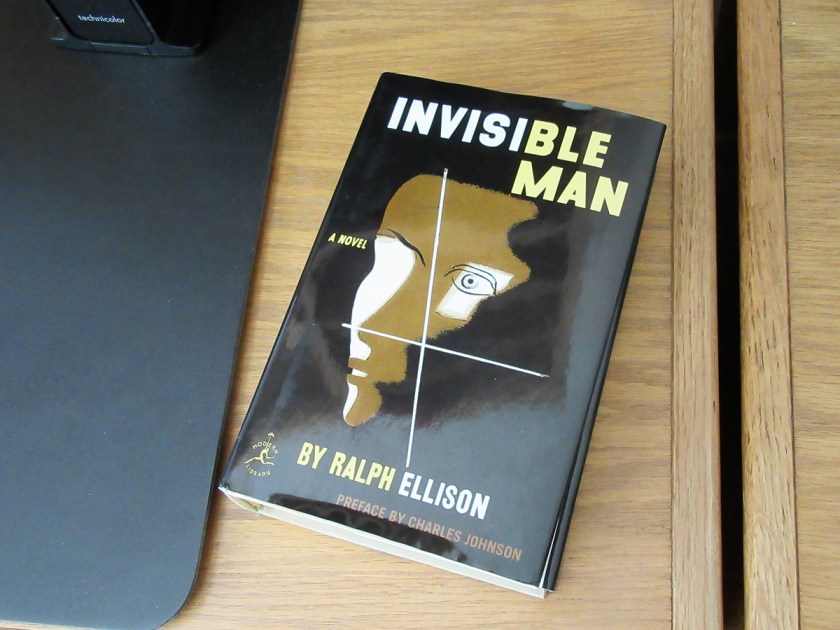
The lyrics reminded me of a character (or maybe more properly a non-character) called Rinehart in Ralph Ellison’s book, Invisible Man. I’m by no means an Ellison scholar but in chapter 23 the main narrator gets mistaken for a black guy named Rinehart who has many faces in the black community. He’s a preacher, a numbers runner, a pimp, and is also related to a political movement in the novel. Rinehart is all of them and none of them, moving between the “rind and heart” of who black people are in America. The implication is that the identity of black people is multifaceted and the similarity of the theme in Toronzo Cannon’s song is striking.

Cannon is also multifaceted. He’s a Blues guitar star and song writer and is also still a bus driver for the Chicago Transit Authority. How does he find time to do all that?

I wonder if Cannon got the idea for the song from Ellison’s novel. I guess I’ll never know.

This reminds me of an encounter I had with a black writer at Huston-Tillotson University (then Huston-Tillotson College, located in Austin, Texas) in the 1970s when I was an undergraduate in college. I’ve described this episode before in another post (“Black Psychiatrists in Iowa” 2019). The excerpt below includes a reference to a book review I wrote that was published in The American Journal of Psychiatry over 20 years ago:

“This reminds me of a book review I wrote for the American Journal of Psychiatry almost 20 years ago (Amos, J. (2000). Being Black in America Today: A multi perspective review of the problem. Am J Psychiatry, 157(5), 845-846.).”

The book was written by Norman Q Brill, M.D. It reminded me of my experience at Huston-Tillotson College (now Huston-Tillotson University, a private school, historically with largely Black enrollment) in Austin, Texas back in the 1970s. I wrote:

“Dr. Brill’s appraisal of many black leaders in chapters such as “Black Leaders in the Black Movement” and “Black Anti-Semitism” may be refreshingly frank in the opinion of some. He tailors his prose so as not to denounce openly those whom many would describe as demagogues. At the same time, it is apparent that his underlying message is that a substantial number of them are not only out of touch with mainstream black America but may even mislead black people into adopting ideological positions that impede rather than foster progress. Dr. Brill’s description of the issue reminded me of my own experience with this phenomenon as a freshman in the mid-1970s at a college of predominantly black enrollment in the southern United States. A guest lecturer (who, as I recall, had also written a book about being black in America) told us that the white man would never allow a black man to be a man in America. He had only three choices: he could be a clown, an athlete, or a noble savage. These corresponded to the prominent and often stereotyped roles that blacks typically held in entertainment, sports, and black churches.” 

I was taken aback by the speaker’s judgment and asked him what my choice should then be. He was equally taken aback, I suspect. He advised me to be a clown.

The lyrics of Cannon’s song “The Preacher, The Politician, and the Pimp,” Ellison’s Rinehart, and another writer’s characterization of the roles allowed in American society for black men all resonate together. What drives the similarity of this perception across different artistic platforms?

When I reflect on how I’ve negotiated my life’s path over they years, I guess I would have to admit that I’ve often played the clown. Anyone can see that in the way my sense of humor comes across. Is it the healthiest way to respond to racism in this country? In terms of the psychological defense mechanisms, I think it’s a relatively mature strategy. You could argue with that by asking, “But where’s the maturity in dad jokes?”

Hey, it worked for Dick Gregory:

“I’ve got to go up there as an individual first, a Negro second. I’ve got to be a colored funny man, not a funny colored man”—Dick Gregory.

Dick Gregory