Hearing an Old Song

I have to admit that I’ve been mis-hearing some of the lyrics of one of my favorite songs, “Lean on Me” for the past fifty-odd years since Bill Withers wrote it. It stayed on the top of the charts for more than 3 weeks back in 1972. That was a special time in my life; and not an easy one.

Back then, you couldn’t just look up song lyrics or anything else for that matter on the world wide web. It didn’t exist yet. I’ve always been prone to mondegreens and I finally found out that I was hearing something different in the verse:

“Please swallow your pride

if I have things (faith?) you need to borrow

For no one can fill

those of your needs

That you won’t let show”

Just to let you know, I found lyrics in one YouTube that substituted the word “faith” for “things”. Think about that one. I don’t know how to settle it, so if anybody knows which word is right, please comment. Anyway, it’s a little embarrassing and revelatory that I heard “…if I have pain…”  instead of “…if I have things (or faith)…” And I never really heard “…That you won’t let show.”

Yet I lived it.

Years later, after I’d finished college, medical school, residency in psychiatry, and had taught residents and medical students at the University of Iowa for a number of years, one of my colleagues, Scott, a brilliant psychologist and writer, stopped by my office one day. This was years ago.

His name is Scott and he suggested that it would be nice to get together sometime soon to catch up. I deferred and I remembered he replied while looking off down the hallway, “I’m 70.”  I wonder if he meant he didn’t know how much more time he had left.

Scott and I had taken similar paths in the middle of our careers at Iowa. I wanted to try private practice and left for Madison, Wisconsin. Scott got the same idea and left for a position in Hershey, Pennsylvania. We both regretted it and soon after returned to Iowa. I swallowed my pride and came back because I loved teaching. I think he returned for the same reason. We were both grateful that the UIHC Psychiatry Dept. Chair, Bob Robinson, welcomed both us of back.

I touched base with Scott a little while ago. We’re both retired. I was trying to find out how to contact Bob about messages I was getting from the publisher of our consult psychiatry handbook. Neither Scott or I could find out what was going on with Bob, who retired several years ago and moved back East. It turned out he had died. Sometimes we all have sorrow.

Scott is my friend, and I leaned on him a long time ago. I’m unsure if I let it show. I’m 70 and I’m grateful to him.

On that note, I’m finding out that I can’t walk all the way to the mall and back anymore. On the other hand, I can walk about half that distance. It’s about a mile and a half out to the Clear Creek Trail and back. There’s a lot of uphill and downhill stretches along the way. I can manage that.

And Sena bought me a couple of pairs of new shoes that I’m breaking in that will probably be easier on my feet and my calves. They’re Skecher slip-ons, not to be confused with the no hands slip-ins. I’m used to slip-ons. I tried one pair out today, in fact. Before I left, I took a few pictures of Sena’s new garden. As usual, she’s planting new flowers. The dogwood tree looks great. She’s even excited about the wild phlox. I can’t keep track of everything else out there. She makes the beauty out there.

And I lean on her for that.

Three Photos to Share for Mental Health Awareness Month

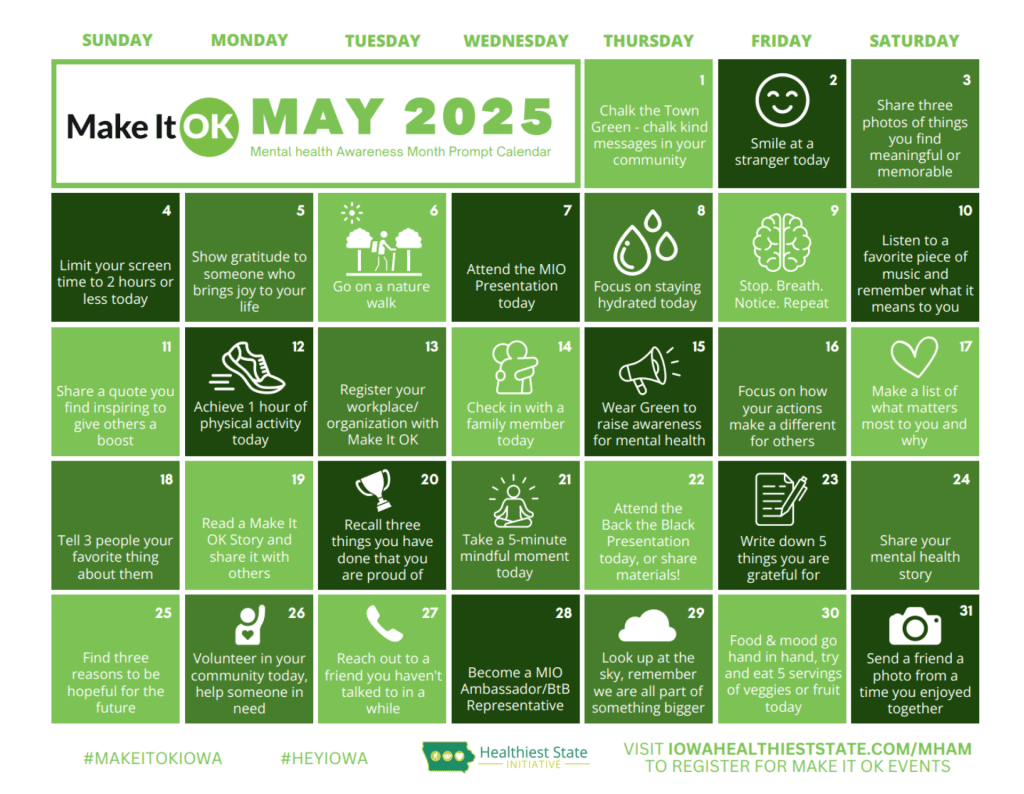
So, I have to hurry up and get these 3 photos posted for today because it’s getting pretty late. Recall the Iowa Healthiest State Initiative calendar along with my photos to share:

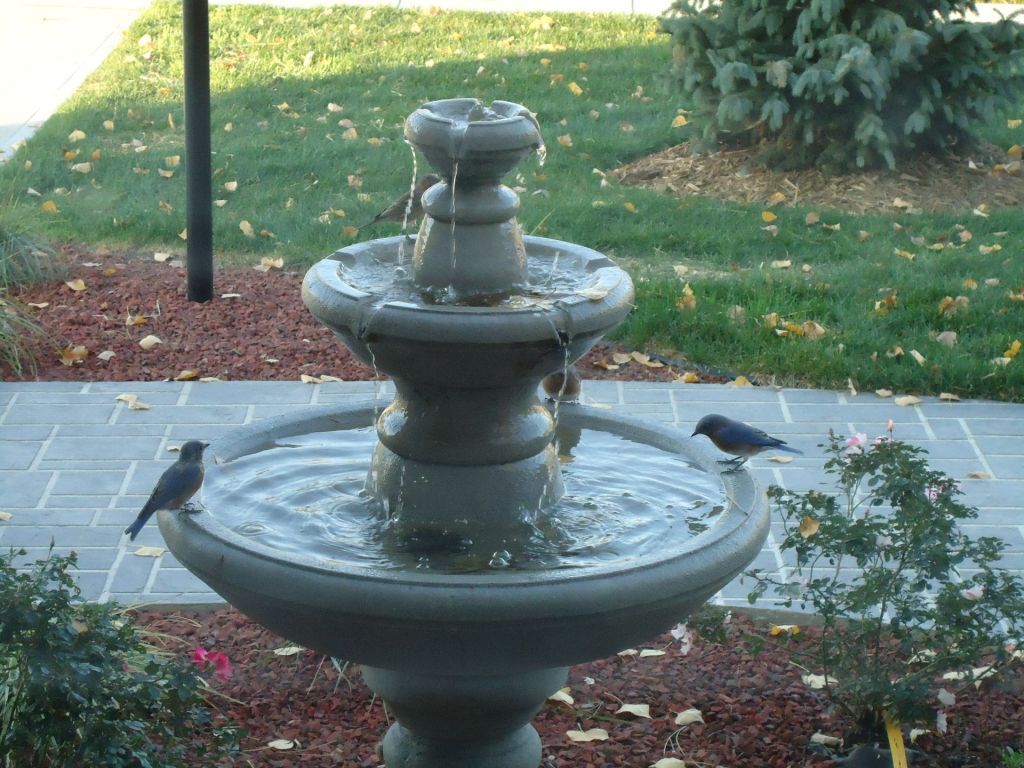
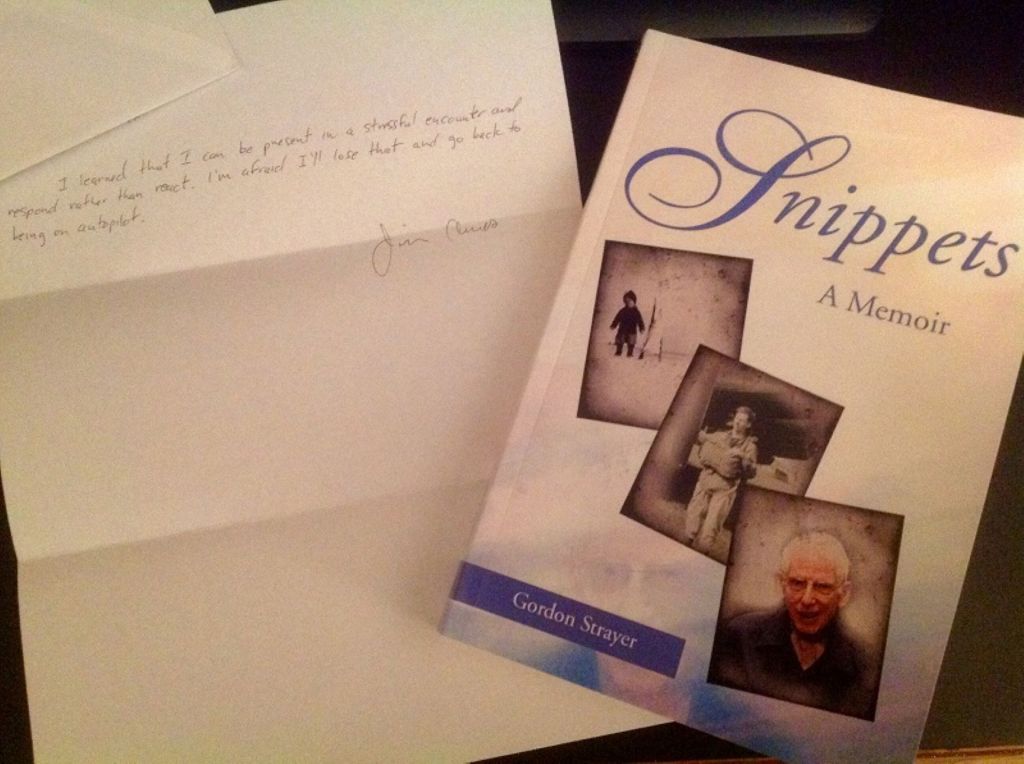
The images are important features of events in my life or my sense of humor.

I’m a birdwatcher and many different species of birds visited the fountain. The fountain attracted bluebirds who splashed and even swam in it. That fountain was very heavy. We couldn’t leave it out all winter. In the fall I had to lift the bowls off and move them somewhere else. Moving them entailed lifting them onto bags of mulch so as to reduce the work of hefting them a small distance at a time. The birds were beautiful to watch.

The letter was a class assignment our Mindfulness Based Stress Reduction (MBSR) teacher had us write at the beginning of the class. After we graduated, she mailed us those letters shortly thereafter. We were to write something connected with what we thought we had gained or what we thought might happen after taking the MBSR class. The book might seem out of place, and while I can’t talk much about Gordon Strayer, I did meet him and read his book (which is now long gone; probably lost in a move). I admired him. I don’t think he feared death.

The Chrysler Building reminds me of the Men in Black (MIB) 3 movie, and I included it because my sense of humor is very important to me. In the movie, Agent J and Jeffrey Price have this funny conversation about time travel back to an era that was not the greatest for black people. I know because I lived through it. Agent J is about to use the time travel device which involves jumping off a tall building (it’s a “time jump!”). Agent J is preparing to travel back in time to M.I.B.’s early days in 1969 to stop an alien from assassinating his friend Agent K and changing history. They have this short conversation:

Jeffrey Price: Do not lose that time device or you will be stuck in 1969! It wasn’t the best time for your people. I’m just saying. It’s like a lot cooler now.

Agent J: How will I know if it works?

Jeffrey Price: You’ll either know…or you won’t.

African American Women in Iowa History

In light of March being Women in History Month (as well as Iowa History Month), I’d like to share some history stories about an African American librarian from Mason City, Iowa named Esther J. Walls. In 2020 during the Covid-19 pandemic, there was an essay about her, “Esther J. Walls: The Role of a Black Leader.” Her life story as a librarian, traveler, and educator is fascinating.

I looked through the list of women elected to the Iowa Women’s Hall of Fame and couldn’t find her name. However, I recognized Deborah Ann Turner’s name on the list. She was the first African American woman to be certified by the American Board of Obstetrics and Gynecology in gynecologic oncology. She was also from Mason City, Iowa. Her life story and list of accomplishments is also impressive.

I identify with both of them because they were born and raised in my hometown, Mason City, Iowa. Esther J. Walls was employed at the Mason City Public Library, my favorite haunt because my love of reading and writing began in early childhood.

An archived news item about Esther J. Walls entitled “A Mason City woman’s globe-trotting career” highlights her travels and her sense of humor.

Making My Own Race Card

Tomorrow’s schedule for the Martin Luther King Jr. Celebration of Human Rights Week has Michele Norris presenting the MLK Distinguished Lecture, “Our Hidden Conversations.” It’s based on her Race Card Project which produced her new book “Our Hidden Conversations: What Americans Really Think About Race and Identity.”

Sena and I probably are not going to make it to Michele Norris’s lecture tomorrow, mostly because of the bad weather.

The Race Card Project involved people sending in cards with just six words on it which described their experience with race and identity and much more than that. I didn’t learn of the project until this month.

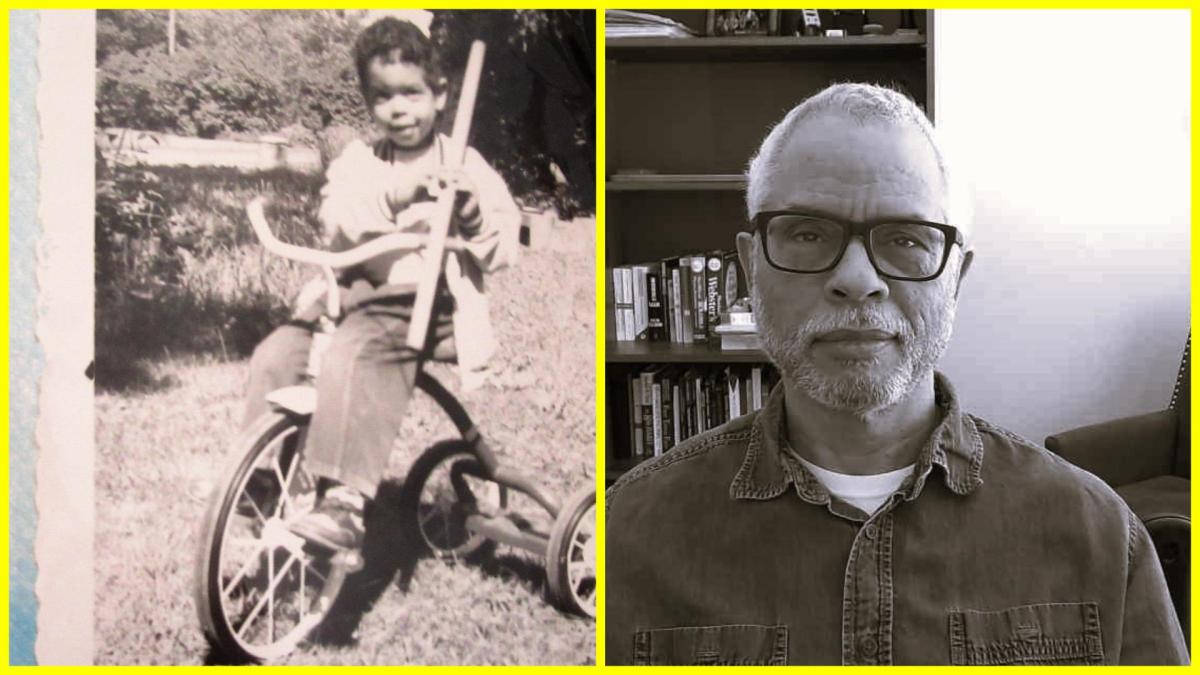
If I were to send in a card, it would say, “Everyone changed but Jim.” What’s important about that is who said it, because it wasn’t me. It was somebody who was my best friend in grade school. I lost touch with Dan, who was white, for a while when we were kids.

When I caught up with him while we were still pretty young, he had changed. He seemed much older than our real age. He used to have a great sense of humor, despite his life being a little difficult. Our lives were both hard, in many ways that didn’t involve race. We both grew up in relative poverty.

But after only a few years of not seeing each other, he seemed cynical, which was very different from how I remembered him.

I don’t recall how I found him, but I met with him at his school. I expected to find the same guy who made me laugh. But he didn’t seem glad to see me. I must have mentioned it, and I probably pointed out that he had changed.

And that’s when Dan said, without looking at me, “Everyone changed but Jim.” The meeting was brief. I left and never saw him again.

Friends were tough to find for me. I didn’t have any black friends. My father was black and my mother was white. They separated when my younger brother and I were little, and we lived with mom. Despite what some people may or are rumored to think, racism has always been a part of living in America.

Black people tended to live in different zip codes, not the one in which I grew up. I was often the only black kid in school, and this story was and is still common. I didn’t have black friends because I didn’t live in the zip codes where black people lived.

Dan wasn’t the only friend I had. There was only one other; he was white too. Like me and Dan, Tim and I didn’t stay friends.

A lot happened after that, which is always a part of coming of age. And I guess that’s because a lot of things changed—including me.

Generosity, kindness, and love, especially the love from my wife, saved me from lifelong bitterness, for which I’m grateful. I think a sense of humor was also important. And even though definitions differ about what friendship is—I have friends.

Rearranging My Books

The other day, I finally rearranged my bookshelf. I’ve put it off for a long time. While I was doing it, I remembered where I spend the most time in my thoughts. I don’t have a very broad library, which probably illustrates where my mind wanders. It has changed very little over the years. Retirement affected it some, but not a great deal. After I rearranged the books, it was not just better organized. It made me think about the past, the present, and the future.

I have a lot of books by Malcolm Gladwell for some reason. The Tipping Point was published around the time when all of my immediate family members died for one reason for another. They died within a few years of each other. It was a difficult time. I remember hoping I would just get through it. I did.

I’m still a fan of Stephen Covey. The 7 Habits Manual for the Signature Program marks a time when I was contemplating leaving my position at The University for a position in private practice. It didn’t work out, and it’s just as well.

Of course, there are many books about consultation psychiatry, including the one I wrote with my former Dept. of Psychiatry Chair, Robert Robinson. Every once in a while, I search the web to find out what former colleagues and trainees are doing now. I can’t find a few, which makes me wonder. A couple have died. I’m a little less eager to look around each time I find out about those. Finding obituaries is a sad thing—and it makes me a little nervous about my own mortality. One or two have apparently simply dropped off the face of the earth.

I read some books for fun. I’m a fan of humorists, which is no surprise. The most recent is The Little Prince. That book and others like it inspire me.

I like books that make me laugh and give me hope. It’s difficult to sustain hope in humanity, if you read much of the news, which I tend to avoid.

I feel better when we go out for walks. Recently we did that about a week ago when there were a couple of warm days. On one day, we saw a couple of bald eagles and northern shovelers (the latter of which we’ve never seen before), at Terry Trueblood Recreation Area.

On another warm day we saw a couple Harvest Preserve staff members preparing to hang a big Christmas wreath on the side of a barn on the property that faces Scott Boulevard. They’d got some evergreen branches from an “overgrown Christmas tree farm.” It had a big red bow. They were going to decorate it further and hang it. We hoped it would be finished by the time we returned that day, but it wasn’t done.

When we returned a day later, it was very cold but the wreath was on the barn wall and it was festooned with gorgeous decorative balls. It was worth waiting for.

Video music credit:

Canon and Variation by Twin Musicom is licensed under a Creative Commons Attribution 4.0 license. https://creativecommons.org/licenses/by/4.0/

Artist: http://www.twinmusicom.org/

Random Connections

Today, I read Dr. George Dawson’s blog post, “How I ended up in a high-risk pancreatic cancer risk screening clinic.” As usual I was impressed with his erudition, scientific literacy, and rigorous objectivity, even as it pertained to a deadly disease which runs in his family genetic history. I couldn’t help admiring his courage.

And, whether this is a random connection or not, this somehow led to my remembering Dr. George Winokur, a giant in the scientific study (including genetics) of psychiatric diseases, especially mood disorders. He died of pancreatic cancer shortly after he was diagnosed with it in the spring of 1996.

Dr. Winokur was chair of the University of Iowa Department of Psychiatry from 1971 to 1990. He remained on faculty, actively involved in research and teaching up until the day of his death in October of 1996.

I was a resident in psychiatry at University of Iowa from 1992-1996 and I have a clear recollection of meeting with Dr. Winokur in his office during my last year, when I was preparing for job interviews. I knew he had been diagnosed with pancreatic cancer.

He had been actively recruiting me to accept a position in the department and did so even as we spoke briefly. I remember noticing that he gripped an electrical conduit on the wall next to his desk so tightly that I wondered if he were in pain.

He was the main reason I stayed in Iowa. He had a great sense of humor. All of us residents loved him. There was even a list of his “commandments” all new residents received when they began their residencies at Iowa.

Winokur’s 10 Commandments

  1. Thou shalt not sleep with any UI Psychiatry Hospital patient unless it be thy spouse.
  2. Thou shalt not accept recompense for patient care in this center outside thy salary.
  3. Thou shalt be on time for conferences and meetings.
  4. Thou shalt act toward the staff attending with courtesy.
  5. Thou shalt write progress notes even if no progress has been made.
  6. Thou shalt be prompt and on time with thy letters, admissions and discharge notes.
  7. Thou shalt not moonlight without permission under threat of excommunication.
  8. Data is thy God. No graven images will be accepted in its place.
  9. Thou shalt speak thy mind.
  10. Thou shalt comport thyself with modesty, not omniscience.

I never got the impression that George Winokur recruited me because I was black, although it was pretty obvious to me that I would be the first black University of Iowa psychiatry department faculty member. He had too much class to make that an issue.

I’ve known a few classy psychiatrists. Maybe the connection is not so random.

About Those Stages of Retirement

We got our new wall clock on the wall the other day. It got me to thinking about how I view time and other matters now that I’ve been retired for about two and a half years.

I actually tried to ease into retirement by getting a 3-year phased retirement contract. I thought that might help me get adjusted to not being a fire fighter as a consultation-liaison psychiatrist. I don’t know how helpful that was.

So, I looked up the stages of retirement on the web. There are slightly different versions but most of them have 5 stages:

  • Realization
  • Honeymoon
  • Disenchantment
  • Reorientation
  • Stability

I guess I’m somewhere at the tail end of disenchantment and the beginning of reorientation. I have to point out a few things about me and the clock on the wall to help get my point across.

When I was running around the hospital, I used to pay a lot of attention to the clock. One example is how I helped medical nurses and doctors diagnose and manage catatonia. That’s a complicated and potentially life-threatening condition linked to a lot of medical and psychiatric disorders. It can make people afflicted with it look like they have a primary mental illness and they can look and act spooky.

Most people with catatonia are mute and immobile. They could also have wild, purposeless agitation but the mute and immobile type is more common. I would recommend administering injectable medicine in the class of benzodiazepines, often lorazepam.

Often the catatonic person would wake up and start answering questions after being like a statue only minutes before the injection. I watched the clock very closely, and the nurse and I watched the vital signs even more closely.

The recovery from a catatonic state looks like a miracle, which often made me look like a hero—despite the fact I could not explain exactly the mechanism of how catatonic states begin or how injectable benzodiazepines work to reverse the state. In most situations, on the general medical and surgery wards, the cause was not infrequently a medical emergency.

That made retirement difficult. I often didn’t notice time passing when I was working. In fact, my job as a C-L psychiatrist was marked by a series of emergencies, hence the fire fighter feel the job held for me.

Somehow, interrupting my schedule (if you can call firefighting a schedule), didn’t help me very much in my adjustment to retirement.

Right from the start, I noticed I missed being a hero. By the time I got to the first stage, Realization, I was already part of the way into the Disenchantment stage. I don’t really recall the Honeymoon stage.

Time passed slowly after full retirement for me. Not even the phased retirement schedule prepared me for it. It was excruciating. I have never slept very well, but my insomnia got worse after retirement.

I had fleeting thoughts about returning to work, and that’s the surprising thing. You’d think I would have just dropped the whole retirement thing and get right back in the fire truck.

But I didn’t. Part of me knew that the job consumed me and burnout was a consequence. My focus on work did not help me be a good husband. On the other hand, retirement by itself didn’t help either.

It’s still hard, but not as difficult as it was at first. I would say that I’m somewhere between the latter part of Disenchantment and the beginning of Reorientation. I’m not anywhere near Stability.

I have replaced my schedule to some degree. Most days, I exercise and practice mindfulness meditation. I have also recently taken up juggling, as many of my readers know.

But any YouTube videos of me “cooking” are bogus. Sena takes video of me messing around making pizza and whatnot as if I know what I’m doing—but she’s giving me cues every step of the way. I’m allergic to kitchens and I probably always will be.

Anyway, I have a different relationship with the clock nowadays. I’m still hoping that I’ll evolve into somebody who knows how to manage not just retirement better, but a whole lot of things in a more adaptive way.

I sure hope so. According to some statistics, at my age I’ve got a limited time to improve. So, I need to get busy.

How the Feathered Half Lives

We were out on the Terry Trueblood Trail and saw a lot of different kinds of birds doing the things that birds—and humans do. Looking for mates, mating, nesting, hunting, feeding. We’re a little more romantic about it, at least sometimes.

Often, I wonder. Who are the real bird brains around here?

Snow Day Reflections on Elevator Pitches

I got up early this morning, partly because I knew I wanted to shovel the snowdrifts from last night, and partly because I heard my neighbor’s snowblower, shortly after 5:00 a.m.

I don’t have a snowblower. I’d rather shovel. It was the wet, heavy stuff. It was still coming down when I charged outside without breakfast, not even coffee.

While I was slogging away at the snow, I kept thinking about how to update my YouTube trailer. It’s been about a couple of years since I made the last trailer. I’m evolving since my retirement from the hospital where I worked as a consulting psychiatrist. I guess it’s time to update my About page on this blog as well.

The further I get in time away from work, the more I wonder what I’m evolving into. Work is not my focus. Sena and I got a big kick out of doing the Iowa cribbage board video. It brought back memories of our travels in Iowa.

I noticed my YouTube trailer is long by usual standards. It’s about 2 minutes. I found instructions for making it on YouTube. It’s supposed to be no longer than 30-45 seconds. Technically it’s supposed to be sort of like an elevator pitch.

I tried to develop elevator pitches back when I was working. There’s all kind of guidance for them on the web.

The framework is designed for those who are job seekers and students and salesmen. I tried googling “elevator pitches for retirees” and didn’t get any real hits.

I’m not trying to sell anything. I’m not competing for a job. The basic format for an elevator pitch could include:

  • Who are you?
  • What problem are you trying to solve?
  • What’s your proposed solution?
  • What’s the benefit of your solution?

I guess the answer to the first one is that I’m a retired psychiatric consultant. I’m not sure who in his right mind would be interested in that. If I shorten it to just “retiree,” that doesn’t seem to gain much traction.

The second one is even harder. Frankly, the problem I’m trying to solve is deeply personal although arguably could be applied to any retiree. I’ve been trying to adjust to no longer having a professional identity. I know George Dawson, MD remarked that he had little trouble with the meaningfulness issues with which one could wrestle after retiring from one’s profession, some after several decades of work.

I’m actually still wrestling with it and I would say it’s normal, at least for me. The loss of my professional identity was a real struggle for at least a year after my last day of work on June 30, 2020. I often failed to cover it up with a sense of humor, although I never fully lost that trait.

I don’t have a solution, and therefore can’t propose one. I have discovered other interests, which have gradually overtaken the one which kept my mind on the hospital most of the time, even when I was not at the hospital. I know I never really seriously considered the solution of going back to work in my former role. Some of my colleagues did, though. I hope they were happier when they did.

Since I don’t have a solution to the problem of adapting to retirement, I can’t really talk about the benefit. On the other hand, I notice I’m changing very slowly from being the firefighter psychiatric consultant to whatever I am now.

I think mindfulness meditation has been helpful, which I started in 2014 mainly as a way to cope with burnout. I was in a class with several others who had various reasons for being in the Mindfulness Based Stress Reduction (MBSR) class at the hospital. The class is no longer given there, and my teacher, Bev Klug, retired. However, resources for it are available elsewhere on the University of Iowa campus.

Maybe I have the beginnings for an elevator pitch after all.

The Fourth in the Series Uncovering Hawkeye History: The Next Chapter: Blazing New Trails (1998-2047)

The final installment of the series of Uncovering Hawkeye History, which is The Next Chapter: Blazing New Trails (1998-2047) was recorded and is now posted on the University of Iowa Center for Advancement website. You can view it below here: