Will There Be a Men in Black 5 or Not?

As a big fan of the Men in Black (MIB) movies, my burning question is: Will there be an MIB 5 or not?

Probably not in my lifetime, which is sad. I’m not really as big a fan of any other films, despite what you might think of my Svengoolie movie reviews—which are always tongue in cheek.

I didn’t see the first MIB film when it came out in 1997 because I was too busy starting my career as a psychiatrist. It’s my favorite, but I can’t remember the first time I saw it. I’ve always thought the chemistry between Will Smith and Tommy Lee Jones was priceless. One of my favorite quotes from that was:

Edwards: Why the big secret? People are smart. They can handle it. (this relates to why the subject of extraterrestrials on the planet is kept a big secret).

Kay: A person is smart. People are dumb, panicky dangerous animals and you know it. Fifteen hundred years ago everybody knew the Earth was the center of the universe. Five hundred years ago, everybody knew the Earth was flat, and fifteen minutes ago, you knew that humans were alone on this planet. Imagine what you’ll know tomorrow.

I Iiked the first sequel, MIB II (2002), although not as much as the first movie. And I just found out what Frank the pug meant by his question to Agent J about missing Laura. I always thought I heard Frank ask him: “What? Still sit and shiver?” That doesn’t make sense, of course. What Frank actually asked is “What? Still in shiva?” I finally just looked up the word “shiva.” Turns out it’s a Jewish term, loosely translated meaning a period of mourning, in this context of losing his girl.

I thought the third sequel, MIB 3 (2012) was really funny (all of them are funny). I always thought this one about time travel and getting trapped in the year 1969 was on target, partly because it was historically accurate. I lived through that era. Somehow, being able to laugh about it might be healing, in a way.

Jeffrey Price: Do not lose that time device or you will be stuck in 1969! It wasn’t the best time for your people. I’m just saying; it’s like a lot cooler now.

Agent J: How will I know if it works?

Jeffrey Price: You’ll either know…or you won’t.

I never watch MIB International (2019). Nothing against the actors; it just doesn’t do for me what Agents J and K do.

Anyhow, I doubt there’s ever going to be an MIB 5. I just wish the cable networks had not recently stopped showing reruns of the movies. Now it looks like the only way to see them is to subscribe to a streaming service, which is way too expensive just to feed nostalgia. I checked the Internet Archive. Comments on the videos mention their low quality. I know they’re available on DVD, but we don’t have a player anymore. I know I could play them on my computer, but I’m too lazy to sit at my desk. It’s just not the same as watching them while sitting in the living room in a really comfortable chair.

I’ve seen them so many times, I’ve practically memorized them anyway.

Three Photos to Share for Mental Health Awareness Month

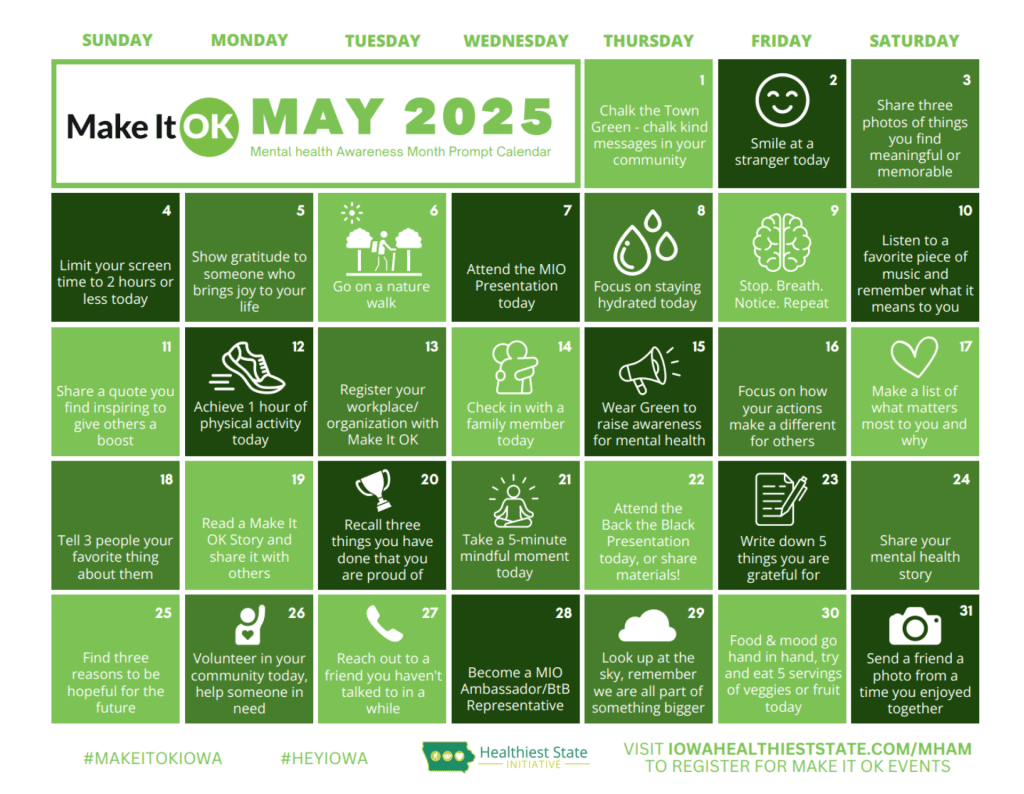
So, I have to hurry up and get these 3 photos posted for today because it’s getting pretty late. Recall the Iowa Healthiest State Initiative calendar along with my photos to share:

The images are important features of events in my life or my sense of humor.

I’m a birdwatcher and many different species of birds visited the fountain. The fountain attracted bluebirds who splashed and even swam in it. That fountain was very heavy. We couldn’t leave it out all winter. In the fall I had to lift the bowls off and move them somewhere else. Moving them entailed lifting them onto bags of mulch so as to reduce the work of hefting them a small distance at a time. The birds were beautiful to watch.

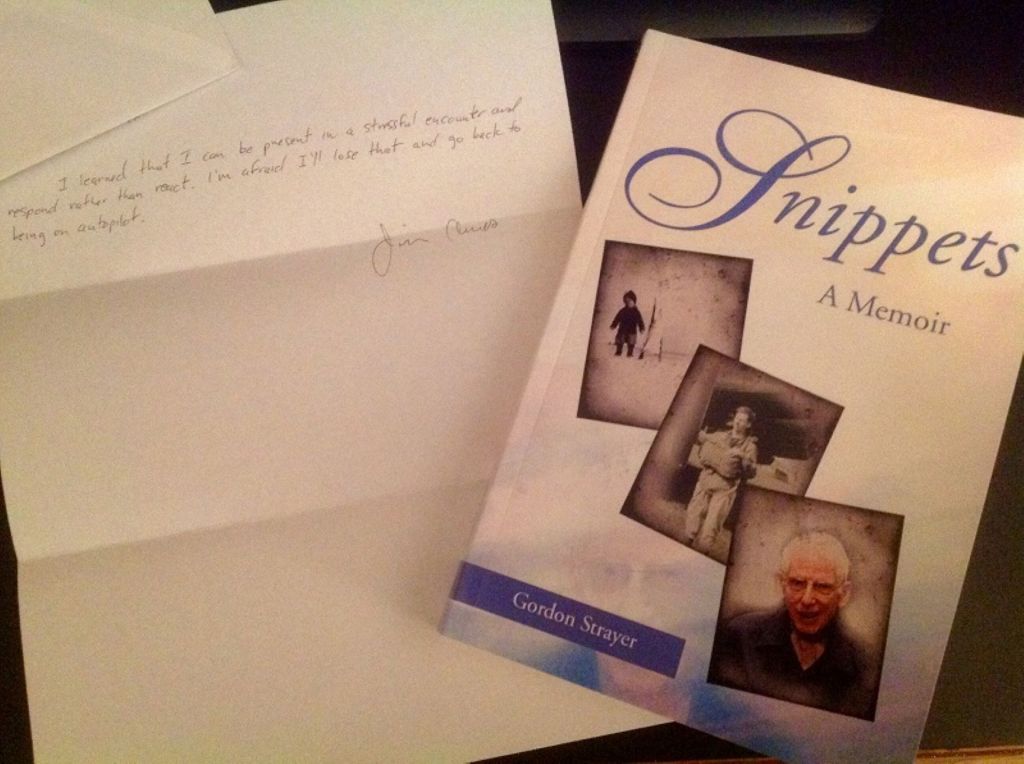
The letter was a class assignment our Mindfulness Based Stress Reduction (MBSR) teacher had us write at the beginning of the class. After we graduated, she mailed us those letters shortly thereafter. We were to write something connected with what we thought we had gained or what we thought might happen after taking the MBSR class. The book might seem out of place, and while I can’t talk much about Gordon Strayer, I did meet him and read his book (which is now long gone; probably lost in a move). I admired him. I don’t think he feared death.

The Chrysler Building reminds me of the Men in Black (MIB) 3 movie, and I included it because my sense of humor is very important to me. In the movie, Agent J and Jeffrey Price have this funny conversation about time travel back to an era that was not the greatest for black people. I know because I lived through it. Agent J is about to use the time travel device which involves jumping off a tall building (it’s a “time jump!”). Agent J is preparing to travel back in time to M.I.B.’s early days in 1969 to stop an alien from assassinating his friend Agent K and changing history. They have this short conversation:

Jeffrey Price: Do not lose that time device or you will be stuck in 1969! It wasn’t the best time for your people. I’m just saying. It’s like a lot cooler now.

Agent J: How will I know if it works?

Jeffrey Price: You’ll either know…or you won’t.

Rife vs Ripe: Which is Right?

I noticed a couple of things about one of the President’s many new Executive Orders, which was “ESTABLISHING THE PRESIDENT’S MAKE AMERICA HEALTHY AGAIN COMMISSION,” or MAHA for short. It was posted on February 13, 2025. One thing it reminded me of is the tax filing season, which is upon us (everything reminds me of the tax filing season around this time of year). The other thing was a short article about the IRS, which is cutting staff sharply in response, probably as a response to the federal government workforce layoffs generally. One sentence in the article read:

“The IRS layoffs, first reported by the New York Times, come as part of a broader effort by President Donald Trump and Elon Musk’s overhaul of the federal government, which they argue is too bloated and inefficient, and ripe with waste and fraud.”

I put the word “ripe” in bold-face type because I sensed that the writer probably meant “rife” instead. I looked up the definitions of both just to make sure: Rife means abundant and ripe means mature (possibly overly mature as in smelly and ready for the garbage can).

I wonder if “rife” or “ripe” could apply to MAHA. I’m all for making us healthy. I agree with promoting health. I’m not sure what is meant by “assess the prevalence of and threat posed by the prescription of selective serotonin reuptake inhibitors, antipsychotics, mood stabilizers, stimulants, and weight-loss drugs.” It sounds like a shot across the bow for psychiatrists and primary care physicians.

Some of the content may be either “rife” (or is it “ripe”?) with potentially misleading innuendo, implying that health care professionals are not doing all we can already to promote health. I agree with promoting research into the “root causes” for mental illness. However, some people need psychiatric medications for “just managing disease.” Reducing the suffering of those who are tortured by depression and delusions and hallucinations makes sense because that’s the humane thing to do.

This reminds me of a very interesting article about what some scientists think about how life began on this planet and how it might start elsewhere in the universe. Some think life evolves mainly by chance, by a cosmic accident. Others think it’s inevitable and occurs when planetary conditions are right. So that might mean there’s a good chance there are extraterrestrials are out there. If they are, what would they think of us?

And this reminds me of a quote from the movie, Men in Black. Agent K is showing Edwards a universal translator, one of the many wonders in the extraterrestrial technology room, which gives us a perspective on how humans rank in the universe:

Agent K: We’re not even supposed to have it. I’ll tell you why. Human thought is so primitive it’s looked upon as an infectious disease in some of the better galaxies.

So is the universe “rife” with life—or is it “ripe”?

Eyes of a Child

Sena wonders if I’m ever going to use Patsy Cline’s tune “If I Could See the World (Through the Eyes of a Child) in a blog post. She also brought home a potted plant she bought, an Easter Lily, ahead of Easter Sunday on April 9th next week. I thought of a couple of things, and of course one is a quote from Men in Black 3:

Agent O: “Agent K is dead!”

Agent J: “Well, I just talked to him last night!”

Agent O: “You are imagining things.”

Agent J: “I’m not imagining anything. Aqua Velva after shave! I didn’t imagine that. Where every stakeout, endless hours of cowboy music.

Agent J and I have a few things in common. One of them is a mild dislike for country western (cowboy by extension) music. I can’t help it OK; the Patsy Cline tune is one of those.

I’m the first to admit I’m not a Bible scholar, but I’m going to talk a little bit about the apparent contradictions between being childish and childlike in the Bible. The reason is that the lyrics in “If I Could See the World” is either an obvious or accidental reference to the seeming contradiction between being like a child in one sense and in another sense, growing up and putting away childish things.

There’s no contradiction if you remember the scripture quotes are in different contexts. In childhood, we’re innocent, trusting, and open. Being open to the kingdom of heaven is the context for that. On the other hand, another context is when we grow up and recognize the duplicity in other people and the inevitable push to learn how to lie. If you don’t tell Aunt Clara that you love her gift of fruitcake at Christmas, you will be grounded for a week.

OK, so that’s the extent of my Bible scholarship.

I’m not a credible music critic either. But it’s easy to see the connection of the Patsy Cline song “If I Could See the World (Through the Eyes of a Child) to the book of Matthew. At the same time, the lyrics ignore the book of Corinthians, which tells how important it is to give up being childish. You need to lie to get by sometimes, although Agent J has trouble telling just where and when to stop lying. Much of MIB 3 is about the conflict over telling the truth and lying.

Come to think of it, that conflict could be much of what life is about.

Agent J after finally telling young Agent K that Boris the Animal will kill him when he goes to Florida to stop Boris, and that’s what Agent J wants to prevent: “I know I told you everything but…”

Young Agent K punches him in the nose: “That’s for lying to me! He punches Agent J again and says, “And that’s for telling me the truth!”

The Patsy Cline song is about seeing all of the good and none of the bad, all of the right and none of the wrong—and how wonderful that would be. Could it be ironic? On the other hand, in the real world of grownups, maybe Griffin has the idea:

Griffin: “The bitterest truth is better than the sweetest lie.” Well, sometimes.

Fathers Can Be a Pain in the Ass

I’m going to talk a little bit about fathers. Mothers are important too, but I’m a guy and I can talk about mothers another day. Because it’s a touchy subject, I’m going to begin with a Men in Black (MIB) joke, like I always do when I’m being defensive. There’s this MIB 3 scene in which Agent K and Agent J have this exchange:

Agent K: I used to play a game with my dad, what would you have for your last meal. You could do worse than this (explanation for this: they’re sitting in a restaurant and an eyeball in Agent K’s soup swivels around and stares at him).

Agent J: Oh, okay, I used to play a game with my dad called catch. Except I would throw the ball and it would just hit the wall, cause—he wasn’t there.

Agent K: Don’t bad mouth your old man.

Agent J: I’m not bad mouthing him, I just didn’t really know him.

Agent K: That’s not right.

Agent J: You’re damn right, it’s not right. A little boy needs a father.

On one level, this scene is just another way of showing the father/son, teacher/student, mentor/mentee relationship Agents K and J had with each other. By extension, their interaction says something about what happens in similar real-life relationships—in the shallow, cliché ways that movies always do.

I sometimes think about the relationship I had with learners when I was a teaching consultation-liaison (C-L) psychiatry. Often, I say to myself that I never had a mentor and I was never a mentor.

That’s not true. Although I never had a mentor who was formally assigned to me, there was more than one faculty member in the psychiatry department with whom I had an informal mentor/mentee relationship. And I was an informal mentor to at least a few trainees.

However, I was middle-aged by the time I entered medical school, which probably set the stage for awkward relationships with my fellow students and some teachers, partly because I was either the same age as or older than them.

That doesn’t mean I was wiser than them. It just means that I was conflicted about them. Later, in residency, I learned about transference and countertransference. In fact, I focused on the psychodynamic as well as the medical issues in teaching trainees. In the first C-L manual I wrote (the forerunner to the book I and my co-editor published later), I devoted a large section to psychodynamic factors relevant to doctor-patient relationships.

So, if you’re wondering when I’m going to start bad-mouthing my old man, you can stop wondering. I’m not going there. He wasn’t a hero, like Agent J’s father was (you need to see the movie to get this angle).

My dad was funny. I don’t think I got my own sense of humor from him, but it makes sense why I would have one—and just because “he wasn’t there” doesn’t explain everything. It never does.

Fathers can be a pain in the ass, not just because of dad jokes. Fathers can be a pain in the brain, too. Ask anybody who was a latchkey kid; I was one of those. We really don’t belong to any specific generation.

We also can’t just up and time travel like Agent J and find out about the father we never really knew. Mostly, it’s just bits and pieces, like a matchbook with a name and address from somebody on your paper route. The path it can lead to doesn’t always mean you find out that “Your daddy was a hero,” like a young Agent K tells young James (who becomes Agent J in the future) after he neuralyzes him to shield him from the hard truth about his father.

You’ll have to watch the movie to get that one.

Live Together

There are lots of reasons why humans find it difficult to live in peace with each other. I don’t pretend to understand them. Artists are sometimes better at capturing the differences we have; not so much about how to overcome them.

There’s this really brief scene in the movie Men in Black (MIB) 3 that I notice every time I watch it (which is every chance I get). It’s in the MIB headquarters where young Agent K is questioning Agent J, who has traveled back to the year 1969 in order to prevent the killing of Agent K by the Boglodite, Boris the Animal, who has also traveled back to 1969 to kill Agent K in order to prevent having his arm shot off by Agent K, being arrested and sent to the LunarMax prison on the dark side of the moon.

Agent J uses a time travel device to “time jump” from the top of the Chrysler Building in New York City with the help of Jeffrey Price, the son of the man (Obadiah Price) who invented the time device. Agent J time jumps, reluctantly, after Jeffrey warns him not to lose the time device because if he does, he’d be “…stuck in 1969! It wasn’t the best time for your people. I’m just saying. It’s a lot cooler now.” This is, of course, a reference to racism in the 1960s.

Anyway, while Agent is chasing Boris the Animal, who has just killed the alien Roman the Fabulist, young Agent K captures Agent J and hauls him back to MIB Headquarters for questioning. The young Agent O interrupts to warn young Agent K that Agent X, the boss, is really upset about the Coney Island incident in which Boris kills Roman.

Now all that is to highlight the short exchange about the Coney Island incident that happens next between Agent X and young Agent K. Agent X stops by his desk and in front of Agent O and Agent J, asks “Any casualties?” Agent K says “Yes, Roman the Fabulist.” Agent X looks scornful and snarls, “Any human casualties?”  Both Agent K and Agent O wince and look down at the floor as Agent K says, “No sir.” It’s an uncomfortable moment because you realize that Agent X doesn’t seem to value any life unless it’s human. I could find lots of quotes from the movie on the web except for these.

Later in the film, when young Agent K decides not to neurolyze Agent J as he begins to trust him, he says “I knew Roman. His wife cooked me dinner once, and while it was not pleasant, he was my friend.”

It’s subtle but I think the implication is that alien life is just as precious as human life. And by extension it means that all life is precious and it’s too bad we can’t somehow learn to live together, regardless of racial, ethnic, cultural, religious, and other differences. MIB 3 is by no means a social message type of film but there are references to at least race relations in the film, even if they’re only framing gags, like the scene with the two cops stopping Agent J because they think he stole the nice car he’s driving—which he did but “…not because I’m black.”

This post used a big buildup for making a point which might seem to many people, as Jeffrey Price said, “…like little blip on the historical radar.”

But, in the broader context of us all learning how to respect and live with each other, that’s a pretty big blip.