Striking a Blow for Science with the Coffee Temperature Experiment!

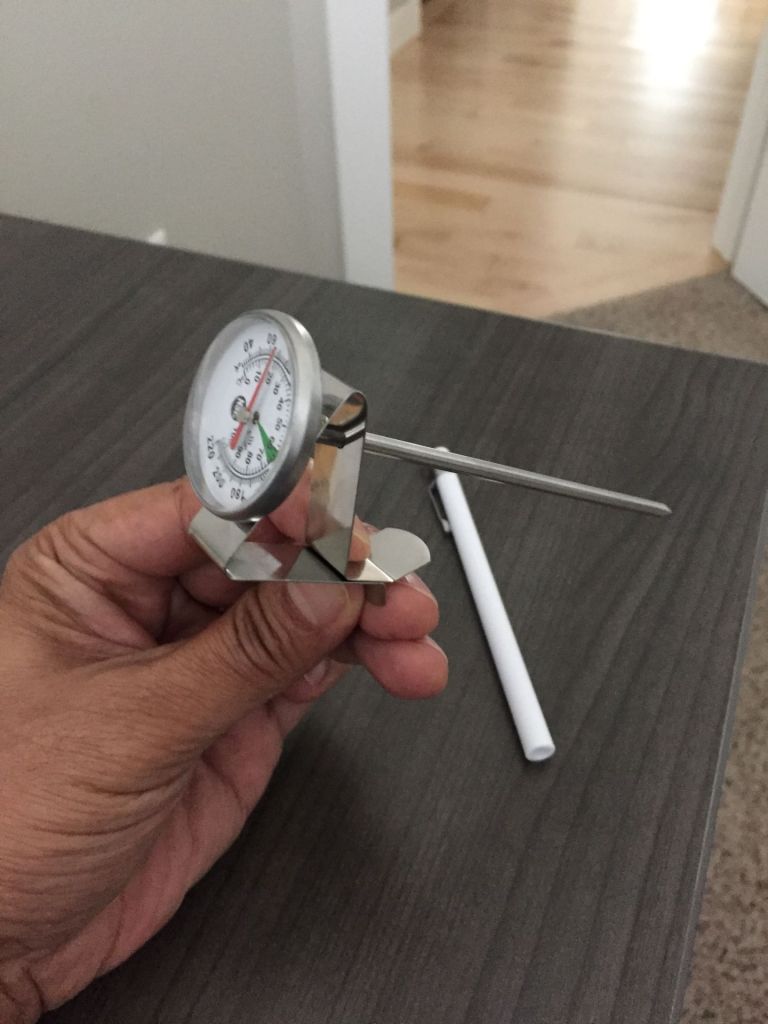
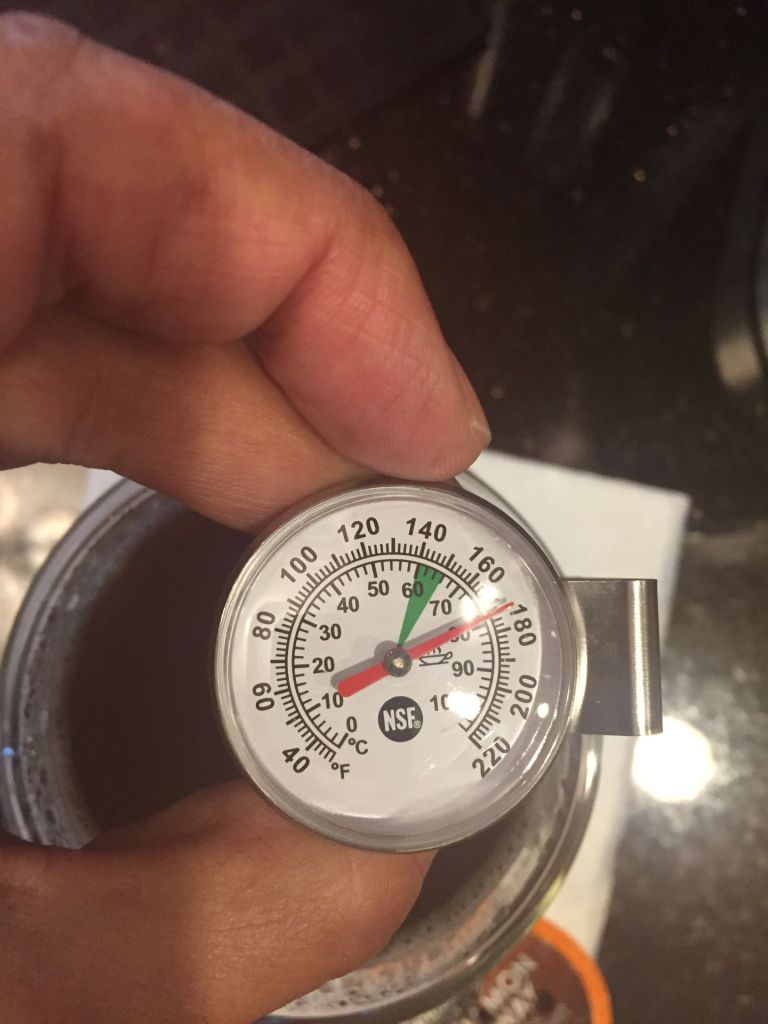
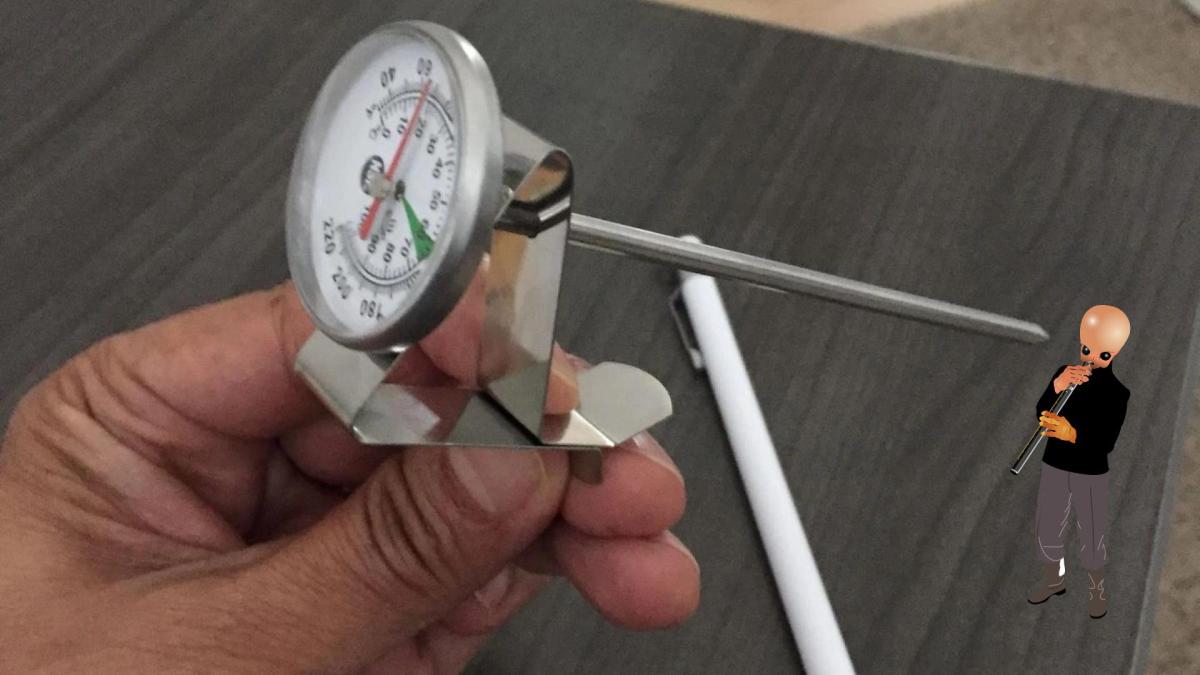
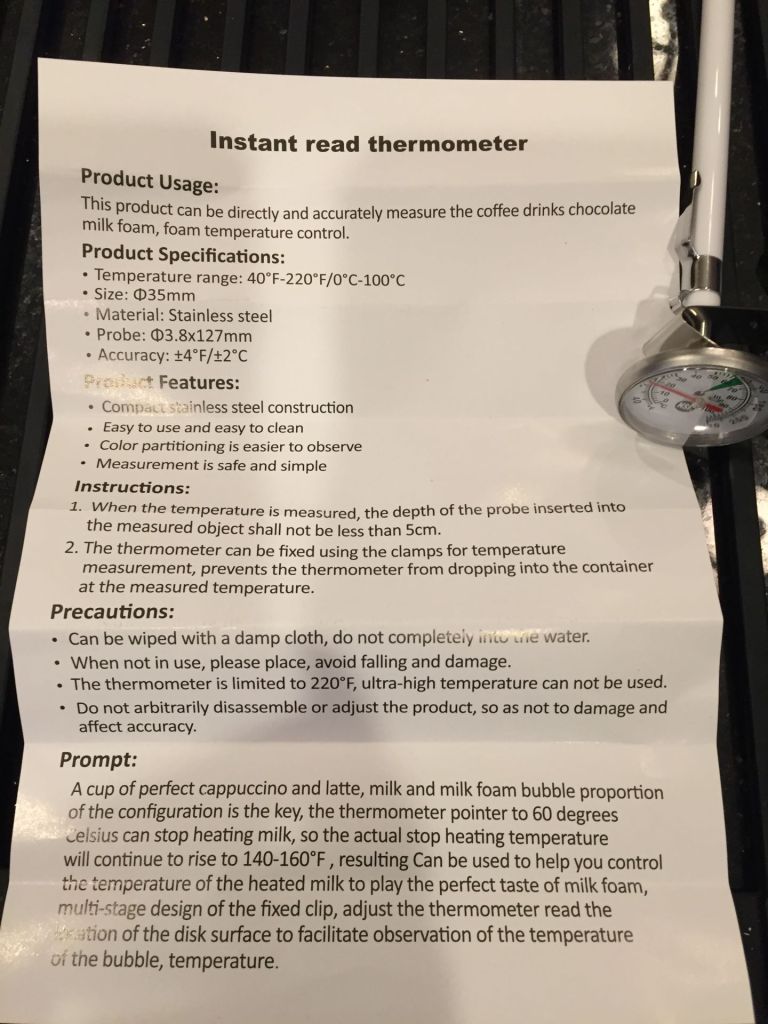
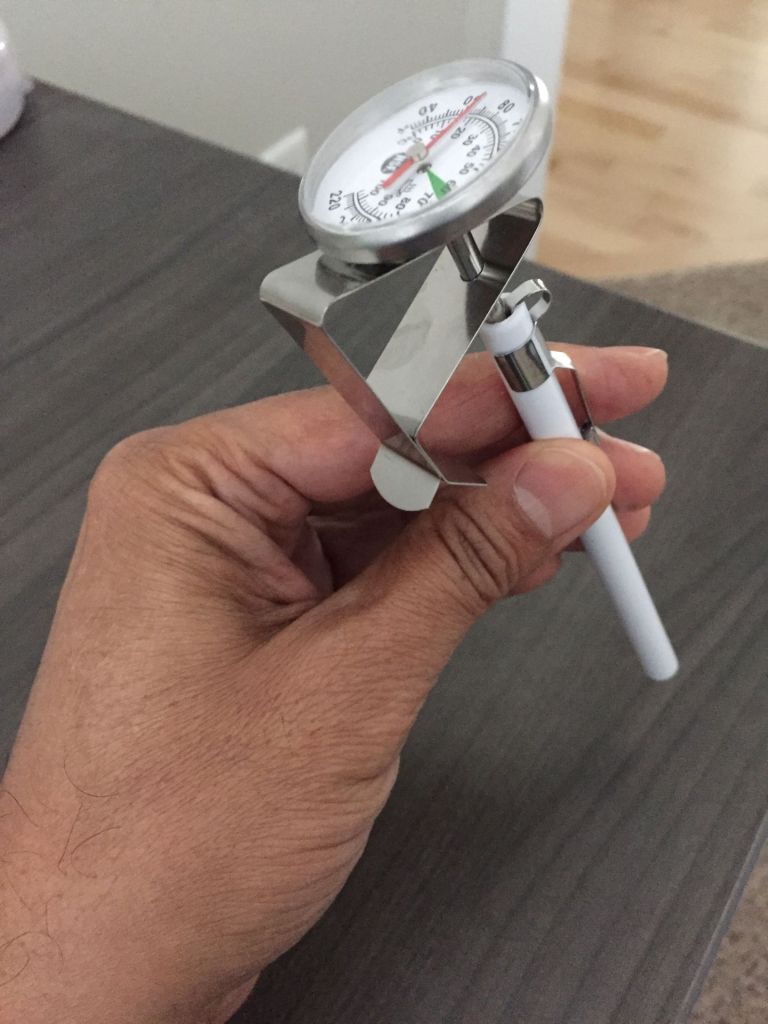
We got our new thermometer the other day and did a coffee cup temperature test. It’s certified by the National Sanitation Foundation (NSF), but we’re not sure where it was manufactured. The instruction sheet looks like it was translated into English.

First, we measured the temperature of coffee in different cups. We measured the temperature of coffee in a double wall glass mug and compared it with the temperature of coffee in a stoneware mug. Stoneware is a type of ceramic.

Right after brewing, the coffee in the double wall glass mug was around 180 degrees. In the stoneware mug, the coffee temperature was around 160 degrees. After 5 minutes the temperature dropped by about 20 degrees in both mugs. Not a big surprise to learn that the double wall glass mug kept coffee hotter.

In fact, I previously noticed when I drank coffee from the stoneware mug last week, it was less hot right after brewing.

Sena wanted to test the Keurig machine to see if the preference setting for making coffee hotter actually worked. In fact, there was no difference in the coffee temperature in either the glass or the stoneware mug after setting the temperature higher.

We then tested the claim of the makers of our old Black & Decker coffee maker that preheating the carafe with hot water actually kept coffee hotter. We were a little surprised that it seemed to work for the stoneware mug, but not for the double wall glass mug.
Just in the interest of full disclosure, we used plain water for the last two experiments. We didn’t think getting buzzed out on coffee was a worthwhile sacrifice in the name of science.

So, the takeaways from this experiment:

  1. The preference setting for temperature adjustment on the Keurig may not be all it’s cracked up to be.
  2. The stoneware mug didn’t keep coffee as hot as the double wall glass mug in either the Keurig or the Black & Decker model.
  3. The stoneware mug seemed to stay hotter when we pre-warmed the carafe on the Black & Decker coffee maker by filling it with hot water before brewing. Be sure you empty out the hot water first.

If you don’t mind sacrificing hot temperature for looks, then go with stoneware mugs. I guess some male reviewers said things like, “Now there’s a man’s coffee mug! I guess maybe that’s because they’re broader than they are tall—I mean the mugs, not the men (although I don’t know if they sent photos of themselves).

By the way, extraterrestrials are not intimidated by a thermometer.
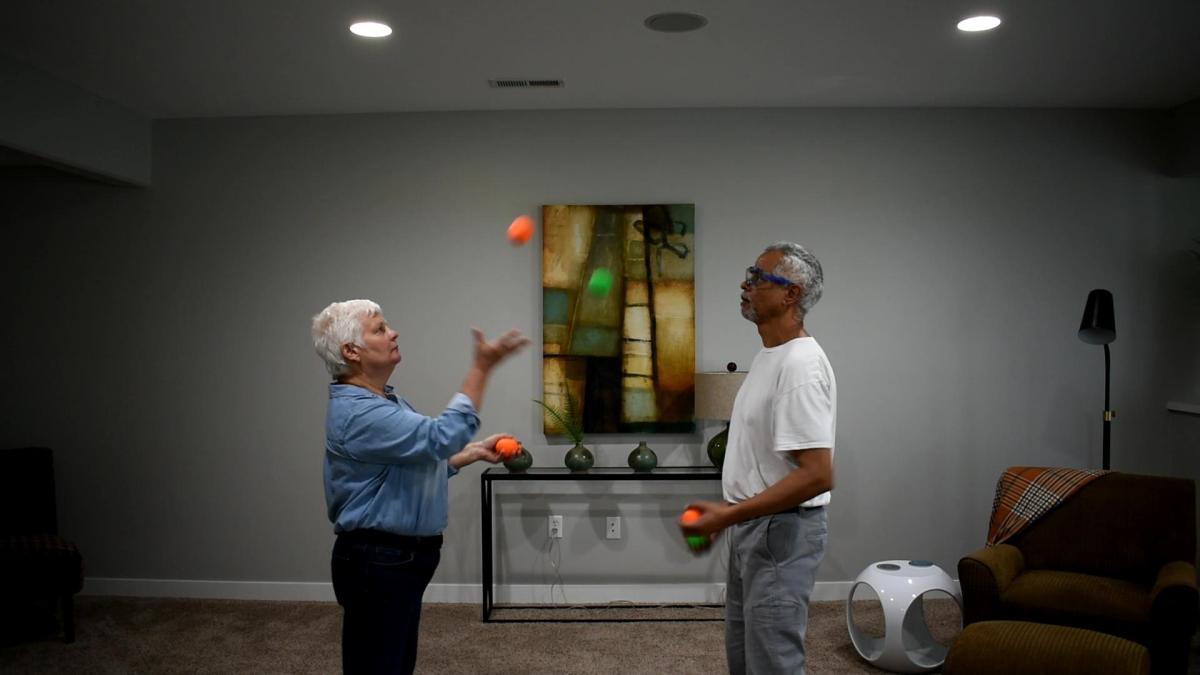
Two Person 5 Ball Passing Jitterbugging Juggling!

Sena and I are going to break the internet with another video of two person juggling! OK, so maybe we won’t exactly break the internet—but we might give it a nosebleed. We had to think of a way to top our recent side hug version of tandem juggling with 3 balls. So, we tried the 5-ball passing juggle pattern.

This one was also inspired by Niels Duinker and his sidekick Piet. On the other hand, it was difficult to get started at first. I found the video tough to follow and was dumbfounded on how to even get started.

Overthinking can put the brakes on any endeavor. Once we just got rolling and quit sweating the details, the pattern just seemed to flow. You have to give it your undivided attention. And you both have to be able to juggle the 3-ball cascade.

There are a couple of rules to remember. The jugglers face each other rather than stand side by side. One juggler tosses balls straight to the partner while the opposite partner tosses them back diagonally to the partner’s opposite hand.

In this pattern, I start with 3 balls, 2 in my right hand and one in my left. Sena starts with 2 balls, one in each hand. The person with 2 balls in the right hand starts by tossing one ball straight to the partner’s left hand. The partner must toss the ball in her left hand (to empty it so she can catch the ball flying in) across to the other’s left hand. One person always throws diagonally and the other always throws straight across.

Even saying that is confusing. You really have to see it and that’s why we included a slow-motion clip. There’s a sweet spot in the distance between jugglers. If you’re too far apart, there’s a tendency for throws to be too long and either too high or too low. There’s a juggle space between you and your partner just as there is for you alone. It’s a little wider, but not much, because lobbing it upwards more than tossing it in a shallow arc duplicates juggling by yourself.

The more we practiced, the smoother and easier the pattern felt. I tend to jitterbug around while Sena tends to stand solidly in place. Nevertheless, we both compensate for imperfections in our throws.

The result looks almost like dancing.

Should Doctors Be Funny?

I ran across an interesting Medscape article, “Should Doctors Be Funnier? These MDs Are Real Comedians.” I don’t know if they should be funny, but it probably wouldn’t hurt.

I think a sense of humor is a good thing for anyone to have and it’s probably not that hard to develop. There’s even a Wikihow article on how to develop a sense of humor.

I usually look for the funny edge in most things that happen to me. I was always very nervous about presenting Grand Rounds when I was on staff at the hospital. I would try to come up with a good case example illustrating both medical and psychiatric features. It was pretty challenging.

I often used humor to help me get through my stage fright. I didn’t tell jokes, but I did clown around a bit. One day, I arrived too early for the Psychiatry Dept. Grand Rounds and accidentally walked in on another scheduled event in the conference room that was obviously not for psychiatrists—only not immediately obvious to me. I got a few chuckles from the audience just from having to back out. Later, during the real Grand Rounds I clowned about my mistake as a sort of opener to my presentation.

Unfortunately, I then had to stumble through my PowerPoint slides (every presenter’s worst nightmare) because I evidently had not organized them correctly. I survived by joking about it. That resulted in a digital award from the residents for being “Improviser of the Year.”

Humor can get you through some pretty sticky situations.

Another Blast from the Past

Today is Labor Day, and I was looking at some of my old blog posts from my previous blog The Practical Psychosomaticist. I found one that I think I haven’t reposted on my current blog called “Going from Plan to Dirt.”

It’s a funny post, at least I think so. It draws a comparison between blue collar and white collar work, similar to what I did the other day (“Why Can’t I Wear Blue After Labor Day?”).

I wrote it in 2011, when I was on a hospital committee to improve detection and prevention of delirium in the general hospital.

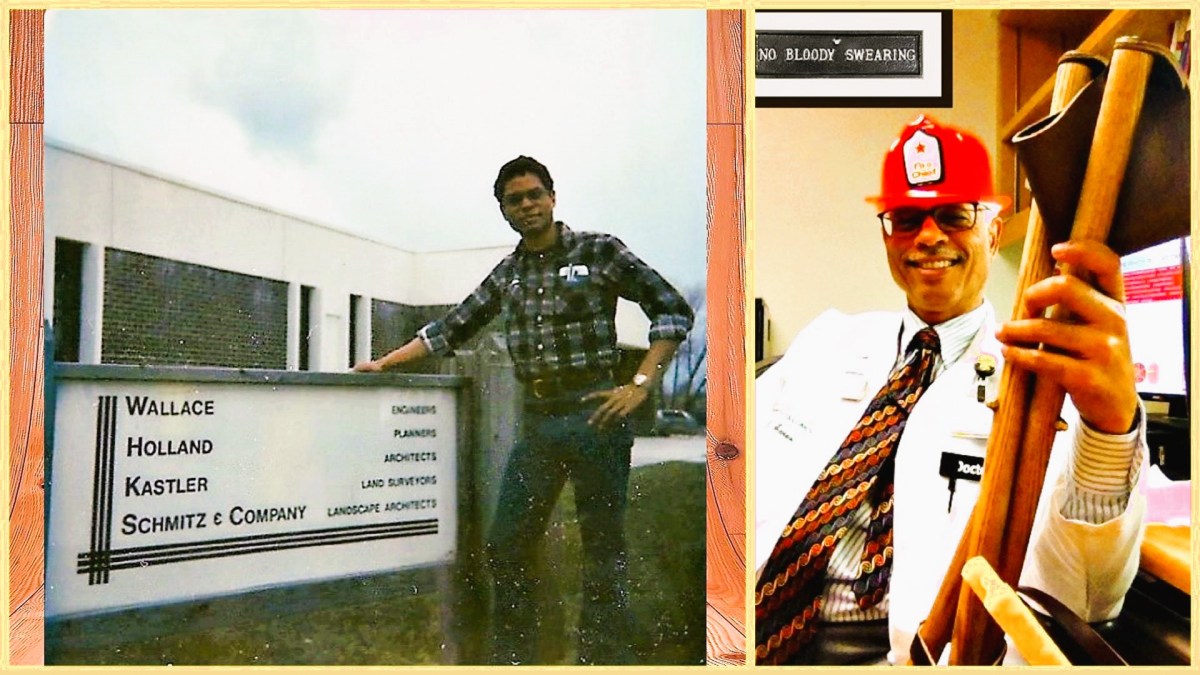
“Our work on the Delirium Early Detection and Prevention Project reminds me of my early formative experiences working as a draftsman and land survey technician starting in 1971 with an engineering company, Wallace Holland Kastler Schmitz & Co. (WHKS & Co.) in Mason City, Iowa. I remember being amazed at how a drawing on paper could be turned into a city street, highway, bridge, or airport runway. They have a website now. I can now find written there what was modeled for me then:

“WHKS & Co. is committed to the continuous improvement of the quality of service provided to our clients.”

Then and now WHKS & Co. worked hard to create the infrastructure that we depend on and then put it into the world in a “safe, functional, and sustainable” way. Out in the field we sometimes joked about how a designer’s drawing was flawed if we couldn’t go from plan to dirt.

It’s common to believe that engineers and land surveyors deal with complex mathematical formulas, structural materials, things instead of people—an applied science in which the emotions and motivations of people play a small role. Nothing could be further from the truth.

I was 16 years old when WHKS & Co. hired me. I had no idea what engineers and land surveyors did, had no experience, and I was at a crossroads in my life. They didn’t hire me because I had any talent or asset they needed. They hired me because they were as committed to the people in the community, not just to things.

And if you think land surveying doesn’t have anything to do with people’s emotions, consider property line disputes. The survey crew I was attached to had been sent out to find the property corners of two neighbors. This involves locating iron pins that mark the corners of the lots that houses sit on. Little maps or “plats” are used as guides and let me tell you, often enough we found the map is not the territory.

Anyway, while we were out there in the back yard of one of the neighbors, they both came outside. One of them was a diminutive elderly lady and the other was a tall, big-boned elderly man. They started arguing about the boundaries of their lots and it got pretty heated. Pretty soon they were yelling in each other’s faces and the lady reached down in the garden in which we were all standing. She picked up the biggest, juiciest rotten tomato she could find and it was clear to us what she planned to do with it. They were both pretty old and neither one of them could move very fast. My crew chief, sensing that something violent was about to happen, moved in between them (a decision I still can’t fathom to this day).

What followed seemed to happen in slow motion, in part because the combatants were so old. The man could see the lady was about to hurl the rotten tomato at him. Ducking must have been beyond his power, probably because of a stiff back. He bent his knees and leaned forward. She cocked the tomato as far back as she could and let fly, screeching, “You’re nothing but an old Norwegian!” My crew chief probably caught a seed or two. Amazingly, the tomato only grazed the top of the man’s head.

I think the altercation took a lot of both of them. They both went back in their houses after that.

It’s not hard for me to see the connection between my past and the present. WHKS & Co. was and still is committed to continuous improvement. And they were and still are all about finding a practical way to do it. If we’re going to improve the quality of care we provide patients and we propose to do it by preventing delirium, we’re going to have to use the same principles that my first employer used. And we’re going to have to be just as practical about how to go from plan to dirt.

We’re still trying to refine the charter for our delirium detection and prevention project, which is a kind of map, really. And even though the map is not the territory, it’s still a necessary guide to remind us of the goal.”

Why Can’t I Wear Blue After Labor Day?

I have a few thoughts on the upcoming Labor Day weekend. It occurs to me that Labor Day often evokes images of blue-collar workers. On the other hand, I think in a broader view of the holiday, most of us can think of ourselves as working toward improving our society no matter whether our jobs are in the white-collar or blue-collar sector.

Many eons ago, I was a blue-collar worker. I was a surveyor’s assistant and drafter for a consulting engineers’ company in Mason City, Wallace Holland Kastler Schmitz & Co. (WHKS & Co.). I got attached to my job because it was the first real job I ever had.

I was proud of what I did, even though I didn’t make much money. I had to travel around the state a lot. I lived at the YMCA and ate all my meals in cafes because I was often out of town on jobs and when I was not, there was no kitchen in my tiny sleeping room at the Y.

I wore blue jeans and tee shirts, flannel shirts when I wasn’t out in the hot sun. I liked being outside except when the ragweed was out in the late summer. I had bad hay fever. I tried desensitization shots, but all they did was make my arm swell up. Winters were cold, especially if I had to stand in one place for a long time, either holding up the rod or running the gun.

I was mostly a rear chain man and rod man early on, but moved up to “running the gun” which meant operating the level and theodolite, the former for measuring elevations and the latter for measuring angles. I was proud of my job.

It took me a while to transition from blue-collar to white-collar mindset. In college, I often returned to work for WHKS during the summer breaks. That was where I formed my identity.

Some aspects of the job were simple. You hammered a stake, an iron property marker, or a frost pin if the ground was frozen. Measuring distances, angles, and elevations were often repetitive tasks, yet satisfying because they marked progress toward a concrete goal, like building an airport runway, establishing the outline of a tract of farmland, or raising a bridge. As one of my bosses on the survey crew put it, the work helped you see “the lay of the land.”

Land surveying, mapping, and drawing up plans set my perspective on life when I was a young man. At one time, that perspective made me think I wanted to be an engineer. I respected engineers because they built the subdivisions, highways, dams, and other real things from ideas.

I respected my teachers at WHKS, but couldn’t do the math. And they respected my change of heart.

I eventually became a doctor, after a short stint as a medical technologist in clinical laboratory medicine. You’d think, given my hands-on background, I would have become a surgeon, but I wasn’t made for that either.

I learned basic things at WHKS like being steady, reliable, and focused. I had to learn other things to be a doctor, especially a psychiatrist. On the other hand, in this white-collar environment, especially in a research-oriented academic medical center, I often looked and acted more like a blue-collar worker.

One of the Family Medicine residents who rotated on the psychiatry consultation-liaison service left me a gift of a fireman’s helmet. It fit my head and my approach to psychiatry in the general hospital. What I did mostly was put out the fires, metaphorically speaking, of behavioral eruptions related to delirium which were caused by medical problems. Often, I had to apply blue-collar approaches in a white-collar world. So, can I wear blue after Labor Day?

Happy Labor Day.

Press And Hold on The Keurig Coffee Maker

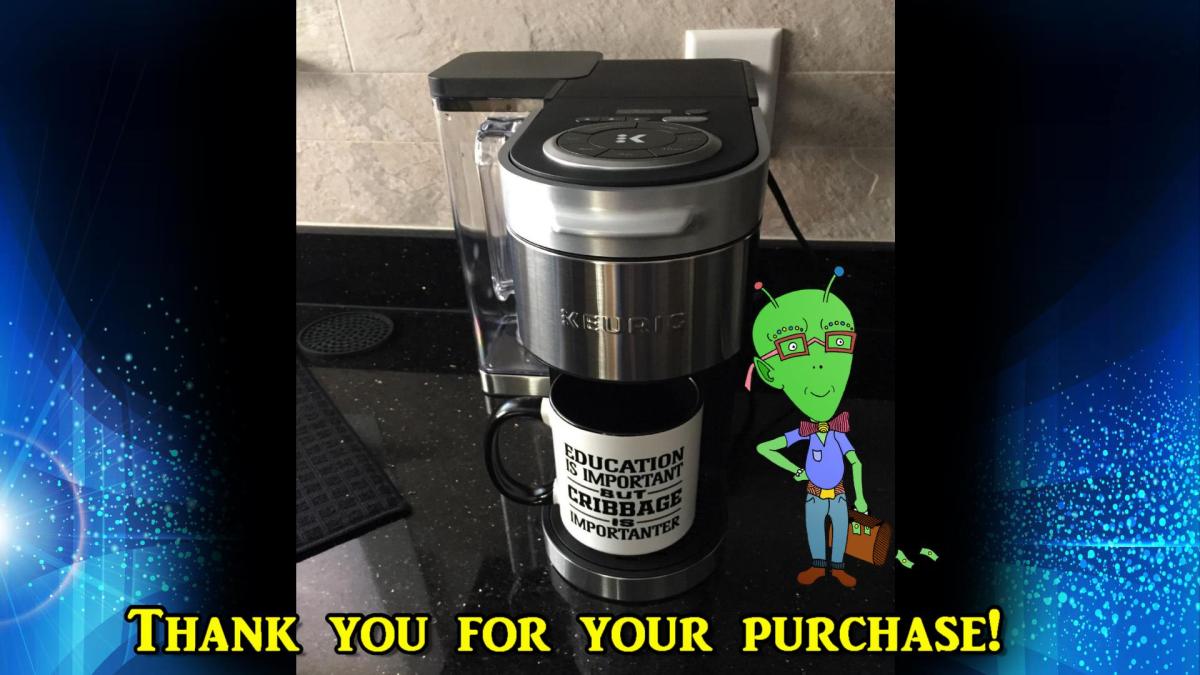
We got our new coffee maker. It’s a Keurig K-Supreme Plus, and it’s as fancy as the name sounds. It’s compact enough to save room for our other coffee maker, a Black & Decker, a model with a carafe and which you have to press and hold the “On” button to start the cleaning mode.

It has options for making your coffee stronger and hotter and you can save your choices.

You can save 3 favorites. You have to press and hold the “Favorite” button until you see the word “saved” in the little window.

I emphasize the “press and hold” because if you don’t strictly obey the rule, you can wind up thinking your brand new appliance is defective.

It does make the coffee hotter. But I think Sena will be looking into other options for cups which will keep the brew hotter for a longer time.

The Keurig coffee makers are normally pricey but Sena got a bargain. And there is nothing wrong with the press and hold maneuver when it comes to your wallet—as in hold it shut.

“I Have a Dream” Speech 60 Years Later

Today is the 60th anniversary of the Reverend Dr. Martin Luther King Jr’s “I Have a Dream” speech at the Lincoln Memorial in Washington D.C.

I was too young to remember it. However, I have a deep appreciation of the meaning it has not just for Black people, but for all of us. It’s not difficult to broaden the implication for all people.

My personal reflection about this started this morning with a look at one of my primary school class pictures. I’m the handsome guy 2nd from the left in the top row. The other kids of color in the photo are Latino.  

The photo shows not just a group of kids. It also illustrates, just by chance, pretty closely the percentage of black persons in the state of Iowa as of the 2021 U.S. census, about 4%. Historically though, in the county in which I was living at that time, the percentage of nonwhite persons was listed at 0.4%. This was a 28% drop from the previous decade. In 1980, the percentage of Black people in the state was only 1.8%. As near as I can tell from the web, the current percentage of Black people as of the most recent data is 3.74% (possibly as of 2021).

My father was black and my mother was white. In Iowa, the law against miscegenation (marriage between blacks and whites) was repealed in 1839. On the other hand, my parents got their marriage license in 1954 in Watertown, South Dakota—which was 3 years prior to when that state repealed its law against interracial marriage. Right below the license, though, is a certificate of marriage marked State of South Dakota in Codington County. It certifies that my parents were married in Mason City, Cerro Gordo County in the state of Iowa.

I’m not going to try to puzzle that one out. My mother kept a lot of old photos and legal records that anchor me in my personal history.

I have photos of my father with me and my brother, Randy. I also have photos of my mother with me and my brother.

What I don’t have are photos of all of us together. It’s understandable to ask why. I wonder if it has something to do with the culture and mindset of the time. Why was it not possible to find someone, black or white, to snap a family photo of us together?

We can pass legislation repealing anti-miscegenation laws as well as other laws to protect civil rights. That is a necessary (but perhaps insufficient) step toward non-exclusion of certain groups of people from basic human rights.

Ashley Sharpton, who is an activist with the National Action Network and daughter of Reverend Al Sharpton, said that Americans need to “turn demonstration into legislation.”

I agree with her. On the other hand, I also wonder what more has to happen in the minds of all of us to turn legislation into transformation—of our personal implicit biases, which are not in themselves always bad or inescapable.

And since we’re into rhyming, what about asking another question? Can we turn demonstration into legislation while encouraging transformation without bitter confrontation?

Okay, More Drain Tile Grate Flipping

Well, on Saturday morning we noticed that a different drain tile grate was flipped in our back yard. Same problem as the other one that I blogged about last year. I put the wormhole gear clamp back on the other one and so far, so good.

Now I’m considering getting another clamp for the other grate.

I can think of a few animals around here that might be guilty of flipping grates: deer, feral cats, dogs, raccoons, and the like. We did catch a big raccoon on video up in the Mulberry tree a couple months ago. On the other hand, it’s not happening to our new neighbor’s grate.

I can’t rule out some kid pulling a prank on us. But I wouldn’t know who it is. As I may have mentioned last year, there aren’t any young kids in the immediate neighborhood.

I’m considering setting up our critter cam again. You never know. I might catch an extraterrestrial on camera.

Again, Sena Returns Another New Coffee Maker!

Sena is returning yet another new coffee maker. It’s a Keurig K Supreme. The problem? The coffee doesn’t stay hot enough after brewing.

What’s the deal?

I think part of it is that we might need to get different coffee cups. On the other hand, we never seemed to notice our coffee cooling off too fast before-except with the current Black and Decker with a carafe that we’re trying to sort of replace with a K type pod coffee maker.

We used to have the original Keurig years ago. I don’t remember that there was ever a problem with the coffee not staying hot.

When I was a resident, I used to have a little Mr. Coffee I kept in my office for when I was on call. It got a lot of use. And it got really dirty. Well, you know, work… I never noticed a problem with the coffee temperature, though.

Why is the temperature of the coffee an issue now? Why are there coffee makers that allow you to set the temperature of the brew? There are 3 settings on some models, one of which Sena has just ordered.

That’s right. This is trial number 3. The MeCity coffee maker had a pod cartridge that made it difficult to remove the pod after brewing. If you don’t have fingernails, you pretty much have to use a tool to catch the pod edge to lift it out. Back to the store.

The Keurig K Supreme was discouraging because the coffee was tepid within a few sips after brewing. Back to the store.

Isn’t this way too much gassing about coffee makers?

I don’t trust customer reviews much. On the other hand, Sena saw one review where the hacked off guy wrote a one liner in all caps about one model of Keurig coffee maker: “WILL NOT WORK WITH ARC FAULT CIRCUIT INTERRUPTERS!” I think there was an expletive deleted in that one.

We actually had that problem in one of the homes we owned years ago. There was only one option—buy a new house (just kidding).

And a previous coffee maker we had got zapped during the derecho here a few years ago. The numbers on the clock faded and it started to gain time. It’s not like we needed to use the clock. I had retired and didn’t need to set it to brew in the morning any more. So, we got a new one.

That’s when all the trouble started. Does any manufacturer make a decent coffee maker nowadays?

Where will this saga end? I don’t think we’ll return the next Keurig model Sena ordered—unless it doesn’t work at all or blows up.

We might have to start thinking about the cups we use. I guess there are different opinions about ceramic vs glass vs whatever kind of cups. Some hold heat better than others, you shouldn’t fill a cup all the way to the top because your coffee could lose heat faster, mug thickness matters damn it! Extraterrestrials are messing with heat transfer physics, blah, blah.

Should we just switch to iced coffee?

Now Playing! See My Psychiatric Times and Medical Word News Juggling Videos

My juggling video is up for viewing now on the Psychiatric Times website! The title is “A Journey of Juggling.” It’s in the section called More Than Medicine.

You can also find it on the Medical World News website with a slightlly different title, “After Hours: Juggling 101.” It’s in the section called After Hours.

They’re both essentially the same video with slightly different editing. They’re both around 14 or 15 minutes long. The Medical World News site requires you to register, which would provide access to a lot more features.

These are not YouTubes so they work a little differently. You’ll have to manually unmute the audio for “A Journey of Juggling.” The “After Hours: Juggling 101” starts playing right away with audio. There’s an introduction that lasts about a minute.

Psychiatric Times staff did the editing and publishing via Psychiatric Times and Medical World News websites. I had a lot of fun making this video.

I’m still juggling and have improved a lot on the under the leg throw trick. I can do the behind the back throw more consistently but still drop balls. I practice doing tricks from both my dominant and non-dominant sides. I can still do only 3 throws most of time with the shower pattern, but I’m still working on it.

I wear safety goggles and it’s really not just one of my gags for YouTube. I had surgery for acute on chronic retinal tear in my right eye last year and I don’t want to go through that again. I didn’t get the retinal tear from juggling. Just getting older puts you at risk for it. On the other hand, I drop enough balls on my head that it makes me leery of taking any chances.

Sena is improving on learning the cascade pattern. She can do up to 20 throws-except while I’m watching!