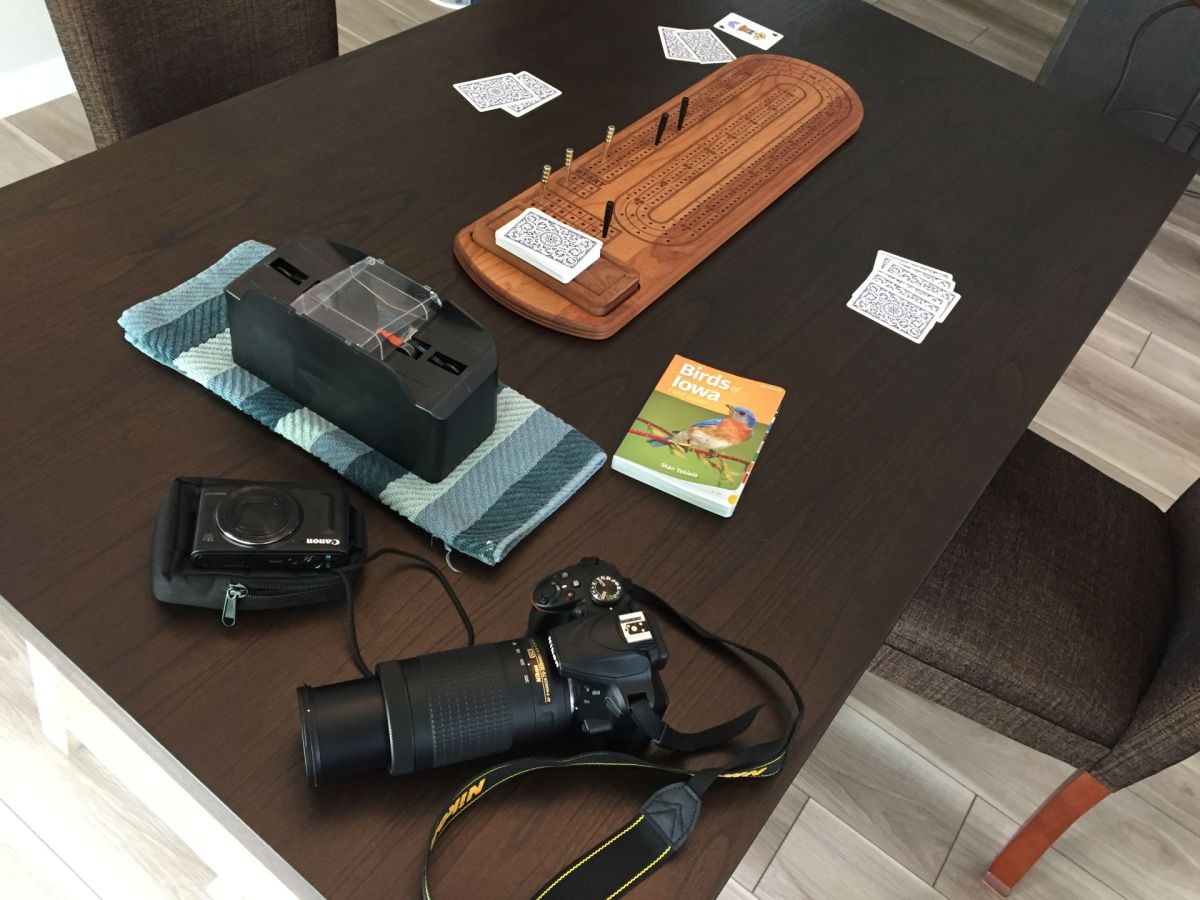
We were distracted from our cribbage match today when Sena saw a couple of goldfinches out in the back yard. One of them was clearly a male, bright yellow all over except for his black wings. The other was probably a female because it was olive colored. The sunlight must have varied because at times it looked like it had colors more like the male.
At one point the male seemed to be distracted by something we couldn’t see shaking the bushes behind them. They sure were hungry. I took the video with my Canon point and shoot. Sena reminded me about the Nikon DSLR and I rushed to get it. By that time, the goldfinches were gone. I have to remember to leave both cameras out after this.
This is a red-letter day! First of all, I saw this article on line about how older people can stay sharp and fit. One of the suggestions for cognitive fitness was to play “complex card games.” Cribbage counts (literally) because today, Sena had a Raggedy Ann hand!
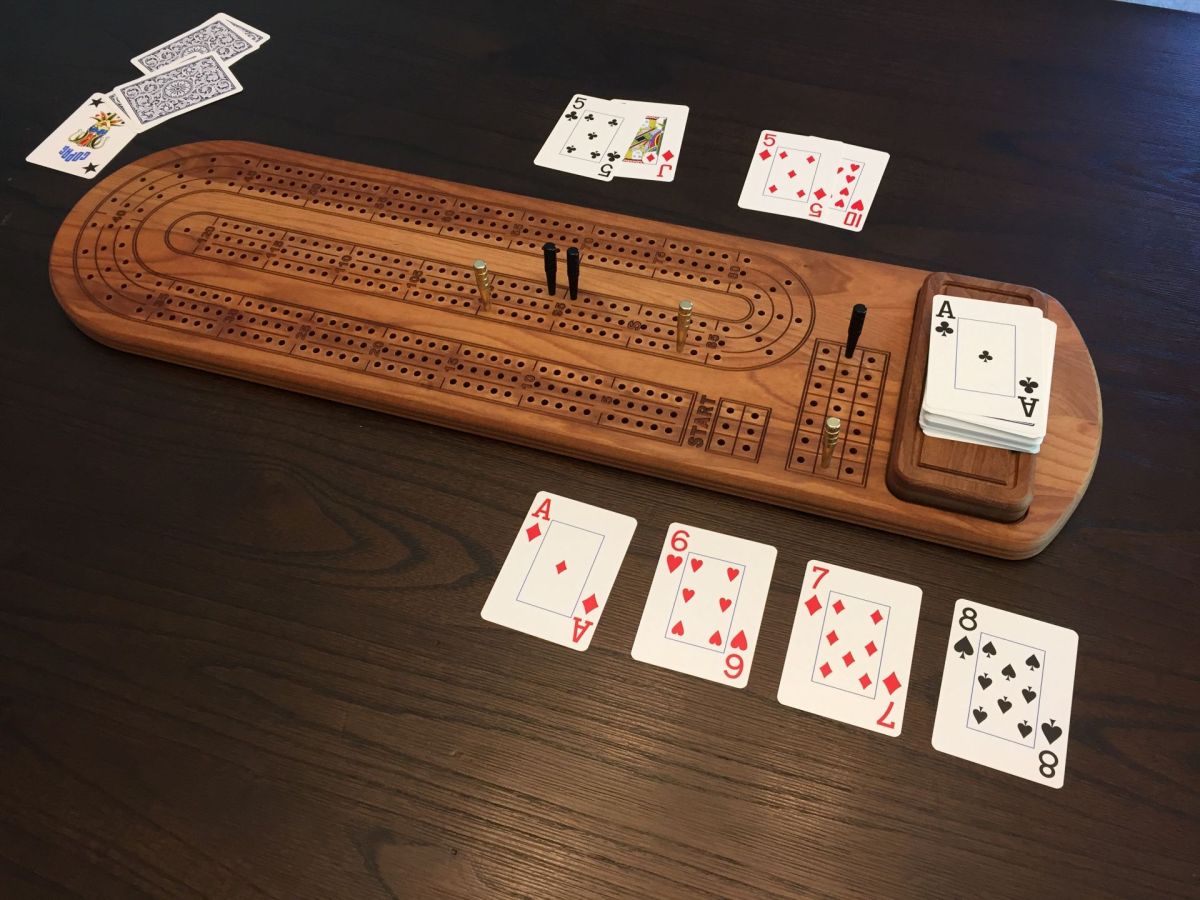
A Raggedy Ann is, as my old medical school pathology textbook authors put it, “not excessively rare,” but it’s uncommon enough that it can trip you up on how to count the points. It consists of 8-7-6-A-A with one of the aces being the cut card, of course. It’s worth 13 points.
First count the 15s, which are cards adding up to 15: the 8 and the 7, the 8 and the 6 and the A diamond, the 8 and the 6 and the A club in the crib, finally the 7, 6, and the two A’s=8 total. Add the three card run 6,7,8=11; then add the A pair for 2 more=13.
What’s hilarious about this is that we thought it was 11 points—which is another weird hand called a Raggedy Andy. It consists of 8-7-6-2-2. But because Sena’s hand had aces, the other 15-point combo was hard to pick out. Both hands are often miscounted.
Substitute deuces for the aces and try to count it. You should come up with 11 and that’s the Raggedy Andy.
Another funny thing about this is that when I was looking on the web for the odds on getting these hands, the AI (which always comes up) got it all wrong, saying “In cribbage, a “Raggedy Ann” hand refers to a hand with a score of 28, which is also known as a “28-hand”. This hand is quite rare, with odds estimated at about 1 in 15,028.” The second time I searched, AI corrected itself and got it right.
As far as I know, there’s no particular name for a 28-hand. Also, I couldn’t find any information of the statistical likelihood of getting a Raggedy Ann or a Raggedy Andy. I couldn’t find any explanation for how the hands got their names either although many assume that it’s because the count is so—raggedy.
As I mentioned earlier, it’s tough to spot one of the fifteens in the Raggedy Ann. Check out the American Cribbage Congress web site for more cribbage lingo.
This kind of gets us pumped for hoping one of us will get the very rare 29 hand.
By the way, the other thing we did today was to plug in the automatic card shuffler to top off the charge, so we both hand shuffled. We plugged it in at 10:30 am and it wasn’t fully charged until 4:30 pm. And you’re supposed to get 2,000 shuffles out of it, and I’m pretty sure we’re nowhere near that. Anyway, shuffling was a lot less noisy.
I was watching a show about the prophet Nostradamus last night. Some experts don’t believe he got any of his predictions for the future right. A few will say he got the one about Louis Pasteur correct, which is that he would invent pasteurization. But then others will deny even that. He made his predictions using cryptic quatrains.
Sena has been drinking her prune juice and I presume she’s regular. Besides that, she could be an excellent astronaut. There was a small study by scientists that seemed to show that mice who ate prunes could be protected from space radiation.
I think you’d have to eat a lot of prunes for that. Being regular is one thing, but being less susceptible to the dangers of space travel to places like Mars might mean a serious commitment to prunes beyond human endurance.
It makes me wonder how extraterrestrials tolerate it. We’re always depicting them as humanoid on TV and in movies. Maybe they already know about this. It would give abduction a whole new meaning.
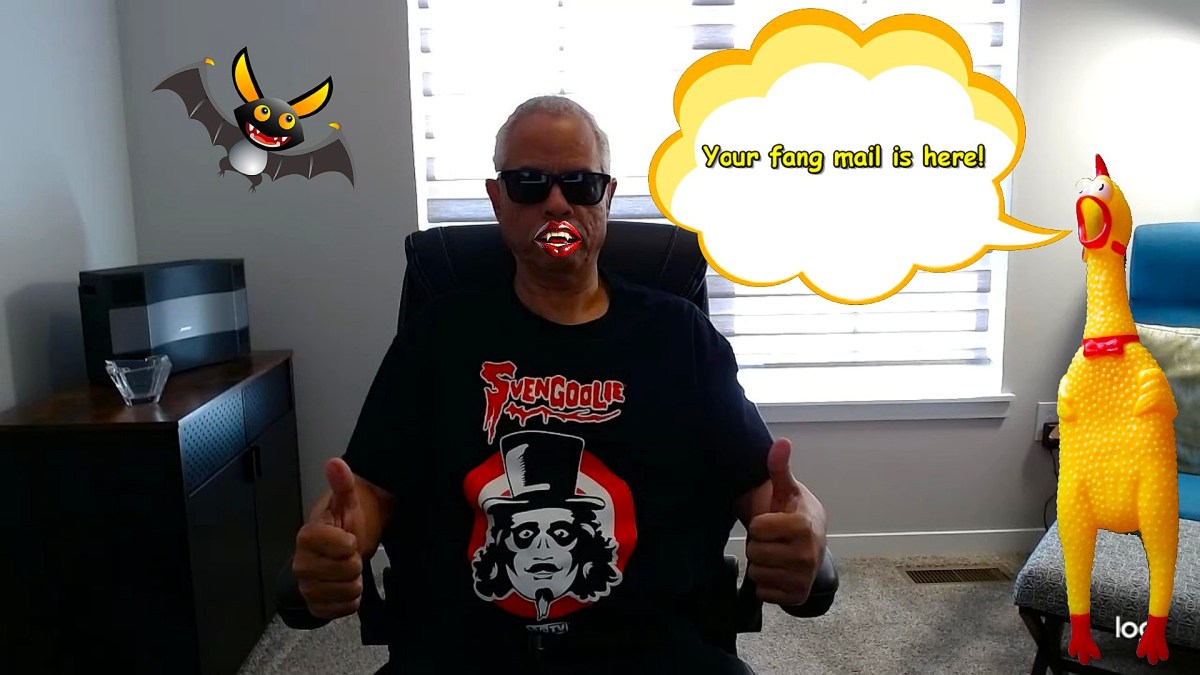
The Svengoolie TV show movie next Saturday will be “Invaders from Mars” released in 1953 and it triggered some memories. One of them is when I was a little kid. I think I saw parts of it on TV while I was supposed to be down for a nap. I recall seeing these burly guys in green body suits trotting stiff-legged through tunnels. Their gait is something I can’t forget—no matter how hard I try. For a long time, I thought I had just been dreaming. But I’m pretty sure the nightmare was real because when we saw the movie last year on the Svengoolie show, those Martians looked familiar.
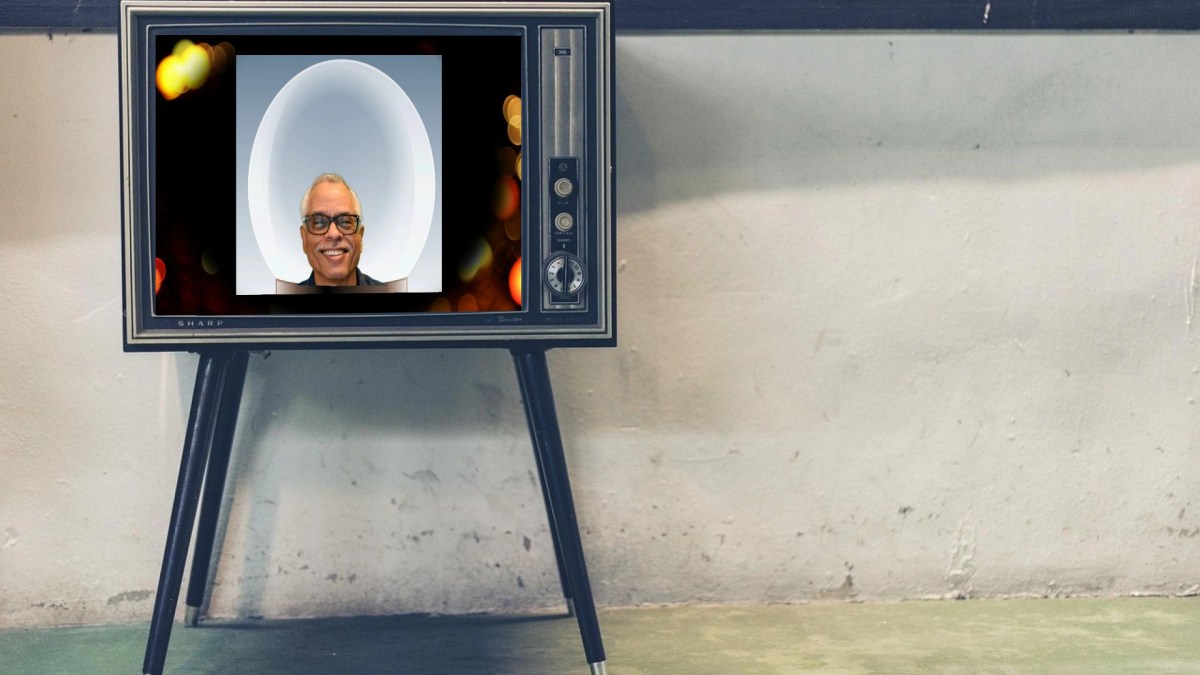
The other memory is of a TV public service announcement (PSA) commercial in the early 1970s. I managed to find a YouTube of it that reminded me of the leader of the Martians. He was in a clear globe and the green guys carried him around. He was just a head with tentacles. He was the leader and was very much ahead of his assistants in an evolutionary sense. At least I think that was the idea. He was basically the brains of the extraterrestrial population. He did all the thinking and planning—but he was stuck in this globe.
Anyway, the commercial is from 1971 and it’s a PSA from the President’s Council on Physical Fitness and Sports. The commercial shows how we’d be by the year 2000 if we didn’t shape up, literally. Richard Nixon was President; during his presidency Apollo 11 landed on the moon—and he resigned from office because of the Watergate scandal. Anyway, food for thought for the upcoming film, “Invaders from Mars,” which probably has a message about leadership.
We watched the Svengoolie show movie, “Return of the Vampire.” I should say Sena watched about 10 minutes of it on the Internet Archive and said it was pretty good. The film was directed by Lew Landers. The writers were Randall Faye, Kurt Neumann (The Fly 1958), and Griffin Jay (Cry of the Werewolf 1944).
The movie was produced by Columbia and released in 1943. Bela Lugosi stars as the vampire Armand Tesla (no relation to Nikola Tesla) and never once says “Bluh, bluh!” This distinguishes him from Dracula, which you can’t even whisper by mistake without being ensnared in a net by lawyers who wouldn’t bat an eyelash at bleeding you dry of all your assets, so wear a garlic necklace.
He couldn’t be called Dracula in this production by Columbia because Universal had already made a few dollars on the Dracula name in their production and threatened Columbia to a thumb-wrestling match between top executives if they plagiarized the name Dracula. Soreheads!
You can’t miss Lugosi’s clawlike hands and the cobra-like sinuosity of his fingers as he mesmerizes his victims. If I tried to imitate that, I’d get cramps. Armand Tesla has all the customary power of vampires, and at least in this film, the producers get it right when we see he casts no reflection in a mirror. But he needs a valet named Andreas who is always bringing him a parcel, presumably with fresh capes from the dry cleaners.
The story spans two world wars; in WWI, Tesla gets bumped off with a spike; in WWII, he gets a new lease on undead life from the Nazi bombing and bungling civil servants (see below), regaining control over Andreas which he lost in WWI when he got spiked. Tesla’s new goal is to recruit a fresh vampire and try the new Wendy’s Frosty flavor, the Bloody Nicki.
Matt Willis plays Andreas Obry, the vampire’s hairy butler, a talking werewolf whose diction doesn’t fumble over his fangs. He’s pretty sharp in a suit but why he doesn’t complete the ensemble with a smart pair of oxfords is puzzling. He prowls barefoot across the graveyards, gardens, and sidewalk cafes (he ignores the signs “No shirt, no shoes, no service”). Watch for his pro wrestling moves in an alley with a couple of hapless detectives who can barely lay a glove on him.
Comedy bits are spaced at tolerable intervals, like the two civil servants in the graveyard who fumble about and do something with the spike that, without their scene, would make the film pretty short. That’s “spike,” not “stake.” They’re in England, after all.
Probably the peak moment in the film is when Andreas unexpectedly makes a different kind of transformation.
The little quarrels between Lady Jane Ainsley and Scotland Yard detective Sir Frederick Fleet (no relation to enemas) highlight the dumb male and smart female dynamic, a thread which runs throughout the movie.
Lady Ainsley: Sir Frederick, I declare I can’t abide it any longer; mud tracked all over the carpet, wolf hair on the toothbrush, and dust on the crucifix!
Sir Frederick: My dear Lady Ainsley, there is no such thing as dirt!
And how is all that fog getting into the house? You can barely see the walls—except for the fourth one.
We have an update on the tree bags. Believe it or not, the tree bags have been constipated! We had to hire out an archery team to shoot a few arrows into them to get them to drain. Otherwise, the trees would get moldy—I guess.
There’s something to consider, though. If the tree bags worked the way they should, you’d have a lot more work to do, filling them up every so often. That would get old in a hurry.
Archers don’t come cheap. They have their own union. And if they occasionally miss, they have to make return trips, which runs up the charges.
If you’re feeling lucky, you can contact them on the internet: Tree Bag Archery: Purging is Our Point!
“Calling all stations, clear the air lines, clear all air lanes for the big broadcast!” (Svengoolie show intro).
Tonight’s Svengoolie movie is “Return of the Vampire.” I’m debating on whether to watch it because I’ve heard there’s a talking werewolf. Is that even legal?
Just like a few days ago, yesterday evening while we were playing cribbage, Sena spied a slim indigo bunting. This one flew right up to our window! It was probably not the same one we first saw. That guy was buff, likely because he’d been branch pressing in the gym.
This character was slim and trim and looked like a lot of other birds we saw charging at their reflections in our windows last month. He really wanted to tell that other bunting where to fly off. I think he should work out more if he’s going to strut like that.
If we’d been sitting by the window all day long with camera at the ready, we’d have been unlikely to ever catch Slim Indigo peering and posing like he was on the bird walk.
It’s a random surprise when lucky breaks like that happen. It can take your breath away. I’m not sure why we’ve been lucky enough to catch a look at Slim, especially after over 20 years since seeing the last one. One answer to that might be here. Sometimes it’s better to be lucky than good. By the way, that reminds me; Sena won the cribbage game—this time.
The one thing I couldn’t get by shooting video through a window is Slim’s voice. Clearly, you can see he was chirping at one point. So, here’s a link for that.
I wish we’d filmed the cribbage match we just played because it was marked by the weird combination of luck and strategy so typical of every cribbage game. On the other hand, I know if we’d tried to film it, we’d have been too flustered to make anything useful of it.
So, I’m going to point out generalities that might be interesting and useful to anyone who wants to know about how to play cribbage.
One skill I’ve picked up from playing the computer game Cribbage Pro is how to figure out which two cards I should throw to either my crib or Sena’s. In general, you can learn from any cribbage player you should throw “bad” cards to your opponent and “good” cards to yourself. It’s just about keeping the most points for yourself and as few as possible to your opponent. Cribbage Pro rates your throws. You want to keep cards that you can make points on when you’re the dealer and you want to throw cards to your opponent which will be least likely to make points for them.
It’s easy to get hypnotized into thinking that the crib tosses are the main way to win—but it’s a false hope. I’ve gotten perfect ratings on my crib throws and been skunked by Brutal, the Cribbage Pro game’s toughest opponent.
Luck is an important part of cribbage and counting on just one of the aspects that you have some modicum of control over is a mistake. In fact, one of the reasons I get dinged by the computer is my tendency to ignore the 3-point run in my hand, which when counted with a two card 15 combo can make me 5 points. I usually get mesmerized by the common double 15 with two 10 cards and a five card, which are worth 4 points and break up the 3-point run. I can’t figure out why I do that so often.
The other thing I miss is the flush in my hand, which often would net me more points, especially when I don’t see what I usually get stuck on—the 15s!
But there’s always a big luck factor along with simple inattention to careful counting that does me in. And focusing too much on the throw to the crib can distract you from learning pegging skills, which is governed by some basic understanding of probability (nothing esoteric here, please, because I barely got through biostatistics in medical school!) and whether or not you’re playing with someone you know pretty well and able to anticipate their usual moves (she always drops the 9 spot on the 6 lead!).
That reminds me of somebody who was one of the top cribbage players in the world, DeLynn Colvert. He won several national cribbage championships in his career and wrote a book about the statistical aspects of the game, including something he called the Twenty-Six Theory. I have the book and I’ve never really even tried to read that chapter. You can get a sense of what kind of cribbage expert he was by reading Part 1 of his Twenty-Six Theory on the American Cribbage Congress (ACC) web site.
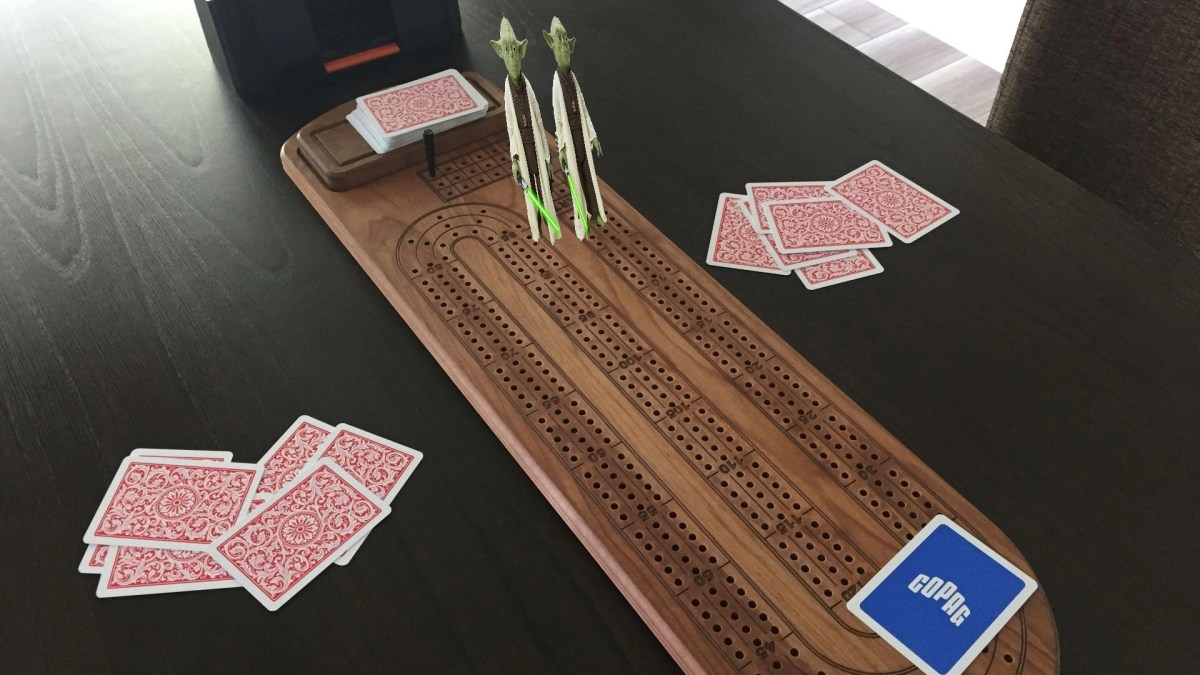
Paraphrasing Master Yoda: “That is why I fail.”
Cribbage YodasDeLynn Colvert cribbage book
Another thing that sometimes prevents us from getting points is the uncertainty about seeing the run during the pegging phase. It’s common for players to place their cards on their sides of the table with the cribbage board between them. Here again, Cribbage Pro can sometimes interfere with learning an important skill. It does all the work because all the cards from both players are automatically placed in the center of the screen, where runs are clearly discernible.
I think in most games nobody has the luxury of seeing how runs actually look in the usual table setup. Maybe others have no trouble spotting what are called interrupter cards in sequences, but we do—although we’re getting better.
What that can lead to is avoiding playing into runs because both players have to sort of conspire to make them. You can actually see them coming and “run” away because you don’t want to get embarrassed by puzzling over what counts as a run or not. We know the cards don’t have to be in order but they do need to be resolvable into a consecutive sequence on close inspection.
That’s harder to do if the players’ cards are on opposite sides of the cribbage board. You also have to pay attention who leads after a go because it’s relatively easy to tell where a run starts at the beginning of a game since pone always leads.
It’s really hard to talk about cribbage. It would be better to make a video of it, but I’m not sure we could do it. Cribbage has been called a “finicky” game by Barry Rigal, who co-edited the book “Card Games for Dummies” and it’s tough to argue that point.
On the other hand, if you stick to it, you can get drawn into all that finickiness.








 Go Retire Psychiatrist