Florida Man News!

We saw the news story about the Florida Man who recently got busted by the cops in Ormond, Florida after he stole a BMW and when he was stopped for going 130 mph (about 5 mph over the local speed limit), he thanked the police for saving him from the extraterrestrials who evidently had teleported him into the BMW. Well, that explains everything!

This is just further evidence on top of what has already been thoroughly documented by Dave Barry in his 2016 documentary book, “Best State Ever; A Florida Man Defends His Homeland.”

Did you hear about the blackout in Florida?

People were stuck on the escalators for 4 hours.

I used to have a ton of Dave Barry books. I got hooked on his humor shortly after I graduated from Iowa State University back in the 1980s. I was in a post graduate program in Medical Technology in a Des Moines hospital and back then you could always find a newspaper on some tables in the cafeteria.

Over the years, I lost many of his books during moves. Sena would ask me something like “Do you really still want all these Dave Barry books?” I knew better than to say “These are very important examples of timeless prose exemplifying humor literature that will be excavated in the distant future by archaeologists who will preserve them in hermetically sealed glass bookcases so people can admire the covers.”

I just threw them out. Please don’t tell Dave.

Anyway, I have managed to preserve a photo of Florida Woman, taken in Miami many years ago. Let this be a lesson to you: never call your wife “Florida Woman” unless you want to live the rest of your life in a refrigerator packing box—although you can use duct tape to seal off those cracks to keep the wind and snow out.

Did you know there’s a song titled “Florida Man”? Believe it or not I heard it a couple of years ago on the Big Mo Blues Show on KCCK radio. It’s by Selwyn Birchwood who is from—that’s right, Tampa, Florida. The song was released by—you guessed it, Alligator Records.

And here’s Iowa Man:

Big Mo Pod Show: “The Dark Side of Legacy”

This was a fascinating episode of the pod show for more than one reason. The title is interesting if only in the sense that it might a reference to B.B. King—who wasn’t on the playlist either last night or the song selection for today’s podcast. Briefly, what we learned was that B.B. King had a lot of heirs (17 was the number of dependents) to his fortune when he died and that led to conflict over his estate. This came up during the conversation about Mud Morganfield.

One song that I couldn’t find on the Big Mo Blues Show playlist was “Floating Bridge” a 1937 classic by Sleepy John Estes and I couldn’t remember hearing it last night. It’s a deeply personal story of his own near-death experience when he nearly drowned but was saved by a friend. Eric Clapton covered it in 1981.

Another thing we learned about was the double neck guitar, which came up in the conversation about the tune “Blue Guitar” by Earl Hooker. Earl Hooker was famous for playing the double neck guitar, a heavy instrument with two necks, in this case a six string and a 12 string. I found a very long and deep web article about multi-neck guitars and they appeared in the late 17th century.

As Big Mo and Noah pointed out, there were other musicians who played double necks, among them Jimmy Page of Led Zeppelin (“Stairway to Heaven”).

Big Mo mentioned the word “mambo” while talking about Mud Morganfield, who sang “Big Frame Woman.” I had to look up mambo and I think he might have meant a latin dance of Cuba? On the other hand, I found a reference that the word has African origins as well. Maybe some of you have ideas about that?

Big Mo Pod Show: “Across the Blues Universe”

I heard the Big Mo Blues Show last night and the Big Mo Pod Show today. The podcast song selection was part of the Lunch with Chuck portion of the show, which I don’t know a whole lot about. The Lunch with Chuck thing I’ve heard Big Mo talk about and I think it involves a real guy named Chuck who talks music with Big Mo sometimes, although I’ve not heard an actual live Lunch with Chuck program during the blues show. And it might be another Big Mo running joke.

The other thing I want to mention is that I heard Big Mo talk last night just before the Lunch with Chuck thing about something like a “fish psychic”. I think it’s a new comedy bit like MayRee’s Hand-Battered Catfish and Shorty’s Adult Diapers. I can’t remember the whole fish psychic bit, but I’m pretty sure he’ll do it again, maybe even next Friday. I think it’s another faux advertisement, and it might be about some kind of fish psychic who can help you catch lunker bass and the like.

Anyway, I learned something from the pod show today. I’d never heard of something called “race records” which is one term Lightnin Hopkins song “Mojo Hand” led to. Race records were 78-rpm phonograph records marketed to black people back in the days of the victrola, between the years of the 1920s to the 1940s, well before my time.

The other term new to me is the title of Hopkins’ song, “Mojo Hand.” The podcast discussion mentioned that mojo hand referred to African American voodoo charms, one of which happened to be a lucky charm, possibly a dried monkey’s paw. The song is actually about using voodoo to keep a lover from being unfaithful. The song means more now that I know that.

Another thing I learned today was that the song “Feel So Bad” (recorded in 1966) by Little Milton has a lyric in it, “feel like a ball game on a rainy day” that was repeated by boxer Muhammad Ali when he found out he had to wait 6 weeks before the Rumble in the Jungle match in 1974. That was because Foreman had to heal up first because he suffered a laceration above his right eye during a sparring match.

What I also didn’t know was that the Rumble in the Jungle had political overtones. There is an article entitled “Remembering the Rumble in the Jungle” subtitled “The 1974 Rumble in the Jungle was freighted with symbolism regarding American racial politics and the pan-African struggle in the context of the Cold War.”

One more thing I learned from the podcast is related to the song “Wine O’Clock” by Shemekia Copeland. He called this song a women’s support tune and, unlike my disagreement about this issue in last week’s podcast, I tend to agree with this song being about women supporting each other or at least understanding their burdens in a society marked by gender role disparity.

What helped me reach this understanding is an article entitled “What makes up wine o’clock…” published in 2022.

Wright CJC, Miller M, Kuntsche E, Kuntsche S. ‘What makes up wine o’clock? Understanding social practices involved in alcohol use among women aged 40-65 years in Australia. Int J Drug Policy. 2022 Mar;101:103560. doi: 10.1016/j.drugpo.2021.103560. Epub 2021 Dec 29. PMID: 34973490.

The abstract reminds me of the discomfort with the idea of women (or anyone regardless of gender) using alcohol to cope with socially designated roles.

“Think I’ll have another glass; the world can kiss my ass; tick tock, it’s Wine O’Clock.”

I sometimes learn a lot more than I expect from the Big Mo Pod Show.

Connecting the Dots between Kintsugi and the Blues

Since I wrote the blog about the Big Mo Pod Show, Hickory Smoked Blues, I’ve been trying to remember how I connected the dots between Kintsugi and blues music, which is said to be healing even though often it sounds like it could make you hurt.

I had a devil of a time tracking this down. The image of Kintsugi or Kintsukuroi, which is the Japanese art of repairing broken pottery by mending the broken parts a mixture which contains powered gold.

The main idea is that repairing something broken using something like gold (read blues music here) can be healing.

You could also apply this to some other process, including psychotherapy.

The writing of a couple of people helped me make the connection. One of them is now a child psychiatrist named Jenna, who used to write the blog The Good Enough Psychiatrist, a link for which is still on my blog menu. Her post entitled “Amae” (a Japanese concept meaning cherished) caught my attention. Amae has both positive and negative aspects. In a way blues music is similar. It can be nourishing as long as it isn’t too focused on trauma.

About a month later, I found an essay by another child psychiatrist, Dr. Ashmita Banerjee, MD, entitled “The Power of Reflection and Self-Awareness,” actually mentions kintsukuroi at the end of the essay following her poem, called “Not A Poem.”

So, I think what I was getting at was pain and suffering can be reduced in healing ways, which can include art forms, like music. Some blues music can be repetitious, negative and even demoralizing when the emphasis is only on the pain. The other side of the blues can be uplifting, especially when there is the element of cherishing the tender, the wise, and the healing notes—the golden glue.

Both essays were the inspiration for my post, “Food for Thought.” The image of the kintsugi bowl is on both that post and “Big Mo Pod Show: Hickory Smoked Blues.” I still think the Robert Cray Band version of “I’ll Always Remember You” is a reminder of Kintsugi, at least for me.

Big Mo Pod Show: “Hickory Smoked Blues”

Today, the Big Mo Pod Show was about how blues music can you help you “exorcise your demons” as Big Mo himself put it today. Isn’t that what it’s always about? And I can’t explain how that even works.

Big Mo Pod Show 085 – “California Bluesin” KCCK's Big Mo Pod Show

After a short break during the Thanksgiving holiday your hosts are back at it again with another episode! This week features the usual mix of blues eras you’ve come to expect along with a few Californian artists, tune in to see which ones! Songs featured in the episode: Solomon Hicks – “Further On Up The … Continue reading
  1. Big Mo Pod Show 085 – “California Bluesin”
  2. Big Mo Pod Show 084 – “Garage Blues”
  3. Big Mo Pod Show 083 – “Legal Pirate radio”
  4. Big Mo Pod Show 082 – “Tribute”
  5. Big Mo Pod Show 081 – “Cheers To Kevin”

But I don’t always understand how it works. I’m going to admit I’m not sure at all how one song last night by Toranzo Cannon would help anybody, and that’s “I Hate Love.” Of course, it’s contradictory and ironic. I’m not going to pretend I know what blues music is all about and how it can sometimes heal your inner soul pain.

But a lot of people believe that blues can help you get past the pain and it seems that it works paradoxically. I don’t always get it. But I’ve been listening to the Big Mo Blues Show for years.

That reminds me. We had a couple of guys install motorized window shades yesterday and one of them was a blues musician. He plays bass guitar and I gather he plays in local bands. He wore the best hat; it’s a fedora! Sena and I sort of ribbed him about it, but I had a fedora like that once, decades ago. It was gray with a narrow leather band. I don’t have it anymore.

I told him that I wore it while I was interviewing for residency. I wore it to dinner in a hotel in St. Louis, Missouri and a woman passing through the hotel restaurant looked at me and said with a grin, “Wear that hat!”

Sena reacted as if she’d never heard that story before. The fedora guy thought it was funny. Fedora man had that style to him that I think is fairly common in musicians. They look and may act in a way that makes you notice them. I don’t think you can always tell what somebody does just by the way he or she dresses. But when he told us he was a musician who liked the blues, that didn’t surprise us.

What did surprise us was that he didn’t recognize the name of a prominent blues musician in Iowa and a lot of other places—Kevin Burt. But he did have a sense of humor.

I think most blues musicians have a kind of slant sense of humor. It probably comes out in some of the music. I’m more drawn to blues music that makes me chuckle. On the other hand, I liked one song on the blues show last night they didn’t discuss today on the pod show. It’s not funny and I had a hard time finding the lyrics for it. It’s “I’ll Always Remember You” by the Robert Cray Band. I found a couple of sites I think got the lyrics below wrong and didn’t make sense. The way I heard the song the lines went like this:

 “Old clothes and worn-out shoes
Empty bottles and a book that’s way past due.”

The line I keep finding that I think is wrong is the second one, which is often written as “Empty bottles and I put this way past due.”

I think the line “a book that’s way past due” makes more sense because it conveys a sense of regret, waste and loss and promises not kept and opportunities lost and probably a half-dozen other ideas that you probably can’t easily encapsulate. It evokes sorrow that is only partly fixed by the letter’s promise— “I’ll always remember you.”

That may not completely heal you, but it’s a little like something I read about kintsugi. It’s about mending broken pottery with gold in a literal sense. In a metaphorical sense, it’s about repairing what might be broken emotionally broken in us and, despite not being the same as we were before we were broken, we’re somehow still functional and healed though not perfect. A psychiatry resident blogger wrote about that.

Big Mo Pod Show: The Yellow Butane Curse and Other Fun Things

I got off my schedule last week on listening to the Big Mo blues show, but as it turns out, he was gone last Friday. I heard last night’s blues show and heard Stevie Ray Vaughn’s Riviera Paradise.

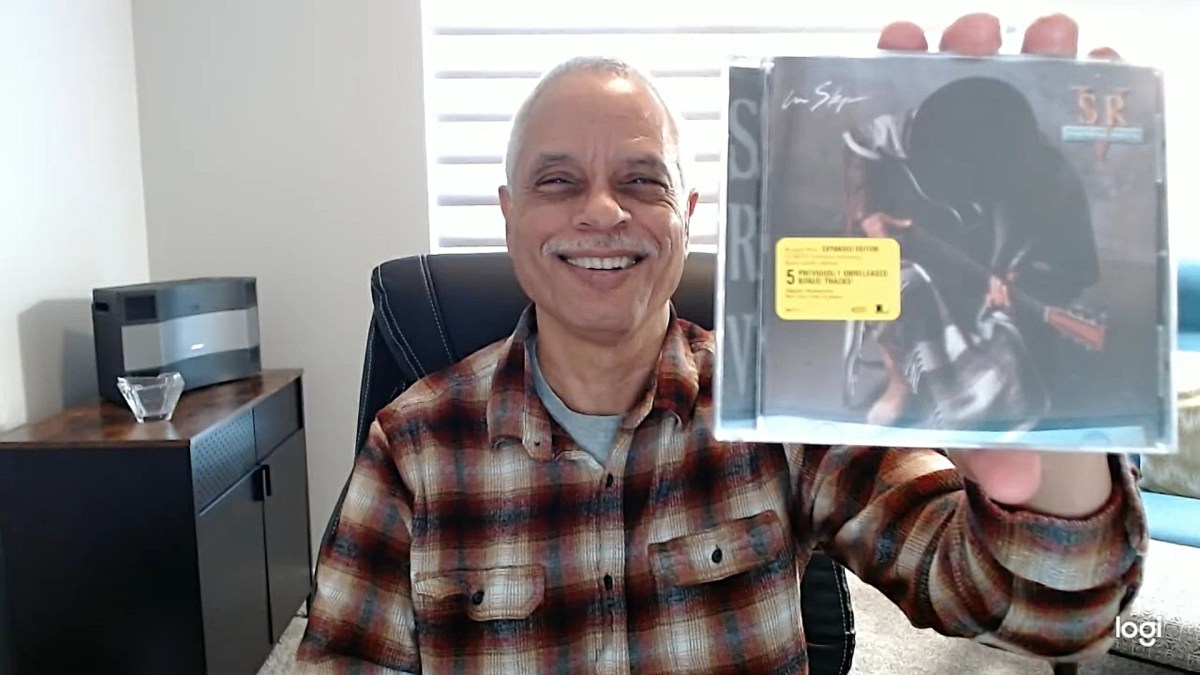
So, of course that was not on the list of songs for the pod show today, but Big Mo did mention that Riviera Paradise and the name of the collection, which was In Step was related to Stevie Ray Vaughn’s having been successful at staying sober from substance use disorder for a year. The name In Step was evidently related to his going through a 12-step program to achieve sobriety. I learned about Stevie Ray Vaughn early in my residency (if I recall correctly) from a University of Iowa psychiatrist who is now the chair of the psychiatry department.

The name of today’s pod show was “The Yellow Butane Curse” which is about superstition. I’m not sure if this means that blues music enthusiasts are prone to being superstitious, but Big Mo did admit to believing that yellow butane lighters were unlucky for him.

This is probably going to seem like a disconnected transition but I missed last week’s pod show (“He plays what can’t be written down” see below), which was not the usual format of song talk but an interview with a successful local musician, Merrill Miller. I don’t know anything about him except what I learned in the podcast. I got a kick out of listening to a couple of musicians just more or less shooting the breeze about living the musician’s life.

Merrill mentioned playing in places like Strawberry Point, Iowa. I don’t have a musical connection to Strawberry Point, and I never went anywhere there that was connected with music like Merrill did. In fact, the only reason I was in Strawberry Point was because I was part of a survey crew staking Highway 13 between there and Elkader to straighten out some of the many curves in the road. We didn’t have much time to listen to music.

One piece of Iowa history they talked about was the issue of black musicians not being able to find a place to stay in this area because of racism. They had to find somebody they knew who would put them up while they were in town for a gig. Funny where a rambling, relaxed conversation will sometimes lead you.

I had few connections to music while I was growing up. My mother tried to teach my little brother and I how to play piano. It was an old out of tune piano. I managed to learn where the “middle C note” was—and that’s about all I recall about it. I took guitar lessons and got pretty good at making buzzing notes with it. Man, I could make that guitar buzz, although my teacher got a good laugh out of it—and couldn’t get me to break the habit. I could blow into a harmonica (what real musicians like Merrill and Big Mo call a harp), but I couldn’t kidnap any notes out of it. I tried picking notes on a banjo for a short while, had a second stab at the guitar, and got not much more than callouses on my fingers before moving on to non-music making careers.

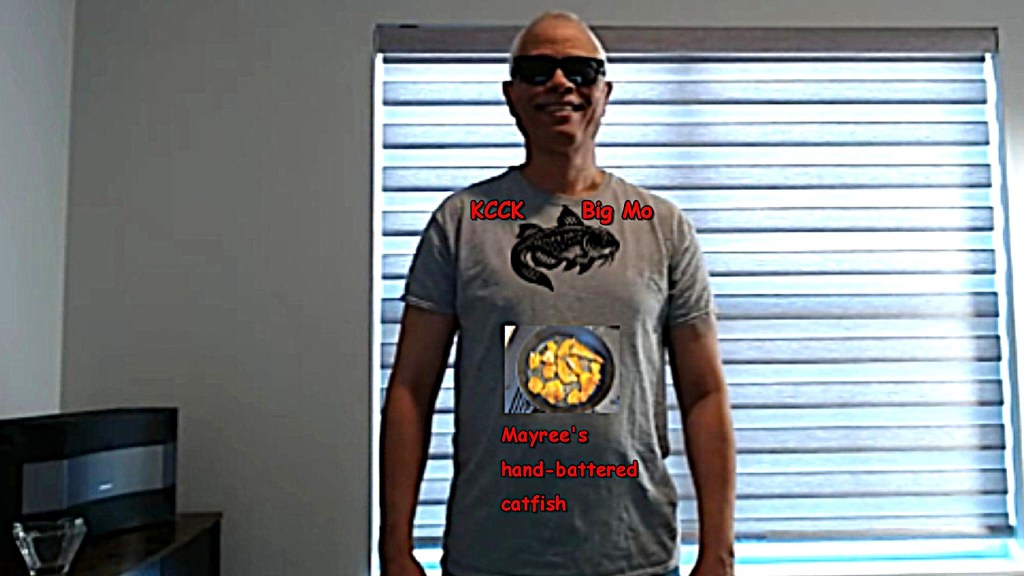
You can be glad about that. Now about that suggestion that I have for a tee shirt design about my favorite faux sponsor created by Big Mo, Mayree of the legendary Mayree’s hand battered catfish; it’s better because it’s battered. I wonder if there’s any movement on that.

Big Mo Pod Show 085 – “California Bluesin” KCCK's Big Mo Pod Show

After a short break during the Thanksgiving holiday your hosts are back at it again with another episode! This week features the usual mix of blues eras you’ve come to expect along with a few Californian artists, tune in to see which ones! Songs featured in the episode: Solomon Hicks – “Further On Up The … Continue reading
  1. Big Mo Pod Show 085 – “California Bluesin”
  2. Big Mo Pod Show 084 – “Garage Blues”
  3. Big Mo Pod Show 083 – “Legal Pirate radio”
  4. Big Mo Pod Show 082 – “Tribute”
  5. Big Mo Pod Show 081 – “Cheers To Kevin”

Starting Without the Big Mo Blues Show Today!

Well, I’ve been waiting all morning for the Big Mo Pod Show and it usually shows up long before now on Saturday morning. In spite of this, Big Mo did say on the blues show last night that the first two songs on the show would be on the pod show and I know what they are. So I’m going to go ahead and start without Big Mo and Producer Noah today.

The first one is a song by someone Big Mo mentioned last week, Monster Mike Welch, “Keep Living Til I Die.” It just happens to be related to my post yesterday on death doulas—only it’s full of raw and feisty humor in how it approaches the usual ideas about death, which can be morbid.

In the lyrics, I think there’s even a classical Greek mythology reference to the river Styx, “I pay my toll at the river…” It could be referring to the river which separates the living from the dead in Hades.

There’s nothing morbid about death in this tune. The singer doesn’t seek death, but neither does he try to run away or hide from it. He’ll just keep living till he dies.

I’m less sure what to think of the next song Big Mo would be on the pod show. It’s by Lil’ Ed & the Imperials, “Walking the Dog.” I can’t make sense of the lyrics.

That’s about as far as I can go so far without the pod show. On the other hand, there was another song on the blues show by an artist I didn’t know about until last night. “Been Here Before” is a striking song because right away I wondered if was about reincarnation. It is sort of related to the idea of what happens after we die.

In fact, the artist, Christone Kingfish Ingram speculates in an interview he might be open to the idea of his have been reincarnated. This is not that different from a few of Dr. H. Steven Moffic’s thoughts about the death, reincarnation, and the afterlife in some of his recent Psychiatric Times columns. A couple of examples are “Past Lives and Psychiatry” and “Past Lives, Death, Dying, and the Afterlife.”

And that’s the “old soul” side of the story about death.

Big Mo Pod Show: Music of the People

I caught the Big Mo Pod Show today, “Music of the People” and of course, I listened to his Friday Blues show last night.

Big Mo Pod Show 085 – “California Bluesin” KCCK's Big Mo Pod Show

After a short break during the Thanksgiving holiday your hosts are back at it again with another episode! This week features the usual mix of blues eras you’ve come to expect along with a few Californian artists, tune in to see which ones! Songs featured in the episode: Solomon Hicks – “Further On Up The … Continue reading
  1. Big Mo Pod Show 085 – “California Bluesin”
  2. Big Mo Pod Show 084 – “Garage Blues”
  3. Big Mo Pod Show 083 – “Legal Pirate radio”
  4. Big Mo Pod Show 082 – “Tribute”
  5. Big Mo Pod Show 081 – “Cheers To Kevin”

Big Mo is a bottomless pit of blues music knowledge (as well as other genres) and that takes me back to my wasted youth when I had a short conversation with one of my former bosses when I worked for Wallace Holland Kastler Schmitz & Co., a consulting engineer firm in Mason City, Iowa.

Ages ago, Ralph Wallace and I got into a short conversation one day about blues music, believe it or not. I can’t recall what actually got that short chat started but it was kind of surreal. He asked me about what I liked about the blues and I brought him up short by telling him I didn’t know anything about it.

I think Ralph thought I would know about the blues just because I was black. I didn’t. He even tried to prompt me by asking about different kinds of blues music, for example 12 bar blues and so on. I’ll never forget his facial expression when he realized I barely knew it existed. He looked puzzled and incredulous. He was a white man and knew more about it than I did. I think it stunned him that a black guy was completely ignorant of the blues.

I could dismiss the interaction simply as a mild form of racism, but I think it was more complicated than that. He was the boss of the company who gave me my very first real job but really didn’t know anything about my background. I was the child of a black man and white woman and my father left home when I was just a little kid. I went to an all-white church. I went to all-white schools, that is, until I was persuaded by a white woman and the black pastor and professor of religion and philosophy to enter Huston-Tillotson College (now Huston-Tillotson University), one of the HBCUs in America located in Austin, Texas. I first heard gospel music there and it raised the hair up on the back of my neck.

It’s a little ironic but I also think of John Heim (aka Big Mo) as another white man who knows more than I’ll ever know about the blues. And I’ve been learning from him for years, which is great.

So, the point is that the theme of the Big Mo Pod Show today is “Music of the People.” The blues is music for all people and the songs can have broad appeal.

One example is the song “Artificial” by Walter Trout. It’s a modern rant against the many synthetic artifacts in modern society and that includes something I rail against—Artificial Intelligence (AI). I can relate to it.

One song that didn’t make it to the list of 5 on the pod show but which was on the blues show last night was “Room on the Porch” by Taj Mahal and Keb’ Mo’ (featuring Ruby Amanfu). I got a surreal feeling about it because it’s about being openly welcoming to everyone. I hear a note of irony in it related to the current conflicts in America and around the world which highlight the opposite of openness and welcome. They’re not new.

On the other hand, I don’t think either Taj Mahal or Keb’ Mo’ intended for the song to be ironic. Maybe I just hear it because of all the background noise that has to be called reality because that’s what’s out there.

What if they’re not being ironic? What if they believe it and they’re trying to say there’s a good reason we should think of the blues as the music of the people—all the people? Where could we go from there?

 Big Mo said it last night, “The blues can heal you, if you let it.”

The Big Mo Pod Show: “Variety is the Spice of Life”

We heard the Big Mo Blues Show last night and heard a couple of tunes that were fun. One of them was mentioned on the Big Mo Pod Show today, “Feelin’ Alright” by Stuff. The other was a riot but was not on the podcast, and it was “I Feel So Good (I Wanna Boogie” by Magic Sam.

Big Mo Pod Show 085 – “California Bluesin” KCCK's Big Mo Pod Show

After a short break during the Thanksgiving holiday your hosts are back at it again with another episode! This week features the usual mix of blues eras you’ve come to expect along with a few Californian artists, tune in to see which ones! Songs featured in the episode: Solomon Hicks – “Further On Up The … Continue reading
  1. Big Mo Pod Show 085 – “California Bluesin”
  2. Big Mo Pod Show 084 – “Garage Blues”
  3. Big Mo Pod Show 083 – “Legal Pirate radio”
  4. Big Mo Pod Show 082 – “Tribute”
  5. Big Mo Pod Show 081 – “Cheers To Kevin”

The one that brought back memories was “Feelin’ Alright” by Stuff. It sounded so familiar and we finally figured out it was a cover of song of the same title and sung by Joe Cocker (the one I remember). However, I guess it was originally written by Dave Mason of the group Traffic in 1968. And there’s even an album “Joe Cocker With Stuff Feelin’ Alright.”

The one Big Mo played last night was from the album Stuff Live at Montreux 1976. It was instrumental and hard to recognize at first. The lyrics are sad, though and it’s about unrequited love, I guess. I associated it years ago with drug and alcohol addiction after seeing the 2012 movie “Flight” on TV. Every scene in which the main character Whip Whitaker (played by Denzel Washington) got high, that song was a part of the scene.

Anyway, moving right along, the song that was not on the podcast and which was a whole lot of fun to listen to was “I Feel So Good (I Wanna Boogie) by Magic Sam. We’ve never heard of him but the way he sang the number made us laugh out loud.

The title of the podcast was right on target: “Variety is the Spice of Life.”

Big Mo Pod Show: “Blues: The Universal Mixer”

We listened to the Big Mo Pod Show (Sena stuck with it for about the first hour anyway) last night and then I got a mini-education in the forms of music, at least, as it relates to timing and rhythm. The theme was “Blues: The Universal Mixer.” Frequently, the blues show and the podcast remind me of previous eras in my life and lead to a few free associations.

Big Mo Pod Show 085 – “California Bluesin” KCCK's Big Mo Pod Show

After a short break during the Thanksgiving holiday your hosts are back at it again with another episode! This week features the usual mix of blues eras you’ve come to expect along with a few Californian artists, tune in to see which ones! Songs featured in the episode: Solomon Hicks – “Further On Up The … Continue reading
  1. Big Mo Pod Show 085 – “California Bluesin”
  2. Big Mo Pod Show 084 – “Garage Blues”
  3. Big Mo Pod Show 083 – “Legal Pirate radio”
  4. Big Mo Pod Show 082 – “Tribute”
  5. Big Mo Pod Show 081 – “Cheers To Kevin”

The 5 songs reviewed by Big Mo and Noah are probably recognizable to many listeners. As usual, I have to search for the lyrics because I seem to have an inborn tendency to hearing mondegreens. And as usual, I don’t always pay the most attention to the songs chosen for the podcast.

But Big Mo did a little teaching session about rhythm forms, which he related to a couple of songs on the list. One of them was “Wait on Time” by The Fabulous Thunderbirds. I happened to notice that a couple of lines in the lyrics of “Wait on Time” reminded me of another artist who didn’t make it to the list on the podcast but was on the blues show playlist last night. That was Junior Walker and the All Stars. Their song “I’m a Road Runner” was one of my favorites because it reminded me of how I ran all over the hospital as a consult psychiatrist. But I can’t relate to the song as a whole.

The lines the two songs share are:

“Wait on Time” lyrics:

“Well, I live the life I love
And I love the life I live
The life I live baby
Is all I have to give”

“I’m a Road Runner” lyrics:

“And I live the life I love
And I’m gonna love the life I live
Yes, I’m a roadrunner, baby.”

Although the lyrics are similar, the themes are different. The guy in the song “Wait On Time” is promising he’ll get back to his lover someday. On the other hand, in the “I’m a Road Runner” lyrics, that guy is making no such promise and is actually is saying just the opposite.

Big Mo pointed out that there is a common rhythmic form in blues that easily mix with other forms of music, including Latin forms (I don’t understand that music lingo but I think I hear and feel what he means). He mentions that Bo Diddley mixed certain rhythms like that into his music, which surprised me because I didn’t know that. It may be why I like Bo Diddley.

Big Mo didn’t play “I’m a Road Runner” last night but played another hit from Junior Walker and the All Stars: “Ain’t That The Truth.” Just an aside, that tune is mostly instrumental and has a total of only 4 lines apparently, which express a common blues sentiment about relationships:

“Say man, what’s wrong with you?
Oh man, my woman done left me
Say it, man, play me some blues, jack
Get it, baby
Ain’t that the truth”

Several artists covered “I’m a Road Runner” including but not limited to the Grateful Dead and Steppenwolf. Bo Diddley did a song called “Road Runner” but it was not the Junior Walker tune. There’s a YouTube video relating it to the cartoon Roadrunner and Wile E. Coyote.

I’m not a roadrunner by any definition, but I learn a little something new just about every time I hear the Big Mo Pod Show.