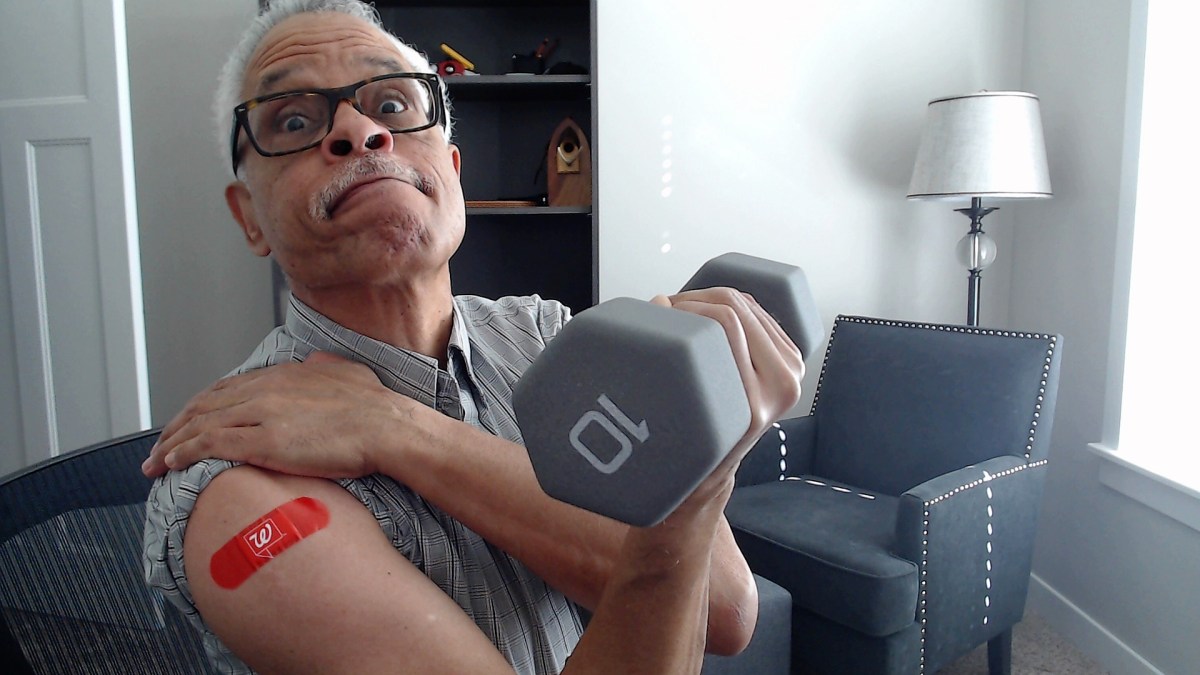
Jim Updates His Workout and Adds a Step Counter!

Since we added the step platform, I’ve been wondering how to count steps when I use it because for some reason my smartphone step counter won’t count steps when I try to use it on the platform.

Sena got a handy step counter and it works! It works if you have it in your pocket or wear it on neck with a lanyard.

I usually practice juggling patterns as a warm up to exercising. I’m still working on the shower pattern. Progress is slow.

My exercise routine takes a half hour. Following that I sit for mindfulness meditation for 30 minutes. We are still using our anti-Peloton exercise bike. I do one leg stands for a minute on each leg. I still do floor yoga, body weight squats, planks, and dumbbells. I still count my own steps on the platform: 50 steps alternating right and left leg four times (200 steps). The counter number varies between 170-200 or so.

As a review, a recently published study found that climbing 5 flights of stairs (approximately 50 steps) was associated with a lower risk of ASCVD types independent of disease susceptibility (Song et al, see reference below). There was a threshold effect of stair climbing in the study, meaning the benefit was lost if you went over a certain number of “floors.” Going over 15 or 20 didn’t gain much for subjects. A flight was 10 stair steps.

Step up!

Reference:

Song Z, Wan L, Wang W, Li Y, Zhao Y, Zhuang Z, Dong X, Xiao W, Huang N, Xu M, Clarke R, Qi L, Huang T, Daily stair climbing, disease susceptibility, and risk of atherosclerotic cardiovascular disease: A prospective cohort study, Atherosclerosis (2023)

The Iowa State University African and African American Studies Research Guide

In keeping with Iowa History Month 2024, you can have a look at the Iowa State University website “African and African American Studies Research Guide.”

Iowa State University happens to be my alma mater, or in a way, one of them. I took my Bachelor’s degree there and later graduated from The University of Iowa College of Medicine.

There is a wealth of information worth browsing on the ISU website devoted to the history of black people in Iowa. In fact, I found out a few of those connections were to Huston-Tillotson University (HT-U, an HBCU) in Austin, Texas, where I spent several semesters in the 1970s before later transferring to ISU.

The connections between HT-U and Iowa go way back into the history of that school. It started as Tillotson College in 1875, which is where some of the ISU black students also later worked as faculty. The list includes notable scholars:

Ada M. Deblanc-Yerwood: After graduation from ISU, she became head of Home Economics at Tillotson College. She was also co-founder of the George Washington Carver Museum in Austin, Texas. She also had an interesting perspective on retirement. She didn’t, and pursued other positions. Her answer to why she didn’t retire: “Old is a state of mind. When you do nothing, you become nothing. The need to be productive—give life to something—doesn’t automatically stop at age 65 or 70.”

Dr. Samuel P. Massie, Jr.: Dr. Massie went to ISU in 1941 to pursue a Ph.D. in Chemistry. He had to hitchhike to campus because there was no housing for Black students within 3 miles. Dr. Henry Gilman at ISU assigned him to work full time as a research assistant on a special assignment connected to the Manhattan Project (the top-secret effort to build an atomic bomb). President Lyndon B. Johnson appointed him to a Chemistry professorship at the U.S. Naval Academy. He distinguished himself as a scientist in many HBCUs (Fisk, Howard University, North Carolina College, and others) and elsewhere despite the racism that tried to hinder him. In 1981, ISU gave him the highest award—the Distinguished Achievement Citation.

Dr. Frederick Douglass Patterson: He was a brilliant student and he attended Samuel Huston College (see history of Huston-Tillotson College at link above). He also attended ISU, graduating with a DVM in 1923. In his book, Chronicles of Faith, he wrote: “In the veterinary program, I did not feel odd being a part of the group of students working in the veterinary clinic although I was the only black person there. The absence of animosity encouraged me to see veterinary medicine as a field in which I could practice without being hampered by the racial stereotypes and obstacles that would confront me as a medical doctor, for example. I found the teachers of Iowa State helpful whenever I approached them. Educationally, it was a fine experience.” He received the Presidential Medal of Freedom from President Ronald Reagan in 1987. He was President of Tuskegee Institute and transformed it into a university. He also founded the United Negro College Fund.

The United Negro College Fund was part of the reason I was able to attend Huston-Tillotson University. And it’s connected to the history of Iowa.

FDA Advisory Committee to Meet in May 2024 to Discuss Updating Covid-19 Vaccine

The FDA Vaccines and Related Biological Products Advisory Committee (VRBPAC) will meet on May 16, 2024 to make recommendations on Covid-19 strain selections for the fall vaccine of 2024-2025.

Fake Snakes Saga Slithers On

The fake snake saga continues with not much change in scaring off birds, evidently. Bird poop calling cards are still being left.

I repositioned them and we’re hoping for the best.

This reminds me that the other night I was awakened by what I was pretty sure was an owl and dogs raising a ruckus at each other. I thought there was either one or two dogs trying to imitate the owl.

I don’t think it was the other way around. There is an owl that barks like a dog, but I believe it’s found only in Australia. I think it barks because it can’t stop eating vegemite, which makes it think it’s a dog.

Snakes don’t make noises generally, other than hissing sounds unless they’ve been abducted by extraterrestrials. The ETs conduct genetic experiments on them and that’s how they came up with the reptilians—who bark like owls.

The Good and the Not So Good About Mental Health Treatment

Sometimes I write “depressing” blog posts. On the other hand, I have both good and bad news today.

I found out that, according to the Treatment Advocacy Center, Iowa’s state psychiatric hospital bed availability is dismal according to 2023 figures. That’s actually not new. Although we rate last in the nation for this, we still get a Grade B overall. I’ll have more to say later about it. You can check your own state’s grade on the web site’s map graphic.

And a recently published article about antidepressant prescribing for young people is sort of depressing, there are ways to address the likelihood that adolescent females are being prescribed antidepressants more often than adolescent males.

I tend to agree with the author of another article on adopting a more nuanced perspective on what is often called “depression” in young people.  Not everybody who is distressed is depressed.

Even if we are depressed, there are healthy activities we can engage in to heal. We don’t all necessarily need antidepressants. That’s the point of a recent systematic review and meta-analysis on the role of exercise for managing depression. Exercise is effective either by itself or in addition to psychotherapy and antidepressant.

Iowa actually seems to be putting a lot of hard work in mental health outreach, such as Your Life Iowa. It’s funded by the Iowa Dept of Health and Human Services under the Division of Behavioral Health.

I’d say that’s pretty positive, overall.

Thoughts on a Study of Sitting with Your Patients

I saw this interesting article on a study about the effect of chair placement on physicians’ behavior when in a patient’s room, specifically whether it altered the length of time a doctor spends with a patient or the level of satisfaction patients had with the interaction. In this study, it didn’t lengthen the time, but seemed to strengthen patient satisfaction with interaction with the physician. It’s a concept I recognize because I took this one level up—I carried my chair with me on hospital rounds in my role as a consultation-liaison psychiatrist.

I got a gift of a 3-legged camp stool from a colleague who ran the palliative care service at University of Iowa hospital. Other members of the palliative team had been using them as well.

Patients got a big kick out of a doctor who carried his chair around with him and actually sat down to talk with them. The way the camp stool folds up apparently made it look like nunchucks to some patients, so I got jokes about that occasionally. It really helped build rapport.

The only drawback with the camp stool was that my one of my legs would go numb the longer I sat on it, and could lead to a challenge getting up from it gracefully because it was partly a balancing act. Even so, I often spent much more than 10-15 minutes with patients.

Once, the stool actually broke and I dropped unceremoniously on my butt while evaluating a patient for catatonia—who proved not to be catatonic by the apparent facial expression of mirth as I fell on the floor. In that sense, the chair actually became a part of the evaluation—accidentally.

Thomas Hackett knew all about this. He was a famous consultation-liaison psychiatrist and a past president of the Academy of Consultation-Liaison Psychiatry (ACLP). One of his quotes from an early edition of the Massachusetts General Hospital Handbook of General Hospital Psychiatry fits perfectly in this context:

“As a matter of courtesy, I sit down when interviewing or visiting patients. Long accustomed to the ritual of making rounds, many physicians remain standing as a matter of course. Standing, physicians remind me of missiles about to be launched, poised to depart. Even if that is not necessarily true, they look the part. Patients sense this and it limits conversation. In addition, when standing, the physician necessarily looks down on the patient. This disparity in height is apt to encourage the attribution of arrogance. Looking down at a patient who is prone emphasizes the dependency of the position. Sitting at the bedside equalizes station. Sitting with a patient need not take longer than standing with him.”— Hackett, T. P., MD (1978). Beginnings: liaison psychiatry in a general hospital. Massachusetts General Hospital: Handbook of general hospital psychiatry. T. P. Hackett, MD and N. H. Cassem, MD. St. Louis, Missouri, The C.V. Mosby Company: 1-14.

Reference: Effect of chair placement on physicians’ behavior and patients’ satisfaction: randomized deception trial BMJ 2023; 383 doi: https://doi.org/10.1136/bmj-2023-076309 (Published 15 December 2023)

African American Women in Iowa History

In light of March being Women in History Month (as well as Iowa History Month), I’d like to share some history stories about an African American librarian from Mason City, Iowa named Esther J. Walls. In 2020 during the Covid-19 pandemic, there was an essay about her, “Esther J. Walls: The Role of a Black Leader.” Her life story as a librarian, traveler, and educator is fascinating.

I looked through the list of women elected to the Iowa Women’s Hall of Fame and couldn’t find her name. However, I recognized Deborah Ann Turner’s name on the list. She was the first African American woman to be certified by the American Board of Obstetrics and Gynecology in gynecologic oncology. She was also from Mason City, Iowa. Her life story and list of accomplishments is also impressive.

I identify with both of them because they were born and raised in my hometown, Mason City, Iowa. Esther J. Walls was employed at the Mason City Public Library, my favorite haunt because my love of reading and writing began in early childhood.

An archived news item about Esther J. Walls entitled “A Mason City woman’s globe-trotting career” highlights her travels and her sense of humor.

Well, The Times They Are A’Changing at the CDC

We just found out that the CDC is, in fact, changing their recommendations on isolation precautions and other guidance for respiratory illness. It turns out the 5 day isolation rule for a positive Covid 19 test is going away. The Respiratory Virus Guidance page has changed as of today.

Sena found out about it from an article in the Wall Street Journal. The rules for health care personnel are not the same as they are for the public. I guess the times theye are a’changing.

CDC ACIP Meeting on the RSV Vaccine and Some Dad Jokes

We watched the section of the CDC ACIP meeting about RSV vaccines on February 29, 2024. There was a lot of discussion on the safety of the vaccine. It looks like it will still have a requirement that you have a shared clinical decision-making meeting with your physician. I think that still implies you’d need a prescription. However, there are only a handful of states which would require a prescription from your doctor. Iowa is one of them.

That made the comment by one of the committee participants thought provoking. I believe she got the RSV vaccine from a pharmacist, who asked no questions. There was no shared clinical decision-making discussion with that pharmacist.

But there was a discussion during the meeting with a pharmacist who was in the room. She made it clear that pharmacists had plenty of training (“20 hours” along with additional learning) and could handle the shared clinical decision-making piece with patients.

Sena and I have had all of our vaccines including the Covid-19 shots administered by pharmacy techs. I hardly know what the pharmacists look like because they are a blur, managing the drive-up window and all other customers. It’s clear that a large proportion of vaccines are available at most pharmacies and the techs give the shots. They are pleasant and happy to apply the Band-Aid.

You can’t even telephone the pharmacy and talk to a live person. Sometimes you’ll get a recording which replies to most of your questions with “Sorry, I didn’t get that. Did you say you want a vaccine or a cheeseburger with fries?” Scheduling vaccine appointments are generally done on line. Scheduling a visit with the pharmacist is probably not easier than scheduling one with your doctor, who might confuse you with “the colonoscopy” in room 5.

I’ve looked at the health care professional section on the CDC website pertaining to the age and medical conditions necessary to qualify for getting the RSV vaccine. I’m pretty sure I’m in the right age category, although I stopped keeping track after the evolution of asparagus. I don’t have any chronic medical conditions, unless you count dad jokes. I exercise, juggle, take only a multivitamin a day, meditate, and regularly leap tall buildings in a single bound. I’m pretty sure I don’t need the RSV vaccine, but what do I know? I’m a retired psychiatrist.

It looks like the risk of getting Guillain-Barre Syndrome (pronounced “GBS”) is not zero and may or may not be associated with the RSV vaccine. It’s pretty clear that 2 of the 3 major manufacturers of the vaccine who attended the meeting were pretty sensitive to any hints their product might have anything to do with GBS and might challenge you to a no holds barred thumb wrestling match if you say otherwise.

We think there’s a long way to go before everybody’s clear on who gets the RSV vaccine and when, and also where. But you can’t get it at the pharmacy drive up window.

CDC ACIP Meeting on Covid 19 Vaccine Additional Dose

The CDC ACIP meeting on February 28, 2024 on the proposal of a Spring booster of the Covid 19 vaccine was interesting and confusing. Initially right after the morning presentations, we were a little confused about whether the committee was targeting only those who got the vaccine booster last fall or everybody. That didn’t make much sense given the concern about low overall uptake of the vaccine.

The presenters also mentioned that getting the Spring Covid booster would be part of a shared clinical decision-making discussion with your doctor, similar to that recommended for the RSV vaccine. That was bewildering because we think that’s part of the reason some people might skip the RSV vaccine, given the news reports last year pointing out you had to have a prescription from a medical provider in some states to get it.

I was pretty interested in learning more about T-cell immunity given the concern about waning which of immunity from vaccines over a few months, which I think was based on neutralizing antibodies from B cells. I thought the CDC web site link to an article about the T-cell immune response suggested that cell mediated immune responses might mean that our immunity might not be waning that quickly. However, one of the presentations, “Evidence to Recommendation” showed a slide indicating that your T-cell immunity gets weaker with age (ref. de Candia P, Prattichizzo F, Garavelli S, Matarese G. T Cells: Warriors of SARS-CoV-2 Infection. Trends Immunol. 2021 Jan;42(1):18-30. doi: 10.1016/j.it.2020.11.002. Epub 2020 Nov 13. PMID: 33277181; PMCID: PMC7664351.)

I’ve read other articles, one of them on the CDC website, which says you may have more durable immunity provided by T-cells, but if I read it carefully, the authors hedge and say that T-cell adaptive immunity may not be as strong when you’re older. (Moss, P. The T cell immune response against SARS-CoV-2. Nat Immunol 23, 186–193 (2022). https://doi.org/10.1038/s41590-021-01122-w).

Later in the afternoon, the committee voted that those who are 65 years old and older should get the spring dose. There was no further discussion of limiting it to only those who got the Covid vaccine in the fall of 2023. There was also no discussion of the shared clinical decision-making detail. The committee upvoted the resolution with a majority.

And yet, the voting question did say: ACIP recommends that persons greater than or equal to 65 years of age “should” (which was changed from “may”) receive an additional dose of 2023-2024 Formula COVID-19 vaccine. The “additional dose” means in addition to the vaccine (monovalent XBB.1.5) given last fall. That’s a relatively select group, when you take the subset of those who are 65 and older.

However, the slides in the “Evidence to Recommendation” had recommended there should be shared clinical decision-making, meaning that you should discuss getting the vaccine with your doctor. However, according to the STAT NEWS article summary of this meeting, substituting the word “should” for “may” would make the conversation with a doctor unnecessary.

Finally, there was no discussion at all of changing the 5-day isolation precaution for those testing positive for Covid-19. If the committee were planning to drop that, as many news agencies recently reported, I would think they’d have discussed it at length at the meeting.

The CDC Director will have to sign off on the additional Covid-19 shot before it’s official.

2/29/2024 Update: CDC Director endorsed the additional dose yesterday.