Upcoming Svengoolie Movie: “King Kong vs Godzilla”

I see the 1962 kaiju movie “King Kong vs Godzilla” is coming to Svengoolie this Saturday. I’m still trying to figure out if I’ve seen this one already. Maybe that’s because it looks similar to other kaiju films I’ve seen on the Svengoolie show, like “Godzilla vs Bozo the Clown,” another classic which I’m sure you’ve seen.

This may be the one where King Kong challenges Godzilla to a food fight at Wendy’s because Godzilla gulped down all the chocolate Frosty malts. It’s a pretty simple battle since all they do is throw the whole restaurant back and forth at each other which causes all the people trying to order burgers and fries to fall out of the building leading to both monsters skidding and slipping on the ketchup and cracking the streets open, which of course causes the storm and sanitary sewers to burst causing a messier flood of crap which doesn’t do anything to improve the taste of French fries. This just makes King Kong even madder because he can’t make his step over toe hold work because he slips in the slop. I think this is when Chuck Norris shows up because all the ruckus makes too much noise, distracting him from his sitar practice. Neither King Kong nor Godzilla dare look at Chuck the wrong way because the dinosaurs did that and you know what happened to them. Then, wouldn’t you know it, the Tall Man shows up, the same 10-foot-tall monster that allegedly haunted a small town and did some window peeking which scared all the townsfolk, an event which is described in the TV documentary, Paranormal Emergency. All three start doing their roundhouse kicks at each other, which Chuck Norris immediately stops by doing the same roundhouse kick in the time when in the beginning there was nothing and he kicked nothing and told it to get a job and…well, that’s probably not how this movie goes per se but you get my drift.

We Just Got MLK Jr Biographies Delivered Today

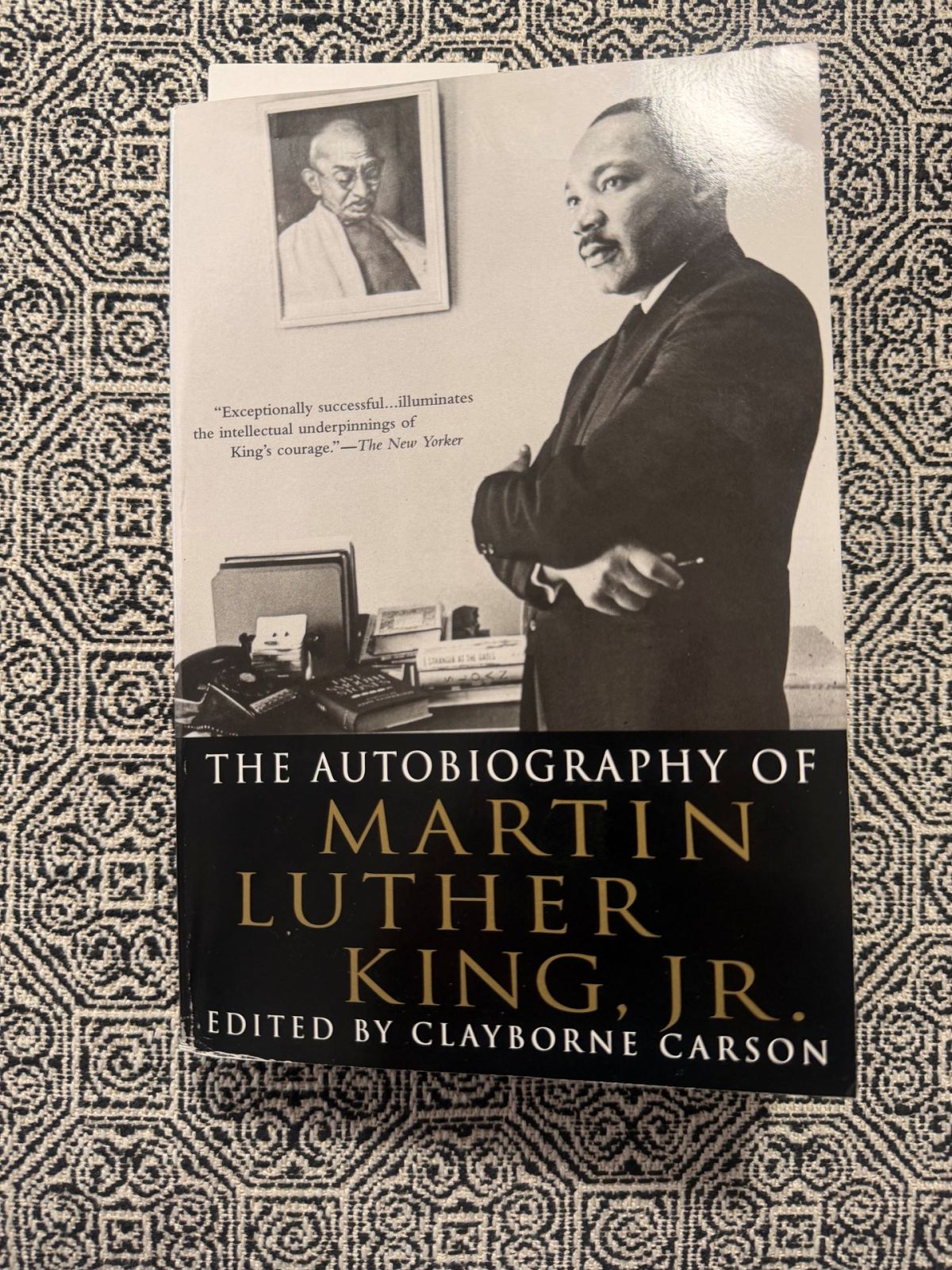
We just got both of the Martin Luther King Jr. biographies delivered today! They both have great photographs and we’ll get started reading them. We’ll keep you posted on what our impressions are.

We also saw a YouTube video of a 1963 TV program of civil rights leaders including MLK Jr posted a few years ago.

Thoughts on Martin Luther King, Jr. Day

Today being Martin Luther King Day, I’m reminiscing a little about my short time as a student at Huston-Tillotson College (one of this country’s HBCUs, Huston-Tillotson University since 2005) in Austin, Texas. It’s always a good idea to thank your teachers. I never took a degree there, choosing to transfer credit to Iowa State University toward my Bachelor’s, later earning my medical degree at The University of Iowa.

However, I was a reporter for the college newspaper, The Ramshorn Journal. That’s where the featured image comes from.

Although I didn’t come of age at HT, I can see that a few of my most enduring habits of thought and my goals spring from those two years at this small, mostly African-American enrollment college. I learned about tenacity to principle and practice from a visiting professor, Dr Melvin P. Sikes, in Sociology (from the University of Texas) who paced back and forth across the Agard-Lovinggood auditorium stage in a lemon-yellow leisure suit as he ranted about the importance of bringing about change.

He was a scholar yet decried the pursuit of the mere trappings of scholarship, exhorting us to work directly for change where it was needed most. He didn’t assign term papers, but sent me and another freshman to the Austin Police Department. The goal evidently was to make them nervous by our requests for the uniform police report, which our professor suspected might reveal a tendency to arrest blacks more frequently than whites.

He wasn’t satisfied with merely studying society’s institutions; he worked to change them for the better. Although I was probably just as nervous as the cops were, the lesson about the importance of applying principles of change directly to society eventually stuck. I remembered it every time I encountered push-back from change-resistant hospital administrations.

As a clinician-educator I have a passion for both science and humanistic approaches in the practice of psychiatry. Dr. James Means struggled to teach us mathematics, the language of science. He was a dyspeptic man, who once observed that he treated us better than we treated ourselves. Looking back on it, I can see he was right.


Dr. Lamar Kirven (or Major Kirven because he was in the military) also modeled passion. He taught black history and he was always excited about it. When he scrawled something on the blackboard, you couldn’t read it but you knew what he meant.

And there was Dr. Hector Grant, chaplain and professor of religious studies, and devoted to his native Jamaica. He once said to me, “Not everyone can be a Baptist preacher.” He tried to explain that my loss of a debate to someone who won simply by not allowing me a word in edgewise was sometimes an unavoidable result of competing with an opponent who is simply bombastic.

Dr. Porter taught English Literature and writing. She also tried to teach me about Rosicrucian philosophy for which she held a singular passion. Not everyone can be a Rosicrucian philosopher. But it prepared the way for me to accept the importance of spirituality in medicine.

I didn’t know it back in the seventies, but my teachers at HT would be my heroes. We need heroes like that in our medical schools, guiding the next generation of doctors. We need them in a variety of leadership roles in our society. Most of my former HT heroes are not living in the world now. But I can still hear their voices.

Sven Squad Movie: “Flight 7500”

Sven Squad Intro: “Calling all stations! Clear the air lanes! Clear all air lanes for the big broadcast!”

So last night we both watched the Sven Squad movie “Flight 7500.” It’s the Sven Squad leading the way because they’re going to give Svengoolie a well-deserved break once a month. However, he did show up a couple of times. We thought the Sven Squad song “Cabin Pressure” was pretty awesome.

Flight 7500 was released in 2014 and the short story is that a lot of people on a big airplane start disappearing after a guy named Lance Morrel (Rick Kelly) nearly bites his hand off trying to remove some salted peanuts from his throat. Lance appears from time to time and even tries to costar in the seat back video presentation of the Twilight Zone TV in-flight movie, “Nightmare at 20,000 Feet.”

After Lance dies despite getting expert chest compressions from the CPR Bran Martin (Ryan Kwanten) gives him gets moved to the upper-level cabin where Lance and William Shatner have a stimulating conversation about how well gremlins and Shinigami dolls get along.  

One guy, Jake (Alex Frost) who likes to steal watches and cell phones swipes Lance’s wristwatch and becomes the first to disappear. OK, there are way too many passengers to keep track of in this film, so don’t blame me if I mix them up or even leave them out.

There are so many passengers struggling with their soap opera lives on this plane that they step on each other’s toes (just like on a real flight!) as they are competing over which one disappears next while they vie viciously for who wins The Snarkiest Award.

There’s this Goth lady Jacinta (Scout Taylor-Compton) in mom jeans who may turn out to be the most well-adjusted of the group as she and the Shinigami doll have a great time playing 7-card cribbage just before Raquel Mendoza (Christian Serratos) finds out she’s not pregnant and throws a tantrum when the tall flight attendant Liz Lewis (Nicky Whelan) fails to bring her any salted peanuts.

The rest of the passengers take turns trying to breathe with the oxygen masks which don’t work and Lance turns into a huge hand, lunging for everyone in sight if they don’t immediately obey orders and accept death when they’re supposed to.

I can’t say much more about this movie without spilling the Boston baked bean snacks, so I’ll just have to say I would give it a 4.5/5 shrilling chicken rating, mainly because Sena would give it a 5/5.

What Questions Should We Ask on MLK Day?

I ran across this quote from Dr. Martin Luther King, Jr. in my notes:

“Human progress is neither automatic nor inevitable… Every step toward the goal of justice requires sacrifice, suffering, and struggle; the tireless exertions and passionate concern of dedicated individuals.”

― Martin Luther King Jr.

This week we’ll be getting the two biographies of Martin Luther King, Jr. One of them is a biography published a couple of years ago by Jonathan Eig, titled “King: A Life.” The other is an autobiography, “The Autobiography of Martin Luther King, Jr.”

This morning, I was focused on puzzling over Eig’s book, in which there is a focus of how depression affected Dr. King. Gradually, I found out more about his struggles with mental health than I ever knew, and people were aware of them many years before Eig.

Dr. King never shared his emotional problems with anyone while he was alive in order to avoid the stigma in those times. Initially I asked “Why?” type questions. Why does anyone dig into a person’s private health information? That’s called PHI for short and it’s not supposed to be readily available to just anybody. Health professionals know that.

And then I remembered something I learned gradually over the course of my career as a psychiatrist. It’s hard to frame useful answers to “Why?” questions. It’s often more helpful to ask “What?” questions, mainly because they lead to actionable replies about things we might need to change.

What did I do as a teacher before I retired from consultation-liaison psychiatry in order to train those who would improve on what I did?

I shared with my students what I thought would be most helpful to them in their careers going forward:

The shortage of psychiatrists in general, and of C-L psychiatrists specifically, still leads me to believe that George Henry was right when he said:

“Relegating this work entirely to specialists is futile for it is doubtful whether there will ever be a sufficient number of psychiatrists to respond to all the requests for consultations. There is, therefore, no alternative to educating other physicians in the elements of psychiatric methods.”– George W. Henry, MD, 1929 (Henry, G.W., SOME MODERN ASPECTS OF PSYCHIATRY IN GENERAL HOSPITAL PRACTICE. Am J Psychiatry, 1929. 86(3): p.481-499.)

There was so much in Henry’s paper published in 1929 that still sounds current today. I can paraphrase the high points:

  • Practice humility and patience
  • Avoid psychiatric jargon
  • Stick close to facts; don’t get bogged down in theories
  • Prevent harm to patients from unnecessary medical and surgical treatment, e.g. somatization
  • “The psychiatrist deals with a larger field of medical practice and he must consider all of the facts.”
  • The psychiatrist should “…make regular visits to the wards…continue the instruction and organize the psychiatric work of internes…attend staff conferences so that there might be a mutual exchange of medical experience”
  • Focus on “…the less obvious disorders which so frequently complicate general medical and surgical practice…” rather than chronic, severe mental illness

The advantages of an integrated C-L Psychiatrist service (here I mean integrating medicine and psychiatry; mind and body) are that it increases detection of all mental disorders although that requires increasing the manpower on the service because of the consequent higher volume demand in addition to other requests, including but not limited to unnecessary consultation requests.

Further, what still astonishes me is the study which found that among consultee top priorities was an understanding of the core question (Lavakumar, M. et al Parameters of Consultee Satisfaction With Inpatient Academic Psychiatric Consultation Services: A Multicenter Study. Psychosomatics (2015). The irony is that the consultees frequently do not frame specific questions (Zigun, J.R. The psychiatric consultation checklist: A structured form to improve the clarity of psychiatric consultation requests. General Hospital Psychiatry 12(1), 36-44; (1990).

Moreover, it is sometimes necessary to give consultees bad news. A consultant should be able to tell a colleague what he or she may not what to hear. This principle is applicable across many disciplines and contexts. And it is best delivered with civility.

A former president of the ACLP said:

“A consultation service is a rescue squad.  At worst, consultation work is nothing more than a brief foray into the territory of another service…the actual intervention is left to the consultee.  Like a volunteer firefighter, a consultant puts out the blaze and then returns home… (However), a liaison service requires manpower, money, and motivation.  Sufficient personnel are necessary to allow the psychiatric consultant time to perform services other than simply interviewing troublesome patients in the area assigned to him.”—Dr. Thomas Hackett.

I don’t think it’s too much to expect things to improve. Speaking of improvement, Stephen Covey called it “sharpening the saw,” one of the 7 habits of highly effective people. For this, The University of Iowa Hospitals and Clinics C-L Psychiatry has the Clinical Problems in Consultation Psychiatry or CPCP. This was started by Dr. Bill Yates in the 1990s, and it was originally called Problem-based Learning. “PBL…emphasis on the development of problem-solving skills, small group dynamics, and self-directed methods of education…most common types of problem categories identified for the conference were pharmacology of psychiatric and medical drugs (28%), mental status effects of medical illnesses (28%), consultation psychiatry process issues (20%), and diagnostic issues (13%) …PBL conference was ranked the highest of all the psychiatry resident educational formats.”

  • Yates, W. R. and T. T. Gerdes (1996). “Problem-based learning in consultation psychiatry.” Gen Hosp Psychiatry 18(3): 139-144.Yates, W. R. and T. T. Gerdes (1996). “Problem-based learning in consultation psychiatry.” Gen Hosp Psychiatry 18(3): 139-144.
    • Covey, S. R. (1990). The seven habits of highly effective people: restoring the character ethic. New York, Simon and Schuster.         

What did I do when burnout made me a less effective teacher? In 2012 I started getting feedback from colleagues and trainees indicating they noticed I was edgy, even angry, and it was time for a change.

After reflecting on the feedback from my colleagues and students, I enrolled in our university’s 8 week group Mindfulness-Based Stress Reduction (MBSR) program. Our teacher debunked myths about mindfulness, one of which is that it involves tuning out stress by relaxing. In reality, mindfulness actually entails tuning in to what hurts as well as what soothes.

Maybe we should ask what helped Dr. Martin Luther King, Jr. persevere in spite of the inner turmoil and external pressure.

Fractured Numismatics

I saw this article on the web about certain coins (state quarters) that might be worth a lot of money. I just raided our piggy bank for pennies and other chicken feed a couple of months ago and knew we had some quartesr.

As it turns out we have a couple of the year 2000 S. Carolina quarters; one was a P and the other a D.

“2000 South Carolina quarter

The 2000 South Carolina quarter was one of the first State quarters to be released. It may have extra value if it has extra strikes during the minting process instead of one strike.

A 2000-P 25C South Carolina (Regular Strike) had an auction record of over $3,000, according to the PCGS, valued due to its MS69 grade. Very few coins in this condition exist.

Estimated worth: $500-$2,500”

I peered at them with a magnifying glass but couldn’t really tell if it was valuable. We looked for a coin shop on line to see if we could get some assistance with grading the coins. There’s a coin and gun shop right here in town. Apparently, coin shops often deal in guns as well. The neighborhood looked a little rough.

So, I checked on the internet on a couple of coin collectors web sites and found an interesting YouTube on S. Carolina state quarters alone. There was a quarter worth about $3,500.

 I saw another one on eBay that somebody was asking $2,500 for. On the other hand, I found another seller who had a quarter going for $23.

We’re not sure if one of our quarters is worth grading. Here’s a picture of it:

Paranormal Productions: The Skunk Ape

Last night, I watched what I thought was a brand-new episode of Josh Gates’ series, Expedition X. It was titled “Beast of the Everglades” and it was about the skunk ape in the Florida everglades. Turns out the show originally aired in 2024, so I’m a little behind. You might want to watch it first before reading this post, because I’m going spill the lima beans about it.

Expedition X is all about chasing cryptids and in this episode the quarry is the skunk ape in the Florida. The skunk ape is a Bigfoot which desperately needs deodorant because it stinks to high heaven. Right from the beginning of the show, I thought of Dave Barry’s book, Best State Ever. A Florida Man Defends His Homeland. It was published in 2016. I used to have nearly every nonfiction book he published up until several years ago.

The aptly named relevant chapter in Barry’s book is “The Skunk Ape.” The book and the TV show intersect in the guy who sort of invented the story of the skunk ape, Dave Shealy, because his video of the cryptid is shown on the show and is widely available on the internet. He has a bit part in the show. He and the co-star Heather Amaro talk about the skunk ape briefly and he does have a piercing gaze, just as Barry describes in his book. Barry’s photo of Shealy in the book shows him wearing a pair of high boots—and he wore the same boots on the show. He didn’t talk about using lima beans as bait to attract the skunk ape on the show but he told Dave Barry about having used the vegetable.

That reminds me of the highly evolved and fancy technology that the stars, Phil Torres and Heather Amaro used in the show. Phil used a really cool, high-tech slingshot to shoot scent balls infused with the stink of 3 different animals (skunk, wild boar, and bear) into the brush to attract the skunk ape. It’s a lot more impressive than tossing out lima beans.

They also used a very expensive looking drone with a camera and caught video of something which looked to them like it was hustling across the marshes on two legs. I thought it looked like it was on four legs, but what do I know about drone video footage?

On the show, Phil and Heather found a few stinky nests which they suspected or at least wondered whether the skunk ape built and sat in. One or two of them I think were in tree tops although the trees were not that tall. I wondered about the relatively small size of the nests, given that the large size of the skunk ape—about 7 feet tall and over 400 lbs. (so, about the size of a typical NFL lineman), if I remember correctly (if that matters). It looked like the nest was about the size of a baby’s car seat.

There were small skeletons in it and one of them Phil identified as a baby alligator gar. That’s a prehistoric-looking animal resembling an alligator. They can grow to massive size. The little one was probably a snack which the skunk ape munched on while watching reruns of My Favorite Martian on the little portable TV, which was on the fritz at the time Phil checked. There were no lima beans in the nest, which means the creature cleaned its plate, which was neatly stacked with others in the tiny dishwasher.

Primates will eat stuff like that, according to a local animal expert on the show. But he politely speculated that the animal bounding across the everglades in Shealy’s video moved more like a person than an ape.

Phil got a few hairs from the grass out in the swamp, which was tested for DNA. It came back human. But since humans and apes share more than 98% of their DNA, that means the skunk ape legend remains intact.

Upcoming Svengoolie Movie: “Flight 7500”!

The upcoming Svengoolie movie this coming Saturday is “Flight 7500.” It reminds me of one of our vacation trips when Sena asked for an extra bag of peanuts from the attendant, who promised she would return with another bag—and never did. Sena’s never forgotten that.

I think that’s kind of how things go on airplanes. I’m not big on airline food and not keen on flying at all. I remember sitting next to an elderly guy (Har! Look who’s talking!) who was probably more nervous about flying than I was (as if that were possible).

As we were taking off, he pressed a little button on his hand or his wrist (can’t remember exactly) that was attached to a wristband. I remember thinking it might have had something to do with acupressure points. I looked this up today and it turns out that there’s a point called Union Valley and it’s in the webbing between your thumb and index finger. Or maybe it was the Inner Frontier Gate point, which is about 3 finger widths below your wrist. I know it wasn’t the Shoulder Well point because that can induce labor. I’m pretty sure he wasn’t pregnant.

Anyway, this movie looks like it could make you nervous. It was released in 2014, which is pretty unusual for Svengoolie. On the other hand, it’ll be the Sven Squad that’ll be in charge of it because Svengoolie is taking the night off. I gather he’ll be doing that once a month now. The Sven Squad members are Nostalgiaferatoo, Imp (Ignatius Malvolio Prankenstein who calls Svengoolie his uncle), and Gwengoolie. They usually do the 2nd film of a double feature—which I can’t stay awake for.

I think Nostalgiaferatoo and Imp will play rock, paper, scissors more than 30,000 times to see who does most of the talking about the movie.

Anyway, the gist of the plot is that passengers start to feel a little queasy after their in-flight meal of beef jerky and turnip pastries and start hallucinating little monsters out on the wings which they keep telling the pilot about who is a little too busy to pay much attention because he’s distracted by the half-dozen or so UFOs zipping around just outside the front window which dodge the windshield wipers so fast it reminds him of the Men in Black movie in which Nick can’t clean off the bug parts of the big dragonfly that hits his window, so he has to take a break and orders his copilot to run back into the cabin and slap some of the passengers who are playing around with a Ouija Board and dousing rods, conjuring up demons who are demanding macaroni and cheese with Pepto-Bismol sauce, cheating at dominoes, and wondering when William Shatner is going to sign up for a sequel to the Twilight Zone smash hit, “And Don’t Call Me Shirley,” featuring a dozen or so nuns who are slapping the hysterical passengers who are unable to open the restroom door because Bigfoot is having THE USUAL PROBLEM of constipation from too much beef jerky…OK, I guess that’s not exactly how the movie goes, but I’m close!

Replace Sycophantic AI with Marvin the Paranoid Android?

I found the perfect JAMA article explaining that sycophancy is programmed into Artificial Intelligence (AI) therapy chatbots.

This reminded me of Marvin the paranoid android (“Life! Don’t talk to me about life!”) in the book series “The Hitchhiker’s Guide to the Galaxy” by Douglas Adams. Marvin is an incredibly depressed robot who would never make a good psychotherapist.

There’s even a Facebook page listing someone posts of questions to ChatGPT about non-inspirational quotes from Marvin.

If programmers can make sycophantic AI therapists, there should be a way to make them less sycophantic. For more specific information, you can check out this relatively recent article published in Psychiatric Times by Dr. Allen Francis, MD and Justin Angel, a tech expert. I would probably substitute the term “confabulation” for “hallucinations” in most places where you read the latter.