I was looking for fun cribbage facts the past few days and while I couldn’t find any good cribbage jokes, I did find an interesting song about cribbage called “One for His Nob (The Cribbage Song.” It was done by a British artist, Richard Thompson. It’s included with another song by him entitled “Meet on the Ledge.” See the credit below and in the YouTube video description.
ADDENDUM 7/16/2025: The video below for the song “One for his nob” has vanished, unfortunately. I found another one called “The Crib Song” by Brett Kessler. You can find out more on my post from 7/16/2025 “Whoops, The One for his nob Cribbage Song Vanished.”
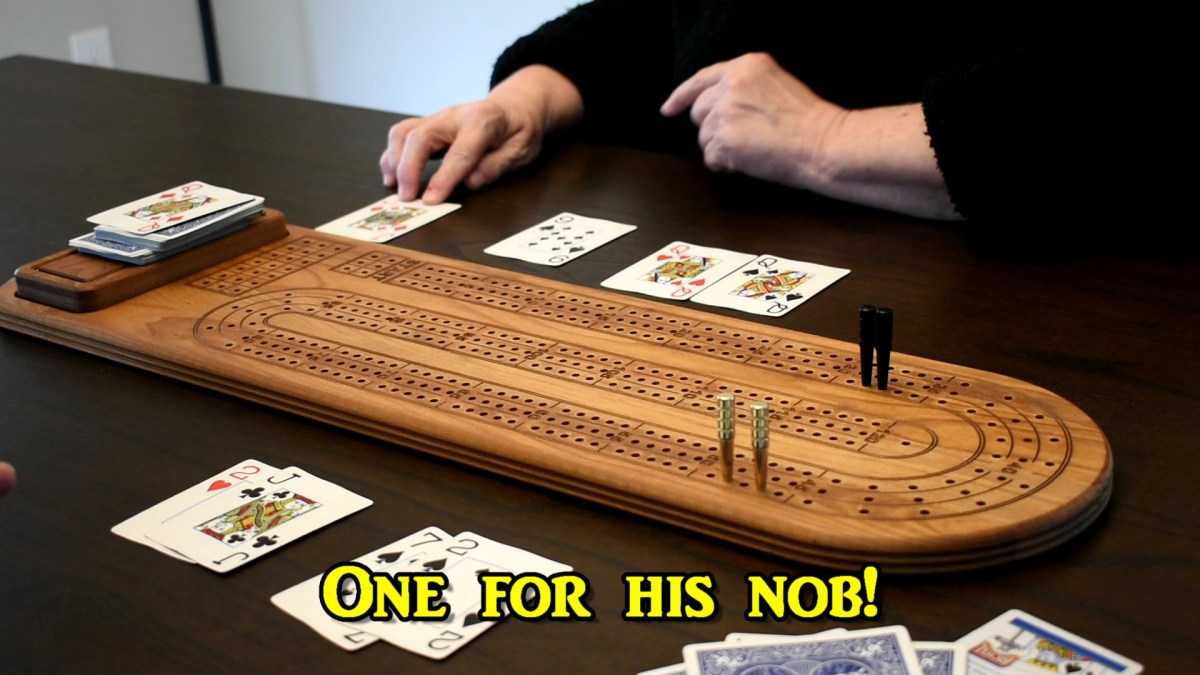
Anyway, the song “One for his Nob” is full of references to cribbage lingo, a lot of which is hard to catch because the tune is so fast. One of the terms is “19 in the box,” which refers to a score of zero in what American cribbage players call the “crib.” A no score in cribbage is often called 19 because that score is impossible. The term “one for his nob” is also standard cribbage lingo for holding the Jack of the same suit as the cut card.
Sena and I thought it would be fun to record a video of us playing cribbage so we could play it back along with Thompson’s song. The thing is I had to speed up the video because it took us a little over 10 minutes to play a cribbage game just to 60 instead of 120. It felt frenetic, but it fits the song a little better because the song is 2 min and 44 seconds long.
If you play the YouTube vide of “One for His Nob” just right and watch our speeded-up video of us playing cribbage, it’s funny. In fact, it just so happened that Sena scored a point twice in the game because she got the nob Jack in two separate hands.
I’ve included the regular speed video of our cribbage game for comparison.
“One for His Nob” is a song about cribbage recorded by British singer-song writer Richard Thompson. It was published by Avon Records and released on July 1, 2015.
I haven’t done a juggling YouTube video in a while, and lucky you I made one. When the daily news gripes me or gets me down, juggling forces me to concentrate on just that—juggling. If I break my concentration for any reason, I literally drop the ball.
I’m limited a little in our new house because of the lower ceiling height, risking a throw into the ceiling lights. And I’m still prone to flinging and dropping balls, depending on the trick I’m practicing. So, I go downstairs to practice more difficult juggling tricks.
So, if you need a special kind of focused attention meditation, try the 100-throw cascade.
I found a very interesting news outlet report about a condition called Foreign Language Syndrome (FLS) which you have to distinguish from Foreign Accent Syndrome (FAS). I wrote a post about that a few years ago. The latter is common by comparison with FLS. FAS is a tendency to speak with a foreign inflection, not speak or be unable to speak a different language, which is what FLS would be.
There are a handful of cases, all within the last 20 years, most of them associated with receiving anesthetic agents prior to surgeries. All could speak more than one language; in other words, they didn’t wake up from anesthesia with the ability to speak another language they never learned before.
I could find only one web link to a case report (see below) about FLS, published about 3 years ago, which is what the news story was about. In fact, the authors of this report describe the case of a 17-year-old male who suffered FLS (forgot his native Dutch language, but who also spoke English) after knee surgery, noting that the other known cases were subjects of news stories.
Oops, sorry, accidentally started babbling in Klingon. I meant to say:
Based on the case report, FLS might be an emergence delirium, caused by the choice of a particular anesthetic agent. Emergence delirium is delirium caused by waking up from anesthesia after surgery, which I’ve experienced a couple of times, although I have difficulty remembering the episodes.
Kiu(j) ne eksklud alia kaŭz por FLS, kvankam verŝajne, plimulto retrov plimalpli tute post du tagojn antaŭ la operacio.
Rats, happened again, with Esperanto. What I meant:
That doesn’t rule out other causes for FLS, although it looks like most people recover more or less completely after a couple of days out from the surgeries.
More studies are needed.
Reference: Salamah, H.K.Z., Mortier, E., Wassenberg, R. et al. Lost in another language: a case report. J Med Case Reports16, 25 (2022). https://doi.org/10.1186/s13256-021-03236-z
The University of Iowa Stead Family Children’s Hospital Neonatal Intensive Care Unit was recently recognized by the American Academy of Pediatrics (AAP) as one of only two such units in the U.S. having the highest levels of neonatal care.
It reminds me of the Iowa Hawkeye football games where, at the end of the first quarter, all the players and football fans wave from the field to the pediatric patients and their families watching the game from UI Stead Family Children’s Hospital. It’s called the Wave, one of the best traditions in college sports.
Well, the AAP waves to Stead Family Children’s Hospital NICU.
Last year, I wanted to present this Distinguished Education Lecture by Dr. Russell Ledet, MD, PhD, given during Martin Luther King Jr. Celebration of Human Rights week. It took a while for my message to the University of Iowa to get through channels, but I want to thank Audra M. King, the Administrative Services Coordinator for the Office of Student Affairs and Curriculum in the University of Iowa Carver College of Medicine for her help in getting it into a YouTube format that allows the general public to see and hear Dr. Ledet’s presentation.
I wrote a post in February last year about how impressed I am with Dr. Ledet as a leader. Now you can hear him tell his own inspirational story.
I just read Dr. H. Steven Moffic’s post on Psychiatric Times, “The Space Station as a Model for Intercultural Cooperation.” I also read the blog of another psychiatric I consider a colleague and friend, Dr. George Dawson, MD, and it’s sort of in the oppositive vein, being about the recent snafu of some Republican Minnesota legislators deciding to submit a bill to the legislature mansplaining Trump Derangement Syndrome (TDS) to the Democrats why TDS needs to become a law. It’s going over like a lead space station.
Incidentally, one legislature activity tracking website (Bill Track 50) has an Artificial Intelligence (AI) summary of the bill which says in part, “…the bill appears to be satirical or politically motivated…”
And the Minnesota Senate Minority Leader, Mark T. Johnson, said the bill was “a little bit tongue in cheek,” and possibly unintentionally joked that “Senate Republicans have always supported mental health funding…” while also calling attention to problems that the two political parties have cooperating with each other (story source WCCO News Minnesota, “Minnesota bill to define “Trump derangement syndrome” as mental illness provokes backlash” by Eric Henderson, Caroline Cummings; accessed March 18, 2025). Obviously these two pieces present opposites when it comes to collaboration.
The other issue pertinent to my post today has been the recent tariff and trade war going on between Canada and America, which is all about competition rather than cooperation.
Therefore, I did a web search for any Red Green Show episodes that demonstrated cooperation as a theme. In fact, the usual AI guidance (which I never ask for) pointed out that The Red Green Show didn’t present episodes about cooperation per se, but satirized the topic. For once, I had to agree with AI for the most part.
On the other hand, I did find a Red Green Show episode called “Twinning” that actually seemed to involve collaboration between Canada and Iowa, if you can imagine that nowadays. Back in the year 2000, The Red Green Show sponsored a survey of all 50 states in America, offering an opportunity for persons from an American city to twin with persons from Canada, I think it was Ontario. This meant that Americans would visit Canada and Canadians would visit America. I may not have the exact details right, but the idea of cross-cultural collaboration and getting to know each other was the main idea.
The whole state of Iowa endorsed the twinning offer with The Red Green Show, which of course, represented Canada. At the time, the Iowa Public Broadcasting Service (PBS) network was supporting the Red Green Show.
I never knew about that when it happened in 2000, probably because I was pretty busy working as a consultation-liaison psychiatrist here in Iowa City, Iowa. Anyway, the “Twinning” episode was one of the funniest I’ve seen. You know, identical twins are not exactly identical in every way.
I’ll bet a lot of people are like me and would like more peace and quiet from government. There’s a crisis every day. There’s even some Minnesota Republicans who want to get a bill through the state legislature defining Trump Derangement Syndrome (TDS) as a new mental illness, applicable only to Democrats. Given the intensely adversarial atmosphere among most politicians, this has made things even more noisy amongst lawmakers.
Because of this highly charged atmosphere which seems to get worse by the hour, I thought it might be instructive to suggest everyone eat some fruit and watch the Red Green Show episode “Good Government.”
Things are much quieter where Red Green lives. Although Jerome, the elected representative of the district, has supposedly been working hard for his constituents for 9 years, it turns out that, in fact, he has been dead for the last 8 years. Things must be pretty quiet in government there because nobody seems to have noticed.
How Red Green and his henchman, I mean co-conspirator, I mean his fellow constituent, address this problem does not involve high drama, although the question of legality does arise—which is hardly a problem provided you ignore the law.
I guess that’s pretty much what happens in real life.
I just discovered the news item about 5 Minnesota Senate Republicans who introduced a bill this month seeking to classify “Trump Derangement Syndrome” (TDS) as a mental illness. This is not a new idea, I think, and it targets Democrats as having the syndrome. There’s a big Wikipedia article about the history of the origin of it.
It reminded me of a Dr. Henry Nasrallah’s editorials about “neuropolitics” a term he used in an effort to understand how much politics can affect the human brain. He published a series of 3 articles in the journal Current Psychiatry. The one published in the October 2018 issue is entitled “Neuropolitics in the age of extremism: Brain regions involved in hatred.”
Dr. Nasrallah is a neuropsychiatrist who has an entertaining and thought-provoking writing style. I met him briefly when I was interviewing for psychiatry residency at the University of Cincinnati.
The political situation now is difficult and it makes me wonder even more if there is a problem with the human brain when it comes to politics.
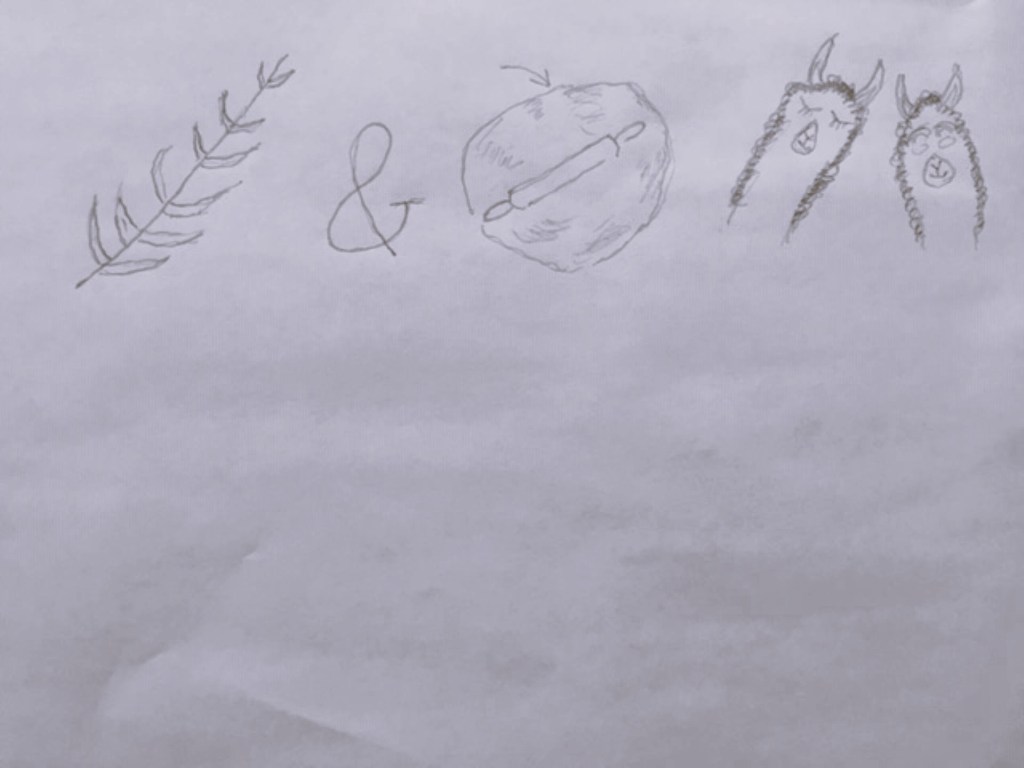
The title of the post is actually a clue to the solution to a picture puzzle riddle I made about the Svengoolie show movie last night, which was “The Lost World,” released in 1960. Svengoolie did one of his picture puzzle riddles which he calls “Too Drawn Out,” which uses a series of pictures to express something about the movie, often one of the actors. It was at the beginning of the show and shortly before that, I had made my own version. I wondered if we were going to be in sync on the riddle.
We weren’t. He drew a couple of pictures, the first one of which depicted a person being clawed by a bear. The second picture showed a cowboy holding the reins of a horse. That segues right into one of the stars in “The Lost World,” Claude Rains. Get it? No? Then have a look at the one I made, which is in a similar vein.
OK, did you guess? If you looked up who starred in the movie, one of them was the subject of a Billy Crystal meme in the 1980s on Saturday Night Live. For those who have seen “The Lost World,” another hint is this actor was often singing a song while strumming a bright yellow guitar, which never picked up any dirt from the land that time forgot in which he and a number of other explorers hunting for living dinosaurs were stranded for a while.
Still stuck? The first drawing is a kind of plant, a fern. I think ferns were around with the dinosaurs and outlived them after the mass extinctions. The second picture is a common symbol. It’s an ampersand, which also means “and.” The third picture shows a roller pin on rolled out dough. And the last picture is of South American animals related to camels—llamas, which pretty much gives the game away. The answer to the riddle is the guy in the movie who always looked “marvelous.” If you thought of Fernando Lamas, the actor who played Gomez in the movie, give yourself a hand.
So, what about the movie “The Lost World?” It starred Claude Rains as Professor Challenger, aptly named probably in part because people found it very challenging to get along with him. He never lost his umbrella (which he sometimes used to punish those who disagreed with him) during the whole trip through the lost world full of volcanic quagmires, giant dinosaurs, and cannibals, huge spiders, man-eating plants and whatnot.
Professor Challenger claims to a group of explorers in London that he’s discovered an island harboring living dinosaurs, which gives everybody a chance to laugh themselves silly, especially when he says he’ll need funds to cover the cost of the expedition, including tickets to Space Mountain. The editor of a newspaper puts up $100,000 to fund the trip, which somehow convinces leaders that this a good bet after all—money talks.
The group includes a reporter named Malone (played by David Hedison) who Professor George Edward Challenger (Claude Rains) bopped on the head with his umbrella, Sir John Roxton (Michael Rennie), Jennifer Holmes (Jill St. John) who wears bright pink stretch paints which was pretty dirt resistant the whole movie, Professor Summerlee (Richard Haydn, who among his film credits was in The Sound of Music), and Gomez (Fernando Lamas) who definitely believes it’s better to look good than to feel good.
When they get to the island, they encounter the dinosaurs almost right away. These are not the stop action models authentic-looking creatures which was the original plan because it turned out to be too costly for production, maybe because it would have cut into cigarette money for the actors.
It was cheaper to trick out big monitor lizards and alligators with horns and plates and then provoke them into a fight which got Fox studios into trouble with the Association for the Prevention of Cruelty to Animals.
The group blunders around the island and eventually they find an old logbook which implicates Sir Roxton as a liar and a greedy cad who abandoned the members of a previous expedition (almost all of whom died) to find diamonds which he never found, which Costa (Jay Novello) another member of the group, gets pretty excited about. Costa tries to get Gomez excited about diamonds too, but he’s pretty mad at Roxton because one of the members of the previous expedition turned out to have been Gomez’ brother.
Pink pants, I mean Jennifer Holmes, who at first wanted to marry Roxton for his title and prestige, now snubs him and shows it by not accepting a cigarette from him. Jennifer brought along her kid brother, David (Ray Stricklyn) and her dog Frosty (which looks like an ancient creature itself, yet gets top billing for some reason: “Frosty, A Dog”). Frosty never gets killed despite being completely helpless and needing to be carted around in what looks like a picnic basket for the whole movie.
The group captures a native girl (Vitina Marcus) who takes a shine to David. Neither of them speaks the other’s language, and the native girl demonstrates her knowledge of how to shoot a rifle, which makes everybody wonder where the island gun shop is. It turns out that the rest of the tribe of cannibals, which later capture them to prepare for a ritual sacrifice, have been keeping one member of the previous expedition, Burton White (Ian Wolfe) alive because he’s blind and it is taboo to kill a blind man. I guess they don’t immediately kill Frosty because they don’t have enough vanilla for the recipe to make what would eventually become the inspiration for the world’s first Frosty malt.
Anyway, White gives the group the remainder of his guns, which the cannibals let him keep evidently because guns are hard to chew. The group takes off on the perilous journey through the volcanic path which turns into something like the Greek myth of Scylla and Charybdis (the devil and the deep blue sea. This is more like molten lava and a dinosaur who has a taste for humans, gobbling up Costa and Gomez (it is better to taste good than to feel good)), both of whom flop back and forth just like small GI Joe size dolls in the lizard’s mouth.
Eventually, what’s left of the group make it out to safety. They lament the lack of any good evidence for dinosaurs to take back with them to civilization—until Professor Challenger pulls out a dinosaur egg. He drops it and it cracks revealing the “Tyrannosaurus rex” iguana squirming around leading to a remarkably Svengoolie-like joke as the final lines of the movie:
Roxton: “…Will it be all right?
Challenger: “It’ll live long enough to grow as big as a house and terrify all London.”
David: “Then what’ll we do?”
Challenger: “Well, we’ll move out of London as fast as possible!”
Well, the forecast was for a very windy day, more windy than we’d like. On the other hand, it was bearable on the Terry Trueblood Trail. However, the forecast is for high winds and hail and we’re not looking forward to that.
The highlight was seeing a leucistic Canadian Goose for the first time. They’re rare. It’s a color variation. The one we saw had a brownish head and white feathers on its body.






 Go Retire Psychiatrist