Cribbage Drips Under Pressure

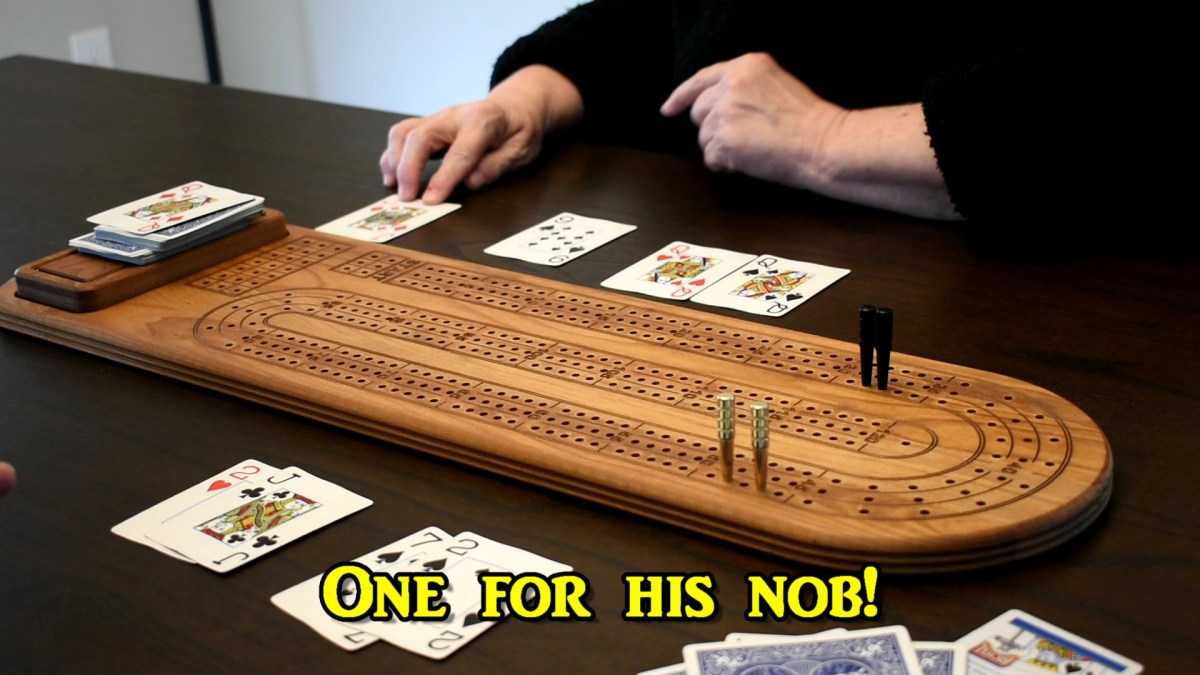
Today we played cribbage under pressure—time pressure that is. We tried it because we wondered about why, in tournament games, you always hear you should be able to play a game in 15 minutes. The American Cribbage Congress (ACC) has over 200 local grassroots cribbage clubs across North America. If you join one of them, you generally have to learn how to play a cribbage game in 15 minutes.

Most clubs have you play 9 other players during regular meetings, which typically last about two and a half to three hours.  I’m sure the practical time range is closer to somewhere between 15-20 minutes, but the driver to keep it shorter is that tournament organizers have to accommodate a large number of entrants. I’m not sure how much you can socialize during meetings. We had to cut the chit chat and focus on the cards.

We’re used to playing at a leisurely pace, chatting and dawdling. Usually, we take about 25 minutes to play a game—sometimes longer. But under time pressure, all phases of the game got more difficult to manage.

We kept getting stuck on certain phases of the game. We probably didn’t throw to the crib as well as we’d like because we felt so pressured to stay under the time limit. I’m sure we made counting and scoring mistakes in both the pegging and scoring phases.

We played 4 games and could play in 15 minutes and 36 seconds in only one of them. It seems like the average for us was somewhere in between 15 and 20 minutes. I used the stopwatch on my cell phone.

Oddly, the second time we tried to play faster led to the fastest time, which was just over 15 minutes as noted above. But each time we played, the longer times got; the first game was around 20 minutes, the next one after that was about 15 minutes; the next was a little over 16 and the next one after that was closer to 17 minutes.

I think fatigue from the pressure got to us. However, I wonder if we just practiced a little more, whether the jitteriness from the sense of pressure would ease because we’d eventually get better at scoring the less common hand and crib scores. Would an expert tell us that? By the way, do you know what the definition of an expert is? A retired drip under pressure.

I gave up on the idea of shuffling 2-3 times each hand and just did it once—which didn’t really seem to improve our times. We’re supposed to get our card shuffling machine tomorrow. I wonder if using that would speed things up or slow us down.

The other point to make is that we usually help each other score and count when we play cribbage. Well, that’s not what tournament players do. You sweat it out and if you make a mistake, your opponent can’t help you. And don’t get me started on the muggins rule. Talk about pressure.

Maybe the answer is to have a fresh deck of cards which don’t stick to each other from the snack foods you eat while playing cribbage just for fun. And don’t talk, joke, laugh, or shuffle too many times, and remember luck is part of the game. Skill can take you just so far. It’s kind of like life. Somebody called cribbage a “finicky game.” OK, so it was Barry Rigal, who’s famous for being a bridge player and edited the book Card Games for Dummies.

So, explain why cribbage players, who I’m guessing are among the most finicky people on the planet, can deal with the pressure of a card game with a lot of finicky rules but manage to play a cribbage game in 15 minutes?

If you’re a cribbage player, we’d love to hear your answers. No pressure.

Big Time Bigfoot Cribbage Game!

Yesterday, Sena and I had a major cribbage showdown on the Bigfoot cribbage board. It took a little practice to get used to it because we generally use the long board. Aside from the usual hiccups figuring out scores, I did a fair job of keeping up for a while.

However; Sena won. She plays a smart game and I didn’t have the time to crack any Bigfoot jokes during the filming of the full game. We’re not tournament players so we took over 25 minutes to play one game. It was fun, though.

Sena ordered a card shuffler machine, and we’ll see how much time that shaves off playing a game. Probably not much although the maker advertises that it shuffles in less than 2 seconds. I don’t think tournaments allow shuffling machines.

Except for the length of the video, I think what it has going for it is the demo of how the game is played.

And on to the important stuff—a couple of Bigfoot jokes:

Do you know why Bigfoot is so good at hiding? He owes money to Chuck Norris.

Bigfoot claims he saw Chuck Norris once, but nobody believed him.

The reason nobody sees Bigfoot is because Chuck Norris found him first.

Bigfoot thinks Chuck Norris is a myth.

Earth Day Trees and Other Thoughts

Today is designated Earth Day although there is such a thing as Earth Month. Among the several trees Sena planted in our back yard trees are a few that we hope exemplify the Earth Day theme, which is Our Power, Our Planet.

One of them is a dogwood, which we’re hoping will bloom soon. Dogwoods represent joy and rebirth. There are a couple of crab apple trees, a red jewel and a perfect purple. Crab apple trees represent love and all are very special to Sena and me.

Love, joy, and rebirth. They can all be linked to power, which can be the power of will. The will to respect the planet also implies respecting each other. Practicing humility can be a kind of power.

The power to be still and listen to each other can make us more open to change.

On that note, because I can’t go for long without joking around, I should retell the story about me and the walking dead meditation. About 13 years ago, I had an even more serious case of not listening to others than I do now, if you can believe that. It eventually led to my choosing to take the Mindfulness Based Stress Reduction (MBSR) class ( see this current University of Iowa mindfulness essay). I wrote an essay for the Gold Foundation and it’s still available (I updated the links):

How I left the walking dead for the walking dead meditation (August 13, 2014)

When I was awarded the Leonard Tow Humanism in Medicine Award in 2007, I was the last person I thought would ever suffer from physician burnout. Early in my career I had won several teaching awards and had even edited a 2006 Psychiatric Times Special Report on Stress.

About a year or so later, I bought Jon Kabat-Zinn’s book on Mindfulness-Based Stress Reduction (MBSR), Full Catastrophe Living, because I was dimly aware of the burden of stress weighing on me as a consulting psychiatrist in an academic medical center. I didn’t get much out of Kabat-Zinn’s book on my first read. But then in 2012 I started getting feedback from colleagues and trainees indicating they noticed I was edgy, even angry, and it was time for a change.

Until then, I’d barely noticed the problem. Like most physicians, I had driven on autopilot from medical school onward.  I had called myself “passionate” and “direct.” I had argued there were plenty of problems with the “system” that would frustrate any doctor. I had thought to myself that something had to change, but I never thought it was me.

After reflecting on the feedback from my colleagues and students, I enrolled in our university’s 8 week group MBSR program. Our teacher debunked myths about mindfulness, one of which is that it involves tuning out stress by relaxing. In reality, mindfulness actually entails tuning in to what hurts as well as what soothes. I was glad to learn that mindfulness is not about passivity.

But I kept thinking of Kabat-Zinn’s book, in which he described a form of meditation called “crazy walking.” It involved class members all walking very quickly, sometimes with their eyes closed, even backwards, and crashing into each other like billiard balls.  I hoped our instructor would not make me “crazy walk” because it sounded so—crazy. I dreaded crazy walking so intensely that I considered not attending the 6-hour retreat where it might occur.

We didn’t do crazy walking. Instead, we did what’s called the “walking meditation.” Imagine a very slow and deliberate gait, paying minute attention to each footfall—so much so that we were often off balance, close to crashing into each other like billiard balls.

I prefer to call this exercise the “walking dead meditation” because it bore a strong resemblance to the way zombies move. One member of the class mentioned it when we were finally permitted to speak (except for the last 20 minutes or so, the retreat had to be conducted in utter silence). It turned out we had all noticed the same thing!

Before MBSR, I was like the walking dead.  I was on autopilot — going through the motions, resisting inevitable frustrations, avoiding unstoppable feelings, always lost in the story of injustices perpetrated by others and the health care system.

In practicing mindfulness, I began noticing when my brow and my gut were knotted, and why. Just paying attention helped me change from simply reacting to pressures to responding more skillfully, including the systems challenges which contribute to burnout. About halfway through the program, I noticed that the metaphor connecting flexibility in floor yoga to flexibility in solving real life problems worked.

Others noticed the change in me. My professional and personal relationships became less strained. My students learned from my un-mindfulness as well as my mindfulness, a contrast that would not have existed without MBSR.

As my instructor had forewarned, it was easy for me to say I didn’t have time to practice meditation. I had to make the time for it, and I value the practice so much that I’ll keep on making the time. I will probably never again do the walking dead meditation.

But I’m no longer one of the walking dead.

This post was written by Dr. James J. Amos, Clinical Professor of Psychiatry in the UI Carver College of Medicine at The University of Iowa in Iowa City, Iowa. He has co-edited a practical book about consultation psychiatry with Dr. Robert G. Robinson entitled Psychosomatic Medicine: An Introduction to Consultation-Liaison Psychiatry. As a clinician educator, among Dr. Amos’s most treasured achievements is the Leonard Tow Humanism in Medicine Award. He blogs at https://retirepsychiatrist.com/

Below was my acceptance speech for the award:

Today we gather to reward a sort of irony.  We reward this quality of humanism by giving special recognition to those who might wonder why we make this special effort. Those we honor in this fashion are often abashed and puzzled. They often don’t appear to be making any special effort at being compassionate, respectful, honest, and empathic. And rewards in society are frequently reserved for those who appear to be intensely competitive, even driven.

There is an irony inherent in giving special recognition to those who are not seeking self-aggrandizement. For these, altruism is its own reward. This is often learned only after many years—but our honorees are young. They learned the reward of giving, of service, of sacrifice. The irony is that after one has given up the self in order to give back to others (family, patients, society), after all the ultimate reward—some duty for one to accept thanks in a tangible way remains.

One may ask, why do this? One answer might be that we water what we want to grow. We say to the honorees that we know that what we cherish and respect here today—was not natural for you. You are always giving up something to gain and regain this measure of equanimity, altruism, trust. You mourn the loss privately and no one can deny that to grieve is to suffer.

But what others see is how well you choose.

I’m still practicing mindfulness-more or less. Nobody’s perfect. We hope the dogwood tree blooms soon.

The Bouncy Egg Caper on Easter!

Want a scientific excuse to waste an egg? Sena and I found this experiment that uses vinegar to make a bouncy egg yesterday.

We put a whole raw egg into a bowl full of vinegar and let it sit for 24 hours. Initially, a couple of hours after we put the egg in the bowl of vinegar, Sena noticed pressure building up in the bowl. Even though the lid was on, vinegar was starting to leak out so she set it inside a larger bowl.

I started to worry a little about whether enough pressure would build to blow the lid off in an explosion—but it never happened.

I think a lot of people get this idea around Easter. The main thing that happens is the vinegar (a weak acid) eats away at the egg shell (which is made of calcium carbonate) until the shell dissolves. Carbon dioxide gas bubbles form. It leaves a rubbery membrane behind. The water in the vinegar diffuses across the membrane.

The egg had a lot of bubbles all over it and was visibly larger. The shell had completely dissolved—and it bounced! Sena tried bouncing it from higher and higher levels until the inevitable splat. All that was left was the yolk and the membrane.

It kind of reminds me of the morgue autopsy scene in the 1997 Men in Black movie between the deputy medical examiner Dr. Laurel Weaver and Agent J (everything reminds of Men in Black movies):

Dr. Weaver: Feel that? Where the eggshell should be? Notice anything strange?                 

Agent J: No, all fine.       

Dr. Weaver: Doctor, the whole shell is missing.                  

Agent J: Well, of course. That’s obviously the first thing I noticed. What I was pointing out is the fact that there are no… pieces…of it left. You know, so the shell is intact; wherever it is whole, somewhere. That we can be sure of.

Svengoolie Movie: It Came from Outer Space

I watched the Svengoolie movie, “It Came from Outer Space” last night. I’m sure I’ll recover someday. Until then, I’ll have to do my best to write about it. Ray Bradbury actually wrote what’s called the film treatment for the story and Harry Essex wrote the screenplay. I gather there’s a difference between the two, but don’t ask me what it is. So, it’s helpful to know that real movie reviewers also noticed what I noticed, which is that the dialogue has a distinctive literary quality. I’m a Ray Bradbury fan from way back in my youth when they were still using stone tablets to write on. But even I noticed the tone and language were more elevated than what I usually see on the Svengoolie TV show.

Kudos to the movie reviewer who mentioned the literary quality of the dialogue, which in my opinion also are reminiscent of Ray Bradbury:

Scheib, Richard. (2002, July 28). It Came from Outer Space (1953). Accessed April 20, 2025. Moriareviews. https://www.moriareviews.com/sciencefiction/it-came-from-outer-space-1953.htm

Interestingly, this blogger’s review says that Bradbury was unhappy with the result of the production.

The other blogger/reviewer had similar remarks, but it was his About post comments which caught my interest, in which his remarks about Svengoolie’s schlocky films on the show are right on target. On the other hand, he likes this movie. He also mentions that Bradbury got fired after getting paid $2,000 for writing the treatment. I’m not clear on why he was fired:

Steve aka Falcon. (Spielberg can’t get enough … It Came from Outer Space (1953). Accessed April 20, 2025. Falcon at the Movies, https://falconmovies.wordpress.com/2014/05/04/spielberg-cant-get-enough-it-came-from-outer-space-1953/

Anyway, I agree with both reviewers that “It Came from Outer Space” is different from most space invaders films in that the extraterrestrials didn’t actually invade Earth. In fact, they had a malfunction in their spacecraft and accidentally crashed here. They were actually headed for somewhere else, possibly Milliways, the restaurant at the end of the universe (“The Hitchhiker’s Guide to the Universe” by Douglas Adams). They took the form of earthlings so they could get around without being noticed.

That doesn’t actually work because, although they looked like us, they talked in a monotone and had blank, unblinking stares. And they crashed here, indicating the same kind of inability to drive that reminded me of the Roswell incident back in 1947 (only a few years before this movie was released) in which a UFO crashed in New Mexico.

The one thing that struck me was that, in the movie, the extraterrestrials not only couldn’t drive their spacecraft, their main goal after crashing was to fix their busted vehicle. Apparently, in their human disguises they had to go to Lowe’s Hardware to buy replacement electrical parts.

So, these extremely advanced creatures who mastered interstellar travel can get electrical parts in a 1950s era hardware store? “Excuse me, can you get me 4,000 gray toggle switches with matching cover plates—and a voltmeter?”

The spaceship carrying the lost creatures looked like a meteor as it crash-landed and again when it took off after it was fixed. Although you can find a Wikpedia article about this movie that, at the very top, links to another which claims that Bradbury published the film treatment as a book, the rest of the article denies that ever happened. I suppose some people are still looking for it, just like those still looking for the Roswell ET bodies.

One Legged Clowning Again

I noticed the other day that I was having trouble doing the one leg stand. It has been getting harder to sustain it past 10 seconds even. It’s not like I’ve been laying off exercising, including the one leg stand. Hey, I can even do a one leg sit to stand (barely). I posted about the one leg stand, including a video, about 2 years ago.

I found another news item and study about old farts like me and it included a new recommendation about the one leg stand. According to this study, if you can’t do a one leg stand for more than 5 seconds, you’ve got one leg in the grave. If you can do 30 seconds, then you’re all good.

So, I practiced a little more and I even tried the one leg juggling trick, which I also tried two years ago—and clearly faked on a video. Well, one leg clowning is back—and this time it’s for real. I think the Latin quote Ars Longa, Vita Brevis fits for this activity. This one leg stand thing is a skill and you have to work at it, even as you age and your life grows shorter.

I still don’t know if this would be called aging gracefully?

References:

Rezaei A, Bhat SG, Cheng CH, Pignolo RJ, Lu L, Kaufman KR. Age-related changes in gait, balance, and strength parameters: A cross-sectional study. PLoS One. 2024 Oct 23;19(10):e0310764. doi: 10.1371/journal.pone.0310764. PMID: 39441815; PMCID: PMC11498712.

Araujo CG, de Souza E Silva CG, Laukkanen JA, Fiatarone Singh M, Kunutsor SK, Myers J, Franca JF, Castro CL. Successful 10-second one-legged stance performance predicts survival in middle-aged and older individuals. Br J Sports Med. 2022 Sep;56(17):975-980. doi: 10.1136/bjsports-2021-105360. Epub 2022 Jun 21. PMID: 35728834.

Learning to Play Cribbage from the Internet

I’ve been looking over the web about learning how and where to play cribbage. It’s a card game for two players usually, but there are variations allowing for 3 to 4 players.

 First, out of curiosity, I started searching the web on where to play cribbage in Iowa.

There are about 200 local clubs across the U.S. connected with the American Cribbage Congress (ACC). You can find them by looking in the Club Directory on their web site. So where could you play cribbage outside of the ACC with others in Iowa?

It turns out there’s a cribbage club in Des Moines, called Capital City. Like many ACC clubs, members play 9 games vs 9 opponents and they are two player games. They accept people of all ages, although one of the main reasons to join is if your interested in tournament cribbage games. Like the web page says, they have fun, but they also have to learn how to play a game in 15 minutes because that’s the usual speed you’d have to play in tournaments. I would expect the atmosphere to be fun and also competitive.

There’s another sort of cribbage club in Iowa and it’s in Indianola, which is only about 20 miles south of downtown Des Moines. It doesn’t have a specific name and it isn’t connected to the ACC. They play in a conference room an Activity Center. Interestingly, they allow only those over 50 years of age to participate. This probably isn’t going to help ensure that the younger generation learns to play cribbage and keep the game alive.

There is a photo of 4 guys sitting at a table and you can see the cribbage board in a corner of the table. So, there is the opportunity to learn the 4-player variation of cribbage. The web site also has a link to a set of rules about how to play the game. The rules have a puzzling suggestion, which is to lead with your highest card. That seems like asking for trouble because your opponent could drop a 5 card on your ten card and get fifteen for two points right away.

Either way, Sena and I are not about to drive several hours just to play cribbage. We’ve only been playing for a little over 5 years now, but over 20 years ago we tried to learn it. Which brings me to the point of how you learn it from the web.

There are so many YouTube videos and other written tutorials, all with variable quality. Some have too much detail for beginners and some don’t have enough detail to keep you interested. The teachers who allow comments on their videos often get heartwarming stories from those who remember playing cribbage with someone they loved.

I like a couple of videos from Jonathan Pinyan. I just watched the shortest one, which is only about 15 minutes long but teaches you all the basics while he plays a game with a friend.

And he made a 20-minute video playing a game with his father. Sena and I watched that one and now she calls the nob jack (one for his nob, the jack of the same suit as the cut card) the right jack because that’s what Jonathan calls it. It’s comical because I always feel like I have to correct her, “It’s the nob jack, not the right jack.”

On the other hand, I just found a web reference which asks about the “his knobs.” You’ll see long, comical discussions on the web about the etymology of terms like that in cribbage, often turning out to be differences between British and American cribbage players’ nomenclature. And the “right jack” is related to the card game Euchre, which is where Jonathan Pinyan got it.

But let’s not get started on that.

CDC ACIP Meeting Today on Vaccines

There’s a CDC ACIP Meeting scheduled to start at 8:00 AM EST today (caught me off guard). The slides are here.

Noteworthy: Dr. Denise Jamieson, MD, MPH is chair of the CMV Working Group. She is Vice President for Medical Affairs and the Tyrone D. Artz Dean, Roy J. and Lucille A. Carver College of Medicine at University of Iowa. In the Q&A session following the Covid-19 vaccine presentation, Dr. Jamieson expressed a preference for a universal recommendation (citing implementation and uptake challenges, which other attendees mentioned as well) for the Covid-19 vaccine as opposed to a risk-based or permissive recommendation. See slide labeled “Discussion” below:

There was no vote scheduled for today’s meeting on the Covid-19 vaccine.

The presentation by Moderna on the new Covid-19 vaccine, mRNA-1283, was helpful. I gather there will be an FDA meeting about it in June.

The Svengoolie Movie: The Deadly Mantis

I watched the 1957 giant insect movie, “The Deadly Mantis” last night on the Svengoolie TV show, and Sena watched some of it. At times, it was a little hard to tell if this was a romantic comedy or a giant insect horror flick. The reporter Marge Blaine (played by Alix Talton) and Colonel Joe Parkman (played by Craig Stevens) had this fling going on which sometimes took precedence over the huge, deadly papier-mâché praying mantis.

There’s a lot of stock film footage of the military and important military radar dividing lines across the northern hemisphere including the DEW Line (standing for Distant Early Warning Line) which were real. There were a couple of shots of Greenland, which is important to you know which U.S. President—who was probably unaware at the time of the dangerous mantis unthawed from its icebound prison in the North Pole.

If you look carefully in the upper right-hand side of the frame at the 34:48-time mark, in the Internet Archive black and white copy of the film, you’ll see an important goof that Svengoolie pointed out (which I missed at first). It’s the shadow of the large microphone and boom which shows up as Marge and Dr. Nedrick Jackson are leaving the room (Jackson is played by William Hopper, cue Perry Mason music because he played detective Paul Drake on that TV Show). It’s interesting that the Perry Mason show was starting the same year this movie was filmed.

One detail never specified about the monster is its exact species. We can’t tell if it’s the European praying mantis or the invasive Chinese Mantis. That’s not important for the movie, but again, it might be important on the world’s current political stage. Most entomologists advise destroying the eggs of the Chinese Mantis. I don’t know if tariff escalation would work. I think it’s hard to distinguish different mantis species eggs apart and we also don’t know the gender of the giant mantis in the movie.

That’s an important detail, which is only delicately referred to in the film as Dr. Jackson reads aloud from a book about the insect’s mating process, which invariably concludes by the female biting off the head of the male and often eating him (called sexual cannibalism). In the movie, Dr. Jackson reads aloud a gentler description, “The female is larger than the male and invariably destroys her mate when he’s fulfilled his function in life.”

There are interesting parallels to the mantis in the way the male and female lead actors interact with each other in the movie. Colonel Parkman and Dr. Jackson both behave like typical male chauvinists, and Marge never bites their heads off. But the romance doesn’t go that far. Marge dances with the soldiers but there’s no scene with Elvis Presley dancing and singing “Heartbreak Hotel.”

And there’s no time for any of that because the giant mantis is too ravenous after being cooped up for thousands of years in an iceberg. All it wants is breakfast: “Two humans on a raft and wreck’em” or is it “Two humans, dummy side up”? Whatever.

Anyway, the ferocious mantis ends up sort of like the bad-tempered giant cockroach in the 1997 movie “Men in Black.” Agents K and J speed through the New York Brooklyn-Battery Tunnel and have a showdown. The soldiers in The Deadly Mantis have their showdown with the monster in New York also, but it’s in what’s called The Manhattan Tunnel, which I found out doesn’t even exist.

But the parallels don’t stop there. Just before that, the terrifying insect climbs the Washington Monument (to get to the top, of course) and buzzes the White House. During the search for the bad bug, the military brass order that every U.S. citizen in the area report any “Unusual Flying Object,” in other words every UFO.

That means the sequel to both movies would need an extraterrestrial giant, bad-tempered female cockroach and mantis hybrid looking to bite the head off a suitable mate who crash-lands her UFO in the 51st state (formerly Canada) leading to the emergency mobilization of Men in Black who partner with Red Green and the rest of the Possum Lodge members to use duct tape and bug spray to overcome the beast and finally ensure peace by neuralyzing everyone in the world using a souped-up satellite owned by Elon Musk. Svengoolie will tell jokes.

It just goes to show you, we’re humans, but we can change, if we have to…we guess.

Music and Change Go Together

We listened to the Big Mo Blues Show last night on KCCK radio 88.3. It was recorded and we noticed that he sounded younger for some reason. Once he remarked that things were difficult because of having to “shelter in place.” The format of the show was different from usual.

That made me wonder if the show was recorded sometime during the Covid pandemic. I’ve been listening to Big Mo for a long time. John Heim, aka Big Mo, been doing the Friday Blues show since about 2005, according to one news story. Another KCCK legend, Bob DeForest, has been doing the Saturday night blues show for over 30 years now.

John Heim, aka Big Mo is still going strong. I think I’ve been listening to his show for about as long as he’s been doing it. He has come back strong since an accidental fall in 2018 in which he sustained a neck injury which led to a long rehab stint. But he’s back.

There have been interesting additions over time, like the Shout-Outs, the Concert Calendar, the Bodega Bay Weather Report, the Big Mo Pod Show in which he and producer Noah on Saturday discuss the music selections he made on Friday. The comedy bits have also been interesting, like MayRee’s hand-battered catfish (It’s better because it’s battered!).

Last night, we heard a couple of songs which we both liked. One of them was “She Don’t Live Around Here” by Samantha Fish. I heard it for the first time on the Big Mo Blues Show and just about every time I hear it, the hair on the back of my neck stands up. I’ve read that music will do that sometimes, although I can’t remember getting that sensation before.

We both liked Delbert McClinton’s rendition of “I’ve Got Dreams to Remember.” He’s had a huge career. Sena asked me if he’s still alive and I foolishly guessed that he died. Nope, he’s 84 years old and evidently still going strong.

I have a personal top ten songs, most of which I’ve heard on the Big Mo Blues Show. They’re not in any particular order. A few of them I like mainly because of the artist’s voice, like Samantha Fish and James Carr.

“She Don’t Live Around Here” Samantha Fish

“The Dark End of the Street” James Carr

“Everyday Will Be Like a Holiday” William Bell or Eric Clapton

“Lean On Me” Bill Withers or Keb Mo

“Mockingbird” Larkin Poe

“I’ve Got Dreams to Remember” Delbert McClinton (written by Otis Redding)

“You Were Never Mine” Delbert McClinton or Janiva Magness

“A Change is Gonna Come” Sam Cooke

“Over The Rainbow and What a Wonderful World” medley Israel Kamakawiwo’ole

“You Can’t Teach An Old Dog New Tricks” Seasick Steve

Lately, Big Mo has played Larkin Poe’s “Mockingbird” a fair number of times. I think one interpretation of it is that people’s sense of their identity tends to evolve over time. At different times in your life, you’ll take on a new voice, so to speak, which fits with the idea of the many songs the imitative Mockingbird sings.

Some songs I like because of the message, like “Lean On Me,” or “A Change is Gonna Come.” And I like the song “You Can’t Teach An Old Dog New Tricks” just because I identify with it. I realized that runs counter to the theme of many songs, which are often about change: people change, the times they are a’changing, and the like. So, my top ten song list will probably change, too.