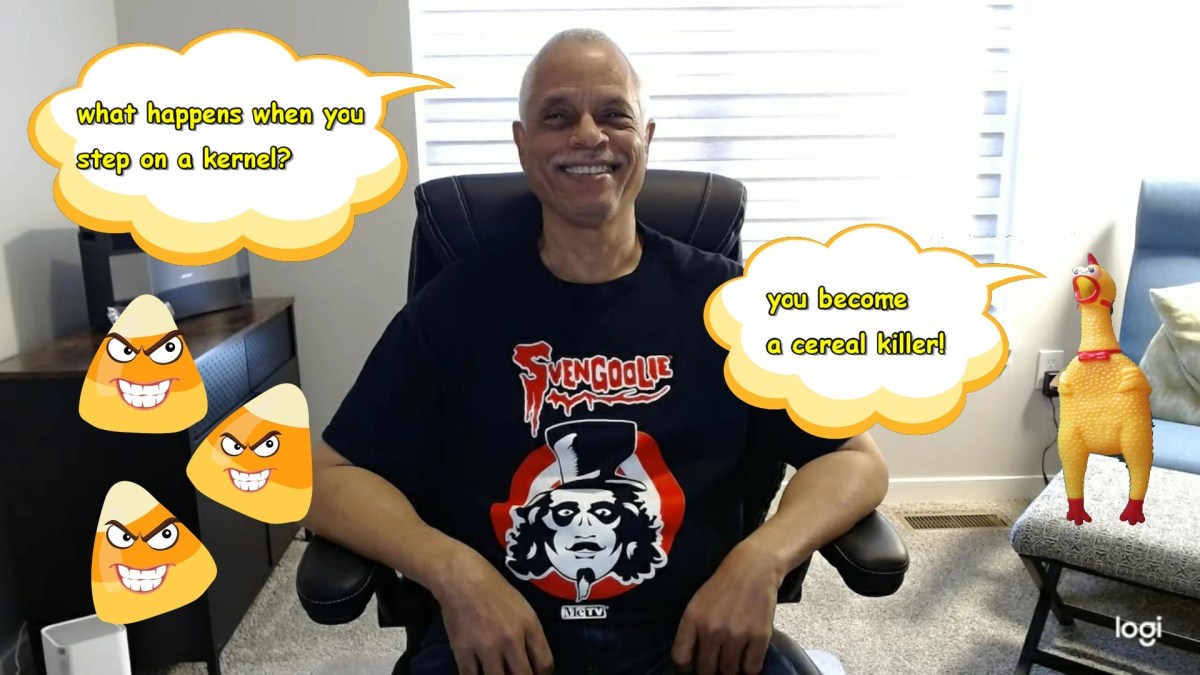
I think I just found out why we have to tune in to the upcoming Svengoolie movie “The Bad Seed” an hour early this Saturday. It comes on at 6:00 p.m. because it’s two hours long!
There’s another crisis. The Iowa Hawkeye vs UMass college football game comes on at 6:40 p.m. tomorrow evening.
That means I’d have to choose between watching “The Bad Seed” or watching the football game. In order to see both I’d have to watch the movie on the Internet Archive.
That means I’d miss Svengoolie’s corny jokes. Hmmmm.
Sena pointed out a swallowtail butterfly fluttering around the lantana in our backyard garden yesterday. The lantana is great for attracting butterflies and hummingbirds because it has bright flowers and sweet nectar.
At first, I didn’t think it was unusual but I got video anyway. When I looked at it, I eventually noticed that the butterfly (which admittedly might be a different species) was lacking either one or both of the tips on its hindwings. For comparison, I checked a video clip of a swallowtail Sena shot when we were out on the Terry Trueblood walking trail a couple of weeks ago. The videos are obviously not the same quality. I shot the one yesterday through a window.
Sure enough, that swallowtail on the Terry Trueblood trail had impressive hindwing tips. I wondered what was so different about the tips on the one we saw yesterday. Not all swallowtails have tips and maybe the tips are smaller or only faintly visible on some species.
It turns out that the wing tips are probably a piece of butterfly anatomy that can be easily sacrificed when bird predators try to eat the butterflies. This is similar to some lizards whose tails can be sacrificed to predators for the same reason. Maybe the wing tips distract birds from attacking the central body parts. Anyway, I found an article about it on the web.
The article cites a study published in the May 2022 issue of the Proceedings of the Royal Society B that seemed to back up the idea that the tips might be an escape tactic. In the article, you can even see a video of bird preferentially targeting the sacrificial tips.
In our video, you can just barely make out either a transparent vestige of one of the tips or maybe there are two barely visible tips on the swallowtail in our garden. I saw a Facebook entry photo showing that females tend to be larger and have more prominent bluish coloring and males tend to be smaller and have more yellowish markings (interestingly, the male in that photo seems to be missing the right hindwing tip). Maybe we’re seeing a female in the video from 2 weeks ago and a male in yesterday’s video, only the male in that picture seems to have obvious hindwing tips, though they are smaller. I don’t know if anyone could help us sort this out.
How about some good news? This just in, University of Iowa Physician-Scientist, Dr. Michael Welsh, wins the 2025 Lasker Award for his research on cystic fibrosis.
His work and the work of two other researchers with whom he’ll share the award set the stage for the development of new drugs which saves the lives of those who suffer from cystic fibrosis.
I learned from the article that the cystic fibrosis gene was discovered in 1989; I was a second-year medical student then. Since then, the development of new treatments has meant that many people who died in early adulthood now can live into their 80s.
We just found out there’s an update to the Forevergreen Monarch tag and release event on September 14, 2025; see announcement below. It still may be a good idea to call ahead and confirm all details of the event.
Since I wrote the blog about the Big Mo Pod Show, Hickory Smoked Blues, I’ve been trying to remember how I connected the dots between Kintsugi and blues music, which is said to be healing even though often it sounds like it could make you hurt.
I had a devil of a time tracking this down. The image of Kintsugi or Kintsukuroi, which is the Japanese art of repairing broken pottery by mending the broken parts a mixture which contains powered gold.
The main idea is that repairing something broken using something like gold (read blues music here) can be healing.
You could also apply this to some other process, including psychotherapy.
The writing of a couple of people helped me make the connection. One of them is now a child psychiatrist named Jenna, who used to write the blog The Good Enough Psychiatrist, a link for which is still on my blog menu. Her post entitled “Amae” (a Japanese concept meaning cherished) caught my attention. Amae has both positive and negative aspects. In a way blues music is similar. It can be nourishing as long as it isn’t too focused on trauma.
About a month later, I found an essay by another child psychiatrist, Dr. Ashmita Banerjee, MD, entitled “The Power of Reflection and Self-Awareness,” actually mentions kintsukuroi at the end of the essay following her poem, called “Not A Poem.”
So, I think what I was getting at was pain and suffering can be reduced in healing ways, which can include art forms, like music. Some blues music can be repetitious, negative and even demoralizing when the emphasis is only on the pain. The other side of the blues can be uplifting, especially when there is the element of cherishing the tender, the wise, and the healing notes—the golden glue.
Both essays were the inspiration for my post, “Food for Thought.” The image of the kintsugi bowl is on both that post and “Big Mo Pod Show: Hickory Smoked Blues.” I still think the Robert Cray Band version of “I’ll Always Remember You” is a reminder of Kintsugi, at least for me.
There’s a new podcast in town from The University of Iowa Health Care and the title is “When to Suspect Atypical Recreational Substances.”
This is a fascinating topic and the discussion ran for close to an hour, which is longer than usual because there’s a lot to say about it. The substances include a lot of chemicals that are not illegal and, in some cases, easily available in convenience stores and gas stations. In fact, the name for one of them is gas station heroin, which is tianeptine, approved in other countries as an antidepressant.
The discussion also included substantial information (or maybe better said, lack of enough information) about bath salts (usually cathinones), kratom, and something I’ve never even heard of: diamond shruumz (chocolate bars which can contain various substances not limited to psilocin). Remember that guy who chewed the face off of somebody in Miami in 2012? That was attributed to intoxication with bath salts.
This is way beyond the 1970s stuff like window pane or blotter (LSD) and pot. Many people end up in emergency rooms for evaluation of what looks like poisoning from multiple drugs. The stickler is the possibility that they got poisoned from something bought at a convenience store. Often it’s difficult to tell what the person ingested.
One of the takeaways from this podcast is that, whenever possible, try to get a history from the patient. They might just tell you what you need to know.
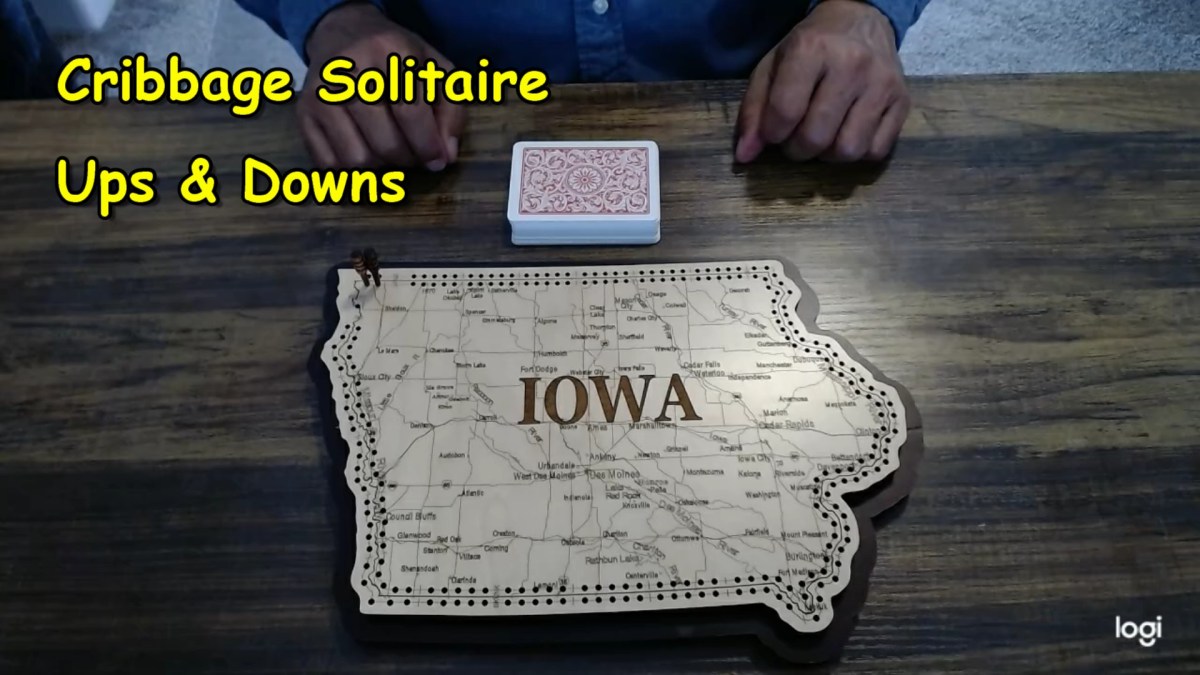
I made this YouTube video of a full six deal game of cribbage solitaire—and missed a 3-card run which would have won the game!
What the heck, I probably made other mistakes too that others will notice.
The rules:
Cribbage solitaire has six hands and six cribs and you peg your six hands.
Start by dealing two cards down to form part of your hand, then one down to form part of the crib. Deal two more to your hand, one more to the crib, and finally two more to your hand (which now has six cards and the crib has two.
Discard two of the six cards to form a four-card crib. Then flip the top card of the deck for the starter card.
Then peg your hand for maximum count, which would not always be the way you’d peg in a game with an opponent. Colbert’s example paraphrased: if you hold 5-10-10-jack. Play the 5 first, then a 10 for “15-2,” then the other 10 for “25, a pair for two and a go.” The remaining jack also scores a “go” for one point. Your peg is six points total.
After scoring the peg, count your hand, then your crib.
Then start the second deal by using the first-hand starter card, which becomes one of the first six cards for your hand. Again, deal the crib two cards. Repeat this process until you complete the game with the sixth deal (the deck will have four cards after six deals). (Colvert, 2015)
Reference
Colvert, D. (2015). Play Winning Cribbage 5th ed. Missoula, Montana: Starr Studios.
Svengoolie Show Intro: “Calling all stations, clear the air lanes, clear all air lanes for the big broadcast!”
This coming Saturday’s (September 13th) Svengoolie movie will be the 1956 Warner Bros. production of “The Bad Seed,” which is about a little psychopathic girl who dares another kid to knock a stick off her shoulder and when he does, he finds out with a shock it’s not a stick but a venomous snake which bites him on the nose, sending him to the hospital in an ambulance which careens off a bridge into a raging river full of giant piranha which—OK, so that’s not exactly how the movie goes and I’ve never seen it before.
The show is coming on at 6:00 p.m. central time instead of 7:00 p.m., just to let you know.
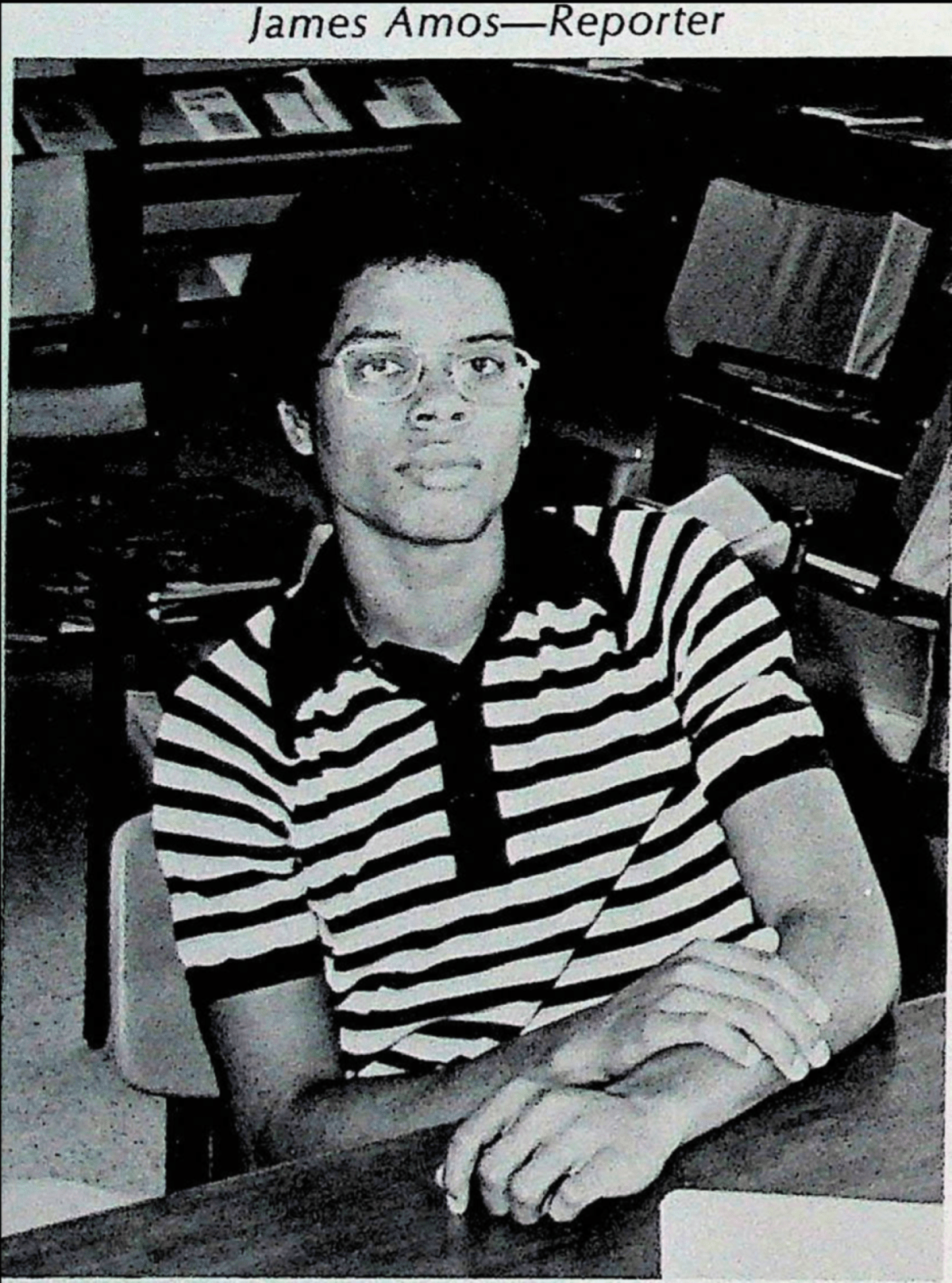
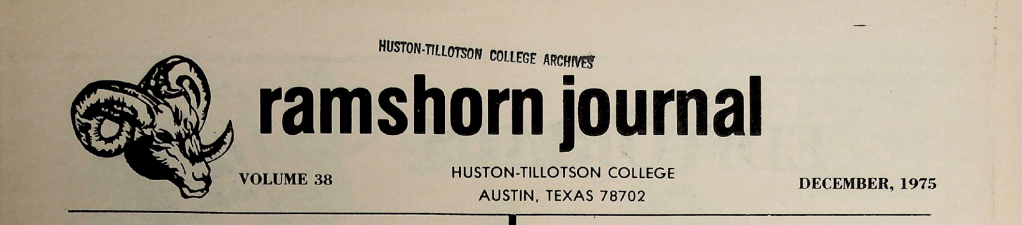
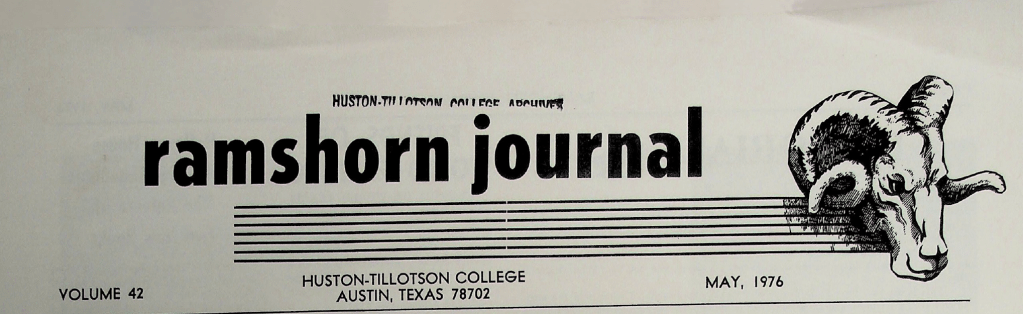
I think I found a pair of articles from the mid-1970s in the Huston-Tillotson College Ramshorn Journal that might have a connection to each other, even though the authors didn’t know it at the time.
One of them was written by yours truly and published in December of 1975, entitled “H-TC Sponsors Education Seminar.”
The other is a New York Times editorial from January 1976 which was reprinted in the May 1976 volume of the Ramshorn Journal and was written by Christopher F. Edley, a very successful lawyer and, at the time, the Executive Director of the United Negro College Fund.
Both were written about the same time, in the era of the civil rights struggles. I’m not comparing myself to the brilliant and accomplished Mr. Edley. And I’m just going to admit that I really don’t remember much about the trip to Houston for the Education Seminar about which I wrote my article, despite my being a participant. But I think it’s hard not to notice the language I used in my description of the importance of what the education seminar was all about. While much of the text is rather dry, when I discuss what was emphasized, I sound a little more intense. I may not remember much of what we specifically did and said but I caught the tone.
When I say the trip was not a guided tour, I mean that both faculty and students were serious about what the main message was for us—as black people. We had to measure up in a way that implied that we had to be better than best. That whole section starting with “Throughout the program, our people were reminded that any person who aspires to a position with any company must fulfill particular criteria.” It was as if I were saying we had to be perfect to make up for being black. We had to be the exemplars.
The individual must exhibit creativity, aggressiveness, ambition, self-confidence, initiative, dedication, maturity, and an ability and willingness to cooperate and effectively communicate with other people. The individual must punctual and reliable. Industry demands nothing less than high-gear performance. But they pay handsomely for that high-gear performance.
As I read this now, I get caught up on all the exhortations to be scrupulous, alert, and so on because, after all, we’re in a corporate jungle which is all about survival. I could have recast the last sentence above as “But they pay dearly for that high-gear performance”—which refers to the candidate, not the one doing the hiring.
I admit that how I wrote the story may reflect my reaction to rather than the reality of the emphasis of speakers at the seminar. But I did get the impression that I, as a black person, would be held to a higher standard than a white person. And I was uncomfortable about that.
When I turn to the New York Times article by Mr. Edley, I again am impressed with the struggle for fairness and justice, which didn’t seem forthcoming. He expressed the same sense of unfairness that I felt in Houston. The tone is almost one of outrage. He described the black people who were going to college in those days as most likely being the first ones in their families to go to college.
That’s what I was.
Mr. Edley was expressing frustration about blacks and browns just being able to get to the door of opportunity. I got the message that the struggle would go on forever—even if we got in the door. We didn’t just have to prove we were equal. We had to prove we were better.
Anyway, as I read the articles I wrote for the Ramshorn Journal 50 years ago, I begin to realize why I had no memory of having written them. It gradually becomes less strange that I still don’t really remember much of my time at Huston-Tillotson College, one of the historically black colleges and universities (HBCU) in America. But I needed that experience, even if I did pay dearly for it.
Click in the gallery; click on the picture, click the icon with an “i” in a circle, click view full size, click the plus sign to enlarge the image.
I’m thinking about the upcoming commemoration of the 24th Anniversary of the 9/11/2001 attack on America. There will be the annual event in New York City.
In Muscatine, Iowa, there will be the annual Patriot Day ceremonies sponsored by the City of Muscatine and the Muscatine Fire Department. After the morning ceremony, the Memorial Stair Climb will begin at 8:52 a.m. at the Muscatine High School football stadium bleachers.
The KCRG news reported on August 7, 2025 that 3 more World Trade Center victims were identified last month by DNA testing. The New York medical examiner’s office continues testing the remains recovered from the wreckage.
Like many people, I remember where I was and what I was doing when the attack happened in 2001. I was the general hospital psychiatric consultant on duty at the hospital at the time. I was hustling up the stairs back to my office after responding to a consultation request.
I happened to glance at the big television screen on the wall of the main floor lobby in the south part of the hospital. I watched in horror as a newscast showed the fire and smoke coming from one of the towers, which I later learned came from the plane crashing into the building. The rest of the day was full of reports of the attack.
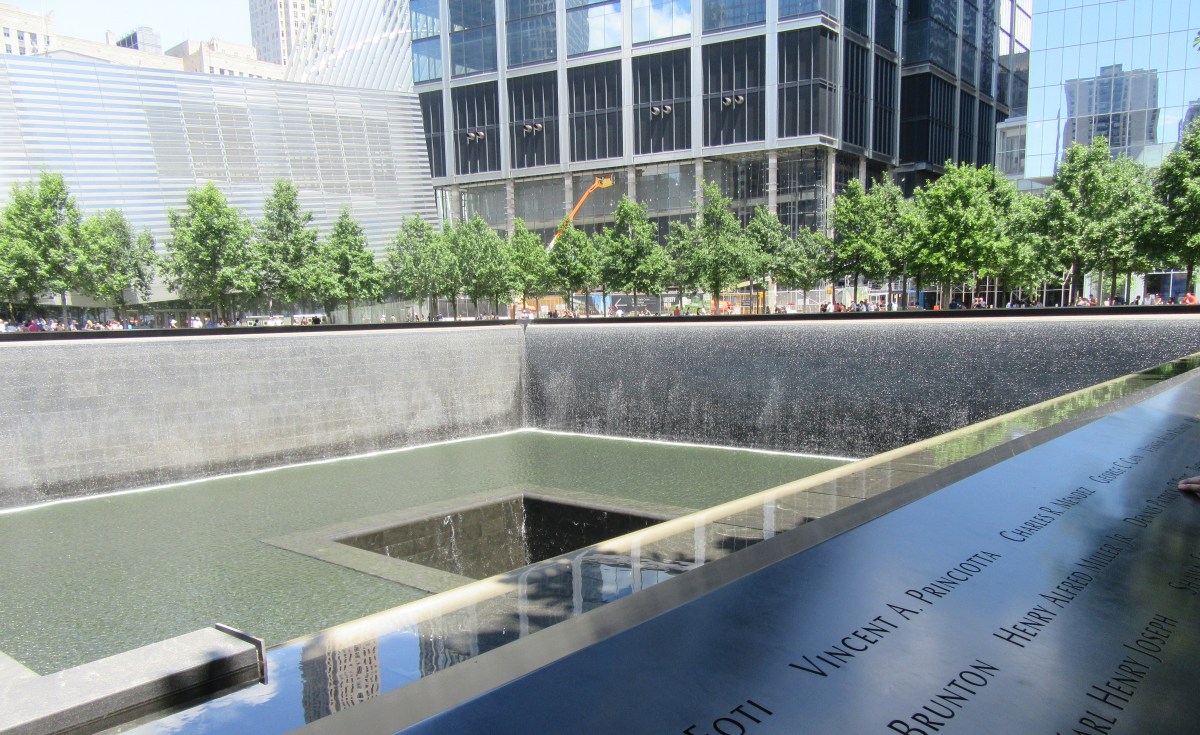
When we visited New York City in 2017, we saw the Memorial & Museum Plaza as well as the Survivor Tree, the Callery Pear. It was discovered at Ground Zero, scarred and scorched but alive and replanted at the Memorial in 2010 after being nursed back to health at the city nursery. It is still alive and well today. It remains a symbol of strength, hope, and a reminder of our connection to each other.













 Go Retire Psychiatrist