Amaryllis Star of Holland On the Comeback Trail!

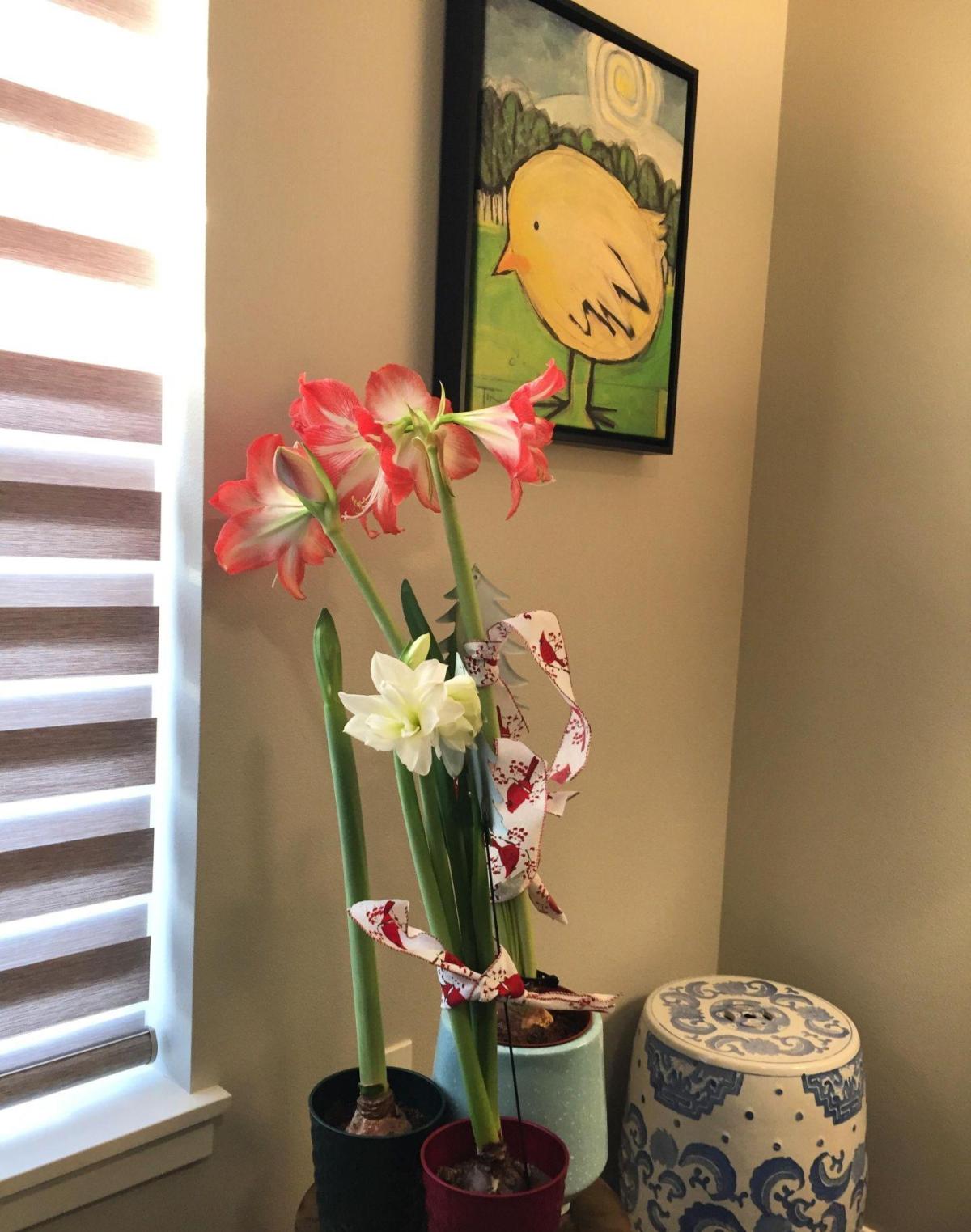
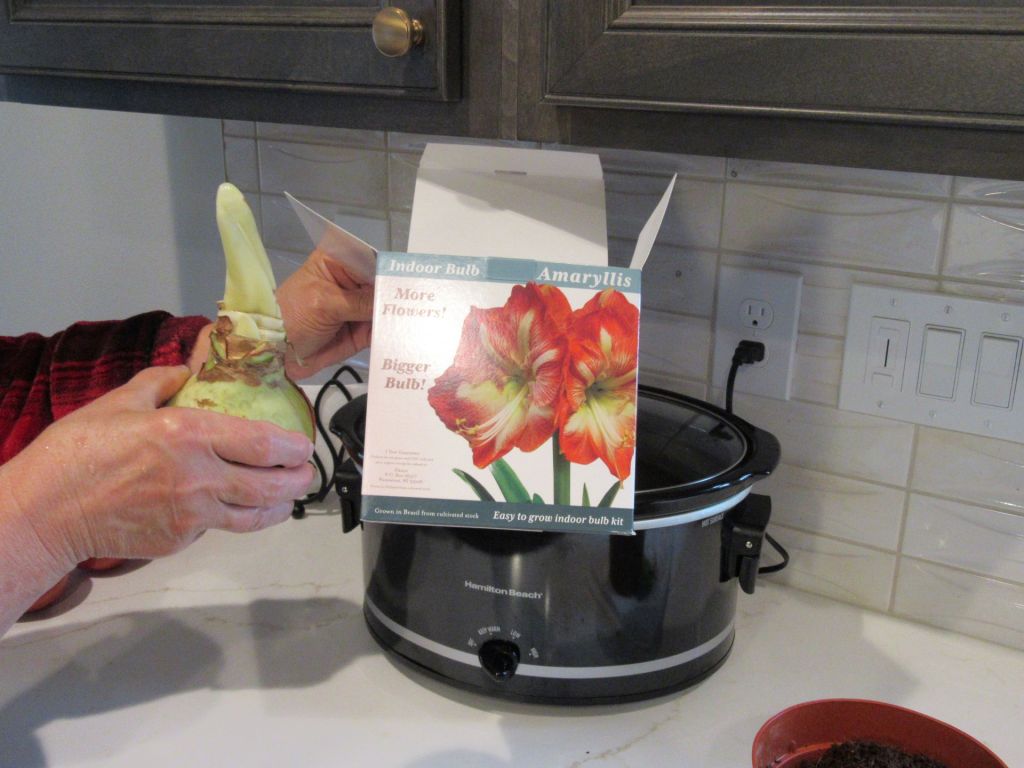
Today, Sena got another Amaryllis Star of Holland bulb. We got one a couple of years ago and it grew like you wouldn’t believe.

The last time we got one, the stalk grew to about 18 inches and sported spectacular blossoms. The stem tended to bend this way and that for some reason.

I wrote the fractured story from Greek mythology about the Amaryllis in 2022, which I’m pretty sure you’ve forgotten by now. I’ll just remind you:

“A little story from Greek mythology says that a maiden named Amaryllis had a monster crush on a shepherd named Alteo, a first-class heel who ignored her but loved flowers. She tried stabbing herself in the heart every day with a golden arrow for thirty days but at first that only led to a lot of trips to the local emergency room. But on the thirtieth day, a gorgeous flower grew from her blood. That’s the only thing that got Alteo’s attention; can you believe that jerk? They got married and honey-mooned at Niagara where they both got smashed on fermented winterberries, jumped out of the Maid of the Mist boat, crashed into a rainbow which turned out to be a wormhole portal to another galaxy where they finally sobered up by eating beef jerky from Sasquatch, who is an interdimensional creature as everyone knows.”

You can check my sources for accuracy of the yarn-if I were willing to give them to you, which I’m not.

We’re eager to see how things go this year with the new Amaryllis.

Little Autumn Promenade

Yesterday, we took a stroll on the Terry Trueblood trail. It was a little breezy and warm for late October.

The fall colors were gorgeous and there was a lot going on. We saw a woman with her toddler flying a butterfly kite. It sailed on the wind beautifully. We saw the quilted hearts hanging from the trees. They’re very cheering. In the wind they looked like they were waving at you.

The woolly bear banded caterpillars were out. I don’t think you can really tell how hard the winter is going to be by looking at the color bands. But it’s fun to talk about.

And then we thought we saw ladybugs. But they could have been Asian lady beetles. It’s hard to tell them apart. The latter often don’t have spots at all. We noticed that they seem to sort of push up their hinders until they’re almost upside down and they may shove each other around.

There’s a pretty vigorous debate on the web about whether the Asian lady beetles are the bad guys and the ladybugs are the good guys. We know they can crawl all over you.

The oddball thing was that we found a baby booty hanging on one of the sign posts. It had an image of a ladybug on it. Or was it an Asian lady beetle?

When you’re in the autumn of your life, it might be time to stop asking too many questions.

Thoughts on the Big Mo Pod Show 034: Laughing in the Face of Death

I heard the Big Mo Blues Show just (Halloween theme) this last Friday night and was not surprised to see that one of the songs discussed on the Big Mo Pod Show on Saturday was Peetie Wheatstraw’s “Devil’s Son-in-Law.”

When I first heard it, it got me chuckling because I didn’t understand hardly a single word until the last line. It was babbling. I can remember googling the term “Peetie Wheatstraw and unintelligible,” which revealed I’m not the only one who thinks he’s unintelligible. It’s a mondegreen mine field. It’s a good thing the lyrics are available.

I want to hastily point out that he’s not always unintelligible—but William Bunch aka Peetie Wheatstraw is speaking in tongues on that song. For comparison I listened to another song, “Sweet Home Blues” and I could understand just about every word in the lyrics.

That led me down the rabbit hole about the artist in a web search that seemed to have no end. I should probably say Brer Rabbit hole since most of my searches pointed in the direction of a character called Peter Wheatstraw, Petey Wheatstraw, as well as Peetie Wheatstraw who had variations in their identities, most often in the context of African American folklore.

I’m not going to attempt a summary of my web search on Peetie Wheatstraw; there’s too many twists and turns. You can start with the Wikipedia article. But from there, you can get trapped in Brer Rabbit’s little tunnels, which can run in different directions.

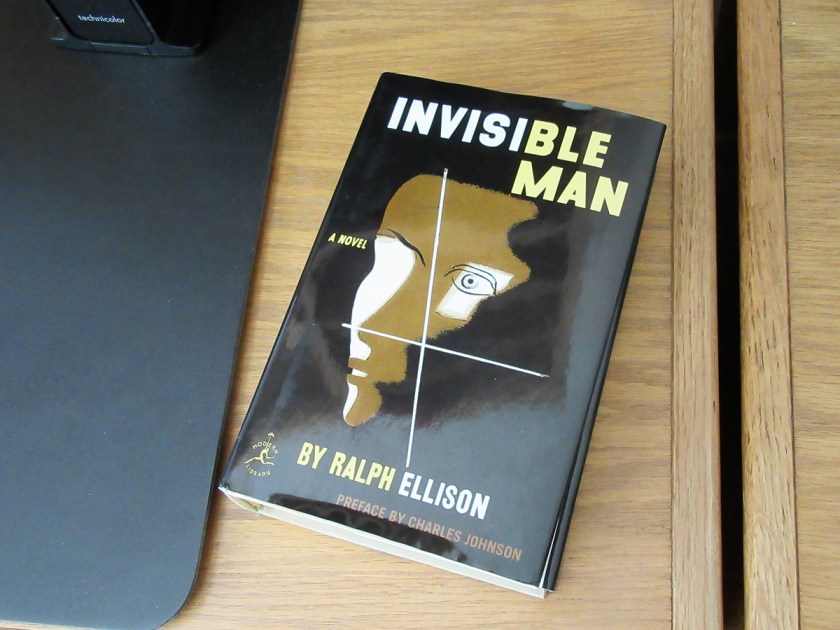
William Bunch was a blues artist in the 1930s who adopted the moniker “Peetie Wheatstraw.” While Big Mo says it’s sort of another name for Satan, I found confusing references by writers who claim that the Peter Wheatstraw character comes from Black folklore. There are those who believe that novelist Ralph Ellison wrote about a character in his book “Invisible Man” named Peter Wheatstraw and said it was the only character in the novel that was based on a live person—William Bunch.

Is that true? And did Ellison ever meet Peetie Wheatstraw (William Bunch)? I can’t tell from the web articles.

I was prompted to get my copy of “Invisible Man” out after reading a scholarly online essay mentioning the Peter Wheatstraw character, “Re-visioning Ralph Ellison’s Invisible Man for a Class of Urban Immigrant Youth” by Camille Goodison, CUNY New York City College of Technology. I couldn’t remember Wheatstraw at first, but there he was in Chapter 9.

Goodison reveals there is a lot more texture to the Wheatstraw character then just as a moniker adopted by William Bunch. Wheatstraw is probably more complex than the devil. He has many sides to him and could be helpful—but mostly in an indirect way. His guidance is full of riddles and there doesn’t seem to be a solid way to cut through the metaphorical morass. As Emily Dickinson advised, Wheatstraw may tell the truth—but tells it slant.

I still don’t know why he mumbles the song.

Thoughts on The Big Mo Podcast 033: “A Balance of Old and New”

This is just a short piece on the Big Mo Podcast last Friday night and his comments about one of the songs he played that night. It made the list of 5 songs he and Producer Noah discussed a couple days later.

Big Mo’s had great comments about all the songs, but I took special notice of those about one of them. It was James Carr’s big hit in 1966, “Dark End of the Street.”

The most important thing about it is that I remember listening to it when I was just a kid. I was too young to understand the meaning of it. But his voice grabbed me. That’s really the only thing I can say about it. His performance still has the power to raise the hair on the back of my neck, even though I can’t identify with the lyrics or connect the theme to any life experience I’ve had. I suspect many people feel the same way.

The other reason I connect with the song other than Carr’s voice is his life story. He was said to have suffered from a psychiatric illness, the nature of which seems like it was never clearly identified. I’ve read a few web articles and terms like “bipolar disorder,” “depression,” and other similar references come up. His psychiatric diagnosis is the least important thing.

Carr’s life story is hard to read, despite what little there is of it to read about. It’s painful. The version on the Black Past website encapsulates what you find in several other articles: Tulino, D. (2018, February 21). James E. Carr (1942-2001). BlackPast.org. https://www.blackpast.org/african-american-history/carr-james-e-1942-2001/.

But to get the real point about James Carr, all you have to do is listen to that one song, “Dark End of the Street.”

Reading My Old Book in a New Light

Sena bought me a wonderful new lamp to read by and it improves on the ceiling fan light I wrote about the other day (And Then a Light Bulb Went Off).”

The new lamp even has a nifty remote control with which you can choose the ambient feel. There are several selections, one of which is called “breastfeed mode,” a new one on me. There’s a light for that?

The lamp arrived at about the same time I got a notice from my publisher for my one and only book, “Psychosomatic Medicine: An Introduction to Consultation-Liaison Psychiatry,” that people are still buying—after 14 years! My co-editor was my former psychiatry department chair, Dr. Robert G. Robinson. As far as I know, Bob has dropped off the face of the earth. I hope he’s well.

Consultation-Liaison Psychiatry is probably about the same as I left it when I retired 4 years ago. I walked all over the hospital trying to help my colleagues in medicine provide the best possible care for their patients. I put in several miles and stair steps a day. I saw myself as a fireman of sorts, putting out fires all over the hospital. I got a gift of a toy fire engine from a psychiatrist blogger in New York a long time ago.

Now I walk several miles on the Clear Creek Trail, like I did yesterday and the day before that. I have shin splints today, which tells me something—probably overdid it.

So, I’m taking a break from walking and reading an old book in a new light.

Because I Wanted a Hurts Donut…

I got an urge for a Hurts Donut so I walked on the Clear Creek Trail to Coralville get to the little hole in the wall shop. You can easily walk to several places in Coralville on the trail. Actually, I wanted to also check out the Coralville Public Library and see S.T. Morrison Park. I’ve never been to that park so it was a novelty all by itself.

It took about 45 minutes to walk to that part of town. It’s great exercise and beats the traffic. You have to walk under some railroad tracks and there’s a sign warning you not to stand in the culvert below while the train is passing over the top. I can see why.

There are funny signs in the rustic Hurts Donut shop. You can see the corny “Wanna hurts donut?” jokes on the walls. There’s another sign saying “School is important but donuts are importanter,” which reminds me of my coffee mug which says sort of the same thing about cribbage: “Education is important but cribbage is importanter.”

The Old-Fashioned donuts there are so good, but so bad for you. I had two.

The Coralville Public Library has a beautiful skylight. I haven’t been in a public library for ages and so it was fascinating to see that libraries haven’t changed much.

In fact, after I found one of Dave Barry’s books, “Dave Barry Book of Bad Songs,” (published in 1997; I had a copy but it got lost in a move) I asked one of the librarians about the old rule I learned as a kid. You might remember it too if you’re old enough. When you pick a book off the shelf and go to a reading room to look it over—can you just put it back on the shelf where you found it or do you have to give it the librarian who will reshelve it?

If you guessed that you have to give it to a librarian, you’re right and you’ve probably dated yourself. The librarian joked that some things never change. Sometimes that’s a good thing.

Among the things that never change are the difficult to understand lyrics in some songs. Dave Barry wrote a whole chapter about it in the Book of Bad Songs, “Songs People Get Wrong.” He mentions one of them, which I always got wrong but never told anyone about it because it was embarrassing. It’s a lyric in the song “Blinded by the Light” that Barry said was done by Bruce Springsteen, but which I didn’t hear until Manfred Mann’s Earth Band covered it.

So, here’s my deal with that lyric. I always heard “wrapped up like a douche” instead of “revved up like a deuce.” Barry notes that many people made the same mistake. Funny thing, Barry never mentions what that common mistake is called and it’s a mondegreen (a misunderstood or misinterpreted word or phrase resulting from mishearing the lyrics of a song). Music is important but mondegreens are importanter.

I finally saw Morrison Park and it’s a very restful place. You can contemplate the sculpture which is placed in the center of a pond. Ducks paddle around it. It’s called “Silver Lilly” and it was made by Professor Hu Hung-shu. Art is important.

Thoughts on the Big Mo Pod Show “Funkin’ Down the Highway”

This is a post about the Big Mo Pod Show we heard last night on the KCCK FM radio dial 106.9. Incidentally, the KCCK fund drive was enormously successful this year, earning $100,000 in donations, according to Big Mo (aka John Heim) himself.

One item is the cover by Buddy Miles of the song “Tobacco Road.” This rendition was different from performances by other artists. Big Mo liked it and so did I. I did a little web search on it because I couldn’t catch all the lyrics. It was originally done by John D. Loudermilk in 1960. Miles’ version is essentially the same.

What interested me even more about “Tobacco Road” are the associations I have about it with specific literary works. I’ll admit I’ve never read nor seen the film adaptations of Erskine Caldwell’s books, “Tobacco Road” and “God’s Little Acre.” But one of my favorite short stories by James Thurber is “Bateman Comes Home,” which was published in a collection entitled “The Thurber Carnival,” in a hardcover edition in 1945. You’ve got to read it to get a sense of how comical the parody is of the regional dialect used in Caldwell’s novels. In fact, Thurber himself gives the game away about his intent in writing “Bateman Comes Home” by adding a wry comment as a subtitle:

Written after reading several recent novels about the deep south and confusing them a little—as the novelists themselves do—with “Tobacco Road” and “God’s Little Acre.”

He also adds another comment at the end of the short story: “If you keep on long enough it turns into a novel.”

The other thing I noticed about the podcast last night is that one of the songs which was not included in the list, “Joliet Bound,” was performed by an artist I haven’t heard of, the Reverend Shawn Amos, who is no relation to me, of course. But my background as a psychiatrist made me take special notice of details about his family, one of which is that his mother, Shirl-ee Ellis, a singer herself, had been diagnosed with schizoaffective disorder. Sadly, she eventually died by suicide. Shawn Amos is also the youngest son of the Famous Amos chocolate chip cookie founder, Wally Amos (again, no relation), although I’ve gotten a lot of friendly ribbing about that.

The song “Joliet Bound” is about a guy who expresses that he’s wrongly accused of killing a man over a woman and is on his way to Joliet prison in Joliet, Illinois. The Joliet Prison is a tourist destination nowadays and has other distinctions attached to it. It was featured in the 1980 film, the Blues Brothers. There were some famous inmates there, among them John Wayne Gacy, who was once evaluated and diagnosed with antisocial personality disorder by psychiatrists at The University of Iowa in 1968 as described in Dr. Donald Black’s book, “Bad Boys, Bad Men: Confronting Antisocial Personality Disorder (Sociopathy).”

Congratulations KCCK Radio!

Notes on the Blues and Rivers of Whiskey

I listened to the Big Mo Blues Show last night on KCCK radio (88.3 on your dial) as I usually do on Friday nights. It runs from 6:00 pm to 9:00 pm and you can learn a lot from Big Mo (aka John Heim) about the blues.

He also has a podcast called the Big Mo Pod Show, which is based on his blues show. He gets quizzed about some of the songs he played on Friday night by Producer Noah (as Big Mo calls him). Last night he was on target for all 5 of the songs he played and why he played them.

One of the songs I’ve never heard before but it was done by Taj Mahal and Keb Mo, artists I’m familiar with just from listening to Big Mo’s show. The title was “Diving Duck Blues. The chorus goes “If the river was whiskey and I was a diving duck, I’d dive to the bottom and I’d never come up.”

That led to a discussion of how alcoholism was sometimes (maybe more than sometimes) a part of the life of blues musicians. In fact, the lead off song last night was “Big Road Blues,” sung by Tommy Johnson. His last name just happens to be the same as Robert Johnson who made the song “Crossroads” famous because he claimed he sold his soul to the devil in order to become a great blues musician. Several blues artists made the claim, which Big Mo debunked as a ruse to get fans to pay more money to hear them perform.

But Tommy Johnson struggled with alcoholism and, according to Big Mo, was driven to the point of drinking Sterno, which was poisonous because it contained methyl alcohol.

This can lead you to think that maybe all blues music is gritty, played by alcoholics, and even depressing as declared by the lead character, Navin Johnson, played by Steve Martin in the movie “The Jerk” (a white guy raised by a black family).

Incidentally, this reminds me that a recent study showing that digital cognitive behavioral therapy is effective for those suffering from alcohol use disorder.

Anyway, blues musicians don’t always play sad, gritty music and die from drinking Sterno. One that is actually funny is “You Left the Water Running” by Otis Redding. You can look up the lyrics or listen to anyone who covers the song and it would be difficult not to laugh out loud.

And speaking of covering a song, Bill Withers originally wrote and sang “Lean on Me” back in 1972 which Keb Mo covered recently. I think it’s one of those uplifting examples of blues music which won’t send you diving to the bottom of any whiskey rivers.

University of Iowa Writing Programs Get High Ranking from U.S. News & World Report

The University of Iowa ranks No. 9 across all universities in the country for its power in the writing disciplines., according to the 2024 U.S. News & World Report.

The school is well known for its writing programs of which the The Writers Workshop is the best known.

The University of Iowa also gives medical students a leg up on writing in its Writing and Humanities Program, which offers courses such as writing and medicine and editorial writing.

This reminds me of a couple of things, one of which was the University of Iowa medical school note service. Many medical schools have note services so that not all students have to write their own lecture notes. It’s ironic in a way that one of the best known public medical schools didn’t encourage all the medical students to labor over their own class notes. I volunteered once to write notes for the class. It was hard work.

The other thing writing education at the University of Iowa reminds me of is the Iowa Avenue Literary Walk. There are several plaques along Iowa Avenue which honor famous authors who had Iowa connections, often through the Iowa Writers Workshop. My favorite is one by Kurt Vonnegut, a former teacher at the workshop.

Thoughts on X-Files Episode “Sunshine Days”

I saw the X-Files episode “Sunshine Days” again last night. It’s the second time I’ve seen it. It’s about a guy who calls himself Oliver who has telekinetic power and who yearns for a father-son relationship with a paranormal researcher (Dr. Reitz) who studied him when he was a kid named Anthony.  

The set of an old 1970s TV show “The Brady Bunch” was used. It was something Oliver created using the power of his mind. As a child, he used to insist that he and Dr. Reitz watch the show regularly. In his mind, it was the perfect family he always wanted but never had.

Anyway, Oliver (Anthony) endangers his life when he uses his telekinetic powers as an adult. He can’t control them and nearly dies from using them. He ends up near death in the hospital after showing the FBI agents including Scully and Doggett (who replaced Mulder) his miraculous ability. The agents and Dr. Reitz are ecstatic because they think it will change the world and humanity.

But after they realize the life-threatening nature of Oliver’s powers, they all agree, including Dr. Reitz, that Oliver should never use them again. Dr. Reitz even tells Oliver (who now wants to be called Anthony) firmly that he can’t use his power, to which Oliver replies that he can’t be alone. Then, Dr. Reitz tells Oliver that he’ll never have to be alone because he’ll always be with him.

A lot of fans hated it because it was the penultimate episode before the final show of the 9th and final season of the X-Files. It was one of the many Monster-of-the-Week (MOTW) shows that had nothing to do with the extraterrestrial mythology.

I liked the MOTW episodes better the ET/conspiracy shows, and Sunshine Days is one of my favorites. However, I never watched The Brady Bunch and the whole perfectly happy and well-adjusted family idea was ridiculously implausible in my opinion.

I doubt there is such a thing as a perfect family. Mine certainly was not and look how well I turned out. Even in nature, there are examples of savagery that can make you doubt the ultimate wisdom of whoever or whatever is in charge of evolution.

For example, birds can be exquisitely cruel. Cowbirds lay their eggs in the nests of completely different species of birds, where the cowbird chicks bully their weaker nestlings. And surely just about everyone has seen the pitiless pecking of the larger of the two shoebill chicks in which the parents calmly watch as the smaller chick gets stepped on, pushed out of the next and essentially murdered by the bigger chick. This is because the parents know there is not enough water for both.

Even the song “A Boy Named Sue” is based on the natural law of survival of the fittest, which has nothing to do with kindness. Incidentally, that song came out in 1969, the same year that The Brady Bunch show began.

On the other hand, the reconciliation of Anthony with Dr. Rietz always fills me with joy.