I have to admit that I’ve been mis-hearing some of the lyrics of one of my favorite songs, “Lean on Me” for the past fifty-odd years since Bill Withers wrote it. It stayed on the top of the charts for more than 3 weeks back in 1972. That was a special time in my life; and not an easy one.
Back then, you couldn’t just look up song lyrics or anything else for that matter on the world wide web. It didn’t exist yet. I’ve always been prone to mondegreens and I finally found out that I was hearing something different in the verse:
“Please swallow your pride
if I have things (faith?) you need to borrow
For no one can fill
those of your needs
That you won’t let show”
Just to let you know, I found lyrics in one YouTube that substituted the word “faith” for “things”. Think about that one. I don’t know how to settle it, so if anybody knows which word is right, please comment. Anyway, it’s a little embarrassing and revelatory that I heard “…if I have pain…” instead of “…if I have things (or faith)…” And I never really heard “…That you won’t let show.”
Yet I lived it.
Years later, after I’d finished college, medical school, residency in psychiatry, and had taught residents and medical students at the University of Iowa for a number of years, one of my colleagues, Scott, a brilliant psychologist and writer, stopped by my office one day. This was years ago.
His name is Scott and he suggested that it would be nice to get together sometime soon to catch up. I deferred and I remembered he replied while looking off down the hallway, “I’m 70.” I wonder if he meant he didn’t know how much more time he had left.
Scott and I had taken similar paths in the middle of our careers at Iowa. I wanted to try private practice and left for Madison, Wisconsin. Scott got the same idea and left for a position in Hershey, Pennsylvania. We both regretted it and soon after returned to Iowa. I swallowed my pride and came back because I loved teaching. I think he returned for the same reason. We were both grateful that the UIHC Psychiatry Dept. Chair, Bob Robinson, welcomed both us of back.
Jim’s teaching awardsBooks by Scott and Jim
I touched base with Scott a little while ago. We’re both retired. I was trying to find out how to contact Bob about messages I was getting from the publisher of our consult psychiatry handbook. Neither Scott or I could find out what was going on with Bob, who retired several years ago and moved back East. It turned out he had died. Sometimes we all have sorrow.
Scott is my friend, and I leaned on him a long time ago. I’m unsure if I let it show. I’m 70 and I’m grateful to him.
On that note, I’m finding out that I can’t walk all the way to the mall and back anymore. On the other hand, I can walk about half that distance. It’s about a mile and a half out to the Clear Creek Trail and back. There’s a lot of uphill and downhill stretches along the way. I can manage that.
And Sena bought me a couple of pairs of new shoes that I’m breaking in that will probably be easier on my feet and my calves. They’re Skecher slip-ons, not to be confused with the no hands slip-ins. I’m used to slip-ons. I tried one pair out today, in fact. Before I left, I took a few pictures of Sena’s new garden. As usual, she’s planting new flowers. The dogwood tree looks great. She’s even excited about the wild phlox. I can’t keep track of everything else out there. She makes the beauty out there.
And I lean on her for that.
dogwood treewild phloxeven more flowersflowersmore flowersnew shoes1new shoes2
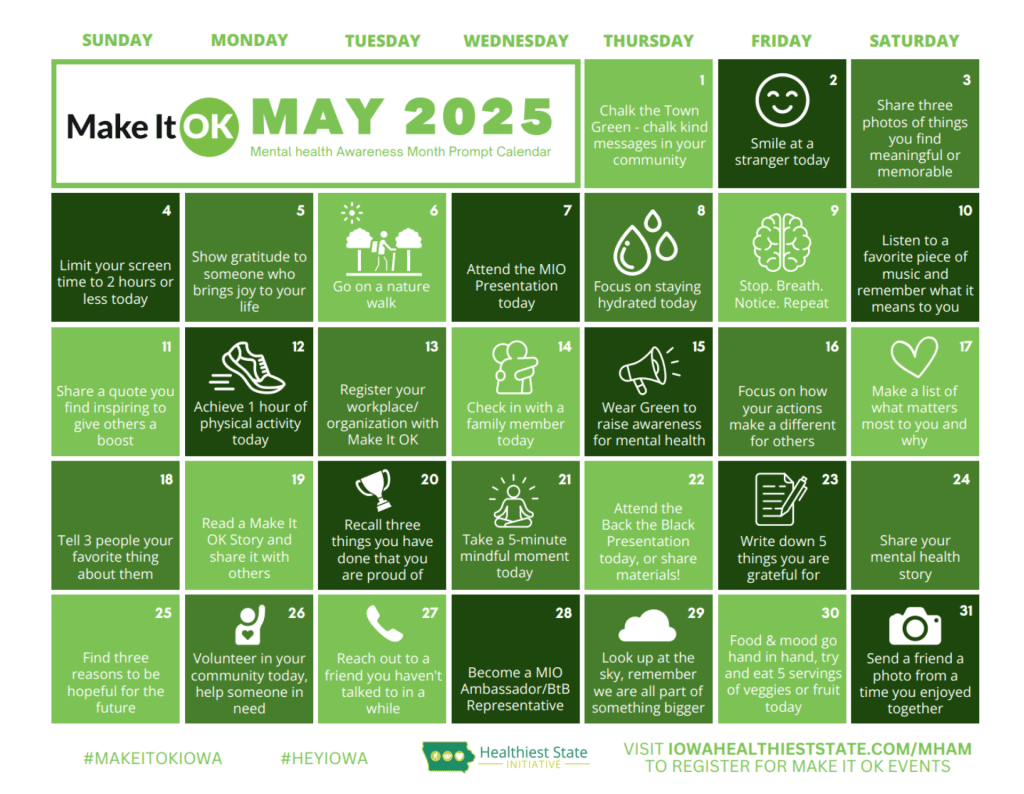
So, I have to hurry up and get these 3 photos posted for today because it’s getting pretty late. Recall the Iowa Healthiest State Initiative calendar along with my photos to share:
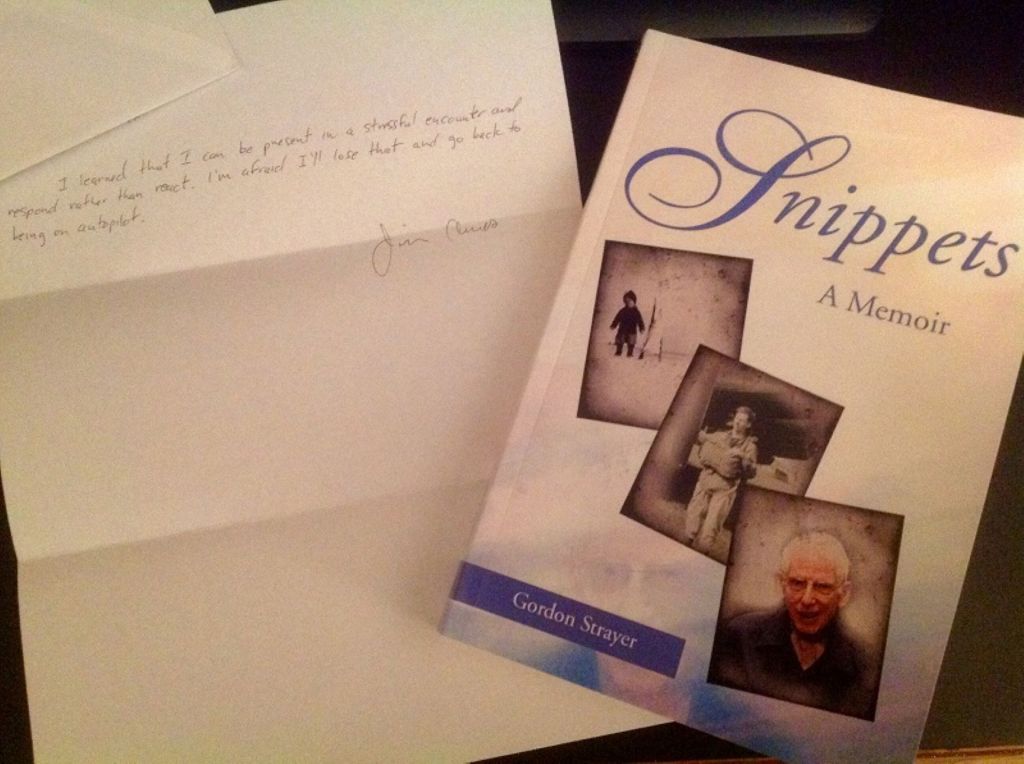
Chrysler Building New York CityBluebirds at the fountainMindfulness letter and Snippets book by Gordon Strayer
The images are important features of events in my life or my sense of humor.
I’m a birdwatcher and many different species of birds visited the fountain. The fountain attracted bluebirds who splashed and even swam in it. That fountain was very heavy. We couldn’t leave it out all winter. In the fall I had to lift the bowls off and move them somewhere else. Moving them entailed lifting them onto bags of mulch so as to reduce the work of hefting them a small distance at a time. The birds were beautiful to watch.
The letter was a class assignment our Mindfulness Based Stress Reduction (MBSR) teacher had us write at the beginning of the class. After we graduated, she mailed us those letters shortly thereafter. We were to write something connected with what we thought we had gained or what we thought might happen after taking the MBSR class. The book might seem out of place, and while I can’t talk much about Gordon Strayer, I did meet him and read his book (which is now long gone; probably lost in a move). I admired him. I don’t think he feared death.
The Chrysler Building reminds me of the Men in Black (MIB) 3 movie, and I included it because my sense of humor is very important to me. In the movie, Agent J and Jeffrey Price have this funny conversation about time travel back to an era that was not the greatest for black people. I know because I lived through it. Agent J is about to use the time travel device which involves jumping off a tall building (it’s a “time jump!”). Agent J is preparing to travel back in time to M.I.B.’s early days in 1969 to stop an alien from assassinating his friend Agent K and changing history. They have this short conversation:
Jeffrey Price: Do not lose that time device or you will be stuck in 1969! It wasn’t the best time for your people. I’m just saying. It’s like a lot cooler now.
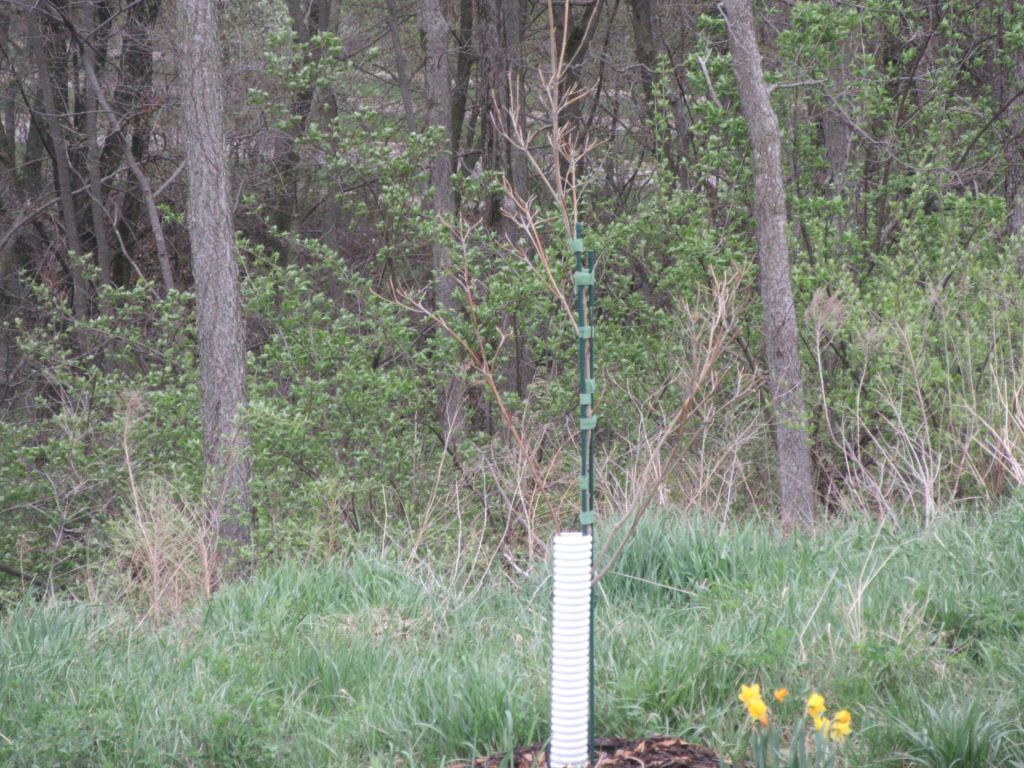
Today is designated Earth Day although there is such a thing as Earth Month. Among the several trees Sena planted in our back yard trees are a few that we hope exemplify the Earth Day theme, which is Our Power, Our Planet.
One of them is a dogwood, which we’re hoping will bloom soon. Dogwoods represent joy and rebirth. There are a couple of crab apple trees, a red jewel and a perfect purple. Crab apple trees represent love and all are very special to Sena and me.
Love, joy, and rebirth. They can all be linked to power, which can be the power of will. The will to respect the planet also implies respecting each other. Practicing humility can be a kind of power.
The power to be still and listen to each other can make us more open to change.
On that note, because I can’t go for long without joking around, I should retell the story about me and the walking dead meditation. About 13 years ago, I had an even more serious case of not listening to others than I do now, if you can believe that. It eventually led to my choosing to take the Mindfulness Based Stress Reduction (MBSR) class ( see this current University of Iowa mindfulness essay). I wrote an essay for the Gold Foundation and it’s still available (I updated the links):
How I left the walking dead for the walking dead meditation (August 13, 2014)
About a year or so later, I bought Jon Kabat-Zinn’s book on Mindfulness-Based Stress Reduction (MBSR), Full Catastrophe Living, because I was dimly aware of the burden of stress weighing on me as a consulting psychiatrist in an academic medical center. I didn’t get much out of Kabat-Zinn’s book on my first read. But then in 2012 I started getting feedback from colleagues and trainees indicating they noticed I was edgy, even angry, and it was time for a change.
Until then, I’d barely noticed the problem. Like most physicians, I had driven on autopilot from medical school onward. I had called myself “passionate” and “direct.” I had argued there were plenty of problems with the “system” that would frustrate any doctor. I had thought to myself that something had to change, but I never thought it was me.
After reflecting on the feedback from my colleagues and students, I enrolled in our university’s 8 week group MBSRprogram. Our teacher debunked myths about mindfulness, one of which is that it involves tuning out stress by relaxing. In reality, mindfulness actually entails tuning in to what hurts as well as what soothes. I was glad to learn that mindfulness is not about passivity.
But I kept thinking of Kabat-Zinn’s book, in which he described a form of meditation called “crazy walking.” It involved class members all walking very quickly, sometimes with their eyes closed, even backwards, and crashing into each other like billiard balls. I hoped our instructor would not make me “crazy walk” because it sounded so—crazy. I dreaded crazy walking so intensely that I considered not attending the 6-hour retreat where it might occur.
We didn’t do crazy walking. Instead, we did what’s called the “walking meditation.” Imagine a very slow and deliberate gait, paying minute attention to each footfall—so much so that we were often off balance, close to crashing into each other like billiard balls.
I prefer to call this exercise the “walking dead meditation” because it bore a strong resemblance to the way zombies move. One member of the class mentioned it when we were finally permitted to speak (except for the last 20 minutes or so, the retreat had to be conducted in utter silence). It turned out we had all noticed the same thing!
Before MBSR, I was like the walking dead. I was on autopilot — going through the motions, resisting inevitable frustrations, avoiding unstoppable feelings, always lost in the story of injustices perpetrated by others and the health care system.
In practicing mindfulness, I began noticing when my brow and my gut were knotted, and why. Just paying attention helped me change from simply reacting to pressures to responding more skillfully, including the systems challenges which contribute to burnout. About halfway through the program, I noticed that the metaphor connecting flexibility in floor yoga to flexibility in solving real life problems worked.
Others noticed the change in me. My professional and personal relationships became less strained. My students learned from my un-mindfulness as well as my mindfulness, a contrast that would not have existed without MBSR.
As my instructor had forewarned, it was easy for me to say I didn’t have time to practice meditation. I had to make the time for it, and I value the practice so much that I’ll keep on making the time. I will probably never again do the walking dead meditation.
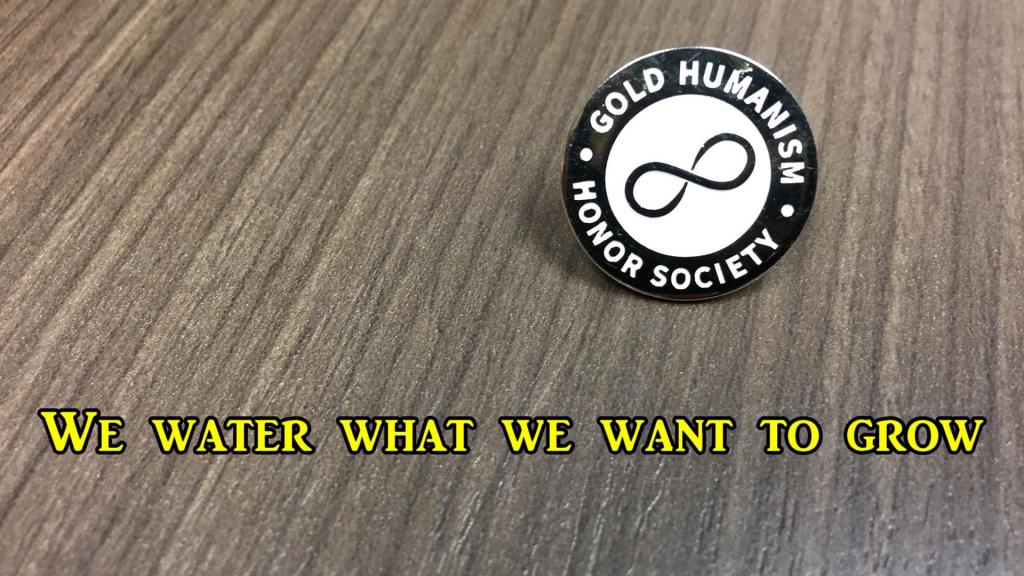
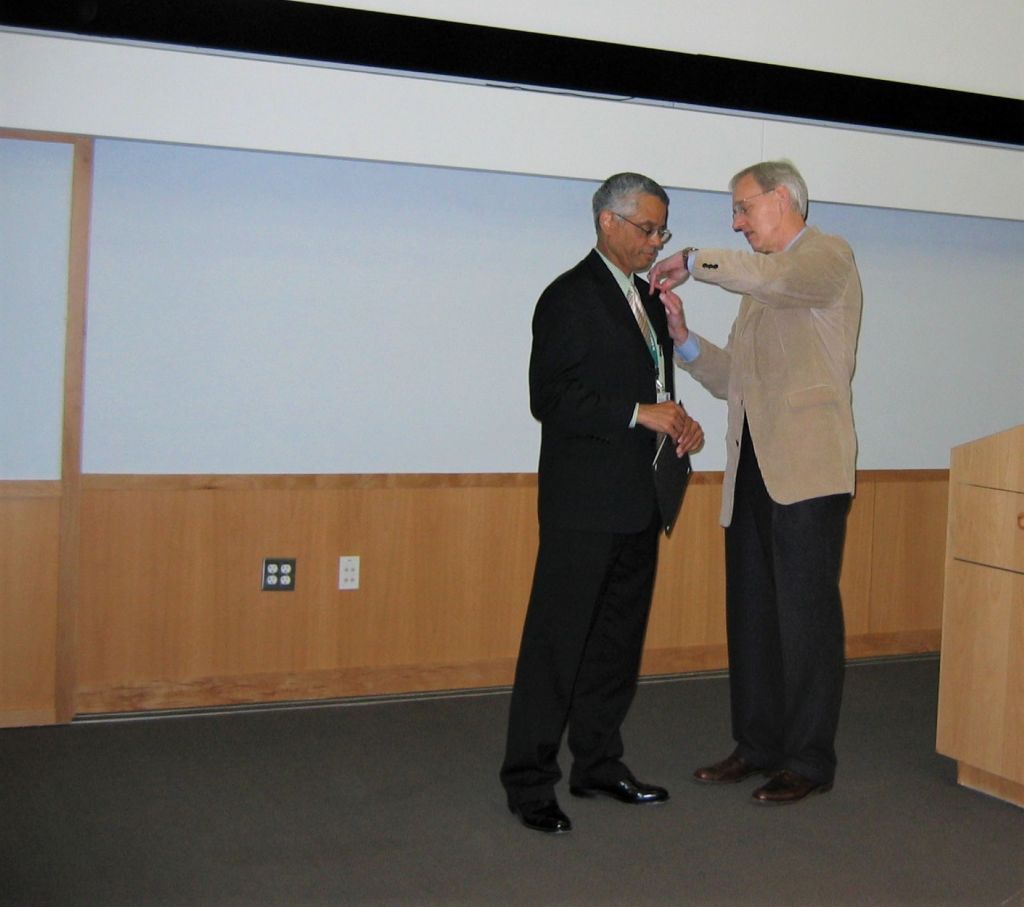
Today we gather to reward a sort of irony. We reward this quality of humanism by giving special recognition to those who might wonder why we make this special effort. Those we honor in this fashion are often abashed and puzzled. They often don’t appear to be making any special effort at being compassionate, respectful, honest, and empathic. And rewards in society are frequently reserved for those who appear to be intensely competitive, even driven.
There is an irony inherent in giving special recognition to those who are not seeking self-aggrandizement. For these, altruism is its own reward. This is often learned only after many years—but our honorees are young. They learned the reward of giving, of service, of sacrifice. The irony is that after one has given up the self in order to give back to others (family, patients, society), after all the ultimate reward—some duty for one to accept thanks in a tangible way remains.
One may ask, why do this? One answer might be that we water what we want to grow. We say to the honorees that we know that what we cherish and respect here today—was not natural for you. You are always giving up something to gain and regain this measure of equanimity, altruism, trust. You mourn the loss privately and no one can deny that to grieve is to suffer.
But what others see is how well you choose.
Leonard Tow awardGetting the pinOn my lapel; in my heart
I’m still practicing mindfulness-more or less. Nobody’s perfect. We hope the dogwood tree blooms soon.
We listened to the Big Mo Blues Show last night on KCCK radio 88.3. It was recorded and we noticed that he sounded younger for some reason. Once he remarked that things were difficult because of having to “shelter in place.” The format of the show was different from usual.
That made me wonder if the show was recorded sometime during the Covid pandemic. I’ve been listening to Big Mo for a long time. John Heim, aka Big Mo, been doing the Friday Blues show since about 2005, according to one news story. Another KCCK legend, Bob DeForest, has been doing the Saturday night blues show for over 30 years now.
John Heim, aka Big Mo is still going strong. I think I’ve been listening to his show for about as long as he’s been doing it. He has come back strong since an accidental fall in 2018 in which he sustained a neck injury which led to a long rehab stint. But he’s back.
There have been interesting additions over time, like the Shout-Outs, the Concert Calendar, the Bodega Bay Weather Report, the Big Mo Pod Show in which he and producer Noah on Saturday discuss the music selections he made on Friday. The comedy bits have also been interesting, like MayRee’s hand-battered catfish (It’s better because it’s battered!).
Last night, we heard a couple of songs which we both liked. One of them was “She Don’t Live Around Here” by Samantha Fish. I heard it for the first time on the Big Mo Blues Show and just about every time I hear it, the hair on the back of my neck stands up. I’ve read that music will do that sometimes, although I can’t remember getting that sensation before.
We both liked Delbert McClinton’s rendition of “I’ve Got Dreams to Remember.” He’s had a huge career. Sena asked me if he’s still alive and I foolishly guessed that he died. Nope, he’s 84 years old and evidently still going strong.
I have a personal top ten songs, most of which I’ve heard on the Big Mo Blues Show. They’re not in any particular order. A few of them I like mainly because of the artist’s voice, like Samantha Fish and James Carr.
“She Don’t Live Around Here” Samantha Fish
“The Dark End of the Street” James Carr
“Everyday Will Be Like a Holiday” William Bell or Eric Clapton
“Lean On Me” Bill Withers or Keb Mo
“Mockingbird” Larkin Poe
“I’ve Got Dreams to Remember” Delbert McClinton (written by Otis Redding)
“You Were Never Mine” Delbert McClinton or Janiva Magness
“A Change is Gonna Come” Sam Cooke
“Over The Rainbow and What a Wonderful World” medley Israel Kamakawiwo’ole
“You Can’t Teach An Old Dog New Tricks” Seasick Steve
Lately, Big Mo has played Larkin Poe’s “Mockingbird” a fair number of times. I think one interpretation of it is that people’s sense of their identity tends to evolve over time. At different times in your life, you’ll take on a new voice, so to speak, which fits with the idea of the many songs the imitative Mockingbird sings.
Some songs I like because of the message, like “Lean On Me,” or “A Change is Gonna Come.” And I like the song “You Can’t Teach An Old Dog New Tricks” just because I identify with it. I realized that runs counter to the theme of many songs, which are often about change: people change, the times they are a’changing, and the like. So, my top ten song list will probably change, too.
Well, thank you very much, State Representative Adam Zabner, for recognizing me as an old fart as you prefer to call it, which is fine with me.
I received a similar honor several years ago, from State Representative Dave Jacoby, who was much more prolix in his remarks on my certificate.
A long time ago, I kept a blog when I was a consulting psychiatrist in the University of Iowa Health Care Dept of Psychiatry. I used to mention occasionally that someday those who recognized my greatness would raise a statue of playdoh to me in the Quad.
Funny thing is I don’t know if the Quad even exists anymore. I supposed the statue could be raised (and perhaps later razed when people finally catch on) somewhere else, in a place much more prominent given my eminence, possibly at the state house in Des Moines or outside Pagliai’s Pizza here in Iowa City at least.
I’ll admit frankly, age does bring with it some of the usual markers: deepening wrinkles, receding hairline, fading memory and the like. There are some advantages, such as the tendency to joke and tell little stories of the distant past (chariot races and so on). This helps to bore younger persons enough for them to move out of line at the ice cream shop so that I can move up.
And I still exercise vigorously, lifting the salt and pepper shakers, crossing and uncrossing my legs on the ottoman, walking back and forth between the chair and the fridge, and power napping.
Seriously, I’m still juggling, which I took up about two and a half years ago. I exercise but not too much. A while ago I had an issue with my quads getting so big they were flopping over my knees so I had to cut back a little.
I don’t know that I’ll get many more certificates of senility from the Iowa House of Representatives. That makes it even more important for somebody to get to work with all possible speed on my playdoh statue.
I just read Dr. Moffic’s column, “Join This Club for Mental Health” in which he described the Clubhouse movement which got started in the 1940s to help those with mental health challenges to cope with their illness and, more importantly, to recover, grow, and achieve success in life.
It made wonder if there are any chapters of the Clubhouse model in Iowa. It turns out there is and it’s Carol House in Davenport, Iowa. It’s connected with the Vera French Mental Health Center. Its namesake is Carol Lujack, who was a member when the center was called “The Frontier Community Outreach Program” in the 1980s in downtown Davenport.
I was looking at the Carol Center website where you can find many interesting features of the people and activities that go on there. The April newsletter is fascinating and funny. You can find out in the April Newsletter about a few of the current members, April holidays (there’s a slew of them), and famous quotes. One of the quotes is familiar and it’s by F. Scott Fitzgerald,
“Vitality shows not only in the ability to persist, but in the ability to start over,” The quote is worded in various ways, but I remember it because I used it as an inspirational quote when The University of Iowa honored me and several of my colleagues with a Feather in Your Cap award back in 2011.
This was shortly after I returned to Iowa after an unsuccessful stab at trying private practice psychiatry in Wisconsin. And it was the second time I did that—the first time was in Illinois.
Did you know that April is National Humor Month? And have you heard the joke “What kind of candy is never on time?” Choco-Late.
One April holiday is not mentioned and that’s Arbor Day, which varies according to what part of the world you’re in as planting times differ. Sena planted a couple of new trees in the back yard.
Starting new chapters of Clubhouse is a little like planting new trees. They need watering.
I watched another episode of the Red Green Show last night called “Coup De Grass.” The one flaw in watching the episodes are commercials, which were rare when I started making my own YouTube videos years ago. Now they’re about as frequent as they are on TV.
The one good thing about commercials on YouTube is that I can click the “skip ad” button, which interrupts them.
Anyway, “Coup De Grass” was good for several chuckles, but I admit I scratched my head a little over the main sketch comedy skit. It was the what the title of the episode was about, and you might get what the parodic title means here.
The introduction opens with Red Green talking about the grass seed he accidentally spilled on the paint and chemical covered floor of his garage. It was a “horticultural breakthrough” because the grass grew only a couple of inches tall, which he though he could make a fortune on.
The next two segments I overthought and realized only later that the idea involved the mutant grass growing very tall and getting smelly and sticky—like the paint and toxic ooze in the garage it sprang from.
What confused me was that, after planting the grass outside the lodge, Red and the other cast members gradually developed abnormal walking with their feet sticking to the floor at every step. They also started to turn green. It reminded me a little of the Silly Walking episode on Monty Python’s Flying Circus.
Actually, the point of the silly walking is that they got contaminated by the grass, which quickly grew tall, sticky, and smelly.
So, who or what actually delivers the “coup de grass” or killing blow and who or what gets “killed?” I could take a stab at the answer, but that might be a spoiler.
I was clicking through the web the other day and came across something that triggered a distant memory—The Red Green Show. It was a Canadian sketch comedy TV program that ran between 1991 and 2006.
I used to watch it and now I can’t see how I ever found the time to do that. I was in medical school between 1988-1992, and was in residency between 1992-1996. After that, I was on staff in the psychiatry department at University of Iowa Health Care.
The Red Green Show was on in the evening and it caught my attention like a couple others: Monty Python’s Flying Circus and Red Dwarf (a really quirky outer space show), which came on just before the Red Green Show. I’ve always been big on comedy, but I just don’t know how I ever found time for it. I was usually pretty tired or up all night on call.
Anyway, there’s this Red Green web site where you can watch all the episodes over the 15 years it was on—for free. The big star was Steve Smith, who played Red Green. The web site marketing all the old shows and T-shirts and whatnot is based in Overland Park in Kansas City, Kansas. Figure that one out, a Canadian TV show now selling souvenirs and Possum Lodge membership cards in Kansas City.
The show won a Canadian Gemini Award (similar to the Academy Emmy Award in America) for comedy in 1998.
If you watch one of the episodes, it’ll make you scratch your head about the notion of making Canada the 51st state, but I won’t get into it.
I had a book written by Steve Smith a long time ago but I can’t remember which one it was. I think it had a red cover. Maybe it was “How to Do Everything.” It’s a guide for do-it-yourself and self-help. That’s a hoot because I can barely tie my shoes, much less fix anything. On the other hand, neither could Red Green.
I watched the first YouTube episode from 1991 and it made me chuckle. I admit that one of the Red Green quotes, the Man’s Prayer, fits me like a fishing vest (I don’t fish!):
“I’m a man, but I can change, if I have to…I guess.” Red Green.
I was walking around the mall today doing ordinary old guy things: watching the Zamboni machine resurface the ice rink, which I’ve never seen before, by the way. The surface was pretty dull before the Zamboni team started. There were two kids in the seat, one young lady driving and the other young man pointing out spots she missed. They went around and around getting the thin layer of water on the whole rink while eager skaters waited to get out there. They rejuvenated the rink, got it shining like crystal and skaters spun, twirled, and had a great time. It was the Zamboni Effect.
After that, I got up and did my usual thing, looked at books in Barnes & Noble, got a bite to eat, wondered why the mall security guy was walking by the bench so often where I was sitting. After his third pass, I got up and did my best to look like a solid citizen who is aware that loitering might look sinister to some mall security guys.
And when I wandered back to the tables next to the ice rink, I sat down again because the mall security guy was nowhere in sight. While I was just zoning out watching people pass by, one of them stopped and made a funny face at me. For a half-second, he didn’t register in my memory and then he called me by name. I suddenly recognized him as a former resident in the Medical-Psychiatry training program at University of Iowa Health Care (UIHC). It was Ravneet, one of the best trainees I have ever had the pleasure to work with.
It was kind of a shock. He had left for a great position with a health care organization out in Arizona many years ago and is very successful. He and his wife and daughter were on vacation and were walking through the mall. His son is also a high-level performer in science but he was not with them today. Ravneet takes time out every so often to travel like that. I’m sure it helps rejuvenate him—kind of like how the Zamboni machine rejuvenates the ice rink–the Zamboni Effect.
We exchanged pleasantries, he took a selfie with me, and I forgot to ask him to send me a copy, probably because I was so flabbergasted at running into him at the mall. It really brightened my day. Again—the Zamboni Effect. I really felt rejuvenated.
Every now and then, we all need the Zamboni Effect. Maybe it could even help the mall security guy.
I wanted to give a shout-out to Dr. H. Steven Moffic, MD for his article highlighting the career of a notable black psychiatrist, Dr. Alvin F. Poussaint, MD, who sadly died on February 24, 2025. I’m mortified that I hadn’t heard of him before now.
It reminded me of the time I mentioned another black psychiatrist I had never heard of either, Dr. Chester Middlebrook Pierce, MD, in a post about the book “Our Hidden Conversations” about a year ago.
I wondered if Dr. Pierce and Dr. Poussaint ever met. I looked this up but couldn’t find a definite link.
Dr. Moffic’s essay, in which he mentions antisemitism. also reminded me of an essay also published in Psychiatric Times in 2020 by Dr. Robert M. Kaplan, MD. The title is “Alois Maria Ott: I was Hitler’s Psychologist.”
It gives even more texture to Dr. Poussaint’s views on whether or when extreme racism should or should not be classified as a mental illness. My own residency training experience was marked by being assigned to a patient said to have schizophrenia—who angrily shouted when he saw me, “I don’t want no nigger doctor!” My faculty supervisor didn’t think I should be reassigned to an alternate patient, a decision I’m still ambivalent about.