The Changing Role of the Psychiatrist in Managing Depression with Medical Illness

This post is mainly a reminiscence about my days as a consultation-liaison psychiatrist. I often evaluated patients who had chronic hepatitis C. The liver disease itself and the treatment (interferon alfa) often led to patients struggling with depression.

The impetus for this came from noticing a couple of items. One is the recent l blog post about treatment of depression by George Dawson, MD (“Are Medication Trials for Depression Too Long in Duration?”). The other is a Psychiatric Times article about the Star-*D depression treatment study published in Psychiatric Times (“Star*D: It’s Time to Atone and Retract” by Nicolas Badre, MD and Jason Compton, MD).

Back in the day, I thought it made sense to use depression rating scales in my clinic practice. I use the term “clinic practice” reservedly because in actual practice I was too often running the hospital psychiatry consultation service to see outpatients regularly.

There has been a recent call to retract the Star*D study. I wasn’t involved in the study, of course. I was too busy running around the hospital responding to consultation requests. I noticed the criticism in the Psychiatric Times article by Badre and Compton of the specific depression rating scale, the QIDS-SR (which stands for Quick Inventory of Depressive Symptomatology (Self-Report).

I tried to integrate into my practice the QIDS-SR as well as the Clinically Useful Depression Outcome Scale (CUDOS). The latter was designed by psychiatrist Dr. Mark Zimmerman around 2008. I believed in the principle of measurement-based assessment of psychiatric symptoms and did my level best to integrate them into my practice.

It was very difficult to do. My patients were typically suffering from both medical and psychiatric illness. Often, they had physical symptoms that you could attribute to either the medical problem itself or “depression”—or both. This is a common challenge in consultation psychiatry.

Returning to my experience with patients who had chronic hepatitis C, in my early career, some of them who were on interferon alfa would not uncommonly develop depressive symptoms during treatment. Sometimes that meant stopping the treatment. Moreover, they sometimes had other side effects including thyroid function abnormalities, which can also cause mood disturbance.

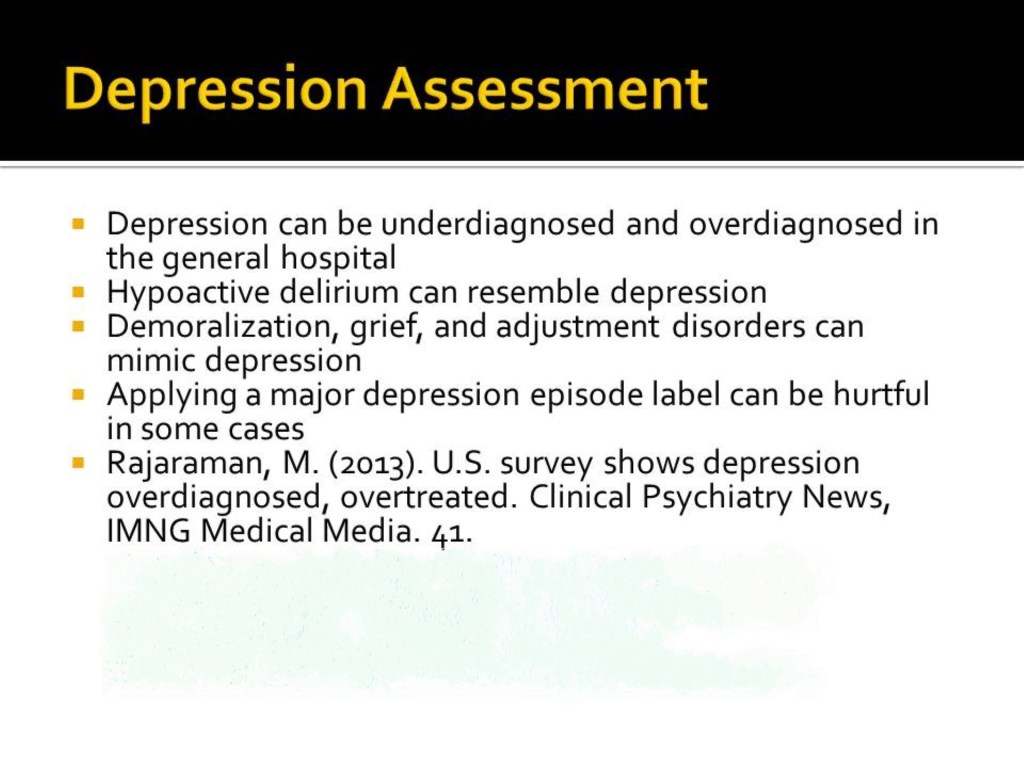
There have been debates about whether to count physical symptoms in depression because of the overlapping symptoms: fatigue, appetite loss, trouble sleeping and the like. There’s also what has been called the “fallacy of good reasons.” Wouldn’t you be depressed too if you were sick and tired of being sick and tired? This could lead to undertreatment of depression. Some diagnostic models suggested counting all symptoms regardless of etiology.

Some randomized controlled trials of antidepressants in the past showed antidepressants were effective in the medically ill with depression. Others showed they were not better than placebo.

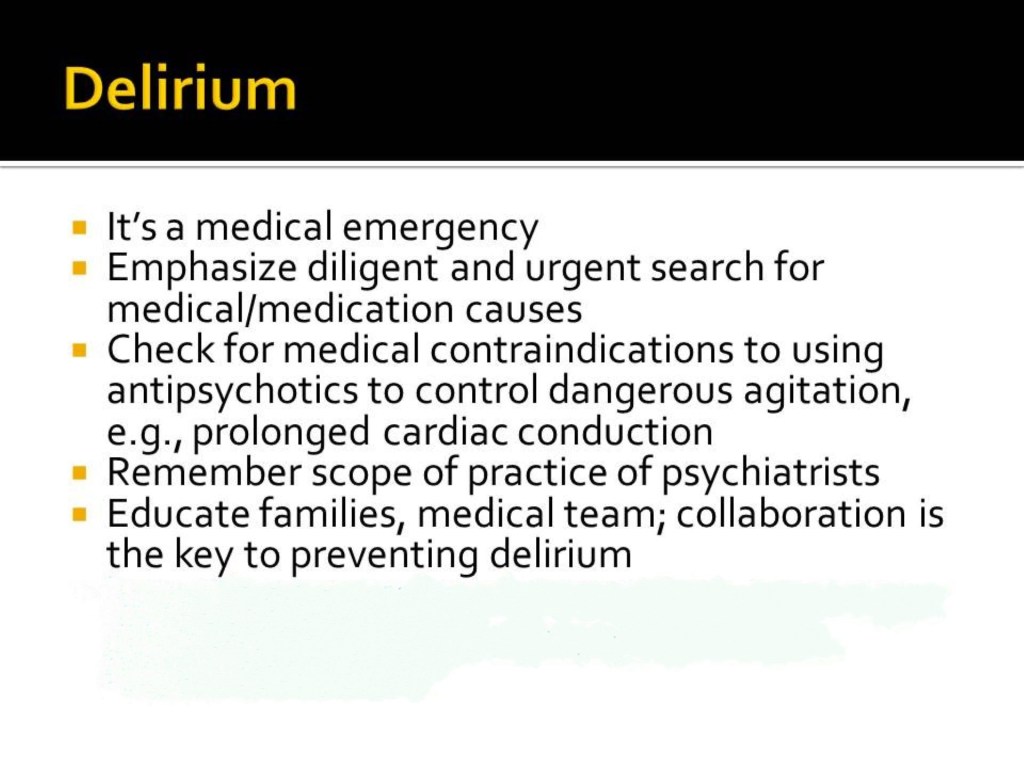
Nowadays there is a new pharmacologic approach to treating hepatitis C and those are in the category of direct-acting antivirals (DAA). According to fairly recent literature, the DAAs offer a better chance of cure of hepatitis C and less psychiatric side effects. That doesn’t mean psychiatrists are no longer needed. The common issues such as comorbid substance use and cognitive disorders, highlighting the ongoing need for collaborative care between medicine and psychiatry.

Transforming Into A Svengoolie Fan

We’re on a Svengoolie roll lately. I watched the Svengoolie show last Saturday and the made for TV movie was Dan Curtis’ Dracula. It was made in 1974. I thought I’d never seen this film before but that final scene in which Dracula (played by the phenomenal heavy, Jack Palance) gets skewered looked familiar. I may have seen part of it a long time ago.

I read the Bram Stoker novel, Dracula years ago when I was just a kid. It’s a scary book. I haven’t seen many movies about Dracula. I think we saw Bram Stoker’s Dracula produced and directed by Francis Ford Coppola, which came out in 1992.

In fact, Dan Curtis’ Dracula (produced and directed by Dan Curtis) was at first called Bram Stoker’s Dracula, although the title had to be changed so they wouldn’t be confused with each other. I got one joke from Svengoolie:

What’s Dracula’s favorite ice cream? Veinilla.

When you look at Svengoolie’s comments section about the movie, it’s astonishing to see there are over 3,900 comments (still counting) and over 3,000 just during the movie.

I thought Jack Palance was riveting as Dracula. Sena didn’t watch the show with me but she remembered Palance’s antics during the 1992 Academy Awards when he got the Oscar for best supporting actor in City Slickers. After he got the Oscar, he moved away from the podium, dropped to the floor and did one-arm pushups—and he was 72 years old at the time. I never saw that, probably because I was on call as a first-year psychiatry resident.

This upcoming Saturday, the movie will be Gargoyles, which I’ve never seen or even heard of before. Svengoolie is known for cheesy films, but many of the stars in some of them went on to have successful careers.

Sena plans to watch it with me! And she ordered a glow in the dark Svengoolie T-shirt as well as a rubber chicken for me. Svengoolie does a lot of dad jokes and he gets rubber chickens tossed at him. I’ll probably try to juggle using the rubber chicken.

Today is National Spinach Day!

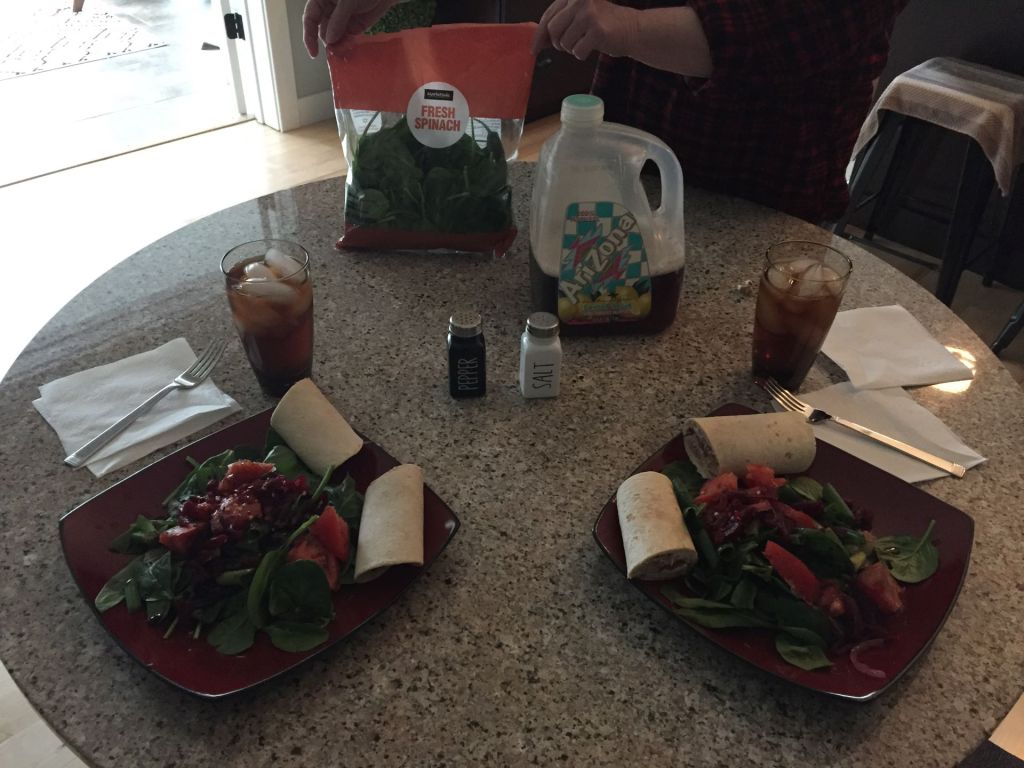
Sena just told me today is National Spinach Day. Naturally this means she is going to prepare a big whopping mess of spinach for us to eat. She also recently ordered a 100-gallon keg of Super Beets supplement capsules as part of her health food project. She drank the Super Beet Kool-Aid, if you know what I mean.

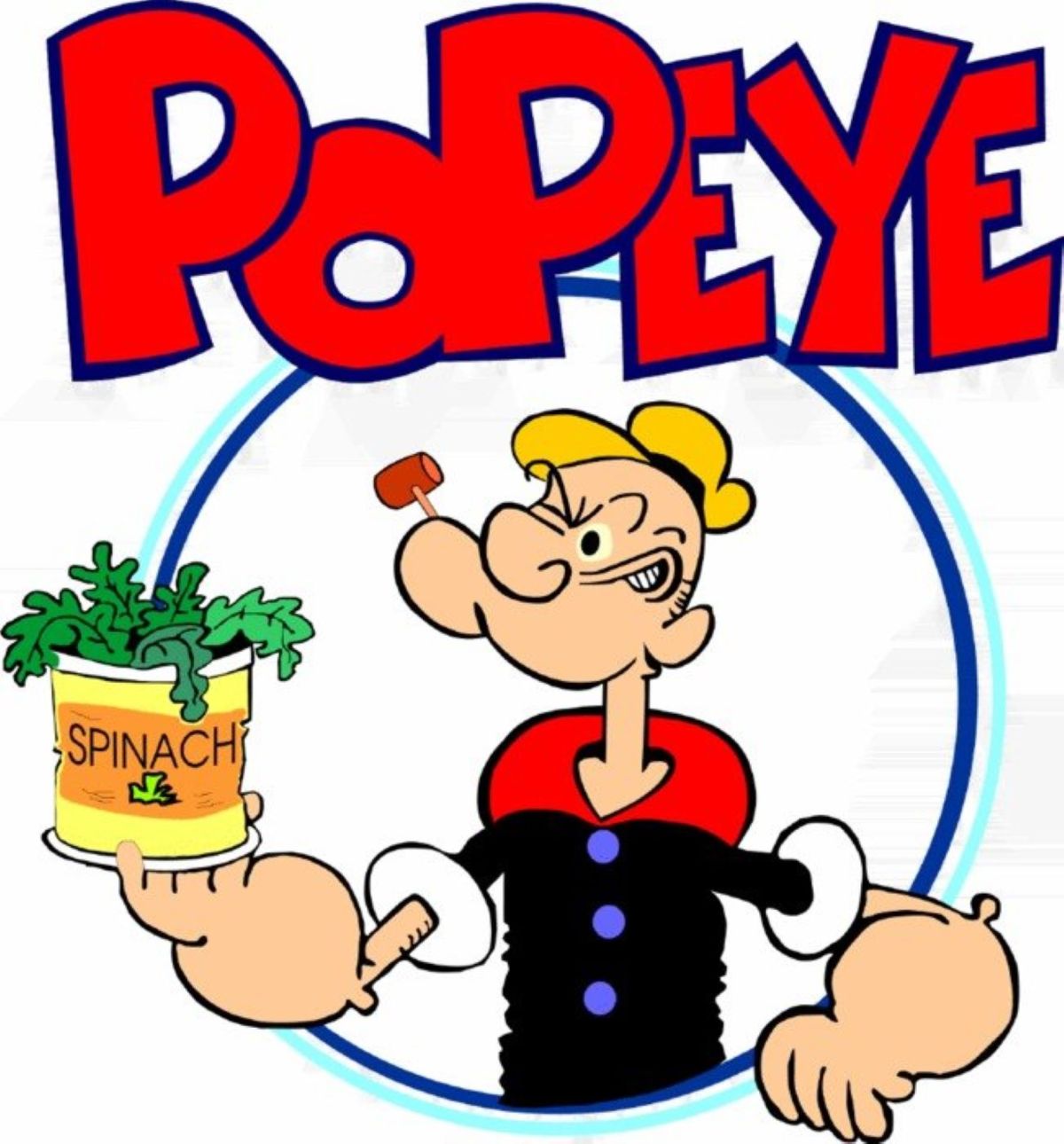
I guess Popeye the sailor man is still one of the best spokespersons for spinach, which I actually sort of like when it’s soaked in vinegar for about a year or so. When I was a kid, I used to watch Popeye cartoons. The basic storyline is Bluto uses Popeye for punching bag until a can of spinach weighing a metric ton drops out of the sky on Bluto. This never taught Bluto a lesson.

In honor of National Spinach Day, we’ll probably have a platter of Florentine chicken fricassee with a pound of spinach simmered with extraterrestrial brain lobes paired with Bigfoot armpit glands and a glass of chilled free range beagle pee layered with beet juice. Yum.

Maybe just a salad. Happy National Spinach Day!

spinach, beets and leeks and fig vinaigrette

Picture credit: Pixydotorg. I’m not sure about exactly when Popeye goes into the public domain. There are different dates on the web. But the picture is free on Pixydotorg.

National Spinach Day!

Svengoolie and The Comedy of Terrors

Last Saturday on Svengoolie, I watched for the second time the 1963 movie “Comedy of Terrors,” a slapstick horror spinoff of Shakespeare’s farce, “Comedy of Errors”—which I’ve never seen. I didn’t see the whole movie the first time around, and I can’t remember exactly where I saw it. Most likely it was on Svengoolie.

The movie story is not actually based on the Shakespeare comedy itself. Most of the lines by Basil Rathbone (as Mr. Black) sounded vaguely familiar and I think they were from “Macbeth.” Vincent Price (Mr. Trumbull) plays an evil mortician and Peter Lorre (Mr. Gillie) plays his bungling assistant. They bury people in a casket which they use over and over because they dump the corpses in the graves after the mourners leave. Boris Karloff plays Hinchley, the senile father of Trumbull’s wife, Amaryllis who is played by Joyce Jameson.

Basil Rathbone as Mr. Black is the landlord who threatens to evict Trumbull from his house if he doesn’t come up with the rent sooner rather than later. This leads to Trumbull’s plan to kill Mr. Black—who doesn’t stay dead more than a few minutes, repeatedly springing back to life and flawlessly reciting Shakespeare in a thundering voice, before collapsing periodically back into his lifelong affliction with bouts of catalepsy.

Now, you know I’m going to have something to say about catalepsy because I’m a retired consultation-liaison psychiatrist and I’ve seen enough patients with catatonia who display various signs of that neuropsychiatric disorder, including catalepsy. According to the University of Rochester Bush-Francis Catatonia Rating Scale Assessment Resources, catalepsy is defined as “Spontaneous maintenance of posture(s), including mundane (e.g., sitting/standing for long periods without reacting).”

After Mr. Black has an apparent heart attack after being shocked by the sight of Mr. Gillie, who sneaked into his house, the butler calls for the doctor. The butler reminds the doctor that the distinguished gentleman suffers from periodic episodes of “catalepsy.” The doctor insists that Mr. Black is dead after applying a perfunctory examination.

After that Mr. Black abruptly snaps into and out of periods of catalepsy typically reciting Shakespeare perfectly, even after Mr. Trumbull shoots him a few times. Needless to say, catalepsy is only one feature of many. It almost invariably appears in those who have severe neuropsychiatric illness such as schizophrenia or epilepsy and they would rarely be able to speak so eloquently.

What amazed me is that all of the actors remembered and spoke their lines perfectly, despite being lengthy and polysyllabic.

Although the film didn’t do well at the box office, I thought it was pretty funny. You can view it for free at the Internet Archive.

Good Luck Dr. Chris Buresh

Sena was looking up the meaning of a four-leaf clover the other day. You might call it a shamrock although that’s usually reserved for the 3-leaf variety. It’s fitting for St. Patrick’s Day to say the four-leaf clover is special because it’s rare to see one. The four leaves represent faith, luck, love, and hope.

The trouble going on in Haiti is regrettable to say the least. However, it also reminded us of how lucky it was for us to have known one of my former colleagues, Dr. Christopher T. Buresh, MD. He was an emergency room physician at the University of Iowa Hospital until just a few years ago, when he and his family moved to Seattle, Washington. Dr. Buresh is now an Associate Professor in the Department of Emergency Medicine with the University of Washington. He’s also Assistant Program Director of their Emergency Medicine Residency Program.

The connection between Dr. Buresh and Haiti goes back a long way. Many Haitians were lucky he and other physicians volunteered to help provide medical care for them on an annual basis for years.

Chris is really a humble, likeable, and practical guy. He and his family were our next-door neighbors for a while and fascinating things were going on there at times. We remember they built this really cool tree house that sort of looked like it grew out of their main home. They even had an apparatus for a zip line between the two structures. I don’t think the zip line ever actually got installed, but it was intriguing.

He and I sometimes saw each other in the emergency room at University of Iowa Hospital. His energy, compassion, and dedication to patient care were an inspiration to colleagues and learners at all levels. Sena saw one of his presentations about his volunteer work in Haiti. He never mentioned the difficult politics of the situation. He emphasized the work of caring for the Haitians most of all and gave credit to members of the team doing everything they could in that challenging and, I’m sure, sometimes horrifying environment.

It would be easy to just sit and wonder why he left Iowa, and to be sorry about that. On the other hand, when you thing about the 4-leaf clover, you really have to wonder about something else. Maybe he had one in his pocket with all four of what we all want: faith, luck, love, and hope.

Remember The Calling

I recommend Dr. George Dawson’s recent posts on seeing the practice of medicine as a calling and his passing a big milestone with 2 million reads on his blog.

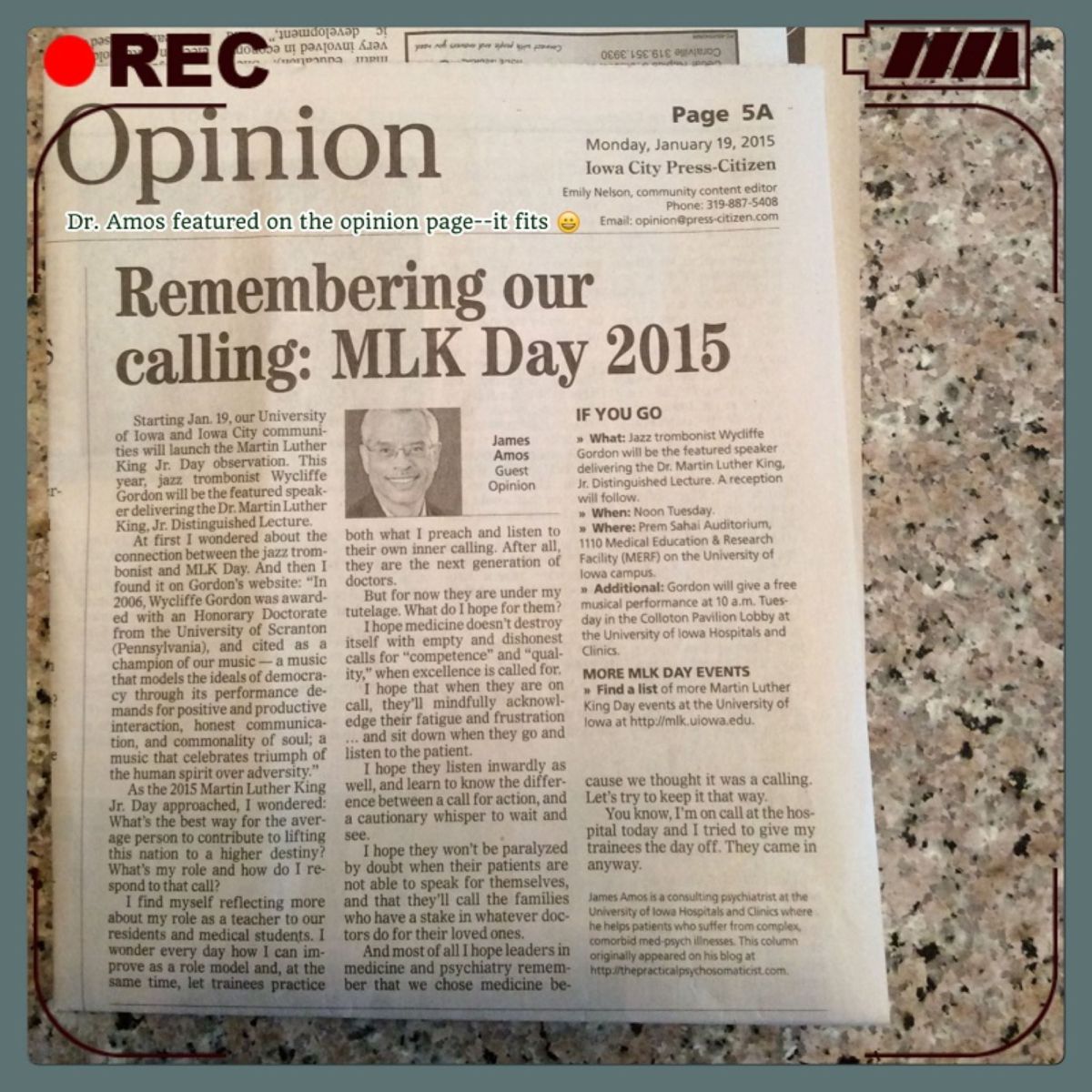
I wrote a post entitled “Remembering Our Calling: MLK Day 2015.” It was republished in a local newspaper, the Iowa City Press-Citizen on January 19, 2015. And I reposted it in 2019 on this blog.

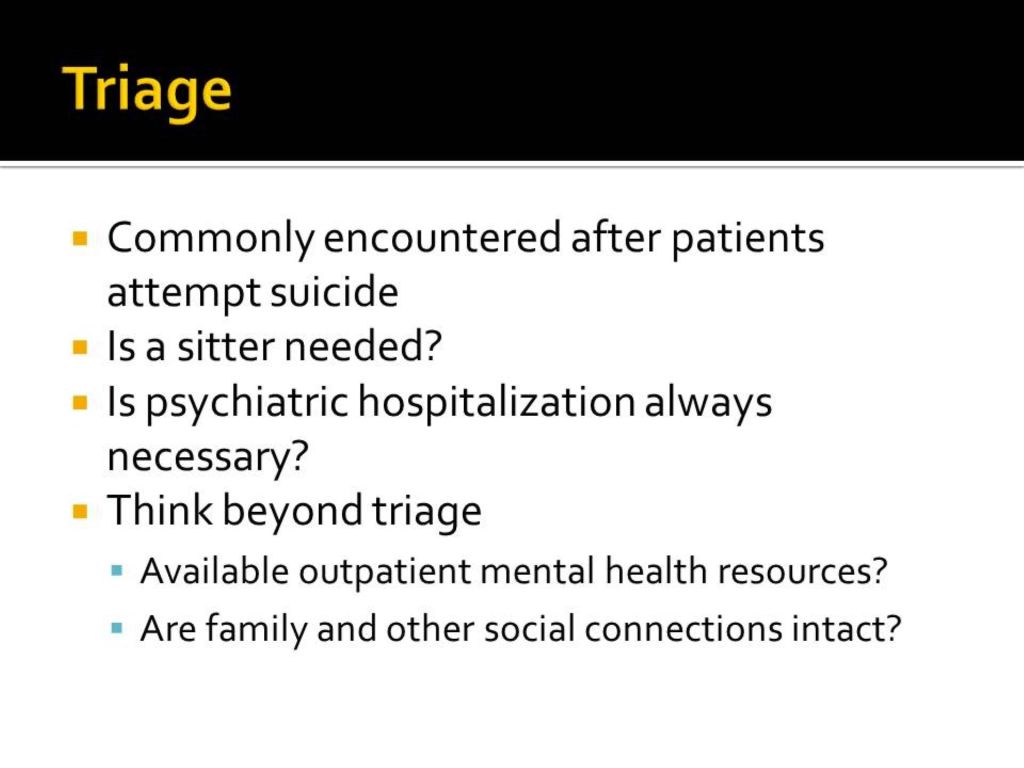
The trainees I taught also taught each other about psychiatry and medicine when they rotated on the consultation-liaison service at the hospital. We put them into the format of short presentations. I called mine the Dirty Dozen. The trainees and I also presented the Clinical Problems in Clinical Psychiatry (CPCP).

There were many of those meetings, which were necessarily short and to the point because the service was busy. We got called from all over the hospital. We answered those calls and learned something new every time.

I posted a lot of the trainees’ presentations in my previous blog, The Practical C-L Psychiatrist, which was replaced by this present blog. I haven’t posted the presentations partly because I wanted to give the younger teachers their due by naming them as they did on their title slides. But I would want to ask their permission first. They are long gone and far flung. Many are leaders now and have been for many years. I still have their slides. I’m very proud of their work. When they were called, they always showed up.

So, you’ll just have to put up with my work and my cornball jokes.  

The Svengoolie Phenomenon

I wrote about Svengoolie a couple of years ago and just for old times’ sake, I watched the 1960 horror film 13 Ghosts on the Svengoolie broadcast by MeTV a few days ago. It had been a while since I watched Svengoolie and I thought I would have the usual experience of being able to sit through the opening credits and then being unable to watch more than 5 minutes of one of the cheesy movies for which Svengoolie is well known.

In fact, I watched and even enjoyed 13 Ghosts which I suppose makes me a hopeless case. The movie is about a family down on their luck and about to become homeless but a rich uncle leaves them a haunted house. It turns out to be haunted by a dozen ghosts, and the surprise ending reveals who the 13th ghost turns out to be.

Back in the day, William Castle, the maker of the film, had a knack for coming up with neat gimmicks for his films. The gimmick for this one was a set of special glasses for the audience, which allowed them to see the ghosts or not, depending on which part of the glasses you looked through.

I recognized a couple of the actors in the movie. One of them was really well known to me and thousands of others. It was Margaret Hamilton as the housekeeper, who played the Wicked Witch of the West in the Wizard of Oz (1939). The other was Martin Milner, who was in the TV crime drama, Adam-12, which ran from the late 1960s to the mid-1970s. Hamilton obviously teased viewers by holding up a broom and smiling broadly in one scene.

I really didn’t get a lot of nostalgia from watching 13 Ghosts since I was too young to see it when it first opened. But I watched it from start to finish, something I could never do in the past when watching Svengoolie. Don’t get me wrong; I actually got more of a kick out of Svengoolie’s cornball jokes and gags complete with rubber chicken firing squads.

One thing I am still amazed about is the popularity of the Svengoolie show. There were over 3500 comments about 13 Ghosts the last time I looked, which was days after the movie. There were over 2,000 just during the show!

Another thought about Svengoolie and his rubber chickens. I looked all over the web for a free picture of a rubber chicken. I found only one. Why is that?

Thoughts on Journalist Sydney J. Harris

I just have a few things to say about Sydney J. Harris, who was a journalist whose columns were syndicated to over 200 newspapers. I remember reading them in the Des Moines Register years ago.

I ran across one of his books for sale on Amazon. I’ve never read any of them, but I found one of them, “Winners and Losers” on sale “new” for $111 and change. I was astonished. I admire his diction and learning, but I would never pay that much money for one of his books. You can buy them for less than $5, even on Amazon. You can read “Winners and Losers” for free on the Internet Archive.

You can also find a lot of quotes from Sydney J. Harris on the web. I found a collection which I thought were admirable. Funny thing is, the more I read, the more I thought he was a product of his times. I thought I could detect a little male chauvinism (maybe more than a little). The more quotes I read, the more I noticed he almost always used the word “men” or “man” and rarely mentioned women, unless you count:

“The commonest fallacy among women is that simply having children makes them a mother—which is as absurd as believing that having a piano makes one a musician.”

Nobody’s perfect.

The Iowa State University African and African American Studies Research Guide

In keeping with Iowa History Month 2024, you can have a look at the Iowa State University website “African and African American Studies Research Guide.”

Iowa State University happens to be my alma mater, or in a way, one of them. I took my Bachelor’s degree there and later graduated from The University of Iowa College of Medicine.

There is a wealth of information worth browsing on the ISU website devoted to the history of black people in Iowa. In fact, I found out a few of those connections were to Huston-Tillotson University (HT-U, an HBCU) in Austin, Texas, where I spent several semesters in the 1970s before later transferring to ISU.

The connections between HT-U and Iowa go way back into the history of that school. It started as Tillotson College in 1875, which is where some of the ISU black students also later worked as faculty. The list includes notable scholars:

Ada M. Deblanc-Yerwood: After graduation from ISU, she became head of Home Economics at Tillotson College. She was also co-founder of the George Washington Carver Museum in Austin, Texas. She also had an interesting perspective on retirement. She didn’t, and pursued other positions. Her answer to why she didn’t retire: “Old is a state of mind. When you do nothing, you become nothing. The need to be productive—give life to something—doesn’t automatically stop at age 65 or 70.”

Dr. Samuel P. Massie, Jr.: Dr. Massie went to ISU in 1941 to pursue a Ph.D. in Chemistry. He had to hitchhike to campus because there was no housing for Black students within 3 miles. Dr. Henry Gilman at ISU assigned him to work full time as a research assistant on a special assignment connected to the Manhattan Project (the top-secret effort to build an atomic bomb). President Lyndon B. Johnson appointed him to a Chemistry professorship at the U.S. Naval Academy. He distinguished himself as a scientist in many HBCUs (Fisk, Howard University, North Carolina College, and others) and elsewhere despite the racism that tried to hinder him. In 1981, ISU gave him the highest award—the Distinguished Achievement Citation.

Dr. Frederick Douglass Patterson: He was a brilliant student and he attended Samuel Huston College (see history of Huston-Tillotson College at link above). He also attended ISU, graduating with a DVM in 1923. In his book, Chronicles of Faith, he wrote: “In the veterinary program, I did not feel odd being a part of the group of students working in the veterinary clinic although I was the only black person there. The absence of animosity encouraged me to see veterinary medicine as a field in which I could practice without being hampered by the racial stereotypes and obstacles that would confront me as a medical doctor, for example. I found the teachers of Iowa State helpful whenever I approached them. Educationally, it was a fine experience.” He received the Presidential Medal of Freedom from President Ronald Reagan in 1987. He was President of Tuskegee Institute and transformed it into a university. He also founded the United Negro College Fund.

The United Negro College Fund was part of the reason I was able to attend Huston-Tillotson University. And it’s connected to the history of Iowa.

Thoughts on a Study of Sitting with Your Patients

I saw this interesting article on a study about the effect of chair placement on physicians’ behavior when in a patient’s room, specifically whether it altered the length of time a doctor spends with a patient or the level of satisfaction patients had with the interaction. In this study, it didn’t lengthen the time, but seemed to strengthen patient satisfaction with interaction with the physician. It’s a concept I recognize because I took this one level up—I carried my chair with me on hospital rounds in my role as a consultation-liaison psychiatrist.

I got a gift of a 3-legged camp stool from a colleague who ran the palliative care service at University of Iowa hospital. Other members of the palliative team had been using them as well.

Patients got a big kick out of a doctor who carried his chair around with him and actually sat down to talk with them. The way the camp stool folds up apparently made it look like nunchucks to some patients, so I got jokes about that occasionally. It really helped build rapport.

The only drawback with the camp stool was that my one of my legs would go numb the longer I sat on it, and could lead to a challenge getting up from it gracefully because it was partly a balancing act. Even so, I often spent much more than 10-15 minutes with patients.

Once, the stool actually broke and I dropped unceremoniously on my butt while evaluating a patient for catatonia—who proved not to be catatonic by the apparent facial expression of mirth as I fell on the floor. In that sense, the chair actually became a part of the evaluation—accidentally.

Thomas Hackett knew all about this. He was a famous consultation-liaison psychiatrist and a past president of the Academy of Consultation-Liaison Psychiatry (ACLP). One of his quotes from an early edition of the Massachusetts General Hospital Handbook of General Hospital Psychiatry fits perfectly in this context:

“As a matter of courtesy, I sit down when interviewing or visiting patients. Long accustomed to the ritual of making rounds, many physicians remain standing as a matter of course. Standing, physicians remind me of missiles about to be launched, poised to depart. Even if that is not necessarily true, they look the part. Patients sense this and it limits conversation. In addition, when standing, the physician necessarily looks down on the patient. This disparity in height is apt to encourage the attribution of arrogance. Looking down at a patient who is prone emphasizes the dependency of the position. Sitting at the bedside equalizes station. Sitting with a patient need not take longer than standing with him.”— Hackett, T. P., MD (1978). Beginnings: liaison psychiatry in a general hospital. Massachusetts General Hospital: Handbook of general hospital psychiatry. T. P. Hackett, MD and N. H. Cassem, MD. St. Louis, Missouri, The C.V. Mosby Company: 1-14.

Reference: Effect of chair placement on physicians’ behavior and patients’ satisfaction: randomized deception trial BMJ 2023; 383 doi: https://doi.org/10.1136/bmj-2023-076309 (Published 15 December 2023)