When I was a consultation-liaison psychiatrist I taught trainees in different ways. One of them was what I called the Dirty Dozen slide sets. They were on various basic topics that are important for psychistrists to know. I tried to put the most important points on only a dozen powerpoint slides.
After I started blogging about C-L Psychiatry around 13 years ago, the WordPress blogging platform started offering a way to post slide presentations using what is called shortcode. Presumably, you didn’t really have to know anything about coding language but the instructions weren’t very helpful.
I think I started trying to make slides using shortcode shortly after it was first introduced around 2013. I had to contact WordPress support because I couldn’t learn shortcode. A lot of bloggers had the same problem.
I think my main reason for getting interested in shortcode was so I could cut down on how many powerpoint slides I had to convert to images, which can take up a lot of space on a blog site after a while.
Anyway, in the past few days I tried to pick up the shortcode but couldn’t get the hang of it again. I finally found a WordPress help forum in which I found a blogger’s solution. She made it so clear.
Anyway, the Dirty Dozen on Delirium is below. A few pointers: click in the lower right hand corner of the slide if you want to view the slides full size. Use the directional arrows on your keyboard to click through the slides. You can also just use the arrow handles on the slides if you don’t want to see them full size. . When you click the URLs on the delirium websites, right click and open them in a new tab.
This slideshow could not be started. Try refreshing the page or viewing it in another browser.
Jim Has a 27-Year-Old Shirt!
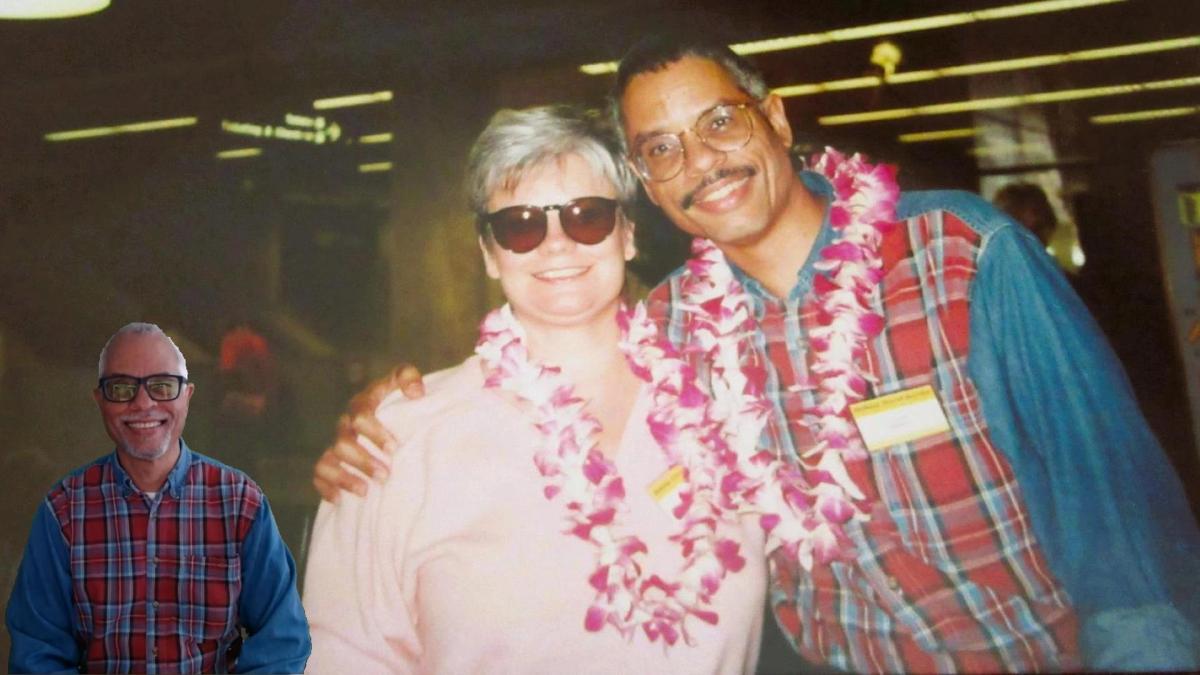
I have a 27-year-old shirt. It’s denim with a plaid pattern on the front. I wore it when we went on vacation to Hawaii in 1997. In the featured image, I’m wearing it as Sena and I pose for a photo after we got off the plane. We and a lot of other vacationers were festooned with leis as we entered the airport.
That makes this shirt 27 years old—at least. I’m sure I had it for a while before we went to Hawaii. I don’t remember where I got it. Sena says she probably bought it for me at Target.
I looked it up and found an identical shirt for sale on eBay—but it was advertised as being for ladies. The description is “VTG 90s Ladies Greatland Denim Flannel Shirt Size M Pocket Streetwear Grunge.
My first thought was: I’m wearing a lady’s shirt that sells for about twenty bucks on eBay? I couldn’t find one labeled for men. I asked Sena about it and found out for the first time that the buttons on a man’s shirt are on the right side and on a women’s shirt the buttons are on the left.
Then I looked at the eBay picture of the shirt again. The buttons are on the right. I guess the woman selling them doesn’t know the rule of right and left side buttons as it pertains to shirts for men and women.
Well, I guess I can stop being insecure about it. I don’t think anyone really knows why that gender-based rule about right and left side shirt buttons exists. I looked at a couple of web pages and they tend to repeat the same reasons and then end up saying nobody knows and it doesn’t matter.
The other thing to consider is whether my shirt could be considered vintage. According to some experts, anything between 20 and 99 years old can be vintage. I guess that makes me and my shirt vintage.
Biggish Events in Iowa in 1982
We’ve been watching for the house finch eggs to hatch sometime soon here. Remember they’re the ones who are nesting in the artificial Christmas tree on our front porch.
The 2023 edition of the book Birds of Iowa Field Guide, written by Stan Tekiela says the house finch was first seen in Iowa in 1982. That makes it a big year for house finches and for Iowa.
It got me to wondering what other big things happened in Iowa in 1982. A number of events as it turns out.
Terry Branstad was first elected governor of Iowa in 1982. He was 36 years old and at the time was the country’s youngest chief executive. After that, it seemed like he never stopped being the governor—even when he wasn’t, which was seldom. He was governor for 22 years. He was notable for being the nation’s longest-serving governor in history as of 2016.
In 1982, the University of Iowa Hawkeye football team went to the Rose Bowl—and lost to Washington 28-0. Coach Hayden Fry was not happy. The biggest thing about it was the long running party before the game.
While we were in Ames in 1982, there was evidently a big fire that destroyed the Iowa State University Alpha Iota chapter fraternity house. We don’t recall it. One of the members of the fraternity named Steve Shamash, wrote a five-page story about it. One quote (author unknown at the time by Shamash) is worth sharing about how the fire affected the fraternity:
“Adversity exasperates fools, dejects cowards, draws out the faculties of the wise and industrious, puts the modest to the necessity of trying their skill, awes the opulent, and makes the idle industrious.” In short, that fire gave our chapter a swift kick in the butt.
I hunted for the author of the quote and I think it’s by Orison Swett Marden who wrote How to Succeed or, Stepping-Stones to Fame and Fortune. The full quote is:
“Adversity exasperates fools, dejects cowards, draws out the faculties of the wise and industrious, puts the modest to the necessity of trying their skill, awes the opulent, and makes the idle industrious. Neither do uninterrupted success and prosperity qualify men for usefulness and happiness. The storms of adversity, like those of the ocean, rouse the faculties, and excite the invention, prudence, skill and fortitude of the voyager.”
One of the biggest things was the Grateful Dead concert at the University of Iowa Field House. We never went because we were living in Ames at the time. I was an undergraduate at Iowa State University. You can hear the songs at the Internet Archive. The only one I recognize as being by the Grateful Dead is “Truckin.”
Sena surprised me by reminding me she bought me a colorful Jerry Garcia necktie while I was a resident in the Psychiatry Department at the University of Iowa in the mid-1990s. I don’t remember that at all, probably because my brain was fried from being post-call most of the time.
Our Solar Eclipse Day: A Happening on Terry Trueblood Trail
Yesterday, we went out to Terry Trueblood Recreation Area to see the solar eclipse. It was a gorgeous day for it, although a bit chilly. When we got there about 11:30 AM, the parking lot was pretty empty and only a few people were there. We even ran into a few on the trail who didn’t know about the eclipse at all.
However, as the day went on, more visitors showed up, although by no means a crushing crowd. Sena and I were testing out our pinhole and cereal box viewers, and I practiced using the solar filter with my smartphone. While we were doing that, a woman approached us and we struck up a great conversation about the eclipse, which she was looking forward to as well.
As the time approached for the big event, others took up positions around the park. It didn’t take long for us to share stories with others. A woman shared her pinhole viewer with us. She also shared her eclipse glasses (Sena did as well) with another couple who had a NASA live feed on their large screen smartphone. They in turn shared the NASA live feed with us. The irony was the couple didn’t have eclipse glasses and couldn’t safely look up at the partial eclipse right where we were in Iowa City.
And that’s how we all got to share our experience of 4 eclipses, 3 of them total eclipses (albeit vicariously by the NASA live feed by smartphone) with Carbondale, Illinois as well as Arkansas and Texas. The videos were mesmerizing.
As the eclipse progressed, we noticed it got colder and darker. The birds stopped singing. On the NASA live feed, we heard a reporter excitedly remark that the bats were flying out of the caves because they thought it was nightfall. The Terry Trueblood Park lights turned on it got so dim; then they came back on as the eclipse reversed.
The eclipse itself was spectacular. Even more fascinating was how it brought some of us together with others to share it. It reminded me of an old term “the happening.” It was coined in the 1950s and, although I think it originally referred to artistic events, you could apply it to a lot of big and cool events—like eclipses. It was a happening.
Svengoolie Triggers Memory Lane Trip to the Drive Ins
Both Sena and I stayed up to see the cheesy 1972 horror flick The Gargoyles last Saturday night. No kidding, Sena stayed up for the whole thing! The show runs from 7-9:30 PM but the actual movie is only a little over an hour long. It’s about a clan of gargoyles that every 500 years hatch from eggs and wage war on humans to take over the planet. They never get the job done, probably because humans have all the guns and all the gargoyles have are claws and flimsy wings which you don’t see used until the very last scene. Like all of the Svengoolie movies, all of the jokes are so bad they’re good.
You can ask a fair question, which would be what else is on in addition to the movie? There’s a lot of commercials, of course, as well as the corny jokes and skits. But the other features last Saturday were excerpts from the Flashback Weekend Chicago Horror Con, in August 2023. I think it’s an annual historical horror convention that takes place in Rosemont, Illinois.
One of the attractions was a panel presentation about the history of the 90th anniversary of the drive-in theater hosted by Svengoolie and Joe Bob Briggs. It was arguably better than the feature flick. I have heard the history elsewhere about how the drive-in theatre began (I think it was on the travel or history channel).
The most interesting part of the history is how the Covid-19 pandemic influenced the recent history of the drive-in theaters. The point was that, when the pandemic hit the country, all indoor theaters closed, leaving the drive-ins the only place to watch movies for several weeks. They did pretty good business.
Moreover, horror movies and drive-ins go together like cheese and crackers (see what I did there, cheese as in cheesy movies?). OK, fine.
Anyway, horror films were mainly linked to low budget projects that big stars and big directors avoided like the plague. Mainly, those movies were played at the drive-ins—which is how they got a tarnished reputation. That led to cherished stories by older people who used to sneak their friends into the drive-ins by stowing them in the trunks of their cars. That probably did happen, even in the old Mason City Drive-In Theater in Iowa where Sena and I grew up. It was demolished in 1997.
As far as The Gargoyle movie goes, the one thing I couldn’t find out was exactly why Bernie Casey, who played the head gargoyle, didn’t voice his own lines. The web references I found just mentioned briefly that it was because his natural speaking voice didn’t fit the character. They were dubbed in by Vic Perrin who did the voice-over for the introduction to The Outer Limits.
Maybe the funniest scene was when the head gargoyle placated and playfully slapped the fanny of the female head breeder gargoyle after she noticed he was flirting with the human woman he kidnapped. The breeder was obviously really jealous. Maybe this means that the battle between gargoyles and humans will always come to a stalemate because we’re too much alike.
The Changing Role of the Psychiatrist in Managing Depression with Medical Illness
This post is mainly a reminiscence about my days as a consultation-liaison psychiatrist. I often evaluated patients who had chronic hepatitis C. The liver disease itself and the treatment (interferon alfa) often led to patients struggling with depression.
The impetus for this came from noticing a couple of items. One is the recent l blog post about treatment of depression by George Dawson, MD (“Are Medication Trials for Depression Too Long in Duration?”). The other is a Psychiatric Times article about the Star-*D depression treatment study published in Psychiatric Times (“Star*D: It’s Time to Atone and Retract” by Nicolas Badre, MD and Jason Compton, MD).
Back in the day, I thought it made sense to use depression rating scales in my clinic practice. I use the term “clinic practice” reservedly because in actual practice I was too often running the hospital psychiatry consultation service to see outpatients regularly.
There has been a recent call to retract the Star*D study. I wasn’t involved in the study, of course. I was too busy running around the hospital responding to consultation requests. I noticed the criticism in the Psychiatric Times article by Badre and Compton of the specific depression rating scale, the QIDS-SR (which stands for Quick Inventory of Depressive Symptomatology (Self-Report).
I tried to integrate into my practice the QIDS-SR as well as the Clinically Useful Depression Outcome Scale (CUDOS). The latter was designed by psychiatrist Dr. Mark Zimmerman around 2008. I believed in the principle of measurement-based assessment of psychiatric symptoms and did my level best to integrate them into my practice.
It was very difficult to do. My patients were typically suffering from both medical and psychiatric illness. Often, they had physical symptoms that you could attribute to either the medical problem itself or “depression”—or both. This is a common challenge in consultation psychiatry.
Returning to my experience with patients who had chronic hepatitis C, in my early career, some of them who were on interferon alfa would not uncommonly develop depressive symptoms during treatment. Sometimes that meant stopping the treatment. Moreover, they sometimes had other side effects including thyroid function abnormalities, which can also cause mood disturbance.
There have been debates about whether to count physical symptoms in depression because of the overlapping symptoms: fatigue, appetite loss, trouble sleeping and the like. There’s also what has been called the “fallacy of good reasons.” Wouldn’t you be depressed too if you were sick and tired of being sick and tired? This could lead to undertreatment of depression. Some diagnostic models suggested counting all symptoms regardless of etiology.
Some randomized controlled trials of antidepressants in the past showed antidepressants were effective in the medically ill with depression. Others showed they were not better than placebo.
Nowadays there is a new pharmacologic approach to treating hepatitis C and those are in the category of direct-acting antivirals (DAA). According to fairly recent literature, the DAAs offer a better chance of cure of hepatitis C and less psychiatric side effects. That doesn’t mean psychiatrists are no longer needed. The common issues such as comorbid substance use and cognitive disorders, highlighting the ongoing need for collaborative care between medicine and psychiatry.
Transforming Into A Svengoolie Fan
We’re on a Svengoolie roll lately. I watched the Svengoolie show last Saturday and the made for TV movie was Dan Curtis’ Dracula. It was made in 1974. I thought I’d never seen this film before but that final scene in which Dracula (played by the phenomenal heavy, Jack Palance) gets skewered looked familiar. I may have seen part of it a long time ago.
I read the Bram Stoker novel, Dracula years ago when I was just a kid. It’s a scary book. I haven’t seen many movies about Dracula. I think we saw Bram Stoker’s Dracula produced and directed by Francis Ford Coppola, which came out in 1992.
In fact, Dan Curtis’ Dracula (produced and directed by Dan Curtis) was at first called Bram Stoker’s Dracula, although the title had to be changed so they wouldn’t be confused with each other. I got one joke from Svengoolie:
What’s Dracula’s favorite ice cream? Veinilla.
When you look at Svengoolie’s comments section about the movie, it’s astonishing to see there are over 3,900 comments (still counting) and over 3,000 just during the movie.
I thought Jack Palance was riveting as Dracula. Sena didn’t watch the show with me but she remembered Palance’s antics during the 1992 Academy Awards when he got the Oscar for best supporting actor in City Slickers. After he got the Oscar, he moved away from the podium, dropped to the floor and did one-arm pushups—and he was 72 years old at the time. I never saw that, probably because I was on call as a first-year psychiatry resident.
This upcoming Saturday, the movie will be Gargoyles, which I’ve never seen or even heard of before. Svengoolie is known for cheesy films, but many of the stars in some of them went on to have successful careers.
Sena plans to watch it with me! And she ordered a glow in the dark Svengoolie T-shirt as well as a rubber chicken for me. Svengoolie does a lot of dad jokes and he gets rubber chickens tossed at him. I’ll probably try to juggle using the rubber chicken.
Today is National Spinach Day!
Sena just told me today is National Spinach Day. Naturally this means she is going to prepare a big whopping mess of spinach for us to eat. She also recently ordered a 100-gallon keg of Super Beets supplement capsules as part of her health food project. She drank the Super Beet Kool-Aid, if you know what I mean.
I guess Popeye the sailor man is still one of the best spokespersons for spinach, which I actually sort of like when it’s soaked in vinegar for about a year or so. When I was a kid, I used to watch Popeye cartoons. The basic storyline is Bluto uses Popeye for punching bag until a can of spinach weighing a metric ton drops out of the sky on Bluto. This never taught Bluto a lesson.
In honor of National Spinach Day, we’ll probably have a platter of Florentine chicken fricassee with a pound of spinach simmered with extraterrestrial brain lobes paired with Bigfoot armpit glands and a glass of chilled free range beagle pee layered with beet juice. Yum.
Maybe just a salad. Happy National Spinach Day!

spinach, beets and leeks and fig vinaigrette
Picture credit: Pixydotorg. I’m not sure about exactly when Popeye goes into the public domain. There are different dates on the web. But the picture is free on Pixydotorg.
Svengoolie and The Comedy of Terrors
Last Saturday on Svengoolie, I watched for the second time the 1963 movie “Comedy of Terrors,” a slapstick horror spinoff of Shakespeare’s farce, “Comedy of Errors”—which I’ve never seen. I didn’t see the whole movie the first time around, and I can’t remember exactly where I saw it. Most likely it was on Svengoolie.
The movie story is not actually based on the Shakespeare comedy itself. Most of the lines by Basil Rathbone (as Mr. Black) sounded vaguely familiar and I think they were from “Macbeth.” Vincent Price (Mr. Trumbull) plays an evil mortician and Peter Lorre (Mr. Gillie) plays his bungling assistant. They bury people in a casket which they use over and over because they dump the corpses in the graves after the mourners leave. Boris Karloff plays Hinchley, the senile father of Trumbull’s wife, Amaryllis who is played by Joyce Jameson.
Basil Rathbone as Mr. Black is the landlord who threatens to evict Trumbull from his house if he doesn’t come up with the rent sooner rather than later. This leads to Trumbull’s plan to kill Mr. Black—who doesn’t stay dead more than a few minutes, repeatedly springing back to life and flawlessly reciting Shakespeare in a thundering voice, before collapsing periodically back into his lifelong affliction with bouts of catalepsy.
Now, you know I’m going to have something to say about catalepsy because I’m a retired consultation-liaison psychiatrist and I’ve seen enough patients with catatonia who display various signs of that neuropsychiatric disorder, including catalepsy. According to the University of Rochester Bush-Francis Catatonia Rating Scale Assessment Resources, catalepsy is defined as “Spontaneous maintenance of posture(s), including mundane (e.g., sitting/standing for long periods without reacting).”
After Mr. Black has an apparent heart attack after being shocked by the sight of Mr. Gillie, who sneaked into his house, the butler calls for the doctor. The butler reminds the doctor that the distinguished gentleman suffers from periodic episodes of “catalepsy.” The doctor insists that Mr. Black is dead after applying a perfunctory examination.
After that Mr. Black abruptly snaps into and out of periods of catalepsy typically reciting Shakespeare perfectly, even after Mr. Trumbull shoots him a few times. Needless to say, catalepsy is only one feature of many. It almost invariably appears in those who have severe neuropsychiatric illness such as schizophrenia or epilepsy and they would rarely be able to speak so eloquently.
What amazed me is that all of the actors remembered and spoke their lines perfectly, despite being lengthy and polysyllabic.
Although the film didn’t do well at the box office, I thought it was pretty funny. You can view it for free at the Internet Archive.
Good Luck Dr. Chris Buresh
Sena was looking up the meaning of a four-leaf clover the other day. You might call it a shamrock although that’s usually reserved for the 3-leaf variety. It’s fitting for St. Patrick’s Day to say the four-leaf clover is special because it’s rare to see one. The four leaves represent faith, luck, love, and hope.
The trouble going on in Haiti is regrettable to say the least. However, it also reminded us of how lucky it was for us to have known one of my former colleagues, Dr. Christopher T. Buresh, MD. He was an emergency room physician at the University of Iowa Hospital until just a few years ago, when he and his family moved to Seattle, Washington. Dr. Buresh is now an Associate Professor in the Department of Emergency Medicine with the University of Washington. He’s also Assistant Program Director of their Emergency Medicine Residency Program.
The connection between Dr. Buresh and Haiti goes back a long way. Many Haitians were lucky he and other physicians volunteered to help provide medical care for them on an annual basis for years.
Chris is really a humble, likeable, and practical guy. He and his family were our next-door neighbors for a while and fascinating things were going on there at times. We remember they built this really cool tree house that sort of looked like it grew out of their main home. They even had an apparatus for a zip line between the two structures. I don’t think the zip line ever actually got installed, but it was intriguing.
He and I sometimes saw each other in the emergency room at University of Iowa Hospital. His energy, compassion, and dedication to patient care were an inspiration to colleagues and learners at all levels. Sena saw one of his presentations about his volunteer work in Haiti. He never mentioned the difficult politics of the situation. He emphasized the work of caring for the Haitians most of all and gave credit to members of the team doing everything they could in that challenging and, I’m sure, sometimes horrifying environment.
It would be easy to just sit and wonder why he left Iowa, and to be sorry about that. On the other hand, when you thing about the 4-leaf clover, you really have to wonder about something else. Maybe he had one in his pocket with all four of what we all want: faith, luck, love, and hope.