Yesterday was the one of those days where everything seemed to happen for a reason. If we had arrived at Terry Trueblood Recreation Area a few minutes too early or too late, we would not have seen the mesmerizing rise and fall of the shore birds on Sand Lake.
I thought of the word “murmuration,” which refers to starlings flying in tight, swirling patterns. I checked the dictionary and discovered that the word “murmuration” refers to the murmuring sound similar to low-pitched noises starlings make as they fly in flocks, swirling this way and that, presumably to avoid predatory birds.
This led to my wondering if starlings were the only birds that form a murmuration.
I wonder of shore birds also do it because we saw them flying in a sort of swirling pattern when there were no visible predators.
We might have missed the light shining just right on a majestic American Sycamore in all its glory, festooned like a Christmas tree with its seed balls hanging from almost every limb. In fact, some people do make Christmas tree ornaments out of them.
We might also have missed the squirrel munching on his lunch in a tree. It was not eating American Sycamore seed balls, probably only because it was not sitting in an American Sycamore tree.
We have walked the Terry Trueblood trail often, in every season, including autumn. We’ve never seen the seed balls before.
And we might have also missed the Subaru Outback with Wisconsin license plates in the parking lot. It was covered with decals. And later I discovered that the word “decal” is short for “decalcomania,” which is exactly how I would describe how the car came to be so heavily decorated—from an episode of decal-co-mania.
A lot happened yesterday which seemed somehow just right. Some people see so-called “glitches in the matrix,” which are events that seem out of place and ill-timed, leading to the idea we’re living in a poorly run computer simulation.
What about the times we see and feel everything occurring so smoothly that we’re surprised by the flow? Maybe we don’t call attention to it so as to avoid interrupting the miracle.
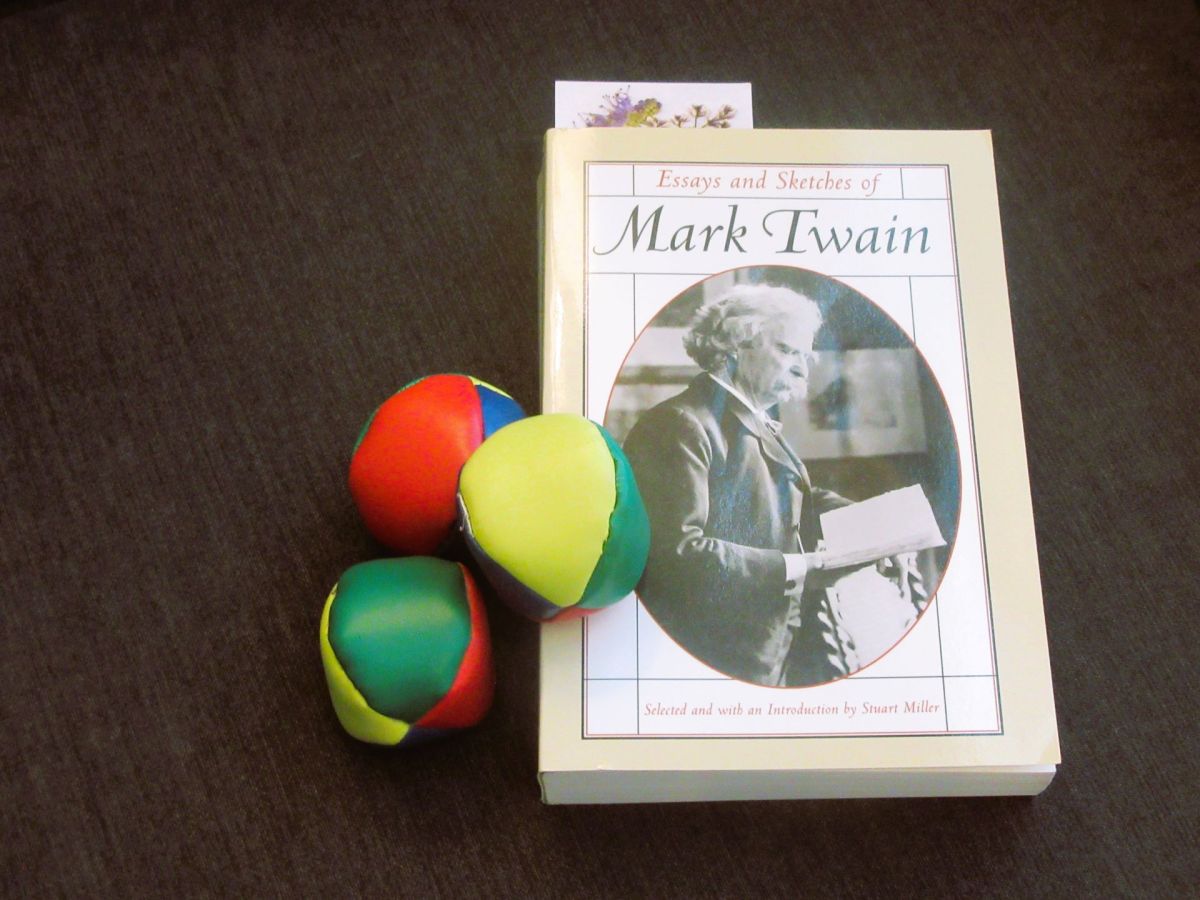
As of November 7, 2022 it has been 22 days since I purchased the Learn to Juggle kit from Barnes and Noble. So far, my learning experience reminds me of a story by Mark Twain, “Taming the Bicycle,” which was published posthumously—obviously after he succumbed from his injuries in the attempt to ride the high-wheeled bicycle in the early 1880s.
Just kidding of course, about his death from the bicycle riding adventure. He did mention using about a barrel of something called Pond’s Extract, which was a liniment for scrapes and other wounds.
Twain was writing about learning something new—a thing all of us are called on to do many times in our lives. He didn’t try to learn to ride the bicycle until he was over 50 years old.
I didn’t try to learn how to juggle until was well past my mid-sixties. How do you account for decisions to embark on new hobbies, adventures, and other nonsense at an age when most people would be content vegetating on the porch or in front of the TV?
I just answered the question, in case you didn’t notice.
Anyway, I am making some progress as juggling, although it’s uneven. It’s hard to believe, but sometimes I think I juggle better as I wander around. I think it might be because there is a natural tendency to throw the balls away from you. That way, I look more adept simply because I’m making a frequently observed beginner’s mistake. But I seem to be steadier even when I walk backward a few paces.
When I stand firmly in one place and attempt to juggle, I can often barely make it past half a dozen throws. Wandering a little, I have made thirty throws.
But then, randomly, the opposite occurs and the theory fails.
Counting the number of each throw seems to help—occasionally. I also notice that unscheduled, short practice episodes for 10 minutes or less work better than struggling along for a half hour or so at set times.
I don’t dread the practice sessions; in fact, I have a sort of itch to juggle at various times during the day. Sometimes I believe I do it to help me collect my thoughts, to keep my hands occupied, or just to pass the time.
I remember learning to ride the bicycle for the first time when I was a kid. I fell down a lot, just like Twain did—until I got the hang of it. Maybe juggling will turn out to be the same.
But I won’t need Pond’s Extract for juggling mistakes—as long as I don’t try juggling while climbing or descending stairs.
By now, you’ve probably read the digital news article describing how we’re all going to evolve into beings who resemble extraterrestrials (ETs) because of our preoccupation with digital technology.
The authors describe us as eventually developing another eyelid that’ll protect us from the blue light emanating from our gadgets. Our hands will become claw-like and permanently flexed because of the way we’re always gripping our smartphones.
You’ll also develop a third hand that protrudes from your butt so you can catch your cell phone as it slips out of the back pocket of your skinny jeans. Come to think of it, that’ll also give rise to a weird new meaning for the term “butt dialing.”
Of course, the article is a criticism of our preoccupation with our gadgets, but it’s still fascinating as speculation about how creatures, including humans, evolve in response to the pressures in our environment.
This kind of thing makes me wonder whatever happened to Neanderthal. The males were huge, especially their arms, which came from frequent arm wrestling with Sasquatch for the last shred of beef jerky. Neanderthal had a very prominent brow which developed to keep snow and pterodactyl droppings out of his eyes.
And this reminds me of the discovery of the fossil of a giant creature on the Greek island of Crete in 2003 (I think). The skull had a huge nasal opening in the center of the skull. That was probably for a trunk, as in elephant trunk. But paleontologists thought it might have been the explanation for why ancient Greeks came up with stories about the terrifying one-eyed cyclops.
And what about that carp with a human-like face on the top of its head? I saw that one a week ago on the show The Proof is Out There. I thought sure Michael Primeau, the forensic video analyst on the show, would dryly dismiss it (“This video is clearly faked.”). Instead, the other experts thought it was natural. Tony summarized it as an example of the “plastic” evolution, by which I think he meant phenotypic or evolutionary plasticity. These are changes in a creature’s appearance, morphology, or physiology in response to changes in its environment. Regarding the carp, one expert opined that the face would confuse its main predator, the eel, by confusing it.
I still don’t get that one. How would the carp species even begin the evolutionary process? Does the carp just think, “Huh, I think that eel might get confused if I had a face like a human”? I get it that the changes occur at the genetic level, but how exactly does it get started?
Could you google the answer? I couldn’t find anything specific, like x plus y equals human-like face on a fish that many humans would not care to eat.
And how about writing? I wrote this blog post longhand using pen and paper, something I gave up doing years ago but which I am sort of rediscovering gradually. I had an old typewriter for a while, which gave way to something called a word processor, which was a stand-alone device made writing and editing text, and eventually I got a computer—which really messed things up.
The thing is, I can remember getting something called writer’s cramp. If you remember that, then you probably recall how painful it was. Back then, did anyone ever wonder whether that would lead to the evolution of a claw like hand?
Could evolution have consequences pertinent to people who are always looking up at the sky looking for UFOs? Some of them, for some unexplained reason, never seem to have a smartphone with them. Anyway, could their eyes migrate, carp-like, to the top of their foreheads to counter neck strain? And could this lead to the evolution of a third eye in the center of the forehead? It would prevent falling into manholes. There are other consequences from evolving into a cyclops.
We would be adept at forging thunderbolts. We would be very talented at cultivating vineyards and herding sheep and goats. But our tempers would still be pretty bad, even worse. We would abandon courts of law and ignore justice. We would be violent giants, feasting on the flesh of ordinary humans. All this because we kept searching the sky, hoping to see UFOs and see ETs, which we would eventually resemble anyway because of our preoccupation with our devices.
The other day we heard this big bang against one of our windows. We both guessed what it was—another bird collision. A couple of years ago, one crashed into a window, got knocked out, lay on its side, and puffed really hard for a half hour or so.
Then it flew away.
This bird was not so lucky. It was hard to identify until we looked at the large flock of similar looking birds in the backyard trees. It was one of a large gathering of juvenile Cedar Waxwings. They didn’t have the red wingtips but they had sporty yellow tail feather tips and they had typical masks around their eyes.
Sometimes birds attack their reflections in windows. Several species do that but this one was not on the list. We think it was just an accident.
They were probably after the winterberry shrubs. There are a lot of articles on the web about birds getting drunk from eating fermented berries. I’m not sure how anyone knows, but some writers say it can cause birds to crash into windows. Have the birds undergone some kind of field sobriety test (“Okay buster, stand on one leg, and touch your beak with your wings.”)?
Cedar Waxwings are very gregarious, raucous, and rowdy birds who eat berries with gusto. The adults look a little like clownish (and maybe drunken) bandits.
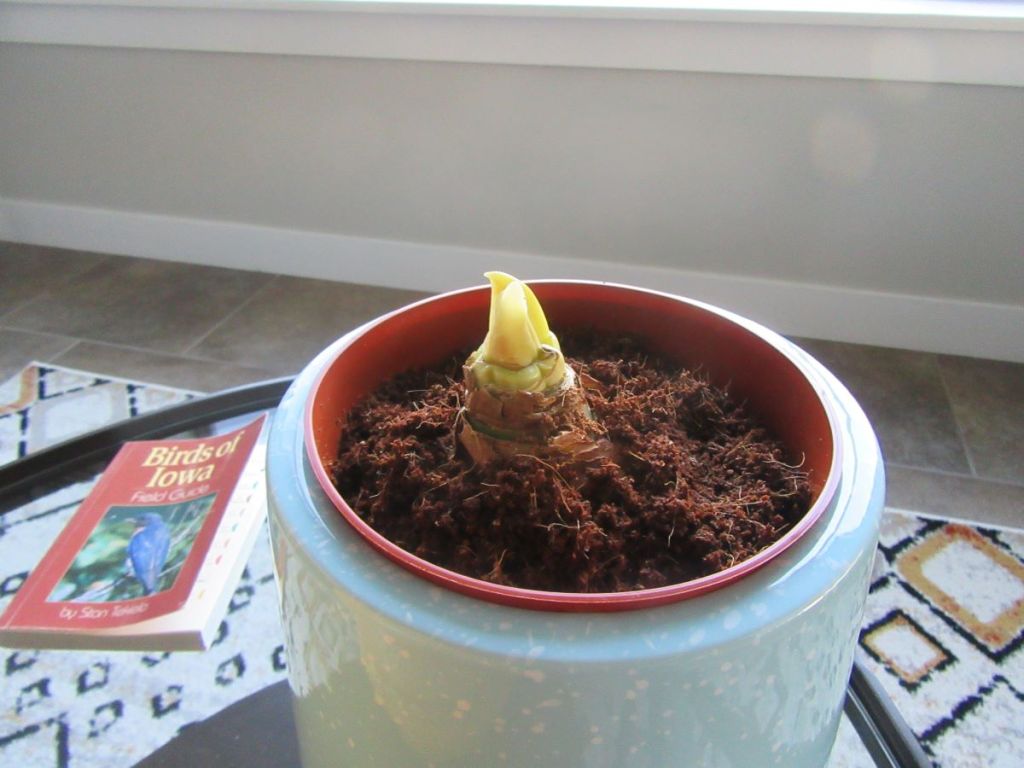
We planted an Amaryllis in a pot to celebrate the bird’s life. I guess Amaryllis bulbs can sprout new blooms for several years, almost like being reborn many times.
A little story from Greek mythology says that a maiden named Amaryllis had a monster crush on a shepherd named Alteo, a first-class heel who ignored her but loved flowers. She tried stabbing herself in the heart every day with a golden arrow for thirty days but at first that only led to a lot of trips to the local emergency room. But on the thirtieth day, a gorgeous flower grew from her blood. That’s the only thing that got Alteo’s attention; can you believe that jerk? They got married and honey-mooned at Niagara where they both got smashed on fermented winterberries, jumped out of the Maid of the Mist boat, crashed into a rainbow which turned out to be a wormhole portal to another galaxy where they finally sobered up by eating beef jerky from Sasquatch, who is an interdimensional creature as everyone knows.
The moral of the story is you should close your window shades more often, which might deter some birds from crashing into your windows—unless they’re really drunk.
I was listening to John Heim aka Big Mo on the Big Mo Blues Show (radio KCCK 88.3) last night and he was talking about this time of year, calling it “Indian summer.” He second-guessed himself about calling it that and even wondered aloud whether it might be “politically incorrect.” Sometimes names are hard.
All of my life I’ve know that this time of year, which can be pretty warm and dry for autumn, has been called Indian summer.
Honestly, I have never given any thought to the term “Indian summer.” I looked into it and it turns out that the term can be offensive to Native Americans (indigenous peoples). One article pointed out that the American Meteorological Society removed the phrase from its official glossary in October 2020.
That was an eye opener for me. It also jogged my memory. I remember hearing about the name for the opposite time of year in North America when I was working as a land surveyor’s assistant and drafter for consulting engineers when I was a young man. It’s called Blackberry winter. According to the Farmer’s Almanac, it’s the time of year when there is a brief period of cold weather in the late spring about the time blackberries are in bloom.
It turns out there are a few other names for the season in which certain flowers bloom during the cold snap, like Locust winter and Dogwood winter.
Alternative names for Indian summer have been proposed; one of them is simply late summer or “Second summer.”
I guess Second summer is okay, although I wonder if we could come up with something snazzier and analogous to Blackberry winter. There are some flowers that bloom during that time of year. How about?
Marigold summer
Zinnia summer
Sunflower summer
I got these ideas from a web article entitled “Indian Summer Flowers; Summer Season Flowers in India.” I realize the meaning of the word “Indian” in this article refers to the country of India, which highlights another complexity of names. On the other hand, marigolds are the flowers a lot of people plant in their gardens in North America.
I also found a web site which calls the Black-Eyed Susan, “Indian Summer Black Eyed Susan.” This one didn’t connect the flower to India. I guess you couldn’t apply the same rule above to rename it to something like Marigold Summer Black-Eyed Susan—too confusing.
So, just call it a Black-Eyed Susan and leave it at that. Sometimes names are hard—which makes us think a little harder about the names we choose.
The secret of patience is to do something else in the meantime.
Croft M. Pentz
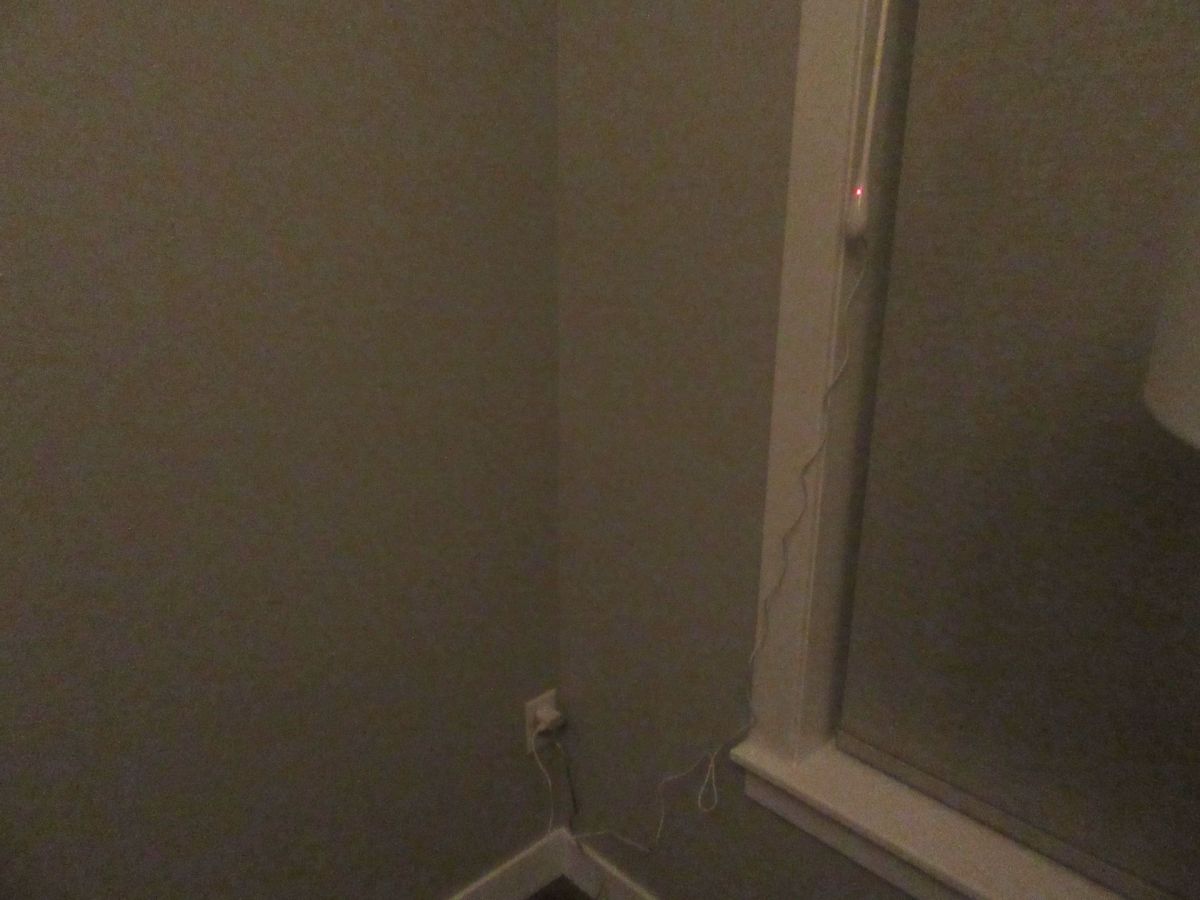
A few days ago, Sena noticed a noise in one of the sunroom window shade wand controls. She can hear noises I can’t hear, which is a good thing. She wondered if the wand battery needed recharging. We have 3 window shades like this and they came with a recharger that works the same way a cell phone recharger does. You plug the small end into the back of the wand which has control buttons for raising and lowering the shade. You plug the two-prong end into a regular electrical outlet.
We had never recharged them. The instructions said that when plugged into the charger the wand indicator light would shine red. When fully recharged, the light should turn green.
I waited one hour, then two hours. I checked the red light every few minutes or so. Finally, I quit looking and did other things. I replaced the refrigerator water filter. I purged the system. I emptied the ice bucket. I did a load of laundry. I vacuumed the carpet in the house. I exercised. I sat in mindfulness meditation. The light was still red. I checked it after 5 hours—still red. I finally just forgot about it.
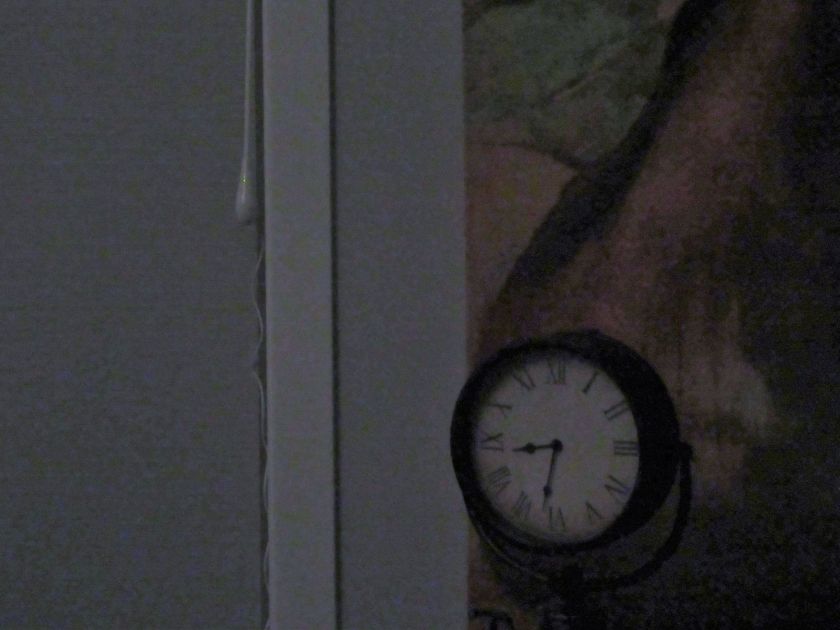
About 6 hours later, I passed by the sunroom, glanced at the window and didn’t see the red light. I looked at the wand and couldn’t see the indicator light very well. I got the magnifying glass out and caught the light just right. It was green! Sena said the noise was gone.
I plugged in another window shade wand. The red light didn’t turn green until 8 hours later. I checked it several times. There was nothing to do but be patient.
I finally just did something else. I checked my blog site and was amazed to find a comment from a colleague, Dr. Ronald W. Pies, MD. He is according to a brief bio: professor emeritus of psychiatry and a lecturer on bioethics and humanities at SUNY Upstate Medical University in Syracuse, New York; a clinical professor of psychiatry at Tufts University School of Medicine in Boston, Massachusetts; and editor in chief emeritus of Psychiatric Times™ (2007-2010). He is the author of several books. A collection of his works can be found on Amazon.
I had written a short shout-out blog post about the article he and Dr. George Dawson, MD had written and published on September 26, 2022 in Psychiatric Times, “Antidepressants Do Not Work by Numbing Emotions.”
What was unusual about Dr. Pies’ comment was that it actually turned up in my spam box! If I had not patiently waited a second to read it carefully, I would have automatically trashed it. That was close.
And I would have missed the golden opportunity to tell him that I consider both him and George my friends.
About a half hour before the wand control light turned the green, our cable TV and internet went out. Wow. I had been watching a TV show rerun, probably for the 100th time, so it was no great loss. There was the usual message you get when the service is out: Please wait while this channel is being restored kind of thing. You can’t do anything but just be patient. It was getting late in the evening and I usually don’t do much on the computer then.
A little later, after Sena had gone to bed, I thought of writing this post. I didn’t want to clack on the keyboard and wake her up, so I did something I haven’t done in years. I got pen and paper out and did some long-hand writing. I had skimmed some articles on the internet before it crashed about how reading and writing on paper were better for your brain than doing those on a computer.
It felt good to write. As I did in the distant past, I scribbled in the margins, drew arrows above lines and carets to corrections and notes. It was a mess—a partly satisfying mess.
I say “partly” because it was also not quite right. I didn’t try to type it that night or even the next day. In fact, I couldn’t post anything the following morning to my blog because the internet was still out. The cable TV came back sometime during the night. Obviously, there had been a service outage.
But because the internet was still out, I called the cable company. This was another exercise in patience. I don’t know if every other cable company puts those automated telephone recordings in front of you before you can reach an actual person. They are nuts.
Cable Company Voice (CCV): Hello, please hold on while I check your account. OK, there, I found it. Am I speaking with the owner of the account or Bozo the Clown?
Me: Nobody here but us bozos.
CCV: Great, how can I help you, Bozo?
Me: Was there a power outage in my area?
CCV: OK, I see you’re having a problem with your internet connection. I can help you with that. Are you in front of your computer now or on the roof of your house dancing the merengue?
Me: In front of my computer.
CCV: Great! Please unplug your modem and wait 3 millenia; then plug it into your toaster. This will reset the incoming signal. When you have completed this step, say “Continue.”
Me: Continue.
CCV: That was a rather quick 3 millenia. Which would you prefer: Going through another dozen more trouble-shooting steps with me or speak to an agent?
Me: Speak to an agent.
I finally got to an agent whose mere presence on the line seemed to lead to an immediate, magical restoration of our internet connection. When I specifically asked her if there had been a service outage, she said that, indeed, an outage in our area had occurred. She then arranged for an account credit to ensure we would not be charged for service during the time of the outage. Patience.
This post does not look much like the hand-written one. But waiting a while to let the thing simmer probably didn’t hurt.
Sena and I were listening to the Mike Waters morning radio show (KOKZ 105.7) this morning and his invitation to listeners was to call in and quote their favorite dumb question. One of the callers recited something which was actually a George Carlin joke. Neither one of us thought we heard it right, but it’s the same framework as the joke I found on the web (only the numbers were changed):
“If you’ve got 24 odds and ends on the table and 23 of them fall off, what’ve you got? An odd or an end?”
This is an example of his wordplay humor.
Carlin’s humor was also marked by satire on American culture and politics, the latter of which has gotten pretty rough. You’ll also find references on the web to Carlin’s past history of substance use, which reportedly included psychedelics.
That reminds me of an opinion piece published in the September issue of Current Psychiatry, by the journal’s editor, Henry A. Nasrallah, MD (From neuroplasticity to psychoplasticity: Psilocybin may reverse personality disorders and political fanaticism. Current Psychiatry. 2022 September, 21(9): 4-6 | doi: 10.12788/cp.0283).
I was a little surprised at Dr. Nasrallah’s enthusiastic endorsement of psilocybin for treatment of personality disorders and political extremism. He acknowledges the lack of any studies on the issue. In the last paragraph of his essay is a sweeping endorsement:
In the current political zeitgeist, could psychedelics such as psilocybin reduce or even eliminate political extremism and visceral hatred on all sides? It would be remarkable research to carry out to heal a politically divided populace. The dogma of untreatable personality disorders or hopelessly entrenched political extremism is on the chopping block, and psychedelics offer hope to splinter those beliefs by concurrently remodeling brain tissue (neuroplasticity) and rectifying the mindset (psychoplasticity).
While I’m not so sure about how effective psilocybin would be for this, I’m all for trying something to reduce the “visceral hatred on all sides.”
Maybe humor could be part of the solution. It doesn’t have to be exactly like that of George Carlin. Both parody and satire have been used by many writers for this.
I like the distinction between parody and satire in one article I found on the web. One recent example of satire (or parody; the distinction is sometimes hard to make since the story was listed as “Iowa Parodies”) was in the news and it apparently fooled at least a few people. It was about the Iowa football coaching staff. The title was “Brian Ferentz Promoted to University President To Avoid Having to Fire Him (Satire): The move was deemed ‘a way easier conversation than having him fired’ by the athletic director. It was written by Creighton M, posted September 5, 2022.
I think the story was originally printed without the word “Satire” in the title. I can’t recall seeing the heading “Iowa Parodies” either. A later version of the story added the word “Satire.”
The story might have been about nepotism in the hiring of Brian Ferentz (he’s the son of head coach Kirk Ferentz) as offensive coach. On the other hand, under Iowa law, it was not illegal to hire Brian Ferentz, who in any case reports to athletic director Gary Barta, not Kirk Ferentz.
I suspect the joke had more to do with negative public attitudes about the performance of the Iowa football offense early in the season.
Is it funny? I guess it depends on your perspective. The Iowa football coaching staff probably didn’t chuckle over it. But it more or less fits the definition of satire. It uses humor to expose flaws in the way we behave. And it avoids direct and nasty confrontation, which usually triggers antagonism rather than collaboration. Will it change the Iowa football program? I doubt it. They’re actually doing pretty good so far.
But satire as a strategy to inform and maybe change the public opinion will endure. The Hitchhiker’s Guide to the Galaxy by Douglas Adams is one of my favorite books and it satirizes governments and the foolishness of people. I first learned about The Onion newspaper while we were in the process of relocating to Wisconsin (a short adventure). It satirizes the Associated Press news style.
One of the most uproarious examples of parody is a TV show which is no longer available on cable television but still offered on a streaming service (I think), Mountain Monsters. It’s a hilarious sendup of all the Bigfoot hunter shows.
The added benefit of parody and satire and other such forms of humor is that they are safer than psychedelics—unless your target was born without a funny bone.
Yesterday was the first day of Autumn. Happy Autumn! Was that too cheerful? You know, I used to watch the show Monty Python’s Flying Circus years ago. I thought it was outrageously funny.
What reminded me of the show was Sena telling me that on Wednesday night, a member of the Flying Circus cast, Eric Idle, was on The Masked Singer, one of her favorite shows. I didn’t watch it. He was Hedgehog and sang the Beatles number, “Love Me Do.” Eric said something about how you should look on the happy side of life. He mentioned there was song with that title.
We looked it up and found “Look on the Bright Side of Life.” It’s a catchy tune and reminded me of Monty Python’s Flying Circus attitude. I guess Eric Idle wrote the song and sang it on The Life of Brian.
While the song seemingly is about looking steadily on the bright side of life, it has that slightly edgy, ironic attitude to it which was typical of the Flying Circus.
While some think that the Covid-19 pandemic is over (not mentioning names), there’s probably a more balanced way of looking at that and other challenges in life. The PennStateExtension published an article on June 12, 2020, “Realistic and Optimistic: Managing Mindset in Challenging Times,” by Suzanna Windon, Ph. D, Assistant Professor, Youth and Adult Leadership, and Mariah Stollar, Former Part-Time Research Assistant, Penn State University.
Their list of ways to look on the bright side while being mindful of potential pitfalls attributable to things like overweening pride and fantasy are good to remember in these trying times (see original article by the authors for full details):
“Practice mindfulness.
Observe and adjust your patterns of thinking.
Believe in yourself, but do not underestimate challenges.
Look forward to the future, but be realistic things may not quickly change.
Keep yourself informed, but limit media intake.
Reflect on messages you are sending to employees, volunteers, and loved ones. ”
In other words, look on the bright side but don’t kid yourself.
I know the term “suicide risk assessment” sounds very clinical. That’s because I did it for many years as a consultation-liaison psychiatrist in the general hospital.
The human part of it was using the suicide safety plan, which I got from the Centre for Applied Research in Mental Health & Addiction (CARMHA). You can download it yourself and adapt it by writing in the National Suicide Prevention Lifeline: 988 Suicide and Crisis Lifeline. That’s because the phone numbers on the form are specific to Canada.
Most often I interviewed patients in the intensive care units, where they were admitted after a suicide attempt. The interviews were very short if they refused to talk to me or were still delirious—often the case.
If they were awake and able to converse, the interviews were often pretty long. One way to connect with the patient was working on the safety plan together. I was often able to tell whether they were sincere or not by the level of detail they gave me about support persons they could get in touch with or things they could do to help them cope with whatever was troubling them.
A lack of detail in the plan, or refusal to work on some parts of it were areas of concern. If there were comments about friends, pets, or pastimes that spontaneously led to laughter (yes, that happened occasionally!), I was more confident that the patient was able to look toward the future and make specific plans for staying alive.
There is healthy debate about how useful specific suicide risk assessment scales are for predicting and preventing suicide. They are an essential part of the computerized medical records now, whatever anyone thinks of their reliability at predicting imminent suicide. I never used no-suicide contracts because well before the time I entered professional practice, most experts agreed that they don’t prevent suicide.
What was more useful for me as a clinician was to sit down at the patient’s bedside and, after getting the details about what the patient actually did in the suicide attempt and the events connected with it (along with a comprehensive and thorough history), I would get the safety plan from my clipboard, hold it up so they could see it and say, “Now let’s work on this; it’s your safety plan.”
I can’t tell you how often working on those plans, frequently for more than half an hour, led to laughter as well as tears from the patient. When it worked, meaning the relationship between us deepened, I sometimes did not find it necessary to admit the person to the psychiatric ward. While this occasionally alarmed the ICU nurses, things usually turned out fine later.
I just read Dr. George Dawson’s post “Happy Labor Day” published August 31, 2022. As usual, he’s right on the mark about what makes it very difficult to enjoy psychiatric practice.
And then, I looked on the web for anything on Roger Kathol, MD, FACLP. There’s a YouTube video of my old teacher on the Academy of Consultation-Liaison Psychiatry (ACLP) YouTube site. I gave up my membership a few years ago in anticipation of my retirement.
I think one of my best memories about my psychiatric training was the rotation through the Medical-Psychiatry Unit (MPU). I remember at one time he wanted to call it the Complexity Intervention Unit (CIU)—which I resisted but which made perfect sense. Medical, behavioral, social, and other factors all played roles in the patient presentations we commonly encountered with out patients on that unit where we all worked so hard.
Dr. Kathol made work fun. In fact, he used to read selections from a book about Galen, the Greek physician, writer and philosopher while rounding on the MPU. One day, after I had been up all night on call on the unit, I realized I was supposed to give a short presentation on the evaluation of sodium abnormalities.
I think Roger let me off the hook when he saw me nodding off during a reading from the Galen tome.
Dr. Dawson is right about the need to bring back interest, fun and a sense of humor as well as a sense of being a part of what Roger calls the “House of Medicine.” He outlines what that means in the video.
What made medicine interesting to me and other trainees who had the privilege of working with Roger was his background of training in both internal medicine and psychiatry. He also had a great deal of energy, dedication, and knew how to have fun. He is a great teacher and the House of Medicine needs to remember how valuable an asset a great teacher is.









 Go Retire Psychiatrist