Protecting the Universe from the Scum of the Earth

The title of this post might sound familiar to those who have seen the movie Men in Black way too many times, like me. There’s a trailer poster from the 1997 MIB movie showing Agents J and K holding huge space guns and the title is “Protecting the Earth from the Scum of the Universe.”

There are reasons to invert the title; all you have to do is read the news headlines. And one of them is on a story posted in the Guardian entitled ‘Bored aliens’: has intelligent life stopped bothering trying to contact Earth?

Whoa! When exactly did they start?

In a nutshell, the author is citing an astrophysicist’s notion that we should consider embracing a novel idea called “radical mundanity” which in this context says that maybe extraterrestrials are not much smarter than earthlings. That could be one explanation why nobody has seen what the majority of humans would call clear and convincing evidence that advanced civilizations exist out in the galaxy.

I guess “clear and convincing evidence” means ETs should be walking up to us and asking for directions to the nearest good rib joint.

I guess terms like “radical mundanity” and “radical empathy” are in vogue because radical rationalization is an old earthling habit that fathered both.

In fact, common sense suggests that something like radical practicality might explain one pretty funny quote from MIB. It’s the one in which Agent K is demonstrating the universal translator to the soon to be Agent J and confides that earthlings are not supposed to have it, and then goes on to explain why:

“Human thought is so primitive it’s looked upon as an infectious disease in some of the better galaxies. That kind of makes you proud, doesn’t it?”

Interesting why Agent K says that the low opinion some ETs have of humans is something to be proud of. Maybe that because of radical admiration, which is what we often have for slick villains clever enough to steal something like the universal translator—since radical criminality is so rampant everywhere on earth.

That would pretty much be the end of this line of thought (if I had any sense). But if you reason that most ETs would be leery of earthlings, why would so many of them travel to this planet? Part of the answer (of course) is in MIB. It’s Agent K’s explanation for why so many of them do.

Agent K: “Back in the mid-1950s the government started a little, underfunded agency with the simple and laughable purpose of establishing contact with a race not of this planet… They were a group of intergalactic refugees wanting to use the earth as an apolitical zone for…creatures without a planet. Did you ever see the movie Casablanca?”

“Today there are approximately 1500 aliens living and working Manhattan and most of them are decent enough; they’re just trying to make a living.”

OK, that’s only part of the story, maybe mostly the radical empathy part. Getting back to radical mundanity, which is how we got started on this crooked tale, where does this put earthlings and ETs? Maybe we’re headed toward realizing that every bright dot in the sky is not evidence for visitors from somewhere out in the galaxy or beyond. Maybe trying to get to Mars is not such a hot idea. Maybe we can try to get along with each other on earth without waiting for ETs to stop us from slaughtering each other. I don’t know as much about this approach as I should, but I think it’s called radical acceptance.

Big Mo Pod Show: “Across the Blues Universe”

I heard the Big Mo Blues Show last night and the Big Mo Pod Show today. The podcast song selection was part of the Lunch with Chuck portion of the show, which I don’t know a whole lot about. The Lunch with Chuck thing I’ve heard Big Mo talk about and I think it involves a real guy named Chuck who talks music with Big Mo sometimes, although I’ve not heard an actual live Lunch with Chuck program during the blues show. And it might be another Big Mo running joke.

The other thing I want to mention is that I heard Big Mo talk last night just before the Lunch with Chuck thing about something like a “fish psychic”. I think it’s a new comedy bit like MayRee’s Hand-Battered Catfish and Shorty’s Adult Diapers. I can’t remember the whole fish psychic bit, but I’m pretty sure he’ll do it again, maybe even next Friday. I think it’s another faux advertisement, and it might be about some kind of fish psychic who can help you catch lunker bass and the like.

Anyway, I learned something from the pod show today. I’d never heard of something called “race records” which is one term Lightnin Hopkins song “Mojo Hand” led to. Race records were 78-rpm phonograph records marketed to black people back in the days of the victrola, between the years of the 1920s to the 1940s, well before my time.

The other term new to me is the title of Hopkins’ song, “Mojo Hand.” The podcast discussion mentioned that mojo hand referred to African American voodoo charms, one of which happened to be a lucky charm, possibly a dried monkey’s paw. The song is actually about using voodoo to keep a lover from being unfaithful. The song means more now that I know that.

Another thing I learned today was that the song “Feel So Bad” (recorded in 1966) by Little Milton has a lyric in it, “feel like a ball game on a rainy day” that was repeated by boxer Muhammad Ali when he found out he had to wait 6 weeks before the Rumble in the Jungle match in 1974. That was because Foreman had to heal up first because he suffered a laceration above his right eye during a sparring match.

What I also didn’t know was that the Rumble in the Jungle had political overtones. There is an article entitled “Remembering the Rumble in the Jungle” subtitled “The 1974 Rumble in the Jungle was freighted with symbolism regarding American racial politics and the pan-African struggle in the context of the Cold War.”

One more thing I learned from the podcast is related to the song “Wine O’Clock” by Shemekia Copeland. He called this song a women’s support tune and, unlike my disagreement about this issue in last week’s podcast, I tend to agree with this song being about women supporting each other or at least understanding their burdens in a society marked by gender role disparity.

What helped me reach this understanding is an article entitled “What makes up wine o’clock…” published in 2022.

Wright CJC, Miller M, Kuntsche E, Kuntsche S. ‘What makes up wine o’clock? Understanding social practices involved in alcohol use among women aged 40-65 years in Australia. Int J Drug Policy. 2022 Mar;101:103560. doi: 10.1016/j.drugpo.2021.103560. Epub 2021 Dec 29. PMID: 34973490.

The abstract reminds me of the discomfort with the idea of women (or anyone regardless of gender) using alcohol to cope with socially designated roles.

“Think I’ll have another glass; the world can kiss my ass; tick tock, it’s Wine O’Clock.”

I sometimes learn a lot more than I expect from the Big Mo Pod Show.

The Magic of the Wave

Over three years ago, I posted about a waving man we used to see a lot of on a busy street in Iowa City (yes, we have them). He worked at the grocery store and waved at traffic whether he was walking to work or leaving. He still works there but we don’t drive that route much anymore so we don’t see him out waving.

Occasionally I’ll see news stories about men who wave at people driving by. They always look like they have a great time being friendly. I think most of us get a big kick out of it.

I saw another story today about a guy named Kent Proudfit in Urbandale, Iowa who does the same thing. After a while I wondered why I saw only stories about men do the waving thing. And then I found a story about a 74-year-old woman named Patricia Bracey who’s a waver in Chesterfield, Virginia. She says the Lord told her to do it.

So, waving at people driving by is an equal opportunity activity for cheering up others. I get the sense that it’s mostly older people who sit or stand by the side of the road and wave at folks driving by.

On the other hand, there is another phenomenon that works on the same principle of helping others feel good. It’s the Iowa Hawkeye Wave at the end of the first quarter of the football game in which the all the players, staff, and tens of thousands of fans of all ages in the stands get up at wave at the kids and their families in the University of Iowa Stead Family Children’s Hospital. It’s now called one of the greatest traditions in college sports. It got started in 2017, which is not such a very long time ago.

So, go ahead and wave.

Connecting the Dots between Kintsugi and the Blues

Since I wrote the blog about the Big Mo Pod Show, Hickory Smoked Blues, I’ve been trying to remember how I connected the dots between Kintsugi and blues music, which is said to be healing even though often it sounds like it could make you hurt.

I had a devil of a time tracking this down. The image of Kintsugi or Kintsukuroi, which is the Japanese art of repairing broken pottery by mending the broken parts a mixture which contains powered gold.

The main idea is that repairing something broken using something like gold (read blues music here) can be healing.

You could also apply this to some other process, including psychotherapy.

The writing of a couple of people helped me make the connection. One of them is now a child psychiatrist named Jenna, who used to write the blog The Good Enough Psychiatrist, a link for which is still on my blog menu. Her post entitled “Amae” (a Japanese concept meaning cherished) caught my attention. Amae has both positive and negative aspects. In a way blues music is similar. It can be nourishing as long as it isn’t too focused on trauma.

About a month later, I found an essay by another child psychiatrist, Dr. Ashmita Banerjee, MD, entitled “The Power of Reflection and Self-Awareness,” actually mentions kintsukuroi at the end of the essay following her poem, called “Not A Poem.”

So, I think what I was getting at was pain and suffering can be reduced in healing ways, which can include art forms, like music. Some blues music can be repetitious, negative and even demoralizing when the emphasis is only on the pain. The other side of the blues can be uplifting, especially when there is the element of cherishing the tender, the wise, and the healing notes—the golden glue.

Both essays were the inspiration for my post, “Food for Thought.” The image of the kintsugi bowl is on both that post and “Big Mo Pod Show: Hickory Smoked Blues.” I still think the Robert Cray Band version of “I’ll Always Remember You” is a reminder of Kintsugi, at least for me.

History Lessons in the Ramshorn Journal

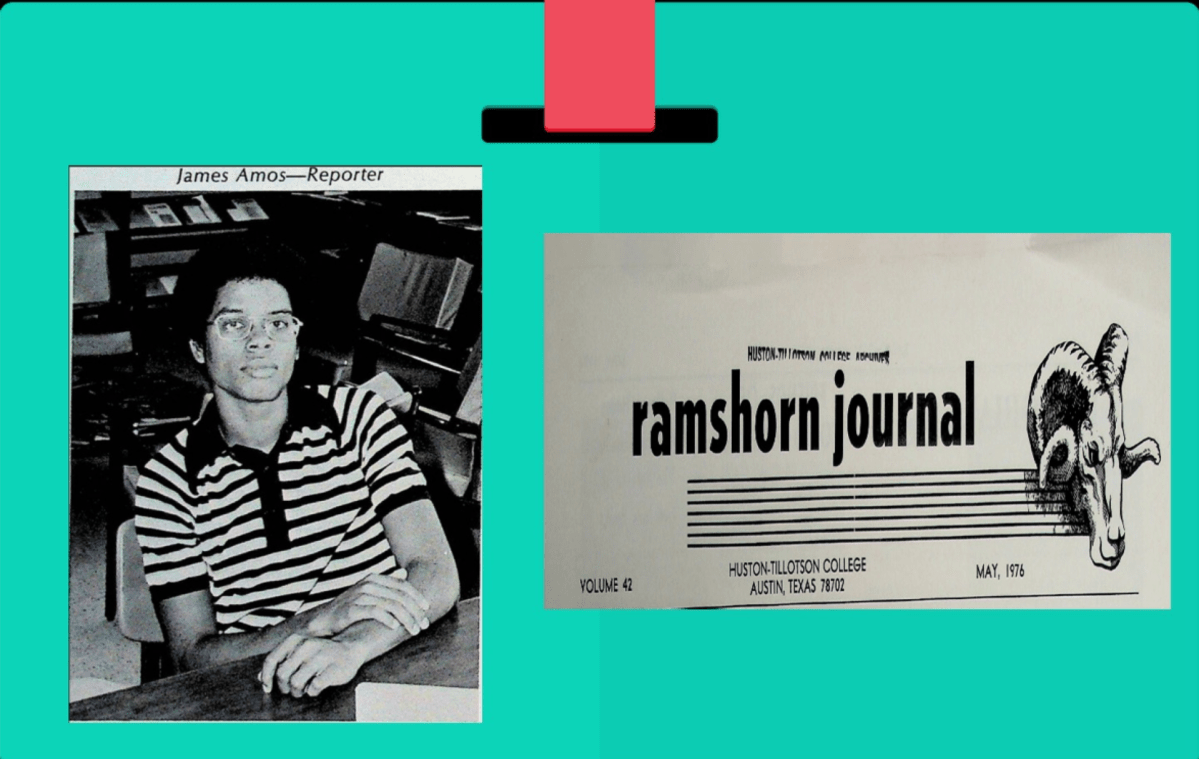
I think I found a pair of articles from the mid-1970s in the Huston-Tillotson College Ramshorn Journal that might have a connection to each other, even though the authors didn’t know it at the time.

One of them was written by yours truly and published in December of 1975, entitled “H-TC Sponsors Education Seminar.”

The other is a New York Times editorial from January 1976 which was reprinted in the May 1976 volume of the Ramshorn Journal and was written by Christopher F. Edley, a very successful lawyer and, at the time, the Executive Director of the United Negro College Fund.

Both were written about the same time, in the era of the civil rights struggles. I’m not comparing myself to the brilliant and accomplished Mr. Edley. And I’m just going to admit that I really don’t remember much about the trip to Houston for the Education Seminar about which I wrote my article, despite my being a participant. But I think it’s hard not to notice the language I used in my description of the importance of what the education seminar was all about. While much of the text is rather dry, when I discuss what was emphasized, I sound a little more intense. I may not remember much of what we specifically did and said but I caught the tone.

When I say the trip was not a guided tour, I mean that both faculty and students were serious about what the main message was for us—as black people. We had to measure up in a way that implied that we had to be better than best. That whole section starting with “Throughout the program, our people were reminded that any person who aspires to a position with any company must fulfill particular criteria.” It was as if I were saying we had to be perfect to make up for being black. We had to be the exemplars.

The individual must exhibit creativity, aggressiveness, ambition, self-confidence, initiative, dedication, maturity, and an ability and willingness to cooperate and effectively communicate with other people. The individual must punctual and reliable. Industry demands nothing less than high-gear performance. But they pay handsomely for that high-gear performance.

As I read this now, I get caught up on all the exhortations to be scrupulous, alert, and so on because, after all, we’re in a corporate jungle which is all about survival. I could have recast the last sentence above as “But they pay dearly for that high-gear performance”—which refers to the candidate, not the one doing the hiring.

I admit that how I wrote the story may reflect my reaction to rather than the reality of the emphasis of speakers at the seminar.  But I did get the impression that I, as a black person, would be held to a higher standard than a white person. And I was uncomfortable about that.

When I turn to the New York Times article by Mr. Edley, I again am impressed with the struggle for fairness and justice, which didn’t seem forthcoming. He expressed the same sense of unfairness that I felt in Houston. The tone is almost one of outrage. He described the black people who were going to college in those days as most likely being the first ones in their families to go to college.

That’s what I was.

Mr. Edley was expressing frustration about blacks and browns just being able to get to the door of opportunity. I got the message that the struggle would go on forever—even if we got in the door. We didn’t just have to prove we were equal. We had to prove we were better.

Anyway, as I read the articles I wrote for the Ramshorn Journal 50 years ago, I begin to realize why I had no memory of having written them. It gradually becomes less strange that I still don’t really remember much of my time at Huston-Tillotson College, one of the historically black colleges and universities (HBCU) in America. But I needed that experience, even if I did pay dearly for it.

Click in the gallery; click on the picture, click the icon with an “i” in a circle, click view full size, click the plus sign to enlarge the image.

24th Anniversary of 9/11 Attack on America: A Reminder of Our Connection to Each Other

I’m thinking about the upcoming commemoration of the 24th Anniversary of the 9/11/2001 attack on America. There will be the annual event in New York City.

In Muscatine, Iowa, there will be the annual Patriot Day ceremonies sponsored by the City of Muscatine and the Muscatine Fire Department. After the morning ceremony, the Memorial Stair Climb will begin at 8:52 a.m. at the Muscatine High School football stadium bleachers.

The KCRG news reported on August 7, 2025 that 3 more World Trade Center victims were identified last month by DNA testing. The New York medical examiner’s office continues testing the remains recovered from the wreckage.

Like many people, I remember where I was and what I was doing when the attack happened in 2001. I was the general hospital psychiatric consultant on duty at the hospital at the time. I was hustling up the stairs back to my office after responding to a consultation request.

I happened to glance at the big television screen on the wall of the main floor lobby in the south part of the hospital. I watched in horror as a newscast showed the fire and smoke coming from one of the towers, which I later learned came from the plane crashing into the building. The rest of the day was full of reports of the attack.

When we visited New York City in 2017, we saw the Memorial & Museum Plaza as well as the Survivor Tree, the Callery Pear. It was discovered at Ground Zero, scarred and scorched but alive and replanted at the Memorial in 2010 after being nursed back to health at the city nursery. It is still alive and well today. It remains a symbol of strength, hope, and a reminder of our connection to each other.

Big Mo Pod Show: “Hickory Smoked Blues”

Today, the Big Mo Pod Show was about how blues music can you help you “exorcise your demons” as Big Mo himself put it today. Isn’t that what it’s always about? And I can’t explain how that even works.

Big Mo Pod Show 085 – “California Bluesin” KCCK's Big Mo Pod Show

After a short break during the Thanksgiving holiday your hosts are back at it again with another episode! This week features the usual mix of blues eras you’ve come to expect along with a few Californian artists, tune in to see which ones! Songs featured in the episode: Solomon Hicks – “Further On Up The … Continue reading
  1. Big Mo Pod Show 085 – “California Bluesin”
  2. Big Mo Pod Show 084 – “Garage Blues”
  3. Big Mo Pod Show 083 – “Legal Pirate radio”
  4. Big Mo Pod Show 082 – “Tribute”
  5. Big Mo Pod Show 081 – “Cheers To Kevin”

But I don’t always understand how it works. I’m going to admit I’m not sure at all how one song last night by Toranzo Cannon would help anybody, and that’s “I Hate Love.” Of course, it’s contradictory and ironic. I’m not going to pretend I know what blues music is all about and how it can sometimes heal your inner soul pain.

But a lot of people believe that blues can help you get past the pain and it seems that it works paradoxically. I don’t always get it. But I’ve been listening to the Big Mo Blues Show for years.

That reminds me. We had a couple of guys install motorized window shades yesterday and one of them was a blues musician. He plays bass guitar and I gather he plays in local bands. He wore the best hat; it’s a fedora! Sena and I sort of ribbed him about it, but I had a fedora like that once, decades ago. It was gray with a narrow leather band. I don’t have it anymore.

I told him that I wore it while I was interviewing for residency. I wore it to dinner in a hotel in St. Louis, Missouri and a woman passing through the hotel restaurant looked at me and said with a grin, “Wear that hat!”

Sena reacted as if she’d never heard that story before. The fedora guy thought it was funny. Fedora man had that style to him that I think is fairly common in musicians. They look and may act in a way that makes you notice them. I don’t think you can always tell what somebody does just by the way he or she dresses. But when he told us he was a musician who liked the blues, that didn’t surprise us.
What did surprise us was that he didn’t recognize the name of a prominent blues musician in Iowa and a lot of other places—Kevin Burt. But he did have a sense of humor.

I think most blues musicians have a kind of slant sense of humor. It probably comes out in some of the music. I’m more drawn to blues music that makes me chuckle. On the other hand, I liked one song on the blues show last night they didn’t discuss today on the pod show. It’s not funny and I had a hard time finding the lyrics for it. It’s “I’ll Always Remember You” by the Robert Cray Band. I found a couple of sites I think got the lyrics below wrong and didn’t make sense. The way I heard the song the lines went like this:

 “Old clothes and worn-out shoes
Empty bottles and a book that’s way past due.”

The line I keep finding that I think is wrong is the second one, which is often written as “Empty bottles and I put this way past due.”

I think the line “a book that’s way past due” makes more sense because it conveys a sense of regret, waste and loss and promises not kept and opportunities lost and probably a half-dozen other ideas that you probably can’t easily encapsulate. It evokes sorrow that is only partly fixed by the letter’s promise— “I’ll always remember you.”

That may not completely heal you, but it’s a little like something I read about kintsugi. It’s about mending broken pottery with gold in a literal sense. In a metaphorical sense, it’s about repairing what might be broken emotionally broken in us and, despite not being the same as we were before we were broken, we’re somehow still functional and healed though not perfect. A psychiatry resident blogger wrote about that.

One More Time: Another Ramshorn Journal Editorial

This is the 2nd editorial I wrote in 1975 about fraternities during my freshman year at Huston-Tillotson College (now Huston-Tillotson University, one of the Historically Black Colleges and Universities, HBCUs). There are a couple of misspelled words (“incidence” should be incidents; “altruish” should be altruism).

On the whole, it’s a more developed piece than the editorial about college hazing. I thought then and still think that Help Week should be substituted for Hell Week.

ramshorn journal vol 38, dec 1975 Click the image; Click the little icon circle with i; hover over the image and click the plus sign to enlarge.

I Was a College News Reporter After All

It turns out I was a news reporter for the Huston-Tillotson College Ramshorn Journal after all! I wrote a few of them, including an editorial about Greek fraternity hazing in 1975. I’m including it in this post below. It has an apparent typo in it (“Motherhood” should be brotherhood).

It’s typical for fired up freshman writing. I see lots of youthful idealism, energy, and a drive for change. How did I forget so much of what I was over the last 50 years?

I wrote “Is Hazing Necessary” (the question mark is missing) because I saw it going on in my freshman year. I can’t remember whether the fraternity members gave me flak about it or not. But I guess I can’t say it didn’t happen just because I can’t remember it.

Hazing still happens, as I found out when I did a quick web search today. I still don’t know why. Even The University of Iowa had an incident in November of 2024.

I don’t know how I lost such an important part of my past. And I don’t know what led me to recover it. I do know that if Sena hadn’t pursued the search after I was ready to forget it, I wouldn’t have these fragments of my personal history now. And I’m grateful to Huston-Tillotson Downs-Jones University Library for their help.

Ramshorn Journal Oct.1975 (page 4) Click the image; Click the little icon circle with i; hover over the image and click the plus sign to enlarge.

Big Mo Pod Show: “Spiritual IV”

I’m trying to figure out what the meaning of the title is of this week’s Big Mo Pod Show. It’s “Spiritual IV” and I looked at all of his past pod shows looking for Spiritual I-III. I can’t find them.

Big Mo Pod Show 085 – “California Bluesin” KCCK's Big Mo Pod Show

After a short break during the Thanksgiving holiday your hosts are back at it again with another episode! This week features the usual mix of blues eras you’ve come to expect along with a few Californian artists, tune in to see which ones! Songs featured in the episode: Solomon Hicks – “Further On Up The … Continue reading
  1. Big Mo Pod Show 085 – “California Bluesin”
  2. Big Mo Pod Show 084 – “Garage Blues”
  3. Big Mo Pod Show 083 – “Legal Pirate radio”
  4. Big Mo Pod Show 082 – “Tribute”
  5. Big Mo Pod Show 081 – “Cheers To Kevin”

The other thing I noticed about the pod show is that the theme of many of last night’s songs is less about spirituality and more about carnality and brutality. Now, that doesn’t mean I’m preaching. I just wonder if the title “Spiritual IV” is ironic.

Take the song “Talk to Me Baby” by Elmore James, or “44 Blues” by Little Arthur Duncan. One song that didn’t make the pod show list was “The Circus is Still in Town (The Monkey Song)” by Rick Estrin and the Nightcats. And Buddy Guy sang his new song “Been There Done That,” meaning he’s been to hell and back. He’s 89 years old and still does gritty blues. The music often seems only about sex, violence and drug addiction.

And the discussion gravitated to guns, specifically the .44 caliber handgun. I never knew Muddy Waters carried a gun. Hey, even Big Mo owns a .44. I didn’t make that up; he said so. It weighs about 7 pounds, by the way.

This morning’s pod show is a reminder that a lot of blues music sounds more earthy than spiritual. However, you can usually find at least one spiritual note letting in a little ray of hope. One of the songs featured in the pod show is Sugaray Rayford’s “How the Other Half Lives.” One line seems to offset the misery and injustice in the rest of the lyrics: “Take it slow, find the flow.”

I’m going to put my nickel down on one of last night’s songs that didn’t make to to the pod show list and it’s “Don’t Wanna Go Home” by Eric Gales, featuring Joe Bonamassa. It’s not spiritual. It’s about having a good time—but notice, he paid all of his bills first.