Today was Day 17 for the house finch nest with eggs-which did not hatch. I suspect the female moved on, probably because of too many intrusions. I removed the nest and eggs.
You’d think they’d know better than to build a nest in a fake Christmas tree in the first place.
It has been said:
You cannot keep birds from flying over your head but you can keep them from building a nest in your hair.
Martin Luther
But you can’t keep birds from nesting in your artificial Christmas tree on your front porch.
I want to gas; I mean talk about copyright as it relates to consultation psychiatry or telling dad jokes. By the way, those aren’t the same.
I used to teach medical students and residents how to do certain quick bedside cognitive tests for delirium and dementia. Over the years the instructions about how to administer them (and the restrictions over using them at all) have changed slightly. The major point to make is that they have been copyrighted, which usually means you have to pay to play.
One of them, the Mini Cog, despite being copyrighted, does not require you to pay for the privilege of using it. The video below shows part of it. I didn’t do a comedy bit about the short term recall of 3 objects. The video also flickers when I show the delirium order set; just pause it to stop the flickering.
There used to be a cognitive assessment called the Sweet 16, which started off being non-copyrighted, but then became copyrighted. At first the Sweet 16 mysteriously just disappeared from the internet. You can now download it from the internet, but it’s clearly marked as copyrighted.
The reason the Sweet 16 became unavailable is because a company called Psychological Assessments Resource (PAR) acquired the copyright and then started enforcing it. I found out about this when I could not obtain the PAR version of a cognitive assessment very similar to the Sweet 16 called the Mini Mental State Exam (MMSE) unless I forked over at least $100.
I then started teaching trainees how to use the Montreal Cognitive Assessment (MoCA) because it was free to use without any strings attached. Then it also was copyrighted although you can use it under certain conditions.
Moving right along to telling dad jokes, I found out that dad jokes (and indeed, any joke) can be copyrighted, at least in theory. In fact, it’s hard to enforce the copyright on jokes, even when you can prove originality. Here’s an example of a dad joke I think I made up:
What do you get when you cross marijuana with a Mexican jumping bean? A grasshopper.
Note: this joke may become more important now that the DEA, according to news agencies, plans to reclassify marijuana from Schedule I to III in the near future.
Sena thought it was funny (the joke, not the DEA), which probably means it’s not, technically, a dad joke. That’s according to the authority about dad jokes, Dad-joke University of Humour, (DUH). I’m far from a joke teller at all, as Sena (and anyone else who knows me) would assert. On the other hand, I did graduate from DUH and have a diploma to prove it. You can now give me money.
Furthermore, I also investigated whether something called anti-jokes can be copyrighted. According to the internet, the answer seems to be no. Here’s my attempt of the anti-joke:
Knock, knock.
Who’s there?
The doorbell salesman.
See what I did there? In case you didn’t know, experts say that Knock-Knock jokes are among the hardest to copyright for reasons I suggest you look up later. If you also frame the Knock-Knock joke as an anti-joke (stay with me here), the literalness and mundanity of the so-called punch line makes it virtually impossible to copyright. And, like the dad joke, it’s usually not funny—although there can be exceptions.
Just for the sake of incompleteness, I’ll mention the concept of copyleft, which is not the same as open-source. Although this is usually applicable to computer software, you could broaden it to include dad jokes—I think. Copyleft could mean you can use or modify a dad joke (or anti-joke), spread it freely at parties and whatnot as long as it’s bound by some condition. This includes paying me (no personal checks, please).
What pet do inventors have a love-hate relationship with? A copycat.
Last Saturday we watched the movie Trilogy of Terror on the Svengoolie show. Well, we tried anyway. There were a lot of interruptions from severe weather warnings. We didn’t mind them because you ignore them at your peril. It’s hard to forget the 2020 derecho in Iowa, which affected a lot of Iowans, including us.
Trilogy of Terror had some psychiatric aspects to it that reminded me how Hollywood frequently gets it wrong when portraying them in films—but sometimes hits the nail on the head.
Although we missed parts of the first and second parts of the movie, it wasn’t difficult to figure out the psychological angle. Both “Julie” and “Millicent and Therese” made me think of antisocial personality disorder (ASPD). The male college graduate student was a pretty good example of a predatory guy lacking any conscience and feeling no remorse for his bad behavior against his apparently meek and defenseless teacher, Julie.
But then the tables were turned and it was Julie who was actually the convincing, coldly calculating and remorseless psychopathic serial killer. She kept a scrapbook of the newspaper stories about her many victims.
One of my colleagues wrote the book about ASPD. Dr. Donald Black, MD, is the author of Bad Boys, Bad Men: Confronting Antisocial Personality Disorder (Sociopathy). In it he recounts the story of serial killer John Gacy. He was diagnosed with ASPD at the University of Iowa. He collected a great deal of data about antisocial men and also acknowledges that women can be diagnosed with ASPD. He has also co-edited and published the Textbook of Antisocial Personality Disorder.
The “Millicent and Therese” part of the movie displayed how a woman can be diagnosed with ASPD. This was the character Therese—who was also Millicent, a very strait-laced alter personality, which makes this also a case of what you could call dissociative identity disorder (DID), which may be related to severe trauma. This used to be called multiple personality disorder. What was interesting about this part of the movie was that both identities were being managed somehow by a family physician, not a psychiatrist—which is not at all plausible.
The last part of Trilogy of Terror is “Amelia,” in which Amelia buys a Zuni fetish doll (named “He Who Kills”) which she intends to give to her boyfriend. However, she’s in a hostile, dependent relationship with her mother who controls her and interferes with every aspect of her life. Of course, the doll comes to life and tries to kill her.
The struggle between Amelia and the doll makes me think about her internal struggle with angry and probably murderous feelings about her controlling mother. Amelia finally internalizes the doll’s rage (actually her own) when he emerges from the oven where she shoved him in an apparently futile attempt to burn him to a crisp. What it looks like is that she inhaled the smoke, finally owning her own rage by internalizing the doll’s smoky remains. This transforms her into a vengeful killer (now grinning with the sharp teeth of the doll) who calls her mother to invite her over to her apartment with the obvious plan to cut her to pieces with a large knife.
This is probably not a movie for kids or sensitive adults, which Svengoolie acknowledges several times during the show. This is why I like the segment with Kerwyn, the dad joke telling chicken with teeth who is voiced by Rich Koz, who also plays Svengoolie. Usually during that segment he tells a series of jokes, repeating the lines a couple of times, seemingly in an effort to teach you how to tell dad jokes. There’s also a Kerwyn joke of the week event, in which he tells a joke submitted by a fan. The joke video takes a few seconds to load, so be patient.
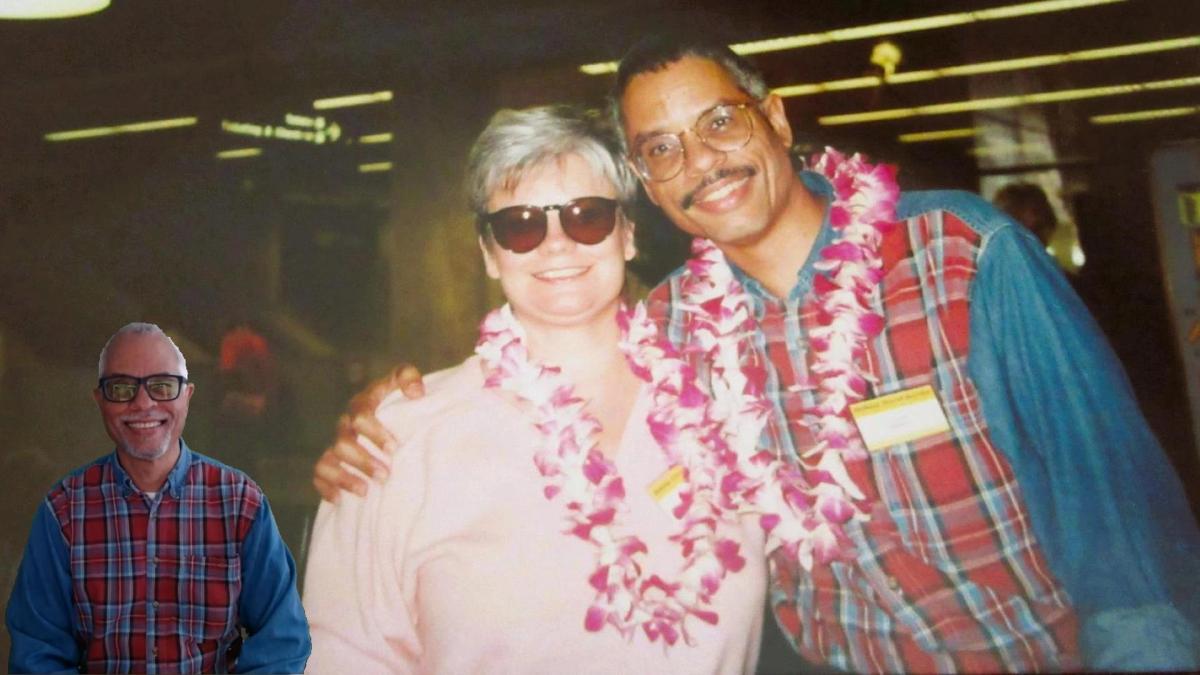
I have a 27-year-old shirt. It’s denim with a plaid pattern on the front. I wore it when we went on vacation to Hawaii in 1997. In the featured image, I’m wearing it as Sena and I pose for a photo after we got off the plane. We and a lot of other vacationers were festooned with leis as we entered the airport.
That makes this shirt 27 years old—at least. I’m sure I had it for a while before we went to Hawaii. I don’t remember where I got it. Sena says she probably bought it for me at Target.
I looked it up and found an identical shirt for sale on eBay—but it was advertised as being for ladies. The description is “VTG 90s Ladies Greatland Denim Flannel Shirt Size M Pocket Streetwear Grunge.
My first thought was: I’m wearing a lady’s shirt that sells for about twenty bucks on eBay? I couldn’t find one labeled for men. I asked Sena about it and found out for the first time that the buttons on a man’s shirt are on the right side and on a women’s shirt the buttons are on the left.
Then I looked at the eBay picture of the shirt again. The buttons are on the right. I guess the woman selling them doesn’t know the rule of right and left side buttons as it pertains to shirts for men and women.
Well, I guess I can stop being insecure about it. I don’t think anyone really knows why that gender-based rule about right and left side shirt buttons exists. I looked at a couple of web pages and they tend to repeat the same reasons and then end up saying nobody knows and it doesn’t matter.
The other thing to consider is whether my shirt could be considered vintage. According to some experts, anything between 20 and 99 years old can be vintage. I guess that makes me and my shirt vintage.
There is a new show on the KCCK radio station at FM 88.3 broadcast out of Cedar Rapids, Iowa (106.9 in Iowa City). It’s called the Big Mo Pod Show, which is keyed to his previous Friday night Big Mo Blues Show which starts at 6:00 PM.
The show generally quizzes the DJ, Big Mo (John Heim) on some of the tunes (name of artist, name of the song, why he played the song) he played the previous Friday night. A good example was Friday, April 19, 2024. You can access the show on different platforms, which are announced at the end of the show.
Big Mo did alright. He got most of the answers right, including the one by John Primer, “Crawlin’ Kingsnake.” I also like John Primer’s song “Hard Times.”
Remember, the Big Mo Pod Show is recorded and based on the Big Mo Blues Show from the previous Friday night. You can hear it by going to KCCKdotorg web site and click the Listen tab to find Shows on Demand to find “BigMoPodShow.”
We’ve been watching for the house finch eggs to hatch sometime soon here. Remember they’re the ones who are nesting in the artificial Christmas tree on our front porch.
The 2023 edition of the book Birds of Iowa Field Guide, written by Stan Tekiela says the house finch was first seen in Iowa in 1982. That makes it a big year for house finches and for Iowa.
It got me to wondering what other big things happened in Iowa in 1982. A number of events as it turns out.
Terry Branstad was first elected governor of Iowa in 1982. He was 36 years old and at the time was the country’s youngest chief executive. After that, it seemed like he never stopped being the governor—even when he wasn’t, which was seldom. He was governor for 22 years. He was notable for being the nation’s longest-serving governor in history as of 2016.
In 1982, the University of Iowa Hawkeye football team went to the Rose Bowl—and lost to Washington 28-0. Coach Hayden Fry was not happy. The biggest thing about it was the long running party before the game.
While we were in Ames in 1982, there was evidently a big fire that destroyed the Iowa State University Alpha Iota chapter fraternity house. We don’t recall it. One of the members of the fraternity named Steve Shamash, wrote a five-page story about it. One quote (author unknown at the time by Shamash) is worth sharing about how the fire affected the fraternity:
“Adversity exasperates fools, dejects cowards, draws out the faculties of the wise and industrious, puts the modest to the necessity of trying their skill, awes the opulent, and makes the idle industrious.” In short, that fire gave our chapter a swift kick in the butt.
I hunted for the author of the quote and I think it’s by Orison Swett Marden who wrote How to Succeed or, Stepping-Stones to Fame and Fortune. The full quote is:
“Adversity exasperates fools, dejects cowards, draws out the faculties of the wise and industrious, puts the modest to the necessity of trying their skill, awes the opulent, and makes the idle industrious. Neither do uninterrupted success and prosperity qualify men for usefulness and happiness. The storms of adversity, like those of the ocean, rouse the faculties, and excite the invention, prudence, skill and fortitude of the voyager.”
One of the biggest things was the Grateful Dead concert at the University of Iowa Field House. We never went because we were living in Ames at the time. I was an undergraduate at Iowa State University. You can hear the songs at the Internet Archive. The only one I recognize as being by the Grateful Dead is “Truckin.”
Sena surprised me by reminding me she bought me a colorful Jerry Garcia necktie while I was a resident in the Psychiatry Department at the University of Iowa in the mid-1990s. I don’t remember that at all, probably because my brain was fried from being post-call most of the time.
Here’s a suitable sort of dad joke Svengoolie style for the 1941 horror movie classic, The Wolf Man:
What do you call a dirty joke about the wolfman given at the strait-laced werewolf convention? A howler.
See what I did there? It puns on the word “howler” defined as an embarrassing mistake that evokes laughter, and also puns on the werewolf’s habit of howling. So, the mistake is the dirty joke being told to a convention audience of strait-laced (strictly moralistic) werewolves. OK, whatever.
I’m not great at telling dad jokes, although I like to hear them. I almost bought a book of dad jokes the other day, but when I read the copyright notice, I decided against it:
The notice of copyright for this book of dad jokes is to inform the purchaser that it is hereby forbidden to share these jokes in written, spoken, whispered, or telepathically delivered form to anyone else. Only the purchaser may whisper the jokes to himself as long as no other person is within earshot although it is preferable to read them silently. If this copyright notice is violated (and we will know because of the cleverly hidden monitoring device inserted in the text on each and every page), the publisher has the right to pursue every legal action necessary to extract money and suitable vengeance on the perpetrator, which means you.
I’ve been to the bookstore which sells several dad joke books and they all have this kind of copyright notice in them, regardless of who writes the books. I end up not buying any of them. Consequently, I never learn how to tell dad jokes. But that probably won’t stop me from trying.
Anyway, we saw The Wolf Man last Saturday and it’s a classic B horror movie. It was our first time seeing it and Lon Chaney, Jr. was a great werewolf. He didn’t like being called junior. We found out his father was a movie star too. I don’t think anybody called him Lon Chaney, Sr.
You can find attempts on the web to attach psychoanalytic interpretations of the Wolf Man, but I don’t buy them. On the other hand, there are some quotes from the film that sound like psychological observations:
Dr. Lloyd, the family physician: “I believe a man lost in the mazes of his own mind may imagine that he’s anything.”
Sir John Talbot (Larry the werewolf’s father): “Larry, to some people, life is very simple. They decide that this is good, that is bad. This is wrong, that’s right. There’s no right in wrong, no good in bad. No shadings and greys, all blacks and whites…Now others of us find that good, bad, right, wrong, are many-sided, complex things. We try to see every side but the more we see, the less sure we are. Now you asked me if I believe a man can become a wolf. If you mean “Can it take on physical traits of an animal?” No, it’s fantastic. However, I do believe that most anything can happen to a man in his own mind.”
You can see The Wolf Man on the internet archive. You can make up your own mind about it.
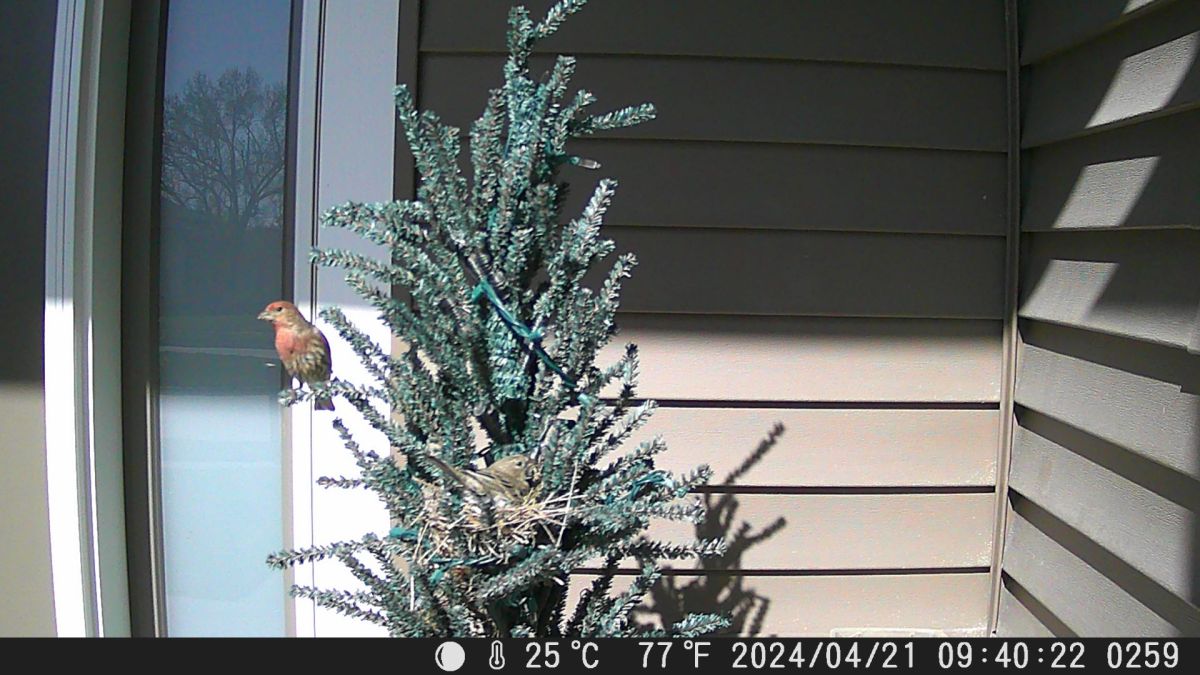
We managed to get some critter cam footage of the male and female house finch pair nesting in the fake Christmas tree in our front entry way yesterday. Crank up the volume on your audio to hear them singing.
The male sports a red face and chest. The female is plain brown except for brown streaks on a white belly. While she incubates the eggs, he feeds her periodically.
It’s definitely a tough job sitting there most of the time with temperatures getting well into the 80’s Fahrenheit on our porch even before noon. On the other hand it’s still getting pretty cold at night.
We don’t know when the eggs were laid, but they take about two weeks to hatch. After that the chicks will take a couple of weeks to fledge.
I’m a little nervous about going out there periodically to pick up the critter cam and peek at the eggs. It always startles the female. It can also alert large predatory birds to the prospect of a meal. This actually happened about 4 years ago when I heard what sounded like large bedsheets flapping in the wind. It turned out to be the biggest crow I ever saw taking off with its beak full of house finch nestlings from the real evergreen tree in our front yard (different house).
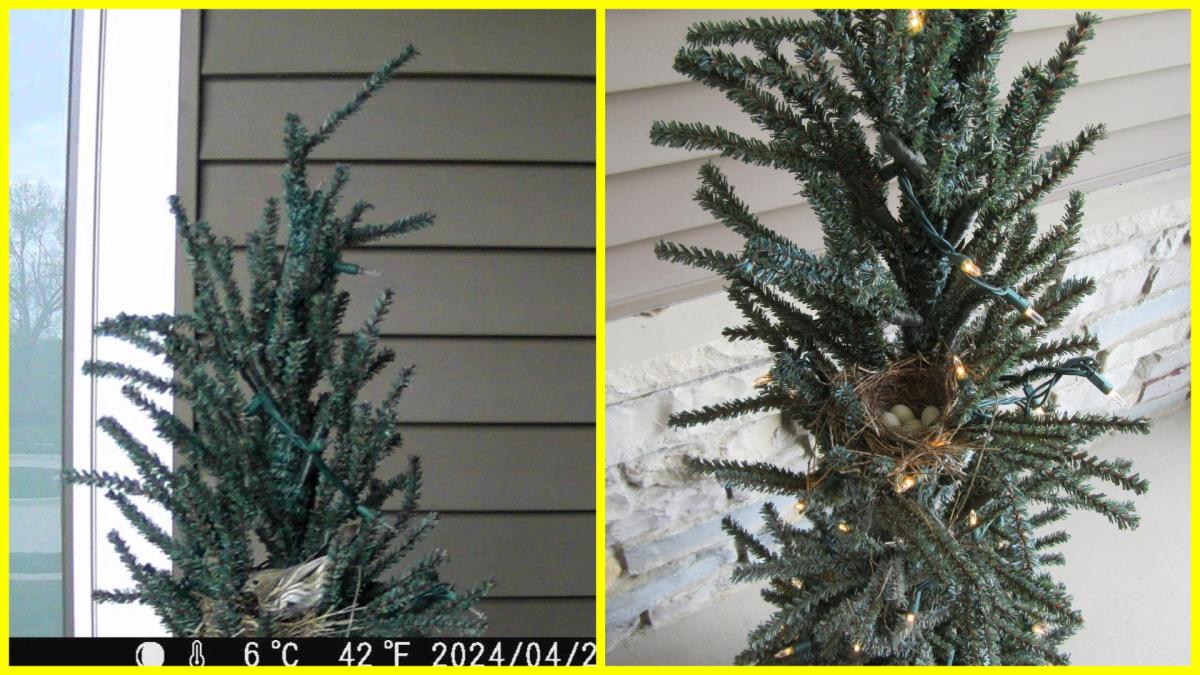
A couple days ago, Sena found a bird’s nest in our front porch artificial Christmas tree. The small nest is made from the clippings of Sena’s ornamental grasses. It has 4 small eggs, which are white with dark specks.
We could hear a bird singing while we were sitting in the house and it always sounded close by. We could see it flitting around but we couldn’t identify it. We thought it might be nesting in our magnolia tree at first but Sena couldn’t find one.
I’ve scared a bird a couple of times lately and it always seemed to be flying off our front porch from somewhere. I never thought to peek in the little fake Christmas tree sitting in a big pot.
So, I got the critter cam out. It hasn’t been getting any use since we solved the problem of our yard drain grate lids popping off by having them screwed down last year. We never did find out what flipped the lids.
Anyway, Sena suggested moving the pot with the tree around to face the front of the porch and set up the critter cam facing the tree. Both the tree and the camera on a tripod are somewhat sheltered from the wind behind one of the columns.
Moving the tree confused the bird a little because it had a little trouble finding it at first. We got a good enough video to identify it as a female house finch. We don’t know when she laid the eggs, but they take a couple of weeks to incubate.
We had been trying to keep birds off our porch by setting out a couple of fake snakes. The birds ignored them. And I guess they don’t mind nesting in fake trees, either.
The nest is probably in a fairly safe spot on the porch. Crows and other predatory birds fly around, but might be less likely to see it from the air. Maybe we should get a fake dog.
We’ll try to keep our intrusions to a minimum, because it tends to tip off big, hungry birds. On the other hand, we would like to get enough footage to make short videos of the progress of the nestlings.
Yesterday I did the Walmart self-checkout thing after grocery shopping. Sena told me a few weeks ago that she saw some people abandon their full shopping carts and just walk out of the store after learning they might have to use self-checkout.
I had mentioned to Sena that I probably would try the self-checkout on a day when I had a short grocery list. It turns out that I made a slightly longer list than I intended (more than 10 items which makes you ineligible for the 10 items or less aisle). And I couldn’t think of a way to wiggle out of going to the Coralville Walmart which is promoting the self-checkout. The Iowa City Walmart is not.
When I got there, I noticed the check-out aisles had undergone a major rearrangement. The aisles were a lot wider and the self-checkout stations were designed so that you don’t have to wait directly behind somebody who might be a slowpoke—like me. There was at least a half-dozen self-checkout stations and a few regular check-out stations with long lines. There was usually no waiting for a self-checkout slot.
Prior to going to the store, I had taken a quick look at the web page “Wiki-How for How to Use the Walmart Self-Checkout.” It works almost exactly like that in a real store. I had a little trouble accidentally double-scanning an item and for some reason I couldn’t get the scale to weigh a small bag of tomatoes. But there is always somebody around to help you out.
Actually, I wasn’t aware of my double-scan until after I got home. Sena found it after checking the receipt (oops). I went back to fix that, which made it necessary to pick up a few more items—including ice cream. So, I actually did the self-checkout twice that day.
I really didn’t think the using the scanner was as much of a challenge as sacking all the items so that things like tomatoes didn’t get crushed, etc. But you can use crushed tomatoes in chili and goulash, can’t you? Don’t answer that.
I was gone most of the day doing the grocery shopping and self-checkout. The most time-consuming part of the trip was finding the items in the store. Does it make any sense to put the liquid hand soap in the pickled pig’s feet aisle?
Anyway, when you’re done at the self-checkout, you get a screen asking you to rate how good your experience was on a 5-star scale. The first time I was there, I didn’t notice it for a couple of seconds and that was a few seconds too late. The rating evaluation doesn’t stay on screen for very long. I guess they figure if it takes longer than a few seconds for you to figure out what you think of the process, the rating is bound to be on the low side.
The second time I was there, I was quicker. I gave it 4 stars, one off for having to dig through the pickled pig’s feet to find the liquid hand soap.








 Go Retire Psychiatrist