A Few Words About the Panera Jumbo Cobb Salad

Well, I’m sure you’ll be relieved to know that I am lucky to still be independently mobile today after eating the FULL Panera Bread green goddess chicken cobb salad—as in full stomach.

I’ll admit I didn’t know what I was getting into. You know the salad is big when it comes with a ladder.

It’s supposed to be a healthy salad although there are cautions about the green goddess dressing—don’t worry, it was barely noticeable.

I got it around noon at the mall. It’s a bad time to try to get lunch because half the city is in there and they’re all hungry. You know it’s busy when potential customers are told the wait is 45 minutes. I was lucky; I think I waited around 15 minutes. Tables were hard to find. I ducked into a booth two guys were busy thumb wrestling for.

You need to bring an axe because, of course, you’ll have to slaughter the chicken—after she lays the eggs because they go on the salad. Plan on extra time to pick the tomatoes—in the back; way in the back.

This thing about the eggs in the salad probably began with the story about how the cobb salad got started. I read that it started in the 1930s after the Hollywood Brown Derby restaurant closed for the night and the salad supposedly was invented by the owner, Robert Howard Eggs…no, wait, that’s Cobb.

Cobb was starved around midnight because he’d been working hard all day wondering what the difference was between a bowler hat and a derby hat and why in heck had he not picked the name the brown bowler for his restaurant because of the alliterative effect and so had not eaten all day.

So, Bob Cobb grabbed whatever leftovers were in the kitchen at the time and thought it was terrible. He texted Domino’s and while eating their famous egg pizza had a brainstorm about marketing a salad with eggs in it and naming it after Ty Cobb because he was observed once having bacon and eggs for breakfast.

Remember, this history moment was brought to you by Serutan; that’s Natures spelled backwards.

They had to carry me out of Panera’s in a wheelbarrow.

A Small Update to a Pseudo-Rap YouTube Video and a Big Tribute to Dr. Robert G. Robinson

I just noticed something about one of my YouTube videos that I made sort of as a combination gag and educational piece about pseudobulbar affect. It needed a couple of updates—one of which is minor and which I should have noticed 10 years ago when I made it.

It’s a pseudo-rap performance (badly done, I have to agree although it was fun to make), but it’s one of my most watched productions; it has 18,000 views.

One minor update is about the word “Dex” in the so-called lyrics of this raggedy rap song (see the description by clicking on the Watch on YouTube banner in the lower left-hand corner). It stands for dextromethorphan, one of the ingredients along with quinidine in Nuedexta, the medication for pseudobulbar affect. Dextromethorphan has been known to cause dissociation when it’s abused (for example, in cough syrup).

The most important update is about Dr. Robert G. Robinson, who I joked about in the piece. He passed away December 25, 2024. He was the chair of The University of Iowa Dept. of Psychiatry from 1999-2011. He was a great teacher, mentor, and researcher. He published hundreds of research papers and books on neuropsychiatric diseases like post-stroke depression and pseudobulbar affect. He lectured around the world and was widely regarded as a brilliant leader in his field.

Early in my career in the department, I left twice to try my hand in private practice psychiatry. Both times Dr. Robinson welcomed me back—warmly. He was my co-editor of our book, Psychosomatic Medicine: An Introduction to Consultation-Liaison Psychiatry, published in 2010.

All who worked with Dr. Robinson will never forget him.

Spotting Venus in the Eastern Sky

I was watching a television show last night about UFOs and had to chuckle about some of the segments in which there was a lot of speculation about underground and underwater bases where extraterrestrials typically are thought to hide from us while they work on whatever it is they work on.

There was the usual discussion of the Chicago O’Hare airport UFO sighting in 2006 which, according to the official FAA explanation was a weather phenomenon known as a “punch hole” cloud. Of course, true believers don’t believe that.

The show also rehashed the remote viewing theme in which somebody describes and draws pictures of things which are said to be seen remotely, often of extraterrestrials and humans working together on antique cars.

Remote viewer: I see many objects lining the walls of a hollowed-out mountain in Wyoming.

Observer: What are the objects?

Remote viewer: They are…socket wrenches. Billions and billions of socket wrenches.

Observer: Zzzzzzzz.

I thought about that show as I was walking out to the mailbox pod early this morning. I saw a very a bright object in the eastern sky. It didn’t move. It wasn’t disk-shaped and it didn’t look like an orb. It didn’t abduct me. It looked like a star, which I decided it was. I looked around the internet and it was most likely Venus, sometimes called the morning star (it also can be known as the evening star).

That reminded me of an X-File episode in which Jesse Ventura, a former Minnesota governor (1999-2003), had a role. The episode was “Jose Chung’s from Outer Space” and it’s one of my favorites. Ventura played a man in black.

I’m not saying Unidentified Flying Objects (UFOs) don’t exist and I don’t know why we need to call them Unidentified Aerial Phenomena (UAP) nowadays. I’m just saying that the morning star is a beautiful thing.

The Big Mo Pod Show: “In the Pocket”

Here’s something fun, try to explain what the phrase “in the pocket” means. The song selections in the pod show led up to a short discussion of what it means—which I didn’t get at all. I don’t think it matters for the ordinary listeners, although former music teachers like Big Mo obviously know what the term means. He taught music for years, has performed, and uses the lingo to explain what “in the pocket” is all about. It’s way over my head, but then I don’t need to know anything about it to enjoy music.

I tried to look up the meaning of the terms “in the pocket” on the web. I took a quick look at a website called Sage Audio. The title is “What is In-the-Pocket for Music?” I couldn’t find the author’s name because I didn’t see a byline.  It’s very long and technical and seems geared for sound engineers. One sentence by the writer caught my attention under the heading “What is In-the-Pocket for Music in Detail”:

“It isn’t uncommon to hear a music term and wonder what it means exactly. Becoming well versed in music means understanding its discourse, which can certainly be easier said than done.”

Here’s how far out in left field I am. Depending on how I read that, I’d almost recast the last part of that sentence: “…which can certainly be easier done than said.” I realize the sense of it is that becoming adept in making music means understanding the lingo. I just don’t understand the lingo, which makes me wonder if musicians have some kind of inner body sense for timing in music as it’s performed which may not readily translate to language for the layperson.

I was like a lot of other students in junior high music class. We were pretty good at whispering or half-mumbling the songs we were supposed learn to sing out loud. That really annoyed the music teacher. I don’t know if Big Mo can relate to that or not. We were supposed to learn the song “Sloop John B.” I’m not sure if we were doing the Beach Boys version or the original “The John B. Sails.”

It hardly mattered. We sounded like we ate up all the corn and held it in our mouths while mumbling. We just stuck our hands in our pockets, moaned the words, and were never in the groove. I don’t think a metronome helped. In fact, I’m not sure there was a metronome.

I have to mention that I probably was too young to know that the song by Little Ed and the Blues Imperials, “Walking the Dog,” was about a kind of dance. I never danced although most of the dancing kids on American Bandstand had the same answer to Dick Clark’s question on what they liked about the song—it was always “the beat.” I guess they knew that meant the number was “in the pocket.”

The Hummingbird is a Blur!

Yesterday I noticed a hummingbird hovering about the flower pots on our porch. I hurried to get my point and shoot camera and shot video, through a window as usual and it was getting a little late in the evening too, so light was low.  

Can I blame the bird for always looking like a blur—or not? Anyway, the video looks similar to others I’ve managed to capture in years past, except this one was the closest I’ve ever gotten to one. I tried messing with the clip using my video editing software, but I ended up believing it best to leave it mostly unmessed around with.

On the other hand, the one I got about 6 years ago was pretty fair for an amateur backyard birder. Same camera, same software although I was closer to the birds and I’m pretty sure I was sitting outside and very patient. They were very interested in our little feeder.

I think the hummingbirds we’ve seen are ruby-throated species partly because that’s the most common in Iowa. Typically, I think it’s just the males who have ruby-colored throats; our visitor didn’t.

I guess the usual way to attract hummingbirds is with a feeder but other people say there are other reasons hummingbirds visit us. More common to the indigenous peoples, they may be thought of as the spirits of those who recently died and are visiting those they were close to.

I don’t remember the movie “The Curious Case of Benjamin Button” so well but I’ve glanced briefly at web articles which connect it with hummingbirds, which has something to do with their ability to fly backwards or in a figure 8, maybe connecting that with reverse aging or infinity. Other symbolic connections are with joy, healing, and partnership. There are so many connections they seem to blur together—sort of like the bird itself as it hovers and flits from flower to flower.

I think this hummingbird just really liked Sena’s flowers.

After The Rain II

We were playing cribbage and Sena noticed a lot of birds out in the back yard—as well as the woodchuck again. We both grabbed the cameras and forgot about cribbage for a while.

You have to gaze at the pictures long enough to see there’s more than one or two birds perching in various places.

That juggler guy is back.

Svengoolie Movie: “The Black Cat” vs The Weather Report

The atmosphere for the Svengoolie TV show airing of the 1934 movie “The Black Cat” was nothing short of electric—as in electrical storm. I thought the mood of ambivalence in the film was firmly set for about the first half hour of the movie. That was how long the TV station weather alert was on screen, shrinking the viewing size of the movie somewhat to make room for a map of the counties at risk and the scrolling warnings about which east central Iowa counties were affected by the flood watch and guidance about what to do.

Anyway, the film is not related in any way to Edgar Allan Poe’s short story of the same title. The movie was directed by Edgar Ulmer and starred Bela Lugosi as the Hungarian psychiatrist and ex-WWI POW (that’s right, I said “psychiatrist”), Dr. Vitus Werdegast; Boris Karloff as the satanic and necrophiliac Hjalmar Poelzig, the former WWI commander of the Fortress Marmorisch and a famed architect who built an ultra-modern mansion on top of the grisly site where thousands of soldiers were killed. Vitus and Hjalmar play chess for the souls of the aspiring novelist Peter Alison (David Manners) and his wife Joan (Jacqueline Wells) who, unfortunately get stranded there along with Vitus after the bus carrying them crashes on the way from the train station to various hotels and Disney World.

The mood of ambivalence I thought was evident, contrasting the creepiness of Hjalmar and Vitus grimly gambling in a chess match for the lives of Joan and Peter and the comicality of the two policemen interviewing the Alisons and the two heavies about the bus accident. The lieutenant and the sergeant arguing with each other in a “My hometown’s better than yours” exchange reminds me of Abbott and Costello. I recommend you see it for yourselves on the Internet Archive; it’s about 35 minutes in.

Contrast this with the hysterical cat phobic Vitus (despite being a psychiatrist) throwing a knife at one of the many black cats prowling around the house after it ejects a hairball on the floor! Or Hjalmar thumb wrestling with Vitus until the latter chooses to pick up what looks like an emery board from an array of much larger knives and bazookas on a large table—and prepares to flay Hjalmar with it. This would only make Hjalmar look even more excruciatingly well groomed, along with the precisely trimmed haircut carefully smeared with a pound of Brylcreem.

I think “The Black Cat” is a hoot. It’s a litter box full of nuggets of melodramatic ailurophobia with here and there a hairball of ambivalence but hey, nobody’s purr-fect!

Shrilling chicken rating 4/5

The Garden After the Rain and Some Juggling

Sena got some video clips of the backyard garden. The woodchuck was out there but pretty much left her stuff alone. She caught a clip of what looks like a house finch as well.

For some reason, possibly involving extraterrestrials, there was some guy juggling out there.

Cribbage Lingo in The Crib Song by Brett Kissel

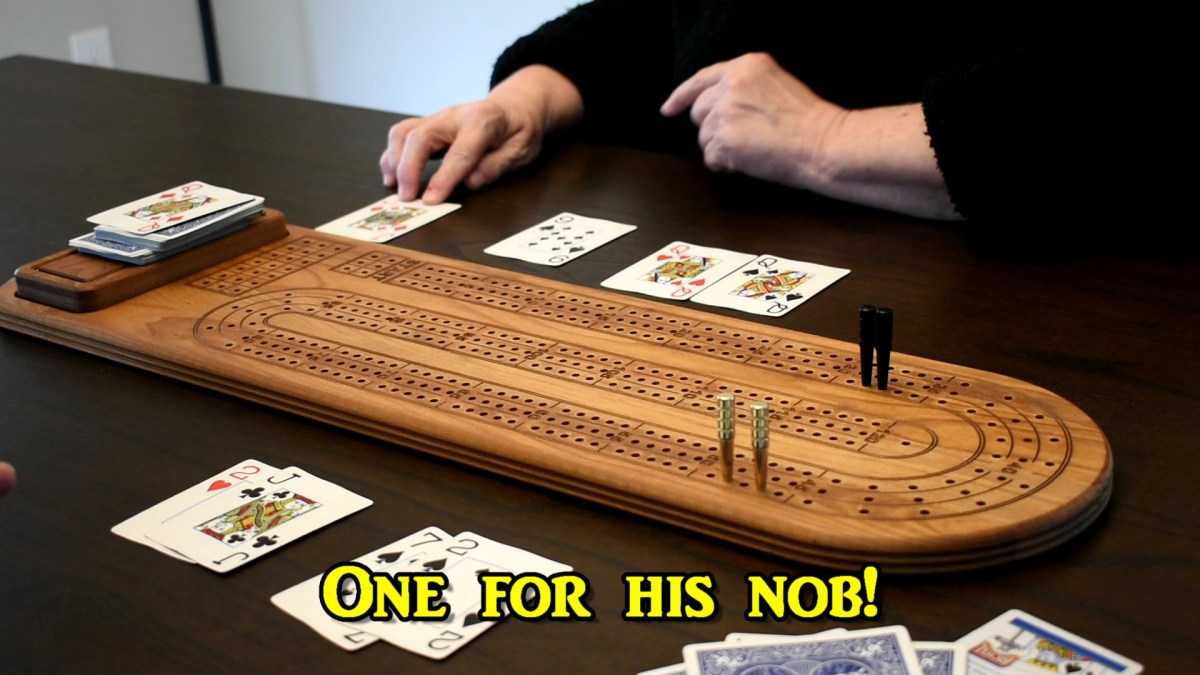
I modified the YouTube cribbage video “One for his nob short” to be about the same length as Canadian country singer Brett Kissel’s song about cribbage “The Crib Song.” I didn’t change any of the subtitles on the video because they fit the game play in the video.

There is no audio in the short version because you’ll need to play the YouTube video of the song “The Crib Song” along with our cribbage game video (see below). We think they still go together.

I found a Facebook entry on the web that must below to Brett, because it shows images of the computer cribbage game Cribbage Classic (which I’ve reviewed in the past, see my YouTube channel) and he says. “I’m a legend. I will play anyone at crib. Except if you’re over 70 years old. I won’t be able to beat you if you’re 70+.” I wonder why. I don’t have a Facebook account so I can’t ask him about the lyrics of The Crib Song.

Anyway, I found the lyrics for the song. OK, it clips along but I can’t verify some of the cribbage lingo in it. Maybe they’re common parlance for cribbage players in Canada. If any of you know what the following mean let me know:

Romney’s-no idea but it’s evidently something Ebs keeps getting

Loins-if all you get is “loins,” what are those? Sounds like if that’s all you get you might be lucky or good or maybe neither.

Gino-from context it sounds like something you win (“I just won a Gino”)

There’s another that I couldn’t figure out:

Piled-this is connected to “Deuce Neon” in some way (Deuce neon got him piled”); maybe a player?

There are a few I recognized. The kitty is another name for the crib (the two extra cards from the non-dealer and the dealer which are for the dealer). A flush is a hand of cards all the same suit, which can include the cut card. You can’t get a flush in the crib unless the cut card is also of the same suit.

The lyric “I’m looking for that 29” is about that very rare hand of 29 points: the nob jack (jack of the same suit as the cut card), and 3 fives in your hand, the cut card being the other 5. And a score of 19 is slang for zero points because 19 is not a possible score in cribbage.

I think the lines below are about forming sequences during pegging:

“Don’t give away your hand

I’ll rope you right into a run

Peg 8 or 9 or 10

Looking at your face”

You can find lists of cribbage lingo, but admittedly they’ll probably be mostly American usage. The American Cribbage Congress (ACC) list is pretty good and so is the Cribbage King list.

Whoops, The “One for his nob” Cribbage Song Vanished!

OK, sorry, I just noticed that my cribbage post “The Best Cribbage Song You Never Heard Of” has lost the video for the cribbage song “One for his nob” by British artist, Richard Thompson. I don’t know where it went (maybe abducted by extraterrestrials), but I think I found another one. It’s called “The Crib Song” and it’s by somebody named Brett Kissel. All I know about him is that he’s a Canadian country singer.

There’s only a couple of hitches relating to the short and speedy cribbage video Sena and I made in March: one is that it was timed to go with “One for his nob.” Brett Kissel’s number is longer than “One for his nob”—and the other is that I’m not a huge fan of country music. One the other hand, it does have a ton of cribbage terms in it, many of which I’ve never heard of.

So, I would have to modify our cribbage game video to fit the length of the song. I think I could manage but it would take a little time and effort. In the meantime, you can hear it here.