Members of the Human Club

I just read Dr. Moffic’s column, “Join This Club for Mental Health” in which he described the Clubhouse movement which got started in the 1940s to help those with mental health challenges to cope with their illness and, more importantly, to recover, grow, and achieve success in life.

It made wonder if there are any chapters of the Clubhouse model in Iowa. It turns out there is and it’s Carol House in Davenport, Iowa. It’s connected with the Vera French Mental Health Center. Its namesake is Carol Lujack, who was a member when the center was called “The Frontier Community Outreach Program” in the 1980s in downtown Davenport.

I was looking at the Carol Center website where you can find many interesting features of the people and activities that go on there. The April newsletter is fascinating and funny. You can find out in the April Newsletter about a few of the current members, April holidays (there’s a slew of them), and famous quotes. One of the quotes is familiar and it’s by F. Scott Fitzgerald,

“Vitality shows not only in the ability to persist, but in the ability to start over,” The quote is worded in various ways, but I remember it because I used it as an inspirational quote when The University of Iowa honored me and several of my colleagues with a Feather in Your Cap award back in 2011.

This was shortly after I returned to Iowa after an unsuccessful stab at trying private practice psychiatry in Wisconsin. And it was the second time I did that—the first time was in Illinois.

Did you know that April is National Humor Month? And have you heard the joke “What kind of candy is never on time?” Choco-Late.

One April holiday is not mentioned and that’s Arbor Day, which varies according to what part of the world you’re in as planting times differ. Sena planted a couple of new trees in the back yard.

Starting new chapters of Clubhouse is a little like planting new trees. They need watering.

How to Support University of Iowa with the One Day for Iowa Fund Drive Today!

Okay, so here’s my pitch on how potential donors can support programs at The University of Iowa. Today the One Day for Iowa fund drive kicks off, and it ends at 11:59 PM today on March 26, 2025.

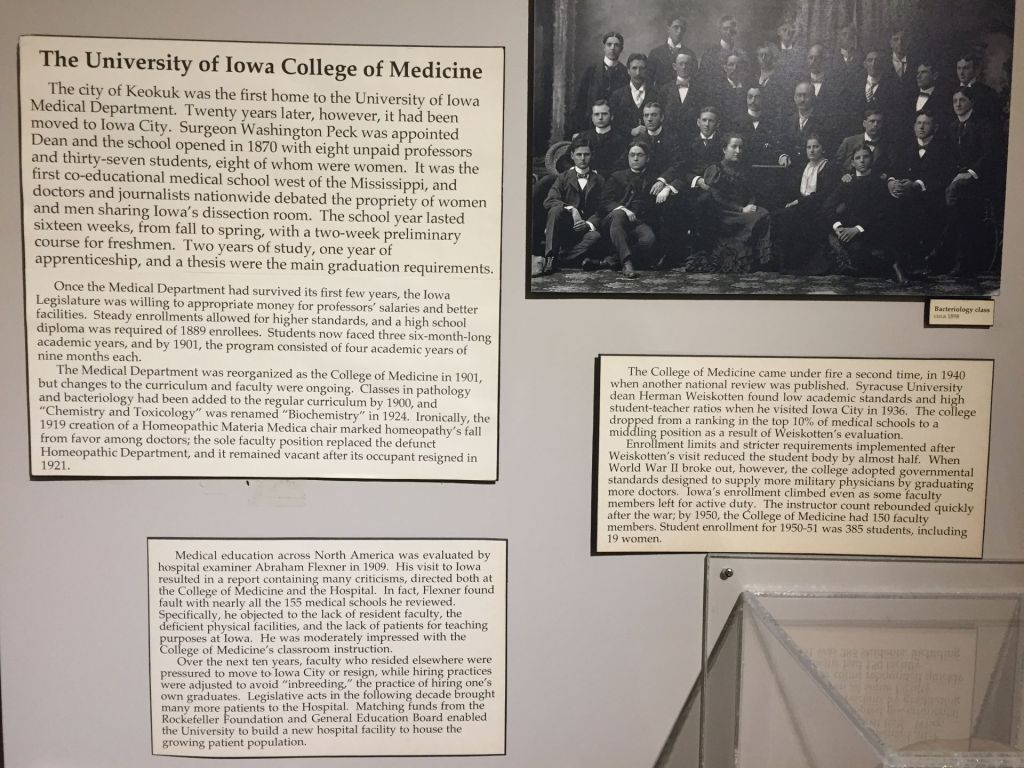
I got a soft spot in my heart for The University of Iowa College of Medicine and University of Iowa Health Care (UIHC), even though my undergraduate Bachelor’s degree was from Iowa State University.

You can find in the UIHC Medical Museum a description of the historical development of the medical school. Following the Flexner Report in 1909 which found fault with all U.S. medical schools including Iowa’s, there was a drive to avoid “inbreeding,” meaning hiring of one’s own graduates. Nowadays, there are legislative efforts to keep as many as we can of Iowa’s best and brightest.  

Go Hawkeyes!

Attack of the Toothworms

I had my regular visit to the dentist at The University of Iowa Health Care (UIHC) today, and it was a good thing I did. For the past couple of weeks or so I’ve had cold and hot sensitivity in a couple of teeth. No surprise, the dentist found 3 teeth that needed a little work.

The dental hygienist also suggested I try using a tongue cleaner and gave me a free one. I’d never heard of a tongue cleaner before. The package advertisement (in English, French, and Spanish) says it’s for combatting bad breath, although the dental hygienist assured me in 6 different languages that she didn’t detect that problem in me.

I was there for my annual teeth cleaning but now I had 3 teeth needing work. Luckily, the dentist had an appointment in the early afternoon. It was a 3 hour wait, but I thought it was better to get it done sooner rather than later. Anticipating a visit with a dentist is sometimes almost as bad as getting in the chair and exercising my ability to refrain from flinching as the high-speed instruments whine in my ear while the dentist and the assistant do their level best to see that I gag several times in at least 9 different languages, including Klingon.

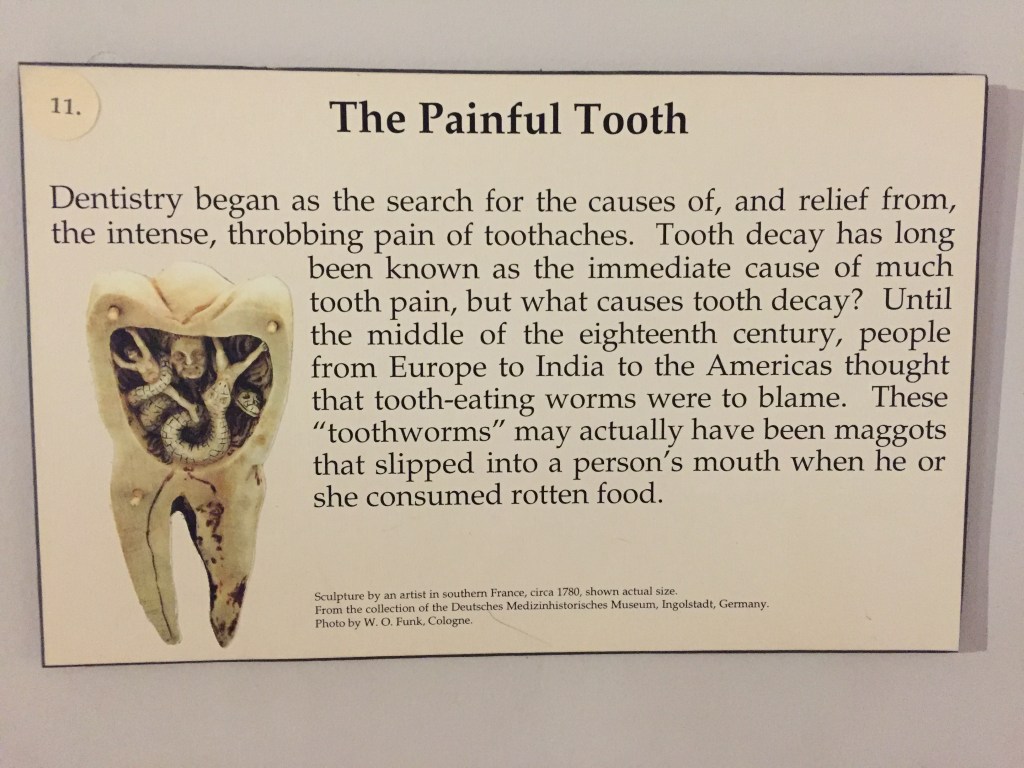
It’s hard to explain why I was having tooth sensitivity because, according to the dentist, the damage was not that severe. It wasn’t until I wandered around the hospital while waiting for the 2nd appointment that I realized I had never visited the Medical Museum on the 8th floor. And that’s where I found a possible explanation that made more sense than the modern one. It’s probably toothworms.

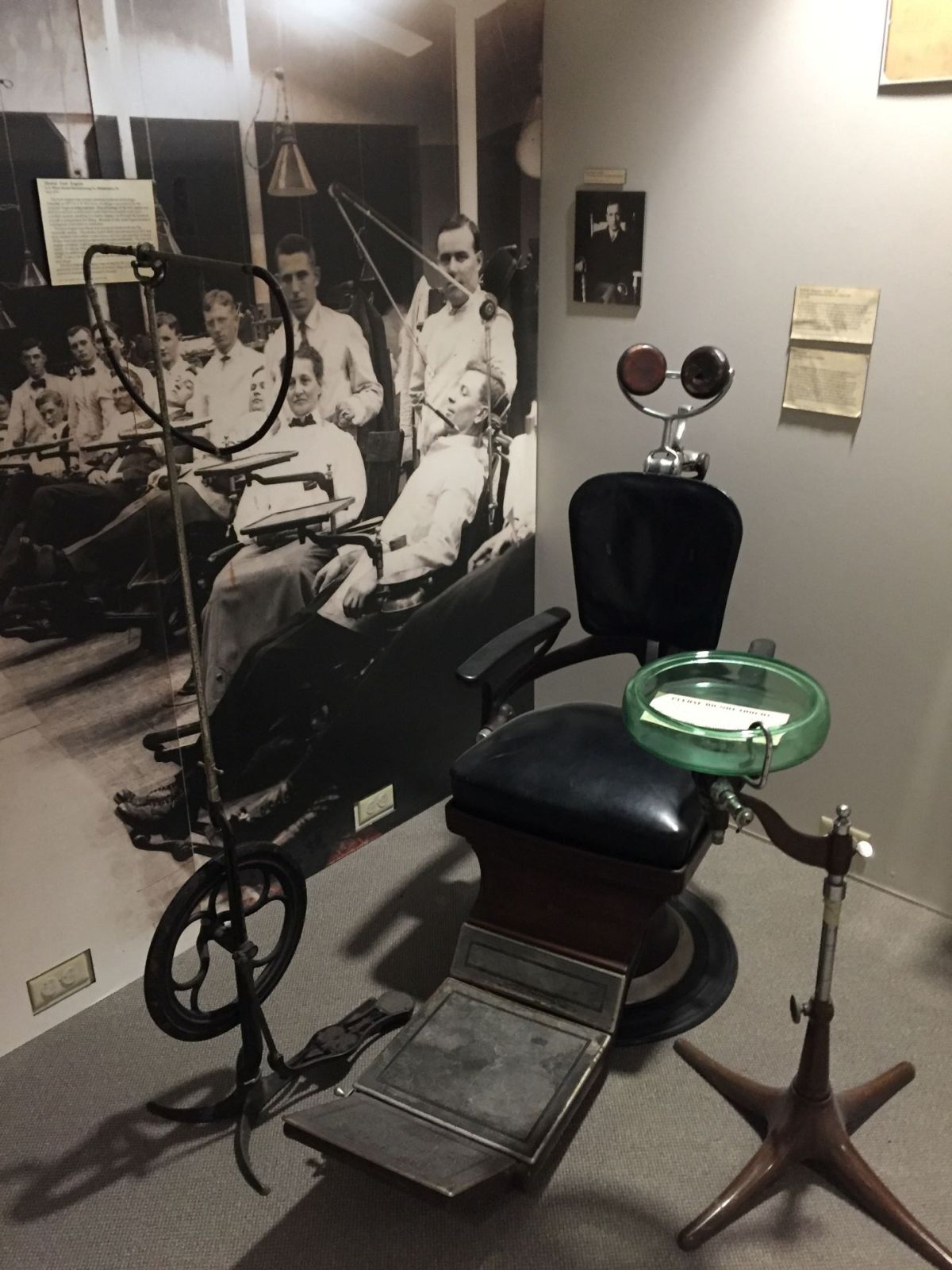
No kidding, back in the 18th century, a lot of people thought worms caused tooth decay by eating them from the inside out. There was also a College of Dentistry display in the Medical Museum featuring a typical dentist chair and samples of rusty tools, which made wonder if I should put off the filling work until, say, after my next ten reincarnations.

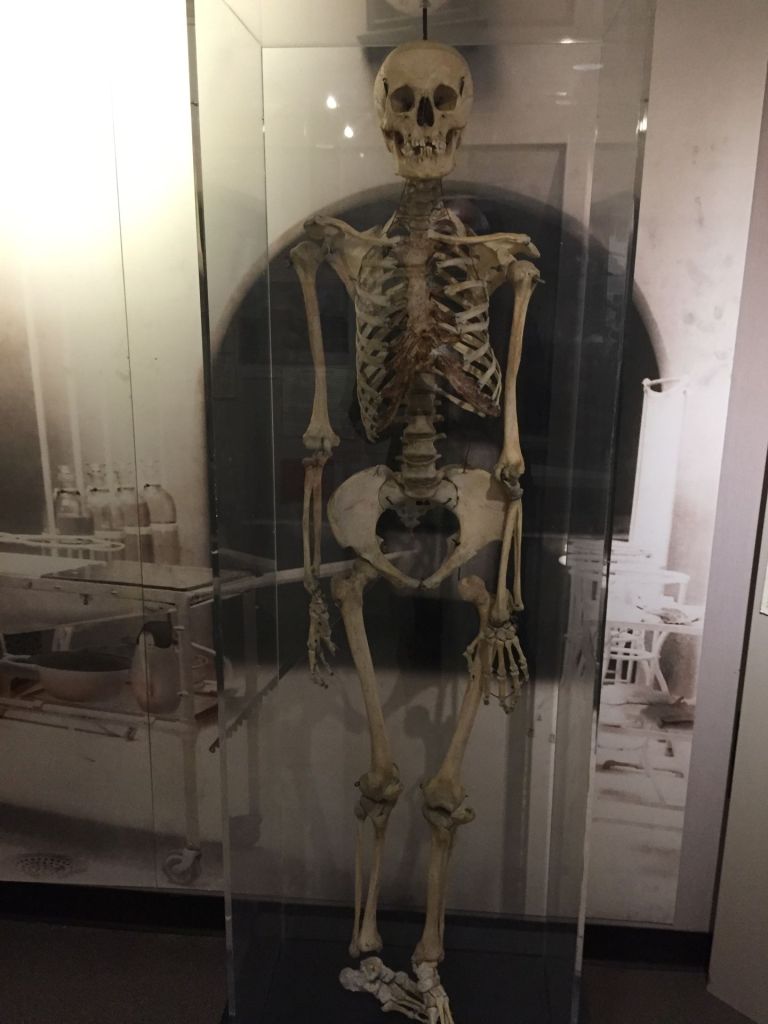
There’s a human skeleton in the museum which is affectionately called Gertie. The historical note on Gertie is very interesting in that it was thought to be a male when Ottumwa Regional Health Center donated it to UIHC in 2013. It turns out he is actually a she and the “…two symmetrical holes in the upper jaw are the result of large dental abscesses.” Just what I wanted to learn on a day when I’m anticipating dental work.

Anyway, my teeth got repaired. I would say that the UIHC dental clinic has come a long way from 1904. You don’t turn and spit in a bowl anymore. They just siphon the toothworms out with a suction wand nowadays.

It Turns Out I Did Not Invent the Term “Zamboni Effect”

Today’s post connects weirdly with the one I wrote yesterday entitled “The Zamboni Effect,” in which I mistakenly believed I had invented the term “Zamboni Effect” based on my observation of what an ice resurfacing machine did to an ice rink in a local mall. It clarified the ice and also metaphorically, by extension, clarified relationships from the past viewed in the present—sort of.

As a reminder, the ice resurfacing machine was first invented in 1949 by a guy named Frank Zamboni. A lot of companies with different names make them nowadays but people still tend to call them all Zambonis.

Just for fun, I looked up the “Zamboni Effect” on the web today and it returned a few surprising results. Among the different meanings of the Zamboni Effect:

  1. Zamboni Effect related to optimizing the ocular surface for surgery.
  2. Zamboni Effect related to a scientist named Paolo Zamboni, who invented a controversial treatment for multiple sclerosis which later turned out to be ineffective.
  3. Zamboni Effect related to something that happens in connection with dynamical nuclear spin polarization (whatever that is).

And for all I know, there may be other meanings for the Zamboni Effect that just never made it to the internet.

Super Bowl Commercial “Mean Joe Frank” 2025 Looked Familiar!

We watched the Super Bowl last night and one of the many commercials (always a big thing) looked vaguely familiar only after Sena pointed it out. It was the Fareway Frank commercial about Fareway stores. It was a reprise of the famous 1979 Coca-Cola commercial with Mean Joe Green, defensive tackle for the Pittsburg Steelers and a kid. When you compare them, the similarities are obvious. There are two Fareway commercials that are the same, but have different titles, one of them being “Mean Joe Frank.”

The Hey Kid, Catch commercial with Mean Joe Green featured a 9-year-old kid named Tommy Okon. I couldn’t find a name for the kid in the “Mean Joe Frank” version.

But you can find film information on Turner Classic Movies titled “The Steeler and the Pittsburgh Kid” which is based on the commercial. The kid is Henry Martin who later starred in the movie, “E.T. The Extraterrestrial” (1982).

This led to reminiscence of Fareway Store in Mason City, Iowa. I used to walk to Fareway to get groceries and walked back carrying at least two big paper sacks. My arms were always pretty sore when I got home. I used a wagon later on, but had to be careful crossing the railroad tracks on the way back to ensure the eggs didn’t break.

There are Fareway stores all across Iowa and several neighboring states now, but the first one opened in Boone, Iowa in 1938. It popularized the idea of shoppers picking out their own items from the shelves rather than letting a store employee pick them out from the shopper’s list. The store name was inspired by what was sold (“fare”) and treating customers and employees fairly.

The Fareway Frank character was called Forrest Frank in 2024 although it looks like the company has settled on Fareway Frank.

The other Iowa connection worth mentioning is that rookie defensive player for the Philadelphia Eagles (Super Bowl winners), Cooper DeJean, who played for the University of Iowa Hawkeye football team, made a pick-6 interception touchdown in the game.

While the Fareway Frank version of the Super Bowl commercials line-up didn’t make the short list (or any list for that matter) of favorites, it sure did bring back memories for us.

All Jokes Aside, What Do I think About the Book “Caste: The Origins of Our Discontents?”

I just finished reading Isabel Wilkerson’s book, “Caste: The Origins of Our Discontents.” It was a painful read because it talks about racism in America, which is a part of my lived experience. Wilkerson’s compares it to the Nazi persecution of the Jews and the caste organization in India. The chapter on the pillars of caste make sense to me.

When I reached the last section (not at all “final” by any means), which is called “Awakening,” I was not surprised that there were no prescriptions or outlines or action plans for how to eliminate caste in any culture. It turns out that we’re all responsible for becoming aware of how we all are complicit in some way with maintaining caste divisions in society. And the word Wilkerson used for how to begin is “empathy,” or somehow becoming conscious of that tendency and to replace it with understanding.

As Wilkerson emphasizes, empathy isn’t sympathy or pity. Empathy is walking a mile in someone else’s shoes, as the song goes. But she goes a step further and uses the term “radical empathy.” It’s difficult to define concretely. It goes beyond trying to imagine how another person feels, going the extra mile and learning about what the other person’s experience. It’s not about my perspective; it’s about yours. It’s not clear exactly how to make that deep connection. She uses terms like “spirit” which may or may not resonate with a reader searching for a recipe or a cure.

Politics turns up in the book. How could it not? I’m going to just admit that I wanted to make this post humorous somehow, especially after I saw Dr. H. Steven Moffic’s article in Psychiatric Times about whether psychiatrists are to act in the role of “bystanders” or “upstanders” in the present era of political and social turmoil. He specifically mentioned the Goldwater Rule, which is the American Psychiatric Association Ethics Annotation barring psychiatrists from making public statements of a diagnostic opinion about any individual (often a politician) absent a formal examination or authorization to make any statements. The allusion to a specific person is unmistakable.

But, as a retired psychiatrist, I’m aware that my sense of humor could be deployed as a defense mechanism and it would certainly backfire in today’s highly charged political context. I’m not sure whether I’m a bystander or an upstander.

Sena and I had a spirited debate about whether America has a caste system or not. I think it’s self-evident and is nothing new to me. I suspect that calling racism (which certainly exists in the United States) a form of casteism would not be altogether wrong. Wilkerson mentions a psychiatrist, Sushrut Jadhav, who is mentioned in the Acknowledgments section of her book. Jadhav is a survivor of the caste system in India. I found some of insights on caste and racism in web article, “Caste, culture and clinic” which is the text of an interview with him.

His answers to two questions were interesting. On the question of whether there is a difference between the experience of racism and caste humiliation, he said “None on the surface” but added that more research was needed to answer the question adequately. And to the question of whether it’s possible to forget caste, he said you have to truly remember it before you can forget it—and it’s important to consider who might be asking you to forget it.

This reminded me of the speech in the movie “Guess Who’s Coming to Dinner,” said by John Prentice (played by Sidney Poitier) to his father:

“You’ve said what you had to say. You listen to me. You say you don’t want to tell me how to live my life? So, what do you think you’ve been doing? You tell me what rights I’ve got or haven’t got, and what I owe to you for what you’ve done for me. Let me tell you something. I owe you nothing! If you carried that bag a million miles, you did what you were supposed to do because you brought me into this world, and from that day you owed me everything you could ever do for me, like I will owe my son if I ever have another. But you don’t own me! You can’t tell me when or where I’m out of line, or try to get me to live my life according to your rules. You don’t even know what I am, Dad. You don’t know who I am. You don’t know how I feel, what I think. And if I tried to explain it the rest of your life, you will never understand. You are 30 years older than I am. You and your whole lousy generation believes the way it was for you is the way it’s got to be. And not until your whole generation has lain down and died will the deadweight of you be off our backs! You understand? You’ve got to get off my back! Dad. Dad. You’re my father. I’m your son. I love you. I always have and I always will. But you think of yourself as a colored man. I think of myself as a man. Hmm? Now, I’ve got a decision to make, hmm? And I’ve got to make it alone. And I gotta make it in a hurry. So, would you go out there and see after my mother?”

 And there was this dialogue that Sena found on the web, which was similar to that of John Prentice. It was a YouTube fragment of a 60 minutes interview in 2005 between actor Morgan Freeman and Mike Wallace. Wallace asked Freeman what he thought about Black History Month. Freeman’s answer stunned a lot of people because he said he didn’t want Black History Month and said black history is American history. He said the way to get rid of racism was to simply stop talking about it. His replies to questions about racism implied he thought everyone should be color blind. John Prentice’s remarks to his father are in the same vein.

I grew up thinking of myself as a black person. I don’t think there was any part of my world that encouraged me to think I was anything different. I think Wilkerson’s book is saying that society can’t be colorblind, but that people can try to walk a mile in each other’s shoes.

The Fortuitous Connection Between the Meyer Lemon and James Thurber

Sena bought some Meyer Lemons today, which we had not heard of until she saw them on TV on the QVC network. She bought them for a fish dinner.

I was curious about the Meyer Lemon. We’ve never eaten them before. People say they’re sweeter than regular lemons. It’s a hybrid between a lemon and an orange.  I did a little digging on the web and found a little background about them, which curiously connects to James Thurber in a roundabout way.

Anyway, an explorer and employee of the U.S. Department of Agriculture named Frank Nicholas Meyer introduced the fruit to the United States in 1908 after he collected them while traveling in China. It was named after him although the fruit had been growing in China for millennia. Meyer was an immigrant to America from Amsterdam in 1901 and became a citizen in 1908, modifying his name from Frans Nicolaas Meijer to Frank Nicholas Meyer.

Meyer is also credited with the discovery that the Chestnut blight disease was originally imported to America from trees in China. He collected fungus specimens which were identified as the cause of the disease which was killing chestnut trees in America in 1904.

That gets us to the connection of Meyer lemons to the writer James Thurber, although I confess the connection is indirect. Thurber wrote a short story, “The Car We Had to Push” which was published in the 1945 collection, The Thurber Carnival.

Part of the story is about a character named Cousin Zenas, who died of—yep, you guessed it, the Chestnut blight. Now, even though the story is in a copyrighted book, the full text turns up in a couple of blogger sites. I found one copy of The Thurber Carnival you might be able to borrow and read for free on the Internet Archive. Don’t believe the Google Gemini Artificial Intelligence bot, which always intrudes itself at the top of my web searches. You can’t get the book as a free pdf from “The Project Gutenberg website,” which I suspect is a confabulation.

Anyway, the Meyer Lemon tastes great and Sena was able to squeeze a lot of juice out of one small Meyer lemon. You can even eat the rind. She bought a bag of 5 of them which cost $7.00, and they were little compared to the large ones she saw on the QVC network.

They’re a great accent to a fish and hush puppies’ dinner. The sauce is made with Miracle Whip, by the way.

Black History Month 2025 ASALH Theme

This is Black History Month and the Association for the Study of African American Life and History (ASALH) theme this year is African Americans & Labor.

When I look back on my youth, I think of my time learning on the job to be a survey crew technician and drafter for a consulting engineer company in Mason City, Iowa, Wallace Holland Kastler Schmitz & Co. (WHKS & Co.).

I was probably not the first black person to work for WHKS & Co. One other black person who was one of very few role models for African Americans was a guy named Al Martin, who I’ve posted about before.

My time there was in the 1970s and there were not many job opportunities open to minorities. I learned more than just the skills specific to the job. I learned that I could succeed in life, which was valuable later on. I developed the confidence to seek other opportunities which included going to medical school and becoming a physician.

Although racism was not absent at WHKS & Co., there was just enough open-mindedness to support my ambition to move forward in life despite the barriers to success in society that existed.

I think the ASALH theme for Black History Month in 2025 is vital to reflect on in the present day. People from all walks of life can relate to this.

Carter G. Woodson is considered the father of Black history and was the founder of Black History Month.

Keep Hope Alive

Just a reminder, Isabel Wilkerson will be giving her presentation, ” “Caste: How the hierarchy we have inherited restricts our humanity” from noon to 1 p.m. Wednesday, Feb. 5, in Prem Sahai Auditorium (room 1110) in the Medical Education and Research Facility.

I’m about halfway through her book, “Caste: The Origins of Our Discontents.” It’s a very difficult read, as I anticipated. It’s full of horrendous descriptions of what those in lower castes suffered, whether from the time of the Nazis, India, or America. I can read it only for a short while and then I have to put the book down and take a break. I get so I feel like I need an inspirational lift.

And it just happened the other night. I heard a poem on TV I’ve heard before, “I am Somebody.” Although it was written in the 1950s by Reverend William Holmes Borders, a civil rights activist and senior pastor at Wheat Street Baptist Church, it was recited by Reverend Jesse Jackson in 1963.

I remember seeing Reverend Jackson cry the night Barack Obama was elected President in 2008. I never heard the original speech Reverend Jackson gave in 1988, during the second time he was running for President himself.

I think it was probably because I was focused on starting medical school at The University of Iowa. I began my studies in August of 1988 in what was then the summer enrichment program for minority students.

One of Reverend Jackson’s speeches contained the other memorable cry, “Keep hope alive!” You can hear it and read the transcript.

You must not surrender! You may or may not get there but just know that you’re qualified! And you hold on and hold out! We must never surrender!! America will get better and better.

Keep hope alive. Keep hope alive! Keep hope alive! On tomorrow night and beyond, keep hope alive! I love you very much. I love you very much. —Rev. Jesse Jackson, 1988.

Just Got Isabel Wilkerson’s Book: “Caste: The Origins of Our Discontents”

I just got a copy of Isabel Wilkerson’s book “Caste: The Origins of Our Discontents.” I read her other book, “The Warmth of Other Suns” years ago. It won a Pulitzer Prize.

I read the first section, “Toxins In The Permafrost And Heat Rising All Around.” It brought back memories of the 2016 Presidential Election, which I won’t discuss in any detail. It does seem ironic now.

I have no doubt that “Caste” will be an uncomfortable read, like Wilkerson’s first one and like Michele Norris’s book, “Our Hidden Conversations.”

Just a reminder, Isabel Wilkerson is scheduled to speak as part of Dr. Martin Luther King, Jr. events on February 5, 2025 at the University of Iowa Medical Education and Research Facility (MERF); Prem Sahai Auditorium. General admission is free although it’s a ticketed event, more information here.