
Mysteries in History

The title of the post is “Mysteries in History,” and before I chose it, I realized it had a familiar ring to it. It’s from Men in Black II. It’s an imaginary, cheesy, very low budget TV series narrated by Peter Graves in the movie. And it’s actually the perfect title for what my wife and I think about the Mason City, Iowa YWCA not being on the National Register for Historic Places. It’s a mystery in history which is anything but cheesy. I mentioned it in my previous post about the Mason City Ys.

I asked the State Historical Society of Iowa about it. It turns out it has been deemed eligible twice for nomination to the National Register, in 1991 and again in 2003, which was a year after the YMCA was added to the list.

The Mason City YWCA has never been nominated. Why it has never been nominated is the mystery in history.

It’s not a simple matter to get a building on the National Register. The process is outlined on the State Historical Society of Iowa web site. Unless you’re a professional historian, it’s a tough project and can take at least a year to accomplish.  

I found a 36-page form on the web which documented the approval of the Mason City YMCA as a historic site fit for the National Register. It’s minutely detailed and I imagine it took a year just to complete the form itself, not to mention all the other hurdles you have to negotiate. The photos bring back memories of when I lived there as a young man. You could actually live in small, single occupancy dormitory rooms. You could do that at the YWCA as well, once upon a time.

There are 2 Artists who bought the YWCA building last year. It’s 100 years old and the place needs a lot of work. There’s a Trulia entry on the web which says it has housed a health spa, an intermediate care facility for people with intellectual and developmental disabilities called One Vision, a Women’s shelter and the list apparently doesn’t stop there.

A couple of articles say that one of the two new owners, Elisha Marin, filmed his music video, “Shining Out,” in an abandoned YWCA. They don’t say which one, but I wonder if it’s the Mason City YWCA. It would fit the long and winding story.

The Mason City Public Library (my favorite place when I was a kid) has a web page with a historical timeline indicating that the YWCA was built in 1918. The YMCA was dedicated in 1927 and placed on the National Register in 2002. I think a lot of the historical documents which helped get the YMCA listed might also prove the YWCA should be listed too.

I found another place called Five College Compass Digital Collections, which also has a ton of documents on microfilm about the Mason City YWCA. It was difficult to navigate and some of the pages were rotated, making them hard to read unless you can bend your head 90 degrees. You can click a button which apparently flips the pages upright, but transforms the text into something that looks like a foreign language.

You can get technical assistance in getting a property listed. The assistant would be available for 24 hours total. You can apply for grants, which can help with some of the expenses. It looks exhausting, though. Hey, I’m the kind of guy who flunked history.

It would sure be nice to solve this mystery in history. Maybe the 2 Artists will consider it. I wish them luck.

The Flag of Honor at Fire Department No. 4

We took a walk this weekend on Scott Boulevard and eventually found our way to Fire Station No. 4. At first, we were struck by what looked like a real Dalmatian apparently sitting just inside the door. It was a pretty good sculpture. Just behind it was a large American Flag hanging on the wall. Below it was the title “Flag of Honor.”

One of the firefighters noticed us and welcomed us inside. He talked a long time about the Iowa City Fire Department and what they did. They responded to a lot of medical calls. In fact, those were the most frequent calls, fires not so much. He graciously answered our questions, including the one about The Flag of Honor on the wall. It’s to honor the victims and the heroes of the September 11, 2001 attack on America.

Later, I found out more on the web about the Flag of Honor. Over 800,000 Flags have been distributed across America. They’re in many places: public buildings, private homes, police and EMS stations, and firehouses.

I remember where I was on September 11, 2001. I was running up the stairs from the lower level to the first floor. I think I had just finished a psychiatric consultation and I was probably on my way to another one, or to my office. It was my usual routine. Like most general hospital psychiatric consultants, I was a lot like a firefighter, going from one urgent consultation to another, to the critical care unit, the emergency room, and others. My pager was like a fire alarm and off I would go.

 I was on the stair landing just going up to the first floor. The stairs overlooked a lobby and the television on the wall was showing a video of one of New York City’s Twin Towers on fire, smoke all around it.

I stopped in my tracks and watched, not comprehending the scene. I can’t remember if the volume was high enough for me to hear the reporter. I don’t think it was. I just saw the fire and the smoke and at that moment I didn’t know what happened. That news I wouldn’t hear until later.

And then much later, in the summer of 2017, Sena and I took a vacation in New York City. Like many tourists, we saw the reflecting pools and Sena took a snapshot of me by the Callery Pear—the Survivor Tree.

The firefighter finally had to excuse himself, because there was somewhere he had to go, something he had to do.

He had probably been busy when we showed up, remarking on the Dalmatian which looked so lifelike, taking pictures of the Flag of Honor, asking questions about what Fire Station No. 4 does, listening to his answers, admiring his patience, his sense of humor, his sense of duty—and thanking him for all of it.

The Written Word is Blurred

I ran across this quote the other day: littera scripta manet. The English translation is, I think, “the written word endures.”

Not to dwell too much on the prosaic side of the issue which is that, for me, often the word has been blurred because of problems with my vision. I just had retinal detachment surgery a little over a month ago and I’m making a good recovery. But early on I had a lot of trouble with blurry vision, tearing, and light sensitivity.

Just the other night though, I was able to read a section of a book without having as much blurred vision as I did before the surgery when I looked up from the page at something distant. I’ve been wearing progressive lenses for many years and it probably got worse because of the detached retina, which was chronic or maybe acute on chronic.

Now to get beyond trivialities, I saw the quote above in an issue of the University of Iowa publication, Iowa Magazine. It was in the last Old Gold column of University Archivist, David McCartney. He retired in March of this year. The title was “Old Gold: The Enduring Power of the Written Word.”

He notes the Latin expression is on the seal of the U.S. National Archives and Records Administration. McCartney’s point is that technology can undermine as well as strengthen the power of the written word. He identities Horace as the originator of the expression, “the written word endures.”

I went pecking around the internet and found out that a lot of people think an educator named Neil Postman was the originator of this quote. What makes me doubt this is that the original is in Latin, which suggests a much older origin. He was born in 1931 and died in 2003. Interestingly, Postman criticized the effect of technology on thought and culture.

A website that seems dedicated to explaining English translations of Latin indicates that the quote comes from a longer expression: Vox audita perit, littera scripta manet, which translates to “the spoken word perishes, but the written word remains.” One contributor says the originator was Horace. Another insists that “littera” does not mean word at all, although concedes that the proposed translation is correct, nevertheless.

Further, there is a Wikipedia entry which cites the Latin expression differently, “verba volant, scripta manent,” which in English is “spoken words fly away, written words remain.” The author says the proverb originated from a speech of senator Caius Titus to the Roman Senate.

Anyway, McCartney points out that the world is becoming increasingly digitized and that the average website lasts only a little over two and a half years. Some important digital records have been lost, unreadable (blurred?) because of improper management.

My previous blog survived about 7 years but is lost. Maybe that’s not such a bad thing. My current blog is a little over 3 years old. So far, I’m beating the odds as far as typical longevity, but is it worthwhile?

Both written and digital records have strengths and weaknesses in terms of durability. And deciding what to preserve and how is essential to any society. We need good stewards to help us decide.

Good luck in your retirement, David McCartney. I’m sure the University of Iowa treasures your stewardship. Let the written word endure unblurred.

Short History of C-L Psychiatry Fellowship at Iowa

I read a short article, “The case for pursuing a consultation-liaison psychiatry fellowship” by Samuel P. Greenstein, MD in Current Psychiatry (Vol. 1, No. 5, May 2022). After 3 years as an attending, he found his calling as a C-L psychiatrist, especially after getting teaching awards from trainees. But when he applied to academic institutions for position as a C-L academic psychiatrist, people kept advising him to complete a fellowship training program in the subspecialty first. He gave it careful thought and did so, even he called it going “backwards” in his career.

On the other hand, he believes C-L fellowships will help meet the challenges of addressing rising health care costs and improving access to what most people see as the critically important goal of providing access to integrated mental health and medical care.

I’ve been retired from consultation-liaison psychiatry for two years now. I get an enormous sense of achievement on the rare occasions when I hear from former trainees who say things like “For me you were…one of the most outstanding attendings I had at my time at Iowa.” And “I can at least take comfort that University of Iowa is still at the forefront of psychiatry.”

Several years ago, one of the residents suggested starting a Psychosomatic Medicine Interest Group (PMIG). This was before the name of the subspecialty was formally changed to Consultation-Liaison Psychiatry in 2018. I know many of us were very pleased about that.

I sent a short survey (see the gallery below the slide show) to the faculty and residents in an effort gauge support for the idea and readiness to participate. I used a paper published at the time to guide the effort, (Puri NV, Azzam P, Gopalan P. Introducing a psychosomatic medicine interest group for psychiatry residents. Psychosomatics. 2015 May-Jun;56(3):268-73. doi: 10.1016/j.psym.2013.08.010. Epub 2013 Dec 18. PMID: 25886971.).

You’ll notice on slide 4 one faculty member’s comment, “I think it doesn’t matter whether faculty are certified in PM.” As Dr. Greenstein discovered, it probably does matter, at least if you want to be board certified.

I was initially certified by the American Board of Psychiatry & Neurology (ABPN), but I objected to the whole Maintenance of Certification (MOC) program, as did many other psychiatrists. I eventually declined to continue participating in the MOC process. However, I notice that the Delirium Clinical Module that I and a resident put together is still accessible on the ABPN website.

Although response numbers were low, there was clearly an interest in starting the interest group. There was also an incentive to reapply to the ACGME for approval of a Psychosomatic Medicine (Consultation-Liaison Psychiatry now) fellowship.

My attempt years earlier had been frustrating. While it was approved, I couldn’t attract any fellows, forcing me to withdraw it without prejudice (meaning another application for approval could be attempted). Fortunately, that situation changed later. The Psychiatry Department at The University of Iowa now has an early career C-L psychiatrist who graduated from the reinstated C-L fellowship.

As the saying goes, “What goes around comes around.” Although the origin of that saying might have originated in the 1970s, at least one person thought his grandmother had her own version in the 1950s: “You get what you give.”

Some Whys and Wherefores of the Mason City Ys

This is just a reminiscence. I know the word “wherefores” in the title is old-fashioned, but I’m an old guy and so what? When I was a young guy living in Mason City, Iowa where I grew up, I could not afford to rent an apartment. Shortly after I became an emancipated minor, I was lucky to be able to rent a dormitory room at the YMCA at 15 North Pennsylvania Avenue. The building was placed on the National Register of Historic Places in 2002.

Reference: M, Ben and Clio Admin. “Mason City YMCA (1926-200).” Clio: Your Guide to History. September 30, 2021. Accessed May 10, 2022. https://theclio.com/entry/140366

I guess that makes me sort of historic too. It was built in 1926. I think it rents out apartments now. I recently read a Globe Gazette article about the beginnings of the YWCA on 2 South Adams and it was built in 1918. The current Mason City Family YMCA is located on 1840 S Monroe Avenue.

There is a local legend that bank robber John Dillinger and his gang stayed at the YMCA while planning their robbery of the First National Bank in 1934. Track star Jesse Owens stayed there briefly in 1937, starring for a basketball exhibition.

I recently read a Globe Gazette article on the web about the beginnings of the YWCA on 2 South Adams. As I said, it was built in 1918, but I don’t know when it closed. The YWCA sat empty for years until a couple of artists got a loan from a local realtor. They’re renovating it. (Zachary DuPont. “Old YWCA building takes strides toward renovation,” Globe Gazette on line, 10/29, 2021, updated 1/18/2022).

They plan to build artist studios on the 2nd floor, performance space where a basketball court is presently, a community area and art gallery on the first floor, and make single apartment/dormitory rooms cheaper than regular apartments (maybe similar to what the YMCA had many years ago, up to 12 units on 3rd floor). My wife, Sena, stayed there briefly and that was very helpful.


The YWCA is not on the National Register of Historic Places. It’s not clear why. The artists have raised some money with a GoFundMe campaign toward the renovation project. The website is titled “Save the Historic Mason City YWCA.” So why is it not on the National Register of Historic Places?

Anyway, I moved into a very cramped room at the YMCA on either the 3rd floor in my teens. I was working as a draftsman and surveyor’s assistant for WHKS & Co., a consulting engineering company. It was mainly a place to sleep. Most of the time I was traveling, working on out-of-town jobs such as relocating Highway 13 between Elkader and Strawberry Point (really more like straightening out all the curves in it), land surveys and the like.

Portrait of the legacy blogger as a young man

I also have a distant memory of learning how to swim at the YMCA when I was a kid. I was terrified of even putting my face in the water and used to get fierce headaches just getting into the pool. I’m not sure how I got over it, but I did.

There were a fair number of eccentric characters who lived at the YMCA back in my day. I didn’t consider myself one of them and that’s probably why I didn’t end up staying there for decades. I could have worked in Mason City for the rest of my life, having breakfast at the café in the old Brick and Tile Building on East State Street, and eating all of my other meals in restaurants along Federal Avenue until I was too old to do much more than sit in Central Park.

But I didn’t. I’ll get to that.

There were a number of guys who stayed long term at the YMCA. It was kind of uncomfortable for that. There was only one communal bathroom and shower. There were no kitchens. There was barely enough room for a bed, a kneehole desk and chair, and you had to listen to the cast iron heater radiator clank most of the night. They were just sleeping rooms, but it was a little too loud to sleep sometimes because of the banging noise from the radiators.

I found out one of my neighbors was building a motorcycle in his room. He was very proud of it. It was a large machine and took up a lot of space. He kept it very clean. The Director of the YMCA at the time was John Calhoun and he’d been involved with the YMCA since 1943. He had a reputation for being pretty strict about the rules, which likely included one prohibiting the building of motorcycles in your dormitory room. We kept the motorcycle a secret of course.

There were some guys whose wives kicked them out of the house. They were always going out for coffee. They could drink a lot of coffee, smoke a prodigious number of cigarettes, and talk non-stop about how bad things were in the world in general.

There was an old candy bar vending machine on the floor. I got what must have been an ancient Butterfinger. I bit into it and found what I thought was half a worm wriggling around. Finding a worm was bad enough, but half a worm alarmed me. Where was the other half?

I even telephoned the local hospital emergency room to ask if I were in danger of some kind of poisoning. There was only a pay phone available at the YMCA, even for the guys who lived there. The ER doc couldn’t stop laughing long enough to say more than I’d most likely be just fine. “Fine,” he said. I haven’t eaten a Butterfinger since.

I met one guy who kept saying basically one thing over and over: “So my ancestors came over on the Mayflower. All well and good…” Then he would sort of trail off. His expression didn’t change at all. In fact, he looked flat most of the time. I didn’t know it at the time, but he probably had a chronic, severe mental illness.

I don’t remember who told me that the athletic director was gay. I don’t know if he was or not, and it didn’t matter. He treated everybody with kindness and respect and we treated him likewise. I remember he gave me sound advice about the safest length of time to spend in the steam room after I almost blacked out after sitting in there way too long.

I learned the dollar bill jump trick from an older guy in the weight room. He didn’t call it that, but it was a similar challenge. The idea is to bet you that you can’t bend over or squat, grab just your toes and jump over a broomstick—without letting go of your toes. I think he actually showed it to me and another youngster. We tried over and over. All we did was fall and laugh. It’s a good thing he didn’t make us bet.

There wasn’t much to do around there except play pool. There was this underfed-looking guy who used to play a deadly game of call shot eight ball. He amazed me because he worse eyeglasses that were as thick as pop bottle bottoms. I didn’t understand how he could even see his own hands. He won every game.

I know it sounds a little dull, living at the YMCA. On the other hand, I’d have probably been in a tight spot if the YMCA had not been there when I was young.

I read a Wikipedia article about the song in the late 1970s, “Y.M.C.A.” by the Village People. The author noted that in the early days of the YMCA, the single room occupancy dormitory rooms were for guys who moved to the city from rural areas to find work. Later, YMCA tenants tended to be youth “…facing life issues” or the homeless.

And I met Sena there. She switched jobs from working across the street at a school administration building to work at the YMCA.

I never hung out at the front desk as much as I did after she showed up. I pretended to read the newspaper a lot. She probably wondered why I was always there. We played bumper pool. I don’t remember who won the games, but I had trouble concentrating on my shots.

She does everything. There must be a God because she is God’s gift to me. I guess after all, I did just fine after eating half a worm.

Featured image picture credit: Pixydotorg.

Black Psychiatrists in Iowa: A Brief Update

I was just googling the search terms “Black Psychiatrists in Iowa” and “African American Psychiatrists in Iowa” recently after finding a broken link in my 2019 blog post “Black Psychiatrists Iowa.”

I always think it’s funny that the results of my web search invariably show mainly a couple of mistakes. One is that I typically find my colleague, Dr. Donald Black, MD, a white male, misidentified as Black. The other mistake is that the search engine makes is confusing psychologists with psychiatrists, as though there were no difference. This happens every time, even nowadays in what many would call the era of wokeness.

The broken link was to what I thought was The 2018 Greater Iowa African American Resource Guide. I discovered the link leads to Iowa State University Diversity, Equity and Inclusion web page along with the “Page not found” notice. I could not find a 2018 issue of the guide on the web.

I found the 2019 guide, which showed that there were only two Black psychiatrists listed, me and Dr. Rodney J. Dean who founded the Dean and Associates psychiatry clinic in Sioux City, Iowa. I guess now there might be only one Black psychiatrist in Iowa.

I could not find later editions of the guide following 2019. I don’t know they were compiled or published by Kimberly Baxter, Director of the Iowa Accountability Program (IAP). According to the director, the guide was widely thought of as useful (see page ii of the guide). I wonder if the Covid-19 pandemic played some role in halting production of the guide.

However, I found a newsletter published (I didn’t see a date) on the Iowa Judicial Branch web page of Iowa Court dot gov web site, indicating the IAP was still active in domestic violence prevention programs. The IAP received a $900,000 continuation grant from the US Department of Justice, Office on Violence Against Women to continue court services for domestic violence victims. Thankfully, Kimberly Baxter is still active as Executive Director of Special Projects.

I don’t know if there will ever be another edition of The Greater Iowa African American Resource Guide.  I think it did a better job of tracking how many Black psychiatrists there are in Iowa than Dr. Google ever did.

Looking Back on Gunslingers and Chess Masters

I was looking at an early version of the handbook of consultation-liaison psychiatry that eventually evolved into what was actually published by Cambridge University Press. I wrote virtually all of the early version and it was mainly for trainees rotating through the consult service. The published book had many talented contributors. I and my department chair, Dr. Robert G. Robinson, co-edited the book.

In the introduction I mention that the manual was designed for gunslingers and chess masters. The gunslingers are the general hospital psychiatric consultants who actually hiked all over the hospital putting out the psychiatric fires that are always smoldering or blazing. The main problems were delirium and neuropsychiatric syndromes that mimic primary psychiatric disorders.

The chess masters were those I admired who actually conducted research into the causes of neuropsychiatric disorders.

Admittedly the dichotomy was romanticized. I saw myself as a gunslinger, often shooting from the hip in an effort to manage confused and violent patients. Looking back on it, I probably seemed pretty unscientific.

But I can tell you that when I followed the recommendations of the scientists about how to reverse catatonia with benzodiazepines, I felt much more competent. After administering lorazepam intravenously to patients who were mute and immobile before the dose to answering questions and wondering why everyone was looking at them after the dose—it looked miraculous.

Later in my career, I usually thought the comparison to a firefighter was a better analogy.

The 2008 working manual was called the Psychosomatic Medicine Handbook for Residents at the time. This was before the name of the specialty was changed back to Consultation-Liaison Psychiatry. I wrote all of it. I’m not sure about the origin of my comment about a Psychosomatic Medicine textbook weighing 7 pounds. It might relate to the picture of several heavy textbooks on which my book sits. I might have weighed one of them.The introduction is below (featured image picture credit pixydotorg):

“In 2003 the American Board of Medical Specialties approved the subspecialty status of Psychiatry now known as Psychosomatic Medicine. Long before that, the field was known as Consultation-Liaison Psychiatry. In 2005, the first certification examination was offered by the American Board of Psychiatry and Neurology. Both I and my co-editor, Dr. Robert G. Robinson, passed that examination along with many other examinees. This important point in the history of psychiatry began many decades ago, probably in the early 19th century, when the word “psychosomatic” was first used by Johann Christian Heinroth when discussing insomnia.

Psychosomatic Medicine began as the study of psychophysiology which in some quarters led to a reductionistic theory of psychogenic causation of disease. However, the evolution of a broader conceptualization of the discipline as the study of mind and body interactions in patients who are ill and the creation of effective treatments for them probably was a parallel development. This was called Consultation-Liaison Psychiatry and was considered the practical application of the principles and discoveries of Psychosomatic Medicine. Two major organizations grew up in the early and middle parts of the 20th century that seemed to formalize the distinction (and possibly the eventual separation) between the two ideas: the American Psychosomatic Society (APS) and the Academy of Psychosomatic Medicine (APM). The name of the subspecialty finally approved in 2003 was the latter largely because of its historic roots in the origin of the interaction of mind and body paradigm.

The impression that the field was dichotomized into research and practical application was shared and lamented by many members of both organizations. At a symposium at the APM annual meeting in Tucson, AZ in 2006, it was remarked that practitioners of “…psychosomatic medicine may well be lost in thought while…C-L psychiatrists are lost in action.”

I think it is ironic how organizations that are both devoted to teaching physicians and patients how to think both/and instead of either/or about medical and psychiatric problems could have become so dichotomized themselves.

My motive for writing this book makes me think of a few quotations about psychiatry in general hospitals:

“Relegating this work entirely to specialists is futile for it is doubtful whether there will ever be a sufficient number of psychiatrists to respond to all the requests for consultations. There is, therefore, no alternative to educating other physicians in the elements of psychiatric methods.”

“All staff conferences in general hospitals should be attended by the psychiatrist so that there might be a mutual exchange of medical experience and frank discussion of those cases in which there are psychiatric problems.”

“The time should not be too long delayed when psychiatrists are required on all our medical and surgical wards and in all our general and surgical clinics.”

The first two quotes, however modern they might sound, are actually from 1929 in one of the first papers ever written about Consultation Psychiatry (now Psychosomatic Medicine), authored by George W. Henry, A.B., M.D. The third is from the mid-1930s by Helen Flanders Dunbar, M.D., in an article about the substantial role psychological factors play in the etiology and course of cardiovascular diseases, diabetes, and fractures in 600 patients. Although few hospital organizations actually practice what these physicians recommended, the recurring theme seems to be the need to improve outcomes and processes in health care by integrating medical and psychiatric delivery care systems. Further, Dr. Roger Kathol has written persuasively of the need for a sea change in the way our health care delivery and insurance systems operate so as to improve the quality of health care in this country so that it compares well with that of other nations (2).

This book is not a textbook. It is not a source for definitive, comprehensive lists of references about all the latest research. It is not a thousand pages long and does not weigh seven pounds. It is a modest contribution to the principle of both/and thinking about psyche and soma; consultants and researchers; — gunslingers and chess masters.

In this field there are chess masters and gunslingers. We need both. You need to be a gunslinger to react quickly and effectively on the wards and in the emergency room during crises. You also need to be a chess master after the smoke has cleared, to reflect on what you did, how you did it—and analyze why you did it and whether that was in accord with the best medical evidence.

This book is for the gunslinger who relies on the chess master. This book is also for the chess master—who needs to be a gunslinger.

“Strategy without tactics is the slowest route to victory. Tactics without strategy is the noise before defeat”—Sun Tzu.”

References:

1.        Kathol, R.G., and Gatteau, S. 2007. Healing body and mind: a critical issue for health care reform. Westport, CT: Praeger Publishers. 190 pp.

2.        Kornfeld, D., and Wharton, R. 2005. The American Psychiatric Publishing Textbook of Psychosomatic Medicine. Psychosomatics 46:95-103.

The Connection Between The University of Iowa and Factitious Disorder

I found another old blog post, Thoughts on Munchausen’s Syndrome, which reminded me of a psychiatric disorder I saw probably more frequently than most psychiatrists unless they are consultation-liaison specialists. I wrote it in June of 2011. I still don’t understand the disorder and I doubt anyone else does either. The interesting connection to Iowa is that a patient with Factitious Disorder was admitted to the University of Iowa Hospital in the 1950s. The treating doctor published a paper about him in the Journal of the American Medical Association.:

“I ran across an old poem written by William Bennett Bean, M.D., who was a physician in the Department of Medicine at the University of Iowa. It’s called “The Munchausen Syndrome” and it was published in 1959 [1]. Dr. Bean was Professor and Chairman of the Department of Medicine at the University of Iowa in 1948. Of course, he did more than write interesting poetry. He specialized in nutrition. He was named the Sir William Osler Professor of Medicine at Iowa in 1970.  He was well-known as a clinician and teacher. He was also called a “masterful teller of tales”, which may explain in part why he wrote “The Munchausen Syndrome.”  One quotation is “The one mark of maturity, especially in a physician, and perhaps it is even rarer in a scientist, is the capacity to deal with uncertainty.”

The poem is about a psychiatric disorder about which there is a great deal of uncertainty, formerly called Munchausen’s Syndrome, now known as Factitious Disorder. It’s based on an actual case of the disorder, an account of which was published in the medical literature [3]. An excerpt from the beginning of the work follows:

THE MUNCHAUSEN SYNDROME

By WILLIAM B. BEAN, M.D.

IOWA CITY, IOWA

The patient who shops around from doctor to doctor, the dowager alert for some new handsome young physician to hear her flatulent and oleagi­nous outpourings, the bewildered neurotic who has had a dozen operations for a thousand misunderstood complaints—these we recognize as interest­ing patients or as nuisances we have to deal with as charitably as we may. They occupy the lower end of the spectrum of humanity with all its in­finitely various people. Nearby reside the malingerer and the deadbeat, a shoplifter of medical aid who escapes just ahead of the policeman. At the frayed end of this spectrum we find a fascinating derelict, human flotsam detached from his moorings, the peripatetic medical vagrant, the itiner­ant fabricator of a nearly perfect facsimile of serious illness—the victim of Munchausen’s syndrome. This is the tale of such a patient. He had our medical department in an uproar off and on for forty days and forty nights. His Odyssey I outline here in verse. I find to my anguish that much of the verse does not scan, some does not rhyme, and all is obscure. I proceed.

THE MUNCHAUSEN SAGA

In the summer of Nineteen and Fifty-four At Iowa City, our hospital door,—

Mecca for hundreds every day—

A merchant seaman came our way—A part time wrestler, in denim jacket

Crashed through the door with a horrible racket,

Two hundred sixty pounds at least,

He was covered with blood like a wounded beast.

Try to excuse the tone of the piece; it was written in another era when a more intolerant attitude toward illness mimicry was viewed as malicious undermining of the physician-patient relationship. In fact, it’s virtually impossible to distinguish Factitious Disorder from Malingering. We think of the former as belonging in the category of mental illness and the latter as, well, not an illness at all, but lying in order to get something or to get out of something. Factitious Disorder is marked by lying as well and some try to make the case that the lying which patients with Factitious Disorder engage in, sometimes called “pseudologia fantastica” or pathologic lying, is somehow different from ordinary lying. According to Bean, it’s like this:

He gave us a history, in elegant diction, Which later we found was all out fiction. Carpenter, wrestler and bosun’s mate And stevedore. He could exaggerate! His body was covered with many a scar He said from surgeons near and far

His appendix went in County Cork A navel hernia in New York.

Once, he declared, in Portland, Maine,

A surgeon stripped out his saphenous vein. Surgical scars above one kidney

Came from an ectomy done in Sidney. Scarred, he was, on his abdomen

From a wreck, he said, when with women roamin.’ Another injury he wouldn’t reveal us

Messed up his left internal malleolus. From time to time, as he wove this story

He boasted of prowess and wealth and glory. By courage he ruled his fellow sailors

But he didn’t say much of his many jailors.

In fact, we understand very little about so-called pathologic lying, though the telling of tales is engaged in not just by psychiatric patients. One of the most fascinating consequences of the frustration physicians feel about Factitious  Disorder was the fraudulent case report about Factitious Munchausen’s Syndrome. The paper was published by a couple of resident physicians in the New England Journal of Medicine and was a spurious account of an emergency room patient named Norman U. Senchbau, who claimed to actually have Munchausen’s Syndrome and who demanded admission to hospital for treatment [2].  He supposedly confessed to having undergone many surgeries and to prove it, displayed many scars on his abdomen…which washed off with soap and water. Of course, the name of the patient is just an anagram of Baron Munchausen.

I occasionally get calls from internists and surgeons about patients whom they suspect of manufacturing illness for the sake of taking the role of patient (part of the definition of the disorder in the Diagnostic and Statistical Manual of Mental Disorders). As often as not, I have no clear idea of how to proceed with interviewing someone who probably does deliberately produce illness, other than to do my best to listen for understanding, to avoid confronting them, and to seek some way to interrupt their self-destructive behavior. In the end I don’t believe we now know much more than Bean did:

What do we know of the pathogenesis

Of hospital vagrants and doctors menaces? Maybe the person acts unenlightened

From a real disease which has him frightened. Does part of the reason he may vex you all Lurk in dark leanings homosexual?

What is the cause, and what are the reasons He wandered pitifully through the seasons? Lonely pilgrim out of orbit

Peace and quiet lost in forfeit.

Hospital haunters, doctor deceivers

Their acting confounds even nonbelievers. Derelicts lost in a cold society

Wanderlusting, without satiety.

Social pariah or medical freak

Whence does he come and what does he seek?

I cannot relieve my brain’s congestion By unveiling an answer to this question In the age of sputniks, the fall of parity We all should try to think with clarity.

L’Envoi

Princes and wise men of many conditions

Beautiful ladies and honored physicians

I’m sorry I cannot fasten my claws in

What causes the Syndrome named Munchausen, This off again, on again, gone again Finnegan

Comes in, than goes out and at length comes in again. Munchausen’s victims must be expected

To plague our lives unless detected.

Those we identify when we sight ’em

Should be restricted ad infinitum

So be alert for this great nonesuchman Munchausen syndrome’s flying Dutchman.

1.    Bean, W.B., The Munchausen syndrome. Perspectives in biology and medicine, 1959. 2(3): p. 347-53.

2.   Gurwith, M. and C. Langston, Factitious Munchausen’s syndrome. The New England journal of medicine, 1980. 302(26): p. 1483-4.

3.   Chapman, J.S., Peregrinating problem patients; Munchausen’s syndrome. Journal of the American Medical Association, 1957. 165(8): p. 927-33.”

Pegging Around Iowa

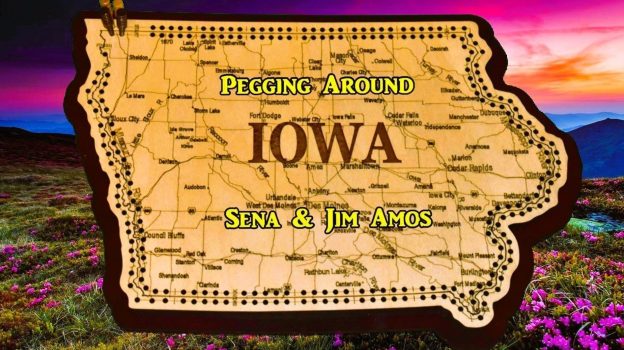
Sena and I got the Iowa map cribbage board and pegged around the state. It was a great way for us to relearn what’s great about Iowa. There is a ton of fun things to do in Iowa.

The 2022 RAGBRAI route, scheduled for July 23-30 will run from Sargeant Bluff to Lansing. It’s the oldest and largest recreational touring bicycle ride in the world, according to the RAGBRAI website. RAGBRAI stands for Register’s Annual Great Bicycle Ride Across Iowa. It’s the largest, longest, and oldest recreational bicycle touring event in the world.

It was started by Des Moines Register reporters John Karras and Donald Kaul. The 7-day trip goes from the Missouri River to the Mississippi River with many stops along the way.

One of them is Mason City, where John Dillinger robbed the First National Bank in the 1930s.

Lake Okoboji in northwestern Iowa is well known for a lot of reasons. It’s a great place to boat and fish, but if you’re an X-Files fan, you’ll recognize that it was the setting for the episode “Conduit,” in which a young woman was kidnapped by aliens although Fox Mulder was unable to prove it happened. The show misspelled the place as “Okobogee,” a mistake that was easy for any Iowan to detect. It was actually shot in British Columbia.

Of course, Iowa City is the home of the Hawkeyes, The University of Iowa, and the Iowa Writers’ Workshop. The African American Museum is in Cedar Rapids.

Clear Lake, as some of you might recall, is where the Surf Ballroom is. Buddy Holly, Ritchie Valens, and J.P. “The Big Bopper” Richardson, after performing there were killed when their plane crashed shortly after taking off from the nearby Mason City Municipal Airport in 1959.

Riverside is the site of the Star Trek Museum and the future birthplace of Captain James T. Kirk in 2233. There’s an annual Trek Fest festival. William Shatner played a hoax on Riverside in 2004 when he visited with a film crew, claiming that they were going to make a science fiction movie there.

Dubuque is the oldest city in Iowa. One of the places to see is the National Mississippi River Museum and Aquarium.

Although it’s not on the cribbage board Iowa map, about a half hour west of Dubuque is Dyersville, where the movie Field of Dreams was shot. The New York Yankees and the Chicago White Sox played there in 2021.

The Pella Tulip Time Festival runs in early May.

You can see Albert, the largest bull in the world, in Audubon. The solid concrete sculpture weighs 45 tons. That’s a lot of bull (obligatory rim shot here).

The Iowa State Fair is in Des Moines, the capital of Iowa. Iowa State University is in Ames. I’m part Cyclone and part Hawkeye because I got my bachelor’s degree at ISU and my medical degree at UI.

Although Nashua is not on the Iowa cribbage board, it’s in our hearts. We were reminded of our wedding at The Little Brown Church there 44 years ago. Come to Iowa and make memories of your own.

The Little Brown Church in Nashua, Iowa

The Fourth in the Series Uncovering Hawkeye History: The Next Chapter: Blazing New Trails (1998-2047)

The final installment of the series of Uncovering Hawkeye History, which is The Next Chapter: Blazing New Trails (1998-2047) was recorded and is now posted on the University of Iowa Center for Advancement website. You can view it below here: