I noticed an article the other day about Monash University in Australia getting funding for further research into growing brain cells onto silicon chips and teaching them how to play cribbage.
Just kidding, the research is for teaching the modified brain cells tasks. They succeeded in teaching them goal-directed tasks like how to play the tennis-like game Pong last year. You remember Pong from the 1970s? Shame on you if you don’t. On the other hand, that means you probably didn’t frequent any beer taverns in your hometown while you were growing up—or that you’re just too young to remember.
The new research program is called Cortical Labs and has hundreds of thousands of dollars in funding. The head of the program, Dr. Razi, says it combines Artificial Intelligence (AI) and synthetic biology to make programmable biological computing platforms which will take over the world and bring back Pong!
It’s an ambitious project. The motto of Monash University is Ancora Imparo, which is Italian for “I am still learning.” It links humility and perseverance.
There’s a lot of suspicion out there about AI and projects like the Pong initiative in Australia. It could eventually grow into a vast industry run by robots who will run on a simple fuel called vegemite.
Shame on you if you don’t know what vegemite is!
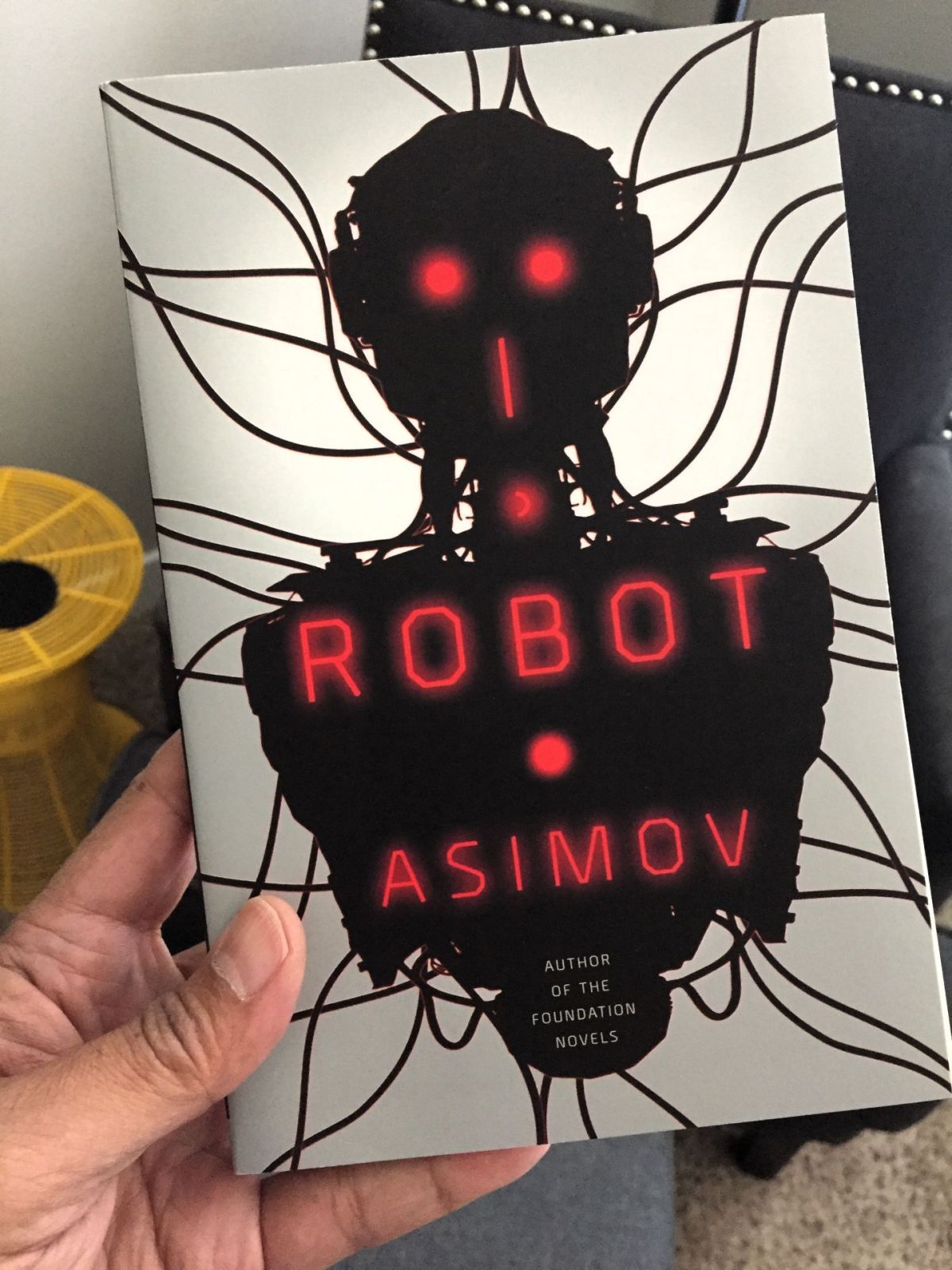
Anyway, it reminds me that I recently finished reading Isaac Asimov’s book of science fiction short stories, “I, Robot.”
The last two stories in the book are intriguing. Both “Evidence” and “The Evitable Conflict” are generally about the conflict between humans and AI, which is a big controversy currently.
The robopsychologist, Dr. Susan Calvin, is very much on the side of AI (I’m going to use the term synonymously with robot) and thinks a robot politician would be preferable to a human one because of the requirement for the AI to adhere to the 3 Laws of Robotics, especially the first one which says AI can never harm a human or allow a human or through inaction allow a human to come to harm.
In the story “Evidence,” a politician named Stephen Byerley is suspected of being a robot by his opponent. The opponent tried to legally force Byerley to eat vegemite (joke alert!) to prove the accusation. This is based on the idea that robots can’t eat. This leads to the examination of the argument about who would make better politicians: robots or humans. Byerley at one point asks Dr. Calvin whether robots are really so different from men, mentally.
Calvin retorts, “Worlds different…, Robots are essentially decent.” She and Dr. Alfred Lanning and other characters are always cranky with each other. The stare savagely at one another and yank at mustaches so hard you wonder if the mustache eventually is ripped from the face. That doesn’t happen to Calvin; she doesn’t have a mustache.
At any rate, Calvin draws parallels between robots and humans that render them almost indistinguishable from each other. Human ethics, self-preservation drive, respect for authority including law make us very much like robots such that being a robot could imply being a very good human.
Wait a minute. Most humans behave very badly, right down to exchanging savage stares at each other.
The last story, “The Evitable Conflict” was difficult to follow, but the bottom line seemed to be that the Machine, a major AI that, because it is always learning, controls not just goods and services for the world, but the social fabric as well while keeping this a secret from humans so as not to upset them.
The end result is that the economy is sound, peace reigns, the vegemite supply is secure—and humans always win the annual Pong tournaments.
I’ve been reading Isaac Asimov’s book I, Robot, a collection of short stories about the relationship between humans and robots. One very thought-provoking story is “Liar!”
One prominent character is Dr. Susan Calvin. If you’ve ever seen the movie I, Robot you know she’s cast as a psychiatrist whose job is to help humans be more comfortable with robots. In the book she’s called a robo-psychologist. She’s a thorough science nerd and yet goes all mushy at times.
The news lately has been full of scary stories about Artificial Intelligence (AI), and some say they’re dangerous liars. Well, I think robots are incapable of lying but Bard the Google AI did sometimes seem to lie like a rug.
In the story “Liar!” a robot somehow gets telepathic ability. At first, the scientists and mathematicians (including the boss, Dr. Alfred Lanning) doubt the ability of robots to read minds.
But a paradoxical situation occurs with the robot who happens to know what everyone is thinking. This has important consequences for complying with the First Law of Robotics, which is to never harm a human or, through inaction, allow a human to come to harm.
The question of what kinds of harmful things should robots protect humans from arises. Is it just physical dangers—or could it be psychological harms as well? And how would a robot protect humans from mental harm? If a robot could read our thoughts, and figure out that our thoughts are almost always harmful to ourselves, what would be the protective intervention?
Maybe lying to comfort us? We lie to ourselves all the time and it’s difficult to argue that it’s helpful. It’s common to get snarled in the many lies we invent in order to feel better or to help others feel better. No wonder we get confused. Why should robots know any better and why wouldn’t lies be their solution?
I can’t help but remember Jack Nicholson’s line in the movie “A Few Good Men.”
“You can’t handle the truth!”
Dr. Calvin’s solution to the lying robot’s effort to help her (yes, she’s hopelessly neurotic despite being a psychologist) is a little worrisome. Over and over, she emphasizes the paradox of lying to protect humans from psychological pain when the lies actually compound the pain. The robot then has the AI equivalent of a nervous breakdown.
For now, we’d have to be willing to jump into an MRI machine to allow AI to read our thoughts. And even then, all you’d have to do is repeat word lists to defeat the AI. So, they’re unlikely to lie to us to protect us from psychological pain.
Besides, we don’t need AI to lie to us. We’re good at lying already.
I just got a copy of Isaac Asimov’s book “I, Robot” the other day. I’ve been thinking about reading it ever since seeing the movie “I, Robot.” As the movie opens, you see the disclaimer saying that the movie was “…inspired by but not based…” on Asimov’s book of the same name.
In fact, the book is a collection of short stories about robots and in the first one, entitled “Robbie” I saw the names of several characters who were transplanted from the book into the movie, Susan Calvin (the psychiatrist), Alfred Lanning, and Lawrence Robertson.
Robbie is the name of the robot who has a special, protective relationship with the 8-year-old daughter of parents who don’t agree about how Robbie could have a positive influence on the girl.
The first of the 3 Laws of Robotics is mentioned in “Robbie.” It is central to the close bond between the little girl and the Robbie All 3 are below:
First Law
A robot may not injure a human being or, through inaction, allow a human being to come to harm.
Second Law
A robot must obey the orders given it by human beings except where such orders would conflict with the First Law.
Third Law
A robot must protect its own existence as long as such protection does not conflict with the First or Second Law.
I just started reading the book. I read a few of the negative reviews of the book on Amazon because when most reviews are effusively positive, it’s difficult to get a balanced view of what the flaws might be. One person called it an “old chestnut” and gave it only 2 stars. Another reader was put off by the old-fashioned portrayal of the relationship between men and women.
Well, after all, the book was published in 1950. A description of their relationship goes like this between the husband and wife:
And yet he loved his wife—and what’s worse his wife knew it. George Watson, after all was only a man—poor thing—and his wife made full use of every device which a clumsier and more scrupulous sex has learned, with reason and futility, to fear.
I’m not at liberty to comment about this.
Moving right along, the story addresses the fear people had of robots—which many of us still have now, in the age of Artificial Intelligence (AI). We tend to forget AI is not independent, like Virtual Interactive Kinetic Intelligence (VIKI) in the movie I, Robot. Why does it have a female name?
Talk about the stereotypical men and women of the 1950s.
Dr. George Dawson’s post “The Freak Show” reminded me of how coarse and cruel we can be to each other, even when we’re not aware of it. Maybe I should say especially when we’re not aware of it. Dr. Dawson emphasizes the importance of the empathic approach. In the same way, Dr. Moffic in the articles in his column, “Psychiatric Views on the News” draws attention to the need for a socially responsible way for us to relate to one another. The Goodenough Psychiatrist blog expresses poignantly the emotional and courageously humanistic ways we can (or could) relate to each other. Dr. Ronald Pies has highlighted the importance of how human interaction with artificial intelligence must help us find a way to treat each other with respect, and teach that to AI because AI learns from humans.
This reminds me of a character in the book “The Hitchhiker’s Guide to the Galaxy” by Douglas Adams. The character is named Gag Halfrunt who is the personal brain specialist for a couple of other characters. In fact, he’s a psychiatrist who orders the destruction of planet Earth, which is a sort of computer program designed to give us the ultimate question to the ultimate answer for life, the universe, and everything. The reason Gag Halfrunt wants to destroy Earth is, if the ultimate question is revealed, it would put psychiatrists out of work because then everyone would be happy.
Just as a personal comment, I’m pretty unhappy with the author’s position on psychiatrists in general, which tends to overemphasize our importance. And I’m pretty sure psychiatrists are not that important, having been employed as one for many years and seeing how much impact of any kind we have. We can’t make people more or less happy at all.
In fact, Adams also takes a shot at philosophers, who are also upset at being thrown out of work should the ultimate question to the ultimate answer be revealed (the ultimate answer, by the way, is 42 if you’re interested).
Giving psychiatrists and philosophers and anyone else who might have a stake in taking credit for making people happy is nonsense. We all bear responsibility for ourselves. You can argue about whether or not we have any responsibility for each other.
Rather than arguing about it, we could give something else a try. We could try a mindfulness approach like the Lovingkindness Meditation. I’m not an authority or expert on this, but you can check it out on the Palouse Mindfulness website, the link to which is in the menu on my blog. You can find the link to the Lovingkindness Meditation there.
There is no guarantee the Lovingkindness Meditation will make you or anyone else happy. But it doesn’t hurt anything to try it and, as far as I know, Gag Halfrunt is not opposed to it.
I’m reposting a piece about a sense of humor and breaking bad news to patients I first wrote for my old blog, The Practical Psychosomaticist about a dozen years ago. I still believe it’s relevant today. The excerpt from Mark Twain is priceless. Because it was published before 1923 (See Mark Twain’s Sketches, published in 1906, on google books) it’s also in the public domain, according to the Mark Twain Project.
Blog: A Sense of Humor is a Wonderful Thing
Most of my colleagues in medicine and psychiatry have a great sense of humor and Psychosomaticists particularly so. I’ll admit I’m biased, but so what? Take issues of breaking bad news, for example. Doctors frequently have to give their patients bad news. Some of do it well and others not so well. As a psychiatric consultant, I’ve occasionally found myself in the awkward position of seeing a cancer patient who has a poor prognosis—and who apparently doesn’t know that because the oncologist has declined to inform her about it. This may come as a shock to some. We’re used to thinking of that sort of paternalism as being a relic of bygone days because we’re so much more enlightened about informed consent, patient centered care, consumer focus with full truth disclosure, the right of patients to know and participate in their care and all that. I can tell you that paternalism is not a relic of bygone days.
Anyway, Mark Twain has a great little story about this called “Breaking It Gently”. A character named Higgins, (much like some doctors I’ve known) is charged with breaking the bad news of old Judge Bagley’s death to his widow. She’s completely unaware that her husband broke his neck and died after falling down the court-house stairs. After the judge’s body is loaded into Higgins’ wagon, Higgins is reminded to give Mrs. Bagley the sad news gently, to be “very guarded and discreet” and to do it “gradually and gently”. What follows is the exchange between Higgins and the now- widowed Mrs. Bagley after he shouts to her from his wagon[1]:
“Does the widder Bagley live here?”
“The widow Bagley? No, Sir!”
“I’ll bet she does. But have it your own way. Well, does Judge Bagley live here?”
“Yes, Judge Bagley lives here”.
“I’ll bet he don’t. But never mind—it ain’t for me to contradict. Is the Judge in?”
“No, not at present.”
“I jest expected as much. Because, you know—take hold o’suthin, mum, for I’m a-going to make a little communication, and I reckon maybe it’ll jar you some. There’s been an accident, mum. I’ve got the old Judge curled up out here in the wagon—and when you see him you’ll acknowledge, yourself, that an inquest is about the only thing that could be a comfort to him!”
That’s an example of the wrong way to break bad news, and something similar or worse still goes on in medicine even today. One of the better models is the SPIKES protocol[2]. Briefly, it goes like this:
Set up the interview, preferably so that both the physician and the patient are seated and allowing for time to connect with each other.
Perception assessment, meaning actively listening for what the patient already knows or thinks she knows.
Invite the patient to request more information about their illness and be ready to sensitively provide it.
Knowledge provided by the doctor in small, manageable chunks, who will avoid cold medical jargon.
Emotions should be acknowledged with empathic responses.
Summarize and set a strategy for future visits with the patient, emphasizing that the doctor will be there for the patient.
Gauging a sense of humor is one element among many of a thorough assessment by any psychiatrist. How does one teach that to interns, residents, and medical students? There’s no simple answer. It helps if there were good role models by a clinician-educator’s own teachers. One of mine was not even a physician. In the early 1970s when I was an undergraduate at Huston Tillotson University (when it was still Huston-Tillotson College), the faculty would occasionally put on an outrageous little talent show for the students in the King Seabrook Chapel. The star, in everyone’s opinion, was Dr. Jenny Lind Porter, who taught English. The normally staid and dignified Dr. Porter did a drop-dead strip tease while reciting classical poetry and some of her own ingenious inventions. Yes, in the chapel. Yes, the niece of author O. Henry; the Poet Laureate of Texas appointed in 1964 by then Texas Governor John Connally; the only woman to receive the Distinguished Diploma of Honor from Pepperdine University in 1979; yes, the Dr. Porter in the Texas Women’s Hall of Fame—almost wearing a very little glittering gold something or other.
It helps to be able to laugh at yourself.
1. Twain, M., et al., Mark Twain’s helpful hints for good living: a handbook for the damned human race. 2004, Berkeley: University of California Press. xiv, 207 p.
2. Baile, W.F., et al., SPIKES-A six-step protocol for delivering bad news: application to the patient with cancer. Oncologist, 2000. 5(4): p. 302-11.
Here’s another vintage post from around a decade ago after my former Psychiatry Dept chairperson, Dr. Robert G. Robinson and I published our book, Psychosomatic Medicine: An Introduction to Consultation-Liaison Psychiatry” in 2010.
Blog: Who Gets The Credit?
When I think about peak moments, I remember this guy back in junior high school who decided to try to break the Guinness Book of World Records for skipping rope. I don’t remember his name but the school principal and his teachers all agreed to let him do it during class hours. They marked out a little space for him in our home room. He was at it all day. And he was never alone because there was always a class in the room throughout the day. We didn’t get much work done because we couldn’t keep our eyes off him. It was mesmerizing. The longer he jumped, the more we hoped. We were very careful about how we encouraged him. We didn’t want to distract him and make him miss a jump. And so, we watched him with hope in our hearts. It was palpable. As he neared the goal, we were all crowded around him, teachers and students cheering. He was exhausted and could barely swing the rope over his head and lift his knees. When he made the time mark, we lifted him high above our heads and you could have heard us yelling our fool heads off for miles. Time stood still. He was a hero and we were his adoring fans. It didn’t occur to us to be jealous. His achievement belonged to all of us.
Another peak moment occurred more recently, when my colleagues and I published a book this summer. It’s my first book. It’s a handbook about consultation-liaison psychiatry which my department chairman and I edited, and the link is available on this page. This time, the effort was collaborative with over 40 contributors. The work took over 2 years and often, being an editor felt like herding cats. But we worked on it together. Many of the contributors were trainees working with seasoned psychiatrists who had much weightier research and writing projects on their minds, I’m sure. Like any first book, it was a labor of love. The goal was to teach fundamental concepts and pass along a few pearls about psychosomatic medicine to medical student, residents, and fellows. The book grew slowly, chapter by chapter. And when it was finally complete, this time the achievement was ours and again it belonged to all of us.
I made a lot of long-distance friends on the book project and occasionally get encouragement to do something else we could work together on. I suppose one thing everyone could do is to propose some kind of delirium early detection and prevention project at their own hospitals and chronicle that in a blog to raise awareness about delirium—sort of like what I’ve been trying to do here. We could share peak moments like:
Getting the Sharepoint intranet site up and going so that group members can talk to each other about in discussion groups about how to hammer out a proposal, which delirium rating scale to use, or which management guidelines to use—and avoid the email storms.
Being invited to give a talk about delirium at a grand rounds conference or regional meeting.
Talking with someone who is interested in funding your delirium project (always a big hit).
That way if one of us falters, we always know that someone else is in there pitching. Copyrighting ideas and tools are fine. Hey, everybody has a right to protect their creative property. I’m mainly talking about sharing the idea of a movement to teach health care professionals, and patients about delirium, to help us all understand what causes it, what it is and what it is not, and how to prevent it from stealing our loved ones and our resources.
“It is amazing what you can accomplish if you do not care who gets the credit”-Harry Truman, Kansas Legislature member John Solbach, Ronald Reagan, Charles E. Montague, Benjamin Jowett, a Jesuit Father, a wise man, Edward T. Cook, Edward Everett Hale, a Jesuit Priest named Father Strickland.
I thought I’d re-post something from my previous blog, The Practical Psychosomaticist, which I cancelled several years ago. The title is “Face Time versus Facebook.” I sound really old in it although it appeared in 2011.
I’m a little more comfortable with the concept of social media nowadays and, despite how ignorant I was back then, I later got accounts in Facebook, Twitter, and LinkedIn. I got rid of them several years later, mainly because all I did was copy my blog posts on them.
The Academy of Psychosomatic Medicine (APM) to which there is a link in the old post below, later changed its name to the Academy of Consultation-Liaison Psychiatry (ACLP), which made good sense. I still have the email message exchange in 2016 with Don R. Lipsitt, who wrote the book “Foundations of Consultation-Liaison Psychiatry: The Bumpy Road to Specialization.” It’s an excellent historical account of the process.
Don liked a post I wrote, entitled “The Time Has Come for ‘Ergasiology’ to Replace ‘Psychosomatic Medicine?” It was a humorous piece which mentioned how many different names had been considered in the past for alternative names for Psychosomatic Medicine. I was actually plugging his book. I don’t think ergasiology was ever considered; I made that part up. But it’s a thing. It was Adolph Meyer’s idea to invent the term from a combination of Greek words for “working” and “doing,” in order to illustrate psychobiology. Don thought “…the Board made a big mistake…” naming our organization Psychosomatic Medicine. He much preferred the term “consultation-liaison psychiatry.” We didn’t use emoticons in our messages.
The Don R. Lipsitt Award for Achievement in Integrated and Collaborative Care was created in 2014 to recognize individuals who demonstrate “excellence and innovation in the integration of mental health with other medical care…”
I don’t think the ACLP uses Facebook anymore, but they do have a Twitter account.
I also included in the old post a link to the Neuroleptic Malignant Information Service (NMSIS). I used to call the NMSIS service early in my career as a consultation-liaison psychiatrist. I often was able to get sound advice from Dr. Stanley Caroff.
Blog: Face Time versus Facebook
You know, I’m astounded by the electronic compensations we’ve made over the years for our increasingly busy schedules which often make it impossible to meet face to face. Frankly, I’ve not kept up. I still think of twittering as something birds do. If you don’t get that little joke, you’re probably not getting mail from the AARP.
The requests for psychiatric consultations are mediated over the electronic medical record and text paging. Technically the medical team that has primary responsibility for a patient’s medical care contacts me with a question about the psychiatric management issues. But it’s not unusual for consultation requests to be mediated by another consultant’s remarks in their note. The primary team simply passes the consultant’s opinion along in a request. They may not even be interested in my opinion.
I sometimes get emails from people who are right across the hall from me. I find it difficult to share the humor in a text message emoticon. And I get more out of face-to-face encounters with real people in the room when a difficult case comes my way and I need to tap into group wisdom to help a patient. These often involve cases of delirium, an acute confusional episode brought on by medical problems that often goes unrecognized or is misidentified as one of the many primary psychiatric issues it typically mimics.
The modern practice of medicine challenges practitioners and patients alike to integrate electronic communication methods into our care systems. And these methods can facilitate education in both directions. When professionals are separated geographically, whether by distances that span a single hospital complex or across continents, electronic communication can connect them.
But I can’t help thinking there are some messages we simply can’t convey with emoticons. By nature, humans communicate largely by nonverbal cues, especially in emotionally charged situations. And I can tell you, emotions get involved when physicians and nurses cue me that someone who has delirium is just another “psych patient” who needs to be transferred to a locked psychiatric unit(although such transfers are sometimes necessary for the patient’s safety).
So, when do we choose between Face Time and Facebook? Do we have to make that choice? Can we do both? When we as medical professionals are trying to resolve amongst ourselves what the next step should be in the assessment and treatment of a delirious patient who could die from an occult medical emergency, how should we communicate about that?
As a purely hypothetical example (though these types of cases do occur), say we suspect a patient has delirium which we think could be part of a rare and dangerous medical condition known as neuroleptic malignant syndrome (NMS). NMS is a complex neuropsychiatric disorder which can be marked by delirium, high fever, and severe muscular rigidity among other symptoms and signs. It can be caused very rarely by exposure to antipsychotic drugs such as Haloperidol or the newer atypical antipsychotics. The delirium can present with another uncommon psychiatric disorder called catatonia, and many experts consider NMS to be a drug-induced form of catatonia. Patients suffering from catatonia can display a variety of behaviors and physiologic abnormalities though they are often mute, immobile, and may display bizarre behaviors such as parroting what other people say to them, assuming very uncomfortable postures for extended periods of time (called waxy flexibility), and very rapid heart rate, sweating, and fever. The treatment of choice is electroconvulsive therapy (ECT) which can be life-saving.
Since NMS is rare, many consulting psychiatrists are often not confident about their ability to diagnose the condition. There may not be any colleagues in their hospital to turn to for advice. One option is to check the internet for a website devoted to educating clinicians about NMS, the Neuroleptic Malignant Syndrome Information Service at www.nmsis.org. The site is run by dedicated physicians who are ready to help clinicians diagnose and treat NMS. Physicians can reach them by telephone or email and there are educational materials on the website as well. I’ve used this service a couple of times and found it helpful. The next two electronic methods I have no experience with at all, but I find them intriguing.
One might be a social network like Facebook. In fact, the Academy of Psychosomatic Medicine (APM) has a Facebook link on their website, www.apm.org. Psychosomaticists can communicate with each other about issues broached at our annual conferences, but probably not discuss cases. Truth to tell, the Facebook site doesn’t look like it’s had many visitors. There are 3 posts which look like they’ve been there for a few months:
Message 1: We have been thinking about using Facebook as a way to continue discussions at the APM conference beyond the lectures themselves. Would anyone be interested in having discussions with the presenters from the APM conference in a forum such as this?
Message 2: This sounds great!
Message 3: I think it’s a very good idea
It’s not exactly scintillating.
Another service could be something called LinkedIn, which I gather is a social network designed for work-at-home professionals to stay connected with colleagues in the outside world. Maybe they should just get out more?
Email is probably the main way many professionals stay connected with each other across the country and around the world. The trouble is you have to wait for your colleague to check email. And there’s text messaging. I just have a little trouble purposely misspelling words to get enough of my message in the tiny text box. And I suppose one could tweet, whatever that is. You should probably just make sure your tweet is not the mating call for an ostrich. Those birds are heavy and can kick you into the middle of next week.
But there’s something about face time that demands the interpersonal communication skills, courtesy, and cooperation needed to solve problems that can’t be reduced to an emoticon.
Listen to Dr. Wes Ely on the show Talk Radio Europe as he talks about the devastating consequences of severe disease that results in admission to critical care units, specifically in the context of the Covid-19 Pandemic.
The title of the presentation is “Understanding the Long Shadow of COVID and ICU Care.”
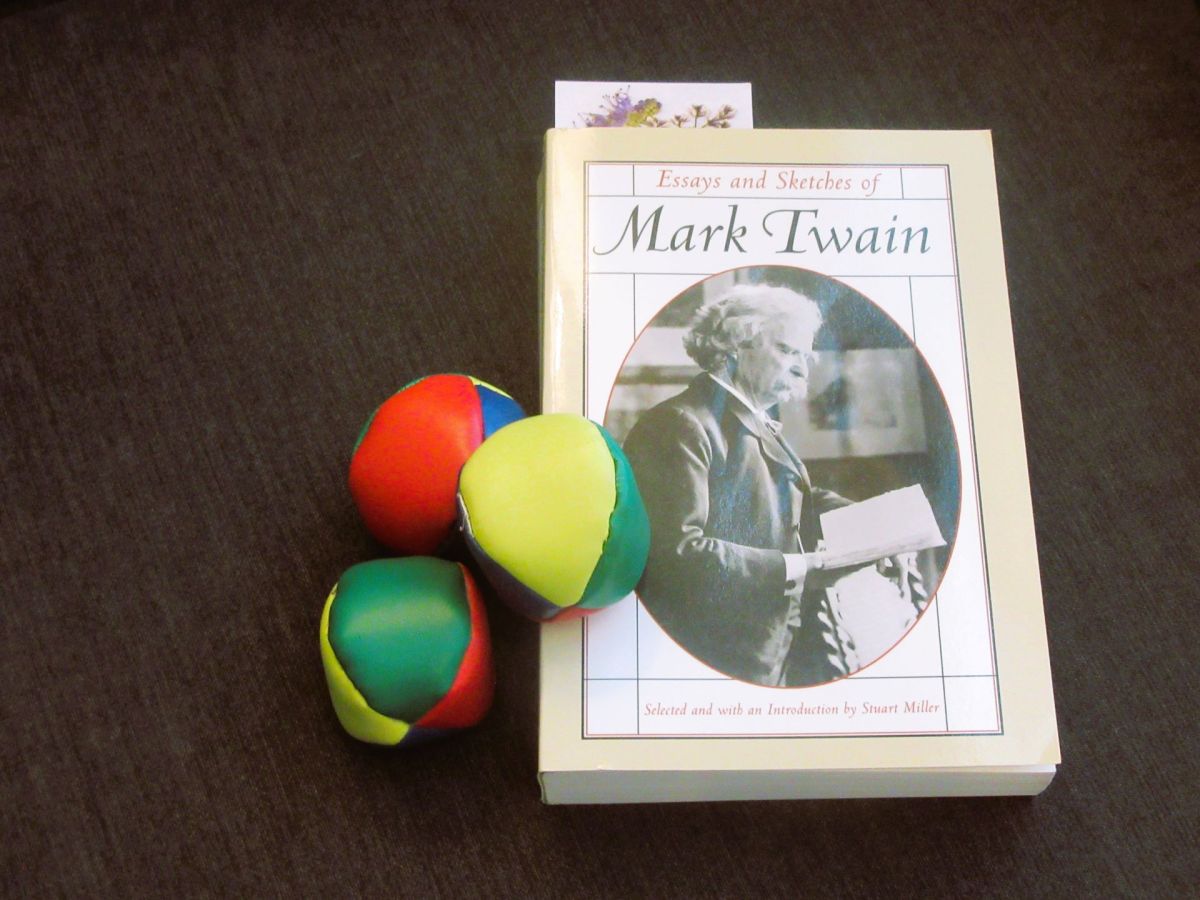
As of November 7, 2022 it has been 22 days since I purchased the Learn to Juggle kit from Barnes and Noble. So far, my learning experience reminds me of a story by Mark Twain, “Taming the Bicycle,” which was published posthumously—obviously after he succumbed from his injuries in the attempt to ride the high-wheeled bicycle in the early 1880s.
Just kidding of course, about his death from the bicycle riding adventure. He did mention using about a barrel of something called Pond’s Extract, which was a liniment for scrapes and other wounds.
Twain was writing about learning something new—a thing all of us are called on to do many times in our lives. He didn’t try to learn to ride the bicycle until he was over 50 years old.
I didn’t try to learn how to juggle until was well past my mid-sixties. How do you account for decisions to embark on new hobbies, adventures, and other nonsense at an age when most people would be content vegetating on the porch or in front of the TV?
I just answered the question, in case you didn’t notice.
Anyway, I am making some progress as juggling, although it’s uneven. It’s hard to believe, but sometimes I think I juggle better as I wander around. I think it might be because there is a natural tendency to throw the balls away from you. That way, I look more adept simply because I’m making a frequently observed beginner’s mistake. But I seem to be steadier even when I walk backward a few paces.
When I stand firmly in one place and attempt to juggle, I can often barely make it past half a dozen throws. Wandering a little, I have made thirty throws.
But then, randomly, the opposite occurs and the theory fails.
Counting the number of each throw seems to help—occasionally. I also notice that unscheduled, short practice episodes for 10 minutes or less work better than struggling along for a half hour or so at set times.
I don’t dread the practice sessions; in fact, I have a sort of itch to juggle at various times during the day. Sometimes I believe I do it to help me collect my thoughts, to keep my hands occupied, or just to pass the time.
I remember learning to ride the bicycle for the first time when I was a kid. I fell down a lot, just like Twain did—until I got the hang of it. Maybe juggling will turn out to be the same.
But I won’t need Pond’s Extract for juggling mistakes—as long as I don’t try juggling while climbing or descending stairs.
Sena has a peony shrub growing dazzling red blossoms. The red ones are said to symbolize love, respect, and honor. The peony genus classification is Paeonia, which is taken from the Greek word Paean. At least a couple of flower web sites say the origin of the name peony comes from a Greek myth involving a deity called Paean (pronounced “Bud”).
According to the flower web sites version of the myth, Paean was the physician of the gods. He was a student of Aesculapius or Asclepius, whose friends just called him “Bud.”
Paean used a peony root to heal Pluto, which was the Roman name of the deity Hades. I don’t know what was ailing Pluto. Maybe it was the gout. Anyway, Aesculapius got wind of Paean’s treatment, and became really jealous. He tried to kill him, but Zeus wasn’t having any of that baloney, intervened and turned Paean into a peony.
I couldn’t find this version in any scholarly source of Greek mythology. In fact, Edith Hamilton, a Greek scholar who wrote a book entitled simply, Mythology, says Paean was just another name for Apollo or Aesculapius, also known as Asclepius—or “Bud.”
In fact, a paean is a song of thanksgiving or triumph addressed to Apollo.
Hamilton’s version is kind of a soap opera. Greek gods always seemed to be having torrid affairs with humans, often leading to drama involving the transformation of humans into various plants, animals and whatnot—and maybe even destroying them.
This is what happened to a human female named Coronis, who had a fling with Apollo who got her pregnant. She snubbed him for a human guy, which annoyed Apollo so he killed her. However, he saved his baby by tearing Coronis open and plucking him out right out of the womb—really extreme.
Apollo than adopts the kid out to an old fart of a Centaur named Chiron. Apollo ordered Chiron to name the child Aesculapius, or Asclepius, “Bud” for short. He was never named Paean, according to Hamilton.
Chiron was pretty slick with healing arts and taught Bud everything he knew. Then Bud got too big for his britches and brought a guy back from the dead. I can’t recall exactly who got resurrected; it was either Hippolytus or Elvis. Gods got mad about it because making zombies is their business, not Bud’s.
Consequently, Zeus killed Bud by slinging a thunderbolt at him. Contrary to flower shop lore, Zeus never even considered turning him into a peony. In his opinion, you had to teach these pups a lesson.
How do you think Apollo felt about this? How would you feel? What would you do? Apollo got on the phone with his lawyer, and before you could say “peony,” he got a court order authorizing Apollo to kill the Cyclops who were manufacturing all of Zeus’s thunderbolts.
If you think it ended there, you’re wrong. Zeus, not to be outdone, sued Apollo, who lost big time and was sentenced to slavery to King Admetus for one to nine years in solitary confinement.
Bud, on the other hand, even though he was slain, was honored by thousands for hundreds of years. Those who came to his temples were invariably healed of various ailments including but not limited to the gout. Snakes were involved in the treatments, though, and some preferred to live with the gout, so declined to sign the informed consent forms.
Hamilton and other scholars don’t ever mention Bud getting turned into a peony. But Sena’s peonies are still beautiful.
Reference: Edith Hamilton, Mythology, Little, Brown and Company, 1942.









 Go Retire Psychiatrist