Svengoolie Show: “The Creature Walks Among Us”

I watched the 1956 Universal-International Pictures production of “The Creature Walks Among Us” last night on the Svengoolie show. It’s a movie about chain-smoking scientists who capture the aquatic Gill-Man, transform it into an air-breather and blow smoke into its face to make it cough. This annoys it so much it starts breaking stuff.

The scientist who pushes the whole project is Dr. William Barton (Jeff Morrow) who at times can be seen smoking 10 cigarettes simultaneously which sets his hair on fire. He’s bald for the rest of the movie, which doesn’t endear him to his wife Marcia (Leigh Snowden) who copes with his pathological jealousy by playing several musical instruments throughout the movie.

The team of scientists includes a geneticist, Dr. Thomas Morgan (Rex Reason), a prince of a guy who spars with Dr. Barton about the pros and cons of contributing to the delinquency of a major monster by altering its biology, moving it closer to the “jungle or the stars.” Dr. Barton doesn’t buy this metaphor and is bent only on pursuing a maniacal plan to teach the creature how to shoplift cigarettes and bottles of Thunderbird wine.

Dr. Morgan is sweet on Marcia but so is the guide, Jed Grant (Gregg Palmer). Marcia plays various musical instruments to keep between her and Jed, starting with a piano, progressing to a guitar and, when he gets more insistent on messing up her hair, she hauls out a cello!

The group of scientists catch the creature out on the river. They’re all smoking when it suddenly leaps into the boat and when it picks up a gas can spilling the contents all over itself, all they have to do is flick their cigarettes at it on a pre-arranged signal (Dr. Barton farts). While the creature is wrapped in flames, the crew takes a little while to figure out which fire extinguisher they should use (what works on scales, foam or dry chemical?).

Apparently, the Creature evolves spontaneously once it’s out of the water and grows a feeble set of lungs. The scales fall off to be replaced by skin, and it develops fingers. Then it tries to steal Marcia’s banjo.

The scientists imprison the creature in a pen which has an electrified fence, which Dr. Barton forgets to re-activate after he dumps Jed (whom he has knocked out with Marcia’s clarinet) in there to distract it.

This doesn’t fool the creature but I wouldn’t want to spoil the ending for you. The moral of the story is that smoking is bad for your health.


Shrilling Chicken Rating 3/5

The Butterfly House or The Bigfoot Monarch Roundup

Sena went over to ForeverGreen, a popular landscaping and garden center locally, to see the butterfly house. She got pictures and video clips which showed the monarch butterfly management operation they have. They have quite a conservation program, including a large monarch butterfly house enclosure along with demos of life cycle stages. The butterfly house is just part of the deal and it’s open to the public. It opened in June of this year and runs until September 14th. The schedule shows there’ll be a big release then and possibly even tagging prior to that. You might want to call ahead and check to see if they’re still going to tag the monarchs.

I think this is also a good way to rehabilitate Bigfoot’s image because they could be sort of like ranch hands tending to the monarch as they go through their life cycle. The monarchs migrate to Mexico every fall. You can learn more about the monarch watch program and why many people believe the monarchs are at risk of extinction.

Big Mo Pod Show: “Hickory Smoked Blues”

Today, the Big Mo Pod Show was about how blues music can you help you “exorcise your demons” as Big Mo himself put it today. Isn’t that what it’s always about? And I can’t explain how that even works.

Big Mo Pod Show 085 – “California Bluesin” KCCK's Big Mo Pod Show

After a short break during the Thanksgiving holiday your hosts are back at it again with another episode! This week features the usual mix of blues eras you’ve come to expect along with a few Californian artists, tune in to see which ones! Songs featured in the episode: Solomon Hicks – “Further On Up The … Continue reading
  1. Big Mo Pod Show 085 – “California Bluesin”
  2. Big Mo Pod Show 084 – “Garage Blues”
  3. Big Mo Pod Show 083 – “Legal Pirate radio”
  4. Big Mo Pod Show 082 – “Tribute”
  5. Big Mo Pod Show 081 – “Cheers To Kevin”

But I don’t always understand how it works. I’m going to admit I’m not sure at all how one song last night by Toranzo Cannon would help anybody, and that’s “I Hate Love.” Of course, it’s contradictory and ironic. I’m not going to pretend I know what blues music is all about and how it can sometimes heal your inner soul pain.

But a lot of people believe that blues can help you get past the pain and it seems that it works paradoxically. I don’t always get it. But I’ve been listening to the Big Mo Blues Show for years.

That reminds me. We had a couple of guys install motorized window shades yesterday and one of them was a blues musician. He plays bass guitar and I gather he plays in local bands. He wore the best hat; it’s a fedora! Sena and I sort of ribbed him about it, but I had a fedora like that once, decades ago. It was gray with a narrow leather band. I don’t have it anymore.

I told him that I wore it while I was interviewing for residency. I wore it to dinner in a hotel in St. Louis, Missouri and a woman passing through the hotel restaurant looked at me and said with a grin, “Wear that hat!”

Sena reacted as if she’d never heard that story before. The fedora guy thought it was funny. Fedora man had that style to him that I think is fairly common in musicians. They look and may act in a way that makes you notice them. I don’t think you can always tell what somebody does just by the way he or she dresses. But when he told us he was a musician who liked the blues, that didn’t surprise us.

What did surprise us was that he didn’t recognize the name of a prominent blues musician in Iowa and a lot of other places—Kevin Burt. But he did have a sense of humor.

I think most blues musicians have a kind of slant sense of humor. It probably comes out in some of the music. I’m more drawn to blues music that makes me chuckle. On the other hand, I liked one song on the blues show last night they didn’t discuss today on the pod show. It’s not funny and I had a hard time finding the lyrics for it. It’s “I’ll Always Remember You” by the Robert Cray Band. I found a couple of sites I think got the lyrics below wrong and didn’t make sense. The way I heard the song the lines went like this:

 “Old clothes and worn-out shoes
Empty bottles and a book that’s way past due.”

The line I keep finding that I think is wrong is the second one, which is often written as “Empty bottles and I put this way past due.”

I think the line “a book that’s way past due” makes more sense because it conveys a sense of regret, waste and loss and promises not kept and opportunities lost and probably a half-dozen other ideas that you probably can’t easily encapsulate. It evokes sorrow that is only partly fixed by the letter’s promise— “I’ll always remember you.”

That may not completely heal you, but it’s a little like something I read about kintsugi. It’s about mending broken pottery with gold in a literal sense. In a metaphorical sense, it’s about repairing what might be broken emotionally broken in us and, despite not being the same as we were before we were broken, we’re somehow still functional and healed though not perfect. A psychiatry resident blogger wrote about that.

Won Cribbage Solitaire on First Game Today!

I won cribbage solitaire in six deals (meaning I got to 121) on my first try today. Lucky break. I’m beginning to think I should just film these because, at least lately, I seem to be on a winning streak. My first and most recent win was 3 days ago and I think I’ve played once or twice since then.

Rules summarized and demo video below:

Cribbage solitaire has six hands and six cribs and you peg your six hands.

Start by dealing two cards down to form part of your hand, then one down to form part of the crib. Deal two more to your hand, one more to the crib, and finally two more to your hand (which now has six cards and the crib has two.

Discard two of the six cards to form a four-card crib. Then flip the top card of the deck for the starter card.

Then peg your hand for maximum count, which would not always be the way you’d peg in a game with an opponent. Colbert’s example paraphrased: if you hold 5-10-10-jack. Play the 5 first, then a 10 for “15-2,” then the other 10 for “25, a pair for two and a go.” The remaining jack also scores a “go” for one point. Your peg is six points total.

After scoring the peg, count your hand, then your crib.

Then start the second deal by using the first-hand starter card, which becomes one of the first six cards for your hand. Again, deal the crib two cards. Repeat this process until you complete the game with the sixth deal (the deck will have four cards after six deals). (Colvert, 2015)

Reference

Colvert, D. (2015). Play Winning Cribbage 5th ed. Missoula, Montana: Starr Studios.

One More Time: Another Ramshorn Journal Editorial

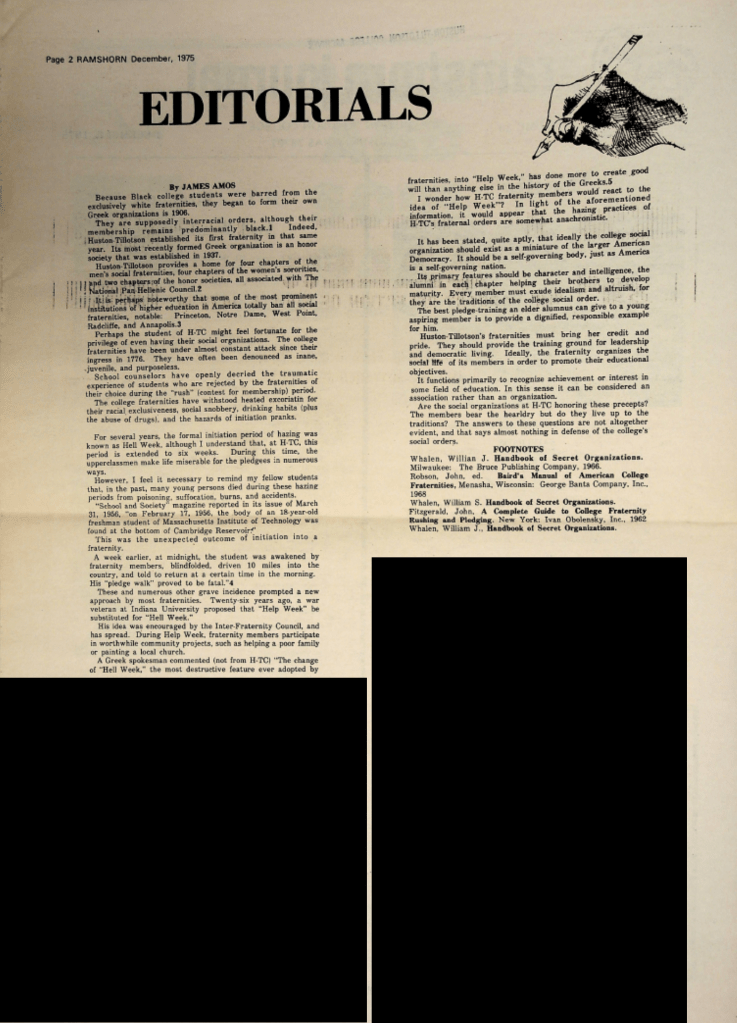
This is the 2nd editorial I wrote in 1975 about fraternities during my freshman year at Huston-Tillotson College (now Huston-Tillotson University, one of the Historically Black Colleges and Universities, HBCUs). There are a couple of misspelled words (“incidence” should be incidents; “altruish” should be altruism).

On the whole, it’s a more developed piece than the editorial about college hazing. I thought then and still think that Help Week should be substituted for Hell Week.

ramshorn journal vol 38, dec 1975 Click the image; Click the little icon circle with i; hover over the image and click the plus sign to enlarge.

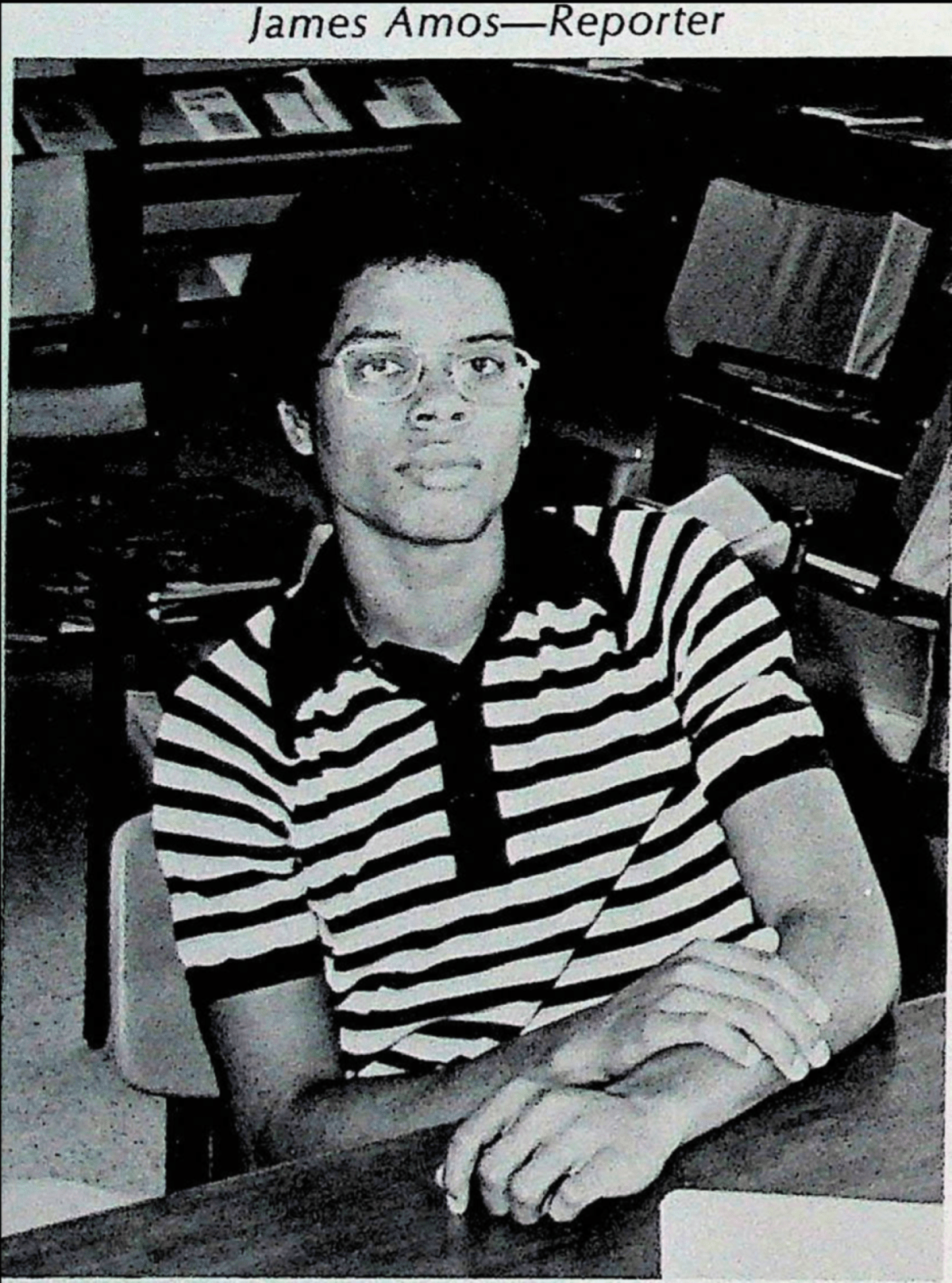
I Was a College News Reporter After All

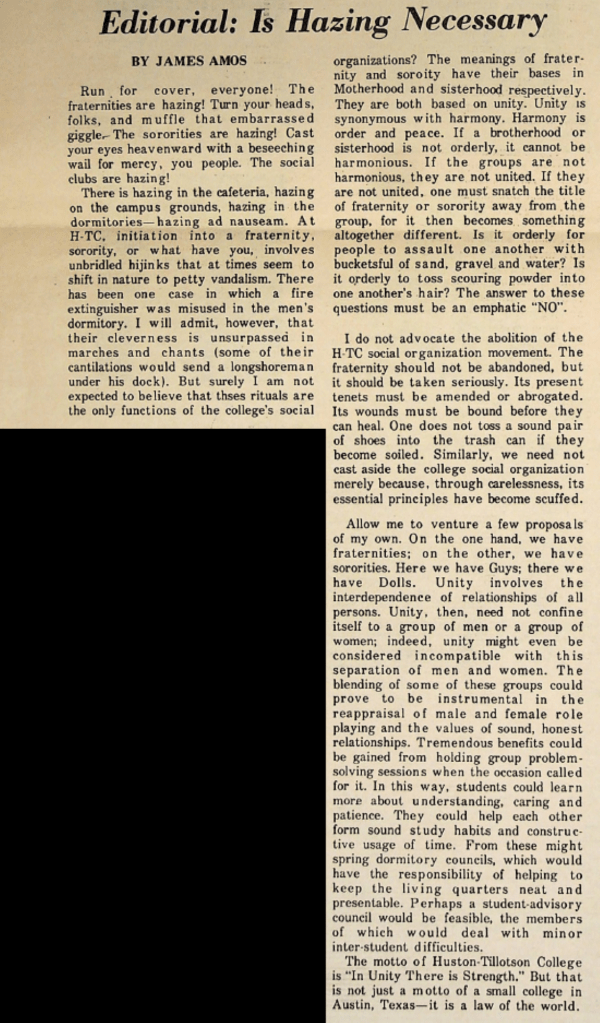
It turns out I was a news reporter for the Huston-Tillotson College Ramshorn Journal after all! I wrote a few of them, including an editorial about Greek fraternity hazing in 1975. I’m including it in this post below. It has an apparent typo in it (“Motherhood” should be brotherhood).

It’s typical for fired up freshman writing. I see lots of youthful idealism, energy, and a drive for change. How did I forget so much of what I was over the last 50 years?

I wrote “Is Hazing Necessary” (the question mark is missing) because I saw it going on in my freshman year. I can’t remember whether the fraternity members gave me flak about it or not. But I guess I can’t say it didn’t happen just because I can’t remember it.

Hazing still happens, as I found out when I did a quick web search today. I still don’t know why. Even The University of Iowa had an incident in November of 2024.

I don’t know how I lost such an important part of my past. And I don’t know what led me to recover it. I do know that if Sena hadn’t pursued the search after I was ready to forget it, I wouldn’t have these fragments of my personal history now. And I’m grateful to Huston-Tillotson Downs-Jones University Library for their help.

Ramshorn Journal Oct.1975 (page 4) Click the image; Click the little icon circle with i; hover over the image and click the plus sign to enlarge.

A Little Iowa Hawkeye Cribbage History

Sena played a couple of games of cribbage solitaire today and came within 8 points of making 121! And so that makes us both fans of this variation on cribbage.

There was a little project I set for myself given that DeLynn Colvert’s book, “Play Winning Cribbage” has a section called Cribbage World Publication, which is a monthly publication you can find on the American Cribbage Congress (ACC) website. Colvert was an editor of Cribbage World and included in his book copies of events and ads of interests to ACC members. Many items are odd and comical.

One of the interesting tidbits is an announcement that is historically important for cribbage in Iowa. However, none of the items including this one are dated. So, I had to hunt it down in the archives on the ACC website. The title is “Two 29’s Within 5 Minutes!” It refers to an event called the Hawkey Classic, which used to be the name for the annual cribbage tournament held in Des Moines, Iowa. Two 29 hands were scored within 5 minutes of each other during this tournament. This is remarkable because the odds of dealt a 29 hand are 1 in 216,580!

I had to dig through many pages of Cribbage World and Artificial Intelligence (AI) was no help at all (not that I asked it because AI intrudes itself on all my searches whether I want it’s help or not). In fact, it denied the existence of the Hawkeye Classic cribbage tournament.

Anyway, I had to make a guess about what issue of Cribbage World that announcement was published. I guessed that it was in the 1990s (for no particular reason) and I found it on page 3 in the June 1990 issue after striking out in the 1991-1993 issues (although I found one item related to cribbage solitaire which involved playing five hands instead of six).

It turns out that there’s been an annual cribbage tournament for over 40 years in Iowa and that tradition did start in Des Moines. It was called the Hawkeye Classic and was ACC sanctioned. However, my guess is that it gradually became absorbed into the Iowa State Fair schedule of events. It’s usually held on the last day of the fair. This year, I found out there were 252 entrants, which I think is probably not unusual.

Another interesting note about this issue of Cribbage World I noticed is that there isn’t a Hawkeye Classic cribbage tournament announcement listed in The Tournament Trail section. However, it does list the Grand National (National Awards Banquet) on September 20, 21, 23 in 1990 at the Hotel Fort Des Moines, Des Moines, Iowa. But I did find an announcement about the Hawkeye Classic in one of the earlier issues from 1991-1993.

Iowa Hawkeye cribbage is alive and well!

First Cribbage Solitaire Win Today!

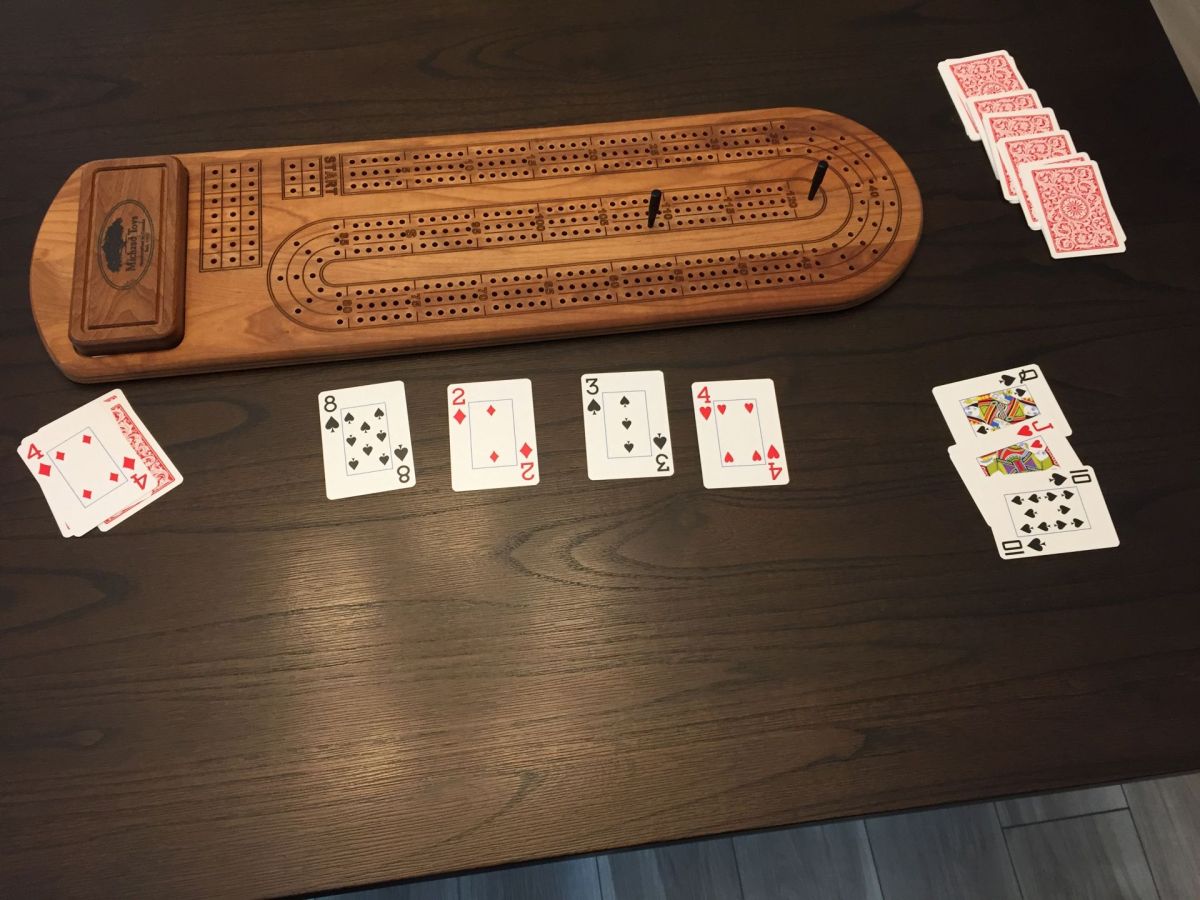
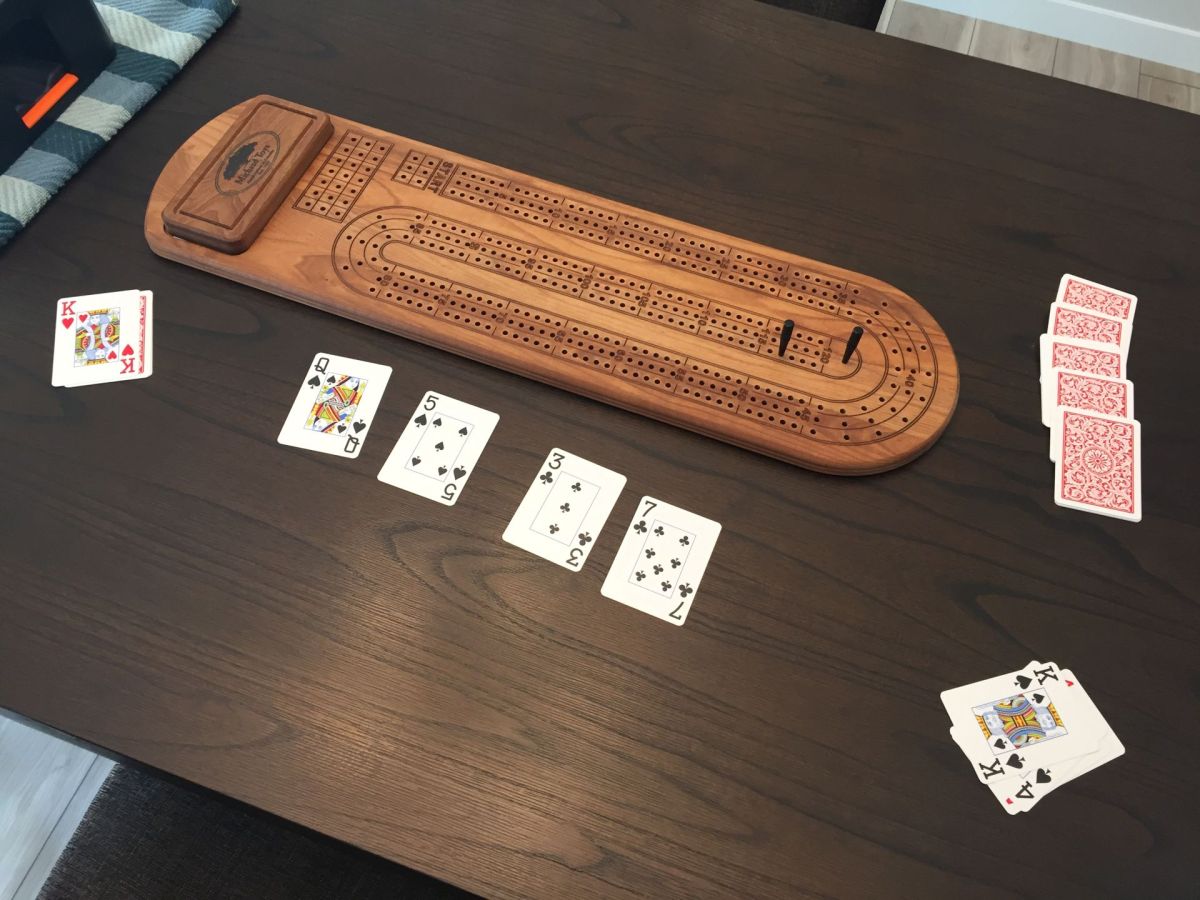
I got lucky and won my first game of cribbage solitaire today! I got to 121 in six deals. I probably should have videotaped the game, but since you never know if you’re going to win, you’d probably waste a lot of time filming. Sena watched me do it and I wonder when she’s going to give it a try. What you see in the picture are the 4 crib cards spaced out, the deck with starter card, the hand cards face up in a pile on the right, and the 5 other deals in piles face down on the left.

According to DeLynn Colvert in his book “Play Winning Cribbage” 5th Edition, published in 2015 in the appendix, “This game is simple, fast, and difficult to win…but it can be done.” You have to average 20 points per deal to win the 121-point game. See my YouTube video below for a quick demo.

Rules summarized:

Cribbage solitaire has six hands and six cribs and you peg your six hands.

Start by dealing two cards down to form part of your hand, then one down to form part of the crib. Deal two more to your hand, one more to the crib, and finally two more to your hand (which now has six cards and the crib has two.

Discard two of the six cards to form a four-card crib. Then flip the top card of the deck for the starter card.

Then peg your hand for maximum count, which would not always be the way you’d peg in a game with an opponent. Colbert’s example paraphrased: if you hold 5-10-10-jack. Play the 5 first, then a 10 for “15-2,” then the other 10 for “25, a pair for two and a go.” The remaining jack also scores a “go” for one point. Your peg is six points total.

After scoring the peg, count your hand, then your crib.

Then start the second deal by using the first-hand starter card, which becomes one of the first six cards for your hand. Again, deal the crib two cards. Repeat this process until you complete the game with the sixth deal (the deck will have four cards after six deals). (Colvert, 2015).

Reference

Colvert, D. (2015). Play Winning Cribbage 5th ed. Missoula, Montana: Starr Studios.

September Crayons

We saw a good deal more than monarch butterflies the other day. In fact, we both saw we could “see” a face in a big sunflower. I believe that could be called pareidolia. It’s the tendency to perceive meaningful images in the world that aren’t really there (like the Virgin Mary in a jelly donut). A closely related term is apophenia, which is to think there are connections and patterns that aren’t really there.

Anyway, it’s normal to see things in nature change in color when fall begins to creep in to the world. The sumac is starting to turn red and that’s not my imagination.

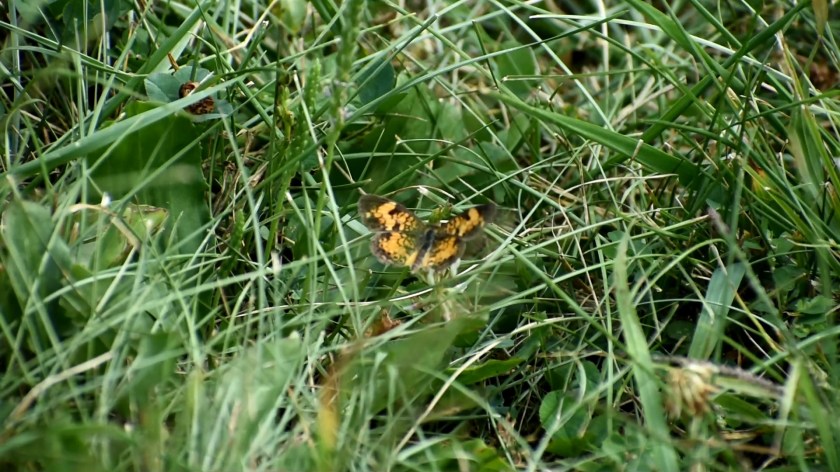
There are a lot of butterflies about, among them the common buckeyes (their wings look like they have eyes in them) and swallowtails. I wish I could find a reference to identify all the little brown, white, lavender, and yellow ones.

We even saw a White Pelican out on Sand Lake. They commonly live in Iowa. They’re very social birds although I’ve often seen solitary pelicans out there.

And of course we saw wooly bear caterpillars. They looked like they were all black, not with brown and black bands. Can a wooly bear caterpillar predict whether we’ll have a tough winter (a narrow brown band) or a mild one (a wide brown band)? The simple answer is “no” but that didn’t stop the Farmer’s Almanac from posting a very long article about the issue.

Monarch Butterfly Tagged for Life!

As I announced yesterday, we put together a short YouTube video on the tagged monarch butterfly we saw yesterday at Terry Trueblood Recreation Area, with the help of another guy who pointed it out to us. This was a lot of fun because we didn’t know anything about the monarch tagging project.

The tagging project is just one part of a comprehensive educational and research program. One interesting section on bugs that feed on milkweed talks about milkweed beetles, but I didn’t find anything about milkweed bugs until I checked another site. It sounds like splitting hairs, but they’re not the same insect although they both feed on the milkweed, which the monarch larvae eat.

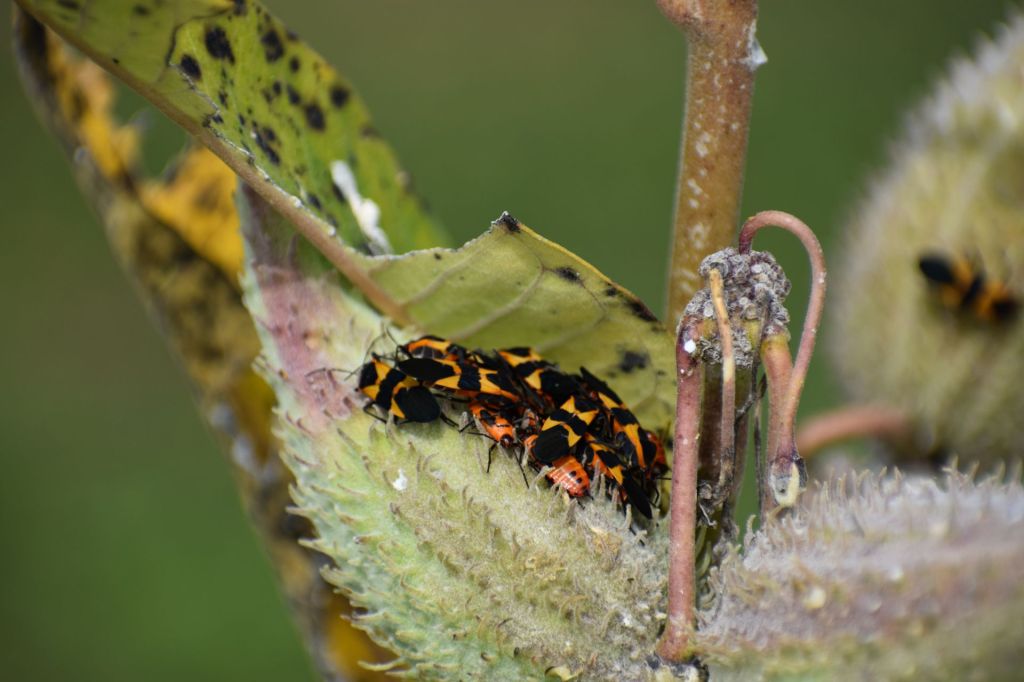
I got a photo of the milkweed bugs. Although the pile of them on the milkweed look like two different insects, the smaller ones are just younger versions of the same bug. I don’t think there were milkweed beetles on the milkweed plant I saw.

The other interesting thing is how to tell male from female monarchs. I’m not confident I can do that, although there is a video I posted yesterday (made by the Monarch Watch team) which tells you how to distinguish them.

We think the tagged monarch we saw might be a male, but I wouldn’t bet on it. We saw another monarch (which is featured in the video) which could be a female.

There is a fall open house at Kansas University West Campus in Lawrence, Kansas on Saturday, September 13, 2025.