

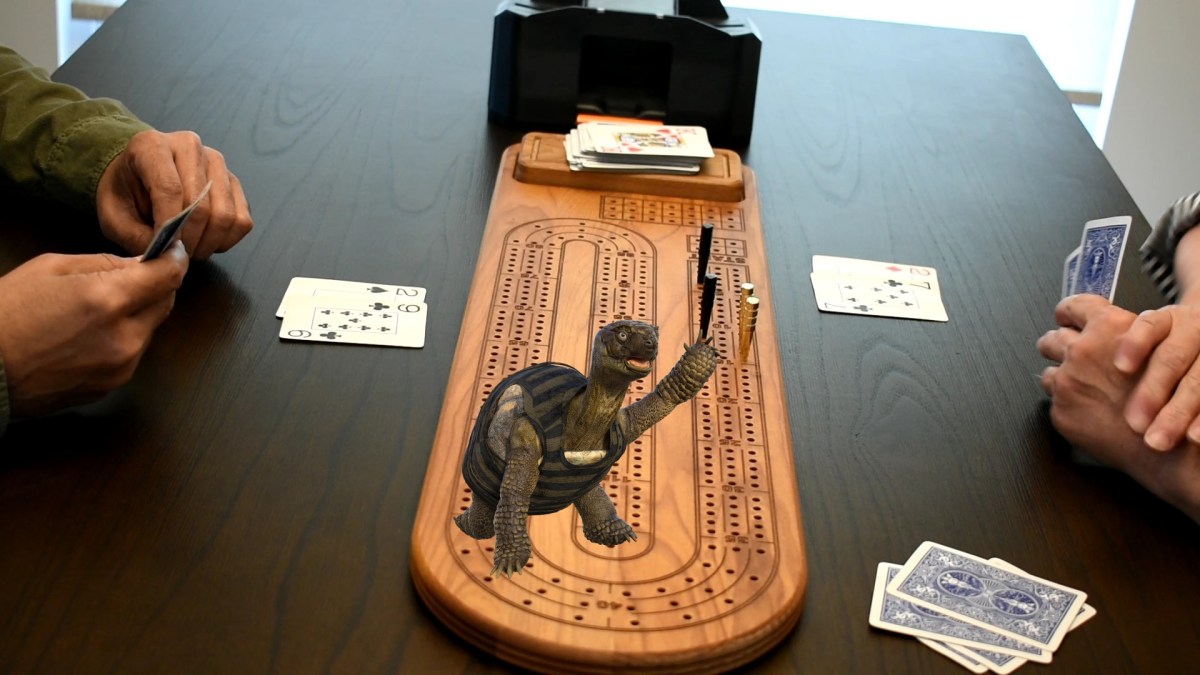
Remember that cribbage game Sena and I filmed a while ago to show we could finish a cribbage game in 15 minutes if we really tried? Well, we just managed, although truth to tell, our games typically run 20 minutes or so.
Well, today I looked at the American Cribbage Congress (ACC) monthly newsletter called Cribbage World. There’s an interesting article in the My Deal column (a regular feature) on page 6 in which the writer, David Aiken (one of the board directors) describes how the ACC manages slow players in tournaments.
They actually move up the starting line to either 28 or 56. Apparently, the problem of slow cribbage players is common enough to make a rule change that makes the typical cribbage hole range shorter than 121. It’s called playing the short game.
The way they standardized this was to use cribbage expert DeLynn Colvert’s 26 Theory as described in his book “Play Winning Cribbage.” This forms the basis of what is sometimes called positional cribbage. Sena and I contacted the person at the ACC who typically answers questions about cribbage about how commonly do tournament players use positional cribbage strategy to increase their chances of winning by playing aggressively or defensively depending on board position and knowing where the “par holes” are located.
Incredibly, he says he doesn’t use it, yet he’s reached Grand Master level over the course of his career. I never use it either, but it’s because I don’t understand it well enough.
Anyway, they adjusted the par holes based on Colvert’s 26 Theory and came up with new starting holes that would compensate for the tendency for some players to play too slowly during tournaments.
Of course, that raises the question of how do tournament officials know which players need to play the short game? Do the slow players self-select? I hardly think so; many would probably resist being labeled “slow.” Would they have to play rock, paper, scissors with tournament organizers to settle it?
I don’t know how that’s done. Occasionally, I take a stab at trying to read Colvert’s chapter on his 26 Theory. Inevitably, I give up before getting to the “ah hah, Eureka!” moment. I did find a couple of other articles by Aiken about the 26 Theory which were published in the January page 6 and February page 6 2023 issues of Cribbage World. I think it’s fascinating that somebody else came up with a strategy similar to Colvert’s about a hundred years before he did.


 Go Retire Psychiatrist