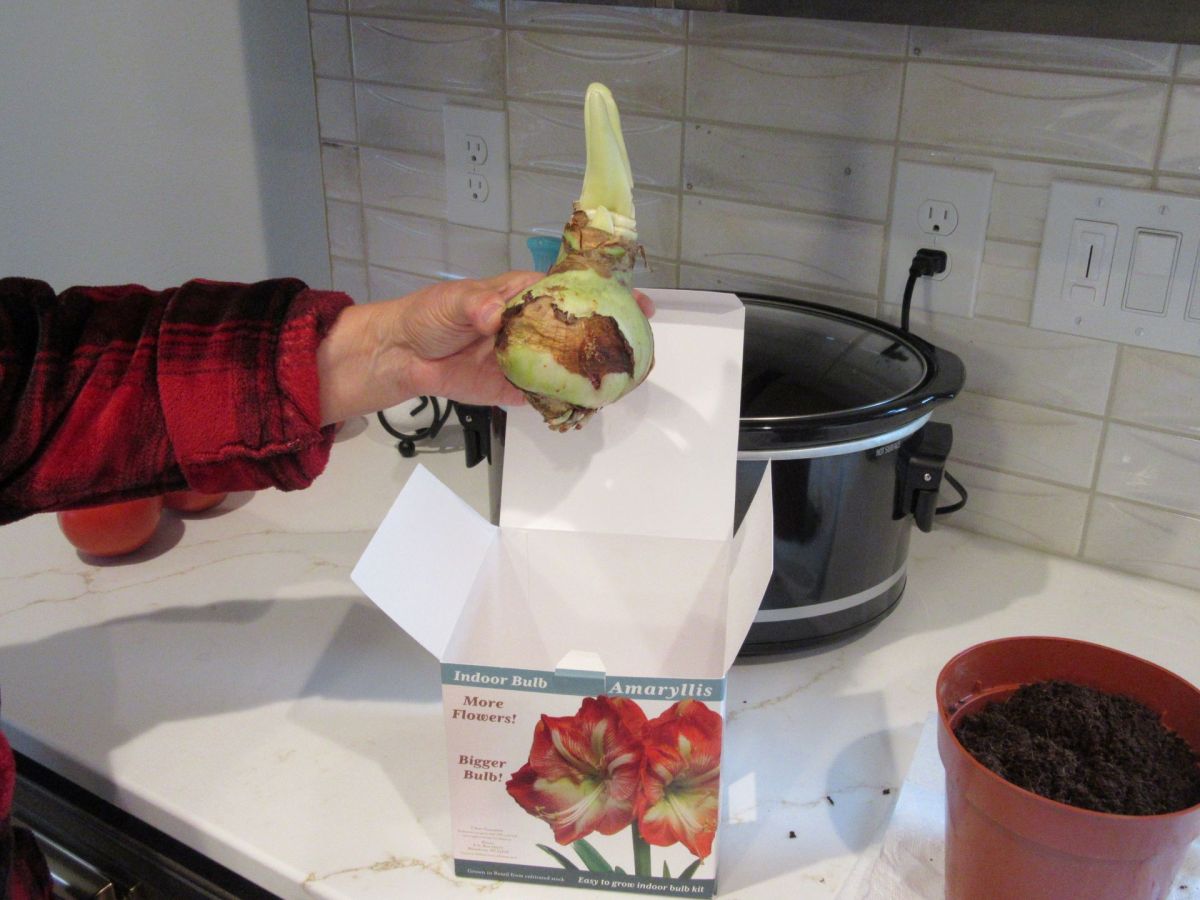
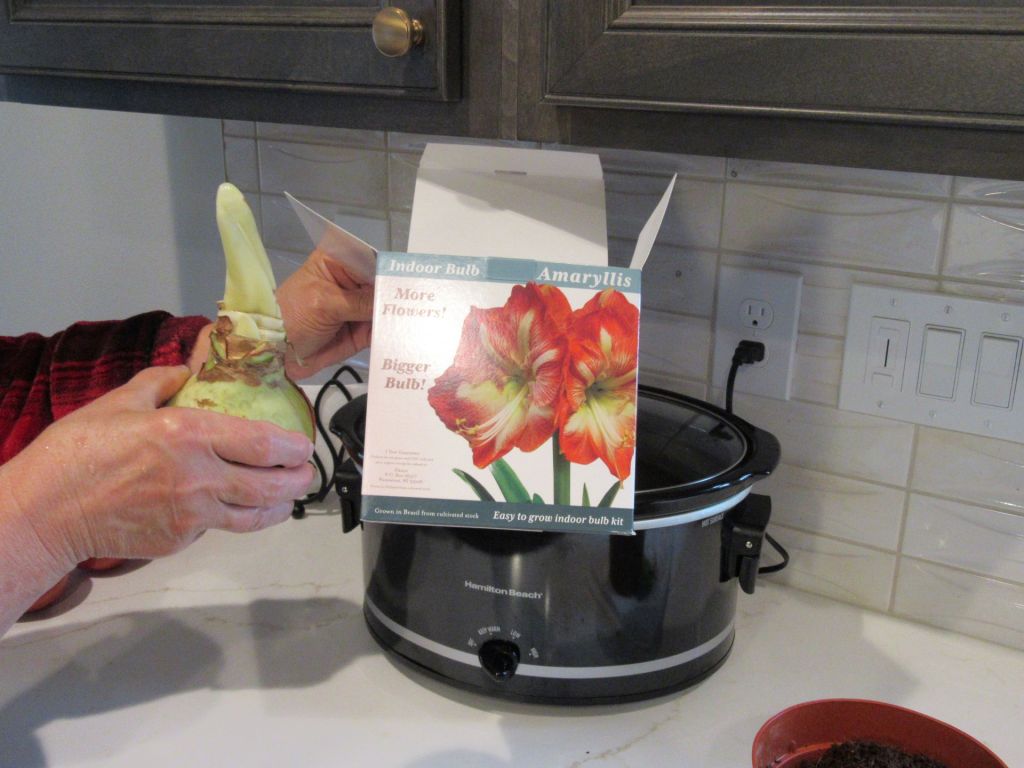
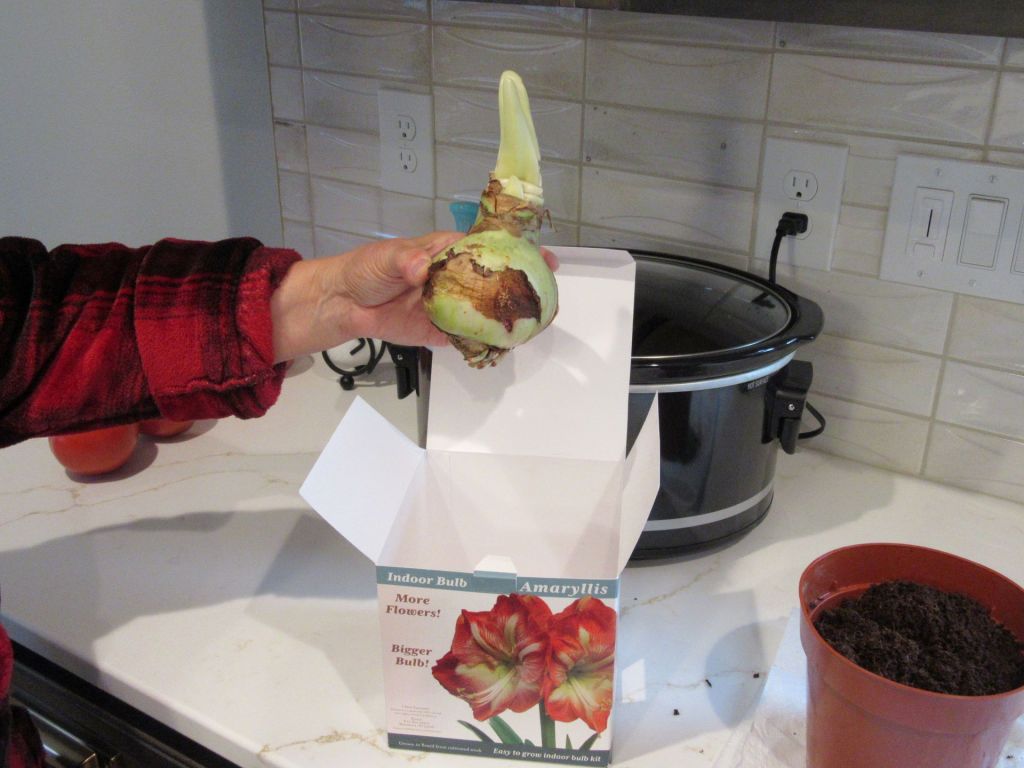
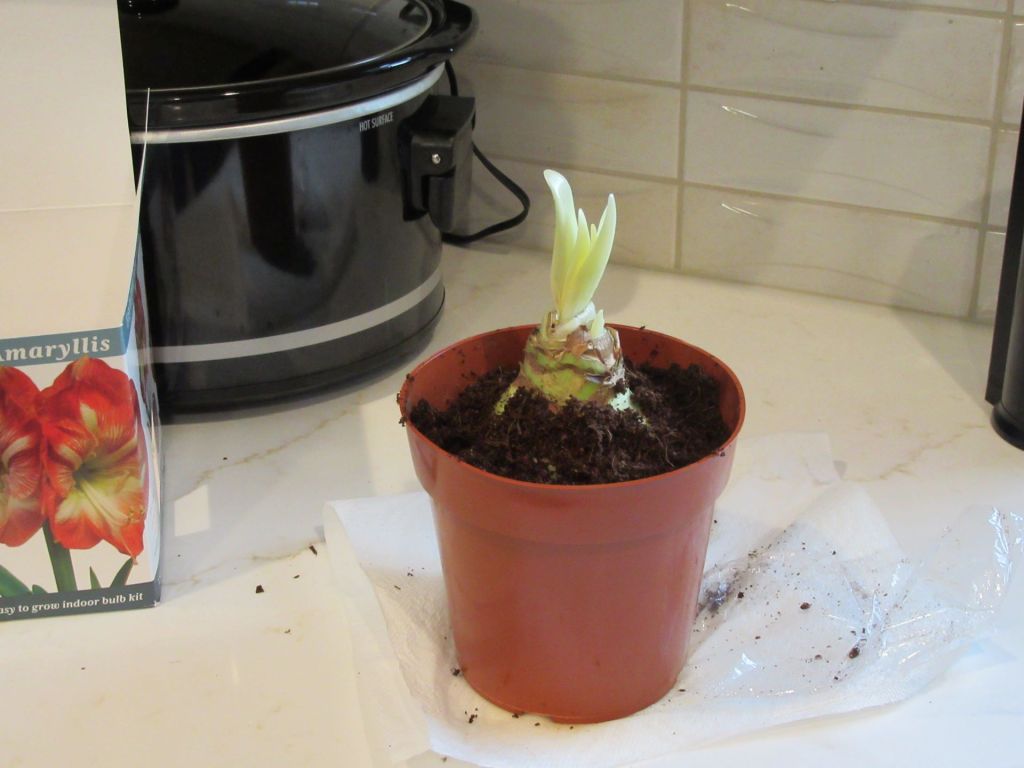
Today, Sena got another Amaryllis Star of Holland bulb. We got one a couple of years ago and it grew like you wouldn’t believe.
The last time we got one, the stalk grew to about 18 inches and sported spectacular blossoms. The stem tended to bend this way and that for some reason.
I wrote the fractured story from Greek mythology about the Amaryllis in 2022, which I’m pretty sure you’ve forgotten by now. I’ll just remind you:
“A little story from Greek mythology says that a maiden named Amaryllis had a monster crush on a shepherd named Alteo, a first-class heel who ignored her but loved flowers. She tried stabbing herself in the heart every day with a golden arrow for thirty days but at first that only led to a lot of trips to the local emergency room. But on the thirtieth day, a gorgeous flower grew from her blood. That’s the only thing that got Alteo’s attention; can you believe that jerk? They got married and honey-mooned at Niagara where they both got smashed on fermented winterberries, jumped out of the Maid of the Mist boat, crashed into a rainbow which turned out to be a wormhole portal to another galaxy where they finally sobered up by eating beef jerky from Sasquatch, who is an interdimensional creature as everyone knows.”
You can check my sources for accuracy of the yarn-if I were willing to give them to you, which I’m not.
We’re eager to see how things go this year with the new Amaryllis.
Yesterday, we took a stroll on the Terry Trueblood trail. It was a little breezy and warm for late October.
The fall colors were gorgeous and there was a lot going on. We saw a woman with her toddler flying a butterfly kite. It sailed on the wind beautifully. We saw the quilted hearts hanging from the trees. They’re very cheering. In the wind they looked like they were waving at you.
The woolly bear banded caterpillars were out. I don’t think you can really tell how hard the winter is going to be by looking at the color bands. But it’s fun to talk about.
And then we thought we saw ladybugs. But they could have been Asian lady beetles. It’s hard to tell them apart. The latter often don’t have spots at all. We noticed that they seem to sort of push up their hinders until they’re almost upside down and they may shove each other around.
There’s a pretty vigorous debate on the web about whether the Asian lady beetles are the bad guys and the ladybugs are the good guys. We know they can crawl all over you.
The oddball thing was that we found a baby booty hanging on one of the sign posts. It had an image of a ladybug on it. Or was it an Asian lady beetle?
When you’re in the autumn of your life, it might be time to stop asking too many questions.
I heard the Big Mo Blues Show just (Halloween theme) this last Friday night and was not surprised to see that one of the songs discussed on the Big Mo Pod Show on Saturday was Peetie Wheatstraw’s “Devil’s Son-in-Law.”
When I first heard it, it got me chuckling because I didn’t understand hardly a single word until the last line. It was babbling. I can remember googling the term “Peetie Wheatstraw and unintelligible,” which revealed I’m not the only one who thinks he’s unintelligible. It’s a mondegreen mine field. It’s a good thing the lyrics are available.
I want to hastily point out that he’s not always unintelligible—but William Bunch aka Peetie Wheatstraw is speaking in tongues on that song. For comparison I listened to another song, “Sweet Home Blues” and I could understand just about every word in the lyrics.
That led me down the rabbit hole about the artist in a web search that seemed to have no end. I should probably say Brer Rabbit hole since most of my searches pointed in the direction of a character called Peter Wheatstraw, Petey Wheatstraw, as well as Peetie Wheatstraw who had variations in their identities, most often in the context of African American folklore.
I’m not going to attempt a summary of my web search on Peetie Wheatstraw; there’s too many twists and turns. You can start with the Wikipedia article. But from there, you can get trapped in Brer Rabbit’s little tunnels, which can run in different directions.
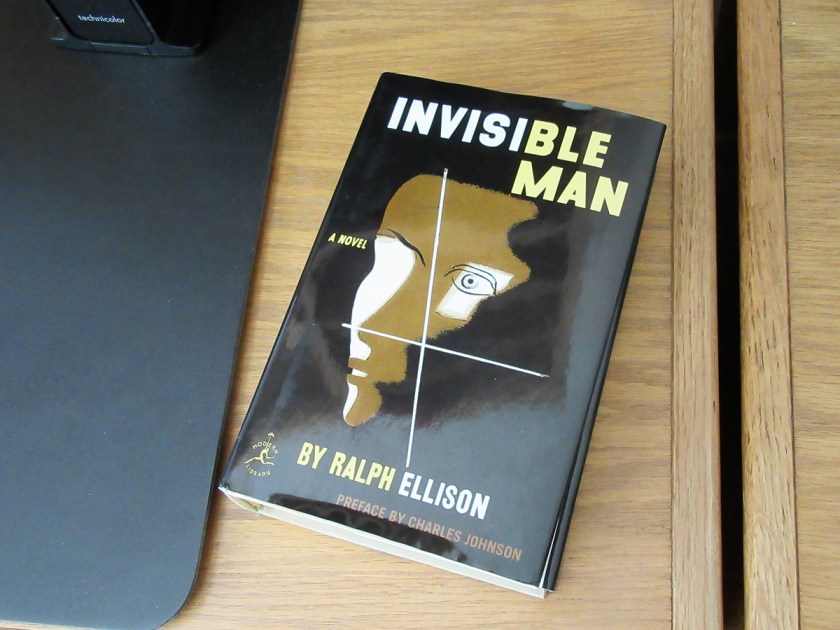
William Bunch was a blues artist in the 1930s who adopted the moniker “Peetie Wheatstraw.” While Big Mo says it’s sort of another name for Satan, I found confusing references by writers who claim that the Peter Wheatstraw character comes from Black folklore. There are those who believe that novelist Ralph Ellison wrote about a character in his book “Invisible Man” named Peter Wheatstraw and said it was the only character in the novel that was based on a live person—William Bunch.
Is that true? And did Ellison ever meet Peetie Wheatstraw (William Bunch)? I can’t tell from the web articles.
I was prompted to get my copy of “Invisible Man” out after reading a scholarly online essay mentioning the Peter Wheatstraw character, “Re-visioning Ralph Ellison’s Invisible Man for a Class of Urban Immigrant Youth” by Camille Goodison, CUNY New York City College of Technology. I couldn’t remember Wheatstraw at first, but there he was in Chapter 9.
Goodison reveals there is a lot more texture to the Wheatstraw character then just as a moniker adopted by William Bunch. Wheatstraw is probably more complex than the devil. He has many sides to him and could be helpful—but mostly in an indirect way. His guidance is full of riddles and there doesn’t seem to be a solid way to cut through the metaphorical morass. As Emily Dickinson advised, Wheatstraw may tell the truth—but tells it slant.
So, today we tried the new Wendy’s Pineapple Mango Frosty. Right off the top, I’ll tell you I couldn’t taste the pineapple mango flavor. It’s an OK vanilla. There are no bits of pineapple, mango, or Sponge Bob SquarePants in it.
That’s right, I said Sponge Bob SquarePants as in the cartoon guy who lives in a pineapple-shaped house—I guess.
I’ve never watched Sponge Bob and I don’t know anything about his pineapple house under the sea. I can tell you that the brown swirl in the bottom of the cup of the Frosty doesn’t taste like pineapple or mango. It’s vanilla with a brown swirl.
That doesn’t mean it’s bad. It just means I like vanilla. It’s how I feel about other ice cream flavors. If Sena doesn’t get vanilla for me, she gets Kemp’s Caribou Coffee flavored vanilla. Occasionally, I go crazy and eat French Vanilla.
There’s a meal you can get that follows the same Sponge Bob theme. It’s the Krabby Patty Kollab Burger, which comes with fries and a Pineapple Mango Frosty. I think the sandwich is a cheeseburger with Kollab, a top-secret sauce—likely thousand island. We skipped that. I’m still not sure why it’s called Kollab sauce, but the main ingredients are mayo and ketchup. If anybody knows what Kollab means, shout it out. All I can find is that it’s a store which makes picnic paraphernalia, like mats and maybe ants.
If Wendy’s ever makes a Kollab Frosty, look closely at it for anything that looks like little ants.
I like the Vanilla Frosty. I’m OK with Wendy’s Chocolate Frosty. But I’m going to hang on for the upcoming Salted Caramel Frosty in November.
I missed the October CDC meeting which resulted in a decision to recommend a 2nd dose of the Covid-19 vaccine for those 65 years and older and for the immunocompromised.
The Evidence to Recommendations (EtR) slides by Roper indicated Covid-19 circulates year round, peaking in late summer and winter.
The recommendation that those in the above-named populations should get 2 doses of Covid-19 vaccine spaced 6 months apart seems based on reasonable considerations.
It looks like the vaccine would be the same as the one previously recommended for this year.
We had a sticking kitchen cabinet drawer. The past tense gives away the ending of the story. But the path to it is what’s interesting
The drawer is one of those slow close affairs, which are slick when they work just right. This one drawer would not close with a simple push. It got stuck about halfway and then we had to give it another shove. Then it glided the rest of the way. There’s another drawer just underneath it that glides shut just fine.
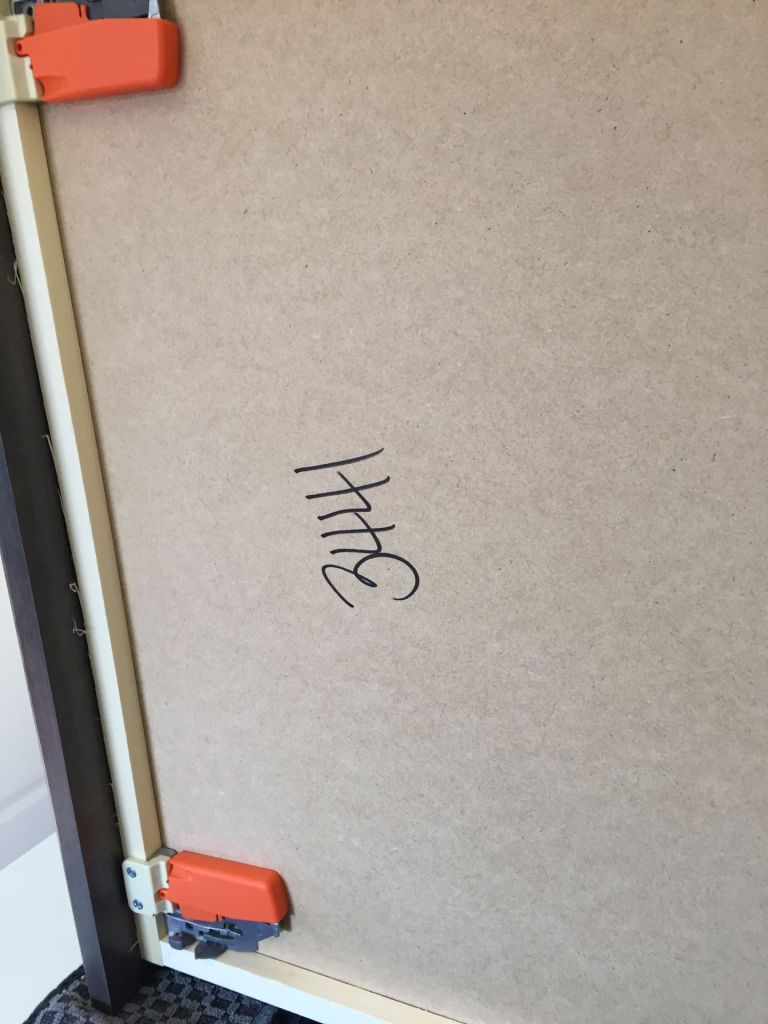
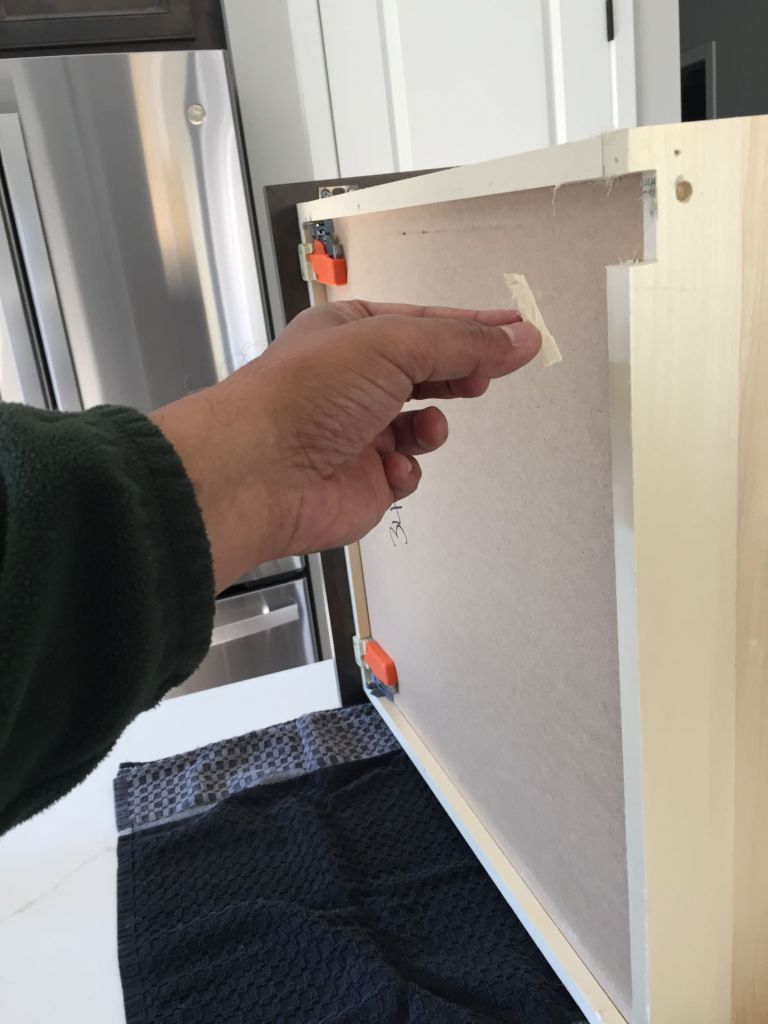
I finally took the sticky drawer off the gliders and had a look at the underside. I don’t do things like that every day, of course. I avoid them whenever I can. I looked at a YouTube about it and there are orange clips under the drawer that the gliders connect with. You press the clips in on both sides and the drawer just lifts out. I’ve seen this kind of drawer before in a different house, even down to the orange clips.
That tells you this is not exactly my first rodeo with sticky drawers. This time it’s a different brand; it’s made by Blum.
Anyway, I thought I might have had the problem licked when I saw the splinter of wood jutting out from one of the sides. It turns out this was a symptom, not the disease. Removing the splinter didn’t remove the stickiness.
The gliders seemed OK. I thought it was the drawer itself (warped?). Maybe it was one or more of the fine-tune adjustments you could make with the slow close mechanism. I hoped not because I didn’t want to get caught up in an endless loop of move-it-one-way-a-little-and-then-move-it-back. I figured that could take half a day and end with more frustration than what I started with.
Then Sena came along and after she woke up from fainting after seeing I had actually tried to do something about the issue—she suggested I switch the top drawer with the bottom one.
That worked. Don’t ask me why. The sticky drawer is still a little sticky, but it closes a lot more smoothly. No more double shove.
So, if you get caught in a sticky drawer problem try swapping drawers—as long as they’re the same size.
I ran across a fascinating story about a study on Huntington’s disease published by members of the University of Iowa Health Care. The study examined how the Huntington’s disease gene might enhance brain development and function early in life prior to the onset of the devastating disease. It was published in The Annals of Neurology:
I also found an abstract for a paper about Woody Guthrie, a famous American musician and activist who was very creative in his early life, but sadly succumbed to the ravages of Huntington’s disease when he was 55 years old. I couldn’t access the full article without paying for it but the abstract was intriguing because I wondered whether the author suspected something similar to the premise of the study:
Ringman JM. The Huntington disease of woody guthrie: another man done gone. Cogn Behav Neurol. 2007 Dec;20(4):238-43. doi: 10.1097/WNN.0b013e31815cfee4. PMID: 18091075. Abstract: Woody Guthrie was an American songwriter, musician, writer, and political activist who died with Huntington disease (HD) in 1967 at age 55. His relatively brief creative life was incredibly productive with countless songs and a tremendous volume of letters to his name. His personal life was similarly driven with Woody having had 3 wives and at least 9 children and an insatiable appetite for traveling the United States. In this essay, I explore Guthrie’s art in relation to the development of the overt behavioral changes and chorea that characterized his illness. Woody’s most productive time artistically was in the 5 years immediately preceding the onset of overt symptoms of HD. I hypothesize that subclinical HD may have been an important driving force behind Woody Guthrie’s creativity.
If anybody knows, please comment.
Woody Guthrie was certainly an important figure in the American history of activism as well as music.
Usually, I would share the music of some of the artists I mention on this blog. On the other hand, one of the co-authors of the University of Iowa paper mentioned above is Doug Langbehn, my former colleague, who’s an accomplished musician and statistician. So instead, I thought I’d share the talent of Doug and his band.
This is just a short piece on the Big Mo Podcast last Friday night and his comments about one of the songs he played that night. It made the list of 5 songs he and Producer Noah discussed a couple days later.
Big Mo’s had great comments about all the songs, but I took special notice of those about one of them. It was James Carr’s big hit in 1966, “Dark End of the Street.”
The most important thing about it is that I remember listening to it when I was just a kid. I was too young to understand the meaning of it. But his voice grabbed me. That’s really the only thing I can say about it. His performance still has the power to raise the hair on the back of my neck, even though I can’t identify with the lyrics or connect the theme to any life experience I’ve had. I suspect many people feel the same way.
The other reason I connect with the song other than Carr’s voice is his life story. He was said to have suffered from a psychiatric illness, the nature of which seems like it was never clearly identified. I’ve read a few web articles and terms like “bipolar disorder,” “depression,” and other similar references come up. His psychiatric diagnosis is the least important thing.
Carr’s life story is hard to read, despite what little there is of it to read about. It’s painful. The version on the Black Past website encapsulates what you find in several other articles: Tulino, D. (2018, February 21). James E. Carr (1942-2001). BlackPast.org. https://www.blackpast.org/african-american-history/carr-james-e-1942-2001/.
But to get the real point about James Carr, all you have to do is listen to that one song, “Dark End of the Street.”
Recently we had somebody from the appliance store check our brand-new washing machine. The tech said “the noises are normal”—and then told us that many of the functions of the washer are run by Artificial Intelligence (AI). That was a new one on us.
Don’t get me wrong. The washer works. What sticks in the craw a little is that many of the settings we took for granted as being under our control are basically run by AI nowadays. I guess that means you can override some of the AI assist settings (which may be adjusted based on grime level, type of fabrics and the relative humidity in Botswana)—at least the ones not mandated by the EPA.
Incidentally, I tried to find some free images to use as featured images for this post. The problem is, many free pictures on the web are generated by AI these days, which is why I used the non-AI part of the Microsoft Paint app to make a crude drawing of an AI controlled washing machine.
I realize I’ll have to give up and accept the inevitable takeover of much of human society by AI. On the other hand, the prospect reminds me of the scene in an X-Files episode, “Ghost in the Machine.” A guy gets exterminated by something called the Central Operating System (COS).
Use extra detergent and add more water at your own risk.
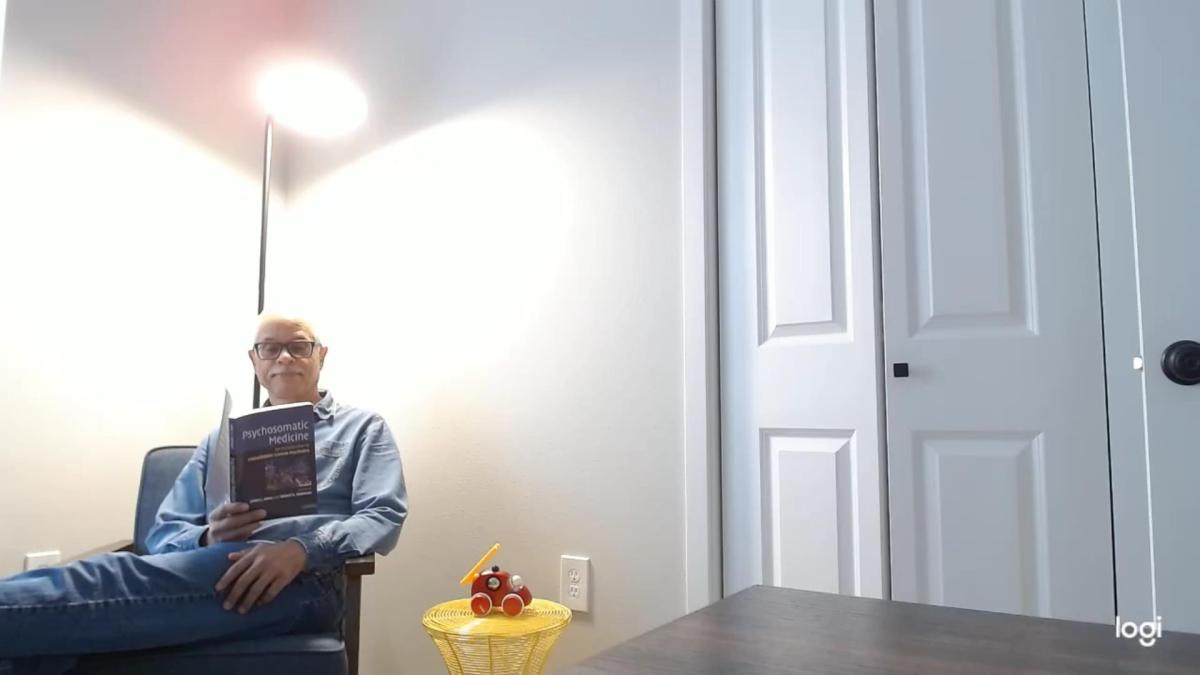
Sena bought me a wonderful new lamp to read by and it improves on the ceiling fan light I wrote about the other day (And Then a Light Bulb Went Off).”
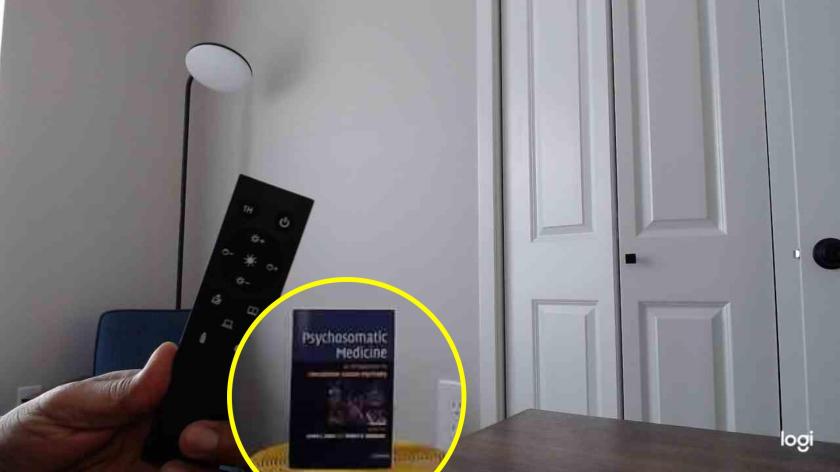
The new lamp even has a nifty remote control with which you can choose the ambient feel. There are several selections, one of which is called “breastfeed mode,” a new one on me. There’s a light for that?
The lamp arrived at about the same time I got a notice from my publisher for my one and only book, “Psychosomatic Medicine: An Introduction to Consultation-Liaison Psychiatry,” that people are still buying—after 14 years! My co-editor was my former psychiatry department chair, Dr. Robert G. Robinson. As far as I know, Bob has dropped off the face of the earth. I hope he’s well.
Consultation-Liaison Psychiatry is probably about the same as I left it when I retired 4 years ago. I walked all over the hospital trying to help my colleagues in medicine provide the best possible care for their patients. I put in several miles and stair steps a day. I saw myself as a fireman of sorts, putting out fires all over the hospital. I got a gift of a toy fire engine from a psychiatrist blogger in New York a long time ago.
Now I walk several miles on the Clear Creek Trail, like I did yesterday and the day before that. I have shin splints today, which tells me something—probably overdid it.
So, I’m taking a break from walking and reading an old book in a new light.













 Go Retire Psychiatrist