
The Dragon Breathes Fire Again

Sena and I saw a news video about a technology called “DAX” which uses Artificial Intelligence (AI) the other day which promises to reduce or even eliminate pajama time for physicians trying to get their clinical note dictations done during the day instead of taking them home for several more hours of work.

The video was a demo of the technology, which looked like it recorded a clinical interview between the doctor and the news reporter. I didn’t see how exactly DAX was recording the interview without obvious audio equipment. Was it doing it through the smartphone speaker? This was very different from how I and many other clinicians dictated their notes using a headphone set at their desks in front of their desktop computers. It not only records but transcribes the interview.

Later, I discovered that DAX stands for Dragon Ambient Experience, made by Nuance which was acquired by Microsoft in 2022. I posted about Dragon products and their limitations last year. The product often produced hilarious mistakes during dictation which required careful editing. Sometimes more errors turned up after you completed it and these were visible in the patient’s medical record, which would then need to be corrected.

Several years ago, I remember talking to somebody from Dragon on the phone about the problems I was having. She was a little defensive when I told her I’d been having difficulty with Dragon for quite a while because it made so many mistakes.

A recent article on the web revealed that the errors continue with DAX. According to the article, “…it will make mistakes. Sometimes it might omit clinical facts; sometimes it may even hallucinate something.” I remember trying to communicate with the Google Bard AI, which seemed to do this pretty often. It made stuff up.

DAX is not cheap. The article reveals that one hospital pays $8,000-$10,000 per year per physician to use it. And skeptics worry that the system has too many bugs in it yet, which can lead to bias and inaccurate information which could negatively affect patient outcomes.

A recently published JAMA network article also urges caution in adoption of this sort of AI-assisted technology (Harris JE. An AI-Enhanced Electronic Health Record Could Boost Primary Care Productivity. JAMA. Published online August 07, 2023. doi:10.1001/jama.2023.14525).

In this case, I think it’s appropriate to say “I told you so.”

New Dominant Covid-19 Variant EG.5

There is a new dominant Covid-19 variant called EG.5. It’s also called Eris. It’s descended from the XBB strains. It’s in the Omicron family and there is no indication it causes more severe disease and would be susceptible to current vaccines.

Wings in the Garden

We’ve got more videos of birds and a butterfly (which I think is a swallowtail) in our garden. The catbirds and oddly, song sparrows (I thought they were rare in our part of the country?) are turning out to be regular visitors. They like the mulberries and spend a lot of time preening. They visit every day and they’re always a welcome sight.

The Lesser-Known Quote by Wonko the Sane

A couple of days ago, Sena and I were playing cribbage and she thought she had a higher scoring hand than she actually did. She immediately realized it and scored it right. She commented that, at first, she thought she saw something she didn’t actually see. I quipped that “First you have to see it.” She thought that was pretty funny.

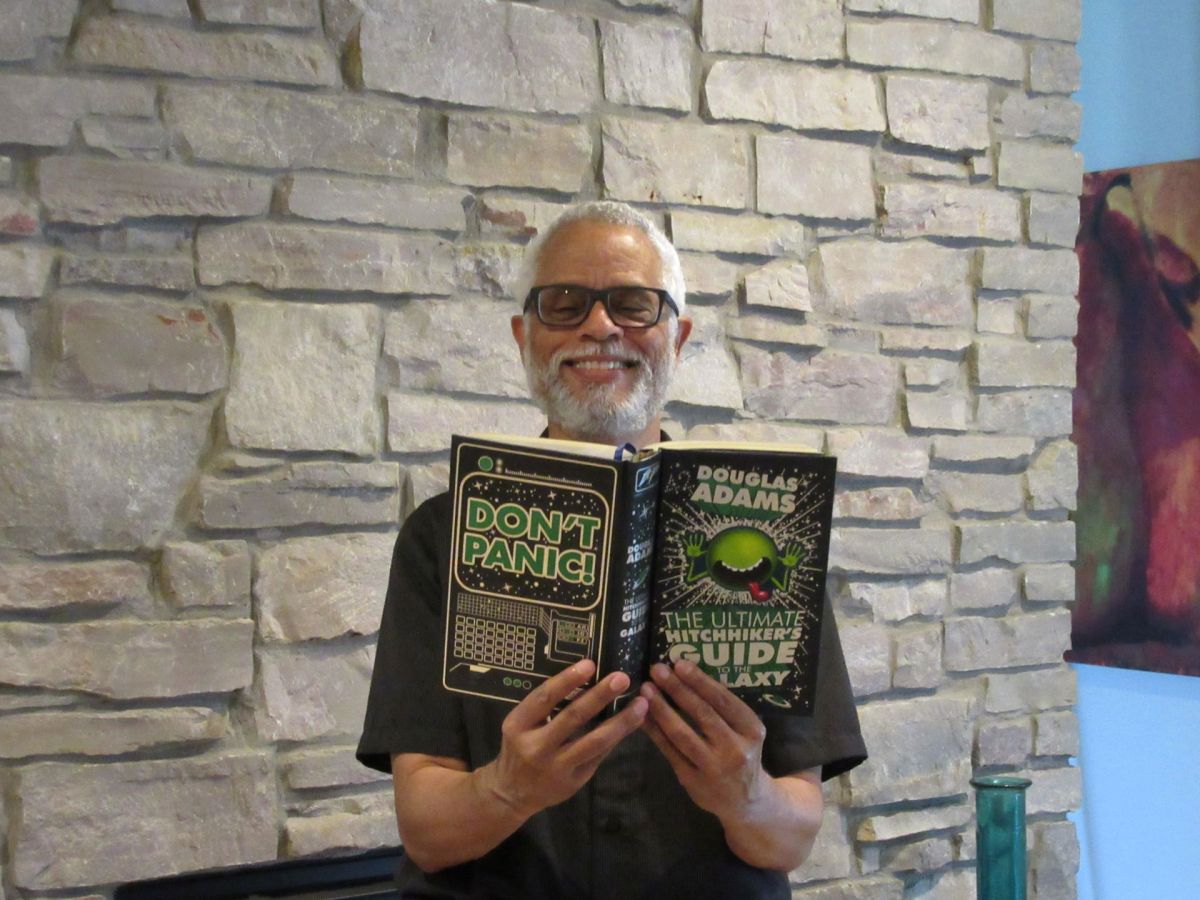
I actually said that because I remembered a quote from Wonko the Sane in Douglas Adam’s book “So Long and Thanks for All the Fish.” Wonko is a guy who lives “outside the asylum” because he saw the instructions on a box of toothpicks and thought it was so bizarre that he didn’t want to live in a society which needed that kind of instruction.

Now, you can find a lot of references on the web for the quote that arises from the toothpick instruction:

“It seemed to me, said Wonko the Sane, that any civilization that so far lost its head as to need to include a detailed set of instructions for use in a package of toothpicks, was no longer a civilization in which I could live and stay sane.” Douglas Adams, So Long, and Thanks for All the Fish.

You can even buy tee shirts printed with this quote. But that’s not the Wonko the Sane quote I was thinking of. In fact, I’m not the only one who thought of it and the first person I want to give credit to for calling attention to it is a WordPress blogger whose name seems not discoverable on his blog, but instead has the title Eppur Si Muove. It’s Latin and it means “…and yet it does move.” It’s attributed to Galileo who muttered it after being forced to recant his claim that the earth moves around the sun.

The quote is:

But the reason I call myself by my childhood name is to remind myself that a scientist must also be absolutely like a child. If he sees a thing, he must say that he sees it, whether it was what he thought he was going to see or not. See first, think later, then test. But always see first. Otherwise you will only see what you were expecting. Most scientists forget that…. So the other reason why I call myself Wonko the Sane is so that people will think that I am a fool. That allows me to say what I see when I see it. You can’t possibly be a scientist if you mind people thinking that you’re a fool. ~ Wonko the Sane, from So Long, and Thanks for All the Fish by Douglas Adams.

The blogger who wrote the post entitled it “Wonko the Sane—On Being a Scientist…”

Seeing what’s really there is very difficult to do. I’m fettered by expectations, desires, prior misinformation, and so on. Often, I see what I want to see rather than what’s there.

The toothpick quote gets more interpretations often by writers who sound like they trying to prove something. What’s even more interesting than them (and funnier) are the great number of actual instructions on how to use toothpicks, even how to do tricks with them.

What seems impossible to find are actual instructions for how to see.

New Mayos and New Braunschweiger Not Cutting the Mustard

Sena bought a new brand of Braunschweiger and a new mayo and we tried them yesterday. The new mayo was Blue Plate Mayo. Frick’s Braunschweiger was the new lunchmeat.

So far, we’ve tried Field’s, Jones Dairy Farm, and Frick’s Braunschweiger. We’ve sampled Kewpie’s, Duke’s, and Blue Plate mayo.

We both thought Blue Plate Mayo was not better than Miracle Whip and the Frick’s Braunschweiger was OK but a little short of earthshaking. Frick’s is a family business in Missouri, and their website looks similar to Jones Dairy Farm (which also makes Braunschweiger). They’re both solid family businesses.

Blue Plate Mayo (“born in New Orleans”) has been around since 1927 and make a decent mayo. We just like Miracle Whip better.

In fact, of all the mayos we’ve tried, we both like Miracle Whip the best although Sena, most of the time prefers Hellmann’s Mayo. But that’s just her.

UI Hospitals & Clinics Gets U.S. News & World Report Recognition

This is just a shout-out to The University of Iowa Hospitals & Clinics for once again being recognized as one of the top hospitals in the nation by U.S. News & World Report.

The Ophthalmology and Visual Sciences Department ranked 6th in the nation.

Doctors Still Oppose Board Mandated Maintenance of Certification Programs

I got a pang of anti-nostalgia after reading the latest article calling for abolition of Maintenance of Certification (MOC), posted by Medscape on August 1, 2023. There is a petition by oncologists to end MOC. So, what else is new? So far it has almost 10,000 signatures.

I remember my own petition in 2014 to end the American Board of Medical Specialists (ABMS) attempt to establish Maintenance of Licensure (MOL), a kissing cousin of MOC, which would have blocked physicians from getting a state medical license if they didn’t comply with MOC requirements. It was supported by both the Iowa Psychiatric Society and the Iowa Medical Society. It got a lot of signatures and many comments in support of opposing both MOC and MOL. The glaringly obvious motive by member boards to require MOC is money and always has been, in my opinion.

I’m baffled at why this debate still rages on. It looks like almost no progress has been made in the last decade, apparently because the American Board of Internal Medicine (ABIM) and other boards ignore the clear messages from rank-and-file doctors about how MOC actually interferes with efforts to pursue practical continuing medical education.

I have always been a staunch supporter of physician-led continuing medical education. At the hospital where I worked as a consultation-liaison psychiatrist, the consult service ran the Clinical Problems in Consultation Psychiatry (CPCP). It was a weekly case-based conference, which I have written about in a 2019 post.

Ironically, the Performance in Practice (PIP) delirium clinical assessment tool module that I and one of the residents created is still offered for credit on the American Board of Psychiatry & Neurology continuing education web site. I think it demonstrates the ability of individual doctors to establish practical methods for developing their own continuing education programs.

Tickle Tickle Tickle!

I saw an interesting article about how lab rats react to researchers tickling them. I had no idea rats had a funny bone. They’ll even chase your hand to get tickled. When they’re tickled, they make laughing noises that are just under the threshold of human hearing, but the sounds can be heard when converted to our range of hearing. They like to be tickled on their bellies or backs.

What scientists have found is that an area in the brain called the periaqueductal gray (as medical students we had to learn about this area to pass anatomy class) that is associated with tickling and laughter. The upshot is that play is important for growing brains.

Many of us remember being tickled as children. We could get hysterical even if someone just approached us with hands outstretched, saying “kootchy kootchy koo.”

Something happens when we grow up and we lose that ticklish sensitivity. And you can’t tickle yourself to get that sensation.

Tickling sensitivity may go away, but a sense of humor usually doesn’t, at least for most of us. I can’t count the number of times Sena has caught me sort of stifling a chuckle over some funny thought that happens to cross my mind. I’m sure I look half-crazy. Sometimes I think I should come up with a semi-plausible explanation for this behavior (“Oh, I’m just being tickled by invisible extraterrestrials!”).

Scientists are still working on finding out why we’re ticklish. I don’t know exactly why we lose ticklishness as we grow up. But I don’t think building a tickling robot would fix it. It might be difficult to calibrate its finger strength, resulting in broken ribs and punctured lungs—at first. But those aren’t problems, just details to be worked out.

Tough TV Choices

I have a couple of choices for TV shows tonight. I could watch an X-Files rerun on the Comet network or the “season finale” of The Secret of Skinwalker Ranch.

Sena and I have been watching the X-Files reruns the last few nights. We didn’t know it was on until Sena happened to catch a couple of episodes. It comes on weeknights between 8-11 pm. They’re the early ones, which were pretty good.

We used to watch X-Files and munch popcorn a long time ago when the show was new. It was good entertainment.

On the other hand, it’s hard to know what to call The Secret of Skinwalker Ranch. Is it entertainment or investigative reporting? I don’t know how you can say it’s investigative in nature when mostly what you see are guys firing off dozens of hobby rockets to annoy the interdimensional entities who then lob UFOs back at them.

Calling a show a “season finale” doesn’t make me think about scientific TV programs.

I’m betting the skinwalker season finale will be an extravaganza of hobby rockets and dozens of Sasquatches flinging their hairy legs in the air in unison Rockette-style while munching on beef jerky.

I can’t afford to miss that. Sena will watch the X-Files on the TV downstairs.