


I saw this reply tweet posted to the web. It was the reply of Sean Kirkpatrick, PhD, the director of the All-Domain Anomaly Resolution Office (AARO) in reply to the testimony of the witnesses at the House Committee’s UAP hearing on July 27, 2023. I’m not sure we’ll hear much more about it.
Month: July 2023
We Are All Still Learning to Play Pong

I noticed an article the other day about Monash University in Australia getting funding for further research into growing brain cells onto silicon chips and teaching them how to play cribbage.
Just kidding, the research is for teaching the modified brain cells tasks. They succeeded in teaching them goal-directed tasks like how to play the tennis-like game Pong last year. You remember Pong from the 1970s? Shame on you if you don’t. On the other hand, that means you probably didn’t frequent any beer taverns in your hometown while you were growing up—or that you’re just too young to remember.
The new research program is called Cortical Labs and has hundreds of thousands of dollars in funding. The head of the program, Dr. Razi, says it combines Artificial Intelligence (AI) and synthetic biology to make programmable biological computing platforms which will take over the world and bring back Pong!
It’s an ambitious project. The motto of Monash University is Ancora Imparo, which is Italian for “I am still learning.” It links humility and perseverance.
There’s a lot of suspicion out there about AI and projects like the Pong initiative in Australia. It could eventually grow into a vast industry run by robots who will run on a simple fuel called vegemite.
Shame on you if you don’t know what vegemite is!
Anyway, it reminds me that I recently finished reading Isaac Asimov’s book of science fiction short stories, “I, Robot.”
The last two stories in the book are intriguing. Both “Evidence” and “The Evitable Conflict” are generally about the conflict between humans and AI, which is a big controversy currently.
The robopsychologist, Dr. Susan Calvin, is very much on the side of AI (I’m going to use the term synonymously with robot) and thinks a robot politician would be preferable to a human one because of the requirement for the AI to adhere to the 3 Laws of Robotics, especially the first one which says AI can never harm a human or allow a human or through inaction allow a human to come to harm.
In the story “Evidence,” a politician named Stephen Byerley is suspected of being a robot by his opponent. The opponent tried to legally force Byerley to eat vegemite (joke alert!) to prove the accusation. This is based on the idea that robots can’t eat. This leads to the examination of the argument about who would make better politicians: robots or humans. Byerley at one point asks Dr. Calvin whether robots are really so different from men, mentally.
Calvin retorts, “Worlds different…, Robots are essentially decent.” She and Dr. Alfred Lanning and other characters are always cranky with each other. The stare savagely at one another and yank at mustaches so hard you wonder if the mustache eventually is ripped from the face. That doesn’t happen to Calvin; she doesn’t have a mustache.
At any rate, Calvin draws parallels between robots and humans that render them almost indistinguishable from each other. Human ethics, self-preservation drive, respect for authority including law make us very much like robots such that being a robot could imply being a very good human.
Wait a minute. Most humans behave very badly, right down to exchanging savage stares at each other.
The last story, “The Evitable Conflict” was difficult to follow, but the bottom line seemed to be that the Machine, a major AI that, because it is always learning, controls not just goods and services for the world, but the social fabric as well while keeping this a secret from humans so as not to upset them.
The end result is that the economy is sound, peace reigns, the vegemite supply is secure—and humans always win the annual Pong tournaments.
Miracle Whip with Cheese Sandwiches Attracts Extraterrestrials!
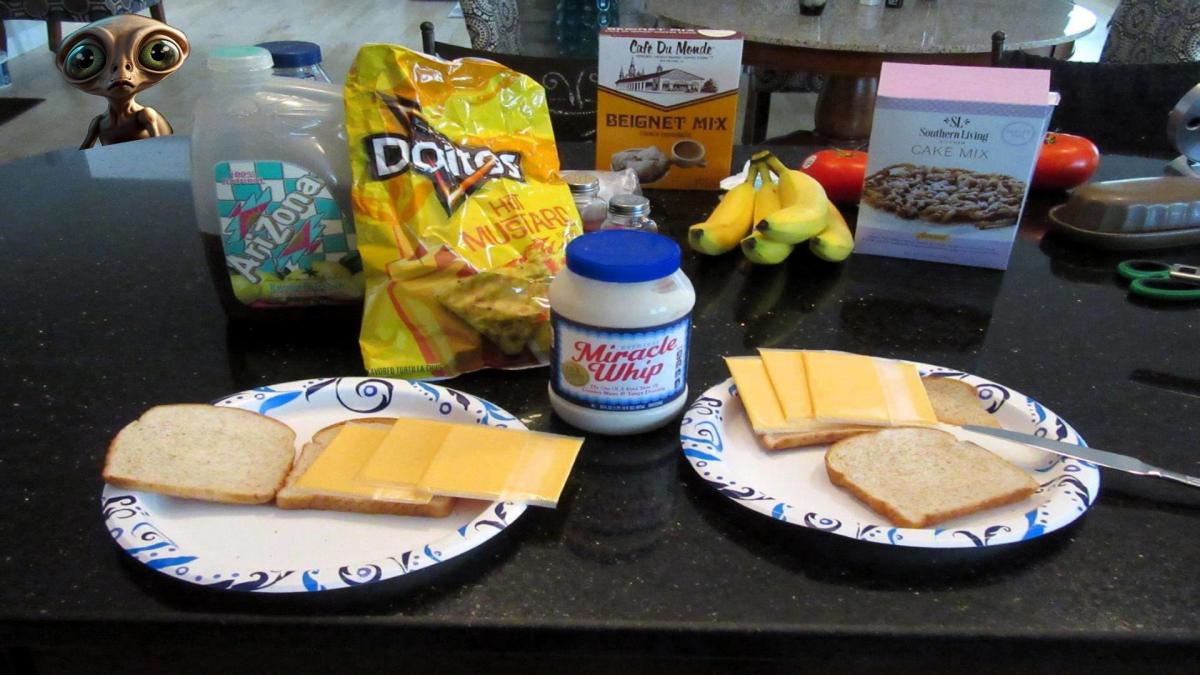
We finally had lunch with Miracle Whip and American cheese sandwiches a few days ago. They were delicious! An extraterrestrial even showed up, begging for a bite.
Miracle Whip sometimes attracts ETs. I’m surprised more people don’t try this method of getting photo evidence for the existence of these creatures.
Sena is still planning to make Beignets sometime in the near future. She did make some really tasty funnel cakes though, using that Southern Living cake mix.

Acts of Kindness Spotted in Walmart!

If you read the news, you rarely find any stories about acts of kindness. Everybody is slamming everybody else. Sena sees acts of kindness at Walmart. Not long ago, a Walmart grocery shopper went out of his way to be kind to her.
She was in the checkout lane of a cashier who greets everyone with a cheery “Did you find everything you want? Thank you for shopping at Walmart!” People actually try to get into her lane, probably to get a dose of her kindness. They will arm wrestle for the privilege, best 2 out of 3 wins.
I rarely go grocery shopping but actually recognized her from Sena’s description and scooted into her lane. She even placed the sacks of groceries up on top of the circle of bags to make it easier for me to grab them, making it less likely to forget them—which is something I would probably do. She’s easy to find; she’s the only one still wearing both a medical grade mask, face shield, and gloves.
Sena almost always encounters kindness from random shoppers and Walmart workers who see her struggling to reach an item on a high shelf. They’ll say “Let me help you with that.”
Anyway, where was I? Oh, the shopper kindness incident. She was in the kind cashier’s lane behind another couple who also prefer this cashier. She had encountered them elsewhere in the store and the guy joked with her about cottage cheese.
There were no dividers to separate Sena’s groceries on the conveyer belt from his, so she used a package of celery and announced it to the cashier—who forgot that and rung it up along with a couple of other items) for the guy and his wife in front of Sena. Sena caught the mistake and they all joked about it.
After the couple left the store with their groceries and as Sena was checking her items, she felt a tap on her shoulder. It was the guy who had been in front of her. He handed her a package of mushrooms, the one item that the cashier had charged to him by mistake and had not caught. He had probably gone all the way out to the parking lot and somehow noticed the mushrooms.
He gave Sena the mushrooms and told her that he didn’t want her to get all the way home and find out that she didn’t have them for a recipe.
Sena knew he’d been charged for them and because she didn’t carry enough cash to pay him back, advised him he could get the mistake fixed at customer service. By this time, it was too late for everyone’s favorite cashier to correct it.
The guy said the transaction was too complicated and not worth standing in the long line at customer service.
But it was worth his while to get all the way out to the parking lot and walk all the way back in to return a $2 package of mushrooms to Sena.
Sometimes, it seems to me we spend more time on the lookout for UFOs in the sky than for human acts of kindness on earth.

To Trap or Not to Trap Japanese Beetles

Sena has some Japanese Beetle traps she’s been thinking about using for some time now. She paid only a dollar a box because they were on sale. She’s hesitant. It’s Spectracide and uses a sex attractant and a floral lure to catch the little scarab beetles in a bag. In fact, the product is called Bag-A-Bug. The box advertises they are an “ideal method” to control Japanese Beetles and protect your yard. They cost about $8 or more a box, depending on where you buy them.
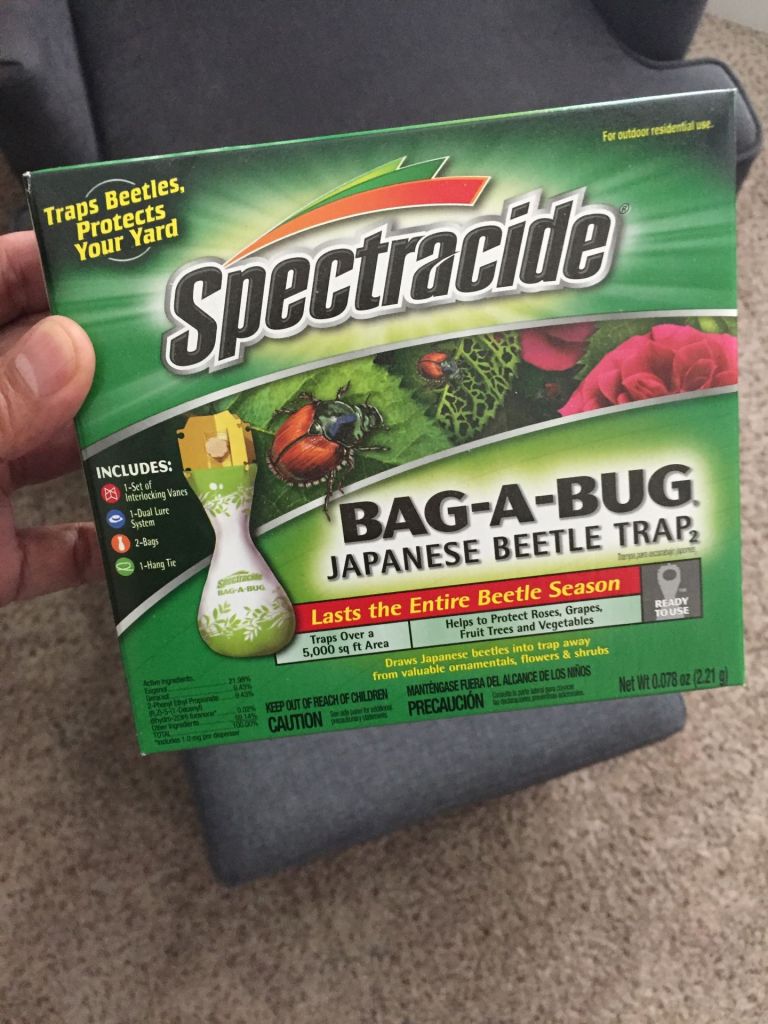
I checked the internet about controlling Japanese Beetles and I was a little surprised to learn that not everyone is in love with the bag method. Some experts say they might attract more bugs to your yard rather than rid your property of them.
The University of Minnesota Extension web article tops the list of those who caution you not to expect a miracle from the bag method. In fact, they frankly state, “While the University of Minnesota is still performing research to understand this pest, one thing we do know is Japanese beetle traps do not reduce beetle feeding.” They baldly state the traps probably won’t benefit your garden. The issue is the chemical lure itself, which might draw even more bugs to your yard. The more bugs you catch, the more stink they squirt. You can end up with thousands more of them because of the trap itself, causing more damage to your plants than if you didn’t use it at all.
What’s the answer? Toss the little buggers in a bucket of soapy water, believe it or not. And while they make holes in leaves which makes your plants look ugly, they usually don’t kill them. Beetles show up in late June and early July and mess with your yard until mid to late August.
Picking off the bugs and the damaged leaves works as good as anything else and rids the areas of the odor which attracts other insects.
What’s The University of Minnesota Extension’s bottom line on beetle traps? Don’t use them. It’s likely they attract more beetles than they catch.
I also checked the Iowa State University Extension web page on Japanese Beetles. The authors say the bugs are the “worst landscape pest in America” but they also are thumbs down on using traps, saying they attract more bugs than they catch. Here’s a funny quote from an ISU Extension article that I originally used but just found out today is not available:
“The only benefit of JB traps is the emotional satisfaction of seeing and smelling hundreds (thousands?) of dead, decaying beetles.”
The Better Homes & Gardens web page has a similar opinion. So, there you have it. During my web search, I was reminded of a neighborhood we visited several years ago where we saw a lot of back yards with these traps. The bugs were everywhere.
So much for the traps. What the heck, they were only a dollar a box.
House Oversight Committee UAP Hearing Today

We watched the House Oversight Committee UAP Hearing today and it was one of the most interesting presentations we’ve seen in a long while.
I make fun of the topic a lot but I thought all the witnesses were credible. In my opinion, the most credible witness today was retired Commander David Fravor of the U.S. Navy. His sense of humor and down-to-earth (no joke intended) demeanor lent credibility to the issue of Unidentified Anomalous Phenomena.
I especially liked Fravor’s advice for anybody reporting UAPs: “Don’t make the fish bigger than it is.
David Grusch, a former U.S. intelligence officer, often deferred answering certain questions because the answer would have meant revealing classified information. Ryan Graves, a former fighter pilot for the Navy, emphasized the need for a safe way to let military and civilian witnesses describe their encounters with UAPs.
There will likely be another meeting, one which would allow David Grusch to be more open to answering questions involving classified information.
Can Robots Lie Like a Rug?

I’ve been reading Isaac Asimov’s book I, Robot, a collection of short stories about the relationship between humans and robots. One very thought-provoking story is “Liar!”
One prominent character is Dr. Susan Calvin. If you’ve ever seen the movie I, Robot you know she’s cast as a psychiatrist whose job is to help humans be more comfortable with robots. In the book she’s called a robo-psychologist. She’s a thorough science nerd and yet goes all mushy at times.
The news lately has been full of scary stories about Artificial Intelligence (AI), and some say they’re dangerous liars. Well, I think robots are incapable of lying but Bard the Google AI did sometimes seem to lie like a rug.
In the story “Liar!” a robot somehow gets telepathic ability. At first, the scientists and mathematicians (including the boss, Dr. Alfred Lanning) doubt the ability of robots to read minds.
But a paradoxical situation occurs with the robot who happens to know what everyone is thinking. This has important consequences for complying with the First Law of Robotics, which is to never harm a human or, through inaction, allow a human to come to harm.
The question of what kinds of harmful things should robots protect humans from arises. Is it just physical dangers—or could it be psychological harms as well? And how would a robot protect humans from mental harm? If a robot could read our thoughts, and figure out that our thoughts are almost always harmful to ourselves, what would be the protective intervention?
Maybe lying to comfort us? We lie to ourselves all the time and it’s difficult to argue that it’s helpful. It’s common to get snarled in the many lies we invent in order to feel better or to help others feel better. No wonder we get confused. Why should robots know any better and why wouldn’t lies be their solution?
I can’t help but remember Jack Nicholson’s line in the movie “A Few Good Men.”
“You can’t handle the truth!”
Dr. Calvin’s solution to the lying robot’s effort to help her (yes, she’s hopelessly neurotic despite being a psychologist) is a little worrisome. Over and over, she emphasizes the paradox of lying to protect humans from psychological pain when the lies actually compound the pain. The robot then has the AI equivalent of a nervous breakdown.
For now, we’d have to be willing to jump into an MRI machine to allow AI to read our thoughts. And even then, all you’d have to do is repeat word lists to defeat the AI. So, they’re unlikely to lie to us to protect us from psychological pain.
Besides, we don’t need AI to lie to us. We’re good at lying already.
Look at Us Back on the Scott Blvd Trek!

The weather was pretty good for a walk on Scot Blvd the other day. Right away I got a video clip of an Indigo Bunting, a bird I haven’t seen in over 20 years! It was sitting on a thin grass stem which couldn’t hold its weight. It looked like it was sinking lower and lower on a slow elevator.
The people we passed along the way were friendly. Just looking at the landscape while sitting next to the Sitting Man was relaxing.
The video of the song “Then You Look At Me” by Celine Dion also fits, depending on your mood. Looking at nature puts you in the mood. Try not to think of robots.
Every Minute Counts in Physical Activity for Health Even If Your Step Counter Does Not Count It!
If you want a quick read for how every minute counts in physical activity for your health, see the JAMA article “Physical Activity for Health—Every Minute Counts” (Katzmarzyk PT, Jakicic JM. Physical Activity for Health—Every Minute Counts. JAMA. 2023;330(3):213–214. doi:10.1001/jama.2023.11014).
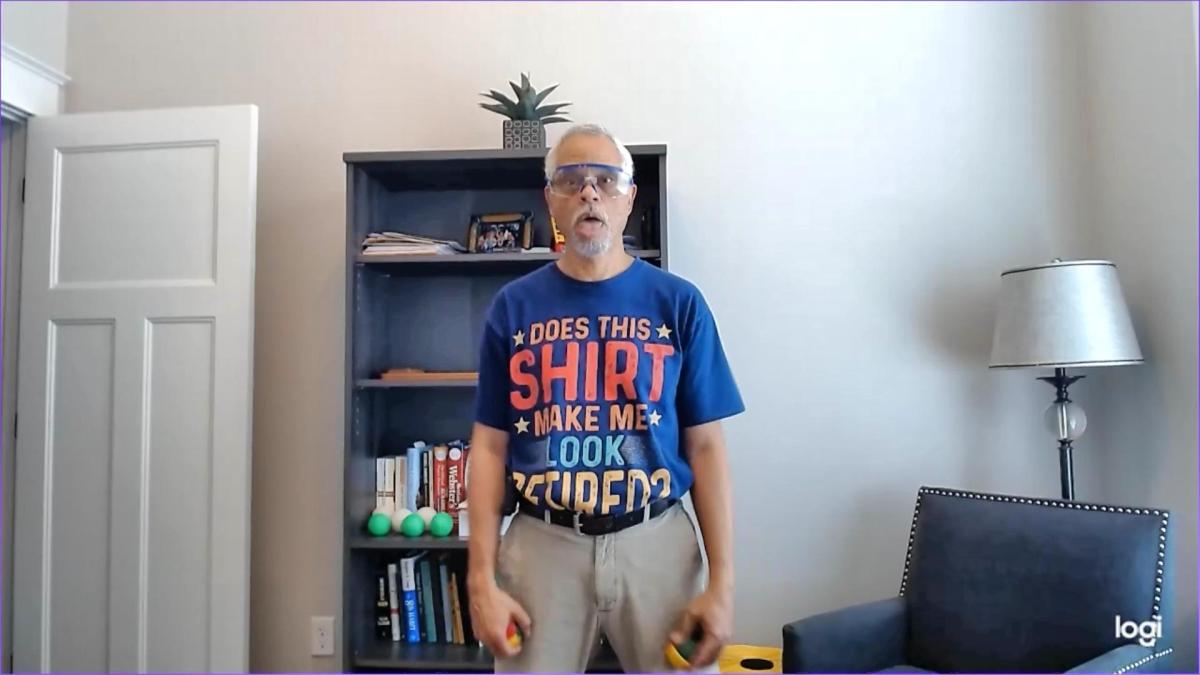
Just for fun, I tried to see if about 5 minutes of juggling would result in a change in the step counter on my cell phone. Unfortunately, it didn’t but I sure could feel the effort!
As the authors state, public health recommendations for physical activity set a bar of 150-300 minutes a week of moderate intensity aerobic activity to get substantial health benefit.
But you benefit from just about any increment below that level. Your step counter probably won’t register it, but you can feel it.
I made a short demo video to show what good exercise juggling is. I didn’t cut any mistakes (and obviously increased the speed on it because 5 minutes is a bit long). Anybody can tell I’m pretty puffed out at the end.
Try juggling for physical activity!
I’m Reading Isaac Asimov’s Book “I, Robot”
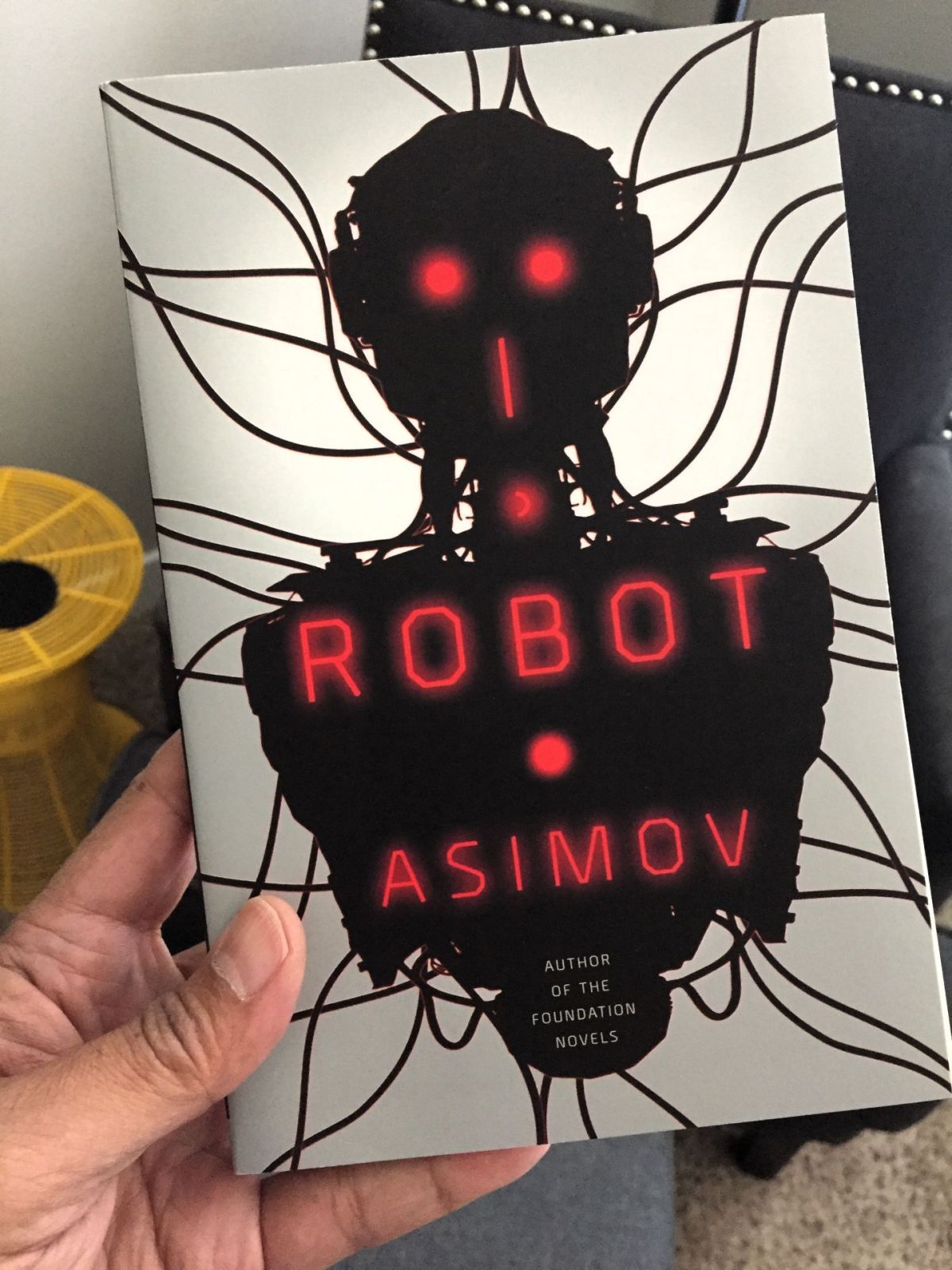
I just got a copy of Isaac Asimov’s book “I, Robot” the other day. I’ve been thinking about reading it ever since seeing the movie “I, Robot.” As the movie opens, you see the disclaimer saying that the movie was “…inspired by but not based…” on Asimov’s book of the same name.
In fact, the book is a collection of short stories about robots and in the first one, entitled “Robbie” I saw the names of several characters who were transplanted from the book into the movie, Susan Calvin (the psychiatrist), Alfred Lanning, and Lawrence Robertson.
Robbie is the name of the robot who has a special, protective relationship with the 8-year-old daughter of parents who don’t agree about how Robbie could have a positive influence on the girl.
The first of the 3 Laws of Robotics is mentioned in “Robbie.” It is central to the close bond between the little girl and the Robbie All 3 are below:
First Law
A robot may not injure a human being or, through inaction, allow a human being to come to harm.
Second Law
A robot must obey the orders given it by human beings except where such orders would conflict with the First Law.
Third Law
A robot must protect its own existence as long as such protection does not conflict with the First or Second Law.
I just started reading the book. I read a few of the negative reviews of the book on Amazon because when most reviews are effusively positive, it’s difficult to get a balanced view of what the flaws might be. One person called it an “old chestnut” and gave it only 2 stars. Another reader was put off by the old-fashioned portrayal of the relationship between men and women.
Well, after all, the book was published in 1950. A description of their relationship goes like this between the husband and wife:
And yet he loved his wife—and what’s worse his wife knew it. George Watson, after all was only a man—poor thing—and his wife made full use of every device which a clumsier and more scrupulous sex has learned, with reason and futility, to fear.
I’m not at liberty to comment about this.
Moving right along, the story addresses the fear people had of robots—which many of us still have now, in the age of Artificial Intelligence (AI). We tend to forget AI is not independent, like Virtual Interactive Kinetic Intelligence (VIKI) in the movie I, Robot. Why does it have a female name?
Talk about the stereotypical men and women of the 1950s.
 Go Retire Psychiatrist