Hickory Hill Park Ramble

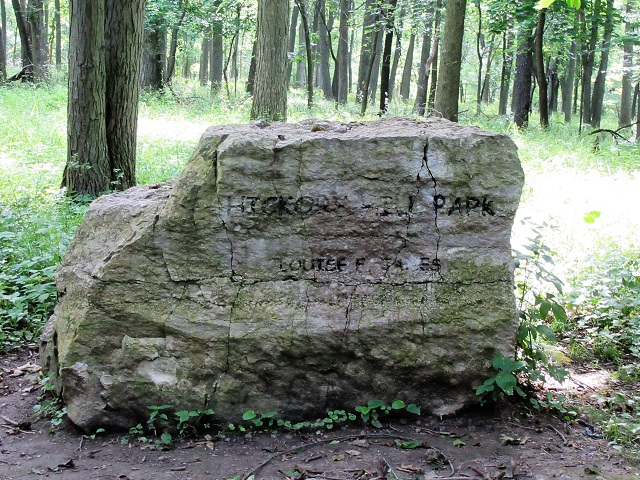
We visited Hickory Hill Park today in Iowa City. We’ve lived in this area for 30 years and have been near it but never walked a trail until now. It’s full of trees, birds, and other wildlife, including deer, which seemed to pose for the camera.

Deer posing

I say we’ve been near it because we have visited Oakland Cemetery, where the famous Black Angel monument is. At least one of the trails leads to one end of the cemetery—which we discovered today.

There are many legends about the Black Angel, most of which are in the vein of various curses and some of which claim that the curses can kill visitors—not true, of course. Many take selfies in front of the Black Angel and toss coins in the base (probably to ward off any curses, just in case).

I was feeling pretty reckless on the day Sena took a snapshot of me in front of the Black Angel. I left a little pocket change. That was a few years ago. The object of the visit was not to visit the Oakland Cemetery but to take part in the picnic and Psychiatry Department Matball Challenge game, Faculty vs Residents at Happy Hollow Park about a block away from the cemetery.
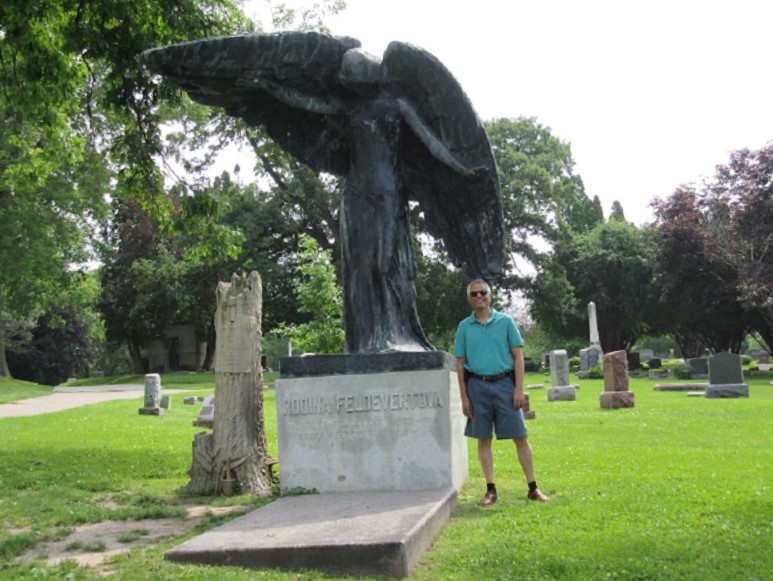
The Black Angel of Oakland Cemetery

Anyway, it was pretty hot today, in excess of 100 degrees with the heat index. We kept the walk short for that reason. It was warm, but the tree canopy kept the heat down a little. There’s something about walking through a thickly wooded area in which most of the sounds you hear are of nature. It tends to make me a little reflective.

Because I’m in my last year of a phased retirement contract and will fully retire next year, I’ve been thinking about transitions, the end of one era of my life and the unknowns about the beginning of another. There are a lot of unknowns. Sometimes I feel a little lost.

Retirement tends to lead me to think about death, which is pretty morbid, I know. I don’t ruminate about it, but walking past some of the park benches, some of which are memorialized to certain persons, got me to wondering about the next bend in the path. On one of them was a small plaque bearing a quote,

“Not all those who wander are lost.”

JRR Tolkien

There was a baseball on the bench.

And not long before we got to that bench, we saw a shoe, apparently lost by someone—who might have been lost. Hickory Hill Park is big. A person could get lost in there.

Lost shoe

We followed a path that others seemed to be taking. It led to the back of Oakland Cemetery where we saw a couple of headstones which puzzled us. The names were very familiar; man and wife, with only the birth years carved in them. But the strange thing was—as far as we knew they were still very much alive! The man had been the closest thing to a mentor that I could remember ever having.

Naturally, later I realized that it was just that they had thought through their own transitions a lot farther than many of us do. They had planned not only for retirement. They had planned for their own deaths. But until I finally got it, I actually searched on the web for obituaries.

Strange, I actually found a pdf file posted that sort of sounded like one—an exquisitely written letter from a relative who described the person we knew in enough detail that it seemed to identify him beyond much doubt. Why would such a beautiful and presumably private remembrance be posted on the web?

Maybe because the relative wanted the world to know how deeply loved this person is—while he is still alive.


Path

Soaring Bird in the Neighborhood

This afternoon after we returned home after lunch out, I got a picture of what could have been the bird that made off with a mouthful of house finch chicks last month.

I don’t know why I didn’t draw up the window blind when I first heard the sound of what reminded me of a bed sheet flapping in a high wind a month ago.

When I finally did crack the blind, I saw the huge, black bird with what seemed like a wingspan as long as my leg beating those wings mightily at the air to stay aloft as it plucked the baby birds from the tree.

It was fast as lightning and the theft was done so quickly, I had no time to be more than a witness.

I vowed not to go pawing into trees anymore looking for bird nests just to get snapshots. I think I gave the big predatory bird, whether crow or turkey vulture or whatever it was a visual cue to where its prey lay helpless.

Informal Bedside Tests for Delirium

Most of this post is an updated redux from years ago about an informal bedside test for delirium called the oral trails test. I learned about it from my senior resident when I was a junior psychiatry resident in training at the VA Medical Center.

There was an elderly patient admitted to the psychiatry unit who was thought to be psychiatrically ill but who actually seemed confused to me and the senior resident. We consulted medicine in order to get him transferred to the general medicine unit but it was tough going. I think the medicine resident disagreed with our clinical impression that he was confused and didn’t think medical transfer was necessary.

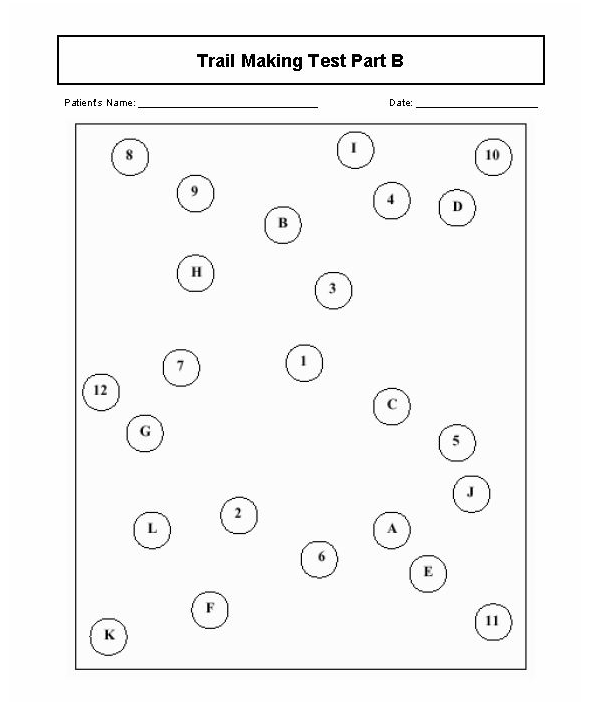
Anyway, my senior resident showed me her version of the oral version of the mixed Trails A and B Test for executive function. There is a written form which is part of the Repeatable Battery for the Assessment of Neuropsychological Status (RBANS). First, she asked him to count from 1 to 7; then she asked him to recite the letters of the alphabet from A to J. She then asked him to try reciting those letters in alternating sequence. Of course, he failed miserably and was eventually transferred to internal medicine. The Trails actually is a paper and pencil test and it looks like a dot to dot game, like the example below:

Trails Test

My senior resident told me she learned the oral Trails test from her senior resident and couldn’t remember anything else about it. I used the test for years but a neuropsychologist criticized the practice, questioning the test’s validity, and rightly so.

Of course, I’d been doing it wrong. You’re supposed to have the patient count to 25, then recite the letters of the alphabet, then recite the numbers and letters in alternating sequence from 1 to 13 and A to M. More than two errors in pairings indicate cognitive impairment.

There are limitations to the verbal Trails and caution is advised in more recent literature, indicating that there are moderate education effects in older patients and that it may be wiser to use both paper and pencil and oral versions together.

Still the search goes on for quick and dirty ways to screen for cognitive impairment in the elderly because this and advanced age are two main risk factors for delirium.

Nowadays, I do the Mini-Cog (shown in the video below) or the Single Question in Delirium (SQiD) test, which just involves asking a family member if the patient seems confused lately.

References:

Mrazik, M., Millis, S., & Drane, D. L. (2010). The oral trail making test: effects of age and concurrent validity. Archives of clinical neuropsychology: the official journal of the National Academy of Neuropsychologists, 25(3), 236–243. doi:10.1093/arclin/acq006

Ricker, J. H., & Axelrod, B. N. (1994). Analysis of an Oral Paradigm for the Trail Making Test. Assessment, 1(1), 47–51. https://doi.org/10.1177/1073191194001001007

Sands, M., Dantoc, B., Hartshorn, A., Ryan, C., & Lujic, S. (2010). Single Question in Delirium (SQiD): testing its efficacy against psychiatrist interview, the Confusion Assessment Method and the Memorial Delirium Assessment Scale. Palliative Medicine, 24(6), 561–565. https://doi.org/10.1177/0269216310371556

My Top Ten YouTube Videos

OK, my top ten YouTube videos are going to get pretty low ratings anyplace else. But where else are you going to see the list but on my blog? In a world where popular videos are viral at a million plus views, I’m way in the back yard.

I wasn’t very picky, of course, because these are the videos I made. I didn’t include any others, especially the ones that were professionally produced. I kept the bar pretty low because I had to. Any video with over 900 views made it to the list, which goes from lowest to highest number of views.

By the way, the only way I could come up with a Top 10 list was to make the bar 900.

10. “Dr. Jim Amos’ Dirty Dozen on Suicide Risk Assessment” published 2012: 940 views

9. “Dr. Jim Amos’ Dirty Dozen on Alcohol Withdrawal Treatment” published 2012: 1,063 views

8. “Dr. Jim Amos’ Dirty Dozen on Catatonia” published 2012: 1,668 views

7. “Mall of America Video” published in 2016: 1,728 views

6. “Dr. Jim Amos’ Dirty Dozen on Interpersonal Psychotherapy” published 2012: 1,840 views

5. “Dr. Jim Amos’ Dirty Dozen on Catatonia, NMS, Serotonin Syndrome” published 2013: 1,960 views

4. “Dirty Dozen on Dr. Allen Frances’ Dozen General Tips on Psychiatric Diagnosis” published 2013: 2,492 views

3. “Pseudobulbar Affect Top Ten” published 2015: 2,613 views

2. “Dr. James Amos’ Dirty Dozen on Somatoform Disorders” published 2012: 8,191 views

1. “Dirty Dozen on Factitious Disorder and Malingering” published 2012: 12,465 views

Now why would a video about abnormal illness behaviors like Factitious Disorder and Malingering be number one?

And why would “Mall of America Video” be my most popular non-work-related video? My wife and I did have a lot of fun there.

I like to think people enjoy “Pseudobulbar Affect Top Ten” because of my superb pseudo-rap acting style—and my hat.

Like my hat?

The Paperboy

I don’t read the news much at all these days. It’s almost always bad, anyway. I was a paperboy in my youth. I delivered the Des Moines Register and Tribune for a year and earned a certificate as Honor Salesman.

My paperboy certificate

Let me tell you a little something about being an Honor Salesman back in those days. First of all, I had to cross some railroad tracks to pick up my papers at the drop up the street from my house. Evidently, tree swallows like to nest around railroad yards sometimes, because they dove at my head like bombers. I had to swing my paper bag at them to fend them off.

And I had to deliver my papers in a little red wagon on Sundays to get the big Sunday edition out. My paper bag wasn’t big enough to carry around my skinny neck with all those supplements, ads, and tons of news.

In the winter, it was twice as bad. If I’d had a sleigh, I could have made like Santa Claus. But I didn’t. All I had was the wagon and dragging it through a foot or more of snow did not put me in a holiday mood.

I learned a little about business. One of the lessons was that you sometimes meet some pretty strange people on a paper route.

I was embarrassed a few times when I had to collect, which was to gather payment from my customers for a paper that one guy said wasn’t worth a shit. In all fairness, he’d been drinking and had fallen on hard times—but he paid me anyway.

Another awkward moment was collecting from a young newlywed couple who always answered the door while wrapped in large bath towels. “Large” is a relative term, especially on the young lady. It left a little to the imagination, but not much.

I folded my papers, which is, of course, a lost art nowadays since everybody gets their news on their electronic devices. I didn’t pitch them on to porches though, because that was frowned on at the time by my boss. We were taught to place it carefully inside the storm door so it wouldn’t get wet or dirty.

Dogs were not as much of a problem as bumblebees, particularly at one house on my route where the guy raised fields of Hollyhocks. They were well over 6 feet tall and they covered his back and front yard, crowding around his front door which I had to open to deliver his paper. The air was always alive with the drone of bees, some of them as big as golf balls (well, it seemed that way). The place scared me to death—but I had to do my job.

I didn’t really develop a head for business but it was good training for life in general.

A Pair of Cufflinks

My wife and I were watching an episode of Antiques Roadshow this evening and saw a spot about a pair of cufflinks that turned out to be worth a lot of money.

That reminded me of the first and only pair of cufflinks I ever owned. Back when I was an undergraduate in the mid-1970s at the private, historically black Huston-Tillotson College (now H-T University), in Austin, Texas, a wealthy, successful white businessman who was fond of my English professor bought me a suit, dress shoes, tie, and cufflinks.

I was ambivalent about the gift as I was being fitted for the suit at the men’s store in downtown Austin.

I wasn’t sure what cufflinks were supposed to do for me. I suppose I shouldn’t judge the guy too harshly. After all, he was just trying to be generous—and probably trying to impress my English professor.

It was the 1970s and it was not a great time for black people in America. There was violent racism of course. There was also a sort of paternalistic generosity which may have emphasized superficial symbols of economic success.

Anyway, after a while the shoes started to squeak. I outgrew the suit. Despite those losses, I became successful through hard work and good luck.

I lost the cufflinks.

The Retirement Home Search and The Well of Memories

We were out for an adventure today, shopping for a retirement home. That’s what it was, really, although we really didn’t make any hard decisions or commitments.

Nowadays there are considerations for whether to build from the ground up, buy and modify a spec home, buy an older home, go condo, even rent, move to a retirement village, and whatnot.

You have to think about mud rooms, pantries, walkout basements, whether to finish the basement or not, lot size, square footage of the house and the yard, two car or one car garage, Jack and Jill sinks, lawn sprinkler systems, Home Owner Associations (HOAs), fences, ceiling fans, gas fireplaces, whether or not you want to live next door to a high school baseball stadium and more even beyond that.

What you don’t have to think about is whether or not there’s indoor plumbing.

When my brother and I were little boys, our pastor and his family took us on a long drive up to the sticks somewhere in Minnesota in the dead of winter. Man, it was cold up there. The object of the visit was to visit a family who lived out on a farm and they didn’t have indoor plumbing.

There was an outhouse and a well. I remember the pastor’s little girl and his brother and me and my little brother stood by the well and talked about how pure the water was in the well. While we were talking, the pastor’s daughter picked up a rock and, before anyone could stop her, dropped it into the well—just to see how it would float down to a bottom nobody could see.

Her little brother was pretty annoyed. The member of the family we were visiting had just remarked how clear and pure the well water was. After the rock spiraled out of sight into the water, her brother spat out, “Well, it was but now it isn’t!” She just snickered.

Because we were staying the night at the farmhouse, we went to bed. There was a large pan for urinating but if you had to move your bowels, the only option was the outhouse.

I had to go. I waited as long as I could because it was really cold out there. Finally, I just couldn’t hold it any longer, and I had to pull on some clothes and trudge over the frozen ground to this shabby little shed that I could smell long before I got to the rickety door.

There was some paper in there but—it wasn’t real toilet paper. It might have been magazine pages. I was so cold it was impossible to relax enough to let go.

I had problems with constipation after that for a good long while, well after we returned home.

Things have changed a lot—mostly for the better in many ways but you still have to pay a high price in other ways.

Toilet paper is softer.

Quiz Show versus Grand Rounds for Delirium Education Redux

Here’s a redux of one of my blog posts from years ago. There’s not been much change in the data or clinical practice regarding delirium, except we’re even less enthusiastic about using any kind of psychotropic medication to treat delirium, even hypoactive delirium. Try the puzzle.

“So, you want to put on a game show contest to educate clinicians about delirium? Contact David Meagher, a psychiatrist in (where else?) Limerick, Ireland. He reported on this innovative educational workshop in the November 2010 Vol. 3 issue of the Annals of Delirium, the newsletter for the European Delirium Association (EDA). He also published the study which describes the contest in International Psychogeriatrics [1].

The workshop focused on clinician attitudes toward drug therapy for distressed delirious patients. It explored pre-existing attitudes and practice toward the use of medications to manage delirium and exposed participants to a very interactive educational event modeled after a popular TV quiz show. There were two teams (skeptics versus neuroleptics) furnished with a list of statements about delirium pharmacotherapy. The participants later completed a post-workshop questionnaire that explored changes in attitudes as a result of the workshop.

The participants were all experts on the subject and there was a good deal of variability in attitudes and practice. Some of the questions put to the teams involved using antipsychotics prophylactically to prevent delirium, the mechanism of action of antipsychotics, and what role benzodiazepines play in the treatment of non-alcohol withdrawal delirium.

One of the more puzzling findings was that the frequency of antipsychotic use was inversely proportional to the perception of the strength of supporting evidence. In other words, the less they knew about antipsychotics, the more often they used them. Most participants seemed to believe that the principal mechanism of action of antipsychotics is sedation, despite the lack of supporting evidence.

Some clinicians used antipsychotics to relieve the stress of caregivers rather than that of delirious patients, an example of patients getting the right treatment for the wrong reasons as observed by Meagher—and many of us in the field.

The workshop also highlighted the tendency of clinicians to focus on risk management rather than effective therapeutic intervention in the management of delirious patients with disruptive behavior and severe distress. This mainly relates to focus on the potential adverse effects of antipsychotics such as extrapyramidal side effects, metabolic, and cerebrovascular effects.

The quiz show activity was fun and challenging. The device of dividing the participants into two small teams with larger audience participation cut down on the anxiety that could be provoked by giving the “wrong answer”. The questions were true/false and didn’t always have clear right or wrong answers. It was highly interactive, a component of continuing medical educational (CME) activities that is increasingly encouraged because it’s more likely to lead to changes in clinician attitude and practice. The one time Grand Rounds CME “seat time” is going the way of the dinosaur.

So a couple of findings from the quiz show post-activity questionnaire were that clinicians were more likely to use antipsychotics prophylactically and to use antipsychotics to manage hypoactive delirium.

 Our delirium intervention project group members are not quite as enthusiastic yet about these two interventions. We’re a bit more inclined at least initially to focus on non-pharmacologic multicomponent strategies such as the example below:

  • Minimize the use of immobilizing catheters, intravenous lines, and physical restraints
  • Avoid immobility, early mobilization
  • Monitor nutrition
  • Provide visual and hearing aids
  • Monitor closely for dehydration
  • Control pain
  • Monitor fluid-electrolyte balance
  • Monitor bowel and bladder functioning
  • Review medications
  • Reorient communications with the patient
  • Place an orientation board, clock, or familiar objects (i.e., family photographs) in patient rooms
  • Encourage cognitively stimulating activities such as word puzzles
  • Facilitate sleep hygiene measures, including relaxation music or tapes at bedtime, warm drinks, and gentle massage
  • Minimize noise and interventions at bedtime, e.g., by rescheduling medication times

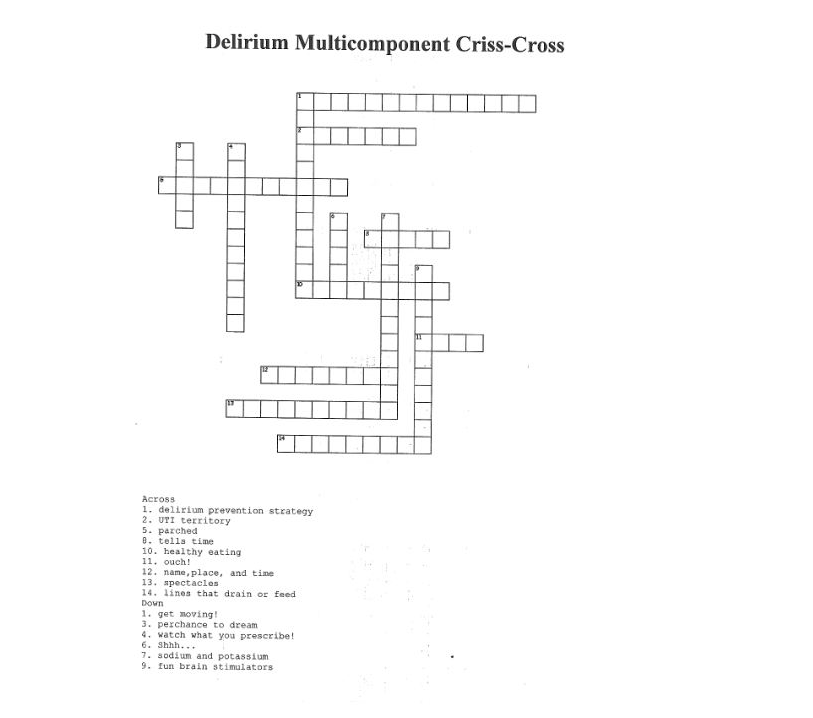
But I’m just as enthusiastic about interactive educational methods to engage learners in order to build a culture more likely to produce champions who will lead the delirium prevention effort—try the delirium multicomponent crisscross puzzle below. The clues are contained in the list of multicomponent tactics above.”

  1. Meagher, D.J., Impact of an educational workshop upon attitudes towards pharmacotherapy for delirium. Int Psychogeriatr, 2010. 22(6): p. 938-46.

Retirement Home?

You know, sometimes I wonder about rephrasing the line in the Men in Black movie, “Let’s put it on…the last suit you’ll ever wear.”

How about, “Let’s do it…the last house you’ll ever buy.” That’s what I think the retirement home should be.

Houses are getting harder to find and the home-buying experience has sometimes been, shall we say, less than a barrel of laughs?

Like many people, we’ve been through a lot of moves. I’m getting too old for this hassle.

Let’s just say I’d like to be done with moving. I don’t mean we should move to a “retirement home” as in one of those retirement communities. I worry that crabbiness and the old-fashioned ways could get to critical mass and we could all go up in an explosion of anecdotage.

Apartment living? I don’t think so. Neighbors are too nosy and too noisy.

Condos? Home Owners Associations (HOAs)? I’m waiting for some hare-brained producer to inflict this notion on TV viewers in the form of yet another crappy reality show.

How’s that for crabbiness?