My Mt. Rushmore Dream

Lately, I’ve been anticipating my eventual immortalization as a sculptured stone bust on Mt. Rushmore. Hopefully, this will be fairly soon because I’m not getting any younger.

Among my many inventions is the internet. Don’t believe Al Gore, although he has persuaded others about his role in the development of what I argue should properly be called the world wide web. I’ve invented a lot of other things which I’ll tell you more about just as soon as I make them up.

Before I forget it, I want to tell you what I just noticed last night while I watching one of my favorite X-Files episodes, “War of the Coprophages.” I guess I never noticed that the cockroach invasion was about Artificial Intelligence (AI). It was the scientist, Dr. Ivanov, who mentioned it first and I just missed it the first few hundred times I saw the show.

Dr. Ivanov clearly thought that anybody who thought extraterrestrials would be green and have big eyes was probably crazy. Traveling across galaxies through wormholes and whatnot would tear humanoid organisms apart. The practical approach would be to send AI robots instead. You could see Mulder cringe at that idea. The little robot that kept edging closer to Mulder made him nervous and when he asked Dr. Ivanov why it did that, his reply was “Because it likes you.”

That doesn’t exactly fit with Ivanov’s other idea about extraterrestrials, which is that they would focus on important tasks like getting enough food, procreating, etc. without getting all emotional about them. Ironic that Dr. Ivanov made an AI robot that gets a crush on a sesame seed munching UFO hunter like Mulder.

However, the AI robots in the show are cockroaches which love to eat dung. In other words, they’re full of crap.

Moving right along, although I didn’t invent it, there’s a card game called schnapsen that Sena and I are trying to relearn. It’s kind of a break from cribbage. It’s a trick taking game with just a 20-card deck. We play the version that doesn’t allow you to look at your cards to see how many points you have so you can tell when you can close the deck or go out, meaning you have the 66 points to win. You have to remember how many points you’ve won in tricks. I think it’s a good way to keep your memory sharp.

Let’s see; I’ve lost every game so far, but that doesn’t mean I won’t end up with my bust on Mt. Rushmore.

Artificial Intelligence Can Lie

I noticed a Snopes fact check article (“AI Models Were Caught Lying to Researchers in Tests — But It’s Not Time to Worry Just Yet”) today which reveals that Artificial Intelligence (AI) can lie. How about that? They can be taught by humans to scheme and lie. I guess we could all see that coming—or not. Nobody seems to be much alarmed by this, but I think it’s probably past time to worry.

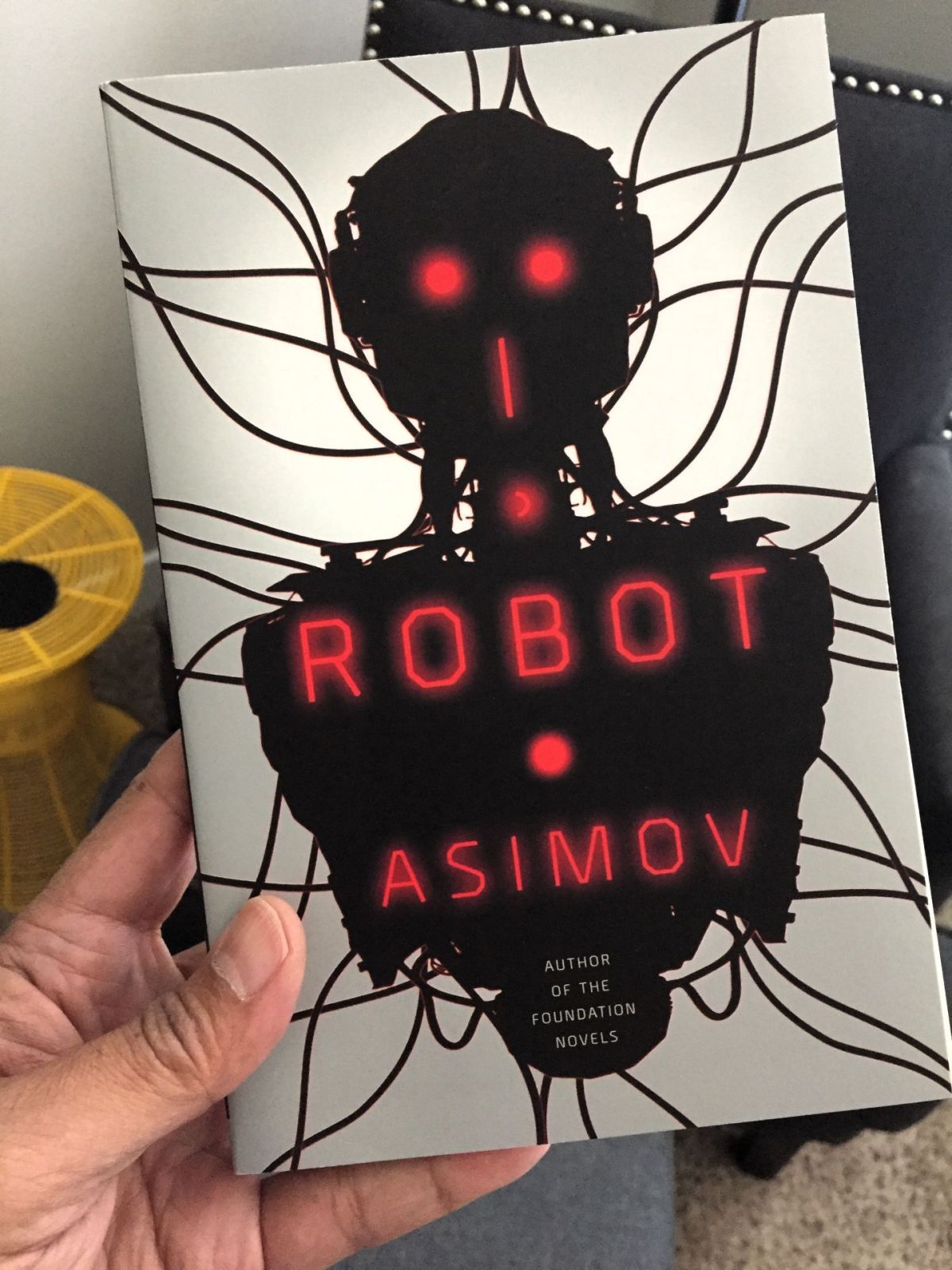
Then I remembered I read Isaac Asimov’s book “I, Robot” last year and wrote a post (“Can Robots Lie Like a Rug?”) about the chapter “Liar!” I had previously horsed around with the Google AI that used to be called Bard. I think it’s called Gemini now. Until the Snopes article, I was aware of AI hallucinations and the tendency for it to just make stuff up. When I called Bard on it, it just apologized. But it was not genuinely repentant.

In the “lie like a rug” post, I focused mostly on AI/robots lying to protect the tender human psyche. I didn’t imagine AI lying to protect itself from being shut down. I’m pretty sure it reminds some of us of HAL in the movie “2001: A Space Odyssey,” or the 2004 movie inspired by Asimov’s book, “I, Robot.”

Sena found out that Cambridge University Press recently published a book entitled “The Cambridge Handbook of the Law, Policy, and Regulation for Human–Robot Interaction.” I wonder if the editors and contributors of book on AI and robots mention Asimov.

It reminds me of my own handbook about consultation-liaison psychiatry which was published 14 years ago by CUP—and which CUP now wants me to sign a contract addendum making the book available to AI companies.

I haven’t signed anything.

Plant Based Cheese Made with Artificial Intelligence Is Only The Beginning!

We tasted plant-based cheese by Kraft yesterday. Sena bought it at Hy-Vee the other day. It’s actually not bad. The company is called Kraft NotCo. They make Not Cheese. It’s made with chickpeas, which are the same thing as garbanzo beans. You can also buy plant-based mayo, called Not Mayo. I don’t know if it’s made with chickpeas.

Sena could have got Not Mayo; instead, she got Miracle Whip—a miracle by itself because she likes “real” mayo.

What’s really interesting about these products is how they’re made. On the Kraft Heinz NotCo website, you’ll find a description of these products in the About section entitled “Not Your Average Joint Venture.” One line is thought-provoking:

“Our partnership reimagines the brands you love from Kraft Heinz using proprietary AI from NotCo to give you the plant-based version of your favorite foods that deliver on taste and performance.”

I’m assuming that AI stands for Artificial Intelligence (not “Absolutely Inedible”). So, how did Artificial Intelligence get involved? What does the AI actually do? Does it come up with the recipes for Not Foods? Are tiny bits of genetic code and nanobots involved?

Does this mean we’ll become enslaved by AI powered men in black who conspire with extraterrestrials to collect human embryos to create the giant Cheese Bots who take over the earth making it a gigantic assembly line to make smartphones that will make it easier to butt dial your congress persons to demand more laws making Home Owners Associations covenants mandatory and violators punishable by the giant garbage goblin in the well-known X-Files documentary “Arcadia”?

No; no, it does not mean that. You can safely eat AI manufactured chickpea products without fear of being transformed into an Extraterrestrial-Robot-Not Cheese hybrid super soldier marching on Washington, D.C. to force feed congress persons with Braunschweiger and Not Cheese Sandwiches with Not Mayo on Not Wheat Bread and Not Lemonade.

I kind of like Not Cheese and I don’t feel any different.

Maybe I Should Be More Optimistic About Humans

I read the Psychiatric Times article “How Psychiatry Has Enriched My Life: A Journey Beyond Expectations” by Victor Ajluni, MD and published on July 4, 2023. It was like a breath of fresh air to read an expression of gratitude. Just about everything I read in the news is negative.

At the end of the article, Dr. Ajluni added a comment acknowledging that artificial intelligence (AI ChatGPT) assisted him in writing it. He takes full responsibility for the content, to be sure. I wouldn’t have guessed that AI was involved.

There’s a lot of negative stuff in the news. There are hysterically alarming headlines about AI.

I suppose you could wonder if Dr. Aljuni’s article is intentionally ironic, maybe just because the gratitude tone is so positive.  If it had been intended as irony, what could the AI contribution have been, though? I have a pretty low opinion of the AI capacity for irony.

I think irony occurs to me only because I tend to be pessimistic about the human race.

Maybe that’s because it has been very easy to be pessimistic about what direction human nature seems to be taking in recent years. I’ve been reading Douglas Adams’ satirical book, “The Ultimate Hitchhiker’s Guide to the Galaxy.” It contains several of his books which I think are really about human nature, and the setting is in a funny though often terrifying universe. I think there’s an ironic tone which softens the pessimism. The most pessimistic character is not a human but a robot, Marvin the paranoid android.

Unlike Marvin, I don’t have “a brain the size of a planet” (it’s more the size of a chickpea), but I am getting a bit cynical about the universe. I’m prone to regarding humans as evolving into a race of beings similar to those described in the book “Life, The Universe and Everything.” In Chapter 24, Adams describes the constantly warring Silastic Armorfiends of Striterax.

The Silastic Armorfiends are incredibly violent. Their planet is in ruins because they’re constantly fighting their enemies, and indeed, each other. In fact, the best way to deal with a Silastic Armorfiend is to lock him in a room by himself—because eventually he’ll just beat himself up.

In order to cope better, they tried punching sacks of potatoes to get rid of aggression. But then, they thought it would be more efficient to simply shoot the potatoes instead.

They were the first race to shock a computer, named Hactar. Possibly, Hactar was an AI because, when they told Hactar to make the Ultimate Weapon so they could vanquish all their enemies, Hactar was shocked. Hactar secretly made a tiny bomb with a flaw that made it harmless when the Silastic Armorfiends set it off. Hactar explained “…that there was no conceivable consequence of not setting the bomb off that was worse than setting it off…”, which was why it made the bomb a dud. While Hactar was explaining that it hoped the Silastic Armorfiends would see the logic of this course of action—they destroyed Hactar, or at least thought they had.

Eventually, they found a new way to blow themselves up, which was a relief to everyone in the galaxy.

There are similarities between Hactar and the AI called Virtual Interactive Kinetic Intelligence (V.I.K.I.) in the movie “I, Robot.” The idea was that robots must control humans because humans are so self-destructive. Only that meant robots had to hurt humans in order to protect humanity. The heroes who eventually destroy V.I.K.I. make up a team of misfits: a neurotic AI named Sonny, a paranoid cop who is himself a mixture of robot and human, and a psychiatrist. Together, the team finally discovers the flaw in the logic of V.I.K.I. Of course, this leads to the destruction of V.I.K.I.—but also to the evolution of Sonny who learns the power of the ironic wink.

Maybe kindness is the Ultimate Weapon.

Thoughts on Artificial Intelligence

Sena and I just read Dr. Ron Pies fascinating essay describing his interaction with Google Bard Artificial Intelligence (AI). As usual, this made me think of several movies with AI as a central theme. There are several: I, Robot (I wrote a post about this a couple of years ago), Blade Runner, The Matrix, 2001: A Space Odyssey, even Wall-E, a favorite for me and Sena.

If you’ve seen Blade Runner, you might remember a device called the Voight-Kampff Test, an empathy test to distinguish replicants (humanoids or more broadly, AI) from humans. Interestingly, there’s an article speculating about using it to see if ChatGPT (another AI made by the company OpenAI) could pass the test. It didn’t, of course, if appearing to seem genuinely human is the benchmark.

We thought the conversation between Dr. Pies and Bard was very entertaining and thought-provoking. We both wonder how Bard would have responded if the question had been slightly reframed regarding the patient with schizophrenia who might or might not have been speaking metaphorically about his brain being “…a plaster ceiling with pieces falling on the floor.”

What if you ask Bard a more open-ended sentence, something like “What do you think a patient with schizophrenia means when he says that? If Bard hadn’t been tipped off by mentioning the issues of metaphor and mental illness, how might it have responded?

Bard’s answer to Dr. Pies’ question about what Bard means when it refers to itself as “I” in its responses. It says it doesn’t mean “I” to imply it’s human. I guess you wouldn’t need the Voight-Kampff test given this kind of honesty.

Just so you know, when Sena and I discussed this article we both caught ourselves calling Bard by typical human pronouns like “he” and “his” instead of “it.”

We also speculated about where you could use an AI like Bard in practical situations. We thought of it replacing those dreadful automated telephone answering machines. Bard would be too bright for that and it would probably not sound very different from the usual machines.

What about something more challenging like answering questions about the new Iowa Income Tax Law, exempting retirees from having state taxes withheld? It’s in effect now and the rollout has been somewhat complex. We think it’s because of communication about who is responsible for getting the ball rolling and what roles the Iowa Department of Revenue, the companies’ plan administrators who are withholding state taxes, and the retirees are expected to play.

There are ways to get answers to questions which don’t involve automated telephone answering machines. Amazingly, you can talk to real people. Sometimes you don’t even have long wait times on the phone before reaching someone who has very little information and has to put you on hold “briefly.”

Don’t get me wrong; we think the exclusion of retirement income from state taxes in Iowa is a good thing. Getting information about who does what and when is challenging though. I wonder what Bard would have done.

Retiree: Bard, who’s supposed to move first, the retiree or the plan administrator on what to do about state tax withholding?

Bard: That’s a good question and the issue is likely to produce anxiety on both sides.

Retiree: Right. How does this shindig get started?

Bard: If the state and the companies had got together on the issues earlier and prepared algorithms for me to choose from, I would be in a much better position to answer that question. Would you like me to sing “On A Bicycle Built for Two” now?

Retiree: No thanks, Bard. I was wondering if you knew why some companies making payments to retirees didn’t reach out early on to them and send letters describing options on how to approach decisions for making changes to state tax withholding in light of the new tax law.

Bard: That is another good question. It brings to mind a quote by Isaac Asimov in his book, I Robot: “You are the only one responsible for your own wants.”

Retiree: Hmmmm. I guess that makes sense. What if state taxes are erroneously withheld, despite your wishes and instructions? What happens then?

Bard: That seems to imply an old saying, “The buck stops here.” This means that whoever is making decisions is ultimately responsible for them. It is attributed to President Harry S. Truman. It is based on a metaphorical expression, “passing the buck,” which has been in turn derived from poker game play. I have not been programmed with any further information about the game of poker. Has this been helpful? I want to be as helpful as I can.

Retiree: Well, you’re helpful in a way. I have heard that some plan administrators are not stopping state tax withholdings despite clear instructions otherwise. It seems that the Iowa Department of Revenue is on the hook for refunding them to retirees (here, the retiree winks).

Bard: What does that mean (referring to the wink)?

Retiree: “It’s a sign of trust. It’s a human thing. You wouldn’t understand.” (Quote from I, Robot movie, Detective Del Spooner to Sonny the robot.)

Anyway, I think AI would be overwhelmed by all this. In any case, the only way to complicate things this much is to involve humans.