

Sena got me a new shirt that says: “Does This Shirt Make Me Look Retired?” It’s the greatest. No, she’s the greatest.
So…does it? Think carefully about your answer.

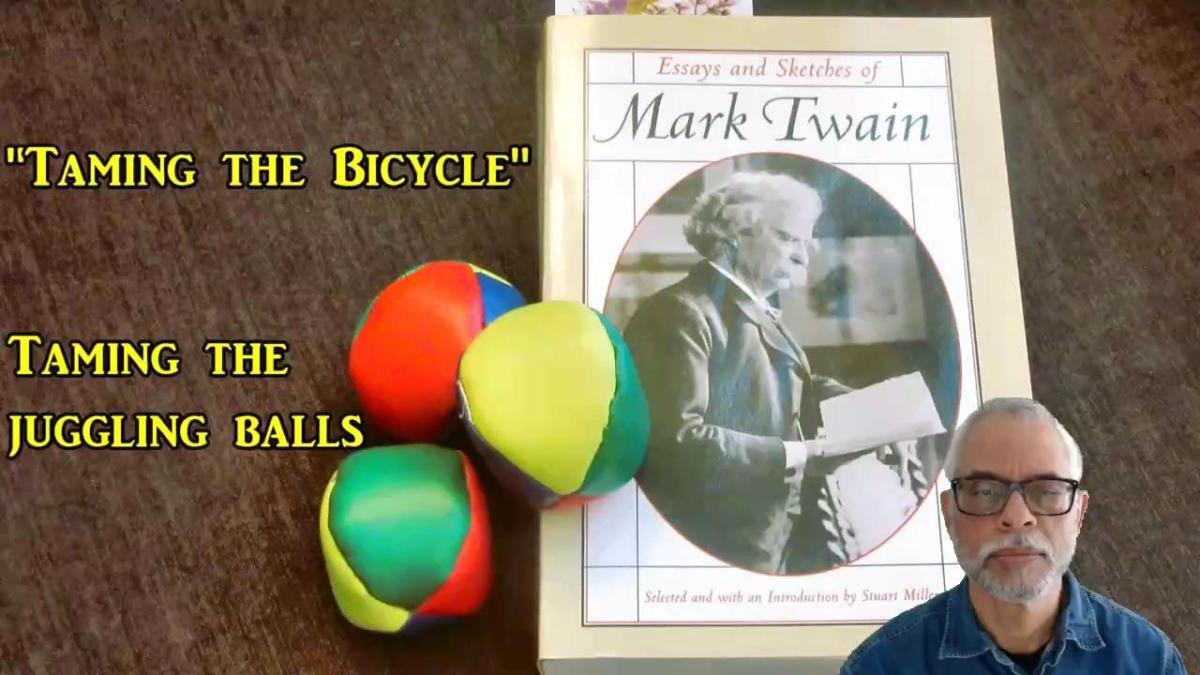
I’ve been juggling for about 5 months now and reflecting on my progress. I think I’m doing OK for a geezer. Sena would call me a hot dog although I would still call it ugly juggling by any standard.
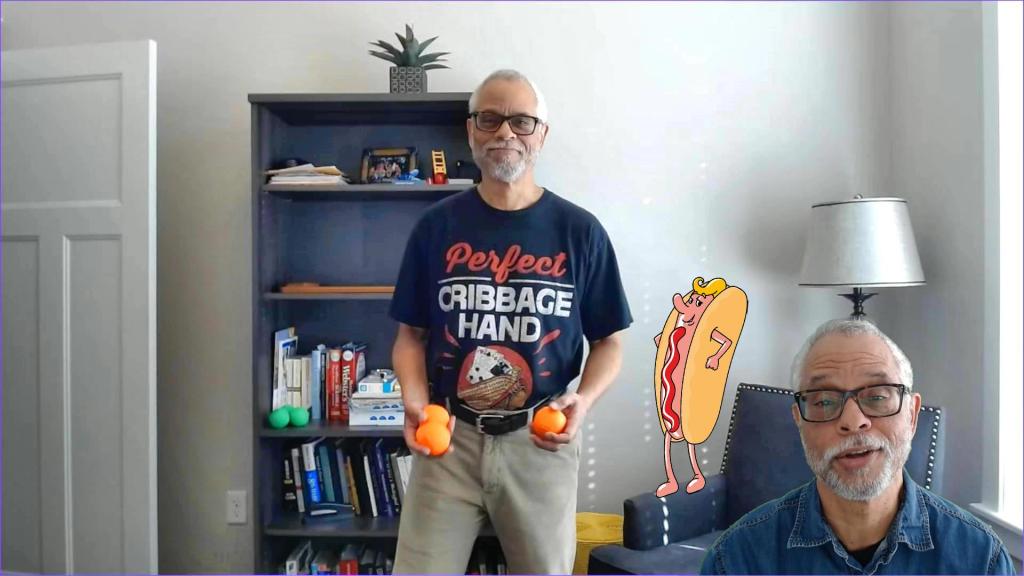
What’s striking, at least to me, is the little bit of science I can find on the web about juggling. I hear the term “muscle memory” when it comes to learning juggling. Actually, there’s some truth to that. There are different kinds of memory. For example, most of us know about declarative memory, which about memorizing facts, because we use it to prepare for exams. Those of us who went to medical school remember the agony of taking tests for the basic sciences.
But so-called muscle memory, or the memory for learning new skills like juggling, takes place in the brain. There was a study published in 2009 which found changes in both gray and white matter of subjects before and after learning to juggle (Scholz J, Klein MC, Behrens TE, Johansen-Berg H. Training induces changes in white-matter architecture. Nat Neurosci. 2009;12(11):1370-1371. doi:10.1038/nn.2412).
The study about correlation of the inability to stand on one leg for 10 seconds with higher mortality in older patients, which I relate to the ability to do the under the leg juggling trick, was published last year (Araujo CG, de Souza e Silva CG, Laukkanen JA, et al. Successful 10-second one-legged stance performance predicts survival in middle-aged and older individuals. British Journal of Sports Medicine 2022; 56:975-980.)
I talk a lot about juggling as though I’m a teacher. I’m not a juggling instructor by any means. You can find better juggling teachers on the web. But my approach to talking about juggling in terms of it being a hobby for me is really not different from how I talked about consultation-liaison psychiatry before and after I retired. I’m still a teacher—just evolving in retirement.
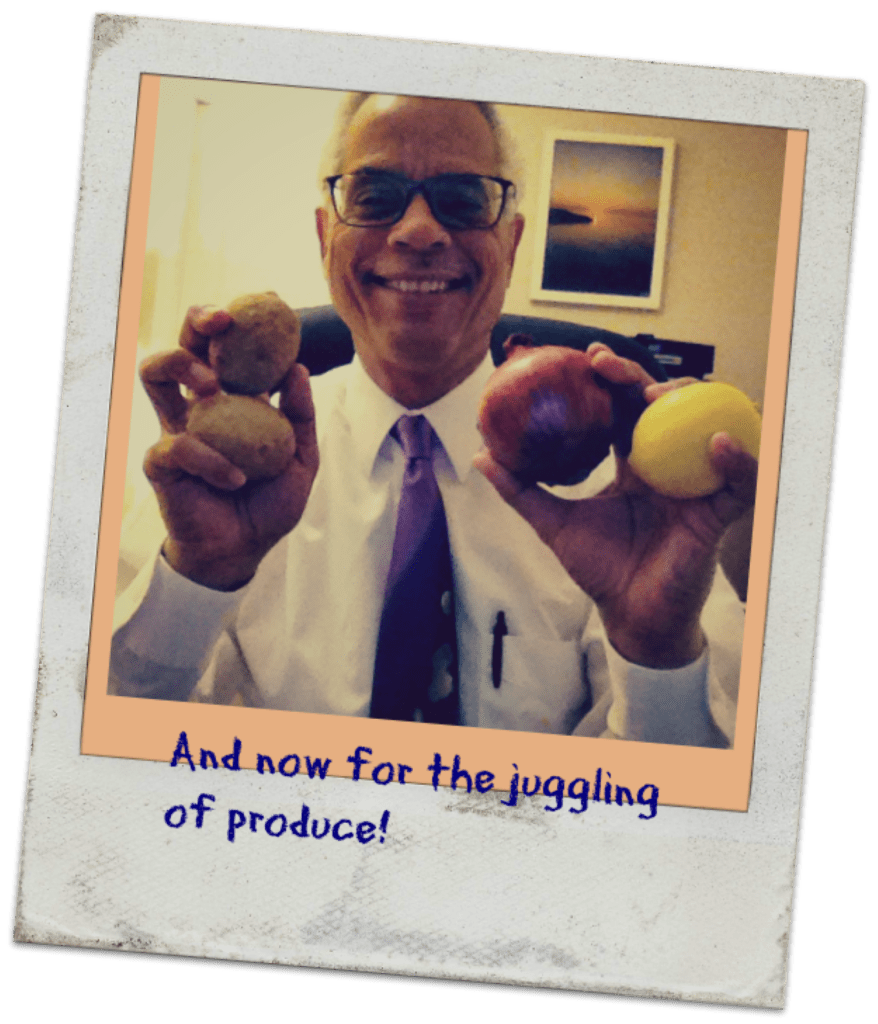
However, you can find much better resources for learning how to juggle at the following websites:
https://www.renegadejuggling.com/
Have fun!
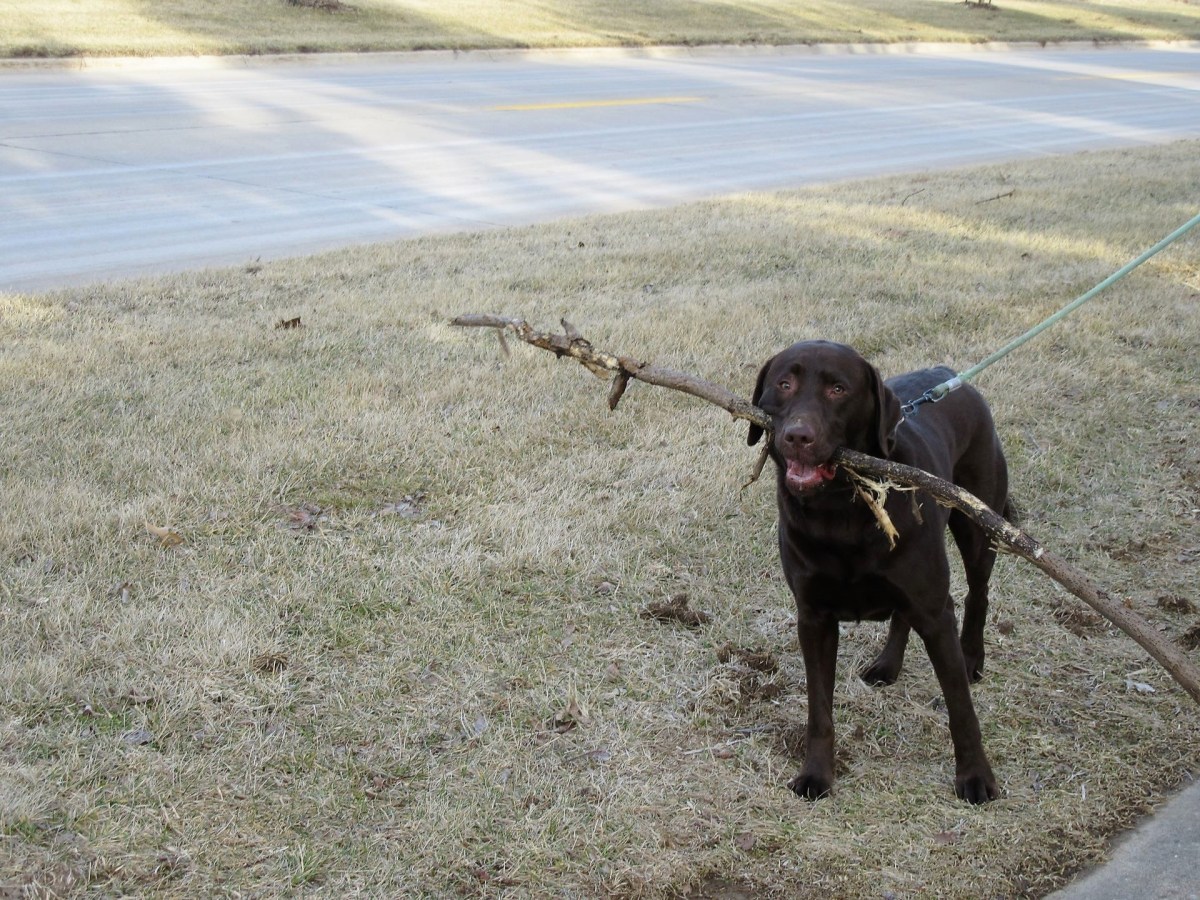
While we were out for a walk yesterday, we ran into someone walking her chocolate Labrador retriever. His name is Hunter and he had a tree branch longer than him in his jaws. He looked like he was having a great time gnawing on it and swinging it around.
I didn’t envy his owner when it came time to going home and taking it away from him.
Mostly younger dogs like to chew on old sticks and some say it might be a good idea to bring a chew toy along with you when you take a dog outside for a walk. It can be tough to persuade a dog to just let the stick go.
As a retired consultation-liaison psychiatrist, I sometimes compare myself to a dog who latches on to a stick and is reluctant to let it go. I’m an old dog that way and, as I’ve mentioned before, it’s a little hard to teach an old dog new tricks.
There are examples of this issue. I rarely go grocery shopping and I still have a lot to learn. I was not good about grocery shopping and other non-work-related chores when I was a doctor for about 28 years, counting residency. Medical school kept me pretty busy too.
Anyway, I went grocery shopping yesterday and I thought I did OK although I had to wander around quite a bit to find everything on my list. Sena doesn’t need a list. She pointed out that I got the unsalted butter—which she never buys. I wondered how I managed to pick up unsalted butter. I thought I was doing good to get the Great Value brand rather than the more expensive brand.
The package was blue instead of red. You mean I have to read the package?
I got a package of chicken breasts and congratulated myself on that. Sena said they were really thin and noticed that they included rib meat—which she normally doesn’t buy. That slipped by me.
I bought a lot of items that we needed; you know, things like milk, eggs, bread, nuclear weapons, etc. But I really didn’t get anything that you could actually make a bona fide meal out of in the sense of cooking something.
Well, I did get a couple of frozen pizzas. This brought the total of frozen pizzas in our freezer to a number I’m not willing to divulge at this time.
I had to maneuver around several shoppers who were filling orders for customers who ordered their groceries on line. I tried that a very few times and it’s more difficult than I thought.
When I got up to the cashier, I just stood there while she rang up my purchases, bagged them—and then she started to put the bags in my cart. She didn’t say anything but a tiny bell in my brain rang somewhere and it occurred to me that I was supposed to put the bags in the cart. I apologized and got to work right away when I noticed. I recalled that it was probably just that mistake that led to my leaving an item at the store the last time I shopped.
Sena went to the grocery store after I got home and returned with items that could be used in menus. I think that is called meal planning.
But I did make dinner last night, meaning I reheated left-over chili and chopped up some vegetables for salads. Oh, and I got the saltines out for the bread group.
Sena is still trying to coax me to let go of the stick.
We got our new wall clock on the wall the other day. It got me to thinking about how I view time and other matters now that I’ve been retired for about two and a half years.
I actually tried to ease into retirement by getting a 3-year phased retirement contract. I thought that might help me get adjusted to not being a fire fighter as a consultation-liaison psychiatrist. I don’t know how helpful that was.
So, I looked up the stages of retirement on the web. There are slightly different versions but most of them have 5 stages:
I guess I’m somewhere at the tail end of disenchantment and the beginning of reorientation. I have to point out a few things about me and the clock on the wall to help get my point across.
When I was running around the hospital, I used to pay a lot of attention to the clock. One example is how I helped medical nurses and doctors diagnose and manage catatonia. That’s a complicated and potentially life-threatening condition linked to a lot of medical and psychiatric disorders. It can make people afflicted with it look like they have a primary mental illness and they can look and act spooky.
Most people with catatonia are mute and immobile. They could also have wild, purposeless agitation but the mute and immobile type is more common. I would recommend administering injectable medicine in the class of benzodiazepines, often lorazepam.
Often the catatonic person would wake up and start answering questions after being like a statue only minutes before the injection. I watched the clock very closely, and the nurse and I watched the vital signs even more closely.
The recovery from a catatonic state looks like a miracle, which often made me look like a hero—despite the fact I could not explain exactly the mechanism of how catatonic states begin or how injectable benzodiazepines work to reverse the state. In most situations, on the general medical and surgery wards, the cause was not infrequently a medical emergency.
That made retirement difficult. I often didn’t notice time passing when I was working. In fact, my job as a C-L psychiatrist was marked by a series of emergencies, hence the fire fighter feel the job held for me.
Somehow, interrupting my schedule (if you can call firefighting a schedule), didn’t help me very much in my adjustment to retirement.
Right from the start, I noticed I missed being a hero. By the time I got to the first stage, Realization, I was already part of the way into the Disenchantment stage. I don’t really recall the Honeymoon stage.
Time passed slowly after full retirement for me. Not even the phased retirement schedule prepared me for it. It was excruciating. I have never slept very well, but my insomnia got worse after retirement.
I had fleeting thoughts about returning to work, and that’s the surprising thing. You’d think I would have just dropped the whole retirement thing and get right back in the fire truck.
But I didn’t. Part of me knew that the job consumed me and burnout was a consequence. My focus on work did not help me be a good husband. On the other hand, retirement by itself didn’t help either.
It’s still hard, but not as difficult as it was at first. I would say that I’m somewhere between the latter part of Disenchantment and the beginning of Reorientation. I’m not anywhere near Stability.
I have replaced my schedule to some degree. Most days, I exercise and practice mindfulness meditation. I have also recently taken up juggling, as many of my readers know.
But any YouTube videos of me “cooking” are bogus. Sena takes video of me messing around making pizza and whatnot as if I know what I’m doing—but she’s giving me cues every step of the way. I’m allergic to kitchens and I probably always will be.
Anyway, I have a different relationship with the clock nowadays. I’m still hoping that I’ll evolve into somebody who knows how to manage not just retirement better, but a whole lot of things in a more adaptive way.
I sure hope so. According to some statistics, at my age I’ve got a limited time to improve. So, I need to get busy.
Occasionally I’ll reminisce, an activity which recently got triggered when I realized why I tend to like watching TV shows like Highway Thru Hell and Heavy Rescue 401, which are heading into the 10th and 6th seasons, respectively. Despite that, last year I didn’t see any episodes in which the COVID-19 pandemic was even mentioned. Nobody wears masks. They’re hard-working people in Canada who basically drag semi-trucks out of various ditches. It’s hard work, they’re down-to-earth and they’re not acting.
I marvel at what they do. It’s brutal, real, and no-nonsense. While I watch them, I tend to forget about the pandemic, and the social and economic upheaval everywhere on the planet. For a little while, I almost stop thinking about bored I am and without a purpose or meaning sometimes in retirement. I just find myself being glad I don’t have their job.
Sometimes I think about how I got my start as a working stiff, starting out as a teenager doing practical work like the heavy tow truck drivers. Now, don’t get me wrong. I’m not trying to sell you the idea that land surveying is really hard work. I was outside most of the time, although in the winter when highway, street, and other construction was down, I would do some drafting. I worked for WHKS & Co. If you click the link to their website, scroll all the way down on the About Us section. There’s a black and white picture with four frowning men sitting at a heavy desk in front of a bookcase with many large books in it. They are from left to right, Richard “Dick” Kastler, Francis Holland, Ralph Wallace, and Frank Schmitz. I didn’t know Richard but his brother, Carol Kastler, was my boss along with the other three. Carol Kastler was the head of the land surveying department.
This is not going to be a history of surveying, which I’m not qualified to do; just my impressions of it as a young man. I can flesh it out a little with a video about how to throw a chain, and an extremely detailed reminiscence written by a real old-timer about surveying that was a lot like the way I remember it. Try to read all of Knud E. Hermansen’s first essay about measuring with a steel tape, “Reminisce Of An Old Surveyor, Part I: Measuring a Distance by Taping.” You can skip Part II, which even I couldn’t relate to because the stuff was way before my time.
Hermansen’s description of measuring distance using a steel tape and plumb bob is spot on, though. The other thing I would do in the winter down time was tie up red heads—which is not what you’re thinking. You tied red flagging around nails which were used to mark distances measured.
We often did work out in the field through the winter, though. When we set survey corners using what were called survey pins. Sometimes we had to break through the frozen ground first by pounding a frost pin with a sledge hammer. I remember WHKS & Co. made their own cornerstones using a wood frame box and cement. They were several feet long and they were heavy and surveyors carried them slung to their backs through the timber.
We spent a lot of cold days on straightening out a lot of the curves in Highway 13 between Strawberry Point and Elkader in eastern Iowa. We had expense accounts and were often away from our homes a week at a time for most of the winter. We ate a lot of restaurant food. Carol Kastler was partial to pea salad.
Guys told colorful stories out in the field, some of them pretty sobering. We were out setting stakes for widening a drainage ditch and talking with an old timer running a piece of heavy equipment called a dragline excavator. It has a long boom and a bucket pulled by a cable. The old timer told a harrowing study about his son, a dragline operator himself, who suffered a terrible accident. Somehow the boom broke off and fell on him. It didn’t outright kill him and workers frantically called his father (the old timer). They told him to come quick to see his son before he died because they knew they couldn’t get him to a hospital quick enough from way out in the field. The old timer just said, “I don’t want to see him.” It was just like that, a simple statement. It sounded cold but he somehow conveyed that he just didn’t want his last encounter with his son to be under a horrifying circumstance like that.
The company had Christmas parties which almost everybody enjoyed a lot. There were some guys who had a hard time relaxing. I remember a driven, work-devoted surveyor, who was thinking about work. I could tell because there was some kind of game we were playing which involved writing something like a question on a piece of paper and giving it to someone else, some inane thing like that, I can’t remember the details. I gave him my slip, and he took it. While he scribbled something on it without looking at it, he looked away and mumbled, “I really don’t have a whole lot of time.” He was at the party but his mind was out in the field.
It’s hard not to absorb experiences like that early in your life when you’re still young and impressionable. Work can become a way of life. It doesn’t seem to make a difference what kind of work it is. Even Agent J in Men In Black 2 gets a short lecture from Zed after Agent J returns from a mission and seems like he’s on autopilot, asking Zed for yet another mission, “What do you got for me?” Zed says, “Dedication’s one thing, but this job will eat you up and spit you out.”
It’s even hard for some of the guys in Highway Thru Hell and Heavy Rescue 410 to relax; even after a heart attack, one older guy can’t wait to get back in the tow truck. But even he knows that it’s a young man’s job.
Anyway, I promised I would show a video about how to throw a chain, which I learned how to do back in the day. I’m pretty sure I couldn’t do it today.


 Go Retire Psychiatrist