I put 2.5 miles on the step counter today walking on the Clear Creek Trail, so my feet are complaining a bit more.
Sena didn’t come with me on the walk today because of some gardening she had to do. She deals with foot issues and has been trying shoe inserts lately. Trimming them is an inexact science, but she got it right. The thing was, her feet hurt even worse with the inserts.
That’s because they were upside down. There are raised gel contours around the bottom for extra support, which have to face downwards in the shoe. They were a lot more comfortable for her once they were in right side up.
I didn’t get any shoe inserts because my new shoes fit pretty well. I walked a little further than usual, moving east on the part of the trail which has a fair number of ups and downs. It feels more like a nature walk (which is on the Make It OK Calendar for May Mental Health Awareness Month).
The trail is paved, but the trees and other vegetation are thick and tend to crowd around both sides. The trees sometime bend in archways across the path.
It was tempting to park my butt on the bench, but just sitting might have invited more flying bugs to buzz around my ears—despite applying enough OFF to defend me and a few other people.
We’ve walked this trail many times, but I saw something a little unusual today. There’s a big old dead tree that looks like a tuning fork.
I set a goal to reach a familiar place that’s high enough and cleared of foliage to see the creek from high above. That’s where I saw the 3 ducksateers: mallards in a line swimming up and down the stream in a sort of aimless way, yet determined to make good time.
After I returned to the trailhead, I heard the camera-shy gray catbird I always hear in a tall shrub right next to the trail. I sat in a bench close by with my camera out. It made the typical catbird noises, which sounds like a collection of whistles, creaks, and meows. But it hid in the leaves and when it burst onto the paved trail, it moved too quickly for me to get a shot.
I think the catbird hides in the trees right next to other birds, like robins, just to misdirect you. And that fooled me today–again. I thought I got a video clip of the catbird—but it turned out to be a robin, hamming it up for the camera like robins always do.
So, I included an old picture of a real catbird I took about a year and half ago.
shoe inserts wrong side upshoe inserts right side upthe archway treethe beckoning benchthe tuning fork treethe 3 ducksateersthe catbird photo taken a year and a half ago
Today is designated Earth Day although there is such a thing as Earth Month. Among the several trees Sena planted in our back yard trees are a few that we hope exemplify the Earth Day theme, which is Our Power, Our Planet.
One of them is a dogwood, which we’re hoping will bloom soon. Dogwoods represent joy and rebirth. There are a couple of crab apple trees, a red jewel and a perfect purple. Crab apple trees represent love and all are very special to Sena and me.
Love, joy, and rebirth. They can all be linked to power, which can be the power of will. The will to respect the planet also implies respecting each other. Practicing humility can be a kind of power.
The power to be still and listen to each other can make us more open to change.
On that note, because I can’t go for long without joking around, I should retell the story about me and the walking dead meditation. About 13 years ago, I had an even more serious case of not listening to others than I do now, if you can believe that. It eventually led to my choosing to take the Mindfulness Based Stress Reduction (MBSR) class ( see this current University of Iowa mindfulness essay). I wrote an essay for the Gold Foundation and it’s still available (I updated the links):
How I left the walking dead for the walking dead meditation (August 13, 2014)
About a year or so later, I bought Jon Kabat-Zinn’s book on Mindfulness-Based Stress Reduction (MBSR), Full Catastrophe Living, because I was dimly aware of the burden of stress weighing on me as a consulting psychiatrist in an academic medical center. I didn’t get much out of Kabat-Zinn’s book on my first read. But then in 2012 I started getting feedback from colleagues and trainees indicating they noticed I was edgy, even angry, and it was time for a change.
Until then, I’d barely noticed the problem. Like most physicians, I had driven on autopilot from medical school onward. I had called myself “passionate” and “direct.” I had argued there were plenty of problems with the “system” that would frustrate any doctor. I had thought to myself that something had to change, but I never thought it was me.
After reflecting on the feedback from my colleagues and students, I enrolled in our university’s 8 week group MBSRprogram. Our teacher debunked myths about mindfulness, one of which is that it involves tuning out stress by relaxing. In reality, mindfulness actually entails tuning in to what hurts as well as what soothes. I was glad to learn that mindfulness is not about passivity.
But I kept thinking of Kabat-Zinn’s book, in which he described a form of meditation called “crazy walking.” It involved class members all walking very quickly, sometimes with their eyes closed, even backwards, and crashing into each other like billiard balls. I hoped our instructor would not make me “crazy walk” because it sounded so—crazy. I dreaded crazy walking so intensely that I considered not attending the 6-hour retreat where it might occur.
We didn’t do crazy walking. Instead, we did what’s called the “walking meditation.” Imagine a very slow and deliberate gait, paying minute attention to each footfall—so much so that we were often off balance, close to crashing into each other like billiard balls.
I prefer to call this exercise the “walking dead meditation” because it bore a strong resemblance to the way zombies move. One member of the class mentioned it when we were finally permitted to speak (except for the last 20 minutes or so, the retreat had to be conducted in utter silence). It turned out we had all noticed the same thing!
Before MBSR, I was like the walking dead. I was on autopilot — going through the motions, resisting inevitable frustrations, avoiding unstoppable feelings, always lost in the story of injustices perpetrated by others and the health care system.
In practicing mindfulness, I began noticing when my brow and my gut were knotted, and why. Just paying attention helped me change from simply reacting to pressures to responding more skillfully, including the systems challenges which contribute to burnout. About halfway through the program, I noticed that the metaphor connecting flexibility in floor yoga to flexibility in solving real life problems worked.
Others noticed the change in me. My professional and personal relationships became less strained. My students learned from my un-mindfulness as well as my mindfulness, a contrast that would not have existed without MBSR.
As my instructor had forewarned, it was easy for me to say I didn’t have time to practice meditation. I had to make the time for it, and I value the practice so much that I’ll keep on making the time. I will probably never again do the walking dead meditation.
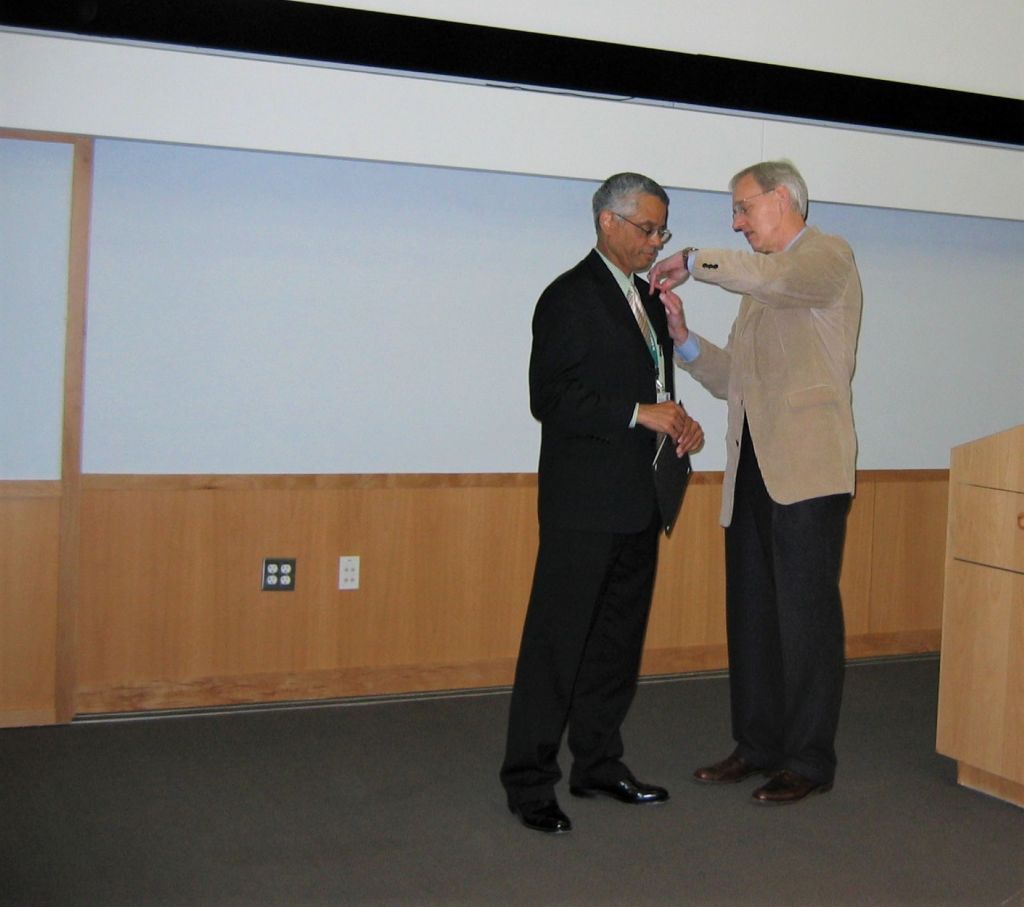
Today we gather to reward a sort of irony. We reward this quality of humanism by giving special recognition to those who might wonder why we make this special effort. Those we honor in this fashion are often abashed and puzzled. They often don’t appear to be making any special effort at being compassionate, respectful, honest, and empathic. And rewards in society are frequently reserved for those who appear to be intensely competitive, even driven.
There is an irony inherent in giving special recognition to those who are not seeking self-aggrandizement. For these, altruism is its own reward. This is often learned only after many years—but our honorees are young. They learned the reward of giving, of service, of sacrifice. The irony is that after one has given up the self in order to give back to others (family, patients, society), after all the ultimate reward—some duty for one to accept thanks in a tangible way remains.
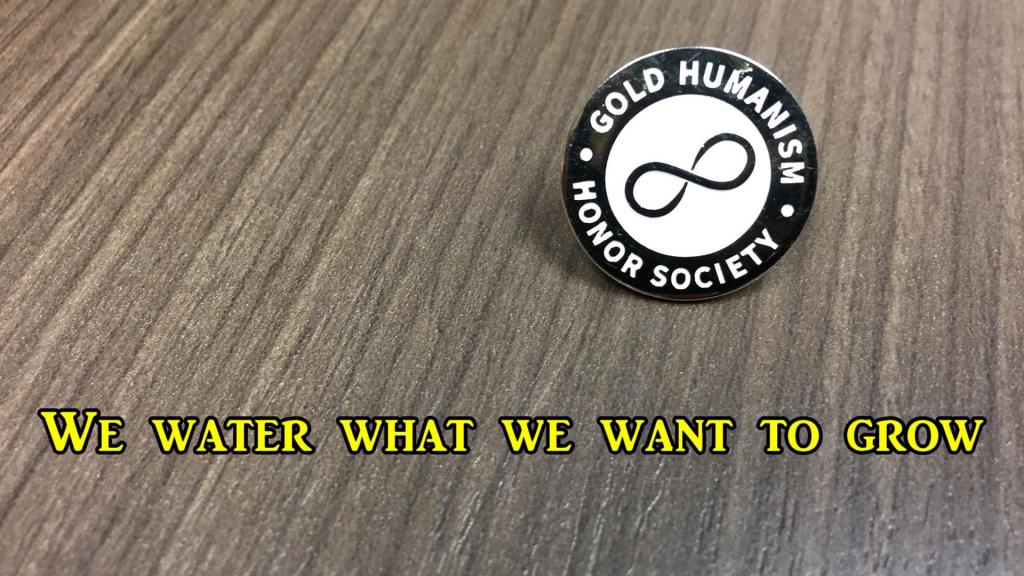
One may ask, why do this? One answer might be that we water what we want to grow. We say to the honorees that we know that what we cherish and respect here today—was not natural for you. You are always giving up something to gain and regain this measure of equanimity, altruism, trust. You mourn the loss privately and no one can deny that to grieve is to suffer.
But what others see is how well you choose.
Leonard Tow awardGetting the pinOn my lapel; in my heart
I’m still practicing mindfulness-more or less. Nobody’s perfect. We hope the dogwood tree blooms soon.
We listened to the Big Mo Blues Show last night on KCCK radio 88.3. It was recorded and we noticed that he sounded younger for some reason. Once he remarked that things were difficult because of having to “shelter in place.” The format of the show was different from usual.
That made me wonder if the show was recorded sometime during the Covid pandemic. I’ve been listening to Big Mo for a long time. John Heim, aka Big Mo, been doing the Friday Blues show since about 2005, according to one news story. Another KCCK legend, Bob DeForest, has been doing the Saturday night blues show for over 30 years now.
John Heim, aka Big Mo is still going strong. I think I’ve been listening to his show for about as long as he’s been doing it. He has come back strong since an accidental fall in 2018 in which he sustained a neck injury which led to a long rehab stint. But he’s back.
There have been interesting additions over time, like the Shout-Outs, the Concert Calendar, the Bodega Bay Weather Report, the Big Mo Pod Show in which he and producer Noah on Saturday discuss the music selections he made on Friday. The comedy bits have also been interesting, like MayRee’s hand-battered catfish (It’s better because it’s battered!).
Last night, we heard a couple of songs which we both liked. One of them was “She Don’t Live Around Here” by Samantha Fish. I heard it for the first time on the Big Mo Blues Show and just about every time I hear it, the hair on the back of my neck stands up. I’ve read that music will do that sometimes, although I can’t remember getting that sensation before.
We both liked Delbert McClinton’s rendition of “I’ve Got Dreams to Remember.” He’s had a huge career. Sena asked me if he’s still alive and I foolishly guessed that he died. Nope, he’s 84 years old and evidently still going strong.
I have a personal top ten songs, most of which I’ve heard on the Big Mo Blues Show. They’re not in any particular order. A few of them I like mainly because of the artist’s voice, like Samantha Fish and James Carr.
“She Don’t Live Around Here” Samantha Fish
“The Dark End of the Street” James Carr
“Everyday Will Be Like a Holiday” William Bell or Eric Clapton
“Lean On Me” Bill Withers or Keb Mo
“Mockingbird” Larkin Poe
“I’ve Got Dreams to Remember” Delbert McClinton (written by Otis Redding)
“You Were Never Mine” Delbert McClinton or Janiva Magness
“A Change is Gonna Come” Sam Cooke
“Over The Rainbow and What a Wonderful World” medley Israel Kamakawiwo’ole
“You Can’t Teach An Old Dog New Tricks” Seasick Steve
Lately, Big Mo has played Larkin Poe’s “Mockingbird” a fair number of times. I think one interpretation of it is that people’s sense of their identity tends to evolve over time. At different times in your life, you’ll take on a new voice, so to speak, which fits with the idea of the many songs the imitative Mockingbird sings.
Some songs I like because of the message, like “Lean On Me,” or “A Change is Gonna Come.” And I like the song “You Can’t Teach An Old Dog New Tricks” just because I identify with it. I realized that runs counter to the theme of many songs, which are often about change: people change, the times they are a’changing, and the like. So, my top ten song list will probably change, too.
The big news for University of Iowa will be a NASA satellite mission to investigate how solar wind interacts with Earth’s magnetosphere. You can read the whole fascinating story in this issue of Iowa Magazine.
According to the story, “twin spacecraft known as TRACERS—Tandem Reconnection and Cusp Electrodynamics Reconnaissance Satellites—will begin their journey to study Earth’s mysterious magnetic interactions with the sun. The satellites will be packed with scientific instruments along with two small, but meaningful, tokens.”
The two small tokens happen to be purple guitar picks that belonged to University of Iowa physicist, Craig Kletzing, who died from cancer in 2023. Kletzing and colleagues got a $115 million contract from NASA for TRACERS. It’s the largest research award in University of Iowa history.
Kletzing played guitar in a few bands, and one them was named Bipolar—which is the only connection to psychiatry that I could see. He was dedicated to work in basic science, and he was often heard to ask “How can we make this simpler?” referring to chunking big scientific challenges into manageable goals. He was a rare person in that he was both a brilliant scientist and a great teacher. One example of his work ethic was that he skipped a meeting with NASA’s top brass in order to deliver a morning lecture on introductory physics to 275 students.
The members of the UI TRACERS team call the project “Craig’s mission.” I’m pretty sure he would have called it a team effort “… to help scientists better understand the powerful forces harmonizing throughout the universe—something the ancient Greeks described as the music of the spheres.”
And that’s what the purple guitar picks represent.
We got out today on the Terry Trueblood Trail because it was sunny and 60 degrees. It felt like early spring, although Punxsutawney Phil put the kibosh on that.
The ice was giving way on Sand Lake. The birds were waking up and hungry. And I can’t remember the last time we saw bluebirds at all, let alone the many we saw out in the open grassland today.
It was the kind of day you forget what’s in the news and just celebrate the coming of spring. Just watch the bluebirds fly.
We listened to the Christmas tunes on the KCCK Big Mo Blues Show last night, “All Dem Christmas Favorites.” We both liked Earth Kitt’s “Santa Baby,” which wasn’t on the podcast list, but what the heck. I got a kick out of Brave Combo’s silly rendition of “O Holy Night.” Fareed Haque’s guitar solo of “You’re a Mean One, Mr. Grinch” was pretty impressive.
After a short break during the Thanksgiving holiday your hosts are back at it again with another episode! This week features the usual mix of blues eras you’ve come to expect along with a few Californian artists, tune in to see which ones! Songs featured in the episode: Solomon Hicks – “Further On Up The … Continue reading
I heard the Big Mo Blues Show just (Halloween theme) this last Friday night and was not surprised to see that one of the songs discussed on the Big Mo Pod Show on Saturday was Peetie Wheatstraw’s “Devil’s Son-in-Law.”
When I first heard it, it got me chuckling because I didn’t understand hardly a single word until the last line. It was babbling. I can remember googling the term “Peetie Wheatstraw and unintelligible,” which revealed I’m not the only one who thinks he’s unintelligible. It’s a mondegreen mine field. It’s a good thing the lyrics are available.
I want to hastily point out that he’s not always unintelligible—but William Bunch aka Peetie Wheatstraw is speaking in tongues on that song. For comparison I listened to another song, “Sweet Home Blues” and I could understand just about every word in the lyrics.
That led me down the rabbit hole about the artist in a web search that seemed to have no end. I should probably say Brer Rabbit hole since most of my searches pointed in the direction of a character called Peter Wheatstraw, Petey Wheatstraw, as well as Peetie Wheatstraw who had variations in their identities, most often in the context of African American folklore.
I’m not going to attempt a summary of my web search on Peetie Wheatstraw; there’s too many twists and turns. You can start with the Wikipedia article. But from there, you can get trapped in Brer Rabbit’s little tunnels, which can run in different directions.
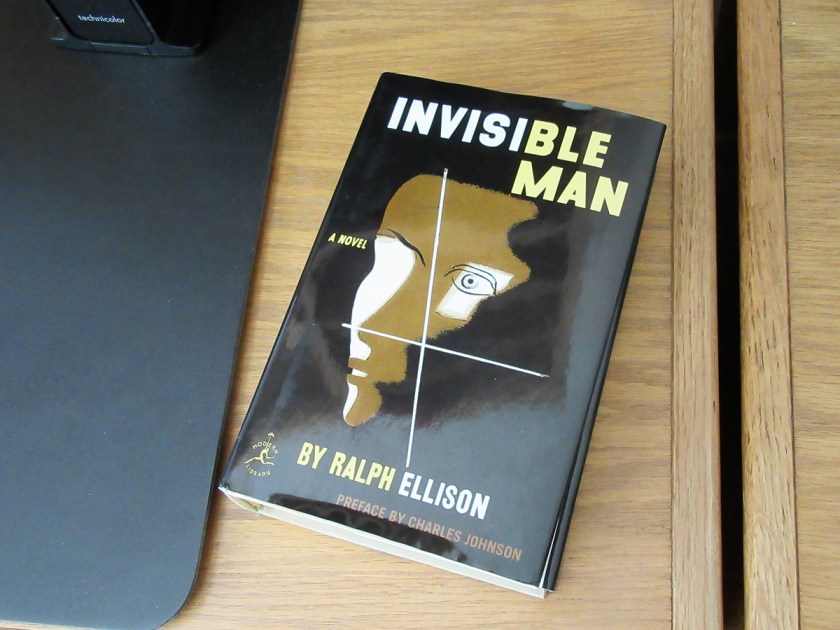
William Bunch was a blues artist in the 1930s who adopted the moniker “Peetie Wheatstraw.” While Big Mo says it’s sort of another name for Satan, I found confusing references by writers who claim that the Peter Wheatstraw character comes from Black folklore. There are those who believe that novelist Ralph Ellison wrote about a character in his book “Invisible Man” named Peter Wheatstraw and said it was the only character in the novel that was based on a live person—William Bunch.
Is that true? And did Ellison ever meet Peetie Wheatstraw (William Bunch)? I can’t tell from the web articles.
I was prompted to get my copy of “Invisible Man” out after reading a scholarly online essay mentioning the Peter Wheatstraw character, “Re-visioning Ralph Ellison’s Invisible Man for a Class of Urban Immigrant Youth” by Camille Goodison, CUNY New York City College of Technology. I couldn’t remember Wheatstraw at first, but there he was in Chapter 9.
Goodison reveals there is a lot more texture to the Wheatstraw character then just as a moniker adopted by William Bunch. Wheatstraw is probably more complex than the devil. He has many sides to him and could be helpful—but mostly in an indirect way. His guidance is full of riddles and there doesn’t seem to be a solid way to cut through the metaphorical morass. As Emily Dickinson advised, Wheatstraw may tell the truth—but tells it slant.
I ran across a fascinating story about a study on Huntington’s disease published by members of the University of Iowa Health Care. The study examined how the Huntington’s disease gene might enhance brain development and function early in life prior to the onset of the devastating disease. It was published in The Annals of Neurology:
I also found an abstract for a paper about Woody Guthrie, a famous American musician and activist who was very creative in his early life, but sadly succumbed to the ravages of Huntington’s disease when he was 55 years old. I couldn’t access the full article without paying for it but the abstract was intriguing because I wondered whether the author suspected something similar to the premise of the study:
Ringman JM. The Huntington disease of woody guthrie: another man done gone. Cogn Behav Neurol. 2007 Dec;20(4):238-43. doi: 10.1097/WNN.0b013e31815cfee4. PMID: 18091075. Abstract: Woody Guthrie was an American songwriter, musician, writer, and political activist who died with Huntington disease (HD) in 1967 at age 55. His relatively brief creative life was incredibly productive with countless songs and a tremendous volume of letters to his name. His personal life was similarly driven with Woody having had 3 wives and at least 9 children and an insatiable appetite for traveling the United States. In this essay, I explore Guthrie’s art in relation to the development of the overt behavioral changes and chorea that characterized his illness. Woody’s most productive time artistically was in the 5 years immediately preceding the onset of overt symptoms of HD. I hypothesize that subclinical HD may have been an important driving force behind Woody Guthrie’s creativity.
If anybody knows, please comment.
Woody Guthrie was certainly an important figure in the American history of activism as well as music.
Usually, I would share the music of some of the artists I mention on this blog. On the other hand, one of the co-authors of the University of Iowa paper mentioned above is Doug Langbehn, my former colleague, who’s an accomplished musician and statistician. So instead, I thought I’d share the talent of Doug and his band.
The University of Iowa Stead Family Childrens Hospital in Iowa City has ranked in 9 pediatric specialties, including pediatric behavioral health by U.S. News & World Report!
I didn’t get to listen to the Friday blues with Big Mo last Friday because my little Sony Dream Machine radio audio kept cutting out.
But on the Friday blues of August 9, 2024, I heard a tune I liked. It was “Hit ‘Em Back” by Kenny Wayne Shepherd and Shemekia Copeland.
Some blues songs can be gritty and dark, but the title “Hit ‘Em Back” isn’t what it makes you think. The song is really about turning the other cheek, emphasizing the growing importance of getting along with each other.
Getting along with each other is hard to do. I know to most old people (including me) that used to be a lot easier. Old people say that, like saying “What happened to the good old days?”
Well, when I reflect on the past just from my perspective, I have trouble remembering the so-called good old days. In general, we all struggle to get along with each other.
I think the song “Hit ‘Em Back” is a novel way of expressing how relationships between people and nations usually go, but also suggest we “hit” them with love. We mostly hit each other back-in a bad way. The lyrics send an apparently paradoxical message which gets your attention.
And then you get it. Let’s not hit each other. Let’s listen to each other instead.











 Go Retire Psychiatrist