Huston-Tillotson University News!

I feel like I should put on my Huston-Tillotson College (H-TC) news reporter press tag for this brief announcement, which you can get pretty much anywhere on the web anyway. Just a reminder, I was a reporter for the Ramshead Journal back in the 1970s for H-TC (now H-T University).

The breaking news is that the Moody Foundation recently gave H-TU a large gift of $150 million. It’s the largest gift to a single Historically Black College and University (HBCU) in history. Furthermore, the philanthropist MacKenzie Scott gave a $70 million gift to the United Negro College Fund recently to be divided among the 37 HBCUs. H-TU will also get a piece of that.

For more details about these donations, see the pbs story.

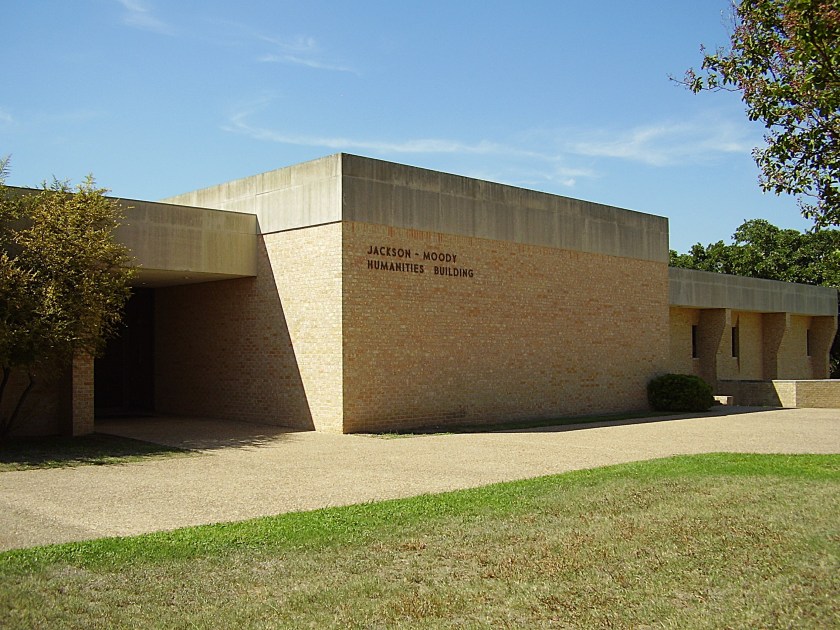
As an aside, the Jackson-Moody Humanities building on campus was named after the Moody Foundation, which covered the financial cost of construction. E.W. Jackson was a former trustee and donor. I took my English, Literature, and Spanish classes there.

picture is in the public domain

The other news is that H-TU rose in the National rankings and is now the #1 private HBCU in Texas for 2026.

A big congratulations to Huston-Tillotson University!

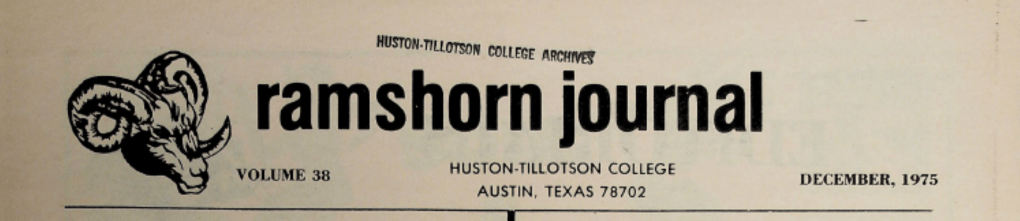
History Lessons in the Ramshorn Journal

I think I found a pair of articles from the mid-1970s in the Huston-Tillotson College Ramshorn Journal that might have a connection to each other, even though the authors didn’t know it at the time.

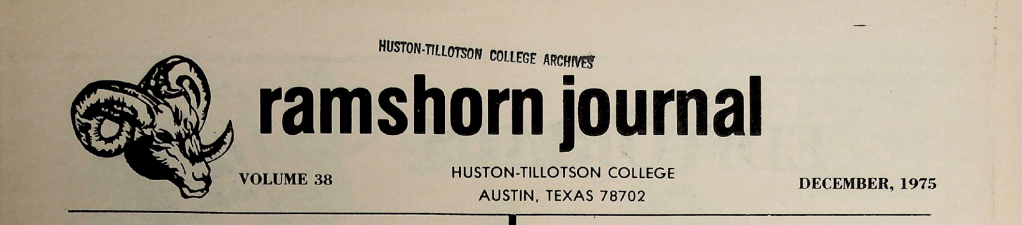
One of them was written by yours truly and published in December of 1975, entitled “H-TC Sponsors Education Seminar.”

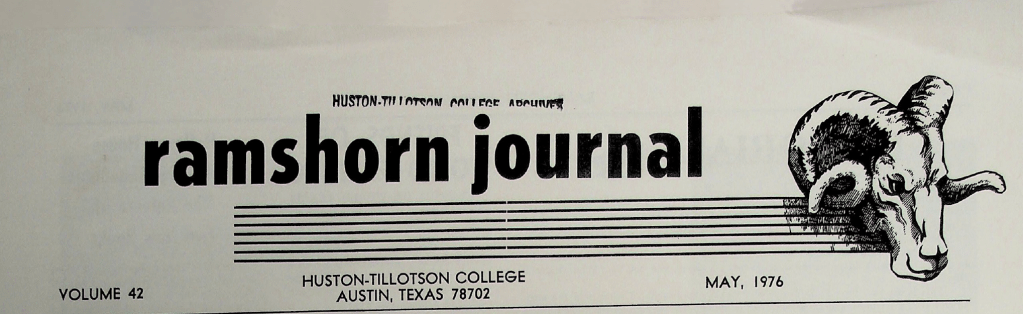
The other is a New York Times editorial from January 1976 which was reprinted in the May 1976 volume of the Ramshorn Journal and was written by Christopher F. Edley, a very successful lawyer and, at the time, the Executive Director of the United Negro College Fund.

Both were written about the same time, in the era of the civil rights struggles. I’m not comparing myself to the brilliant and accomplished Mr. Edley. And I’m just going to admit that I really don’t remember much about the trip to Houston for the Education Seminar about which I wrote my article, despite my being a participant. But I think it’s hard not to notice the language I used in my description of the importance of what the education seminar was all about. While much of the text is rather dry, when I discuss what was emphasized, I sound a little more intense. I may not remember much of what we specifically did and said but I caught the tone.

When I say the trip was not a guided tour, I mean that both faculty and students were serious about what the main message was for us—as black people. We had to measure up in a way that implied that we had to be better than best. That whole section starting with “Throughout the program, our people were reminded that any person who aspires to a position with any company must fulfill particular criteria.” It was as if I were saying we had to be perfect to make up for being black. We had to be the exemplars.

The individual must exhibit creativity, aggressiveness, ambition, self-confidence, initiative, dedication, maturity, and an ability and willingness to cooperate and effectively communicate with other people. The individual must punctual and reliable. Industry demands nothing less than high-gear performance. But they pay handsomely for that high-gear performance.

As I read this now, I get caught up on all the exhortations to be scrupulous, alert, and so on because, after all, we’re in a corporate jungle which is all about survival. I could have recast the last sentence above as “But they pay dearly for that high-gear performance”—which refers to the candidate, not the one doing the hiring.

I admit that how I wrote the story may reflect my reaction to rather than the reality of the emphasis of speakers at the seminar.  But I did get the impression that I, as a black person, would be held to a higher standard than a white person. And I was uncomfortable about that.

When I turn to the New York Times article by Mr. Edley, I again am impressed with the struggle for fairness and justice, which didn’t seem forthcoming. He expressed the same sense of unfairness that I felt in Houston. The tone is almost one of outrage. He described the black people who were going to college in those days as most likely being the first ones in their families to go to college.

That’s what I was.

Mr. Edley was expressing frustration about blacks and browns just being able to get to the door of opportunity. I got the message that the struggle would go on forever—even if we got in the door. We didn’t just have to prove we were equal. We had to prove we were better.

Anyway, as I read the articles I wrote for the Ramshorn Journal 50 years ago, I begin to realize why I had no memory of having written them. It gradually becomes less strange that I still don’t really remember much of my time at Huston-Tillotson College, one of the historically black colleges and universities (HBCU) in America. But I needed that experience, even if I did pay dearly for it.

Click in the gallery; click on the picture, click the icon with an “i” in a circle, click view full size, click the plus sign to enlarge the image.

One More Time: Another Ramshorn Journal Editorial

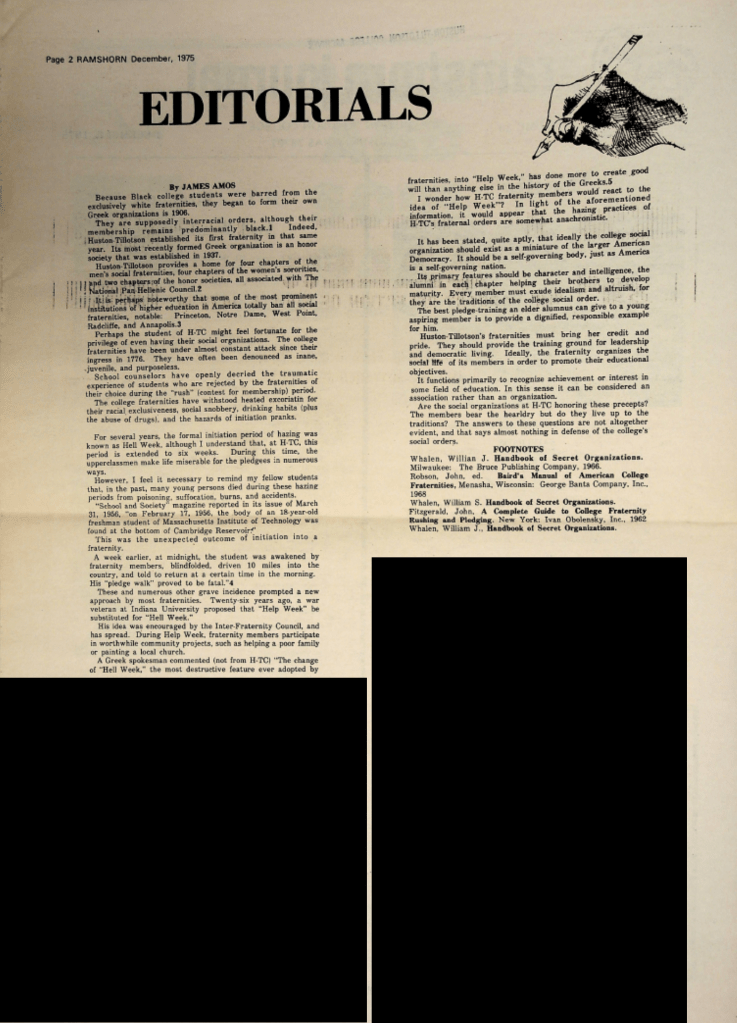
This is the 2nd editorial I wrote in 1975 about fraternities during my freshman year at Huston-Tillotson College (now Huston-Tillotson University, one of the Historically Black Colleges and Universities, HBCUs). There are a couple of misspelled words (“incidence” should be incidents; “altruish” should be altruism).

On the whole, it’s a more developed piece than the editorial about college hazing. I thought then and still think that Help Week should be substituted for Hell Week.

ramshorn journal vol 38, dec 1975 Click the image; Click the little icon circle with i; hover over the image and click the plus sign to enlarge.

I Was a College News Reporter After All

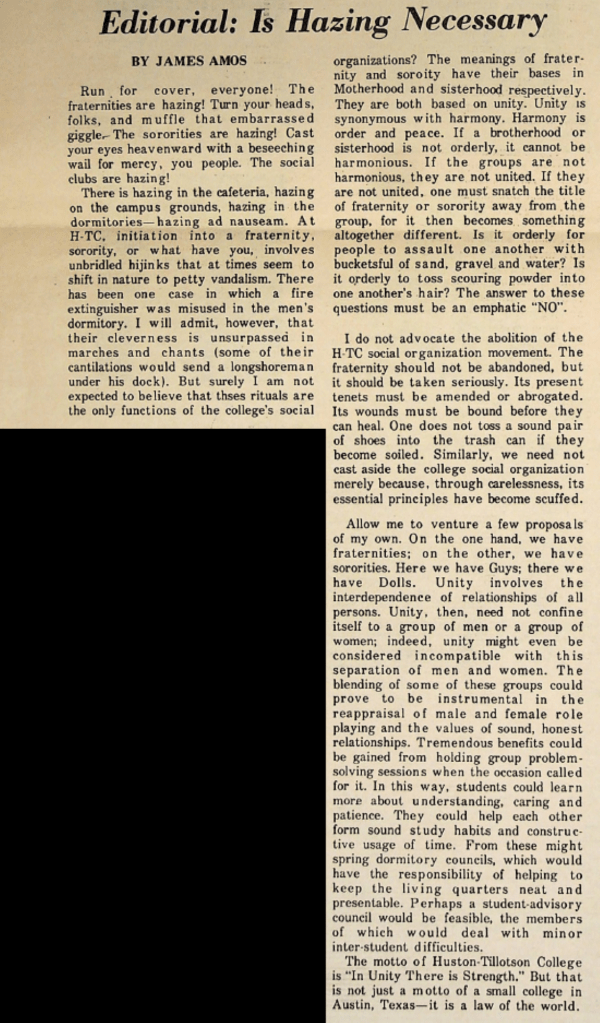
It turns out I was a news reporter for the Huston-Tillotson College Ramshorn Journal after all! I wrote a few of them, including an editorial about Greek fraternity hazing in 1975. I’m including it in this post below. It has an apparent typo in it (“Motherhood” should be brotherhood).

It’s typical for fired up freshman writing. I see lots of youthful idealism, energy, and a drive for change. How did I forget so much of what I was over the last 50 years?

I wrote “Is Hazing Necessary” (the question mark is missing) because I saw it going on in my freshman year. I can’t remember whether the fraternity members gave me flak about it or not. But I guess I can’t say it didn’t happen just because I can’t remember it.

Hazing still happens, as I found out when I did a quick web search today. I still don’t know why. Even The University of Iowa had an incident in November of 2024.

I don’t know how I lost such an important part of my past. And I don’t know what led me to recover it. I do know that if Sena hadn’t pursued the search after I was ready to forget it, I wouldn’t have these fragments of my personal history now. And I’m grateful to Huston-Tillotson Downs-Jones University Library for their help.

Ramshorn Journal Oct.1975 (page 4) Click the image; Click the little icon circle with i; hover over the image and click the plus sign to enlarge.

Pondering a Mystery in My Past at Huston-Tillotson University

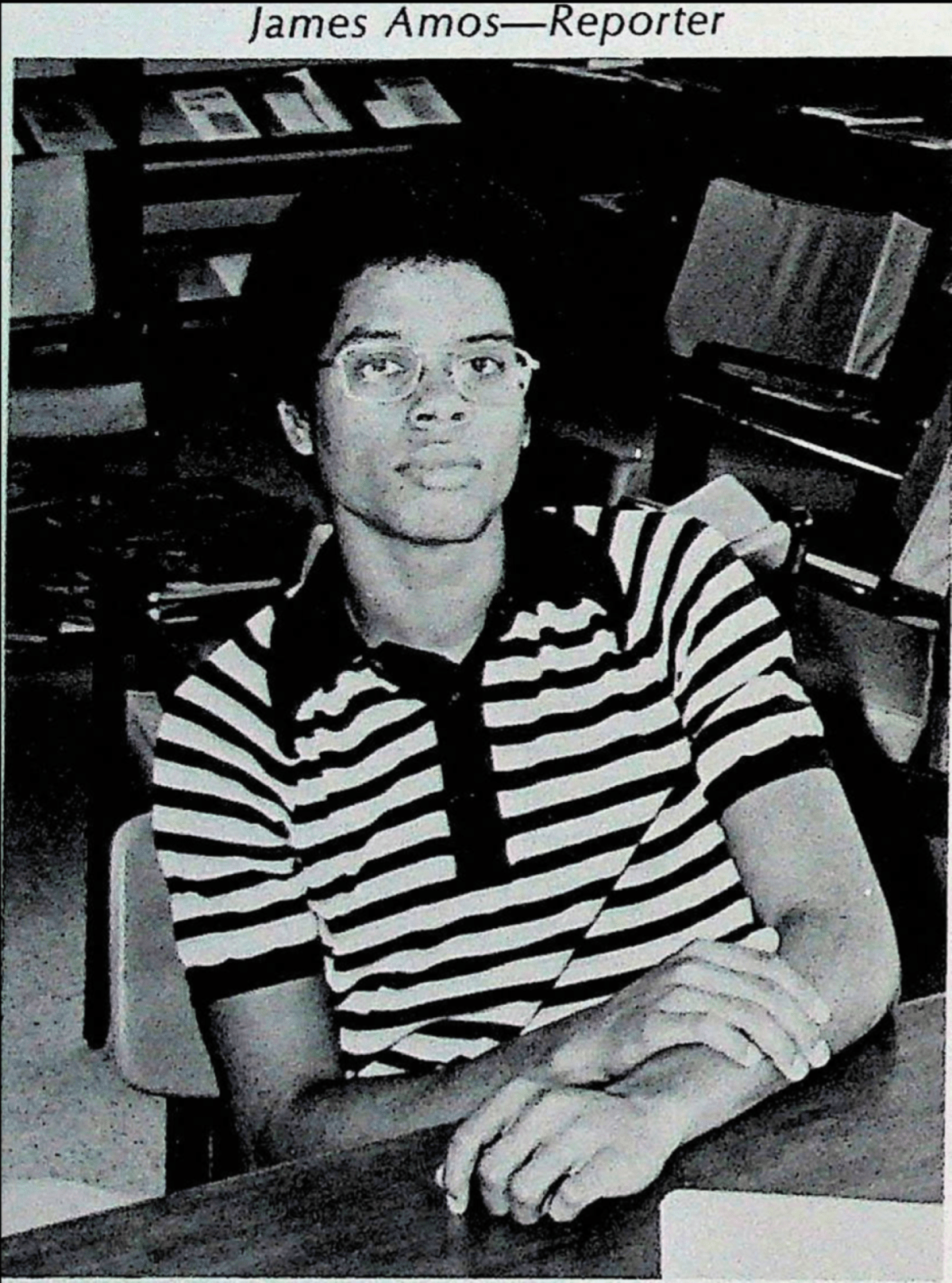
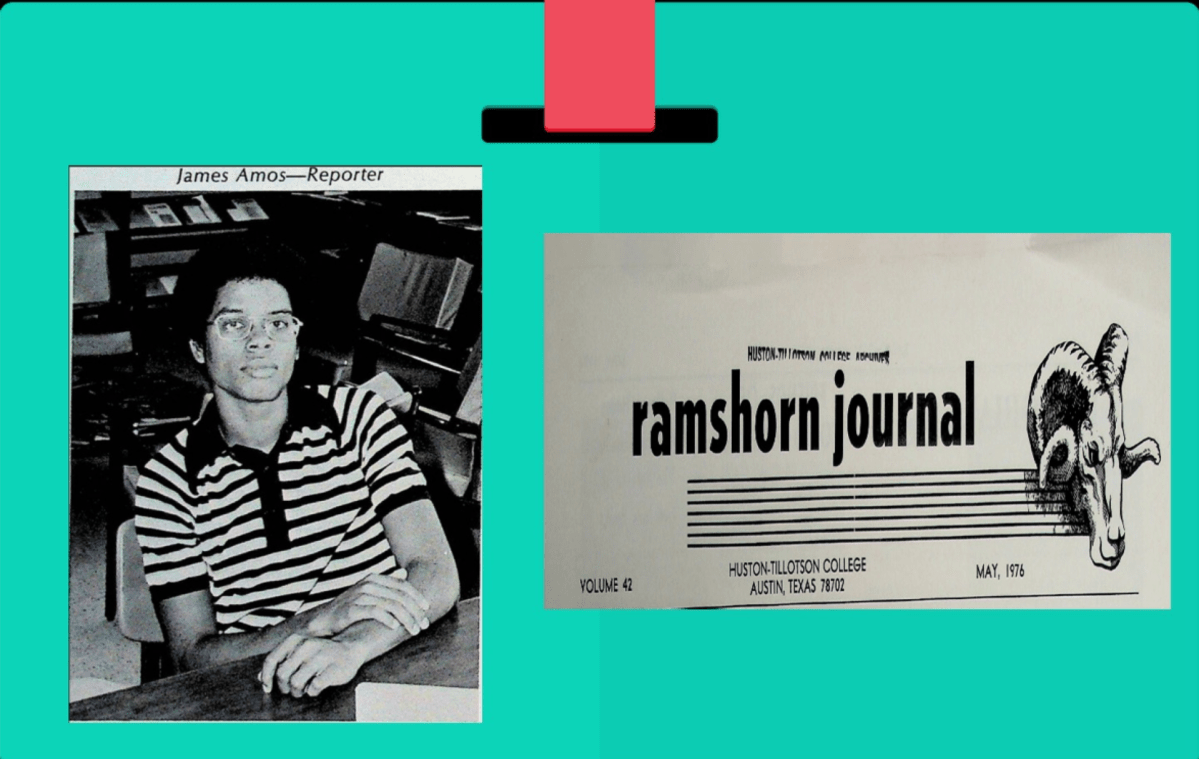
I found a photo of me in the Downs-Jones Library files at Huston-Tillotson University (formerly Huston-Tillotson College) today. It’s the featured image for this post. I was going down memory lane looking at old pictures of former classmates and teachers at H-TU and—there I was. It’s a photo of me in 1975, and it looks like I’m sitting in the Downs-Jones Library on campus posing for the picture. I don’t remember sitting for it. I had hair then and afros were in style.

I was a little worried about copyright issues just downloading or printing the image until I finally noticed the icons for doing both on the web page. I guess they wouldn’t be there if it were prohibited.

What’s also funny is that the caption above my picture says “James Amos—Reporter.” This meant that I was contributing to the college newspaper, The Ramshorn Journal. Funny thing is, I couldn’t remember writing anything for it.

I tried to find copies of the Ramshorn Journal for 1975, but there were only records for issues published in the early to mid-1960s. I guess I’ll never know what I wrote, if anything.

I’m surprised there would be any photos of me at all since I didn’t graduate from H-TU but transferred to Iowa State University and graduated from there in 1985.

I clipped out my photo from a few others. The group included the sponsor of the Ramshorn Journal, the editor, and the typist. That makes it looks I was a part of the staff. I’ll be darned if I remember doing anything for it. If I had written anything, I would think I’d have kept copies. But I have no documents proving it. I don’t have copies of the Ramshorn either. I’m a writer by inclination and habit so this is a mystery.

As I looked through yearbooks, I couldn’t find anyone I could ask about it either. That makes sense because it was 50 years ago. On the other hand, if there are digitized issues of the Ramshorn Journal from the 1960s, there might be some later issues kept somewhere in the library. Maybe there’s something with my byline on it.

If I get curious enough about it, I might ask somebody at the Downs-Jones Library if they could check on it.

Black History Month: James Spaights Concert Pianist

I was thinking about my time as a student at Huston-Tillotson University in the 1970s (then Huston-Tillotson College) and remembered somebody who was a student there. His name is James Spaights. In honor of his stature in music as it connects to the Black History Month theme of African Americans and the Arts, I just want to make special mention that Mr. Spaights is a concert pianist. I have not found his obituary (you know already about my habit of checking the obituaries) so I’m not going to talk about him in the past tense.

When I met him, Mr. Spaights was straightforward about his life goal, which was to be a concert pianist. Little did I know that he had already achieved that by the time I met him at H-TU.

He gave a fantastic performance for the faculty and students. I’m pretty sure we gave him a standing ovation.

I found some news clippings and other items about his career (unfortunately I couldn’t find recordings of his performances), which deserves to be better known. He was a member of the Alpha Phi Alpha Fraternity and a fraternity news letter shows his photo and bio in the 1977 issue of the SPHINX:

“Brother James Spaights, pianist, whom New York critics acclaimed “a virtuoso pianist and technician of the first rank” after his New York debut at Town Hall in 1965, was presented in concert on March 20, 1977 in Carnegie Hall, New York City, by the Behre Piano Associates of New York. Spaights is a former student of Madam Edwine Behre in New York City, also Freda Rosenblatt, Bronx, N.Y. and Emma Slutsky, Brooklyn, N.Y.

For three years Spaights served as Ambassador of Goodwill for the United States’ State Department as a concert pianist touring throughout Europe, parts of Canada, and the United States.

On his most recent United States tour, Spaights was presented by the Music Department at Morgan State College in Baltimore, Maryland, and Goddard College in Montpellian, Vermont.

Spaights holds his B.A. Degree in Music from Howard University and a Master of Arts Degree in Music from Columbia University. He is a member of the Lechetisky Association of America, The Behre Piano Association of New York, and a member of Gamma Eta Lambda Chapter of Alpha Phi Alpha Fraternity in Austin, Texas.

He is presently serving a post in the Music Department of Huston-Tillotson College of Austin, Texas.” (The SPHINX, Fall 1977, Volume 63, Number 3 197706303).

I guess I misunderstood what Mr. Spaights was doing at H-TU when I was an undergraduate there. I thought he was a student! He never mentioned his career or accomplishments (at least to me) and he had a great sense of humor. I was in the presence of a music luminary and never knew it.

Ref: The SPHINX Volume 63, Number 3, October 1977.

Thoughts on the Passing of Artie Hicks

Yesterday, I was thinking about Artie Hicks, one of my old English teachers at Huston-Tillotson University, which was Huston-Tillotson College back in the mid-1970s when I was a student there. I looked him up on the web, just out of curiosity—and found his obituary. That seems to happen a lot lately.

Anyway, he was a gifted teacher and had a great sense of humor. He bought tickets for the whole class to see the movie Harold and Maude, a ground-breaking film in those days. He had a simple and direct approach to talking with students. He always seemed comfortable in a place where white people (including teachers) were the minority—unlike the wider world outside the campus.

He was bald and the students called him Kojak, which was the name of the bald, tough detective star (played by Telly Savalas) of the TV crime drama which aired on CBS from 1973 to 1978.

I think you could have called Artie tough as well; not bad guy tough but honest and direct.

Plate!

I was listening to the Big Mo Blues Show last night on KCCK radio, 88.3 on your FM dial. I didn’t hear him mention his favorite cook, May Ree. She cooks hand-battered catfish; it’s better because it’s battered. Often, he’ll add a little to the legend, like where you can find May Ree’s establishment where you can buy her hand-battered catfish, which is filled with nitrates, cooked to perfection with manic delight, and which you can pair with any one of three flavors of moonshine, including the famous Classic Clear.

I don’t know whether Classic Clear has fruity, nutty, or extraterrestrial notes. You’ll have to try to find her joint, which is somewhere at the intersection of a highway and a street the name of which I can never recall. The story gets a new variation every now and then. May Ree has many facets to her character.

May Ree actually reminds me of the head cook at Huston-Tillotson College (now Huston-Tillotson University) in Austin, Texas. Back in the 1970s, I was a student there for a while. The head cook in the college cafeteria was Miss Mack. I don’t think you could say she cooked anything with manic delight. In fact, some of us were regular visitors who rushed with manic delight to Church’s Chicken because the H-TC cafeteria didn’t always serve what you’d call top of the line fare.

I guess Church’s want to call themselves Church’s Texas Chicken these days, mainly because they got the business started in San Antonio. Back in the day, Church’s Texas Chicken was a five-minute walk from the college. I checked a map recently, and now there isn’t a joint within an hour’s walk.

Anyway, I was a fairly frequent customer to Church’s Texas Chicken. You didn’t have a whole lot of choices about what to select. In fact, I don’t recall that there was a selection, per se. What you saw was what you got.

Sometimes, certain students were pretty frank about what they thought of Miss Mack’s cooking. One day, a guy who was fed up, in a manner of speaking, of course, held up his plate so that it was vertical, and weirdly, none of the food slid off. It just stuck there, like it was sort of a sculpture of a meal.

And then he called out loudly to everyone else in the cafeteria (not that there were many people there) as if he were offering to give to anyone there:

“Plate!” (no takers). “Plate!” (still no takers). “Plate!” (students just ignored him, but started making funny looks at their own plates).

I don’t remember what happened, but I think he just left his plate on the table and departed. I doubt Miss Mack was there. I was ambivalent about the whole deal. I liked Miss Mack, as did a lot of other students. She was kind and always had a bright smile for us.

Maybe he made a run to Church’s Texas Chicken. Funny, I didn’t see him there.

An Old Blog Post About My College Days in Texas

There’s something embarrassing yet fascinating about reading my old blog posts from years ago. The one I read yesterday is titled simply “I Remember HT Heroes.” I make connections between my undergraduate college days at Huston-Tillotson College (now Huston-Tillotson University (an HBCU in Austin, Texas) and my early career as a consultation psychiatrist at The University of Iowa Hospitals & Clinics (now rebranded to Iowa Health Care).

My first remark about getting mail from AARP reminds me that organization is sponsoring the Rolling Stones current tour, Hackney Diamonds. And the name of my specialty was changed from Psychosomatic Medicine to Consultation-Liaison Psychiatry in 2017.

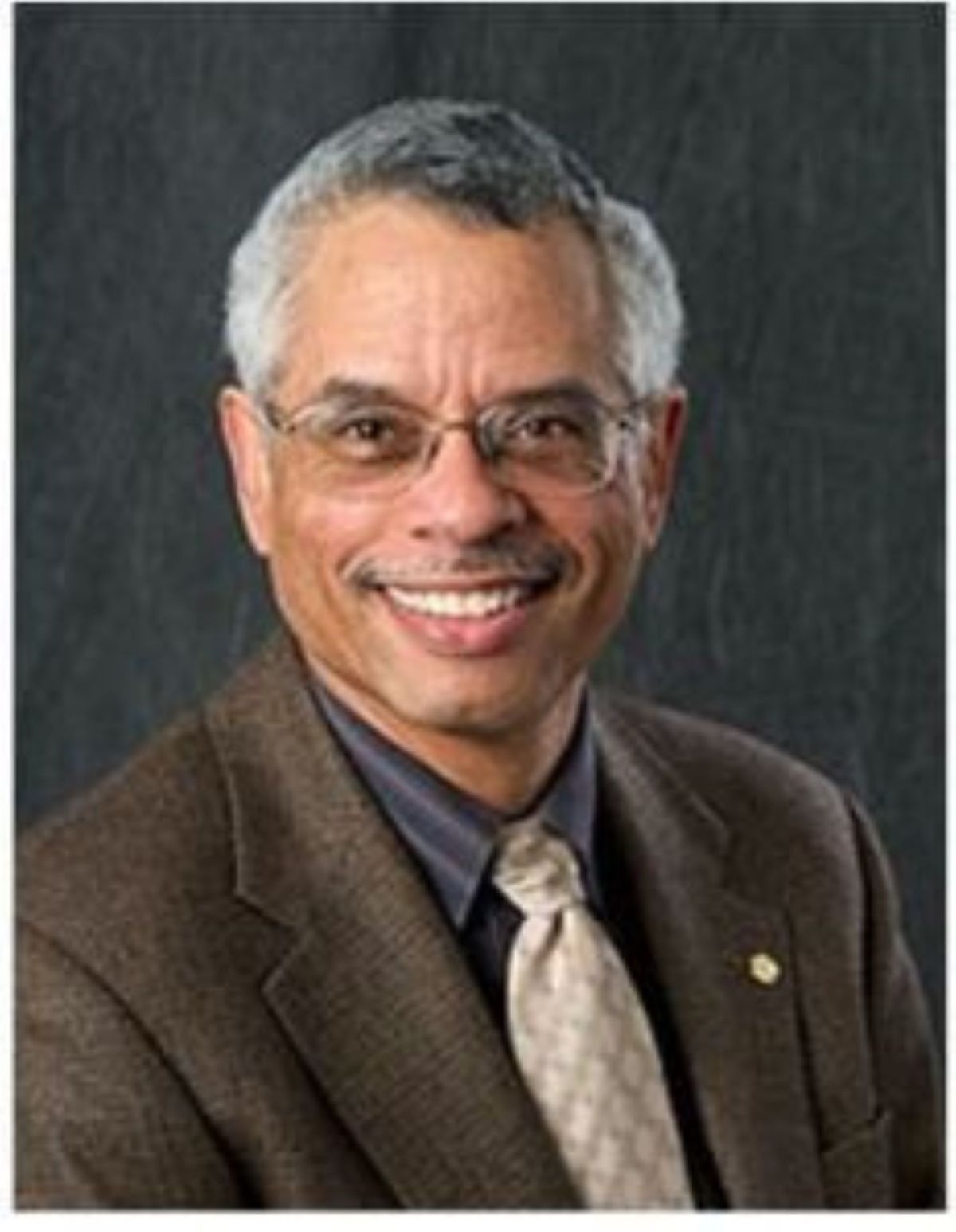
The photo of me attached to the original post reminds me of how I’ve gotten older—which also makes me hope that I’ve gotten wiser than how I sound in this essay. The pin in my lapel is the Leonard Tow Humanism in Medicine award I received in 2006.

I Remember HT Heroes

Getting membership solicitations in the mail from the American Association of Retired Persons (AARP) is a sure sign of aging, along with a growing tendency to reminisce. Reminiscence, especially about the seventies, may be a sign of encroaching senility.


Why would I reminisce about the seventies? Because I’m a baby boomer and because my ongoing efforts to educate my colleagues in surgery and internal medicine about Psychosomatic Medicine, (especially about how to anticipate and prevent delirium) makes me think about coming-of-age type experiences at Huston-Tillotson College (Huston Tillotson University since 2005) in Austin, Texas. Alas, I never took a degree there, choosing to transfer credit to Iowa State University toward my Bachelor’s, later earning my medical degree at The University of Iowa.


Alright, so I didn’t come of age at HT but I can see that a few of my most enduring habits of thought and my goals spring from those two years at this small, mostly African-American enrollment college on what used to be called Bluebonnet Hill. I learned about tenacity to principle and practice from a visiting professor in Sociology (from the University of Texas, I think) who paced back and forth across the Agard-Lovinggood auditorium stage in a lemon-yellow leisure suit as he ranted about the importance of bringing about change. He was a scholar yet decried the pursuit of the mere trappings of scholarship, exhorting us to work directly for change where it was needed most. He didn’t assign term papers, but sent me and another freshman to the Austin Police Department. The goal evidently was to make them nervous by our requests for the uniform police report, which our professor suspected might reveal a tendency to arrest blacks more frequently than whites (and yes, we called ourselves “black” then). He wasn’t satisfied with merely studying society’s institutions; he worked to change them for the better. Although I was probably just as nervous as the cops were, the lesson about the importance of applying principles of change directly to society eventually stuck. I remember it every time I encounter push-back from change-resistant hospital administrations.


I’m what they call a clinical track faculty member, which emphasizes my main role as a clinician-educator rather than a tenure track researcher. I chose that route not because I don’t value research. Ask anyone in my department about my enthusiasm for using evidence-based approaches in the practice of psychiatry. I have a passion for both science and humanistic approaches, which again I owe to HT, the former to Dr. James Means and the latter to Dr. Jenny Lind Porter. Dr. Means struggled to teach us mathematics, the language of science. He was a dyspeptic man, who once observed that he treated us better than we treated ourselves. Dr. Porter taught English Literature and writing. She also tried to teach me about Rosicrucian philosophy. I was too young and thick-headed. But it prepared the way for me to accept the importance of spirituality, when Marcia A. Murphy introduced me to her book, “Voices in the Rain: Meaning in Psychosis”, a harrowing account of her own struggle with schizophrenia and the meaning that her religious faith finally brought to it.


Passion was what Dr. Lamar Kirven (or Major Kirven because he was in the military) also modeled. He taught black history and he was excited about it. When he scrawled something on the blackboard, you couldn’t read it but you knew what he meant. And there was Dr. Hector Grant, chaplain and professor of religious studies, and champion of his native Jamaica then and now. He once said to me, “Not everyone can be a Baptist preacher”. My department chair’s echo is something about how I’ll never be a scientist. He’s right. I’m no longer the head of the Psychosomatic Medicine Division…but I am its heart.


I didn’t know it back in the seventies, but my teachers at HT would be my heroes. We need heroes like that in our medical schools, guiding the next generation of doctors. Hey, I’m doing the best I can, Dr. Porter.

On the Other Hand Thoughts on HBCUs

Historically Black Colleges and Universities (HBCU) are in the news lately. It reminds me of the short time I spent at Huston-Tillotson College. It was renamed Huston-Tillotson University (H-TU) in 2005. I was there in the mid-1970s.

A new President and CEO was just named this month, Dr. Melva K. Williams. And H-TU was recently added to the National Register of Historic Places last month. It has been renovated and modernized. Pictures show a well-kept campus pretty much as I remember it over 40 years ago. I didn’t graduate from H-TU, but instead transferred credits to Iowa State University where I graduated in 1985.

My favorite teacher was Dr. Jenny Lind Porter-Scott, who was white, taught English Literature. Another very influential teacher was Reverend Hector Grant who was black. He taught philosophy and religion. He was instrumental in recruiting me to matriculate at H-TU. He helped me to process my loss on the debating team when the question was whether or not the death penalty played any role in the reduction of crime.

My opponent won the debate mainly because he talked so much, I couldn’t get a word in edgewise. I can’t remember which side of the question I argued, but I thought I could have done better if he had just shut up for a few minutes and let me speak. Reverend Grant used the word “bombastic” in describing the approach my opponent used. On the other hand, he also gently pointed out that sometimes this can be how debates are won.

There’s this “On the other hand” tactic in debating and in reflective thought that my debating opponent managed to repeatedly deflect.

I don’t know what ever happened to Reverend Grant. We spoke on the telephone years ago. He sounded much older and a hint of frailty was in his voice.

I could find only a photo on eBay of a man who closely resembles the teacher I knew and the name on the picture is Reverend Hector Grant. The only other artifact is a funeral program for someone I never knew, which lists Reverend Hector Grant as being the pastor and some of the pallbearers were members of one of the Huston-Tillotson College fraternities.

I think it’s unusual for people to disappear like that, especially nowadays when we have the world wide web. Reverend Hector Grant was an important influence for me. He was one of the few black men of professional stature I encountered in my early life.

On the other hand, contrast that with Reverend Glen Bandel, another clergyman who was a white man and another important influence starting in my early childhood. Reverend Bandel persuaded me to be baptized at Christ’s Church in Mason City, Iowa. He radiated mercy, generosity, and kindness. He died in June of this year. I can find out more about him on the web just from his obituary than I can ever find on Reverend Grant, who apparently disappeared from the face of the earth.

Both of these men were leaders for whom skin color didn’t matter when it came to treating others with respect and civility.

My path in life was largely paved by these two clergymen. Reverend Bandel sat up with our family one night when my mother was very sick. His family took me and my little brother into their home when she was in the hospital.

On the other hand, Reverend Grant was instrumental in guiding me to an HBCU where I saw more black people in a couple of years than I ever saw in my entire life. The First Congregational Church in Mason City was instrumental in making that possible because they helped fund the drive to support H-TU (one of six small HBCUs) by the national 17/76 Achievement Fund of the United Church of Christ.

The news is replete with stories, some of them tragic, about how Greek fraternities haze their pledges. On the other hand, H-TU was pretty rough on pledges too. Upper classmen would make the pledges roll down the steep hills around the campus. They looked exhausted, wearing towels around their necks, running in place when they weren’t running somewhere in the Texas heat.

One H-TU professor said that H-TU was “small enough to know you, but big enough to grow you.” Although I can’t remember ever seeing him on campus because he was traveling most of the time, I at least knew the name of the President was John Q. Taylor (1965-1988). On the other hand, when I transferred credit to Iowa State University, I never knew the name of the President of the university.

Habari Gani is Swahili for “What’s the news?” or as it translated in the context I’m about to set, “What’s going on?” Habari Gani was the name for the annually published book of poetry by the H-TU students. Dr. Porter supported the project. I submitted a poem for the 1975 edition, which didn’t make the cut. When I transferred to Iowa State University, I left without getting a copy.

On the other hand, years later, I got a digital copy of that edition. I tracked it down to the H-TU library in 2016. The librarian was gracious.

Habari Gani has always been a reminder of the reason why I went to H-TU in the first place. I grew up in Iowa and was always the only black student in school. I grew up in mostly white neighborhoods.

On the other hand, when I finally got to H-TU, one of the students asked me, “Why do you talk so hard?” That referred to my Northern accent, which was not the only cultural factor that made social life challenging.

Once I tried to play a pickup game of basketball in the gymnasium. I’m the clumsiest person for any sport you’ll ever see. I was terrible. But the other players didn’t give me a bad time about it. They softly encouraged me. This was in stark contrast to the time I played a pickup game with all white men years before in Iowa. When I heard one of them yell, “Don’t worry about the nigger!” I just sat down on the bleachers.

On the other hand, when I was a kid and our family was hit by hardship, Reverend Bandel was the kindest person on earth to us—it didn’t matter that he was white. And my 2nd grade teacher, who was black (the only black teacher I ever had before going to H-TU), slapped me in the face so hard it made my ears ring—because I was rambunctious and accidentally bumped into her. It’s far too easy to polarize people as good or bad based on the color of their skin, especially when you’re young and impressionable.

It takes practice and experience to learn how to say and think, “On the other hand….”