Don’t Shovel Your Heart Out

We’re waiting for the next snowfall. We’ve had a couple of light ones so far and we used shovels to clear our driveway and sidewalk. They didn’t amount to much, but we’ll get a heavy snow here pretty soon.

We’ve been using shovels for years. I’m aware of the risks for heart attacks in certain people, especially sedentary middle age and older men with pre-existing cardiac risk factors. I’m not keen on snowblowers, mostly because I like to shovel.

I’ve been using an ergonomic shovel for years, although the wrong way until about 4 years ago. I used to throw snow over my shoulder while twisting my back. Now I push snow with a shovel that has a smaller bucket or with a snow pusher with a shallow, narrow blade. I lift by keeping my back straight and bending at the knees, flipping the small load out. I take my time.

I don’t know how high my heart rate gets while I shovel. I exercise 3-4 days a week. I warm up by juggling. I do floor yoga with bending and stretching, bodyweight squats, one leg sit to stand, use the step platform, dumbbells and planks. When I’m on the exercise bike, I keep my heart rate around 140 bpm, and below the maximum rate for my age, which is 150 bpm.

I’m aware of the recommendations to avoid shoveling snow based on the relevant studies. I realize I’m way past the age when experts recommend giving the snow shovel to someone else.

The question is who would that be? There aren’t any kids in the neighborhood offering to clear snow. Maybe they’re too busy dumb scrolling. I’m also aware of the city ordinance on clearing your driveway after a big snow. They’re very clear, at least in Whereon, Iowa.

“The city of Whereon requires every homeowner to clear snow from sidewalks within 24 hours after a snowfall. This means you. If you fail in your civic duty to clear snow and ice from your walkway within the allotted time of 10 minutes, the city will lawfully slap you with a fine of $3,000,000 and throw your dusty butt in jail for an indeterminant time that likely will extend beyond the winter season and could be for the rest of your natural life and even beyond, your corpse rotting in your cell, which will not bother the guards one iota because of the new state law mandating removal of their olfactory organs. Hahahahaha!!”

In light of the strict laws, Sena ordered a couple of new snow removal tools. Neither one of them is a snow blower. I think it’s fair to point out that some cardiologists have reservations even about snowblowers:

 There are even studies that show an increased risk for heart attacks among people using automatic snow blowers. Similar to the extra exertion of pushing shovel, pushing a snow blower can raise heart rate and blood pressure quickly–from “Snow Shoveling can be hazardous to your health” article above.

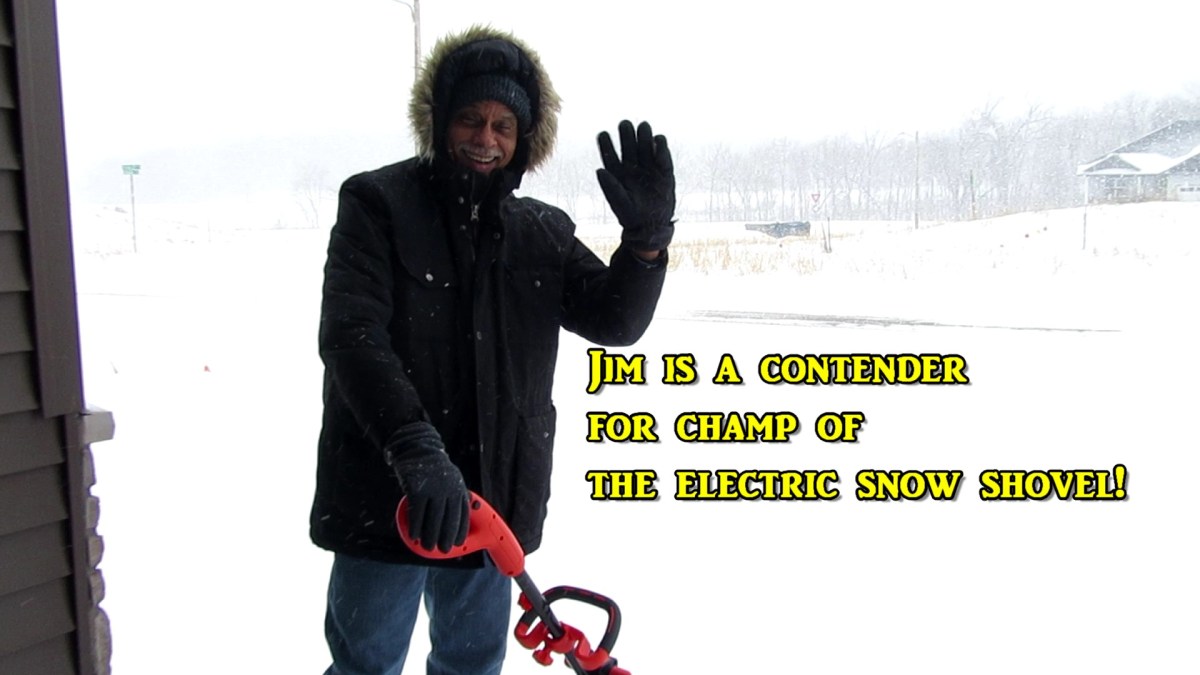
One of them is a simple snow pusher with a 36-inch narrow blade. That’s for me. The other is a cordless, battery powered snow shovel that looks like a toy for Sena. The ad for that tool includes a short video of an attractive woman wearing skinny jeans and her stylish coat open revealing her svelte figure while demonstrating how the electric shovel works. It appears to remove bread slice sized pieces of snow from the top of a layer which stubbornly sticks to the pavement. Call the Whereon snow police.

We should be getting both tools before the next big snow.

Should We Trust Artificial Intelligence?

I‘ve read a couple of articles recently about Artificial Intelligence (AI) lately and I’m struck by how readily one can get the idea that AI tends to “lie” or “confabulate” and sometimes the word “hallucinate” is used. The term “hallucinate” doesn’t seem to fit as much as “confabulate,” which I’ll mention later.

One of the articles is an essay by Dr. Ronald Pies, “How ‘Real’ Are Psychiatric Disorders? AI Has Its Say.” It was published in the online version of Psychiatric Times. Dr. Pies obviously does a superb job of talking with AI and I had as much fun reading the lightly edited summaries of his conversation with Microsoft CoPilot as I had reading the published summary of his conversations with Google Bard about a year or so ago.

I think Dr. Pies is an outstanding teacher and I get the sense that his questions to AI do as much to teach it how to converse with humans as it does to shed light on how well it seems to handle the questions he raised during conversations. He points out that many of us (including me) tend to react with fear when the topic of AI in medical practice arises.

The other article I want to briefly discuss is one I read in JAMA Network, “An AI Chatbot Outperformed Physicians and Physicians Plus AI in a Trial—What Does That Mean?” (Accessed January 6, 2025).

Hswen Y, Rubin R. An AI Chatbot Outperformed Physicians and Physicians Plus AI in a Trial—What Does That Mean? JAMA. Published online December 27, 2024. doi:10.1001/jama.2024.23860 (accessed January 6, 2024).

I think the conversation amongst the authors was refreshing. Just because the title of the article suggested that AI might take the place of physicians in the consulting room doesn’t mean that was the prevailing opinion of the authors. In fact, they made it clear that it wasn’t recommended.

I liked Dr. Chen’s comment about confabulation and hallucinations of AI:

“A key topic I talk about is confabulation and hallucination. These things are remarkably robust, and only getting better, but they also just make stuff up. The problem isn’t that they’re wrong sometimes. Lab tests are wrong sometimes. Humans are definitely wrong sometimes. The problem is they sound so convincing, they confabulate so well. “Your patient has an alcohol problem, Wernicke-Korsakoff syndrome.” It’s only if you double check, you’ll realize, “Wait a minute, that wasn’t actually true. That didn’t make sense.” As long as you’re vigilant about that and understand what they can and can’t do, I think they’re remarkably powerful tools that everyone in the world needs to learn how to use.”

What’s interesting about this comment is the reference to Wernicke-Korsakoff syndrome, which can be marked by confabulation. Clinically, it’s really not clear how this comes about in AI although thiamine deficiency is the main cause in WKS. In both, it involves inventing information, which is technically not the same as lying.

Unfortunately, this contrasts sharply with the recent fact checking Snopes article I wrote about recently, which suggests that humans are teaching AI to lie and scheme.

In any case, it’s prudent to regard AI productions with skepticism. My conversations with Google Bard clearly elicited confabulation. Also, it didn’t get humor, so I wouldn’t use it as a conversational tool, given that I’m prone to kidding around. As far as trusting AI, I probably wouldn’t trust it as far as I could throw it.

Connection Between Cribbage and Obituaries?

Just for fun today (which is New Year’s Day of 2025) after Sena and I played a few games of cribbage, I searched the internet using the term “cribbage in Iowa.” I found a local newspaper story entitled “There’s No Crying in Cribbage. There’s No Politics Either,” published August 18, 2024 in the digital version of the Cedar Rapids Gazette which, by the way, promised me that I have “unlimited” access to articles.

It was written by Althea Cole and it was longer than I expected it to be. Much of the story was about the longstanding history of annual cribbage tournaments at the Iowa State Fair. She also mentioned that her grandfather had been an avid cribbage player.

But I was also puzzled by the significant number of obituaries that popped up in the web links. I’ve looked up cribbage dozens of times but not with this particular search term. I checked several of the obits and found the majority mentioned that the decedents had been avid cribbage players.

I’m not sure what to make of this. What does it mean that cribbage is associated with obituaries in Iowa? I suppose some would say that it might mean that cribbage is a game mainly played by old people—which is probably true. The American Cribbage Congress (ACC) web site makes it very clear that they encourage young people to play cribbage. Be patient, the site takes a while to load.

That said, whenever I see photos of people of playing cribbage, almost all appear to be over 50 years old.

So, I tried searching the web using the term “cribbage in Wisconsin” and didn’t get any obituaries. I got the same result with “cribbage in Minnesota” and “cribbage in Illinois.” I decided not to run the search for every state in the country, because I think the point is already made. For whatever reason, cribbage in Iowa seems to be associated with obituaries and advanced age.

I imagine some reading this post might point out that the connection with obituaries in Iowa and cribbage could just mean that a lot of Iowans enjoy cribbage. That could be true. However, on the ACC web site, I can find only one city in Iowa that has an ACC Grass Roots Club, and it’s in Des Moines.

There’s a web article entitled “Is cribbage too antiquated to survive this digital world? Players and board collectors sure hope not.” It was written by Rebecca Zandbergen in April 2023 and I reviewed it again today. One thing I can say about cribbage is that it’s probably good exercise for the brain. I can find plenty of article which praise cribbage as a way to keep your brain healthy and engage socially.

I don’t know if there are any scientific studies on the benefits of cribbage for your brain. I had trouble finding them on the web, although I admit I didn’t conduct anything like a thorough search. I did find one study on the association of playing cribbage with social connectedness.

Kitheka, Bernard & Comer, Ronald. (2023). Cribbage culture and social worlds: An analysis of closeness, inclusiveness, and specialization. Journal of Leisure Research. 54. 1-21. 10.1080/00222216.2022.2148145. Accessed January 1, 2025.

“Abstract: Recreation specialization through the lenses of social worlds is a common approach used to describe how people define and are defined by recreation activities. This ethnographic study investigates the social worlds of cribbage players. The study analyzes cultural structures through the lenses of closeness, inclusiveness, and recreation specialization. Using survey questionnaires, informal interviews, and researcher observations, data were collected at cribbage events over a period of 3 years. Findings reveal a distinct cribbage culture characterized by varying levels of commitment, specialization, and degrees of connectedness. The study contributes to the currently limited literature on social worlds and indoor recreation specialization. It provides insight as to how people align at a community level to find meaning via recreational activities. Data also reveals a lack of social diversity in the cribbage community. Findings could be used in leisure programming for diversity and inclusion at community and grassroots levels.”

There was also a paper entitled “Cribbage: An Excellent Exercise in Combinatorial Reasoning:

Markel, William. (2005). Cribbage: An Excellent Exercise in Combinatorial Thinking. The Mathematics Teacher. 98. 519-524. 10.5951/MT.98.8.0519. Accessed January 1, 2025.

Abstract: Card games have long been a rich source of combinatorial exercises. Indeed, determining the probabilities of obtaining various hands in poker, and often in bridge, has been standard fare for elementary texts in both probability and combinatorics. Examples involving the game of cribbage, however, seem rare. This omission is especially surprising when one considers that cribbage hands offer excellent applications of combinatorial reasoning.

It’s a math thing, which is good for brains. Math won’t kill you and neither will cribbage. Happy New Year!

Happy Dad Joke Your Way Into the Holidays!

Happy Christmas Eve! Hey, I found all these Dad Jokes on the web. These ought to keep you busy well into New Year’s Eve and beyond. And remember, you don’t have to be a Dad to tell Dad jokes. It might help to attend Dad-joke University of Humour (DUH) though.

Here’s kind of a dad joke about our red Hippeastrum, which bloomed nicely!

And you can hear a dad joke in the Claymation Christmas video below (hint: a taxi is involved).

Fluoride in Your Precious Bodily Fluids

Yesterday, Sena and I talked about a recent news article indicating that a federal judge ordered the Environmental Protection Agency (EPA) to review the allowed level of fluoride in community water supplies. The acceptable level may not be low enough, in the opinion of the advocacy groups who discussed the issue with the judge, according to the author of the article.

A few other news items accented the role of politicians on this issue. This seems to come up every few years. One thing leads to another and I noticed a few other web stories about the divided opinions about fluoride in “your precious bodily fluids.” One of them is a comprehensive review published in 2015 outlining the complicated path of scientific research about this topic. There are passionate advocates on both sides of whether or not to allow fluoride in city water. The title of the paper is, “Debating Water Fluoridation Before Dr. Strangelove” (Carstairs C. Debating Water Fluoridation Before Dr. Strangelove. Am J Public Health. 2015 Aug;105(8):1559-69. doi: 10.2105/AJPH.2015.302660. Epub 2015 Jun 11. PMID: 26066938; PMCID: PMC4504307.)

This of course led to our realizing that we’ve never seen the film “Dr. Strangelove Or: How I Learned to Stop Worrying And Love the Bomb,” a satire on the Cold War. We watched the entire movie on the Internet Archive yesterday afternoon. The clip below shows one of the funniest scenes, a dialogue between General Jack Ripper and RAF officer Lionel Mandrake about water and fluoridation.

During my web search on the fluoridation topic, one thing I noticed about the Artificial Intelligence (AI) entry on the web was the first line of its summary of the film’s plot: “In the movie Dr. Strangelove, the character Dr. Cox suggests adding fluoride to drinking water to improve oral health.” Funny, I don’t remember a character named Dr. Cox in the film nor the recommendation about adding fluoride to drinking water to improve oral health. Peter Sellers played 3 characters, none of them named Cox.

I guess you can’t believe everything AI says, can you? That’s called “hallucinating” when it comes to debating the trustworthiness of AI. I’m not sure what you call it when politicians say things you can’t immediately check the veracity of.

Anyway, one Iowa expert who regularly gets tapped by reporters about it is Dr. Steven Levy, a professor of preventive and community dentistry at the University of Iowa. He’s the leader of the Iowa Fluoride Study, which has been going on over the last several years. In short, Dr. Levy says fluoride in water supplies is safe and effective for preventing tooth decay in as long as the level is adjusted within safe margins.

On the other hand, others say fluoride can be hazardous and could cause neurodevelopmental disorders.

I learned that, even in Iowa there’s disagreement about the health merits vs risks of fluoridated water. Decisions about whether or not city water supplies are fluoridated are generally left to the local communities. Hawaii is the only state in the union which mandates a statewide ban on fluoride. About 90 per cent of Iowa’s cities fluoridate the water. Tama, Iowa stopped fluoridating the water in 2021. Then after a brief period of public education about it, Tama restarted fluoridating its water only six months later.

We use a fluoridated dentifrice and oral rinse every day. We drink fluoridated water, which we offer to the extraterrestrials who occasionally abduct us, but they politely decline because of concern about their precious bodily fluids.

Dr. Phibes Loves Brussels Sprouts

I watched the 1971 movie “The Abominable Dr. Phibes” last night on the Svengoolie show last night and I just have a few remarks. It starred Vincent Price as the ghoulish Dr. Phibes who was really cranky about doctors who he accused of botching the medical treatment of his wife who died in the hospital.

Supposedly, Dr. Phibes was killed in a fiery car crash on his way to the hospital to see her. Of course, he survived to take revenge on the doctors by killing them in a pattern that mimicked the deadly biblical plagues, which most people remember from another movie, “The 10 Commandments.”

I’ve never seen “The Abominable Dr. Phibes” and like most of the movies on Svengoolie, it was fodder for corny jokes, of which Svengoolie always has a big supply.

There was even a psychiatrist victim. The way Dr. Phibes knocked him off was to somehow get him invited to a costume party where he gives him a special whole head mask of a frog. It has a diabolical mechanism which slowly tightens around the psychiatrist’s neck, finally cutting his throat.

I guess you could say the psychiatrist croaked (see what I did there?).

OK, so frogs are consistent with one of the plagues foretold by Moses and is loosely based on the biblical scripture of Exodus.

On the other hand, there were several other murders of doctors which made you scratch your head about the biblical plague plot.

Dr. Phibes impaled one doctor by shooting a large brass statue of a unicorn at him from a block away. One of the humorous (dark humor, of course) parts of the movie were the inept police who were supposed to be protecting the doctors from Dr. Phibes. They tried to figure out how to unscrew the horn of the brass unicorn from the victim (clockwise or counterclockwise?). Although I’m anything but a biblical scholar, as I recall, there was no plague of brass unicorn statues impaling the Israelites.

One of the more bizarre plagues was juiced brussels sprouts followed by locusts which apparently think it’s a tasty sauce that leads to them chewing the face off a nurse.

Speaking of going faceless, toward the end of the film, Dr. Phibes reveals he has no face. This either means that his face was burned away in the car accident or that one of his favorite foods was brussels sprouts garnished with locusts.

It looks like you can watch The Abominable Dr. Phibes on the Internet Archive, which apparently survived being hacked a month ago.

Humble Pie for Me Today

I had to eat humble pie today. I did not take Sena seriously about the amount of water she said was shooting out of the sump pump discharge pipe on the side of the house. She said it was making a hole in the yard. We’ve gotten a fair amount of rain lately. I was pretty skeptical about the plastic hose kit she got to attach to the pipe.

I was skeptical until I got a blast of water from the pipe as I was preparing to attach the hose. We’ll have to replace the hose eventually with a more permanent solution.

But she was right.

Amaryllis Star of Holland On the Comeback Trail!

Today, Sena got another Amaryllis Star of Holland bulb. We got one a couple of years ago and it grew like you wouldn’t believe.

The last time we got one, the stalk grew to about 18 inches and sported spectacular blossoms. The stem tended to bend this way and that for some reason.

I wrote the fractured story from Greek mythology about the Amaryllis in 2022, which I’m pretty sure you’ve forgotten by now. I’ll just remind you:

“A little story from Greek mythology says that a maiden named Amaryllis had a monster crush on a shepherd named Alteo, a first-class heel who ignored her but loved flowers. She tried stabbing herself in the heart every day with a golden arrow for thirty days but at first that only led to a lot of trips to the local emergency room. But on the thirtieth day, a gorgeous flower grew from her blood. That’s the only thing that got Alteo’s attention; can you believe that jerk? They got married and honey-mooned at Niagara where they both got smashed on fermented winterberries, jumped out of the Maid of the Mist boat, crashed into a rainbow which turned out to be a wormhole portal to another galaxy where they finally sobered up by eating beef jerky from Sasquatch, who is an interdimensional creature as everyone knows.”

You can check my sources for accuracy of the yarn-if I were willing to give them to you, which I’m not.

We’re eager to see how things go this year with the new Amaryllis.

Little Autumn Promenade

Yesterday, we took a stroll on the Terry Trueblood trail. It was a little breezy and warm for late October.

The fall colors were gorgeous and there was a lot going on. We saw a woman with her toddler flying a butterfly kite. It sailed on the wind beautifully. We saw the quilted hearts hanging from the trees. They’re very cheering. In the wind they looked like they were waving at you.

The woolly bear banded caterpillars were out. I don’t think you can really tell how hard the winter is going to be by looking at the color bands. But it’s fun to talk about.

And then we thought we saw ladybugs. But they could have been Asian lady beetles. It’s hard to tell them apart. The latter often don’t have spots at all. We noticed that they seem to sort of push up their hinders until they’re almost upside down and they may shove each other around.

There’s a pretty vigorous debate on the web about whether the Asian lady beetles are the bad guys and the ladybugs are the good guys. We know they can crawl all over you.

The oddball thing was that we found a baby booty hanging on one of the sign posts. It had an image of a ladybug on it. Or was it an Asian lady beetle?

When you’re in the autumn of your life, it might be time to stop asking too many questions.

How Does Sponge Bob Get Involved with Wendy’s Pineapple Frosty?

So, today we tried the new Wendy’s Pineapple Mango Frosty. Right off the top, I’ll tell you I couldn’t taste the pineapple mango flavor. It’s an OK vanilla. There are no bits of pineapple, mango, or Sponge Bob SquarePants in it.

That’s right, I said Sponge Bob SquarePants as in the cartoon guy who lives in a pineapple-shaped house—I guess.

I’ve never watched Sponge Bob and I don’t know anything about his pineapple house under the sea. I can tell you that the brown swirl in the bottom of the cup of the Frosty doesn’t taste like pineapple or mango. It’s vanilla with a brown swirl.

That doesn’t mean it’s bad. It just means I like vanilla. It’s how I feel about other ice cream flavors. If Sena doesn’t get vanilla for me, she gets Kemp’s Caribou Coffee flavored vanilla. Occasionally, I go crazy and eat French Vanilla.

There’s a meal you can get that follows the same Sponge Bob theme. It’s the Krabby Patty Kollab Burger, which comes with fries and a Pineapple Mango Frosty. I think the sandwich is a cheeseburger with Kollab, a top-secret sauce—likely thousand island. We skipped that. I’m still not sure why it’s called Kollab sauce, but the main ingredients are mayo and ketchup. If anybody knows what Kollab means, shout it out. All I can find is that it’s a store which makes picnic paraphernalia, like mats and maybe ants.

If Wendy’s ever makes a Kollab Frosty, look closely at it for anything that looks like little ants.

I like the Vanilla Frosty. I’m OK with Wendy’s Chocolate Frosty. But I’m going to hang on for the upcoming Salted Caramel Frosty in November.