We’ve lived in the Iowa City area for over 37 years and never heard of the Brain Rock until today. I don’t know how we ever missed it. It’s a work of art called Ridge and Furrow created by artist Peter Randall-Page, a world-famous artist from the United Kingdom.
It’s been called the Brain Rock for obvious reasons because the stone has what you might call gyri and sulci all over its surface. It has recently been relocated from the T. Anne Cleary walkway outside the Pomerantz Career Center to the Medical Education and Research Facility (MERF).
As Randall-Page says, if you trace the line from one side of the sculpture you can follow it to its end on the—far side of the rock, I guess you’d call it.
The other interesting thing about the Brain Rock is that a couple of intoxicated college students urinated on it back in November of 2021. No mention of whether they were trying to trace the furrow. Maybe they’d heard of the urinating sculpture and fountain called Piss in Prague.
So, this movie ‘Frankenstein Meets the Space Monster” is high in cheese content and don’t expect to see the Frankenstein made famous by Boris Karloff. It was released in 1965 and directed by Soupy Sales, no wait, it was Robert Gaffney. Marilyn Hanold played the big female lead, Marcuzan, the amazonian leader who looks nothing like the male Martians, one of whom, Dr. Nadir (played by Lou Cotell), reminds me of Yoda.
Seriously this Nadir to take we are? Fits him the name because at the lowest level his quality is! Hmmmm?
In fact, all the male Martians sort of remind me of Yoda. Marcuzan doesn’t resemble any of them. Other cast members include Jim Karen as Dr. Adam Steele, Nancy Marshall as Karen Grant, David Kerman as General Bowers, and Robert Reilly as Col. Frank Saunders, the android astronaut. You can watch the movie on the Internet Archive, but you’ll miss Svengoolie’s cornball jokes and commentary.
The gist of the story is that the Martians (who are never identified as such, by the way) lost an atomic war and somehow all the females on the planet got wiped out. So Marcuzan and Nadir and a bunch of Martians take off for earth to round up new females to repopulate Mars.
At the same time, scientists on earth have built an android named Frank who is test-driving a brand-spanking new NASA space capsule. Nadir boy and the gang shoot it down over Puerto Rico. Frank gets shot in the brain and goes off his nut, which can’t be screwed back on because none of the Martian repairmen know how to use the metric system in order to select the right size socket wrench.
Marcuzan and Nadir and the gang and Frank all cause mayhem in Puerto Rico. It’s kind of like parallel play until the Martians hustle out their hairy monster champion, called Mull, to thumb wrestle Frank and settle the matter. Guess which one is Frankenstein? That’s right—Marcuzan!
Anyway, if you’re looking for production value, you’re barking up the wrong tree. This is about extreme campiness, which is exaggeration and purposeful emphasis on bad taste. Even though the producers wanted a serious science fiction/horror film, according to Svengoolie and one of the original screenwriters who is still teaching at Hollins University in Roanoke, Virgina, the goal was to make a wild parody of the genre. While the producers insisted on the straight version, somehow the screenwriters obviously prevailed.
That explains the obviously botched makeup jobs, the stock footage making up 65% of the scenes, and the comical and jarringly timed soundtrack. One song called “That’s the Way It’s Got to Be,” done by The Poets seems like a sort of anthem for the movie’s real aim. In other words, don’t complain about the lack of production value because it’s a parody, hence (all together now), that’s the way it’s got to be.
The Martians used a weapon that was a popular toy for a short time, the Wham-O Air Blaster. It could shoot air 40 feet and was banned after the blast ruptured a kid’s eardrum.
Early on in the movie, right after Frank the android gets bunged up after being shot down by the Martians, he ends up looking like he’s got a couple of tubes hanging and bouncing around off his chest for the rest of the movie, so I couldn’t help thinking of him by the nickname “Tubular Teats.”
And for some reason this gets connected to the scenes of the bikini-clad women being rounded up for a weird technical assessment (reminiscent of a sliding cat scan table) of their suitability for repopulating the female population back on Mars. The women obligingly assist the Martians who lift them onto the table. This is bizarre considering the fate for some of them.
Anyway, I have to rate “Frankenstein Meets the Space Monster” using a different standard from that which was used by some to rate it as pretty high up on the list of the 50 Worst Movies Ever Made. That’s because I think it’s a parody and therefore not comparable to a serious science fiction/horror flick—because that’s the way it’s got to be!
We were having a prune juice moment early this morning. I didn’t know Sena was going to buy it about a week ago. I’m not having any problems with getting enough fiber in my diet. I draw the line at prune juice and also Metamucil.
prune juiceBottoms up!
This brings back memories. When me and my younger brother were kids, we both had problems with irregularity and a doctor recommended mineral oil. I guess we should have been glad he didn’t recommend castor oil. I think mom just ignored us when we displayed our histrionics about the awful taste. She just insisted it didn’t have a taste.
Technically, mom was right; mineral oil is tasteless. But I think the oily consistency is what grossed us out. It doesn’t take much imagination to think you’re swilling motor oil. I don’t remember that it helped much with constipation. You’d think the exercise of sprinting away from the house would help us avoid the mineral oil ordeal, but mom usually caught up with us just before we got to the railroad tracks a few blocks away.
After I got older, early in our marriage I developed a minor problem again with irregularity. I tried prune juice then but I had to throw a few ice cubes in it to moderate the flavor. There are a few breakfast cereals that helped, like bran flakes and the like. I was in my second year of medical school before I found out about Colon Blow.
Of course, the other side of the food remedies for irregularity is the opposite of constipation—meaning accidental overflows. I haven’t had trouble like that so far, but it reminds me of a comedy bit Big Mo does on KCCK jazz and blues radio, which is 88.3 on your FM dial. If you follow this link, you can hear part of Dr. Shorty’s Adult Diapers (“…they’re ready when you aren’t!”). By the way “camo” color is short for camouflage, which is a mix of green, brown, and gray—an obvious hint about overflow.
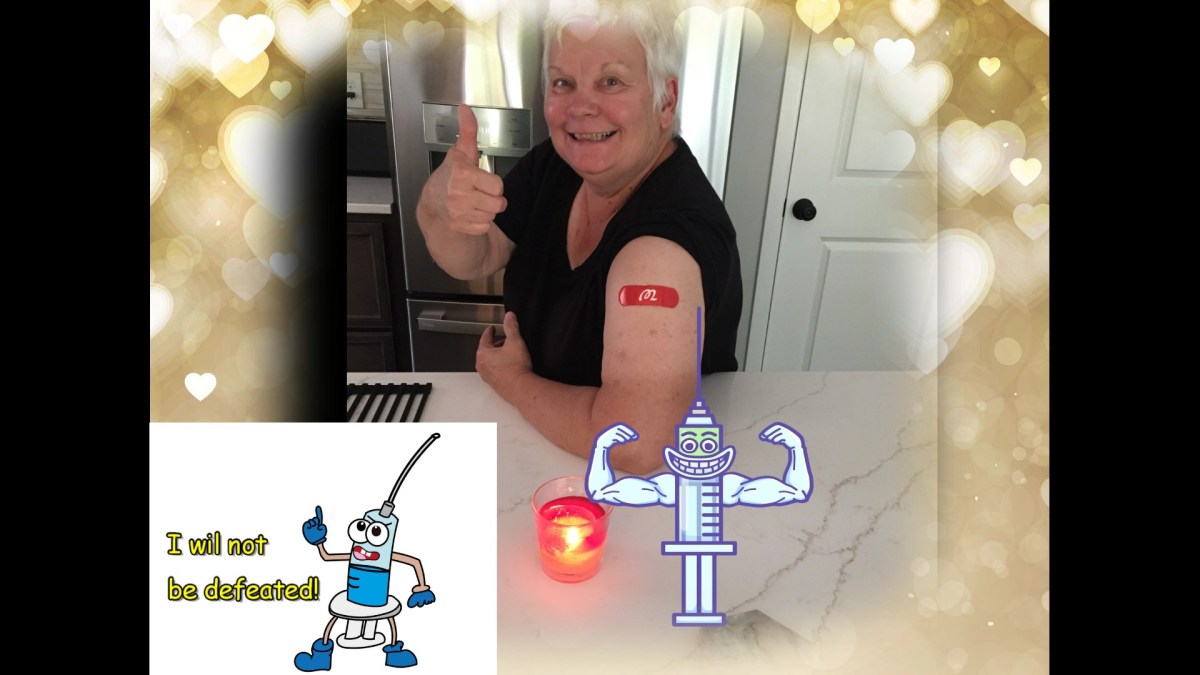
Sena got a measles vaccine booster today just to be on the safe side given the increase in the number of measles cases all over the country, including Iowa.
The history of the measles vaccine is fascinating by the way. It can make it challenging to figure out who might need a booster.
Despite the mild headache from the shot—she won our cribbage match again. She will not be defeated!
Sena after measles vaccine boosterSena wins cribbage match again!
“Calling all stations, clear the air lanes, clear all air lanes for the big broadcast!” (Svengoolie show intro).
Fee Fi Fo Fum, something shlocky this way comes! Next Saturday the Svengoolie show will present the movie “Frankenstein Meets the Space Monster.” It’s not the Frankenstein’s monster you know and love necessarily, and it involves Martians looking to repopulate their planet’s female population. Can I even stand it?
I don’t get out often to the mall to do mall walking, but I did today. I put on a little over 2.5 miles on my step counter. Mall walking is OK for exercise although I have to drive over there. Right next door to the entrance to the mall is the outdoor entrance to Planet Fitness, which is kind of ironic. But you have to pay a membership fee to use the facilities there. You can just walk through the mall for free and it opens an hour before the other shops just to accommodate mall walkers.
I think mall walking does wonders for my lower back. I see a lot of older people who look like they make mall walking regular exercise. They’re my age or older. Some of them have physical challenges that may be the reasons why they mall walk, that is, for conditioning. Their physicians might have even recommended it.
A minority of mall walkers I see are young, so this isn’t just for the elderly. Occasionally I’ll see a group who are challenged in various ways. Today it looked like the guy who was blind and using a cane was right out in front, actually leading the group.
Mall walking has advantages over, say, walking downtown. It beats getting clobbered by an exploding manhole lid, bit by a dog, or mugged.
There are some studies about mall walking, but the authors of a 2015 review mainly noted that there’s a need for more rigorous studies. Their conclusion sounds a little grumpy:
“We found the potential for mall walking programs to be implemented in various communities as a health promotion measure. However, the research on mall walking programs is limited and has weak study designs. More rigorous research is needed to define best practices for mall walking programs’ reach, effectiveness, adoption, implementation, and maintenance.”
Farren L, Belza B, Allen P, Brolliar S, Brown DR, Cormier ML, Janicek S, Jones DL, King DK, Marquez DX, Rosenberg DE. Mall Walking Program Environments, Features, and Participants: A Scoping Review. Prev Chronic Dis. 2015 Aug 13;12:E129. doi: 10.5888/pcd12.150027. PMID: 26270743; PMCID: PMC4552141.
Maybe the authors need to go for a walk.
It’s inspiring to see some of the mall walkers out there despite having major disability of one kind or another. I often see a lady who uses a wheeled walker and cannot hold her head up straight. When she sits down for a break, it looks like she’s collapsed. But she just gets up and at it again a few minutes later.
Mall walking may be understudied—but it’s also underestimated as a sign of resilience in anyone young or old.
I just read a few news articles and saw a couple of videos on something called the sit and rise or sitting rising exercise. It’s not the same as the sit to stand exercise, which is how many times you stand up from a chair without falling down after drinking several beers. The sit and rise exercise is sitting down and then standing back up in a cross-legged position.
Just to let you know, there are dozens of news stories that claim if you can’t do the sit and rise exercise without using one or both hands or a crane to get back up, you’re marked for death within hours. Make sure your last will and testament is notarized.
OK, I also saw a Snopes fact-check story about the sit and rise thing and it’s a myth that the inability to do it predicts mortality within a few years. It does indicate you have problems with mobility and that could be from a number of factors, including previous joint injuries and not having legs. Check a full-length mirror.
Apparently, there was a study done in Brazil in 2012 that got this story going about imminent mortality if you can’t do the sit and rise cross-legged routine. It looks like there have been news stories about it every year or so since then just to scare old people.
I can’t do the sit and rise cross-legged and wondered if there’s some kind of trick to it. There isn’t and the main problem according to experts are weak glutes. And I’m able to stand on one leg for 30 seconds and I can do 3-4 reps of the single sit to stand exercise on both legs. I also have no problem getting up from a chair from a sitting position without pulling myself up using grab bars or having somebody haul me up with a tow chain.
I can’t remember a time when I could even sit cross-legged, although I guess I did when I was in kindergarten. When I took a Mindfulness Based Stress Reduction (MBSR) course, I had to try to sit cross legged to meditate and I was numb in my hips and knees within a couple of minutes. When I got up, I usually fell over, sustained a minor head injury and was rushed to the ER about 1,200 times (“It’s Dr. Amos again; he’s been trying to sit in that lotus position” “OK, put him in the rack.”).
There’s a web page that gives advice on how to fix a problem with not being able to sit in a crossed leg position for longer than a minute. The author provides a short list of exercises without instructions for how to do them:
Child Pose: I imagine this resembles standing pigeon-toed, holding your crotch and dancing around a little about an hour after drinking a half-gallon of Kool-Aid.
Pigeon Pose: This is kind of like the Child Pose only it’s done while pooping on the head of a statue.
Toe Touch: Self-explanatory but apparently you can touch anything with your toe as long as it’s not something recently expelled from a pigeon.
Vajrasana: It involves contacting extraterrestrials who will assist you by inserting various probes in several orifices while you remain very still to allow the tracking device to be correctly installed.
Lung Pose: I’m not sure how this strengthens your glutes but obviously it involves surgery. Check your insurance.
Bridge Pose: This might tone your glutes if you dive off a bridge without a parachute. Make sure your life insurance policy is up-to-date.
That about does it for the sit and rise cross-legged issue. Remember, it’s only when you do it while cross-eyed that all the trouble starts. Glad I could clear that up.
Today’s essay by Dr. Moffic was pretty interesting about the role of video gaming in health for men and women. Computer games were emphasized but it got me thinking about hands-on games that you might thing of as being more old-fashioned—like cribbage.
I wrote a post about cribbage already today, but there’s another angle on it that’s readily adaptable to considering its role in promoting mental health for both men and women.
That reminds me that until yesterday and today, I was on a major losing streak in cribbage with Sena. Cribbage wins and losses seem to occur in streaks and I was beginning to wonder if I’d lost my touch.
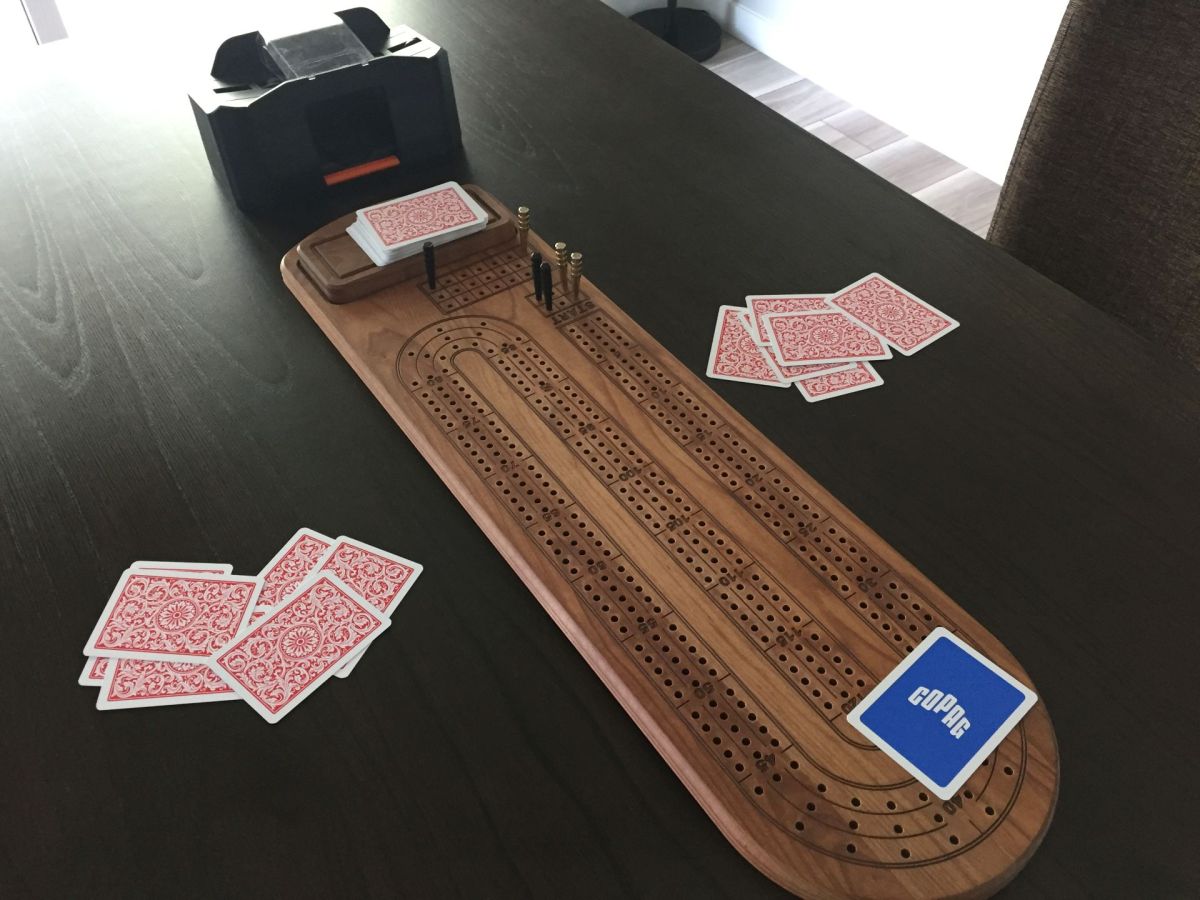
There’s a cribbage connection with the electronic gaming realm in that we also play the computer video cribbage game Cribbage Pro. There are three levels, Standard, Challenging, and Brutal (the toughest opponent). We always play Brutal, and often win. There’s a way to play internet cribbage on Cribbage Pro, but we don’t. I prefer playing live. I think the popular view of cribbage is that it’s an old guy’s game. I suspect people think it’s a card game old men play on their lunch hour at the factory.
Nothing could be further from the truth. It’s very popular with women and kids and my guess is that no matter what your gender preference is, there’s a greater diversity of cribbage players out there than anyone realizes.
Playing cribbage promotes and maintains brain health by requiring you to practice basic arithmetic by counting your scores and pegging. You lose a little of that in Cribbage Pro although you can turn on the feature allowing manual counting of scores.
And the American Cribbage Congress (ACC) accommodates internet cribbage tournaments. It’s very popular and competitive. By the way, expanding on my other post today about how to verify your luck in getting a 29 hand in cribbage, you can easily prove it on Cribbage Pro by taking a screen shot of it!
Computer games are fine, but I like to manually shuffle the cards for cribbage. Sena likes to use the shuffling machine—which is very loud but gets the job done. I’ve not yet found a way to “accidentally” lose the shuffling machine (Can’t imagine where it went; must have grown legs and walked downtown!).
We always help each other count our scores. The one time we tried muggins rule, which involves penalizing each other for missing scores by taking them from each other, we just couldn’t seem to get it straight. And it wasn’t as much fun.
There are local cribbage clubs that you could get involved in although they might be hard to find. The nearest one to us is several hours away.
I used to play computer games years ago (although not Nintendo), but nowadays I feel more like Agent K in Men in Black II as he’s trying to quickly learn how to steer a spacecraft using what looks like a PlayStation 2 controller (I used to have one of those).
after K turns on the auto pilot during the chase…
Agent K: It is not automatic pilot.
Agent J: He doesn’t work when we’re in hyperspeed.
Agent K: I could really use a steering wheel!
Agent J: We don’t have no damn steering wheel! This is what we got! [turns off auto pilot] Didn’t your mother ever give you a Gameboy?
Sena and I were talking about the elusive 29 hand score in cribbage and I wondered how you could ever verify it. Let’s face it, it’s hard to imagine anybody filming themselves playing cribbage in order to catch it on tape.
Just for the sake of completeness, here’s a video of how to count the 29 score. You can see from the comments that it is indeed possible to get the 29 hand in your lifetime—if you’re an extraterrestrial from a galaxy where the typical lifespan is several hundred years.
As noted in the video, the odds of getting a 29-score hand are 1 in 216,580. I have rarely seen news stories that highlight this happening at some hardware store in East Overshoe, name-your-state where a couple of guys are playing cribbage on their lunch break. One supposedly gets a 29 hand. He calls up the local news announcing that and a reporter hustles over to snap a photo of the guy holding up the perfect hand with a nob jack and three 5 cards next to a card deck showing the obligatory 4th turnup 5 card.
How hard would it be to set that up?
OK, I’m not saying they’re making it up, but it’s not impossible to prank everybody by staging this as an April Fool’s joke. Would it be worth doing? No, not in my opinion.
I’ve never seen a story about anybody making a video of a cribbage game in which somebody gets the 29 hand. That would be interesting! But who would ever do that? You could make video recordings of your cribbage games every day for your whole life and never get a 29 hand. But a lot of people have a “29 hand cribbage” story. In fact, in the video above you can find a few comments about it. Is it just lore or are people telling tall tales or what?
There might another way to increase your chances of getting the 29 hand. You could become a vampire. That’s right; vampires can live for hundreds of years or even longer, provided they don’t get exposed to daylight or take a stake through the heart. Being immortal would give you more time to play cribbage. The only hitch is that you have to let a vampire bite you, making you a loathsome creature only able to get around during the night, when most people are sleeping. And somebody would probably invent cribbage pegs shaped like little crosses and there you go.
There might be another solution. One is to require the person who claims to have gotten a 29 hand to take a lie detector test. Sound good?
But lie detector tests are probably not infallible. You can even find instructions on the web claiming you can learn how to outsmart them. Believe it or not, there’s a Wikihow on “How to Fool a Polygraph Exam.” And even if Artificial Intelligence (AI) is used as part of the exam, everybody knows AI lies! Besides, there’s a bigger problem with lie detector tests. They would take all the fun out of the thrill of getting the 29 hand and telling everyone the story about it!
And after all, it’s the stories about getting the 29 hand that carry the day.
I saw the Svengoolie show 1943 film, “First Cousin Twice Removed of Dracula” last night. Sorry, that’s actually “Son of Dracula.” You can watch it colorized on the Internet Archive.
It starred Lon Chaney as Count Alucard, and that name didn’t fool anybody because it’s just Dracula spelled backward. The goof everybody already knows about occurs early in the show when Dracula transforms from a bat in front of a mirror and his reflection is clearly visible.
You don’t see that much of Count Dracula and you never see his fangs. He’s well-spoken and mostly polite. He didn’t cry out “Bluh, bluh” even once, but then neither did Bela Lugosi.
Maybe I was just overthinking Dracula’s overall plan for taking over America. Was he supposed to suck the blood of hundreds of millions of people one by one or what? Even with the help of Enirehtak, the Southern belle he hypnotized into being his wife, that would be a long-term project even for the immortal vampires.
That approach is probably what killed the movie “Attack of the Vicious, Loathsome, Depraved but Suave Vampire Anteaters with Denture Fangs from Saturn!” The solution to save the planet was to ban Poligrip. Theater staff had to wake up the audience members, but only occasionally.
In spite of what you might think about the flying bat special effects, there were no strings involved—just a decrepit bat.
There were a few elderly gentlemen in the film, Dr. Brewster being one. He had a great idea about how to protect a little boy from another attack by Dracula. He drew little crosses on the kid’s neck where the fang puncture wounds were. See there? You don’t need to carry a crucifix around! Just cross your fingers at vampires.
And Dracula (no spring chicken himself) suffered a mishap while carrying his bride across the threshold after their wedding. He fell and broke his hip. Vampirism doesn’t protect men from osteoporosis. The action shots got a little shorter after that. Using a walker tends to slow chase scenes down.
On the other hand, Dracula was otherwise well preserved for being hundreds of years old. He got a little perturbed when somebody threw out his bottle of Serutan. Remember, that’s Natures spelled backwards.















 Go Retire Psychiatrist