Big Mo Pod Show “BluesMore” Today

So, the Big Mo Pod Show was on just now and I listened to it because I heard the Big Mo Blues Show last night.

Big Mo Pod Show 085 – “California Bluesin” KCCK's Big Mo Pod Show

After a short break during the Thanksgiving holiday your hosts are back at it again with another episode! This week features the usual mix of blues eras you’ve come to expect along with a few Californian artists, tune in to see which ones! Songs featured in the episode: Solomon Hicks – “Further On Up The … Continue reading
  1. Big Mo Pod Show 085 – “California Bluesin”
  2. Big Mo Pod Show 084 – “Garage Blues”
  3. Big Mo Pod Show 083 – “Legal Pirate radio”
  4. Big Mo Pod Show 082 – “Tribute”
  5. Big Mo Pod Show 081 – “Cheers To Kevin”

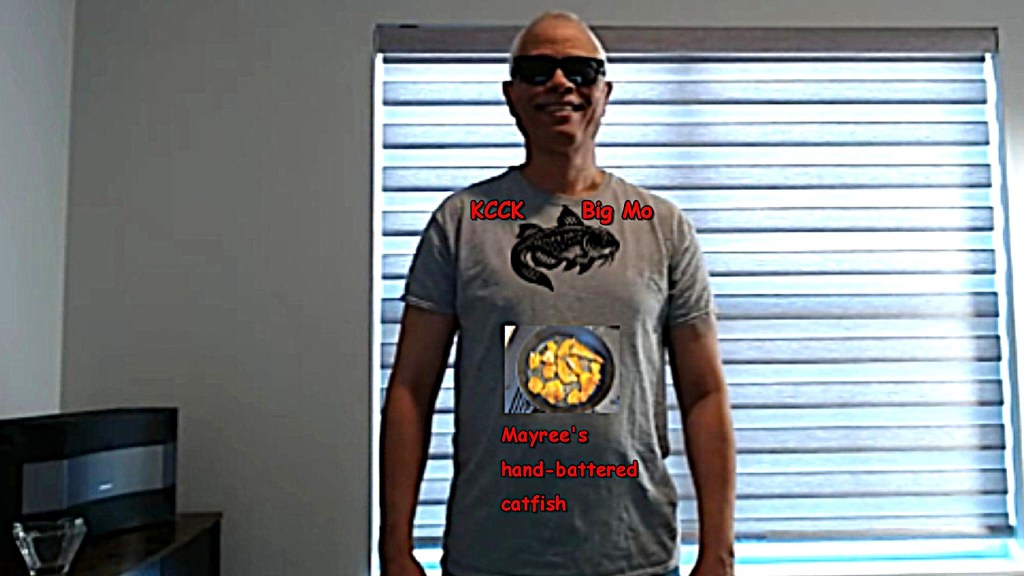
I just want to mention that I heard Big Mo do an extended version of his comedy bit on Mayree’s hand-battered catfish last night too. I never know when he’s going to do the long version of it and I nearly always regret not having some way to record it. It’s kooky and complicated with twists and turns like a long hairy dog story with punchlines scattered like land mines all over it.

Anyway, the pod show was pretty interesting. I think the Beth Hart song “Can’t Let Go” could be about more than a busted relationship, a frequent subject of a lot of blues songs. There’s a lot of baggage that we can’t let go of in life. The other notable feature of that song is Sonny Landreth cutting all the way loose with guitar licks spinning out beyond every nearby galaxy.

What was strange during last night’s blues show was I could have sworn I heard the lyrics of “Stand by Me” but it’s not on the list of songs. Songs sometimes don’t get on the list. Anyway, it reminded me of the Playing for Change version that starts with Roger Ridley and goes around the world, released 16 years ago.

Help Me Find the Origin of the Bald Eagle Joke!

Help! I’m stuck on this bald eagle joke that I heard decades ago and I wonder if anyone my age can remember who originally told it. I could write the joke here, but it’s sort of a live performance thing so I have to do a little acting. That’s why I made the short video. If anybody remembers it, just make a comment. Sorry, I don’t allow comments on my YouTube channel.

Groundhog Great House!

How much round could a groundhog grind if a groundhog could grind ground and so could you call that grind ground round?

Now that we’ve got that out of the way, let’s talk about the woodchucks in our back yard. By the way, woodchuck and groundhog are different names for the same big rodent that can feast on whatever’s growing in your garden.

Now that it looks like our pesky robin has retired from beating on our windows for whatever reason, we’ll probably return the black window film we got to cover them.

Now we’ve got a completely different critter visiting us—a family of marmots, groundhogs, woodchucks, whistle pigs (they emit a high-pitched whistle when alarmed), giant rats munching veggies in our back yard. They remind Sena of meerkats, so I guess you could call their home Groundhog Great House.

It’s actually a little family of momma woodchuck and her two pups, who are almost as big as she is. Their den is close to the flower garden. They tend to feed in the early or latter part of the day and we caught them on film yesterday afternoon. They’re pretty skittish and tend to freeze and scamper at the drop of a leaf.

When we lived at a previous house several years ago, there was a big woodchuck that lived in back part of our yard. One evening it was standing up stock still and mesmerized by something in the sky. It looked like a statue of a woodchuck. There were big gray clouds blotting out the sun. It just so happened that a big storm was coming and not long after there was a severe storm warning.

Woodchuck staring at the cloudy sky in 2018

I snapped the picture of the woodchuck on May 2, 2018 and the National Weather Service has a record of hail reports in Iowa City on that date. I don’t know how much evidence there is for the theory that some animals can sense changes in atmospheric pressure, so it could have been a coincidence.

Anyway, the family of woodchucks in our backyard are more concerned about filling their stomachs than checking barometric pressures or looking up the weather reports on their tiny screen TVs in burrows which can run for 50 feet, by the way. They dig like crazy. For now, they munching on the wild stuff and turn up their noses at the catmint.

I suppose some think woodchucks look cute, but they can carry a variety of diseases including rabies most commonly, tularemia (rabbit fever), Lyme disease, hantavirus and others.

Slow Down, Tithonus

What I sometimes don’t like about the X-Files episodes were the esoteric titles. One of them was “Tithonus.” I watched it again last night. It’s about a police photographer named Fellig who claimed to be about 150 years old because he cheated death sometime during the days of Yellow Fever in the U.S. in the 18th through the 20th centuries. He was in a hospital sick from Yellow Fever but didn’t look at Death, which was some kind of entity taking those who were dying from Yellow Fever. Death took his nurse instead because she looked at him.

Ever since then, he’s been trying to catch a glimpse of Death mainly by following people around who he somehow knew were about to die. I think the idea was that if he caught up with Death and stared at it, then he could finally die, because by this time he’s so tired of living that he’s attempted suicide several times. He often acts like he’s in a hurry to catch a glimpse of Death.

The main way Fellig knows who is about to die is because they look black and white instead of in living color. Agent Scully is working with another investigator who believes Fellig is a serial killer. Fellig looks at Scully and she’s monochromatic (black and white) which means she’s about to die. So, he tries to stick close to her so he can get a look at Death. The other investigator shoots Fellig and the bullet also hits Scully. Fellig tells her to close her eyes and he finally gets his chance to look at Death and dies. Scully survives.

So, that preamble leads me to talk about the title “Tithonus” a little. Tithonus in Greek mythology was this rich mortal with whom Eos, the goddess of dawn, fell in love. She made him immortal but forgot to give him eternal youth so he gradually because a shriveled up, demented old fart. This led to some pretty intense arguments between them:

Tithonus: So, here I am, senile because you neglected to give me eternal youth when you gave me immortality. This is just like the time you made me a Braunschweiger sandwich, but instead of using my favorite spread, Miracle Whip, you used mayonnaise!

Eos: How does that even make sense? I try my best! You should use your walker more often; then you wouldn’t trip and fall so much.

Tithonus: Excuses! And you hide my Geritol!

So, Eos turned him into a cricket to interrupt his constant babbling.

Anyway, occasionally I think about my mortality because I’m not getting any younger. I’m more forgetful. I can’t walk as far as I used to. I can still juggle, but I’m beginning to accept the fact that I may never be able to do the shower pattern or the off the head trick. Sena and I still play cribbage, but I’m starting to notice that I make certain mistakes in counting that I didn’t make in the past. I can’t stay up as late as I once did.

On the other hand, I can get along without certain things like TV, mainly because I notice I enjoy reading more. I ignore the news a lot more than I formerly did. I would rather listen to music or watch the birds. I admire Sena’s garden from our back windows, where I can watch the dawn arise.

I’m in no hurry.

The Window Hating Demonic Robin!

Now we’ve got a female robin who is pecking our window well window and even tearing up the screen.

She can turn her head almost completely backward so I know she’s the window-hating, demonic robin from hell. She never pecks the window panes below the level of the well, which makes me believe this is still a problem with seeing her own reflection as another marauding bird.

I call her demonic because I caught pictures of her sitting on a wooden lath staring back at me with her head turned at pretty much 180-degree angle, glaring at me—like something out of the movie The Exorcist.

She’s been at it for over a week now with no end in sight. She’ll stay up most of the night flapping against the glass. Sena got the idea of trying some window film which has a pattern on it. Maybe that’ll break up the light. We taped it up just to see if it works.

It’s not like there’s a whole flock of birds attacking the house or the block or the town, like the movie “The Birds.” It’s not the Alfred Hitchcock thing, which he got from a story by Daphne du Maurier, also titled “The Birds.” I’ve never read it. I’m aware of one scientific explanation for birds attaching en masse, which was about the time thousands of seabirds attacked the coastline near Monterey, California because they ate neurotoxin infested phytoplankton.

It’s just one obsessed bird, and maybe she’s the only one snacking on poisoned phytoplankton. I can find plenty of advice on the web about how to stop this crazed bird-brain preoccupation. Take a look at the blog “Hinessight: How things look through an Oregonian’s eyes” and read the very long post “How we stopped a robin’s pecking at window glass.”

Read it for entertainment. And maybe you’ll find something workable to prevent devil-driven robins who spend a lot of time twirling their heads watching reruns of “The Exorcist” on their tiny screen TVs and get their kicks from pecking at your window. There are 13 years’ worth of comments, so get comfortable.

Comments Without Spoilers on the Svengoolie Movie “The Haunted Strangler”

Last night I watched the Svengoolie Show movie, “The Haunted Strangler” (1958), starring Boris Karloff as Dr. Rankin, which had psychiatric overtones, along with hints at demonic possession. This was evidently a rerun of a previous Svengoolie episode.

Without spoilers, I can point to a time setting goof you can see in two copies of the film on the internet Archive. It involves a line by the character Dr. Kenneth McColl (played by Tim Turner, in which he attempts to explain Dr. Rankin’s behavior using the term “projective identification.” The problem is that as far as the time setting of the film’s story (from 1860 to the early 1880s), this psychoanalytic term for a defense mechanism was not invented until the mid-1940s by psychoanalyst Melanie Klein.

The point in one of the Internet Archive copies of the movie “The Haunted Strangler” where “projective identification” is mentioned by Dr. Kenneth McColl (played by Tim Turner) as a way to explain Rankin’s behavior is at 1:03:28, added on 09/02/2019 by Amalgamated. It’s also at 1:28:44 on the Internet Archive copy “Creature Feature: The Haunted Strangler” which is actually a Svengoolie episode, added by “Uh? Want Entertainment” on 02/22/2022.

Another interesting feature pointed out on the Svengoolie show includes the lack of complicated makeup for the transformation of Dr. Rankin into a homicidal monster. Karloff just removed his dentures and grimaced. I’m pretty sure it saved money on production costs.

The other psychiatric connection of “The Haunted Strangler” to psychoanalysis is dissociation both as a mental disorder and a defense mechanism. It’s also connected to dissociative identity disorder. In fact, the character Dr. Kenneth McColl mentions “dual personality” in the movie “The Haunted Strangler.”

There’s an echo also to “The Strange Case of Dr. Jekyll and Mr. Hyde” which was a novella published in the mid-1880s by Robert Louis Stevenson, which was adapted from Freud’s concepts of the id, the ego, and the superego. And we got the 1920 film “Dr. Jekyll and Mr. Hyde” (which I’ve never seen) arising from the dual personality idea. I think Svengoolie showed “Abbott and Costello Meet Dr. Jekyll and Mr. Hyde,” which I’ve also not seen.

There were several warnings (more than I usually have seen) to viewers about the possibility some scenes in the movie might be too intense for younger or sensitive viewers.

Update on the Tree Bag Thing

I have a quick update on the tree bag project around here. The landscaper dropped by and replaced a plant. Sena asked for his opinion on tree bags. He says tree bags are good.

Sena got four of them, one on the front yard maple and three for the rest of the trees in the back yard.

What’s a tree’s favorite song? “Please rebag me, let me grow, for I’m so thirsty anymore…” Think Engelbert Humperdinck. It’ll come to you.

I bet you didn’t know Michael Jackson did a song about tree bags. “You know I’m bagged; I’m bagged…, you know it…Who’s bagged?”

An Anecdote About “Supportive” Psychotherapy

I just read Dr. George Dawson’s excellent blog post on supportive psychotherapy (“Supportive Psychotherapy—The Clinical Language of Psychiatry.” If you’re looking for an erudite and humanistic explanation of supportive psychotherapy, I think you’re unlikely to find anything superior to Dr. Dawson’s essay.

Now, about my take on “supportive” psychotherapy—there’s a reason why the word supportive is wrapped in quotes. It’s because I have a sort of tongue in cheek anecdote about it based on my experience with a staff neurologist in the hospital. It was long enough ago that I’m not sure what level of training I was in exactly. I was either a senior medical student or a resident doing a rotation on an inpatient neurology unit.

Dr. X was staffing the neurology inpatient service and I happened to overhear a brief conversation he had with the psychiatry consultants about what approach to adopt with a patient who he believed had a gait problem due to a psychological conflict. He wanted a psychological approach, preferring something on the psychodynamic side. I remember the psychiatric consultant said flatly, “We’re pretty biological.” I can’t remember what their recommendation was, but he disagreed. Later in the day, Dr. X gathered all of the trainees and we rounded on the patient in his hospital room.

We all crowded into the room with the patient, who had a severe problem walking due to what seemed to be unexplained hemiparesis. This is where the “supportive” element of Dr. X’s approach to psychological treatment came in.

Whether due to a deformity or past injury (I can’t recall which), Dr. X walked with a pronounced limp. He asked the patient if he would be willing to try walking vigorously with him across his room. Dr. X promised to assist him up and made it very clear that, despite his own limp, he was going to walk with the patient as normally as possible, together using both their legs.

The patient was very hesitant. Dr. X offered a lot of reassurance and encouragement—and then hoisted him up out of bed and marched with him across the room, ensuring that the only way this could happen was if he used both legs. The scene was comical, Dr. X limping but strongly moving in one direction while hauling the patient along with him.

The patient did it—twice and with increasing speed while obviously using both legs, never collapsing to the floor while Dr. X effusively praised him. He looked embarrassed and also seemed genuinely grateful for this miraculous cure. I was impressed.

I’m calling this a form of supportive psychotherapy partly in jest, but also to make a point about what support can mean, both literally and figuratively speaking, under certain circumstances according to how differently trained health care professionals might define psychiatric help.

Later in my career as a psychiatric consultant in the general hospital, I often found that many medical generalists and specialists preferred patients with these kinds of afflictions be transferred to psychiatric wards.

I don’t recall Dr. X ever suggesting that.

The personal identities of both doctor and patient were de-identified.

Finally Got Pics of Gray Catbirds!

I finally got pictures of gray catbirds this morning! They’re swooping around our back porch, like a lot of other birds have been doing lately. See my video from yesterday about the sassy robin!

The last time I got photos of them was about a year and a half ago. As Mr. Charles Muntz said in the movie Up: “I’ve spent a lifetime tracking it. Sometimes years go by between sightings. I’ve tried to smoke it out of that deathly labyrinth where it lives. You can’t go in after it.”

OK, so maybe I’m exaggerating a little. On the other hand, catbirds are more often heard than seen. Many times, all you hear is a mewing noise reminiscent of a cat, but raspy and mixed with a lot of other noises it mimics from other birds (which might be one reason why the literature says it’s related to the mockingbird). And while it doesn’t live in “deathly” labyrinths, the catbird can be almost invisible in thick shrubs where it builds its nest.

The catbirds have a rusty color under their tails, which can be hard for amateurs like me to get a snapshot of. But you can find a lot of excellent videos out there, like the one below:

A Robin Attacks Our Windows!

Tonight, a female robin attacked our windows. My guess is that it’s attacking its own reflection. A lot of backyard birds are out, nesting, stealing our herbs, pooping on our deck. Sena saw a Baltimore oriole and we both saw a female goldfinch trying to do the same thing as the robin—bite the screen.

We’ll see what happens over the next couple of weeks.