Time for Another Blast from the Past

I found an interesting blog post from my previous blog, The Practical Psychosomaticist. I wrote it in 2011 and it’s about the patient experience of delirium. I was delirious briefly after a colonoscopy many years ago. I don’t remember much about it. But from what Sena tells me about it, it was similar to other delirium episodes I’ve seen in the hospitalized medically ill. Thankfully, it was not severe.

“Recalling the Experience of Delirium: The Delirium Experience Questionnaire (DEQ)

Have you ever been delirious and recalled the experience? Many patients do and they usually are frightened by the experience which can be marked by delusions and hallucinations that are remembered as fragments of a harrowing nightmare. This has been studied by Breitbart, et al using an instrument they developed called the Delirium Experience Questionnaire (DEQ). In the article there’s a description of the scale:

The DEQ is a face-valid, brief instrument that was developedby the investigators specifically for this survey study andassesses recall of the delirium experience and the degree ofdistress related to the delirium episode in patients, spouses/caregivers,and nurses. The DEQ asks six questions of patients who haverecovered from an episode of delirium including: 1) Do you rememberbeing confused? Yes or No; 2) If no, are you distressed thatyou can’t remember? Yes or No; 3) How distressed? 0–4numerical rating scale (NRS) with 0 = not at all and 4 = extremely;4) If you do remember being confused, was the experience distressing?Yes or No; 5) How distressing? 0–4 NRS; and 6) Can youdescribe the experience? This final question allowed for a qualitativeassessment of the delirium experience through the verbatim transcriptionof patients’ description of the experience (not reported inthis paper). In addition, spouse/caregivers and nurses wereeach asked a single question: 1) Spouse/caregiver: How distressedwere you during the patient’s delirium? 0–4 NRS; 2) Nurse:Your patient was confused, did you find it distressing? 0–4NRS. The DEQ was administered on resolution of delirium[1].

54% of patients recalled their delirium experience. Perceptual disturbances were among the best predictors of recall. Delusions were the most significant predictor of distress. Patients with hypoactive delirium were just as distressed as those with hyperactive delirium. Mean distress levels for patients were rated at around 3 by patients and their nurses and close to 4 by family members.

In another more recent and similar study using the DEQ, the numbers were even more sobering. 74% of patients recalled being delirious and 81% reported the experience as distressing with a median distress level of 3[2].

In my work as a consultant, I’ve interviewed many patients who are delirious and their relatives and friends, who suffer as well from the experience of watching someone they love suffer from delirium. It’s very difficult to watch this kind of mental torture caused by medical disorders and medications.

The 6th question of the DEQ often produced accounts that sound terrifying. The point of the article was that the subjective report of delirium sufferers confirms that the distress levels are very high indeed and remind us of the major reason for developing systematic methods of preventing it or detecting it early and managing the syndrome—reducing suffering.”

1.            Breitbart, W., C. Gibson, and A. Tremblay, The Delirium Experience: Delirium Recall and Delirium-Related Distress in Hospitalized Patients With Cancer, Their Spouses/Caregivers, and Their Nurses. Psychosomatics, 2002. 43(3): p. 183-194.

2.            Bruera, E., et al., Impact of delirium and recall on the level of distress in patients with advanced cancer and their family caregivers. Cancer, 2009. 115(9): p. 2004-12.
Another Blast from the Past

Today is Labor Day, and I was looking at some of my old blog posts from my previous blog The Practical Psychosomaticist. I found one that I think I haven’t reposted on my current blog called “Going from Plan to Dirt.”

It’s a funny post, at least I think so. It draws a comparison between blue collar and white collar work, similar to what I did the other day (“Why Can’t I Wear Blue After Labor Day?”).

I wrote it in 2011, when I was on a hospital committee to improve detection and prevention of delirium in the general hospital.

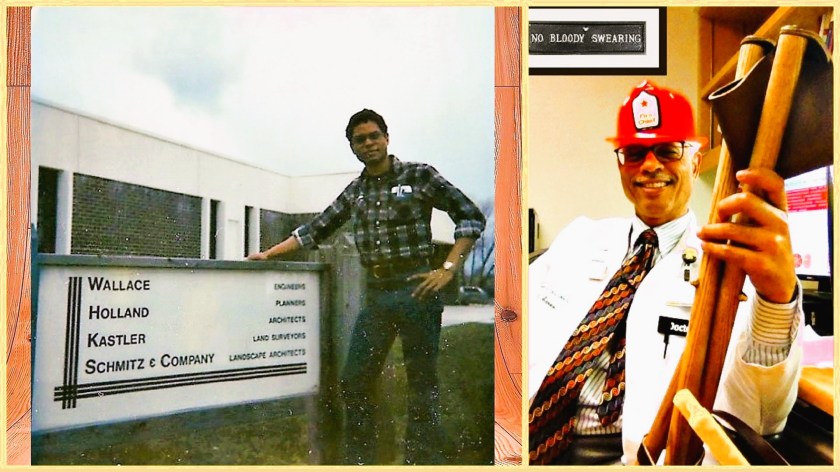
“Our work on the Delirium Early Detection and Prevention Project reminds me of my early formative experiences working as a draftsman and land survey technician starting in 1971 with an engineering company, Wallace Holland Kastler Schmitz & Co. (WHKS & Co.) in Mason City, Iowa. I remember being amazed at how a drawing on paper could be turned into a city street, highway, bridge, or airport runway. They have a website now. I can now find written there what was modeled for me then:

“WHKS & Co. is committed to the continuous improvement of the quality of service provided to our clients.”

Then and now WHKS & Co. worked hard to create the infrastructure that we depend on and then put it into the world in a “safe, functional, and sustainable” way. Out in the field we sometimes joked about how a designer’s drawing was flawed if we couldn’t go from plan to dirt.

It’s common to believe that engineers and land surveyors deal with complex mathematical formulas, structural materials, things instead of people—an applied science in which the emotions and motivations of people play a small role. Nothing could be further from the truth.

I was 16 years old when WHKS & Co. hired me. I had no idea what engineers and land surveyors did, had no experience, and I was at a crossroads in my life. They didn’t hire me because I had any talent or asset they needed. They hired me because they were as committed to the people in the community, not just to things.

And if you think land surveying doesn’t have anything to do with people’s emotions, consider property line disputes. The survey crew I was attached to had been sent out to find the property corners of two neighbors. This involves locating iron pins that mark the corners of the lots that houses sit on. Little maps or “plats” are used as guides and let me tell you, often enough we found the map is not the territory.

Anyway, while we were out there in the back yard of one of the neighbors, they both came outside. One of them was a diminutive elderly lady and the other was a tall, big-boned elderly man. They started arguing about the boundaries of their lots and it got pretty heated. Pretty soon they were yelling in each other’s faces and the lady reached down in the garden in which we were all standing. She picked up the biggest, juiciest rotten tomato she could find and it was clear to us what she planned to do with it. They were both pretty old and neither one of them could move very fast. My crew chief, sensing that something violent was about to happen, moved in between them (a decision I still can’t fathom to this day).

What followed seemed to happen in slow motion, in part because the combatants were so old. The man could see the lady was about to hurl the rotten tomato at him. Ducking must have been beyond his power, probably because of a stiff back. He bent his knees and leaned forward. She cocked the tomato as far back as she could and let fly, screeching, “You’re nothing but an old Norwegian!” My crew chief probably caught a seed or two. Amazingly, the tomato only grazed the top of the man’s head.

I think the altercation took a lot of both of them. They both went back in their houses after that.

It’s not hard for me to see the connection between my past and the present. WHKS & Co. was and still is committed to continuous improvement. And they were and still are all about finding a practical way to do it. If we’re going to improve the quality of care we provide patients and we propose to do it by preventing delirium, we’re going to have to use the same principles that my first employer used. And we’re going to have to be just as practical about how to go from plan to dirt.

We’re still trying to refine the charter for our delirium detection and prevention project, which is a kind of map, really. And even though the map is not the territory, it’s still a necessary guide to remind us of the goal.”

They Did Learn How to Check for Delirium!

Here’s another oldie but goodie blog post, “It’s Survey Time.” It’s a blast from the past (May of 2011) but it needs a short introduction on why I’m reposting it.

So, I’m about a week out from my surgery for a detached retina. I’m doing pretty well. I keep thinking about a question a nurse asked me right after I was taken to the recovery room from the operating room. I was a little hazy because I’m pretty sure I got some sedation medication, although I was definitely mostly awake for the procedure. The nurse asked me, “Well, can you answer a question for me; will a stone float on water?”

First of all, I gave the right answer, “No.” More importantly, I was momentarily stunned because I recognized the question is from the Confusion Assessment Method for the Intensive Care Unit (CAM-ICU). And I told the nurse that. It reminded me of my early career as a general hospital consultation-liaison psychiatrist.

Most of my old blog posts from The Practical Psychosomaticist are about my frustration over what seemed to be my fruitless efforts to teach nurses and physicians about how to prevent, assess, and manage delirium.

I can’t tell you how happy I was that my recovery room nurse asked me a CAM-ICU delirium screening question.  

I mentioned the American Delirium Society (ADS) in the post and also found a fairly recent article on the CAM ICU. Among the authors were those I met at one of t he first ADS meetings: Malaz Boustani and Babar Kahn.

“It’s Survey Time!”:

“I know, I know, I can hear it out there, “Doesn’t Dr. Amos ever learn? Nobody does surveys and polls!” Hey, that’s OK; I have so much fun doing them anyway. Of course, it would be nice to get some responses… I’ve talked to you and I’ve talked to you, and I’m done talkin’ to you! Come back here, I’m not done talkin’ to you!

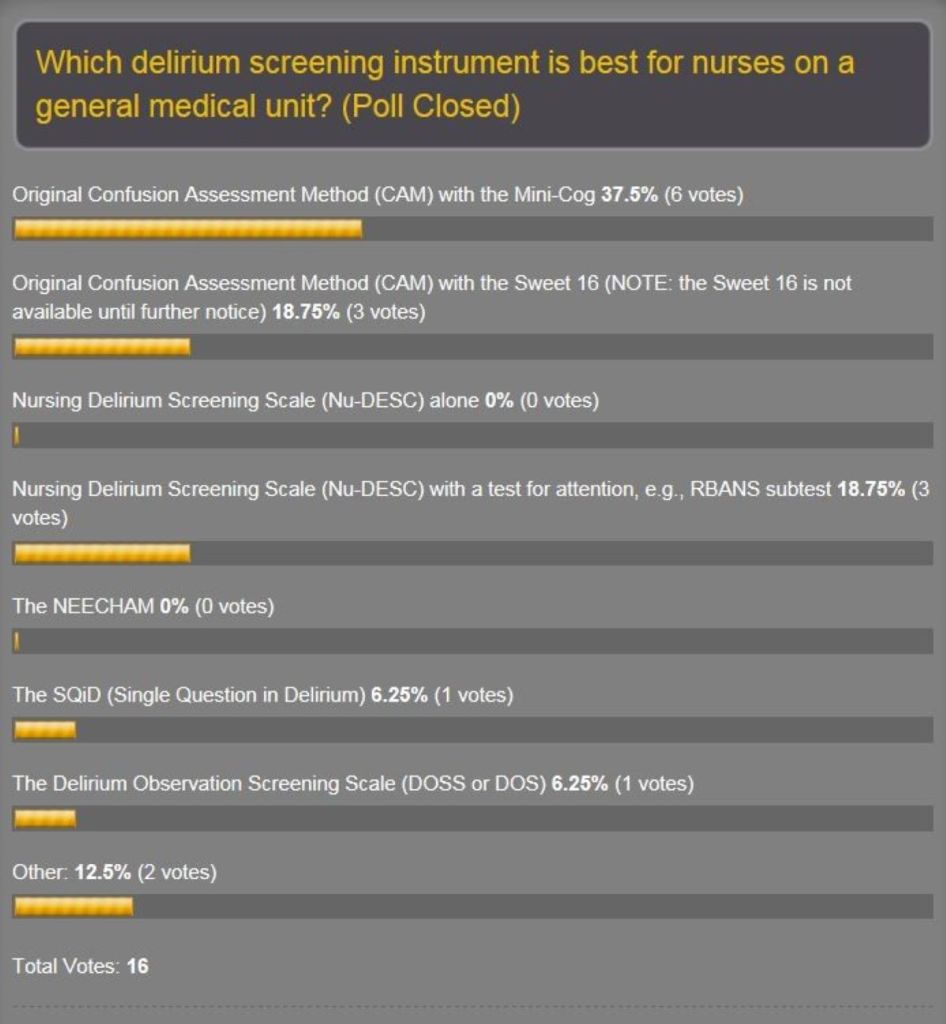
Anyway, the new poll for what’s hot and what’s not about delirium screening scales is up on the home page. The original one was partly to help our delirium prevention project committee to decide on which one to use. Well, the original got only 16 responses…but they were great responses! The amazing thing was that, despite the paucity of votes, the results were plausible. See the results:

Recall that at our 7th project meeting we selected the DOSS. What? There is good literature supporting all of these scales and a lot of factors influence selection of any tool, not the least of which is feasibility, which is mainly ease of use. That means it’s quick and doesn’t require a lot of training or additional assessments. And you should use a tool that’s validated for the patient population you want to protect from delirium. I probably got a lot of questioning looks at the screen when this poll came out because the Confusion Assessment Method-Intensive Care Unit (CAM-ICU) was not on the list. Well, you heard it from one of the main dudes on the team that developed the CAM-ICU that it’s probably not appropriate for use on general medical units…Dr. E. Wesley Ely himself (see post April 29, 2011). Hey, as far as the ICU patient population goes, the CAM-ICU is the holy grail. We need to keep looking for a sensitive and specific tool which is quick and easy for nurses to administer on general medical units.

We’re going with the DOSS. And one of my neuropsychologists, John, is offering to run neuropsychology test batteries on the patients that nurses screen with the DOSS. Atta boy, John! Neuropsychologists are going to be indispensable in this area. I remember pushing for the addition of subtests of the Repeatable Battery for the Assessment of Neuropsychological Status (RBANS), especially the Coding test in order to detect delirium early as possible. It didn’t make it, but it was close. This has been advanced by another one of our neuropsychologists here who’s done some delirium research in the bone marrow transplant unit with delirious patients. Hey, I still wonder what we could accomplish if the Coding test were added to the DOSS or even the Nursing Delirium Screening Scale (Nu-DESC). Maybe there’s already somebody out there putting a practical implementation plan for that into the real world.

So why do the poll again? Because I’d like to see if I could persuade nurses from large American and world organizations to put the nickel down and vote. And if I keep shoving this thing out there, maybe somebody will let us know that, hey, we’re not in this alone and offer to collaborate.

And I stole a couple of survey questions from our group to see what physicians and nurses think about how they manage delirium. It’s a way to take a snapshot of the culture of how docs and nurses work together on delirium recognition and interventions. And hey, why am I doing that? Because I’m a thief…no, no, I mean the reason is delirium is a medical emergency and we all need to work together to find ways to understand it better in order to prevent it. The American Delirium Society (ADS) tell you why delirium prevention is critical in the endless search to find ways to deliver high-quality medical care to patients:

Delirium Simple Facts:

  • More than 7 million hospitalized Americans suffer from delirium each year.
  • Among hospitalized patients who survived their delirium episode, the rates of persistent delirium at discharge, 1, 3 and 6 months are 45%, 33%, 26%, and 21% respectively.
  • More than 60% of patients with delirium are not recognized by the health care system.
  • Compared to hospitalized patients with no delirium and after adjusting for age, gender, race, and comorbidity, delirious patients suffer from:
  • Higher mortality rates at one month (14% vs. 5%), at six months (22% vs. 11%), and 23 months (38% vs. 28%);
  • Hospital stay is longer (21 vs. 9 days); Receive more care in long-term care setting at discharge (47% vs. 18%), at 6 months (43% vs. 8%) and at 15 months (33% vs. 11%); and
  • Have higher probability of developing dementia at 48 months (63% vs. 8%).

And have you registered for the ADS inaugural conference on June 5-7 in Indianapolis? Good for you! And are you going to bring back something from that conference for The Practical Psychosomaticist, and I don’t mean doughnuts? That’s the spirit! The surveys have spaces for free-text comments as well, which I want to hear!”

My Old Elevator Pitches on Delirium

I thought it would be fun to take a look back at my chronicle as expressed in my old blog posts. As the featured image shows, I used to have a blog I called The Practical Psychosomaticist, which I started back in 2010. It was mostly about how to diagnose, manage, and prevent delirium. One of them was about developing elevator pitches promoting delirium awareness. My blog post Elevator Pitch for a Delirium Prevention Project is below:

“Sir Winston Churchill: Be clear, be brief, be seated.

I have been told that I could improve my chances of selling my product of delirium prevention to various stakeholders by developing a good elevator pitch. An elevator pitch is a short summary used to quickly and simply define a product or service and sell it. The idea is that you should be able to deliver the pitch in the time it takes to ride an elevator or about thirty seconds to two minutes.

I’m a doctor, not a salesman. But I’ll give it a shot.

Pitch to a staff nurse: I’m Dr. JA and I teach nurses how to assess, treat, and prevent delirium in hospitalized patients. Delirium is an acute confusional episode that mimics mental illness but is actually a medical emergency. Delirium worsens concentration, can lead to hallucinations, withdrawal, changes in appetite, reduced mobility, and sleep disturbance. When nurses have the skills and tools to prevent delirium, they ultimately do less work yet provide safer and more effective care for their patients, thereby promoting healing. Delirium leads to increased death rates, longer lengths of hospital stay, and persisting cognitive impairment. Nurses work harder to take care of them because confusion makes patients less cooperative, emotionally volatile, harder to communicate with, and sometimes even violent. Nurses want and need to know how to prevent delirium and I can help them do that.

Pitch to a potential funding source: I’m Dr. JA and I teach doctors and nurses how to assess, treat, and prevent delirium, an acute confusional disorder caused by multiple medical problems that mimics mental illness but is actually a medical emergency. They may be slow to respond, withdrawn, have attitude changes, and have mood symptoms. Because the risk for delirium is higher in the elderly, physicians and nurses in hospitals actually have to work harder to treat delirious patients with serious medical disorders. That’s because the patients are too cognitively impaired to cooperate with treatment, too disorganized to consent for them, and too agitated and restless to sit still for necessary tests. Doctors and nurses want and need to learn how to use assessment skills and tools to prevent delirium. This vital educational resource allows them to provide the best health care for older patients.

Pitch to Patient and Carers: I’m Dr. JA and I help doctors and nurses care for patients who may be at high risk for or who are in fact suffering from delirium. Delirium is an abrupt change in your mental state that represents a distinct change from your usual self and is often alarming to you and your loved ones. You can be disoriented, restless, hallucinate, have delusions and personality changes, or be very sleepy and seem depressed. Delirium is often temporary but can cause longer hospital stays, or the need for long-term care and raises the risk for falls and bed sores. Those at risk are over age 65, already have memory problems or dementia, have a broken hip, or several serious medical illnesses. We’ll assess regularly for changes in your emotions, behavior, or thinking and if they occur, we’ll use a special test to spot delirium early. We’ll work to prevent delirium by providing high-quality medical care. Occasionally, distress and behavioral changes could make patients a risk to themselves and if non-medication methods don’t reduce these, then a short course of medication called Haldol may be used.”

Well, all of the elevator pitches are way too long. But the message is still important.

Quiz Show versus Grand Rounds for Delirium Education Redux

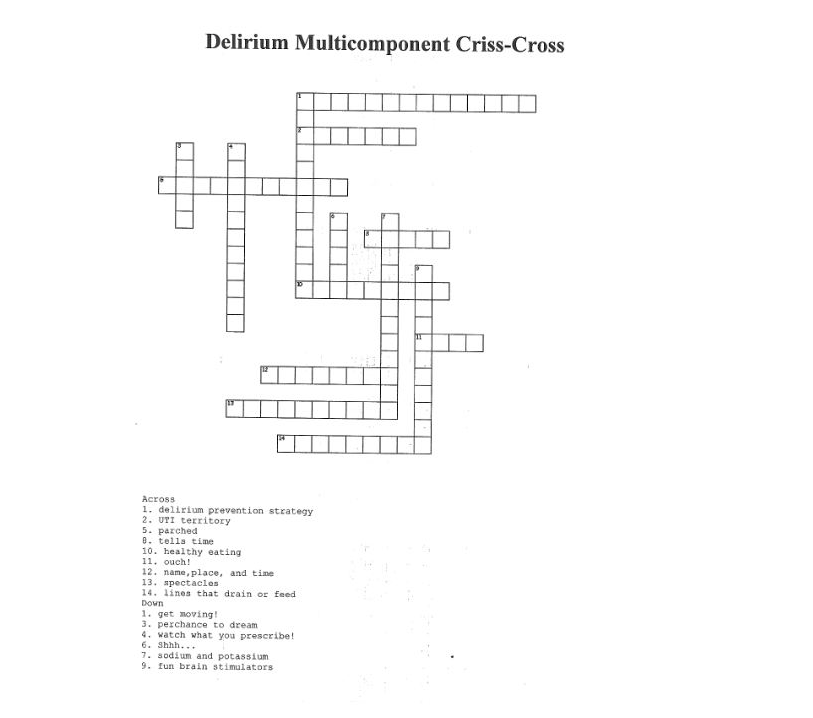
Here’s a redux of one of my blog posts from years ago. There’s not been much change in the data or clinical practice regarding delirium, except we’re even less enthusiastic about using any kind of psychotropic medication to treat delirium, even hypoactive delirium. Try the puzzle.

“So, you want to put on a game show contest to educate clinicians about delirium? Contact David Meagher, a psychiatrist in (where else?) Limerick, Ireland. He reported on this innovative educational workshop in the November 2010 Vol. 3 issue of the Annals of Delirium, the newsletter for the European Delirium Association (EDA). He also published the study which describes the contest in International Psychogeriatrics [1].

The workshop focused on clinician attitudes toward drug therapy for distressed delirious patients. It explored pre-existing attitudes and practice toward the use of medications to manage delirium and exposed participants to a very interactive educational event modeled after a popular TV quiz show. There were two teams (skeptics versus neuroleptics) furnished with a list of statements about delirium pharmacotherapy. The participants later completed a post-workshop questionnaire that explored changes in attitudes as a result of the workshop.

The participants were all experts on the subject and there was a good deal of variability in attitudes and practice. Some of the questions put to the teams involved using antipsychotics prophylactically to prevent delirium, the mechanism of action of antipsychotics, and what role benzodiazepines play in the treatment of non-alcohol withdrawal delirium.

One of the more puzzling findings was that the frequency of antipsychotic use was inversely proportional to the perception of the strength of supporting evidence. In other words, the less they knew about antipsychotics, the more often they used them. Most participants seemed to believe that the principal mechanism of action of antipsychotics is sedation, despite the lack of supporting evidence.

Some clinicians used antipsychotics to relieve the stress of caregivers rather than that of delirious patients, an example of patients getting the right treatment for the wrong reasons as observed by Meagher—and many of us in the field.

The workshop also highlighted the tendency of clinicians to focus on risk management rather than effective therapeutic intervention in the management of delirious patients with disruptive behavior and severe distress. This mainly relates to focus on the potential adverse effects of antipsychotics such as extrapyramidal side effects, metabolic, and cerebrovascular effects.

The quiz show activity was fun and challenging. The device of dividing the participants into two small teams with larger audience participation cut down on the anxiety that could be provoked by giving the “wrong answer”. The questions were true/false and didn’t always have clear right or wrong answers. It was highly interactive, a component of continuing medical educational (CME) activities that is increasingly encouraged because it’s more likely to lead to changes in clinician attitude and practice. The one time Grand Rounds CME “seat time” is going the way of the dinosaur.

So a couple of findings from the quiz show post-activity questionnaire were that clinicians were more likely to use antipsychotics prophylactically and to use antipsychotics to manage hypoactive delirium.

 Our delirium intervention project group members are not quite as enthusiastic yet about these two interventions. We’re a bit more inclined at least initially to focus on non-pharmacologic multicomponent strategies such as the example below:

  • Minimize the use of immobilizing catheters, intravenous lines, and physical restraints
  • Avoid immobility, early mobilization
  • Monitor nutrition
  • Provide visual and hearing aids
  • Monitor closely for dehydration
  • Control pain
  • Monitor fluid-electrolyte balance
  • Monitor bowel and bladder functioning
  • Review medications
  • Reorient communications with the patient
  • Place an orientation board, clock, or familiar objects (i.e., family photographs) in patient rooms
  • Encourage cognitively stimulating activities such as word puzzles
  • Facilitate sleep hygiene measures, including relaxation music or tapes at bedtime, warm drinks, and gentle massage
  • Minimize noise and interventions at bedtime, e.g., by rescheduling medication times

But I’m just as enthusiastic about interactive educational methods to engage learners in order to build a culture more likely to produce champions who will lead the delirium prevention effort—try the delirium multicomponent crisscross puzzle below. The clues are contained in the list of multicomponent tactics above.”

  1. Meagher, D.J., Impact of an educational workshop upon attitudes towards pharmacotherapy for delirium. Int Psychogeriatr, 2010. 22(6): p. 938-46.

Let’s Promote Living Well to 100

Living Well

I get a big kick of this video every time I see it. It’s a YouTube about people who are 100 years old who are funny, wise, and talented. It’s included on the SSM Health St. Mary’s Hospital YouTube channel. St. Mary’s Hospital is in Madison, Wisconsin. I worked as a psychiatrist there very briefly a long time ago.

However, the other thing this video brings to mind is something sad. I see patients half my age (nowhere near 100) almost every day in the hospital who are delirious, sometimes for prolonged periods of time. According to the medical literature, they will be at risk for developing dementia and not infrequently do. In fact, research tends to show that for every day someone spends delirious, the risk for developing dementia goes up 35%. That makes delirium a life-limiting condition which can happen to anyone at any age.

I got delirious after a routine colonoscopy, a procedure to screen for colon cancer and other pre-cancerous tumors that used to be routinely recommended for those who reach 50. It was the worst 50th birthday present a guy could ever get.

I was delirious probably because I got sedated with a combination of Versed and Demerol. The worst part of the condition probably lasted only a couple of hours at most following the procedure. But I was sure wiped out the rest of the day.

I would have a tough time picking out the worst part of the whole process, the bowel prep (guzzling a big jug of GoLytely which should be called GoHeavily) or enduring the post-procedure delirium. It was probably the latter.

I don’t remember much. My wife tells me that I kept repeating something about not taking NSAIDs. I think there was something about that in the informed consent and education materials that got sort of stuck in one of my neurons. I kept sliding down in bed while I was in the recovery room, which I was in for a little while longer than is usually expected.

Preventing delirium is a vital job for health care professionals everywhere. We can’t prevent each and every case, but there are definitely things we can do to mitigate the problem. One of the most important goals is to try to minimize or avoid the use of certain offending drugs such as anticholinergic and sedative-hypnotic agents.

It’s also good to remember that the population at highest risk for getting delirious is the elderly and those who already may have cognitive impairment.

Preventing delirium, based on current literature, means first implementing non-pharmacologic multicomponent interventions. These may require a large cadre of volunteers. The best example is the Hospital Elder Life Program (HELP) at Yale, which is copyrighted by Dr. Sharon Inouye. Six of the most important features to address:

–Normalizing electrolytes such as sodium and keeping patients well-hydrated

–Mobilizing patients as much as possible, including getting immobilizing devices such as foley catheters removed as early as you can

–Making sure sensory aids such as eyeglasses and hearing aids are available

–Ensuring that medications are monitored so as to minimize exposure to drugs that are anticholinergic or sedating.

Anyway, working on preventing delirium and minimizing its impact is an ongoing challenge. Keep the goal in mind: We want as many people as possible to live well to 100.