Big Mo Pod Show: “Blues: The Universal Mixer”

We listened to the Big Mo Pod Show (Sena stuck with it for about the first hour anyway) last night and then I got a mini-education in the forms of music, at least, as it relates to timing and rhythm. The theme was “Blues: The Universal Mixer.” Frequently, the blues show and the podcast remind me of previous eras in my life and lead to a few free associations.

Big Mo Pod Show 085 – “California Bluesin” KCCK's Big Mo Pod Show

After a short break during the Thanksgiving holiday your hosts are back at it again with another episode! This week features the usual mix of blues eras you’ve come to expect along with a few Californian artists, tune in to see which ones! Songs featured in the episode: Solomon Hicks – “Further On Up The … Continue reading
  1. Big Mo Pod Show 085 – “California Bluesin”
  2. Big Mo Pod Show 084 – “Garage Blues”
  3. Big Mo Pod Show 083 – “Legal Pirate radio”
  4. Big Mo Pod Show 082 – “Tribute”
  5. Big Mo Pod Show 081 – “Cheers To Kevin”

The 5 songs reviewed by Big Mo and Noah are probably recognizable to many listeners. As usual, I have to search for the lyrics because I seem to have an inborn tendency to hearing mondegreens. And as usual, I don’t always pay the most attention to the songs chosen for the podcast.

But Big Mo did a little teaching session about rhythm forms, which he related to a couple of songs on the list. One of them was “Wait on Time” by The Fabulous Thunderbirds. I happened to notice that a couple of lines in the lyrics of “Wait on Time” reminded me of another artist who didn’t make it to the list on the podcast but was on the blues show playlist last night. That was Junior Walker and the All Stars. Their song “I’m a Road Runner” was one of my favorites because it reminded me of how I ran all over the hospital as a consult psychiatrist. But I can’t relate to the song as a whole.

The lines the two songs share are:

“Wait on Time” lyrics:

“Well, I live the life I love
And I love the life I live
The life I live baby
Is all I have to give”

“I’m a Road Runner” lyrics:

“And I live the life I love
And I’m gonna love the life I live
Yes, I’m a roadrunner, baby.”

Although the lyrics are similar, the themes are different. The guy in the song “Wait On Time” is promising he’ll get back to his lover someday. On the other hand, in the “I’m a Road Runner” lyrics, that guy is making no such promise and is actually is saying just the opposite.

Big Mo pointed out that there is a common rhythmic form in blues that easily mix with other forms of music, including Latin forms (I don’t understand that music lingo but I think I hear and feel what he means). He mentions that Bo Diddley mixed certain rhythms like that into his music, which surprised me because I didn’t know that. It may be why I like Bo Diddley.

Big Mo didn’t play “I’m a Road Runner” last night but played another hit from Junior Walker and the All Stars: “Ain’t That The Truth.” Just an aside, that tune is mostly instrumental and has a total of only 4 lines apparently, which express a common blues sentiment about relationships:

“Say man, what’s wrong with you?
Oh man, my woman done left me
Say it, man, play me some blues, jack
Get it, baby
Ain’t that the truth”

Several artists covered “I’m a Road Runner” including but not limited to the Grateful Dead and Steppenwolf. Bo Diddley did a song called “Road Runner” but it was not the Junior Walker tune. There’s a YouTube video relating it to the cartoon Roadrunner and Wile E. Coyote.

I’m not a roadrunner by any definition, but I learn a little something new just about every time I hear the Big Mo Pod Show.

Reading My Old Book in a New Light

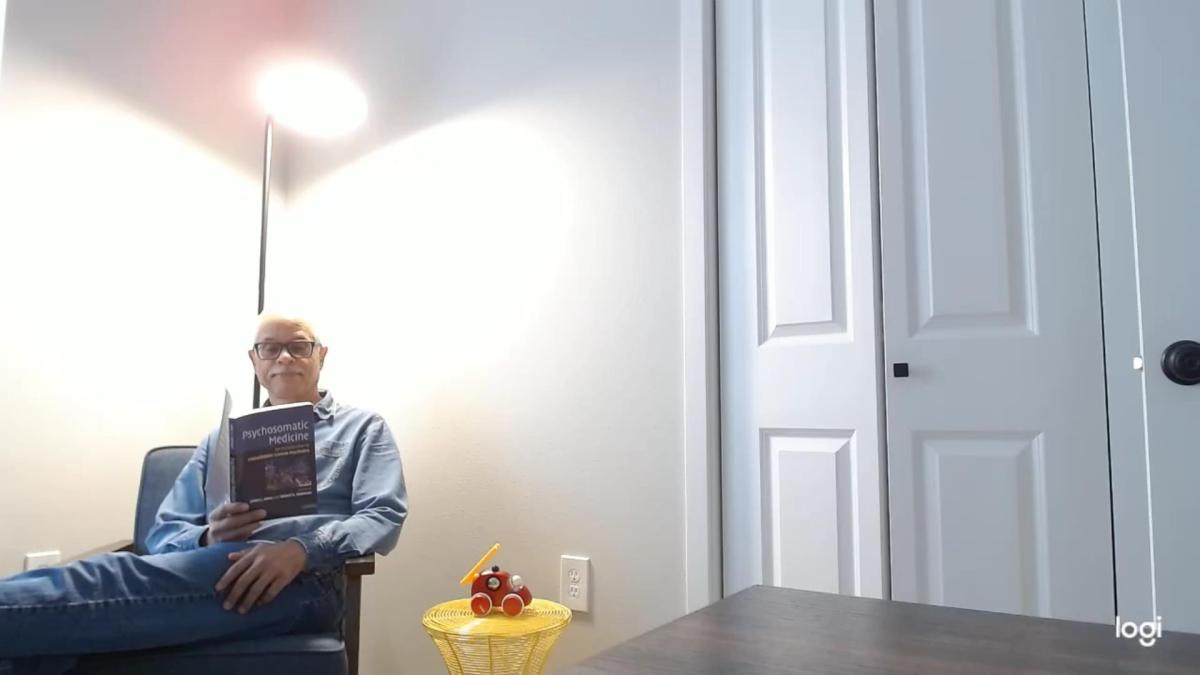
Sena bought me a wonderful new lamp to read by and it improves on the ceiling fan light I wrote about the other day (And Then a Light Bulb Went Off).”

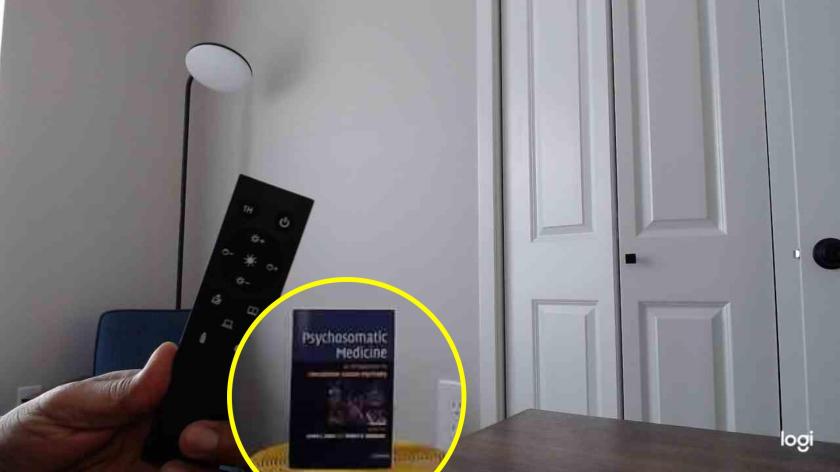
The new lamp even has a nifty remote control with which you can choose the ambient feel. There are several selections, one of which is called “breastfeed mode,” a new one on me. There’s a light for that?

The lamp arrived at about the same time I got a notice from my publisher for my one and only book, “Psychosomatic Medicine: An Introduction to Consultation-Liaison Psychiatry,” that people are still buying—after 14 years! My co-editor was my former psychiatry department chair, Dr. Robert G. Robinson. As far as I know, Bob has dropped off the face of the earth. I hope he’s well.

Consultation-Liaison Psychiatry is probably about the same as I left it when I retired 4 years ago. I walked all over the hospital trying to help my colleagues in medicine provide the best possible care for their patients. I put in several miles and stair steps a day. I saw myself as a fireman of sorts, putting out fires all over the hospital. I got a gift of a toy fire engine from a psychiatrist blogger in New York a long time ago.

Now I walk several miles on the Clear Creek Trail, like I did yesterday and the day before that. I have shin splints today, which tells me something—probably overdid it.

So, I’m taking a break from walking and reading an old book in a new light.

Verbal De-escalation Education Videos

I was looking at the Academy of Consultation-Liaison Psychiatry (ACLP) and discovered a free online video educational series on verbal de-escalation of agitated patients. It reminded me of my own early attempts to educate trainees about this very important topic (see my post “A Little Too Exuberant”).

The Simpson et al presentation includes 5 free online videos. The first one is below.

Simpson, Scott & Sakai, Joseph & Rylander, Melanie. (2019). A Free Online Video Series Teaching Verbal De-escalation for Agitated Patients. Academic Psychiatry. 44. 10.1007/s40596-019-01155-2.

Old Blog Post on Decisional Capacity Assessment

I just found a blog post I wrote about assessing decisional capacity. It’s over 13 years old and you can tell I was a little frustrated when I wrote it. It was back in the days when consulting psychiatrists were called psychosomatic medicine specialists. Here’s to another blast from the past.

Blog from 2011: Thoughts on Assessment of Medical Decision-Making Capacity

Listen very carefully to what I’m about to say. A patient’s ability to make decisions about her medical or surgical treatment does not depend on knowing her surgeon’s name.

Let me put it differently. Simply because you can recall your surgeon’s name doesn’t mean you have the decisional capacity to give or not give informed consent to have surgery.

If that’s too obvious to most of you, then maybe I can stop worrying that it isn’t to so many doctors, who sometimes misunderstand or are simply unaware of the basic principles of assessing decisional capacity regarding medical treatment. Believe it or not, some physicians actually believe the above is part of an adequate decisional capacity assessment.

Psychosomaticists are frequently called to assess decisional capacity to participate in the informed consent discussions that are such an important part of the doctor-patient relationship today.  Many non-psychiatric doctors simply don’t feel confident that they can do it themselves. And when they try, their description of the process often indicates an alarming deficit in their medical school education about this basic skill.

In order to give informed consent, you need to have enough information from your doctor, be able to voluntarily make a decision without undue pressure from others (including your doctors), and be competent to decide. Exceptions to obtaining informed consent include but are not limited to “incompetence” (the inability to decide) and medical emergencies.

In a nutshell, the basic elements of assessing decisional capacity are:

  1. Any physician can do it; a psychiatric consultation is not obligatory though it may be helpful in difficult cases in which delirium or other mental illness may be substantially interfering with decision-making.
  2. The patient’s ability to understand her medical condition and the risks and benefits of the main and alternative medical interventions proposed as treatment.
  3. The patient’s appreciation of the nature of her medical condition and the potential consequences of the treatment options or no treatment in the context of her values and wishes.
  4. The patient’s ability to reason through her choices regarding treatment.
  5. The patient’s ability to express a choice.

Notice that nowhere in the above list is recall of the surgeon’s name even mentioned. Remembering your surgeon’s name may be flattering but it’s not essential to the assessment of decisional capacity.

There are several reasons to assess decisional capacity including but not limited to an abrupt change in the patient’s mental status. This is commonly caused by delirium, which by definition is an abrupt change in affect, cognition, and behavior that fluctuates and is by definition related to medical causes.

Any physician can conduct a decisional capacity evaluation, yet a psychiatric evaluation is frequently requested.  The reason for that may arise from the assumption that the Psychosomaticist is a sort of “informed consent technician”[1]:

  1. “Efficiency model” scenario
    1. Incompetence is presumed.
    1. Psychiatric consultant is expected to remove legal barriers expeditiously to obtain a surrogate decision maker.
  2. “Pseudoconsultation” scenario
    1. Consultation requestor lacks the patience, interest, or time to do an assessment.
  3. “Persuasion” scenario
    1. Psychiatric consultant is expected to persuade the patient to reverse his refusal of needed treatment.
  4. “Protection” scenario
    1. Psychiatric consultant is expected to provide documentation to protect against potential litigation.
  5. “Punishment” scenario
    1. Stigma associated with psychiatric evaluation is used unconsciously to punish treatment refusal behavior.

In all fairness, psychiatrists are sometimes just as guilty of this buck-passing; for example, when we request a cardiology consultation to “medically clear” a patient for electroconvulsive therapy to treat life-threatening depression.

In an ideal world, a decisional capacity evaluation would be requested in and accepted in “the true spirit of dialogue as the result of a genuine evaluation of the patient’s mental state as a whole”[1].

We don’t live in an ideal world. So when a doctor is truly stuck and needs help with decisional capacity evaluations, she can confidently call a practical Psychosomaticist in the true spirit of collaboration as a result of the genuine appreciation of the importance of the patient’s medical and psychiatric care as a whole.

1.            Zaubler, T.S., M. Viederman, and J.J. Fins, Ethical, legal, and psychiatric issues in capacity, competency, and informed consent: an annotated bibliography. Gen Hosp Psychiatry, 1996. 18(3): p. 155-72.

Remember The Calling

I recommend Dr. George Dawson’s recent posts on seeing the practice of medicine as a calling and his passing a big milestone with 2 million reads on his blog.

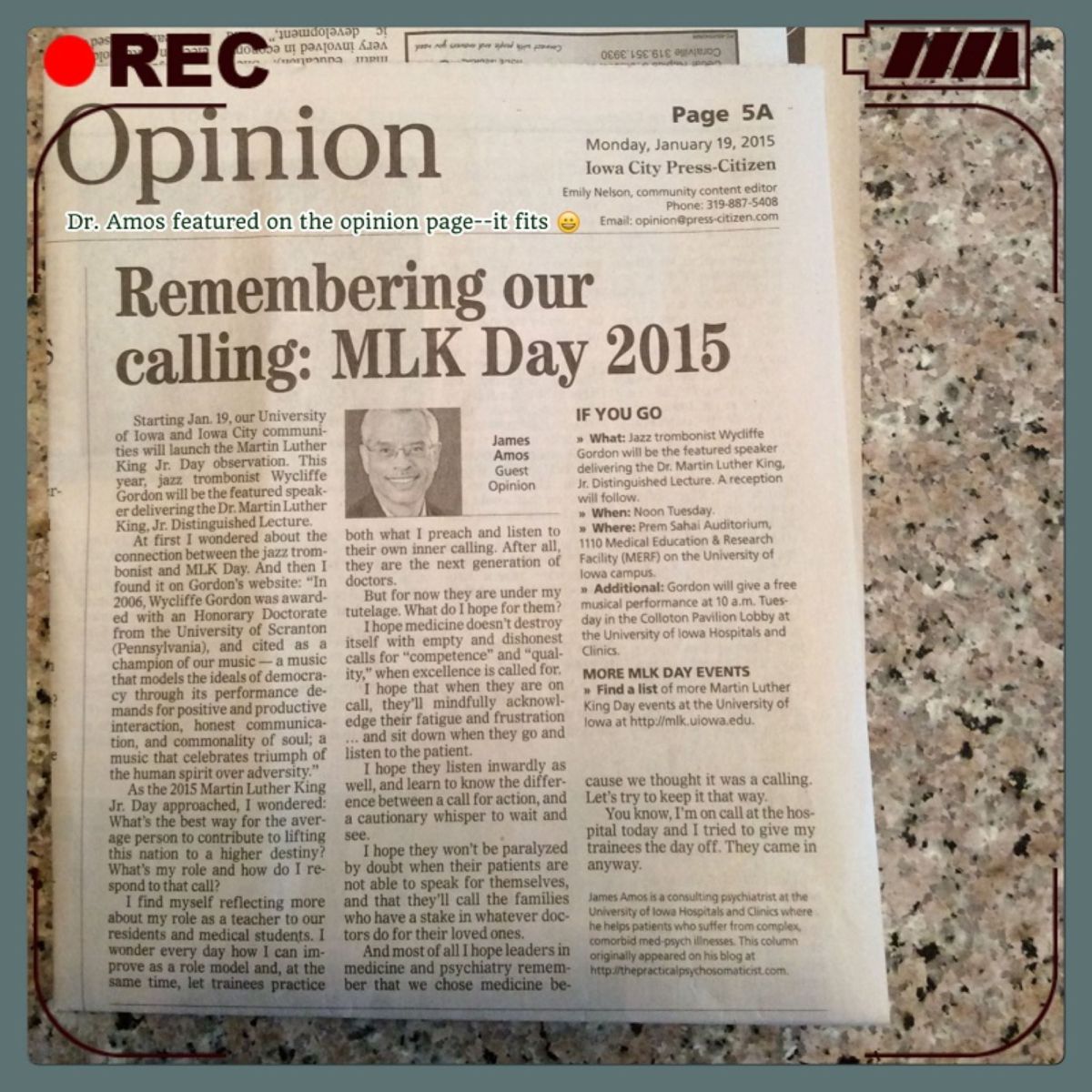
I wrote a post entitled “Remembering Our Calling: MLK Day 2015.” It was republished in a local newspaper, the Iowa City Press-Citizen on January 19, 2015. And I reposted it in 2019 on this blog.

The trainees I taught also taught each other about psychiatry and medicine when they rotated on the consultation-liaison service at the hospital. We put them into the format of short presentations. I called mine the Dirty Dozen. The trainees and I also presented the Clinical Problems in Clinical Psychiatry (CPCP).

There were many of those meetings, which were necessarily short and to the point because the service was busy. We got called from all over the hospital. We answered those calls and learned something new every time.

I posted a lot of the trainees’ presentations in my previous blog, The Practical C-L Psychiatrist, which was replaced by this present blog. I haven’t posted the presentations partly because I wanted to give the younger teachers their due by naming them as they did on their title slides. But I would want to ask their permission first. They are long gone and far flung. Many are leaders now and have been for many years. I still have their slides. I’m very proud of their work. When they were called, they always showed up.

So, you’ll just have to put up with my work and my cornball jokes.  

Thoughts on a Study of Sitting with Your Patients

I saw this interesting article on a study about the effect of chair placement on physicians’ behavior when in a patient’s room, specifically whether it altered the length of time a doctor spends with a patient or the level of satisfaction patients had with the interaction. In this study, it didn’t lengthen the time, but seemed to strengthen patient satisfaction with interaction with the physician. It’s a concept I recognize because I took this one level up—I carried my chair with me on hospital rounds in my role as a consultation-liaison psychiatrist.

I got a gift of a 3-legged camp stool from a colleague who ran the palliative care service at University of Iowa hospital. Other members of the palliative team had been using them as well.

Patients got a big kick out of a doctor who carried his chair around with him and actually sat down to talk with them. The way the camp stool folds up apparently made it look like nunchucks to some patients, so I got jokes about that occasionally. It really helped build rapport.

The only drawback with the camp stool was that my one of my legs would go numb the longer I sat on it, and could lead to a challenge getting up from it gracefully because it was partly a balancing act. Even so, I often spent much more than 10-15 minutes with patients.

Once, the stool actually broke and I dropped unceremoniously on my butt while evaluating a patient for catatonia—who proved not to be catatonic by the apparent facial expression of mirth as I fell on the floor. In that sense, the chair actually became a part of the evaluation—accidentally.

Thomas Hackett knew all about this. He was a famous consultation-liaison psychiatrist and a past president of the Academy of Consultation-Liaison Psychiatry (ACLP). One of his quotes from an early edition of the Massachusetts General Hospital Handbook of General Hospital Psychiatry fits perfectly in this context:

“As a matter of courtesy, I sit down when interviewing or visiting patients. Long accustomed to the ritual of making rounds, many physicians remain standing as a matter of course. Standing, physicians remind me of missiles about to be launched, poised to depart. Even if that is not necessarily true, they look the part. Patients sense this and it limits conversation. In addition, when standing, the physician necessarily looks down on the patient. This disparity in height is apt to encourage the attribution of arrogance. Looking down at a patient who is prone emphasizes the dependency of the position. Sitting at the bedside equalizes station. Sitting with a patient need not take longer than standing with him.”— Hackett, T. P., MD (1978). Beginnings: liaison psychiatry in a general hospital. Massachusetts General Hospital: Handbook of general hospital psychiatry. T. P. Hackett, MD and N. H. Cassem, MD. St. Louis, Missouri, The C.V. Mosby Company: 1-14.

Reference: Effect of chair placement on physicians’ behavior and patients’ satisfaction: randomized deception trial BMJ 2023; 383 doi: https://doi.org/10.1136/bmj-2023-076309 (Published 15 December 2023)

Old Doctors vs Young Doctors

I ran across a recently published web article that originated from the Wall Street Journal (WSJ), to which I don’t have access because I’m not a subscriber. The title is “Do Younger or Older Doctors Get Better Results?” and it’s in the form of an essay by Pete Ryan.

It’s been picked up by over 130 news outlets and is actually based on an open access study published in the British Medical Journal (BMJ) in 2017, (BMJ 2017;357:j1797): Tsugawa Y, Newhouse J P, Zaslavsky A M, Blumenthal D M, Jena A B. Physician age and outcomes in elderly patients in hospital in the US: observational study BMJ 2017; 357:j1797 doi:10.1136/bmj. j1797.

I had a quick look at the rapid response comments. A couple resonated with me. One was from a retired person:

“I did not see specific patient age statistics vs physician age groupings. Wouldn’t older patients, whose risk of dying soon was higher, want to see their own older doctors? Lots of uncontrolled variables in this study… I also agree with one of the other comments that a patient who knew the end of their life was near would seek care from an older physician that would tend to be more empathetic with a patient of their own age.”

Another was from an emergency room physician, Dr. Cloyd B. Gatrell, who entered the comment on June 8, 2017. Part of it echoed my sentiments exactly:

“The authors’ own statements call their conclusion into question: “Our findings might just as likely reflect cohort effects rather than declining clinical performance associated with greater age….”

I suspect most of the web articles spawned by the study didn’t really talk about the study itself. They probably were mainly about your attitude if the doctor who entered the exam room had gray hair or not.

The study involved internal medicine hospitalists and measured mortality rates comparing physicians were in different age ranges from less than 40 years to over 60.

It got me wondering if you could do a similar study of younger and older psychiatrists. Maybe something like it has been done. I’m not sure what an appropriate outcome measure might be. If you focus on bad outcomes, completed suicides are probably too rare and can involve psychiatrists of any age. The quote that comes to mind:

“There are two kinds of psychiatrists—those who have had a patient die by suicide, and those who will.”

Robert Simon, MD, forensic psychiatrist

I doubt they would fall into any particular age category more often than any other.

Anyway, on the subject of physicians who are getting older and required to retire at a specific age, recent news revealed that Scripps Clinical Medical Group agreed to pay almost $7 million to physicians to settle an age and disability discrimination charge filed with the U.S. Equal Opportunity Commission over a policy requiring them to retire at age 75.

And this reminds me of an article in Hektoen International A Journal of Medical Humanities: Jean Astruc, the “compleat physician.” He was a doctor in the Age of Enlightenment and was a geriatrician. An excerpt from the article:

Jean Astruc had a special interest in geriatrics and in 1762 gave a series of lectures that were taken down by one of his students. He described how in old age the skin becomes thick and hard, the hair and teeth fall out, there becomes need for glasses, respiration becomes labored, urine escapes, there is insomnia, and people forget what they have done during the day but remember every detail of what they have done in the distant past. He recommended diet, some wine to help the circulation, exercise, long sleep, and “a life from bed to table and back to bed.”

I think there is a contradiction in Astruc’s recommendations.

I retired voluntarily a little over 3 years ago. It just so happens that one of the reasons was the Maintenance of Certification (MOC) program, which the BMJ study authors mentioned in the first paragraph of the introduction:

“Interest in how quality of care evolves over a physician’s career has revived in recent years, with debates over how best to structure programs for continuing medical education, including recent controversy in the US regarding maintenance of certification programs.”

That reminds me that I got an email a few days ago from Jeffrey M. Lyness, MD, the new President and CEO of the American Board of Psychiatry and Neurology (ABPN) in January of 2023, replacing Larry Faulkner, MD. It was a letter explaining how I could recertify. I decided not to renew several years ago and I’m not thinking of coming out of retirement. I have always been an opponent of the MOC.

Maybe he sent me the letter because he found the Clinical Chart Review Module on delirium that a resident and I made in 2018. As of January 24, 2024 you can still find the module on the web site just by typing in the word “delirium” in the search field. It could be the only document about delirium on the ABPN web site, although that’s difficult to believe.

On the other hand, it’s one of two modules that are labeled as approved although valid through December 31, 2023. Maybe it’s headed for retirement.

Testament to Testiness on Liaison Psychiatry

The other day, I got an email message from the Academy of Consultation-Liaison Psychiatry (ACLP). It was from the Med-Psych Special Interest Group (SIG). It was an intriguing question about a paper somebody was looking for and having trouble getting it through the usual channels.

The paper was “The Liaison Psychiatrist as Busybody” by somebody named G.B. Murray and published in the Annals of Clinical Psychiatry in 1989. The person looking for the paper mentioned that there was a note from the editor that the paper was of a “controversial nature.”

I was immediately intrigued after doing a search of my own and finding out that the full note from the editor was as follows:

“Editor’s Note: We are aware of the controversial nature of this communication and invite responses from psychiatrists in practice as well in academic settings.”

Nothing is as exciting as holding something out to us and at the same time hiding it from us. Why was it unavailable through the usual channels? Nowadays “usual channels” means accessing the digital copy over the internet from the journal.

Anyway, soon enough somebody found a copy of what turned out to be Dr. George B. Murray’s presentation of the paper with the title “The Liaison Psychiatrist as Busybody” at the American Psychiatric Association (APA) meeting in 1983 in New York. It looked like it was copied from the Annals of Clinical Psychiatry journal where it was published in 1989.

The paper was one of four APA presentations (p. 76) in a symposium entitled “The Myth of Liaison Psychiatry.” The titles and presenters including Murray’s:

  1. Teaching Liaison Psychiatry as Medicine at Massachusetts General Hospital—Ned Cassem MD, Boston, MA
  2. The Liaison Psychiatrist as Busybody—George Murray MD, Boston, MA
  3. Liaison Psychiatry to the Internist—John Fetting, MD, Baltimore, MD
  4. The Hazards of “Liaison Psychiatry”—Michael G. Wise, MD, Baltimore, MD

Before I get to the paper itself, I should mention that it was my wife, Sena, who gets the credit for actually finding out that “G.B. Murray” was George B. Murray, a distinguished consultation psychiatrist at Massachusetts General Hospital.

I purposely omitted the word “liaison” from “consultation psychiatry” because he was said to have “loathed the word ‘liaison’.” This was according to the blogger (Fr Jack SJ MD) who posted an in-memoriam piece on his blog in 2013 shortly after Father George Bradshaw Murray died. He had been a Jesuit priest as well as a psychiatrist. Fr Jack SJ MD also noted that Murray ran the consult fellowship at Mass General, saying:

“George’s fellowship was unique.  He founded it in 1978 and directed it full-time until a few years ago.  By the time he retired he had trained 102 fellows mostly on his own.  His didactic methods would be frowned upon by politically-correct, mealy-mouthed, liberals of academe (bold face type by J. Amos).  His fellows thrived.  George turned us, in the words of Former Fellow Beatriz Currier, MD, “into the kind of psychiatrist I wanted to be but didn’t know how to become.”  We worked hard.  Many consults per day.  Vast amounts of reading for which he expected us to be prepared.  But he worked even harder for us.”

So, right about now, to quote one of my favorite Men in Black movies character, Agent J: “That grumpy guy’s story’s starting to come into focus a little bit here.”

I’m not going to dump big quotes from Murray’s presentation, but I can say that it’s understandable to me now why it has been described as controversial. He just sounds a little testy.

Getting back to the New York symposium, I noticed that the chairperson was Thomas P. Hackett, and the co-chair was Ned Cassem, both of Mass General, the latter also a Jesuit priest. I never met either of them, but they are legends. Hackett died in 1988 and Cassem died in 2015.

I’ve read what Hackett wrote about the difference between psychiatric consultation and psychiatric liaison:

“A distinction must be made between a consultation service and a consultation liaison service.  A consultation service is a rescue squad.  It responds to requests from other services for help with the diagnosis, treatment, or disposition of perplexing patients.  At worst, consultation work is nothing more than a brief foray into the territory of another service, usually ending with a note written in the chart outlining a plan of action.  The actual intervention is left to the consultee.  Like a volunteer firefighter, a consultant puts out the blaze and then returns home.  Like a volunteer fire brigade, a consultation service seldom has the time or manpower to set up fire prevention programs or to educate the citizenry about fireproofing.  A consultation service is the most common type of psychiatric-medical interface found in departments of psychiatry around the United States today.

A liaison service requires manpower, money, and motivation.  Sufficient personnel are necessary to allow the psychiatric consultant time to perform services other than simply interviewing troublesome patients in the area assigned.  He must be able to attend rounds, discuss patients individually with house officers, and hold teaching sessions for nurses. Liaison work is further distinguished from consultation activity in that patients are seen at the discretion of the psychiatric consultant as well as the referring physician.  Because the consultant attends social service rounds with the house officers, he is able to spot potential psychiatric problems.”—T. P. Hackett, MD.

Here’s the thing. This quote comes from Hackett’s chapter in the 1978 edition of the Massachusetts General Handbook of General Hospital Psychiatry. But I tended to gloss over what he wrote right below it:

“Once organized, a liaison service tends to expand. Most liaison services are appreciated and their contribution is recognized. Sometimes this brings tangible benefits such as space and salary from the departments being serviced. However, even under the best circumstances, the impact of a liaison effort seldom lingers after the effort is withdrawn. Lessons taught by the psychiatrist need constant reinforcement or they are forgotten by our medical colleagues. In a way, this is an advantage since it ensures a continuing need for our presence. Conversely, it disappoints the more pedagogical, because their students, while interested, fail to learn. I believe we must be philosophical. After all, our surgical colleagues do not insist that we learn to do laparotomies. They insist only that we be aware of the indications.”—T.P. Hackett, MD.

You get a clear sense of Hackett’s sense of humor as well as a practical appreciation of what can and maybe cannot be done when you try to apply liaison principles in a formal teaching approach.

So, what does Murray say about liaison psychiatry that seemed cloaked behind the term “controversial”? He starts off by admitting that his remarks will be “inflammatory” and makes no apology for it. He starts with three main statements:

  1. What all nonpsychiatric physicians appreciate, and what, in fact, works, is the medical model of consultation psychiatry.
  2. Liaison psychiatry is more myth than reality.
  3. The liaison psychiatrist is to a great extent a relatively high-status busybody.

It’s difficult to pick out excerpts from Murray’s presentation—so much of it is integral to the main message and entertaining as well that I hate to omit it. Here’s my pick anyway:

“There is a certain Olympian quality surrounding liaison psychiatrists. It is as if they will teach others the wonders of the labyrinthine biopsychosocial factors involved in patient care. The other Olympian feature centers on the so-called consultee-oriented consultation. In hearing discussions and reading the literature one can get a downwind whiff of antiphysician feeling. There are remarks made, for example, of the insensitivity of surgeons, of patient “harassment” and how little the attending physician understands this hysteric’s or sociopath’s inner dynamics. This attitude is snobbish, unhelpful, and in semistreet parlance, “chickendip.” It does not seem to bother liaison psychiatrists that there are no liaison cardiologists, liaison endocrinologists, and so forth—another clue to the vacuity of liaison psychiatry.”

He is testy and with good reason, if you define liaison in this way. His paper is uproarious. And there are lots of controversies in medicine. I’m still not sure why this one seemed hidden from public view.

I opened up the door by saying “…if you define liaison in this way.” There are other ways to convey useful information to “consultees.” For example, I had better luck talking in a casual way about what I could for a MICU medicine resident about how to help manage a very agitated delirious patient on a ventilator who was in restraints because of the fear of self-extubation (a common problem psychiatric consultants get called about).

We were sitting in the unit conference room and the unit pharmacist was present. I don’t remember if the attending was there. I started to describe what had been studied in the past, which was continuous intravenous infusions of haloperidol lactate (there are several studies which do not support the use of haloperidol for treating delirium). There was no way to administer oral sedatives. In fact, the patient was being given heavy doses of intravenous benzodiazepines and opioids.

I notice that the more details I shared about the intravenous haloperidol, the wider the pharmacist’s eyes got. Long story short, the MICU resident decided to try something other than psychiatric medication. Indirectly, you could say I was using a motivational interviewing technique to teach. But Murray would have described that as Olympian and in any case, I didn’t consciously do that. All I had were facts and I told the resident what they were. A matter-of-fact approach and tact can be part of a liaison approach, but that’s not what Murray was concerned about and probably not what he saw from most liaison psychiatrists.

And I had to work hard not to display testiness (much less loftiness), which I’m afraid I didn’t always do.

An Old Blog Post About My College Days in Texas

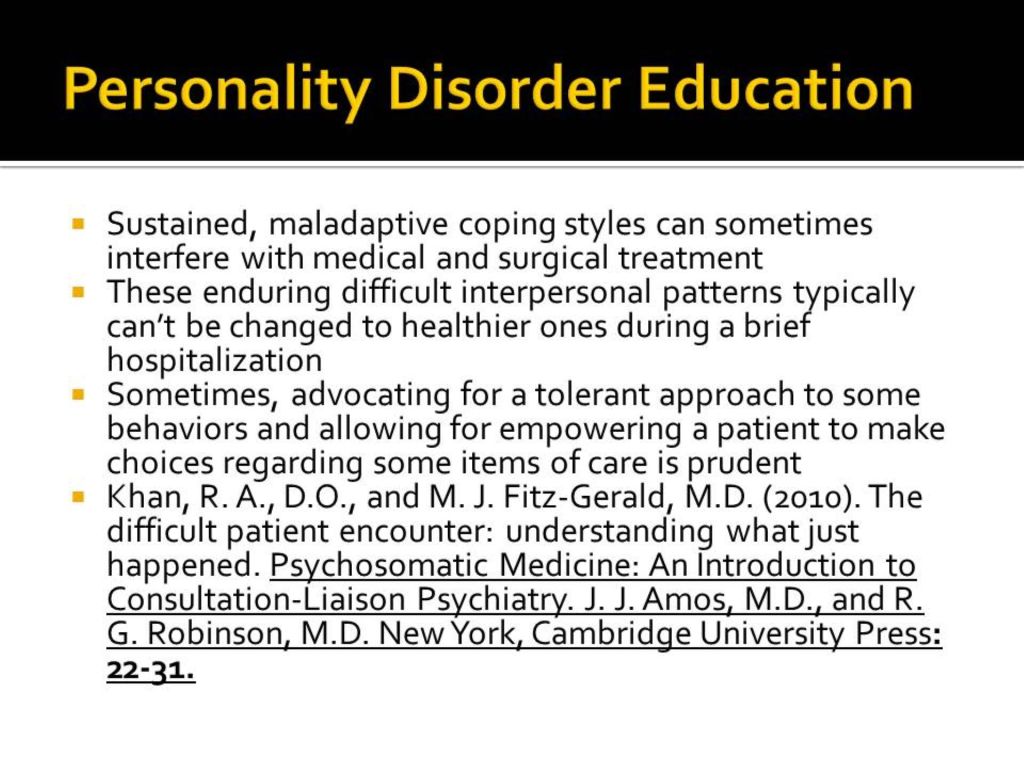
There’s something embarrassing yet fascinating about reading my old blog posts from years ago. The one I read yesterday is titled simply “I Remember HT Heroes.” I make connections between my undergraduate college days at Huston-Tillotson College (now Huston-Tillotson University (an HBCU in Austin, Texas) and my early career as a consultation psychiatrist at The University of Iowa Hospitals & Clinics (now rebranded to Iowa Health Care).

My first remark about getting mail from AARP reminds me that organization is sponsoring the Rolling Stones current tour, Hackney Diamonds. And the name of my specialty was changed from Psychosomatic Medicine to Consultation-Liaison Psychiatry in 2017.

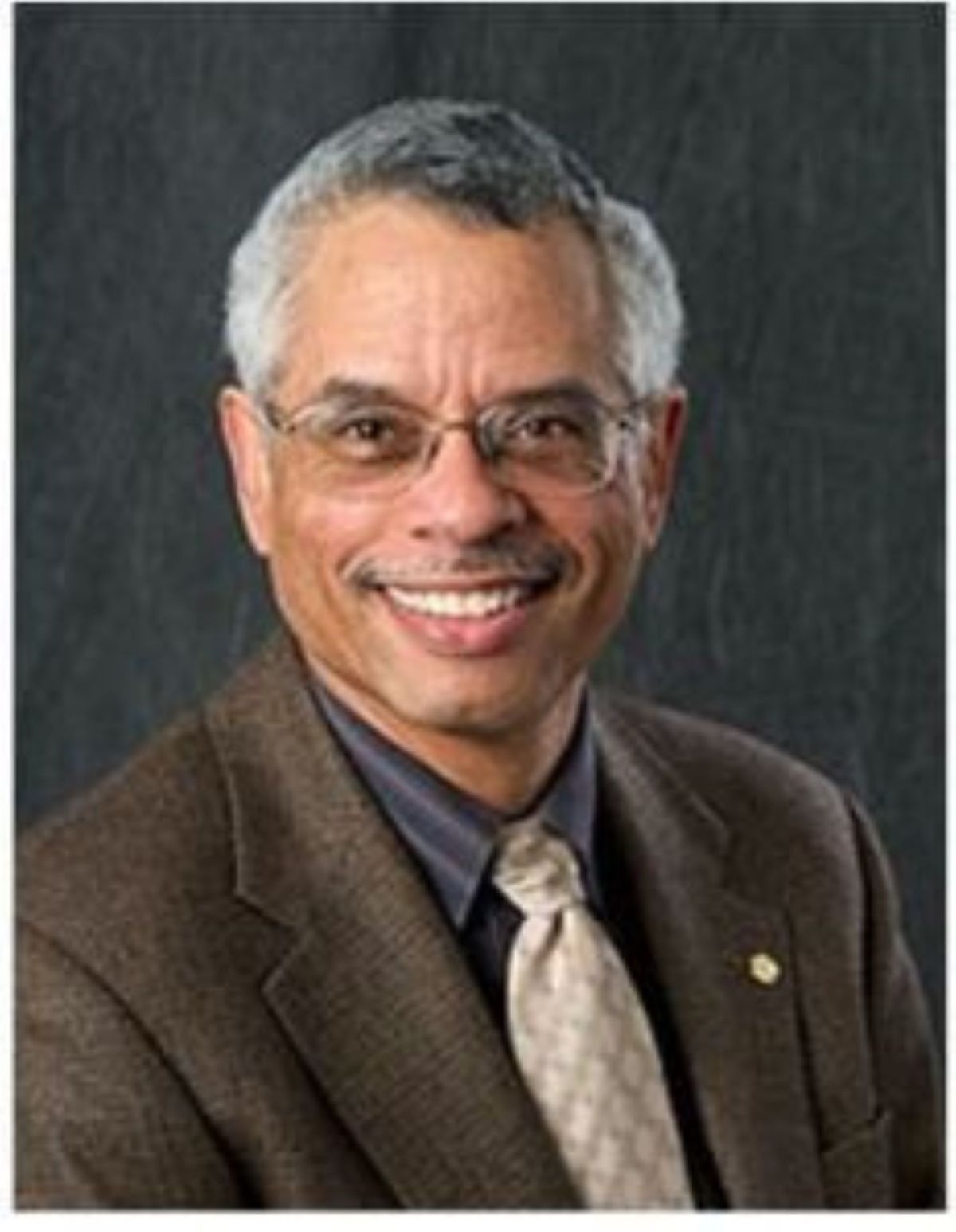
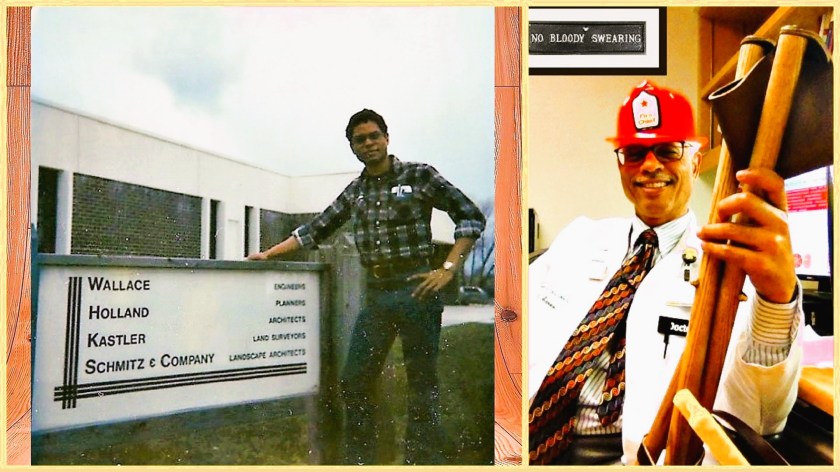
The photo of me attached to the original post reminds me of how I’ve gotten older—which also makes me hope that I’ve gotten wiser than how I sound in this essay. The pin in my lapel is the Leonard Tow Humanism in Medicine award I received in 2006.

I Remember HT Heroes

Getting membership solicitations in the mail from the American Association of Retired Persons (AARP) is a sure sign of aging, along with a growing tendency to reminisce. Reminiscence, especially about the seventies, may be a sign of encroaching senility.


Why would I reminisce about the seventies? Because I’m a baby boomer and because my ongoing efforts to educate my colleagues in surgery and internal medicine about Psychosomatic Medicine, (especially about how to anticipate and prevent delirium) makes me think about coming-of-age type experiences at Huston-Tillotson College (Huston Tillotson University since 2005) in Austin, Texas. Alas, I never took a degree there, choosing to transfer credit to Iowa State University toward my Bachelor’s, later earning my medical degree at The University of Iowa.


Alright, so I didn’t come of age at HT but I can see that a few of my most enduring habits of thought and my goals spring from those two years at this small, mostly African-American enrollment college on what used to be called Bluebonnet Hill. I learned about tenacity to principle and practice from a visiting professor in Sociology (from the University of Texas, I think) who paced back and forth across the Agard-Lovinggood auditorium stage in a lemon-yellow leisure suit as he ranted about the importance of bringing about change. He was a scholar yet decried the pursuit of the mere trappings of scholarship, exhorting us to work directly for change where it was needed most. He didn’t assign term papers, but sent me and another freshman to the Austin Police Department. The goal evidently was to make them nervous by our requests for the uniform police report, which our professor suspected might reveal a tendency to arrest blacks more frequently than whites (and yes, we called ourselves “black” then). He wasn’t satisfied with merely studying society’s institutions; he worked to change them for the better. Although I was probably just as nervous as the cops were, the lesson about the importance of applying principles of change directly to society eventually stuck. I remember it every time I encounter push-back from change-resistant hospital administrations.


I’m what they call a clinical track faculty member, which emphasizes my main role as a clinician-educator rather than a tenure track researcher. I chose that route not because I don’t value research. Ask anyone in my department about my enthusiasm for using evidence-based approaches in the practice of psychiatry. I have a passion for both science and humanistic approaches, which again I owe to HT, the former to Dr. James Means and the latter to Dr. Jenny Lind Porter. Dr. Means struggled to teach us mathematics, the language of science. He was a dyspeptic man, who once observed that he treated us better than we treated ourselves. Dr. Porter taught English Literature and writing. She also tried to teach me about Rosicrucian philosophy. I was too young and thick-headed. But it prepared the way for me to accept the importance of spirituality, when Marcia A. Murphy introduced me to her book, “Voices in the Rain: Meaning in Psychosis”, a harrowing account of her own struggle with schizophrenia and the meaning that her religious faith finally brought to it.


Passion was what Dr. Lamar Kirven (or Major Kirven because he was in the military) also modeled. He taught black history and he was excited about it. When he scrawled something on the blackboard, you couldn’t read it but you knew what he meant. And there was Dr. Hector Grant, chaplain and professor of religious studies, and champion of his native Jamaica then and now. He once said to me, “Not everyone can be a Baptist preacher”. My department chair’s echo is something about how I’ll never be a scientist. He’s right. I’m no longer the head of the Psychosomatic Medicine Division…but I am its heart.


I didn’t know it back in the seventies, but my teachers at HT would be my heroes. We need heroes like that in our medical schools, guiding the next generation of doctors. Hey, I’m doing the best I can, Dr. Porter.

Another Blast from the Past

Today is Labor Day, and I was looking at some of my old blog posts from my previous blog The Practical Psychosomaticist. I found one that I think I haven’t reposted on my current blog called “Going from Plan to Dirt.”

It’s a funny post, at least I think so. It draws a comparison between blue collar and white collar work, similar to what I did the other day (“Why Can’t I Wear Blue After Labor Day?”).

I wrote it in 2011, when I was on a hospital committee to improve detection and prevention of delirium in the general hospital.

“Our work on the Delirium Early Detection and Prevention Project reminds me of my early formative experiences working as a draftsman and land survey technician starting in 1971 with an engineering company, Wallace Holland Kastler Schmitz & Co. (WHKS & Co.) in Mason City, Iowa. I remember being amazed at how a drawing on paper could be turned into a city street, highway, bridge, or airport runway. They have a website now. I can now find written there what was modeled for me then:

“WHKS & Co. is committed to the continuous improvement of the quality of service provided to our clients.”

Then and now WHKS & Co. worked hard to create the infrastructure that we depend on and then put it into the world in a “safe, functional, and sustainable” way. Out in the field we sometimes joked about how a designer’s drawing was flawed if we couldn’t go from plan to dirt.

It’s common to believe that engineers and land surveyors deal with complex mathematical formulas, structural materials, things instead of people—an applied science in which the emotions and motivations of people play a small role. Nothing could be further from the truth.

I was 16 years old when WHKS & Co. hired me. I had no idea what engineers and land surveyors did, had no experience, and I was at a crossroads in my life. They didn’t hire me because I had any talent or asset they needed. They hired me because they were as committed to the people in the community, not just to things.

And if you think land surveying doesn’t have anything to do with people’s emotions, consider property line disputes. The survey crew I was attached to had been sent out to find the property corners of two neighbors. This involves locating iron pins that mark the corners of the lots that houses sit on. Little maps or “plats” are used as guides and let me tell you, often enough we found the map is not the territory.

Anyway, while we were out there in the back yard of one of the neighbors, they both came outside. One of them was a diminutive elderly lady and the other was a tall, big-boned elderly man. They started arguing about the boundaries of their lots and it got pretty heated. Pretty soon they were yelling in each other’s faces and the lady reached down in the garden in which we were all standing. She picked up the biggest, juiciest rotten tomato she could find and it was clear to us what she planned to do with it. They were both pretty old and neither one of them could move very fast. My crew chief, sensing that something violent was about to happen, moved in between them (a decision I still can’t fathom to this day).

What followed seemed to happen in slow motion, in part because the combatants were so old. The man could see the lady was about to hurl the rotten tomato at him. Ducking must have been beyond his power, probably because of a stiff back. He bent his knees and leaned forward. She cocked the tomato as far back as she could and let fly, screeching, “You’re nothing but an old Norwegian!” My crew chief probably caught a seed or two. Amazingly, the tomato only grazed the top of the man’s head.

I think the altercation took a lot of both of them. They both went back in their houses after that.

It’s not hard for me to see the connection between my past and the present. WHKS & Co. was and still is committed to continuous improvement. And they were and still are all about finding a practical way to do it. If we’re going to improve the quality of care we provide patients and we propose to do it by preventing delirium, we’re going to have to use the same principles that my first employer used. And we’re going to have to be just as practical about how to go from plan to dirt.

We’re still trying to refine the charter for our delirium detection and prevention project, which is a kind of map, really. And even though the map is not the territory, it’s still a necessary guide to remind us of the goal.”