OK, so last night I watched Don Wildman’s Van Meter Visitor (supposedly a mysterious Van Meter, Iowa cryptid) episode first seen over 100 years) from his show Beyond the Unknown. The season 3 episode first aired in October 9, 2021, and I’d never seen it before.
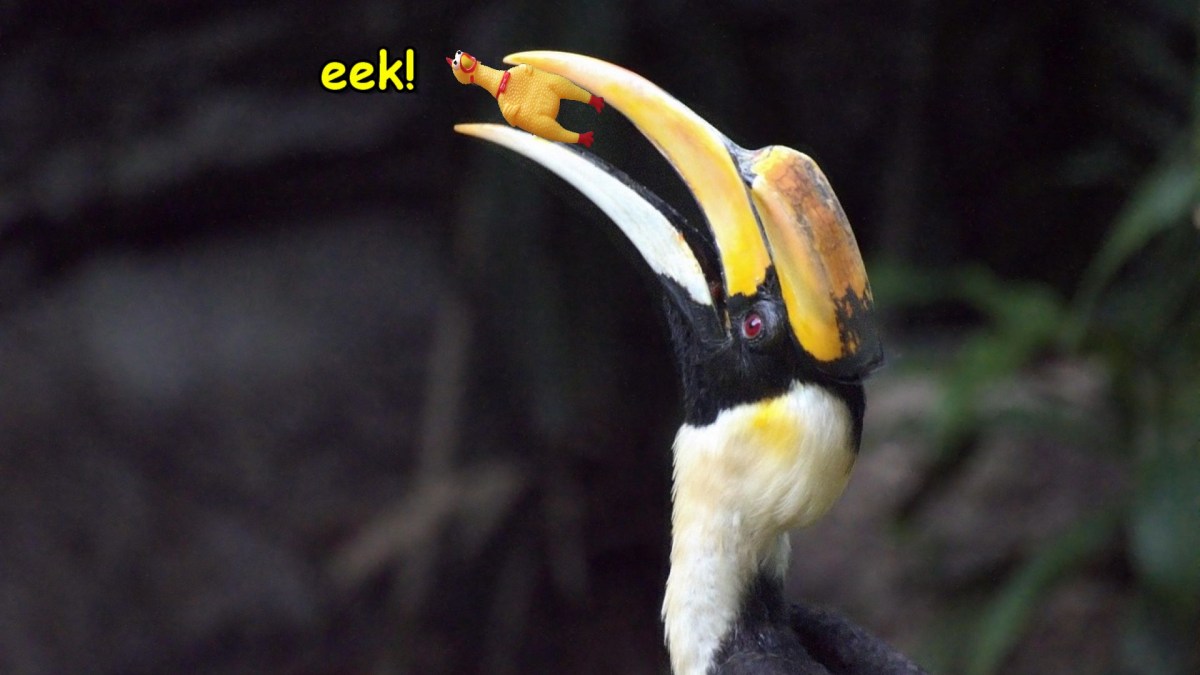
Wildman said that somebody investigated the history of this creature who was spotted in 1903 in Van Meter, Iowa and concluded that the 8-foot-tall monster with a huge shining beak was actually a great hornbill—a pretty big bird but hardly 8 foot tall (more like 3-4 foot).
Supposedly, according to some experts, this big bird escaped from an exotic pet enthusiast. It’s never seen in America and is native to India or Southeast Asia.
I can’t find anything on line that says anything about this explanation. By most accounts, the Van Meter Visitor is a cryptid that is unexplained to this day. I think there’s still an annual festival for it in Van Meter.
The cast of Expedition X (season 4, episode 2) also did a TV episode about the Van Meter Visitor on September 9, 2021. I might have seen it, but I don’t remember the conclusion. I’m pretty sure the team didn’t think it was just a big bird. I don’t know why the Expedition X episode appeared about the same time as the Beyond the Unknown episode. Maybe Don Wildman and Josh Gates joked about the Van Meter monster over lunch one day and decided they’d both do a show about it.
Hey, I’m open to the great hornbill explanation, but so far, I can’t find any links to web articles that agree with it. Heck, even AI says “There is no connection between the great hornbill and the Van Meter Visitor.” I didn’t ask AI; it just pipes up because I can’t block it.
If any readers know about the great hornbill explanation for the Van Meter Visitor, drop a comment!
I did something for the first time today, which was to install the iPhone 17 Pro OtterBox Glass screen protector (that’s a mouthful). I remember putting the screen protector on my old iPhone many years ago and it wasn’t anything fancy. There was no device to help you line things up and apply the screen protector. You put it on by hand and prayed that you could eventually scrape out all the bubbles—if you were lucky enough to get it on straight.
The main reason I made a YouTube video about how to install the screen protector was because I couldn’t find a YouTube video about this particular brand. It turns out all the applicator devices are different and installing them is slightly different for each brand.
Sena ordered the case, screen protector, and holster from OtterBox, which is where I got the original case and holster for my old iPhone. I had to replace the case after the battery swelled up and cracked it five years ago. This reminds me of an old Men in Black 3 quote in which a young Agent K holds a very large mobile phone up to his ear (this film is about time travel and the action is in 1969). Agent J says to him “That’s a bigass phone; don’t hold that up to your head!).
Anyway, I decided to make a video of me installing the OtterBox Glass screen protector. I plan to make a YouTube video of installing the case as well—but that’ll be another day.
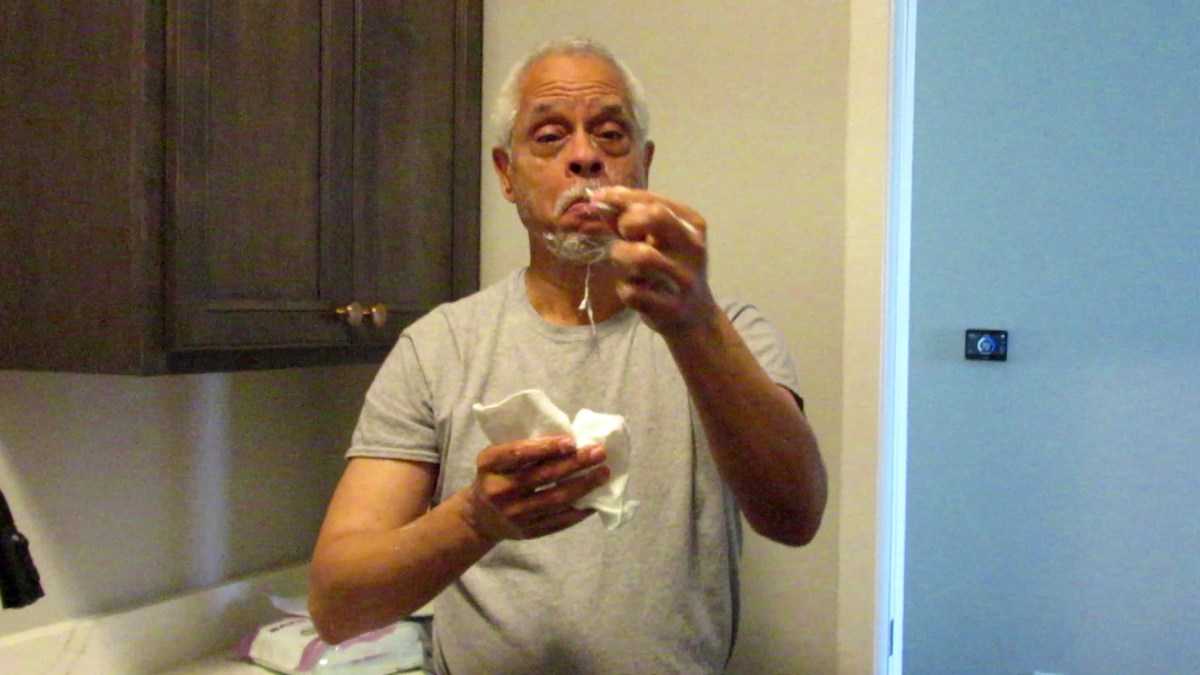
Just like Sena talked me into letting her do a facial on me, I had to do the bath sponge thing. This product is called Scrubzz, a soap generating rinse-free bath sponge you can wash up advertised as “no rinse, no bathing, and no sticky residue.
I could beg to differ on the no sticky residue claim, but it might be just quibbling. If you don’t shave for a day or two, you might get something you could legally call “residue” because the polyester fibers will get caught in your stubble. Remember that if you try to shampoo your hair with it.
It has a lavender scent, which I could live without, but other than that the bath sponge works OK. You just add water to a single cloth and you’re bathing without the need to rinse. Towel dry and you’re done. You get 25 cloths to a pack.
We could have used these when our water heater went out a few years ago. Cold showers are no fun.
Svengoolie Intro: “Calling all stations! Clear the air lanes! Clear all air lanes for the big broadcast!”
This big broadcast is about the upcoming Svengoolie show movie, “Them!” on October 11, 2025 at 7:00 p.m. One problem I have with this schedule is that the Iowa Hawkeye vs. Wisconsin Badgers football game starts at 6:00 p.m. on the same day. This happened previously with another Svengoolie movie last month, “The Bad Seed,” and I got around it by watching the movie on the Internet Archive. I may have to do that again.
Anyway, “Them!” is a 1954 classic atomic bomb testing leading to giant creatures film (in this case ants) terrorizing the desert southwest countryside. James Arness (who plays FBI agent Robert Graham although Arness starred as Marshal Matt Dillon in Gunsmoke a year later) who has run afoul with then FBI director J. Edgar Hoover and heads to a New Mexico field office because he wanted to investigate the Mafia but Hoover didn’t think that gang existed, leading to Dillon’s famous quote heard around the world in many languages, “I gotta get outta Dodge!” As happens repeatedly in the 1950s, radiation-exposed insects grow to gigantic size, in this case ants who beat the living daylights out of grasshoppers running a protection racket on them for food (so much for Hoover’s dismissal of organized crime!) and in their headlong search for Insectopia, where the streets are lined with picnic baskets, trample on a tiny guy in a weird suit who is incredibly strong who charges the once oppressed lower class ants huge sums of money to defend them against the superior race of ants who have larger mandibles and shake down the lower class ants (leading agent Graham to write a letter to J. Edgar Hoover saying “That is why you fail!” which is yet another famous quote parroted by middle schoolers everywhere).
OK, so that’s not exactly how the movie goes, but I’ve never seen it so how should I know?
Today, as usual, we had to interrupt our cribbage game so Sena could capture video of all the birds in our backyard, the fall colors, and whatnot.
She caught some shots of Northern Flickers, which she has not seen before although I can remember catching them on camera years ago. They’re really strikingly colored birds and you can easily distinguish female from male birds.
The males have a black mark next to their bills which is called a mustache, which the females don’t have. They don’t migrate and you can see them all year round.
Sena was slinging the camera around and hurrying from window to window to get the best shots. She accidentally caught me on camera. I threw a still shot of it in the video just for laughs.
We saw a bird we didn’t recognize at first mostly because it was small and preening with its back to us. It had a red breast, so it was probably a young robin. Our luck, it’ll try to attack our windows next spring, although Sena put up some window film which may prevent that—we hope.
The fall colors are relaxing. The squirrel reminded me of Dug the dog in the Disney Pixar movie Up. I would have stuck a picture of Dug in the video but it’s copyrighted.
By the way, I won the cribbage game today. It happens.
Both Sena and I enjoyed the Svengoolie show movie last night, “The Ghost and Mr. Chicken.”
This 1966 film directed by Alan Rifkin and starring Don Knotts as Luther Heggs, Joan Staley as Alma Parker, Liam Redmond as Kelsey, Philip Ober as Nick Simmons, and Dick Sargent as George Beckett is a horror spoof that we’ve seen before but it’s still really funny.
Luther Heggs is a typesetter for a newspaper in a little town who sort of agrees to spend the night in a haunted house where a couple of murders took place twenty years in the past which were never solved. Luther wants to be a reporter and gets his chance when Kelsey talks him into writing a filler story on the anniversary of the murders.
In fact, if not for Kelsey’s slick manipulation of the main characters including George Beckett the editor of the newspaper, a lot of the story wouldn’t take place. A big part of the action is related to bringing whoever killed the occupants of the house (who were related to Simmons) to justice.
A lot of the hilarity comes from Knott’s superb portrayal of the extremely nervous guy who does brave things despite his fears. Luther has a crush on Alma and despite his shyness, to impress her he shows her his karate moves which he has been learning entirely from a correspondence course he’s been taking for years and which has made his whole body a lethal weapon.
Luther convinces the town that he has seen supernatural events in the Simmons’ haunted mansion, which makes him a hero worthy of celebration in his honor. His bungles his acceptance speech and then gets a summons to appear in court to fight a libel charge from Nick Simmons because he doesn’t want the publicity about the haunting to interfere with his plans to demolish the house.
The trial is one of the funniest scenes in the movie, leading to a couple of witnesses inadvertently making things a bit more difficult for Luther to beat the libel charge by revealing that he has a lifelong track record of telling tall tales.
The detective part of this story involves the manipulation of Kelsey, the motive of Simmons to demolish the house, and the perseverance of Luther to confront his terror while confronting the mystery of what happened twenty years previously in the Simmons’ mansion.
I have given this very funny film the highest Shrilling Chicken Rating of 5/5.
I’ll deal with the silly KOBWA acronym later. Sena bought some new kitchen utensils and she got these egg flippers (one red and one black). They’re supposed to make it easier to flip fried eggs. I think a regular person who knows how get around a kitchen would do better than I did this morning to handle this tool.
On the other hand, I think I have a legitimate point to make about the egg flipper. I usually break yolks when I try to flip eggs, so they end up not looking pretty.
The egg flipper is a combination of a spatula and tongs. The tong set is above the spatula and you just squeeze the flexible handle to close them over the egg when you’re ready to flip them over.
I’m not sure how to make sure the yolk is out of the way. I hope others besides me notice that unless you position this instrument just right, you’d end up with crushed yolks. This doesn’t make much of a difference to me because I usually find a way to crush the yolks anyhow.
Sena found an interesting article about the inventor of the spatula, although I didn’t actually see that one; she just mentioned it. I think I found it later, though. The writer often doesn’t get credit for the original article but wrote another article in which he says his first one is often misquoted and leaves out his byline. His name is George Billions. For what it’s worth, the line under his name on his blog says “writes fiction and other lies.” Just sayin’.
There was one comment on Billion’s’ original article who requested a reference to support what he wrote about John Spaduala. For complicated reasons, a reference is hard to come by, and I think I’ll just add a reference to Billions’ article out of respect:
“John Spaduala: Inventor of the Spatula.” Spatula Planet. Spatula Planet, 3 Feb. 2014. Web. 10 Feb. 2014.
I don’t know why he calls himself Mike because the name of his blog is George Billions.
I don’t usually pay much attention to Artificial Intelligence (AI) from the internet, but sometimes they are too intrusive to ignore. AI essentially says there was no such person as John Spaduala and that the story is a recurring anecdote. It’s an urban legend.
What lends weight to the AI judgment is a web article purporting to be an interview with John Spaduala himself, even though the guy lived in the 19th century and the interview was conducted in 2017 by Jason Denness who entitled it “Fake Interview: John Spadula.” Denness thanks George Billions for being the “victim of this interview.” While Denness credits George Billions by saying “He is the creation of John Spaduala…” I suspect that’s a typo and maybe what he meant was that Billions is the “creator” of John Spaduala.
That said, the question is who invented the egg flipper? It wasn’t John Spaduala. Technically, even though I have no right to make any judgments about this, there might not be any specific person identified as the inventor of the egg flipper. As near as I can tell, a spatula can be a “turner,” (also called a flipper) but a turner isn’t necessarily a spatula.
The name or acronym applied is KOBWA, which I suspect is not the inventor’s name, but the name of the company that markets the egg flipper spatula. The only thing I found on my admittedly cursory search is the Komati Basin Water Authority, which has no connection to any kitchen utensil. You can find kitchen gadgets with the name Kobwa (or KOBWA), though. However, there are other weird trademark related names for the egg flipper as well. I don’t know why.
I’m pretty sure they weren’t invented by any descendants of John Spaduala—if he had any. You’re welcome.
First, I’d like to point out that the title “High Strangeness” doesn’t apply to all of the songs on the podcast. In fact, only the first one, “Neoprene Fedora” would sound a little strange as a blues tune, and then only the first couple of minutes or so of this guitar instrumental. We think it has 3 or 4 segments with only the first one sounding mostly like a surfing tune. Most of it did sound bluesy.
The song “Catfish Blues” by Corey Harris was fascinating mainly because it prompted Big Mo to mention MayRee’s hand-battered catfish. We heard him say that this was about MayRee. We’re not so sure. We couldn’t figure out the connection between MayRee and catfish that you could catch in a river maybe somewhere down south, (possibly Louisiana?) in a very specific place where there used to be a couple of shacks where you could get hand-battered catfish.
He had very specific names for places like “Brownsville” or someplace the name of which reminded me of a French word, “rouleaux” (which I connect with stacks of red blood cells just because I learned this is medical school). But it sounded like it was a place. AI popped right up and said there’s no such place by that name in Louisiana or Texas. Big Mo also mentioned that it was close to a “Missouri river bridge.” I think we heard him right. The Missouri runs along the western boundary of Iowa. There are bridges in that area, but I can’t tell which one is referred to.
I’m thinking this story might just be adding texture to the whole MayRee’s hand-battered catfish yarn.
Another puzzle was somebody Big Mo mentioned called Tail Dragger, to which Corey Harris had a connection. Big Mo didn’t expand on this, but I did manage to find out about somebody named Tail Dragger Jones, who was an American Chicago blues singer. He has an interesting Wikipedia entry on the web. He shot and killed a blues artist known as Boston Blackie and did prison time for it.
And we had the impression that the last song reviewed on the podcast, “Take It Easy” by Ruthie Foster, was a blues song that was readily applicable to anyone having a tough time in life. On the other hand, Big Mo thought it was about women being mistreated by men and how to bear up under this burden.
Conversely, our impression is that most blues songs done by men often have themes that remind you of the chauvinistic attitude men have for women. Just listen to any of the other songs on the podcast list and look up the lyrics (because you can’t always understand them on the recordings).
I especially like songs which have lyrics that I can clearly understand, and “Take It Easy” is one of them.
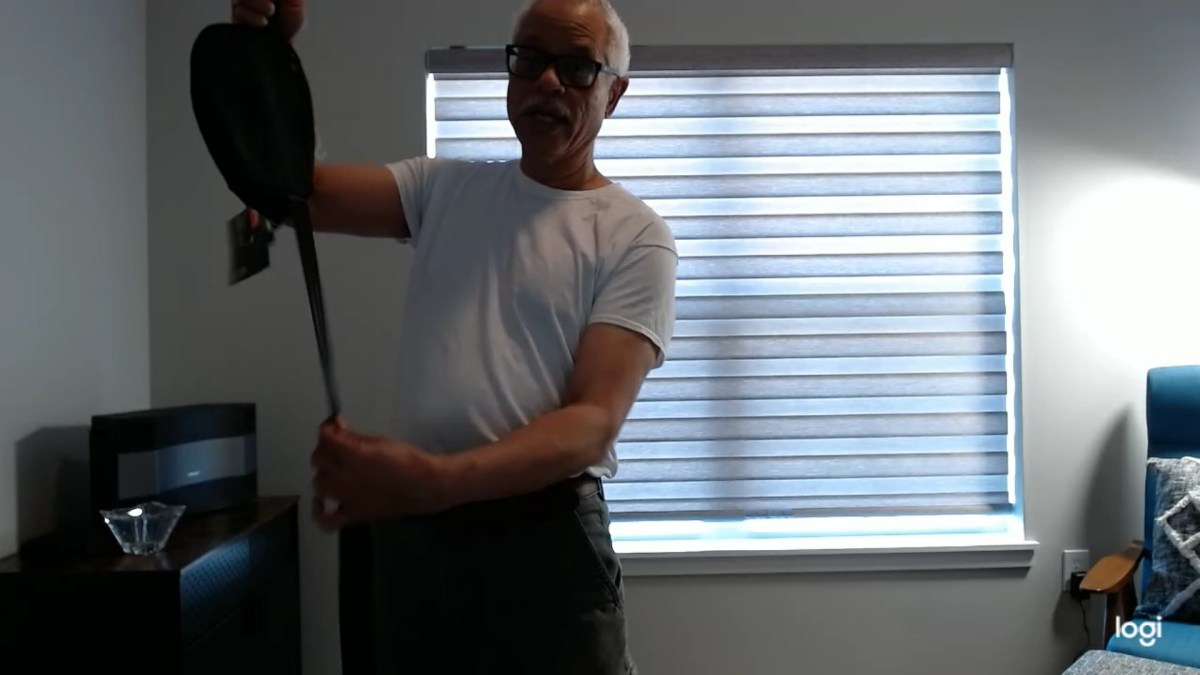
I’m waiting for delivery of my case, protector screen, and holster clip for my new smartphone. It’s taking a while and I need a safe way to carry my phone. So, Sena got me a fanny pack.
I’ve never had to deal with a fanny pack strap, but since it’ll be a few weeks for my stuff to be delivered, I had to cope with the adjustable strap. Believe it or not there’s a couple of YouTube videos that show how to put things into the pouch—but no videos demonstrating how to adjust the strap.
I’ve never had to cope with a fanny pack strap, but I think I figured it out. I made a video. See what you think.
Over three years ago, I posted about a waving man we used to see a lot of on a busy street in Iowa City (yes, we have them). He worked at the grocery store and waved at traffic whether he was walking to work or leaving. He still works there but we don’t drive that route much anymore so we don’t see him out waving.
Occasionally I’ll see news stories about men who wave at people driving by. They always look like they have a great time being friendly. I think most of us get a big kick out of it.
I saw another story today about a guy named Kent Proudfit in Urbandale, Iowa who does the same thing. After a while I wondered why I saw only stories about men do the waving thing. And then I found a story about a 74-year-old woman named Patricia Bracey who’s a waver in Chesterfield, Virginia. She says the Lord told her to do it.
So, waving at people driving by is an equal opportunity activity for cheering up others. I get the sense that it’s mostly older people who sit or stand by the side of the road and wave at folks driving by.
On the other hand, there is another phenomenon that works on the same principle of helping others feel good. It’s the Iowa Hawkeye Wave at the end of the first quarter of the football game in which the all the players, staff, and tens of thousands of fans of all ages in the stands get up at wave at the kids and their families in the University of Iowa Stead Family Children’s Hospital. It’s now called one of the greatest traditions in college sports. It got started in 2017, which is not such a very long time ago.








 Go Retire Psychiatrist