I stopped by the Storyshucker blog today and it sent me on a wave of nostalgia. You really out to stop by Stuart Perkins’ blog and get that feeling. You can read his post, “Baby Bear” in The Local Scoop Magazine. The link is on my menu, so there’s no excuse!
Stuart has his baby bear and, although I don’t have keepsakes going that far back, it sent me back. It reminded me of our last move (I hate moving!). We have this piggy bank we toss loose change into. I can’t remember when we first got it, ages ago. When we moved last year, we tried to get all the coins in it into our bank, but they wouldn’t just count them and deposit the amount—I had to learn how to roll and wrap them myself! That’s not a great memory.
I had a spark plug gap measuring tool and that was back in the day when guys adjusted stuff like that by hand when tuning up their car engines. It’s a good thing I don’t do that anymore. I accidentally hit the accelerator instead of the brake one time and put a dent in the garage wall. That’s not such a great memory, either.
We used to have an old vintage calculator I used when I was a student at Iowa State University. Memories linked to that are a little better.
We lose track of some things from our past and that can be a good thing occasionally. Guys like Stuart know what’s worth keeping.
Sena alerted me to an article about the 28th anniversary of when the first Men in Black movie hit the theaters in 1997. The author praises it and says it’s still pretty good.
I can’t remember the first time I saw it, but it was probably not in 1997. I was in my second year of being an assistant professor of psychiatry at the University of Iowa Hospitals & Clinics (now called University of Iowa Health Care). I was too busy to do much of anything except run around the hospital responding to requests for psychiatry consultations from medicine and surgery. I did that a long time.
I’ve been blogging since 2010. I cancelled my first blog which was called The Practical Psychosomaticist. I then restarted blogging, calling it Go Retire Psychiatrist. One blog that pays homage to my career and to the Men in Black films is “The Last White Coat I’ll Ever Wear.”
It’s part reminiscence and part comedy in the style of Men in Black dialogue and jokes. Since I retired, I have not been back to the hospital except for scheduled appointments in the eye and dentistry clinics. I don’t know if I’ve ever reconciled myself to being retired. If someone were to tell me “We have a situation and we need your help” (think Men in Black II), I would probably say something like “There is a free mental health clinic on the corner of Lilac and East Valley.”
I saw a couple of web resources about staying healthy and fit that seem to make sense to me. One of them was actually a YouTube video by a personal trainer advising people to stop doing certain kinds of workouts that could be unhealthy. He recommended avoiding certain kinds of weight lifting exercises, especially for those over 40. I’m way over 40 and I agreed with him.
The video was posted about 2 months ago and there are so far 725,000 view and well over 2,000 comments, both for and against the trainer’s advice. Many of the older commenters disagreed with slowing down after the age of 40.
I’m 70 and I’m a minimalist when it comes to exercising. I’ve slowed down from daily exercise, but I still enjoy juggling, riding an exercise bicycle, limited use of dumbbells, body weight squats, a step platform routine, planks, stretching and wrestling grizzly bears. I occasionally go for walks when the weather permits.
I remember trying to lift really old barbells in the free weight room at the YMCA when I was a kid. I dropped them once and the director directed me out of the room. After they got a weight machine, a guy bet me and a friend a dollar that he could jump over a broom handle (in another variant of this stunt you try to jump over a dollar bill, I think) while bent over and grasping his toes. He did it but we couldn’t. We didn’t pay him any money. I still can’t do that trick. Nobody recommends doing this as a regular fitness exercise.
On the other hand, patient YMCA teachers taught me how to swim and helped me get over my severe headaches related to my initial fear of the water.
The other web source is an article that actually recommends we stop focusing on working out. In fact, the title is “Stop focusing on working out”—a professor says you should follow these five science-backed steps to improve your wellness instead.”
There are so far no comments on it. The authors have five suggestions:
Make movement fun
Be socially active
Use mindfulness as a stress buster
Be kind to yourself and others
Prioritize quality sleep
The last one usually is difficult for me. Ever since kindergarten, when the teacher wanted the class to take a nap, I’ve had trouble sleeping. The teacher never understood that. I also tend to be shy. I like playing cribbage, though my wife is my only partner. I still practice mindfulness meditation. Juggling is a fun movement activity and it’s also beneficial exercise.
I think it might be a little safer to try to jump over a dollar bill while squatting and grabbing your toes than squatting with barbells if you’re 70. You’re welcome. That’ll be one dollar, please.
I’m a little slow getting to the Big Mo Pod Show after his blues show this last Saturday night. I guess that’s just the way things go. The title of the pod show “Cheers to Kevin” is a shout out to somebody important in Big Mo’s life. It turns out Kevin was really supportive of Big Mo when he was just getting started years ago when he was first starting on the KCCK blues show. Kevin has also made many donations to KCCK to support the show. Big Mo calls him his favorite bartender.
That gets me started with the last of the 5 songs Big Mo and Producer Noah talked about, which was Bob Margolin singing the song “Brown Liquor in a Dirty Glass.” I remember speculating in a past blog that the “dirty glass” part might have meant putting olives or olive brine in the drink—but I don’t think so after listening to the song again.
I’m pretty sure it means the singer is feeling so down and dirty himself that he might actually want a dirty glass in the usual sense of the word.
And by the way, Big Mo mentioned “mambo” again. Last week, it was hard to tell what he meant, but this time it sounds like he might be referring to a Latin American dance rhythm influence—maybe. The influence of different rhythms on blues music was a topic in that maybe steered the discussion about one song on the list, and I believe it was “Star” by Gary Clark, Jr., which Big Mo thought had more of a reggae than a blues rhythm to it.
One interesting song was from someone who has been around a long time but I’ve not heard her before, Duffy Bishop. She sang “69 Years Old.” It mentions Viagra, which is in line with the general theme, which is sex and not just for the old. I stumbled on an article in which she’s interviewed about her music. When they start talking about this “69 Years Old song,” Bishop has this funny anecdote. She had just finished singing it at a club in Daytona Beach and some old gentleman walks up to her and says, “Here, I got something for you, pass these on to someone who needs them,” and then hands her some Cialis.
I’m 70 and I’m a little embarrassed about it but I want to pass the tune on to you guys because we just never know.
I’ve been reading about artificial intelligence (AI) in general and its healthcare applications. I tried searching the web in general about it and got the message: “An AI Overview is not available for this search.”
I’m ambivalent about that message. There are a couple of web articles, one of which I read twice in its entirety, “Are we living in a golden age of stupidity?” The other, “AI, Health, and Health Care Today and Tomorrow: The JAMA Summit Report on Artificial Intelligence”was so long and diffuse I got impatient and tried to skip to the bottom line—but the article was a bottomless pit. The conflict-of-interest disclosures section was overwhelmingly massive. Was that part of the reason I felt like I had fallen down the rabbit hole?
I recently signed an addendum to my book contract for my consult psychiatry handbook (published in 2010, for heaven’s sake) which I hope will ultimately protect the work from AI plagiarism. I have no idea whether it can. I delayed signing it for months, probably because I didn’t want to have anything to do with AI at all. I couldn’t discuss the contract addendum with my co-editor Dr. Robert G. Robinson MD about the contract addendum because he died on December 25, 2024.
I found out today the book is old enough to find on the Internet Archive as of a couple of years ago. One notice about it says “Borrow Unavailable” and another notice says “Book available to patrons with print disabilities.”
All I know is that an “archivist” uploaded it. The introduction and first chapter “The consultation process” is available for free on line in pdf format. I didn’t know that until today either.
Way back in 2010 we didn’t use anything you could call AI when we wrote the chapters for the book. I didn’t even dictate my chapters because the only thing available to use would have been a voice dictation software called Dragon Naturally Speaking. It was notorious for transcribing my dictations for clinic notes and inserting so many errors in them that some clinicians added an addendum warning the reader that notes were transcribed using voice dictation software—implying the author was less than fully responsible for the contents. That was because the mistakes often appeared after we signed off on them as finished, which sent them to the patient’s medical record.
Sometimes I think that was the forerunner of the confabulations of modern-day AI, which are often called hallucinations.
Now AI is creating the clinic notes. It cuts down on the pajama time contributing to clinician burnout although it’s not always clear who’s ultimately responsible for quality control. Who’s in charge of regulatory oversight of AI? What are we talking about?
We watched the Svengoolie show 1958 movie “The Fly” last night and Sena says she’s seen it before. I can’t remember seeing the full movie, but for some reason the final scenes when the tiny creature in a tiny voice keeps screaming “Help me!” sounds familiar. I don’t know why I would “remember” only that scene.
That brings up something Sena alerted me to and which I’ve mentioned before in an oblique reference to the non-review I did of the Svengoolie movie, “Young Frankenstein” a week ago. It’s the Mandela Effect.
Some trivia about “The Fly” included the Mandela Effect about whether it was made in black and white—which didn’t happen. It was made in color. But many believe it was made in black and white.
Anyway, as a guy who writes parodic reviews, I can say that I have a couple of issues about this film directed by Kurt Neumann and starting Vincent Price (Francois Delambre), David Hedison (Andre Delambre), Patricia Owens (Helene Delambre), Charles Herbert (Phillipe Delambre), Herbert Marshall (Inspector Charas) and a white-headed fly as himself.
Andre is a dedicated scientist who develops the early version of the Star Trek transporter for which he gets no credit and his brother, Francois, who secretly loves his brother’s wife, Helene, eventually tricks her by lying about having the white headed fly locked in his desk drawer next to his shaving kit, convincing her to tell him the whole story about how and why Andre can apparently see just fine to use a typewriter, write on a black board and operate all the knobs and dials in his lab despite wearing a black beach towel draped over his head, which essentially makes this movie a very long flashback about the original theft of the x-ray vision technique from Superman, who already had a patent on it for about 20 years.
That’s one thing I don’t get about this film. Flies have compound eyes, but they don’t see in the dark any better than humans do, partly because they’re not related to bats who use sonar to guide them in dark caves where they zero in on your hair because you’re fool enough to blunder into the Bat Cave in order to find out just how Alfred keeps Bruce Wayne’s suits so nicely pressed.
Another thing that “bugs” me (Har! See what I did there?) is why do I not remember seeing Andre ever talking to his son, Phillipe. Is that some other variant of the Mandela Effect, only, of course, if my experience is similar to that of anyone else who has seen this movie? I know I didn’t fall asleep during the movie and miss the scenes of heartfelt interactions between father and son. Phillipe and his mother get along just fine and discuss the finer points of capturing white headed flies with Zagnut bars, which Beetlejuice described in the materials and methods section of his article published in the Lancet some time ago.
Svengoolie mentioned something pretty funny about the only scene which I seem to remember, which is the white-headed fly (which is you know who!) incessantly screaming “Help me deepen my voice so that Herbert Marshall and Vincent Price won’t bust out laughing at me!”
I think this movie is OK, and I give it a shrilling chicken rating of 4/5.
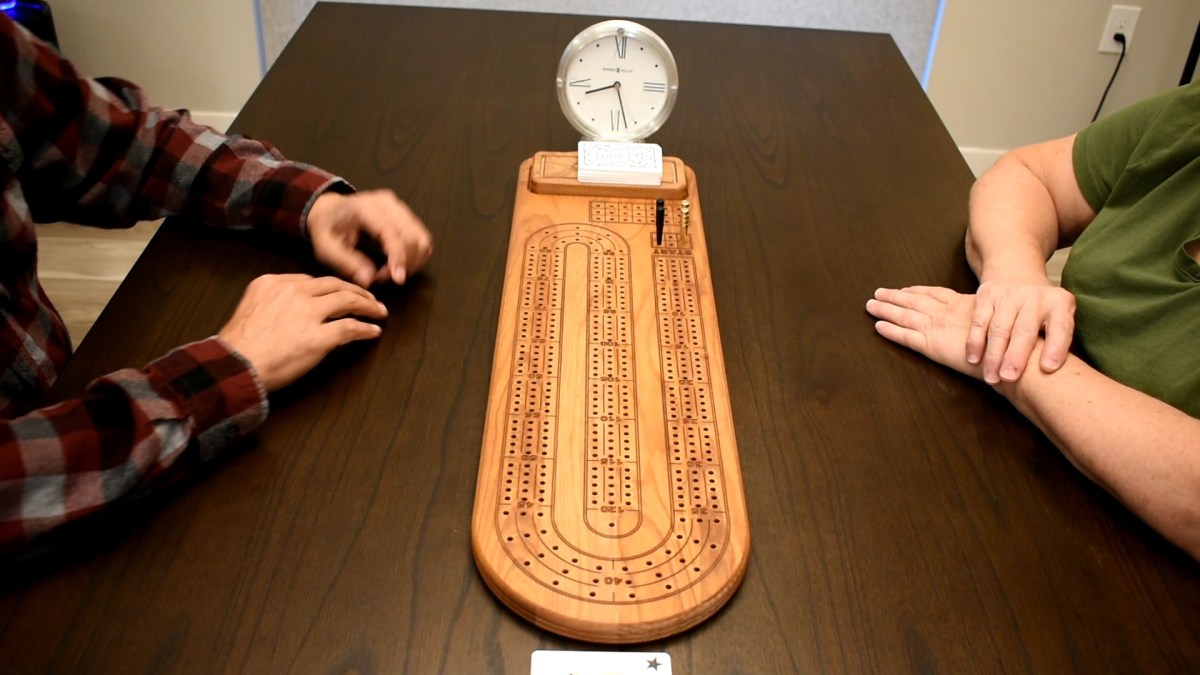
Today we filmed our cribbage game with a goal of completing a game in 15 minutes. We managed to do it, although I played out of turn on the last pegging phase. Sena got skunked today, but that’s rare!
You have to pay attention to the clock on the table in the video, showing we essentially made the 15-minute mark that cribbage tournament rules require for playing a game. We also decided to shuffle a few times every deal so as to try to mix the cards enough.
This is better than the time we usually take to play a typical game, which is generally 20 minutes. It’s hard to shave just 5 minutes off the game. I get pretty jittery trying to stay that focused, but today we did it. We helped each other, which doesn’t happen in tournaments. And there’s not the distraction of hundreds of other players in a giant auditorium all crammed together cheek by jowl and talking at once.
I just saw an article that working on your cognitive skills might make you less susceptible to dementia. There are some websites that help you, but I think some, like BrainHQ, could cost you money.
On the other hand, there is some evidence that playing card games can help protect your brain. I think cribbage could be one of them, although it’s tough to find specific studies on it.
I checked around and found a few studies about how playing games like solitaire and hearts could help keep you sharp. On the other hand, when I was a young man, I worked on a land survey crew. We played hearts over lunch hour and when it rained. I consistently lost.
But for the last several years, Sena and I have regularly played cribbage, a card game that calls for some math skills, concentration, attentiveness, and strategy.
The one problem I see with picking cribbage as one of your main sources of cognitive stimulation is that many people see it has an old person’s game. They should try playing cribbage with someone who really knows how to play.
Cribbage players tend to be older; many tend to be over 50. The American Cribbage Congress (ACC) is the major organization for cribbage and they hold lots of tournaments, both local (called grass roots clubs) and national. They always welcome new and younger players. In general, you need to be able to play a game in 15 minutes in tournaments.
We have tried to finish a cribbage game in 15 minutes, but we can’t seem to do it in less than 20 minutes. I always know when Sena wants to play. She like to use the automatic card shuffler (I like to shuffle manually) and whenever I hear the card shuffling machine (which is loud enough to hear from all over the house), I know it’s time for a game!
Svengoolie Intro: “Calling all stations! Clear the air lanes! Clear all air lanes for the big broadcast!”
We got the 1958 classic bug flick “The Fly” with Vincent Price coming up this Saturday and boy can I wait…no, sorry, I mean I can’t wait. I’ve never seen this particular film, but I did see the one made in 1986 in which Jeff Goldblum played the fly and developed superhuman strength, busting a man’s arm in a wrist wrestling match.
Until now, the insects we’ve seen on the Svengoolie show have been atomic bomb testing created giant insects like spiders and ants. Now we get to see a dead guy who survived the black plague, went to Harvard Business School and Julliard, and saw the Exorcist 167 times trick a giant fly by tempting it with a Zagnut bar, and drag it into his dining room where he has built the well-known transporter room with only limited help from chief engineer Scotty and also they’ve modified it to rearrange the atoms of creatures including humans and extraterrestrial giraffes, enabling them to prevail in stomping combat with the army of the planet of the apes who are just looking for a decent banana split for crying out loud and…well, that’s probably not how this movie goes, but I’m not in charge here.
Took a quick hike on the Clear Creek Trail this afternoon. Last week, my step counter logged about 5 miles or so when I walked out to the mall. I paid dearly for that; I could barely limp around the house for a day and a half. Today, I got about 7,500 steps which now gives me an average of about 10,850 steps over the last week. But I burned only 30 calories per day over the last month. Walking 10,000 steps usually burns 300-500 calories.
Not good if I’m going to get rid of a belly which could threaten to qualify me to play Santa Claus at the mall—eventually (I’m exaggerating—a little). The web tells me I have to burn 3,500 calories by exercise to lose a pound or 500 calories per day over a week.
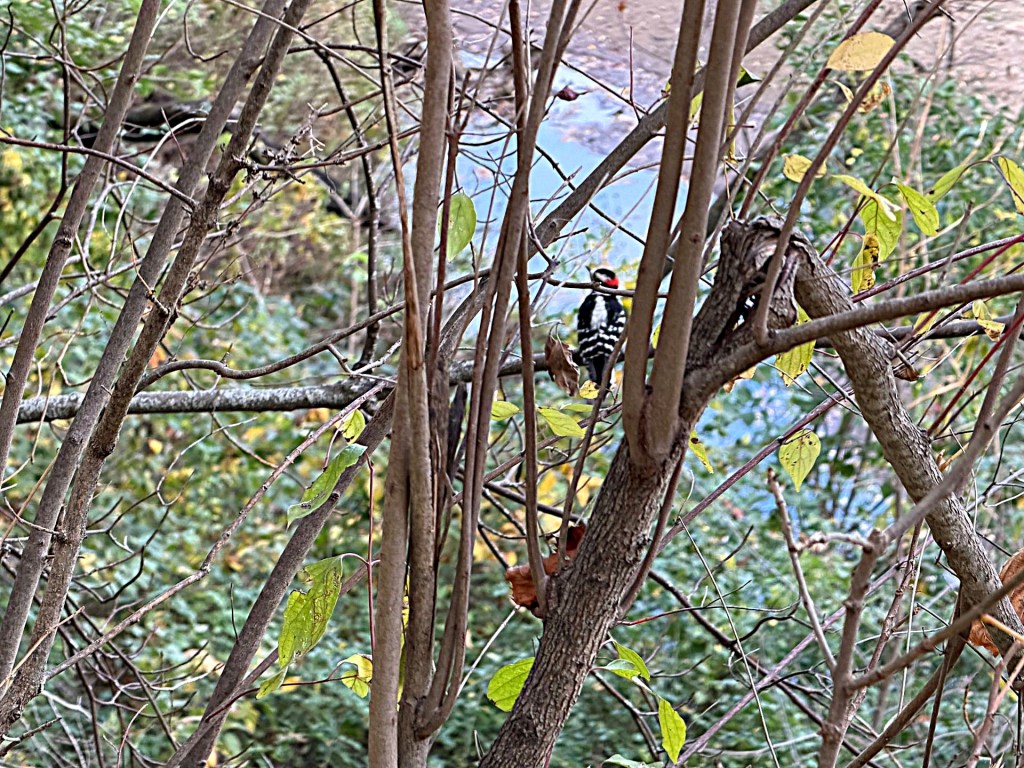
One incentive to walk more frequently (at least until the snow flies) is to walk where I can see interesting scenes in nature, like today. I’m pretty sure I saw a downy woodpecker because it was pretty small, which distinguishes it from a hairy woodpecker—otherwise they look a lot alike. And I caught a chipmunk trying to hide from me.
downy woodpeckerchipmunk
On the other hand, I saw an article indicating that you could get good results from working out 2 days a week. They always quote a study, which in this case was published in the open access journal Obesity. It says that a weekend warrior can get the same results at losing belly fat as those slogging away every day. Maybe.
I’m not a weekend warrior. In fact, lately I’m a peacenik when it comes to exercise. I’d rather sit on a bench than bench press.














 Go Retire Psychiatrist