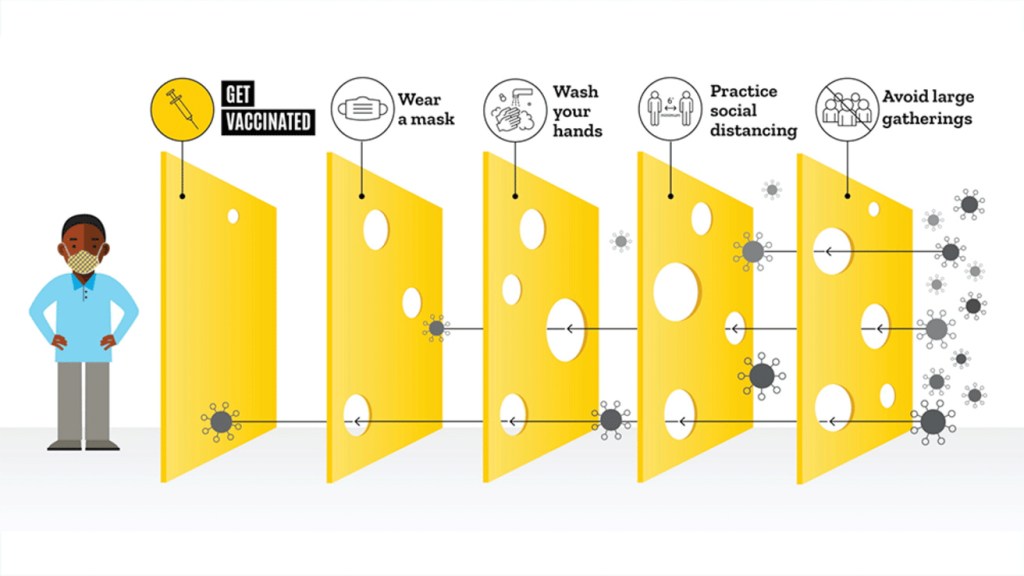
The CDC has reported that the level of COVID-19 transmission in Johnson County, Iowa is Medium. It’s recommended to adopt appropriate safety precautions accordingly. The Swiss Cheese Model is an easy way to remember:
Swiss Cheese Model
Learn more about how to keep yourself and others safe.
University of Iowa Health Care is participating in a multi-center Phase 2 clinical trial evaluating various additional COVID-19 vaccine boosters. It’s the COVID-19 Variant Immunologic Landscape (COVAIL) trial, sponsored by the National Institute of Allery and Infectious Disease (NIAID). The trial “will test new and existing booster vaccines in various combinations to see which ones provide immune responses that cover existing and emerging COVID-19 variants.”
I had so much fun making the picture of me crying me, meaning what I now call Tear Drop Jim, as the featured image for my blog post, “Jim’s Only Kidding Endlessly” (which by the way contains the acronym JOKE).
The tearing and light sensitivity after the retinal detachment surgery was a nuisance. It’s gradually resolving.
I made a screen recorder video of how I created the image using PowerDirector 17.
I was just googling the search terms “Black Psychiatrists in Iowa” and “African American Psychiatrists in Iowa” recently after finding a broken link in my 2019 blog post “Black Psychiatrists Iowa.”
I always think it’s funny that the results of my web search invariably show mainly a couple of mistakes. One is that I typically find my colleague, Dr. Donald Black, MD, a white male, misidentified as Black. The other mistake is that the search engine makes is confusing psychologists with psychiatrists, as though there were no difference. This happens every time, even nowadays in what many would call the era of wokeness.
The broken link was to what I thought was The 2018 Greater Iowa African American Resource Guide. I discovered the link leads to Iowa State University Diversity, Equity and Inclusion web page along with the “Page not found” notice. I could not find a 2018 issue of the guide on the web.
I found the 2019 guide, which showed that there were only two Black psychiatrists listed, me and Dr. Rodney J. Dean who founded the Dean and Associates psychiatry clinic in Sioux City, Iowa. I guess now there might be only one Black psychiatrist in Iowa.
I could not find later editions of the guide following 2019. I don’t know they were compiled or published by Kimberly Baxter, Director of the Iowa Accountability Program (IAP). According to the director, the guide was widely thought of as useful (see page ii of the guide). I wonder if the Covid-19 pandemic played some role in halting production of the guide.
However, I found a newsletter published (I didn’t see a date) on the Iowa Judicial Branch web page of Iowa Court dot gov web site, indicating the IAP was still active in domestic violence prevention programs. The IAP received a $900,000 continuation grant from the US Department of Justice, Office on Violence Against Women to continue court services for domestic violence victims. Thankfully, Kimberly Baxter is still active as Executive Director of Special Projects.
I don’t know if there will ever be another edition of The Greater Iowa African American Resource Guide. I think it did a better job of tracking how many Black psychiatrists there are in Iowa than Dr. Google ever did.
It has been a little over 3 weeks since my retinal detachment surgery. I got a scleral buckle and didn’t need a vitrectomy in which you get a gas or oil bubble placed and have to keep your head down which would have made it even easier for me to not see dirt.
By the way, I mostly complied with the postoperative recommendation against lifting anything over 20 pounds. However, a few days after surgery I felt like I could restart with half my usual exercise routine so I tried 30 reps each of 800-pound squats, 600-pound curls, 1200-pound bench presses, and I guess about a half hour into that routine, my scleral buckle popped out, ricocheted off a couple of walls and the ceiling, landing on the floor. Boy, I cleaned that mess up right away, but had a little trouble getting it buckled up again. It’s tricky doing that in front of a mirror.
It’s normal to have a lot of tearing after this kind of surgery. I looked like I was crying constantly out of one eye for a good two weeks after the procedure. It’s gradually slowing down. I quit taking one or two doses of acetaminophen a day for pain after two weeks.
I don’t see the shadow in the top part of my visual field anymore. I noticed that after only a few days, at least after the swelling went down enough so that I could at least open my eye. I was pretty light sensitive, but that’s eased off.
But I cried a river for a couple of weeks. I dabbed at the runoff with a lot of tissues, which I suspect contributed to the irritation. After a while I wondered whether there might be another procedure which could slow it down or at least divert the flood.
You could name the procedure Retinal Implant Diverting Irritating Cascading Unrelenting Liquid Ophthalmic Urinary System. Of course, this would divert tear flow to your bladder.
I suppose that might make you run frequently to the bathroom instead of to the tissue box.
The other option would be to divert the tear runoff to a small tank (hangs on your belt) of reverse-engineered alien ray gun chemical ammo which, as everyone knows, reacts with the acidic tears and can kill dandelions and crabgrass from about 50 yards as well as deodorize Bigfoot.
The federal government denies all of this, but the Freedom of Information act allowed me to obtain documents which, despite the heavily redacted content, proves beyond a shadow of a doubt that I should be the star of my own paranormal TV show.
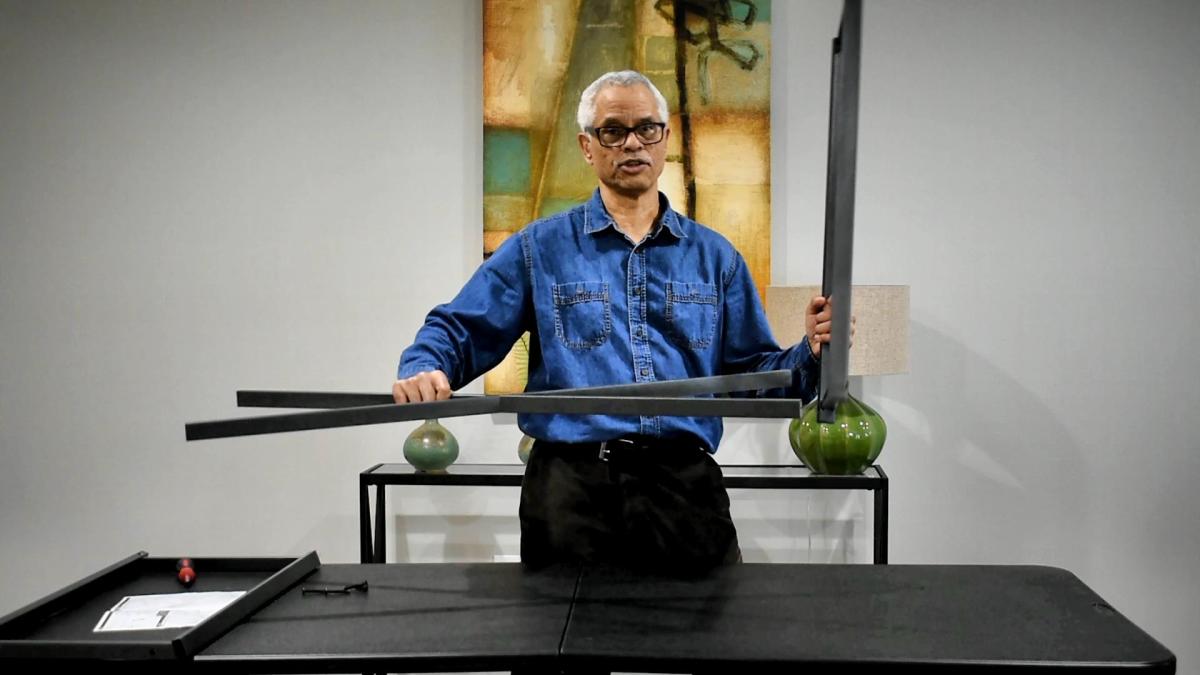
There are a few handy man jobs Sena lets me do around the house. They tend to be chores like Knock Down Furniture assembly. The most recent job was a small sofa table. You know, usually the companies send you a cheap tool to put things like this together. This time they didn’t enclose a hex head wrench—because they didn’t use hex head screws. The sofa table came with Phillips head screws—but no Phillips head screwdriver. No problem; I have one of those.
In the video I made, I mention the chin technique to use when you’re putting stuff like this together by yourself. You just hold on to the parts with your chin pressing against your shoulder. I don’t have a patent on it yet.
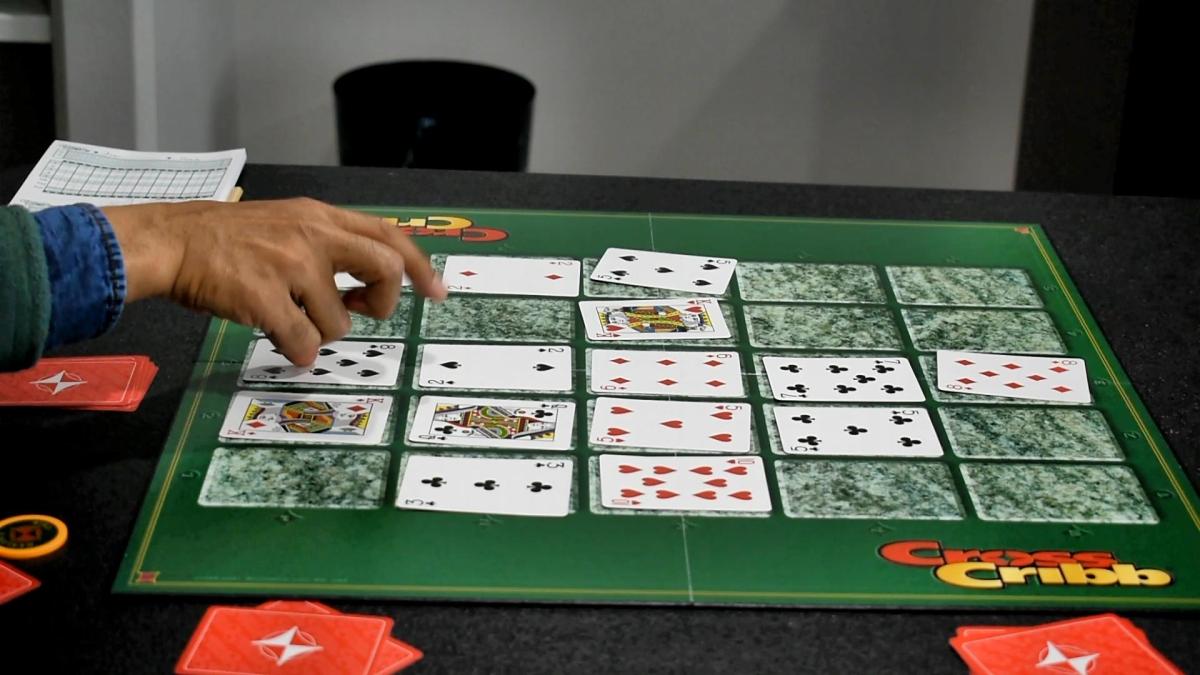
We finally started making a video of us playing CrossCribb. It took a while, partly because it takes more time to finish a game than we thought it would. If we’re playing it right, each hand or round takes about 8-10 minutes including scoring. We figure you’re supposed to play to 31, according to the rules. We played and filmed 6 rounds before our camera’s battery had to be recharged. We were 30-29 at that point with me leading.
Later when the battery was recharged, we played the 7th round. I won by a nose.
I’m not sure that making an hour long CrossCribb video will win any academy awards so I might plan this as a series of videos, one per round.
Playing it is a lot of fun! No wonder it has won awards. Knowing how to count cribbage points in cards gives you a leg up on playing and scoring.
The Iowa City Nature Challenge began on April 29, 2022. It’s sponsored by the University of Iowa Office of Sustainability and the Environment. According to their web site:
“From April 29th to May 2nd, find and photograph plants and animals in your backyard, in parks, along city streets, on school grounds—anywhere you find nature in Iowa City. Then, simply use the iNaturalist app to upload your photos and add them to the Iowa City project!”
It sounds fun. Read all the instructions carefully. This reminded me of my own amateur naturalist post back in 2019 about a toeless Mourning Dove.
Video Description from my YouTube post:
This is a rather sad little video about a Mourning Dove without toes who visited our back porch in early August 2018. The first slide is of a bird with normal feet, followed by several shots of the bird with abnormal feet.
There’s a slide with a bird seemingly sitting in its own poop, which is said by some to cause the problem–which is doubtful.
The last shot is that of a pair of doves trying to nest in our window box, which was full of sharp, plastic artificial plants, which was painful to watch and I wonder if their hazardous habits could lead to injuring their feet.
Speculation about the causes of these injuries range from something called string foot (string or human hair used to build nests getting wrapped around toes leading to amputation), sitting in poop leading to infections, and frostbite.
I think frostbite is plausible, and so did a birdwatcher named Nickell, who published an article about it over a half century ago; Nickell, W. P. (1964). “The Effects of Probable Frostbite on the Feet of Mourning Doves Wintering in Southern Michigan.” The Wilson Bulletin 76(1): 94-95, complete with hand-drawn illustrations that look exactly like the one in the video.
String foot is also plausible, but I’m reminded of an essay by E.B. White, Mr. Forbush’s Friends, White, E. B. (1966). “Annals of birdwatching: Mr. Forbush’s friends.” New Yorker. 42(1) or in White, E. B. (1999). Essays of E.B. White. New York, Harper Perennial, in which White recounts the book, Birds of Massachusetts and Other New England States by Edward Howe Forbush, in which you can read one of the many anecdotes from amateur ornithologists about bird behavior that Forbush collected for his book, which was published circa 1929:
“Mrs. Olive Thorne Miller. Reported case of female tufted titmouse stealing hair from gentleman in Ohio for use in nest building. Bird lit on gentleman’s head, seized a beakful, braced itself, jerked lock out, flew away, came back for more. Gentleman a bird lover, consented to give hair again. No date.”– Forbush, Edward Howe, 1858-1929. Birds of Massachusetts and Other New England States. [Norwood, Mass.: Printed by Berwick and Smith Company], 192529. I wonder why a bird would risk string foot by using hair in nests?
Whenever John Heim gets a request from out there to hear something from the Tedeschi Trucks Band, he always plays “Tell The Truth,” which I like of course. On the other hand, I really like to hear a song from them I can relate to and which speaks to how important it is for people to learn how to live together, especially now-“Space Captain.”
I’ve seen several articles on Medscape about how to convince doctors to retire or even force them to retire when they’re too old to practice. The articles are titled, “How Old Is Too Old to Work as a Doctor?”; “Are Aging Physicians a Burden?”; and “When Should Psychiatrists Retire?”
The Great Resignation almost makes the debates about this moot. Doctors, including psychiatrists, are retiring or quitting in droves because of burnout, largely related to the stress of the Covid-19 pandemic in the last two years. However, a lot of physicians were quitting medicine even prior to the pandemic.
The same arguments get trotted out. Doctors often lack insight into their failing cognition and physical health as they age. How do we respectfully assess and inform them of their deficits? Are there gentle ways to move them away from active medical, surgical, and psychiatric practice and into mentoring roles to capitalize on their strengths in judgment and experience?
The decision to persuade some doctors to retire, not so much because of advancing chronological age but because of dwindling cognitive capacity and other essential skills, needs to be handled with empathy and wisdom, especially if this is going to increase the workload for the rest of the doctors holding the fort.
Like the song says, “Break it to Me Gently.”
And speaking of songs, this doctor retirement discussion reminded me of a song I heard on TV when I was a kid. I could remember just one line, “Your Love is Like Butter Gone Rancid.”
I thought I heard it on an episode of an old TV sitcom, The Real McCoys. In fact, it was from a 1968 episode of the Doris Day Show called The Songwriter. Hey, we watched what my mom wanted to watch.
The song’s awful lyrics, which Doris Day “wrote” (only as part of the show; it was actually written by Joseph Bonaduce) were tied to the melody of “My Bonnie Lies Over the Ocean”:
Your love is like butter gone rancid,
It’s no good now, it’s started to turn,
I pray that it’s just like the man said,
You can’t put it back in the churn
Can’t put
Can’t put
Can’t put it back in the churn
Oh, durn!
You can’t put it back…in the churn
The context here is that another character (Leroy) in the show had previously submitted the lyrics of a similarly bad song (“Weeds in the Garden of My Heart”) to a crooked music publishing company that lavishly praised the song and promised to publish it—at Leroy’s expense.
Leroy was clueless about getting cheated. He was too dumb to know how bad the song was, but his feelings would have been badly hurt if the family just flatly told him that. They had to figure out a way to break it to him gently. So, Doris wrote the equally terrible “Your Love is Like Butter Gone Rancid,” and performed it for Leroy and the rest of the family. Leroy thought Doris Day’s song was garbage but didn’t know how to tell her without hurting her feelings.
Doris then told Leroy she was also going to submit her rancid song to the crooked publishing company.
After Doris got the exact same letter the crooked company sent to Leroy—he learned his lesson and felt supported, gosh darn.
Anyway, I was moved to write a short song about the doctor retirement issue, “When Doctors Are Too Old to Practice,” sung to the tune of “My Bonnie Lies Over the Ocean” of course:
When doctors are too old to practice
And can’t tell your elbows from knees
When they sing old songs to distract us
It’s high time we tell them to leave
High time
High time
It’s high time we tell them to leave
Oh, beans!
It’s high time we tell them…to leave
I’ve received hundreds of billions of requests for a sing-a-long version of “My Bonnie Lies Over the Ocean” because you can’t sing the parodies unless you know the original tune.






 Go Retire Psychiatrist