CDC ACIP Meeting Today on Vaccines

There’s a CDC ACIP Meeting scheduled to start at 8:00 AM EST today (caught me off guard). The slides are here.

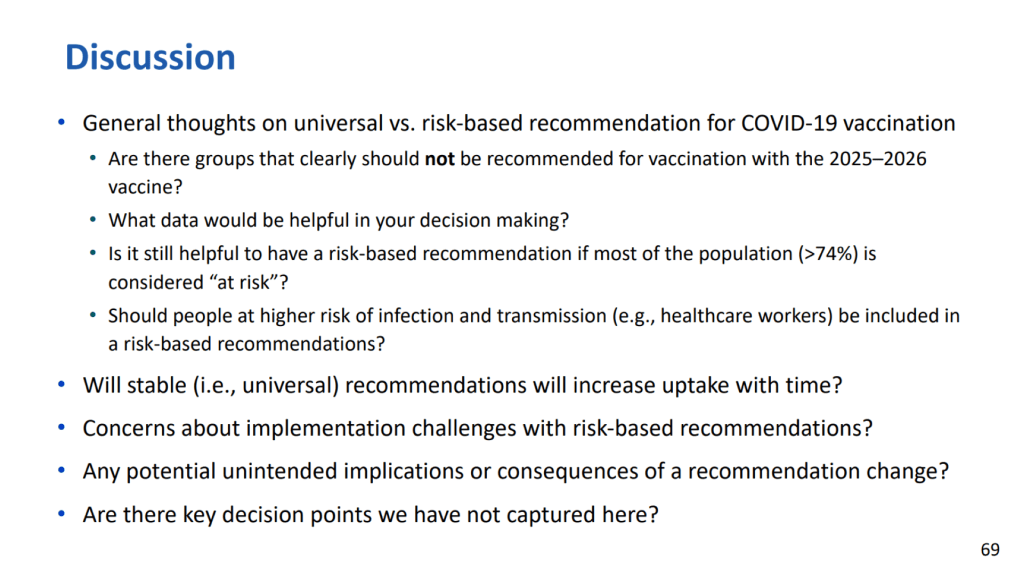
Noteworthy: Dr. Denise Jamieson, MD, MPH is chair of the CMV Working Group. She is Vice President for Medical Affairs and the Tyrone D. Artz Dean, Roy J. and Lucille A. Carver College of Medicine at University of Iowa. In the Q&A session following the Covid-19 vaccine presentation, Dr. Jamieson expressed a preference for a universal recommendation (citing implementation and uptake challenges, which other attendees mentioned as well) for the Covid-19 vaccine as opposed to a risk-based or permissive recommendation. See slide labeled “Discussion” below:

There was no vote scheduled for today’s meeting on the Covid-19 vaccine.

The presentation by Moderna on the new Covid-19 vaccine, mRNA-1283, was helpful. I gather there will be an FDA meeting about it in June.

SAINT Therapy for Treatment Resistant Depression at The University of Iowa

First of all, if you looked up Saint therapy for depression, you might have accidentally found information on Saint Dymphna, the Catholic patron saint of those living with mental illness.

Actually, SAINT stands for Stanford accelerated intelligent neuromodulation therapy. It’s a personalized protocol for using transcranial magnetic stimulation (TMS) to treat severe depression. The University of Iowa is the first academic center to offer it in the Midwest.

This is a big step forward from the days many years ago when we were starting use right unilateral electrode placement for applying electroconvulsive therapy (ECT) to treat depression because it was thought to lead to fewer cognitive problems post-treatment.

SAINT is a game changer according to Dr. Nicholas Trapp, MD, assistant professor of psychiatry, who describes it as a method to pinpoint the best location in each patient’s brain to target with TMS to treat major depressive disorder. The procedure is quick and recovery from depression can be sustained for months.

Kudos to The University of Iowa. And maybe thanks to Saint Dymphna.

How to Support University of Iowa with the One Day for Iowa Fund Drive Today!

Okay, so here’s my pitch on how potential donors can support programs at The University of Iowa. Today the One Day for Iowa fund drive kicks off, and it ends at 11:59 PM today on March 26, 2025.

I got a soft spot in my heart for The University of Iowa College of Medicine and University of Iowa Health Care (UIHC), even though my undergraduate Bachelor’s degree was from Iowa State University.

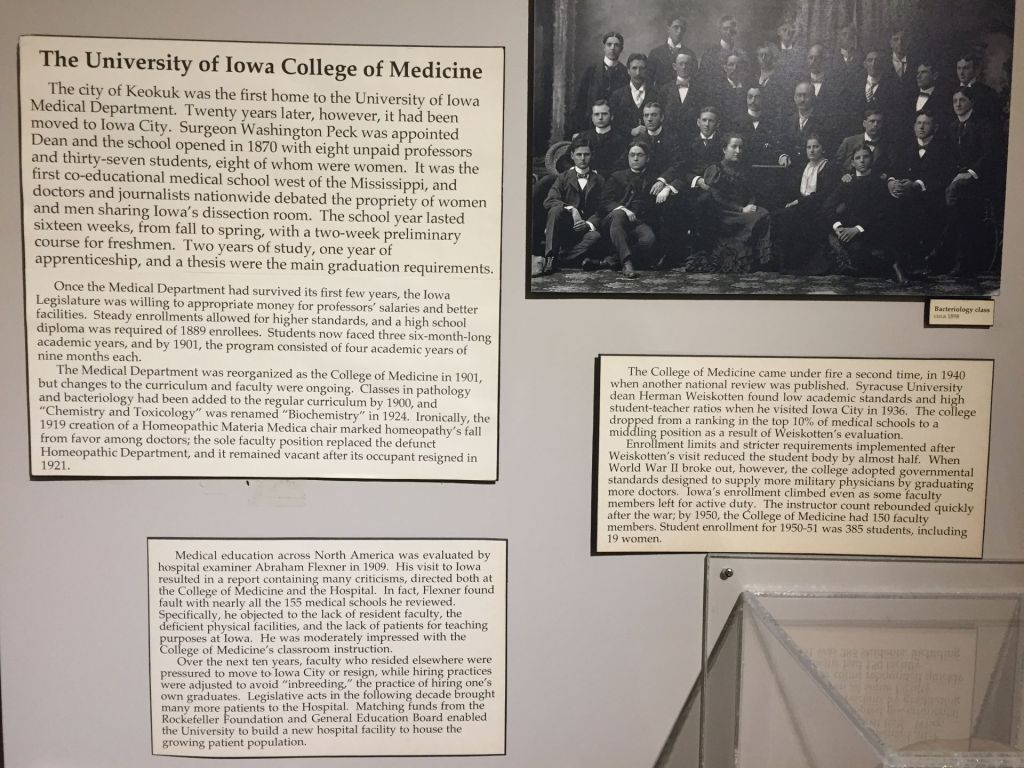
You can find in the UIHC Medical Museum a description of the historical development of the medical school. Following the Flexner Report in 1909 which found fault with all U.S. medical schools including Iowa’s, there was a drive to avoid “inbreeding,” meaning hiring of one’s own graduates. Nowadays, there are legislative efforts to keep as many as we can of Iowa’s best and brightest.  

Go Hawkeyes!

Attack of the Toothworms

I had my regular visit to the dentist at The University of Iowa Health Care (UIHC) today, and it was a good thing I did. For the past couple of weeks or so I’ve had cold and hot sensitivity in a couple of teeth. No surprise, the dentist found 3 teeth that needed a little work.

The dental hygienist also suggested I try using a tongue cleaner and gave me a free one. I’d never heard of a tongue cleaner before. The package advertisement (in English, French, and Spanish) says it’s for combatting bad breath, although the dental hygienist assured me in 6 different languages that she didn’t detect that problem in me.

I was there for my annual teeth cleaning but now I had 3 teeth needing work. Luckily, the dentist had an appointment in the early afternoon. It was a 3 hour wait, but I thought it was better to get it done sooner rather than later. Anticipating a visit with a dentist is sometimes almost as bad as getting in the chair and exercising my ability to refrain from flinching as the high-speed instruments whine in my ear while the dentist and the assistant do their level best to see that I gag several times in at least 9 different languages, including Klingon.

It’s hard to explain why I was having tooth sensitivity because, according to the dentist, the damage was not that severe. It wasn’t until I wandered around the hospital while waiting for the 2nd appointment that I realized I had never visited the Medical Museum on the 8th floor. And that’s where I found a possible explanation that made more sense than the modern one. It’s probably toothworms.

No kidding, back in the 18th century, a lot of people thought worms caused tooth decay by eating them from the inside out. There was also a College of Dentistry display in the Medical Museum featuring a typical dentist chair and samples of rusty tools, which made wonder if I should put off the filling work until, say, after my next ten reincarnations.

There’s a human skeleton in the museum which is affectionately called Gertie. The historical note on Gertie is very interesting in that it was thought to be a male when Ottumwa Regional Health Center donated it to UIHC in 2013. It turns out he is actually a she and the “…two symmetrical holes in the upper jaw are the result of large dental abscesses.” Just what I wanted to learn on a day when I’m anticipating dental work.

Anyway, my teeth got repaired. I would say that the UIHC dental clinic has come a long way from 1904. You don’t turn and spit in a bowl anymore. They just siphon the toothworms out with a suction wand nowadays.

Stead Family Children’s Hospital NICU Gets a Wave from the AAP with New Designation

The University of Iowa Stead Family Children’s Hospital Neonatal Intensive Care Unit was recently recognized by the American Academy of Pediatrics (AAP) as one of only two such units in the U.S. having the highest levels of neonatal care.

It reminds me of the Iowa Hawkeye football games where, at the end of the first quarter, all the players and football fans wave from the field to the pediatric patients and their families watching the game from UI Stead Family Children’s Hospital. It’s called the Wave, one of the best traditions in college sports.

Well, the AAP waves to Stead Family Children’s Hospital NICU.

The 2024 Distinguished Education Lecture by Russell Ledet, MD, PhD

Last year, I wanted to present this Distinguished Education Lecture by Dr. Russell Ledet, MD, PhD, given during Martin Luther King Jr. Celebration of Human Rights week. It took a while for my message to the University of Iowa to get through channels, but I want to thank Audra M. King, the Administrative Services Coordinator for the Office of Student Affairs and Curriculum in the University of Iowa Carver College of Medicine for her help in getting it into a YouTube format that allows the general public to see and hear Dr. Ledet’s presentation.

I wrote a post in February last year about how impressed I am with Dr. Ledet as a leader. Now you can hear him tell his own inspirational story.

Rounding@Iowa Podcast: “Advances in the Treatment of Pancreatic Cancer”

This episode of Rounding@Iowa is about important medical advances in the treatment of pancreatic cancer. As you listen to Dr. Clancy interview Dr. Joseph Cullen about what’s new, you’ll hear a lot about high-dose intravenous Vitamin C. This can enhance treatment and improve response to chemotherapy and radiation therapy. Dr. Cullen’s most recent study about this technique showed the overall survival of patients with late-stage pancreatic cancer increased from 8 months to 16 months.

86: Cancer Rates in Iowa Rounding@IOWA

Iowa's cancer rates are among the highest in the country, and they are rising. In this episode of Rounding@Iowa, Dr. Gerry Clancy and guest experts Dr. Mary Charlton and Dr. Mark Burkard discuss the data, risk factors, and prevention strategies clinicians can use to make a difference. CME Credit Available:  https://uiowa.cloud-cme.com/course/courseoverview?P=0&EID=81274  Host: Gerard Clancy, MD Senior Associate Dean for External Affairs Professor of Psychiatry and Emergency Medicine University of Iowa Carver College of Medicine Guests: Mark E. Burkard, MD, PhD Professor of Internal Medicine-Hematology, Oncology, and Blood and Marrow Transplantation University of Iowa Carver College of Medicine Director, University of Iowa Health Care Holden Comprehensive Cancer Center Mary Charlton, PhD Professor of Epidemiology Director, Iowa Cancer Registry Iowa College of Public Health Financial Disclosures:  Dr. Clancy, Dr. Burkard, Dr. Charlton, and Rounding@IOWA planning committee members have disclosed no relevant financial relationships. Nurse: The University of Iowa Roy J. and Lucille A. Carver College of Medicine designates this activity for a maximum of 0.75 ANCC contact hour. Pharmacist and Pharmacy Tech: The University of Iowa Roy J. and Lucille A. Carver College of Medicine designates this knowledge-based activity for a maximum of 0.75 ACPE contact hours. Credit will be uploaded to the NABP CPE Monitor within 60 days after the activity completion. Pharmacists must provide their NABP ID and DOB (MMDD) to receive credit. UAN: JA0000310-0000-25-090-H99 Physician: The University of Iowa Roy J. and Lucille A. Carver College of Medicine designates this enduring material for a maximum of 0.75 AMA PRA Category 1 CreditTM. Physicians should claim only the credit commensurate with the extent of their participation in the activity. Other Health Care Providers: A certificate of completion will be available after successful completion of the course. (It is the responsibility of licensees to determine if this continuing education activity meets the requirements of their professional licensure board.) References/Resources:  Iowa Cancer Plan  
  1. 86: Cancer Rates in Iowa
  2. 85: Solutions for Rural Health Workforce Shortages
  3. 84: When to Suspect Atypical Recreational Substances
  4. 83: Hidradenitis Suppurativa
  5. 82: End-of-Life Doulas

Reference:

Kellie L. Bodeker, Brian J. Smith, Daniel J. Berg, Chandrikha Chandrasekharan, Saima Sharif, Naomi Fei, Sandy Vollstedt, Heather Brown, Meghan Chandler, Amanda Lorack, Stacy McMichael, Jared Wulfekuhle, Brett A. Wagner, Garry R. Buettner, Bryan G. Allen, Joseph M. Caster, Barbara Dion, Mandana Kamgar, John M. Buatti, Joseph J. Cullen,

A randomized trial of pharmacological ascorbate, gemcitabine, and nab-paclitaxel for metastatic pancreatic cancer,

Redox Biology,

Volume 77,

2024,

103375,

ISSN 2213-2317,

(https://www.sciencedirect.com/science/article/pii/S2213231724003537)

Abstract: Background

Patients with metastatic pancreatic ductal adenocarcinoma (PDAC) have poor 5-year survival. Pharmacological ascorbate (P-AscH-, high dose, intravenous, vitamin C) has shown promise as an adjunct to chemotherapy. We hypothesized adding P-AscH- to gemcitabine and nab-paclitaxel would increase survival in patients with metastatic PDAC.

Methods

Patients diagnosed with stage IV pancreatic cancer randomized 1:1 to gemcitabine and nab-paclitaxel only (SOC, control) or to SOC with concomitant P-AscH−, 75 g three times weekly (ASC, investigational). The primary outcome was overall survival with secondary objectives of determining progression-free survival and adverse event incidence. Quality of life and patient reported outcomes for common oncologic symptoms were captured as an exploratory objective. Thirty-six participants were randomized; of this 34 received their assigned study treatment. All analyses were based on data frozen on December 11, 2023.

Results

Intravenous P-AscH- increased serum ascorbate levels from micromolar to millimolar levels. P-AscH- added to the gemcitabine + nab-paclitaxel (ASC) increased overall survival to 16 months compared to 8.3 months with gemcitabine + nab-paclitaxel (SOC) (HR = 0.46; 90 % CI 0.23, 0.92; p = 0.030). Median progression free survival was 6.2 (ASC) vs. 3.9 months (SOC) (HR = 0.43; 90 % CI 0.20, 0.92; p = 0.029). Adding P-AscH- did not negatively impact quality of life or increase the frequency or severity of adverse events.

Conclusions

P-AscH− infusions of 75 g three times weekly in patients with metastatic pancreatic cancer prolongs overall and progression free survival without detriment to quality of life or added toxicity (ClinicalTrials.gov number NCT02905578).

Keywords: Pancreatic neoplasms; Ascorbic acid; Controlled clinical trial; Gemcitabine; Nab-paclitaxel

Dr. Cullen mentions that patients contact him not infrequently to ask if taking high-dose oral Vitamin C will help them achieve similar results. Unfortunately, it will not. Giving it intravenously facilitates giving much higher doses. The study had a relatively small number of participants, which limited ascertainment of quality of life.

On the psychological side, there are ways to bolster the mental health challenges of those with pancreatic cancer, which typically has a grim outcome in terms of survival:

Spiegel D. Mind matters in cancer survival. Psychooncology. 2012 Jun;21(6):588-93. doi: 10.1002/pon.3067. Epub 2012 Mar 21. PMID: 22438289; PMCID: PMC3370072.

Further, Dr. William Breitbart, MD, Chair of the Department of Psychiatry and Behavioral Sciences at Memorial Sloan Kettering Cancer Center was interviewed in 2021 and emphasized the need for bolstering mental health for those diagnosed with pancreatic cancer. According to Breitbart, “Pancreatic cancer triggers an inflammatory response in the body, which can lead to mood disorders,” Breitbart explains. Psychiatrists can prescribe certain antidepressant medications that directly target that inflammatory response.”

The Zamboni Effect

I was walking around the mall today doing ordinary old guy things: watching the Zamboni machine resurface the ice rink, which I’ve never seen before, by the way. The surface was pretty dull before the Zamboni team started. There were two kids in the seat, one young lady driving and the other young man pointing out spots she missed. They went around and around getting the thin layer of water on the whole rink while eager skaters waited to get out there. They rejuvenated the rink, got it shining like crystal and skaters spun, twirled, and had a great time. It was the Zamboni Effect.

After that, I got up and did my usual thing, looked at books in Barnes & Noble, got a bite to eat, wondered why the mall security guy was walking by the bench so often where I was sitting. After his third pass, I got up and did my best to look like a solid citizen who is aware that loitering might look sinister to some mall security guys.

And when I wandered back to the tables next to the ice rink, I sat down again because the mall security guy was nowhere in sight. While I was just zoning out watching people pass by, one of them stopped and made a funny face at me. For a half-second, he didn’t register in my memory and then he called me by name. I suddenly recognized him as a former resident in the Medical-Psychiatry training program at University of Iowa Health Care (UIHC). It was Ravneet, one of the best trainees I have ever had the pleasure to work with.

It was kind of a shock. He had left for a great position with a health care organization out in Arizona many years ago and is very successful. He and his wife and daughter were on vacation and were walking through the mall. His son is also a high-level performer in science but he was not with them today. Ravneet takes time out every so often to travel like that. I’m sure it helps rejuvenate him—kind of like how the Zamboni machine rejuvenates the ice rink–the Zamboni Effect.

We exchanged pleasantries, he took a selfie with me, and I forgot to ask him to send me a copy, probably because I was so flabbergasted at running into him at the mall. It really brightened my day. Again—the Zamboni Effect. I really felt rejuvenated.

Every now and then, we all need the Zamboni Effect. Maybe it could even help the mall security guy.

More on the Focused Practice Designation in Emergency Psychiatry

This post just provides further information (in addition to what was in yesterday’s post) on the evolution of the Focused Practice Designation (FPD) for consultation-liaison psychiatrists who might be interested in certifying to work in emergency departments. I use the word “certifying” because it seems clear that the FPD pathway has been intended to follow the board certification pathway, which I wondered about.

There’s a little background on the progress to the FPD path (established by ABMS in 2017) that began a few years ago in the article below:

Simpson S, Brooks V, DeMoss D, Lawrence R. The Case for Fellowship Training in Emergency Psychiatry. MedEdPublish (2016). 2020 Nov 11;9:252. doi: 10.15694/mep.2020.000252.1. PMID: 38058898; PMCID: PMC10697437.

The take home message is quoted below:

“-Over 10 million emergency department encounters a year in the United States are for behavioral health concerns, but quality emergency psychiatric care remains inconsistently available.

-New emergency psychiatry fellowship programs are being developed to train expert clinicians and prepare leaders in the subspecialty.

-These efforts will improve access to high quality mental health treatment for all patients regardless of treatment setting.”

And there is a 55-page form on the web from the American Board of Medical Specialties (ABMS) Committee on Certification (COCERT). There are several endorsements from various stakeholders including but not limited to the Academy of Consultation-Liaison Psychiatry (ACLP) and the American Board of Psychiatry & Neurology (ABPN) which make it clear there is a consensus about the value of “board certification” because most of the endorsement letters specify that. These letters are dated from just last year.

The University of Iowa Health Care system, based on the website does not (yet) offer an emergency psychiatry fellowship. They do offer a consultation-liaison psychiatry fellowship, which the ABMS supports as contributing to the attainment of the FPD credential.

However, I’m unclear if the FPD pathway won’t soon become yet another ongoing certification challenge for clinicians, many of whom find it more of an interference to their practice than a benefit. Although I believe that appropriately trained psychiatrists are helpful in the emergency room (after all, I did that for a long time), I have a nagging doubt that it will unclog the overcrowding there. Dr. George Dawson pointed that out yesterday in his comment to my post.

In the Purpose, Status, and Need section of the ABMS 55-page application form, starting on p.2 of the pdf, the American Board of Emergency Medicine (ABEM) specifies that the PFD would not be yet another subspecialty. The proposed 12-month fellowship in Emergency Behavioral Health (EBH) “…would not be ACGME-accredited training…” which distinguishes it from a subspecialty—yet they would be “recognized” for having the FPD.

Further, the application asserts that the EBH would “…address the mental health crisis in the US.” The reference to the “moral injury” that our colleagues suffer in the emergency room is not lost on me. I believe in the all for one and one for all concept. However, I’m less confident that this would lead to fewer patients boarding in emergency rooms. These days, entire hospitals often have no or too few beds available for either psychiatric or non-psychiatric patients.

Under the “Eligibility and Assessment” section, the emergency room psychiatrist seeking FPD status must hold ABEM or ABPN primary psychiatry certification. They would also be required to meet continuing certification requirements in EBH to maintain active FPD status. There is presently a “Practice Pathway” to the FPD, but that would eventually close. After that, the psychiatrist would need to complete a 12-month ABEM-approved EBH fellowship. The cycle length for the FPD in EBH would be 5 years, beyond which the applicant would be subject to re-verification of ongoing EBH practice experience “…to meet continuing certification requirements.”

You can learn more about FPD (including frequently asked questions) at this ABMS web site.

It sounds like board mandated MOC to me, and I don’t know how many clinicians will choose that route. It could discourage some psychiatrists from pursuing the FPD pathway. I’m also unsure how this will address the practical issue of emergency room boarding of patients with psychiatric illness, since doctors ultimately don’t control hospital bed capacity.

Rounding@Iowa Podcast: “Challenges in Transitioning Seriously Ill Patients from Pediatric to Adult Systems of Care”

I listened to the Rounding@Iowa podcast of February 11, 2025, “Challenges in Transitioning Seriously Ill Patients from Pediatric to Adult Systems of Care.”

86: Cancer Rates in Iowa Rounding@IOWA

Iowa's cancer rates are among the highest in the country, and they are rising. In this episode of Rounding@Iowa, Dr. Gerry Clancy and guest experts Dr. Mary Charlton and Dr. Mark Burkard discuss the data, risk factors, and prevention strategies clinicians can use to make a difference. CME Credit Available:  https://uiowa.cloud-cme.com/course/courseoverview?P=0&EID=81274  Host: Gerard Clancy, MD Senior Associate Dean for External Affairs Professor of Psychiatry and Emergency Medicine University of Iowa Carver College of Medicine Guests: Mark E. Burkard, MD, PhD Professor of Internal Medicine-Hematology, Oncology, and Blood and Marrow Transplantation University of Iowa Carver College of Medicine Director, University of Iowa Health Care Holden Comprehensive Cancer Center Mary Charlton, PhD Professor of Epidemiology Director, Iowa Cancer Registry Iowa College of Public Health Financial Disclosures:  Dr. Clancy, Dr. Burkard, Dr. Charlton, and Rounding@IOWA planning committee members have disclosed no relevant financial relationships. Nurse: The University of Iowa Roy J. and Lucille A. Carver College of Medicine designates this activity for a maximum of 0.75 ANCC contact hour. Pharmacist and Pharmacy Tech: The University of Iowa Roy J. and Lucille A. Carver College of Medicine designates this knowledge-based activity for a maximum of 0.75 ACPE contact hours. Credit will be uploaded to the NABP CPE Monitor within 60 days after the activity completion. Pharmacists must provide their NABP ID and DOB (MMDD) to receive credit. UAN: JA0000310-0000-25-090-H99 Physician: The University of Iowa Roy J. and Lucille A. Carver College of Medicine designates this enduring material for a maximum of 0.75 AMA PRA Category 1 CreditTM. Physicians should claim only the credit commensurate with the extent of their participation in the activity. Other Health Care Providers: A certificate of completion will be available after successful completion of the course. (It is the responsibility of licensees to determine if this continuing education activity meets the requirements of their professional licensure board.) References/Resources:  Iowa Cancer Plan  
  1. 86: Cancer Rates in Iowa
  2. 85: Solutions for Rural Health Workforce Shortages
  3. 84: When to Suspect Atypical Recreational Substances
  4. 83: Hidradenitis Suppurativa
  5. 82: End-of-Life Doulas

This was a very interesting presentation about the challenges of helping persons with life-limiting conditions (for example, hemophilia, cystic fibrosis, sickle cell anemia and more) transition from pediatric to adult systems of care. Most of the discussion was about the difficulty in finding doctors who would be willing and able to assume care of patients who had survived to adulthood who had been previously seen in pediatrics throughout childhood.

I listened very carefully to the whole podcast, waiting to hear about what the role of mental health care professionals would be in this kind of transition. There was no mention of it, not even after one of the presenters described a patient who was starting to have hallucinations.

My role as a consulting psychiatrist in a general hospital was mainly to see those with chronic diseases who were being treated by colleagues during a bout of cystic fibrosis or sickle cell crisis. I remember they were young adults, struggling with emotional distress and disruptive behavior.

I was surprised at the lack of discussion about the role of mental health assessments, diagnoses, and treatment including psychotherapy during transitions from pediatric to adult health care. Not that I would have had much to offer other than questions about how mental health professionals could be helpful regarding transitions—but I think they would have not been out of place.

I took a quick look at the resources provided. One of them was a University of Iowa website, the Iowa Center for Disabilities and Development: Transition to Adulthood Clinic For Teens and Young Adult Ages 14-30. Even here, the role of a psychologist was to evaluate learning problems.

One of the discussants mentioned a program called Got Transition, which has a very comprehensive website. There was a section for Special Populations and a list of resources and research when I searched the site using the term “mental health.” It was hard to find a section specific to the population under discussion in the podcast. On the other hand, it was very comprehensive.

In this podcast, discussants talked about the importance of a team approach to transitions. I wonder if there’s a place on the team for psychiatry.