We just found out there’s going to be a total solar eclipse on April 8, 2024. We hope to get some solar eclipse glasses before then if they don’t run out of stock everywhere. They’re selling fast.
We’ve seen a couple of lunar eclipses and those were fun. The most recent one was during cold weather in November 2022. I had to wear a winter coat.
In Iowa City, it starts at about 1:00 PM on April 8, 2024 and runs until a little after 3:00 PM. We missed the last one in 2017. The next one visible in the U.S. won’t be until 2044. We think we better see the one next month.
Just in case you missed it, the FDA posted an announcement about Kratom in February this year. According to the FDA:
“Kratom is a tropical tree (Mitragyna speciosa) that is native to Southeast Asia. Products prepared from kratom leaves are available in the U.S. through sales on the Internet and at brick-and-mortar stores. Kratom is often used to self-treat conditions such as pain, coughing, diarrhea, anxiety and depression, opioid use disorder, and opioid withdrawal.”
The other day as we were driving home on Highway 1 through Iowa City, I saw a sign advertising Kratom on a small store. I thought that might be illegal, but when I checked the Iowa Office of Drug Control and Policy, I found out it’s currently legal in the state.
Opinions vary about risks of using Kratom. The DEA tried to place in on the Schedule I, but the American Kratom Association and other supporters apparently prevented that simply by protesting it. The pharmacist who wrote the article (link above) raised a note of irony by questioning why marijuana is still regulated as a Schedule I drug.
The legality of Kratom also varies across the country. There is a very detailed review article about it that attempts to examine the use of Kratom from both the medical practitioner and patient points of view.
Last Saturday on Svengoolie, I watched for the second time the 1963 movie “Comedy of Terrors,” a slapstick horror spinoff of Shakespeare’s farce, “Comedy of Errors”—which I’ve never seen. I didn’t see the whole movie the first time around, and I can’t remember exactly where I saw it. Most likely it was on Svengoolie.
The movie story is not actually based on the Shakespeare comedy itself. Most of the lines by Basil Rathbone (as Mr. Black) sounded vaguely familiar and I think they were from “Macbeth.” Vincent Price (Mr. Trumbull) plays an evil mortician and Peter Lorre (Mr. Gillie) plays his bungling assistant. They bury people in a casket which they use over and over because they dump the corpses in the graves after the mourners leave. Boris Karloff plays Hinchley, the senile father of Trumbull’s wife, Amaryllis who is played by Joyce Jameson.
Basil Rathbone as Mr. Black is the landlord who threatens to evict Trumbull from his house if he doesn’t come up with the rent sooner rather than later. This leads to Trumbull’s plan to kill Mr. Black—who doesn’t stay dead more than a few minutes, repeatedly springing back to life and flawlessly reciting Shakespeare in a thundering voice, before collapsing periodically back into his lifelong affliction with bouts of catalepsy.
Now, you know I’m going to have something to say about catalepsy because I’m a retired consultation-liaison psychiatrist and I’ve seen enough patients with catatonia who display various signs of that neuropsychiatric disorder, including catalepsy. According to the University of Rochester Bush-Francis Catatonia Rating Scale Assessment Resources, catalepsy is defined as “Spontaneous maintenance of posture(s), including mundane (e.g., sitting/standing for long periods without reacting).”
After Mr. Black has an apparent heart attack after being shocked by the sight of Mr. Gillie, who sneaked into his house, the butler calls for the doctor. The butler reminds the doctor that the distinguished gentleman suffers from periodic episodes of “catalepsy.” The doctor insists that Mr. Black is dead after applying a perfunctory examination.
After that Mr. Black abruptly snaps into and out of periods of catalepsy typically reciting Shakespeare perfectly, even after Mr. Trumbull shoots him a few times. Needless to say, catalepsy is only one feature of many. It almost invariably appears in those who have severe neuropsychiatric illness such as schizophrenia or epilepsy and they would rarely be able to speak so eloquently.
What amazed me is that all of the actors remembered and spoke their lines perfectly, despite being lengthy and polysyllabic.
Although the film didn’t do well at the box office, I thought it was pretty funny. You can view it for free at the Internet Archive.
I recommend Dr. George Dawson’s recent posts on seeing the practice of medicine as a calling and his passing a big milestone with 2 million reads on his blog.
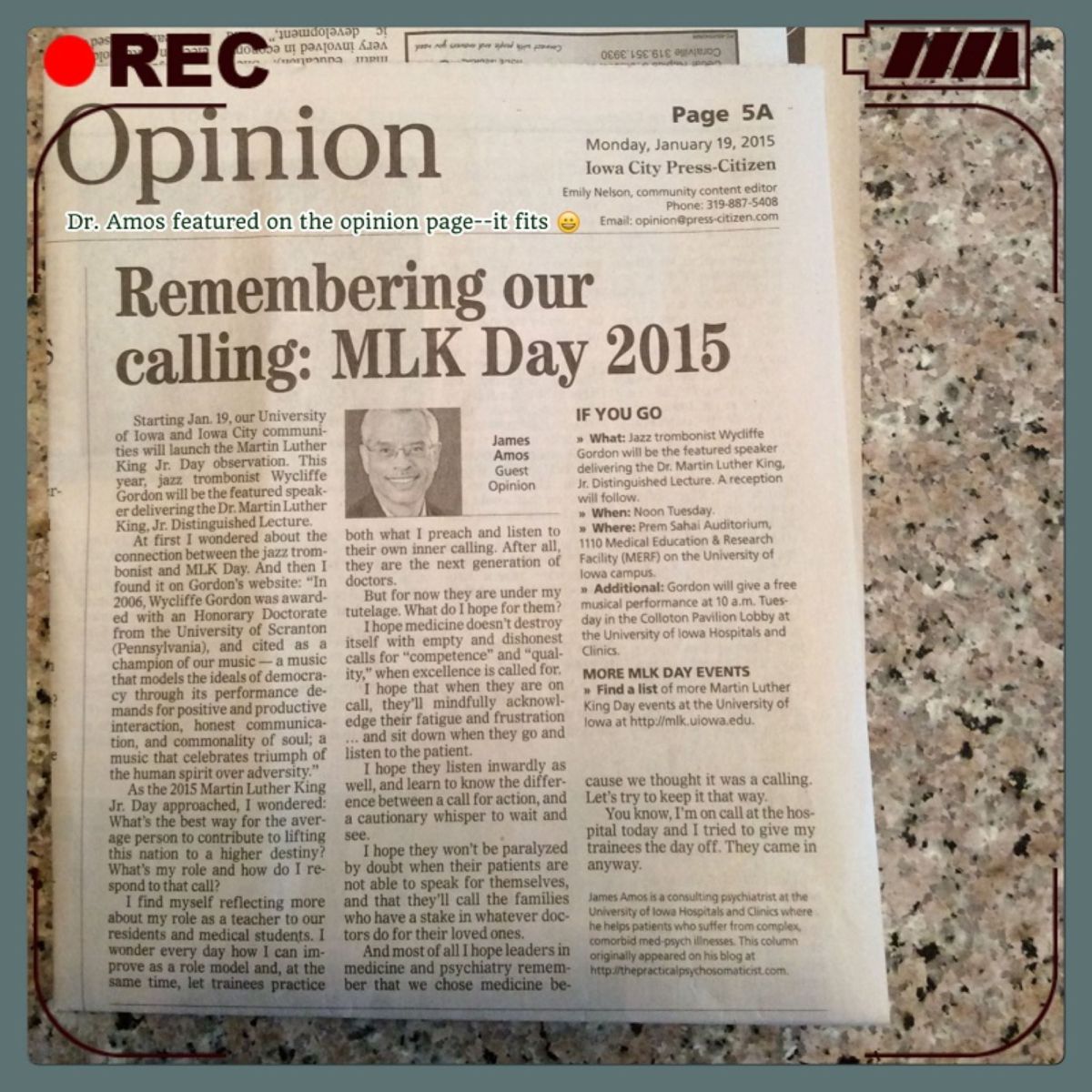
I wrote a post entitled “Remembering Our Calling: MLK Day 2015.” It was republished in a local newspaper, the Iowa City Press-Citizen on January 19, 2015. And I reposted it in 2019 on this blog.
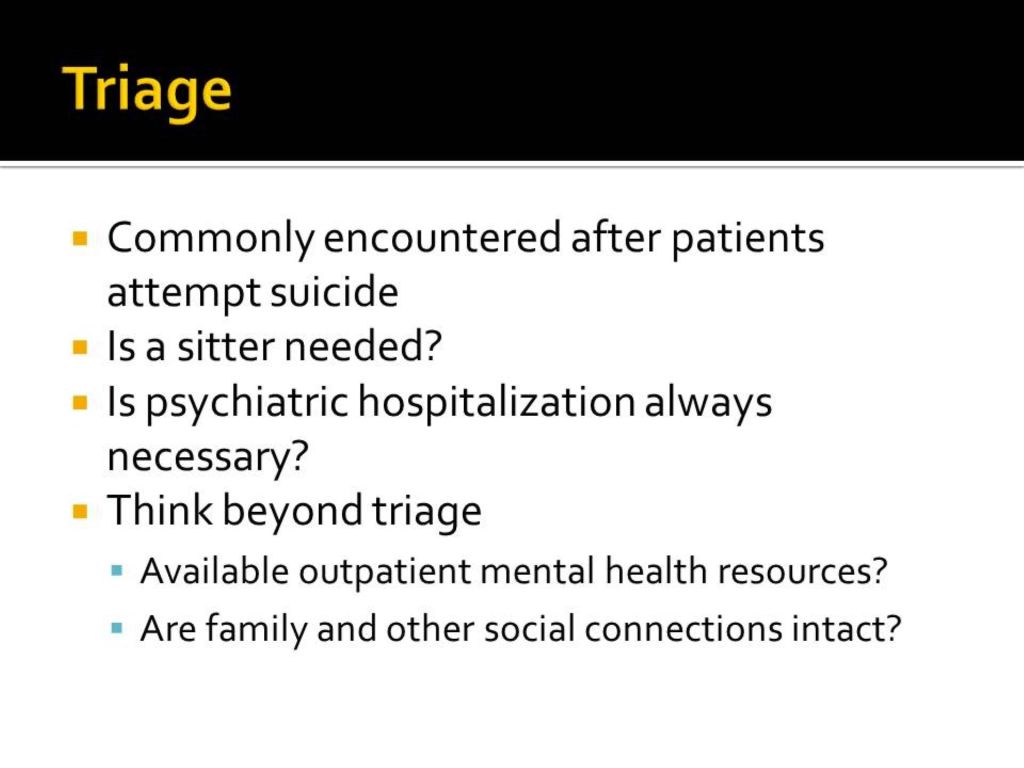
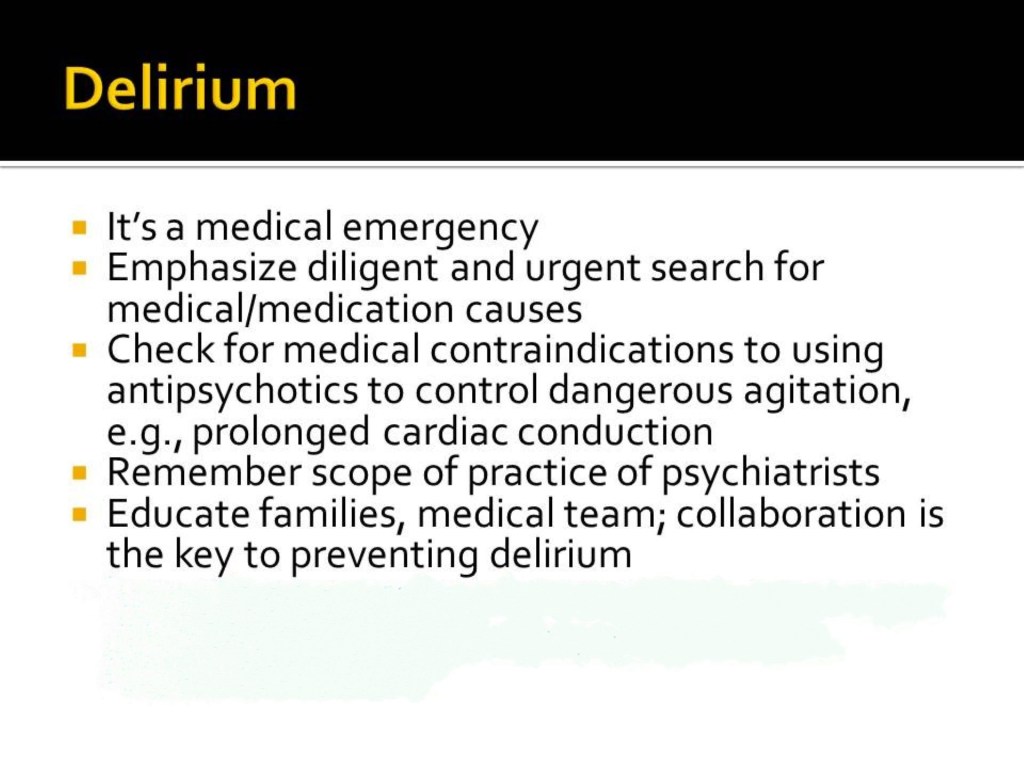
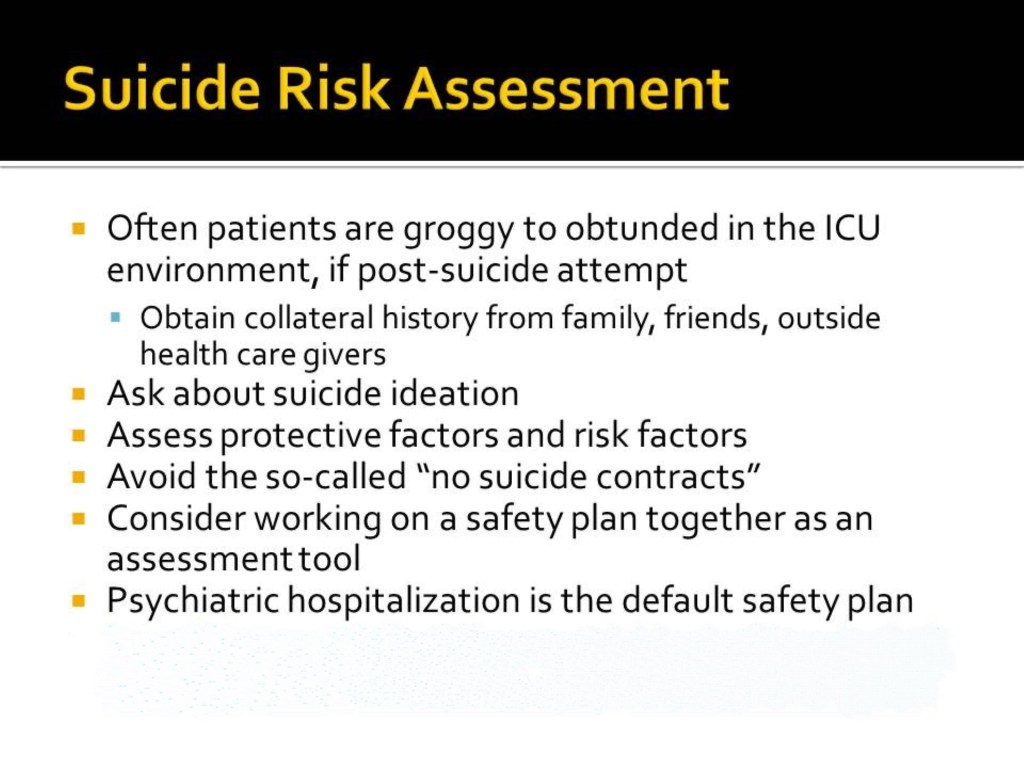
The trainees I taught also taught each other about psychiatry and medicine when they rotated on the consultation-liaison service at the hospital. We put them into the format of short presentations. I called mine the Dirty Dozen. The trainees and I also presented the Clinical Problems in Clinical Psychiatry (CPCP).
There were many of those meetings, which were necessarily short and to the point because the service was busy. We got called from all over the hospital. We answered those calls and learned something new every time.
I posted a lot of the trainees’ presentations in my previous blog, The Practical C-L Psychiatrist, which was replaced by this present blog. I haven’t posted the presentations partly because I wanted to give the younger teachers their due by naming them as they did on their title slides. But I would want to ask their permission first. They are long gone and far flung. Many are leaders now and have been for many years. I still have their slides. I’m very proud of their work. When they were called, they always showed up.
So, you’ll just have to put up with my work and my cornball jokes.
The other day, Sena was out at the auto dealership getting our lease car serviced and had an interesting conversation with the service guy and another customer.
The other customer was discussing his vehicles issues with the service guy and mentioned that rodents were probably snacking on his engine wires and hoses. The bill for a partial repair just to get his car back on the road temporarily was several hundred dollars. Sena overheard him mention “mice” and asked him about it.
The other customer and the service guy both endorsed the idea that mice and other rodents were eating the edible tubes and belts of the engine because nowadays they more often are made of plant-based materials. It’s a phenomenon connected with the economy going green, and making products that are generally more environmentally friendly. They said that, while rodents generally have always nibbled on engine parts, it’s gotten worse with the auto industry adoption of things like soy-based hoses and whatnot.
We were curious about this and looked it up on the internet. It turns out that the soy-based auto parts are not just a shenanigan supported by soybean intensive states like Iowa—so you can’t blame us.
We noticed that the idea that rodents chew auto parts because they smell like vanilla is controversial. Sometimes it seems like what side you’re on depends on how you make your living. Auto makers tend to deny that the soy-based materials attract mice—for obvious reasons if they use them in the manufacture of their products. On the other hand, some (but not all) pest control experts tend to endorse the notion, often in an obvious effort to get your business.
One auto expert said this whole idea about rodents getting addicted to soy-based alternator belts and the like was debunked by a study. The problem is the author didn’t give a link or a citation for the study.
One of the pest control experts testified, I mean reported, that the rodents are actually chewing through the compressed super beets radiator hoses because they’re seeking a healthier way to keep their teeth from growing too long. They need to gnaw things partly because if they didn’t their teeth would grow through their lower jaws.
Yet another den of bald-faced liars, I mean stakeholders, say that the critters might be addicted to certain substances other than soybeans. There is a story about mice eating their way through a half ton of marijuana in a police break room, I mean evidence room, in police headquarters. That was just because of the munchies.
That’s a little hard to believe until you have a look at the study of laughing rats. It turns out if you tickle them on the back or the belly, they laugh so hard you can actually hear them if you use special audio equipment and smoke a bong of weed.
Alternatively, the auto industry could make radiator hoses with little fingers on them which is similar to the hand chasing game in rat tickling experiments. As the rat crawls on them, the little hands tickle it on the belly. They would laugh so hard they fall off the hose. On the other “hand,” if the auto industry made auto fan belts of marijuana, that could get the rats (the rodents, not the auto makers) so stoned they might just forget what they’re doing.
Seriously, the most intelligent and even- “handed,” well-documented summary of the problem with rodents eating timing belts made of Iowa ditch weed was written by Erin Gobler, an auto insurance staff writer, updated August 22, 2023. It’s entitled “Does Car Insurance Cover Rodents Chewing Wires?”
“Conclusions: Any amount of daily steps above the referent 2200 steps/day was associated with lower mortality and incident CVD risk, for low and high sedentary time. Accruing 9000–10 500 steps/day was associated with the lowest mortality risk independent of sedentary time. For a roughly equivalent number of steps/day, the risk of incident CVD was lower for low sedentary time compared with high sedentary time.”
Reference:
Ahmadi MN, Rezende LFM, Ferrari G, et al. Do the associations of daily steps with mortality and incident cardiovascular disease differ by sedentary time levels? A device-based cohort study. British Journal of Sports Medicine 2024;58:261-268.
I figure I’m in the low sedentary category. This is somewhat reassuring to me because so far, my step counter averages (over 3 days) about 2500 steps during my usual daily exercise periods. Of course, this doesn’t count trips to the bathroom. I guess I can relax now.
I saw the story in Psychiatric Times about the compound MM-120, which the FDA recently granted breakthrough designation. MM-120 is related to LSD. Breakthrough designation is defined by the FDA as, “…a process designed to expedite the development and review of drugs that are intended to treat a serious condition and preliminary clinical evidence indicates that the drug may demonstrate substantial improvement over available therapy on a clinically significant endpoint(s).”
The compound is made by the company MindMed. This is not to be confused with mind meld, a Star Trek thing related to Vulcans like Spock who can do this telepathic touch thing. The MindMed organization made MM-120 to help treat people who suffer from Generalized Anxiety Disorder. Their study shows the drug could be used as a standalone treatment for the disorder.
According to one story about it published in the December issue of Drug Discovery and Development, it’s not likely MM-120 will be stocked in pharmacies next to the antihistamines and decongestants. The authors believe it would be more likely included in a Risk Evaluation and Mitigation Strategies (REMS) program.
This brings back nightmares about the Clozapine REMS program, which many psychiatrists found almost impossible to enroll in several years ago because of glitches in the web-based application. In fact, the FDA was still not happy with it a couple of years ago, to the extent they had to “temporarily exercise enforcement discretion” over aspects of the program.
Anway, the article goes on to say that the drug has a pretty good safety profile, although concede that the study found the higher dose of MM-120 led to “…perhaps some more challenging experiences….” There were no incidents of suicidal or self-injurious behavior.
I wonder what the “challenging experiences” were, exactly. After all, MM-120 is basically LSD, which was invented in 1938 by the Swiss chemist, Albert Hofmann. He was doing research into crop fungus. He thought it could be used to treat mental illness, even after he accidentally ingested some of it and hallucinated a future in which a guy named Timothy Leary would advise everyone to “turn on, tune in, drop out.”
That whole fungus research issue reminds me of the still unsettled question of how a whole town in France got higher than a kite (leading to some deaths) back in 1951. Ergot poisoning was the initial theory, although later somebody believed it might have been perpetrated as a secret LSD experiment by the CIA. I think the mystery is still unsolved.
However, there is also the history of MK-Ultra, which apparently actually was a classified CIA project running during the Cold War which involved giving LSD to certain unlucky subjects, some of whom didn’t know they were getting it—with disastrous results in some cases.
Just to let you know, I don’t suspect there is some conspiracy between extraterrestrials and the pentagon to get the world population so confused on LSD that we start believing all those crop circles are being created by two guys using a board and a rope. Forget what Agent Mulder says.
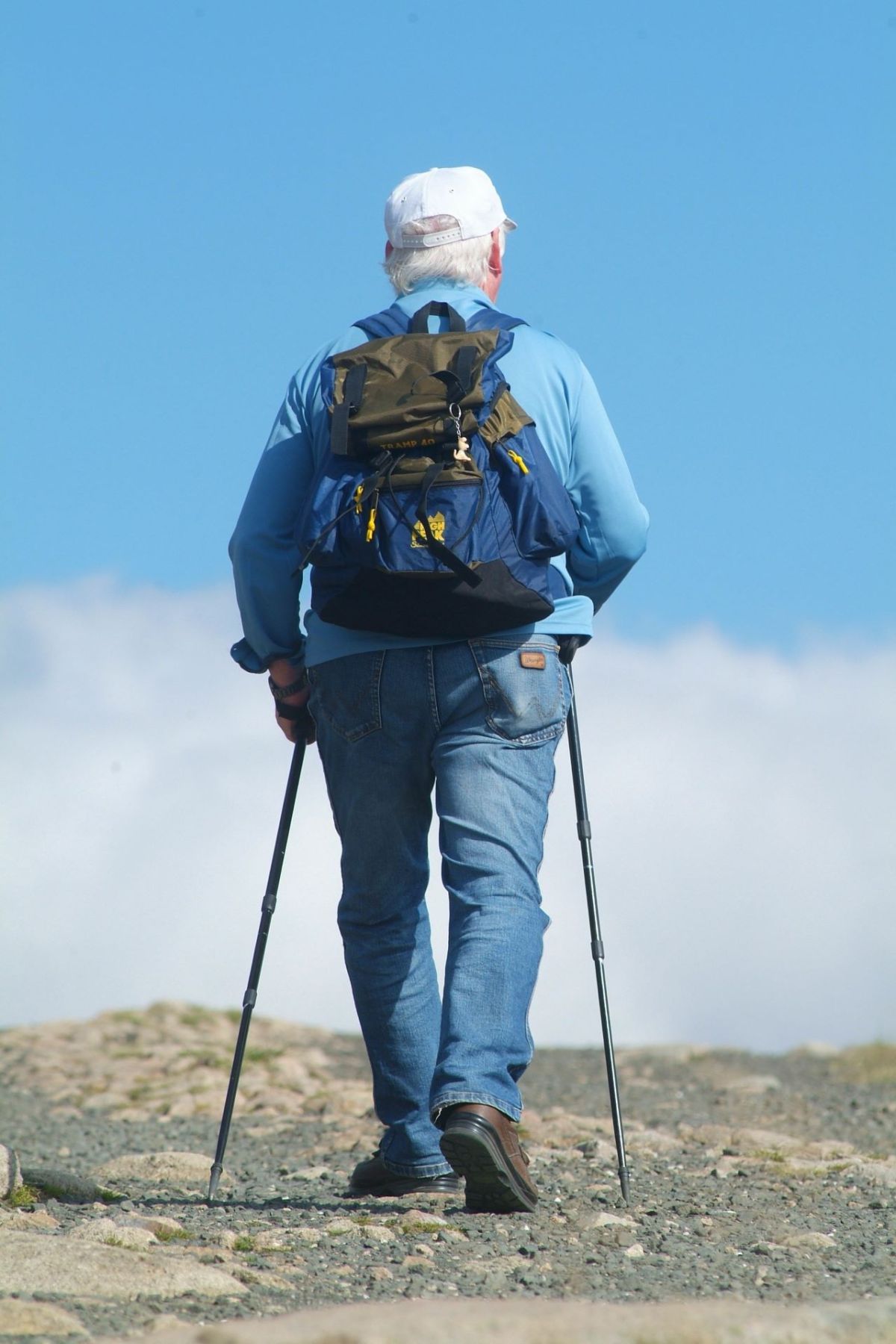
Since we got this little step counter, I’ve been paying more attention to how I exercise. The step counter will even track steps when I juggle—probably because I drop balls often enough to chase after them a lot.
And then I ran across the 10,000 steps as a benchmark for walking to keep healthy. I get about 3,000 steps during a typical 30-minute exercise session, which I do at least 5 days a week. Most people probably know that the CDC recommends that older adults spend 150 minutes as week (5 days a week for about 30 minutes a day) of moderate-intensity exercise.
That includes walking, jogging, wrestling Bigfoot, things like that. Muscle strengthening and balance are also important.
The 10,000-step thing (or 4,000-6,000 steps for older adults) puzzled me a little. The 10,000-step goal has an interesting story behind it. It turns out that around the time of the 1964 Tokyo Olympic games, that 10,000 steps goal had no scientific basis and was a marketing gimmick for selling the early pedometers.
In fact, if you really use your imagination, you might see how the Japanese character for 10,000 looks a little like a man walking—a stick man. The meter was called a Manpo-kei which literally translates to 10,000 steps.
Just walking 10,000 steps a day as a health goal probably doesn’t have a lot of scientific support. But you can increase the intensity of walking to get more benefit, such as walking up stairs or using a step platform, which I use nowadays. As a consultation-liaison psychiatrist, I walked all over an 8-floor hospital. I would usually use the stairs, often well over 20 flights pretty much every day.
I think the other way to make walking a more vigorous exercise is to develop and practice the well-known technique of silly walking, documented in the Ministry of Silly Walks documentary.
Since we added the step platform, I’ve been wondering how to count steps when I use it because for some reason my smartphone step counter won’t count steps when I try to use it on the platform.
Sena got a handy step counter and it works! It works if you have it in your pocket or wear it on neck with a lanyard.
I usually practice juggling patterns as a warm up to exercising. I’m still working on the shower pattern. Progress is slow.
My exercise routine takes a half hour. Following that I sit for mindfulness meditation for 30 minutes. We are still using our anti-Peloton exercise bike. I do one leg stands for a minute on each leg. I still do floor yoga, body weight squats, planks, and dumbbells. I still count my own steps on the platform: 50 steps alternating right and left leg four times (200 steps). The counter number varies between 170-200 or so.
As a review, a recently published study found that climbing 5 flights of stairs (approximately 50 steps) was associated with a lower risk of ASCVD types independent of disease susceptibility (Song et al, see reference below). There was a threshold effect of stair climbing in the study, meaning the benefit was lost if you went over a certain number of “floors.” Going over 15 or 20 didn’t gain much for subjects. A flight was 10 stair steps.
Step up!
Reference:
Song Z, Wan L, Wang W, Li Y, Zhao Y, Zhuang Z, Dong X, Xiao W, Huang N, Xu M, Clarke R, Qi L, Huang T, Daily stair climbing, disease susceptibility, and risk of atherosclerotic cardiovascular disease: A prospective cohort study, Atherosclerosis (2023)
In keeping with Iowa History Month 2024, you can have a look at the Iowa State University website “African and African American Studies Research Guide.”
Iowa State University happens to be my alma mater, or in a way, one of them. I took my Bachelor’s degree there and later graduated from The University of Iowa College of Medicine.
There is a wealth of information worth browsing on the ISU website devoted to the history of black people in Iowa. In fact, I found out a few of those connections were to Huston-Tillotson University (HT-U, an HBCU) in Austin, Texas, where I spent several semesters in the 1970s before later transferring to ISU.
The connections between HT-U and Iowa go way back into the history of that school. It started as Tillotson College in 1875, which is where some of the ISU black students also later worked as faculty. The list includes notable scholars:
Ada M. Deblanc-Yerwood: After graduation from ISU, she became head of Home Economics at Tillotson College. She was also co-founder of the George Washington Carver Museum in Austin, Texas. She also had an interesting perspective on retirement. She didn’t, and pursued other positions. Her answer to why she didn’t retire: “Old is a state of mind. When you do nothing, you become nothing. The need to be productive—give life to something—doesn’t automatically stop at age 65 or 70.”
Dr. Samuel P. Massie, Jr.: Dr. Massie went to ISU in 1941 to pursue a Ph.D. in Chemistry. He had to hitchhike to campus because there was no housing for Black students within 3 miles. Dr. Henry Gilman at ISU assigned him to work full time as a research assistant on a special assignment connected to the Manhattan Project (the top-secret effort to build an atomic bomb). President Lyndon B. Johnson appointed him to a Chemistry professorship at the U.S. Naval Academy. He distinguished himself as a scientist in many HBCUs (Fisk, Howard University, North Carolina College, and others) and elsewhere despite the racism that tried to hinder him. In 1981, ISU gave him the highest award—the Distinguished Achievement Citation.
Dr. Frederick Douglass Patterson: He was a brilliant student and he attended Samuel Huston College (see history of Huston-Tillotson College at link above). He also attended ISU, graduating with a DVM in 1923. In his book, Chronicles of Faith, he wrote: “In the veterinary program, I did not feel odd being a part of the group of students working in the veterinary clinic although I was the only black person there. The absence of animosity encouraged me to see veterinary medicine as a field in which I could practice without being hampered by the racial stereotypes and obstacles that would confront me as a medical doctor, for example. I found the teachers of Iowa State helpful whenever I approached them. Educationally, it was a fine experience.” He received the Presidential Medal of Freedom from President Ronald Reagan in 1987. He was President of Tuskegee Institute and transformed it into a university. He also founded the United Negro College Fund.
The United Negro College Fund was part of the reason I was able to attend Huston-Tillotson University. And it’s connected to the history of Iowa.














 Go Retire Psychiatrist