Glue Myself to My Biography

There’s a reason for why I so often tell Dad jokes. In keeping with my post from yesterday about Dr. Martin Luther King, Jr’s biographies:

I glued myself to my autobiography. You may not believe it, but that’s my story and I’m sticking to it.

We’ve ordered a couple of biographies about Dr. King. One of them is his autobiography and the other is Jonathan Eig’s book, “King: A Life.”

I’m getting to be too old to write my own autobiography—guess it’ll have to be done by autopen. Sorry about that one (no I’m not).

I’m a psychiatrist so I know when I’m using humor as a defense mechanism. A lot of good that does.

I’ve never seriously considered writing my autobiography. I could have it tattooed on my back—it would be my backstory.

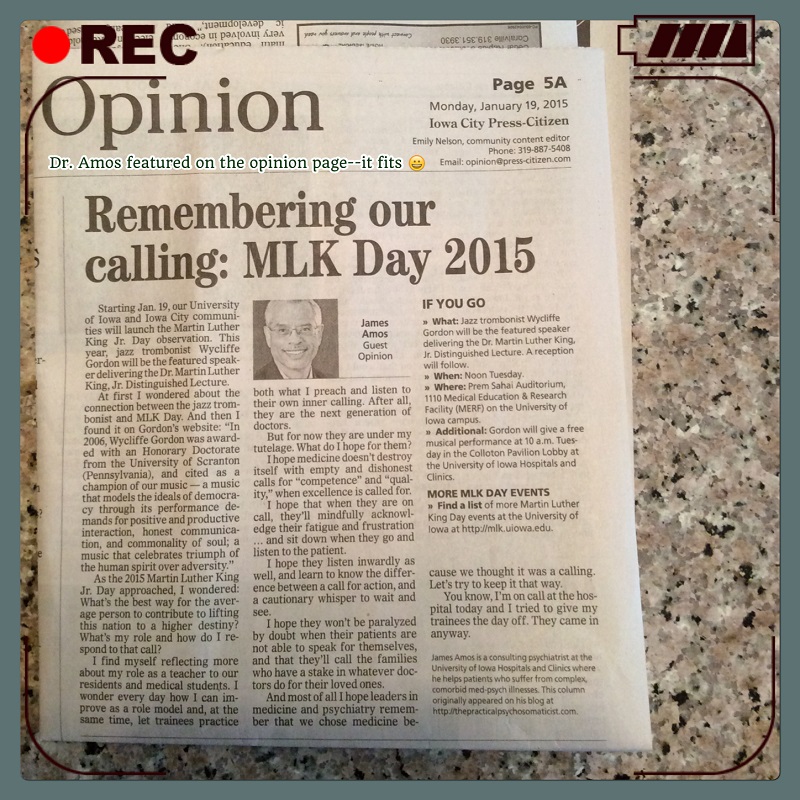
Seriously—no, I guess that’s impossible. On the other hand, every year about MLK Day, I think about the blog I wrote that the Iowa City Press Citizen published in 2015 on January 19th. It’s becoming almost something like a tradition. I think I need to repost it annually around this time. The title is “Remembering our calling: MLK Day 2015.” 

“Faith is taking the first step, even when you don’t see the whole staircase.”

-Martin Luther King, Jr.

That quote is interesting because Jonathan Eig’s biography of MLK can be said to reveal more of the staircase, so to speak, at least from the standpoint of his flaws as well as his strengths. But I stray from the tradition:

As the 2015 Martin Luther King Jr. Day approached, I wondered: What’s the best way for the average person to contribute to lifting this nation to a higher destiny? What’s my role and how do I respond to that call?

I find myself reflecting more about my role as a teacher to our residents and medical students. I wonder every day how I can improve as a role model and, at the same time, let trainees practice both what I preach and listen to their own inner calling. After all, they are the next generation of doctors.

But for now, they are under my tutelage. What do I hope for them?

I hope medicine doesn’t destroy itself with empty and dishonest calls for “competence” and “quality,” when excellence is called for.

I hope that when they are on call, they’ll mindfully acknowledge their fatigue and frustration…and sit down when they go and listen to the patient.

I hope they listen inwardly as well, and learn to know the difference between a call for action, and a cautionary whisper to wait and see.

I hope they won’t be paralyzed by doubt when their patients are not able to speak for themselves, and that they’ll call the families who have a stake in whatever doctors do for their loved ones.

And most of all I hope leaders in medicine and psychiatry remember that we chose medicine because we thought it was a calling. Let’s try to keep it that way.

You know, I’m on call at the hospital today and I tried to give my trainees the day off. They came in anyway.

I used to joke that they would erect a playdoh statue of me in the Quad (Quadrangle Hall was there) on the University of Iowa campus someday. Unfortunately, the Quad was demolished in 2016, so I guess I can’t put that in my autobiography.

Since I retired in 2020, I keep meaning to write my memoirs, but I never get around to it. I guess that makes it my oughta biography.

Shoveling Through Retirement Thoughts

I was just musing on Philip Rivers. You know about him. I blogged recently about his coming out of retirement to play quarterback for the Indianapolis Colts. I guess you already know this, but he retired again.

Unlike Philip Rivers, I’ve not even considered coming out of retirement since I left my position at The University of Iowa Health Care (UIHC) over 5 years ago. I never looked back.

But that doesn’t mean I never think about looking back. I look back a lot and that’s mostly because I’m an old guy. I was a consulting psychiatrist in the general hospital.

Anyway, occasionally I search my name on the web and laugh at what comes up. I never went to Baylor College of Medicine, much less graduated from there.

I did a few things when I was a doctor. Not all of them were about work, but most of them were.

Those who know me know that I always hated Maintenance of Certification (MOC). I checked the American Board of Psychiatry & Neurology website and my MOC contribution to continuing education is still there. It’s a clinical module on Delirium, which a lot of doctors and other health care practitioners see every day in the hospital. Dr. Emily Morse worked on it as well. She’s still working at UIHC.

I co-edited a book about consultation-liaison psychiatry with my former chair of the Psychiatry Dept, Dr. Robert G. Robinson, may he rest in peace. It’s “Psychosomatic Medicine: An Introduction to Consultation-Liaison Psychiatry.” You can buy it on Amazon—please.

I wrote a case report on catatonia caused by withdrawal from lorazepam (a benzodiazepine), and it’s still available. It was first published in Annals of Psychiatry.

But one of the things I’m proudest of doing was writing a short article for the University of Iowa Library for Open Access Week.

In it, I tell a short anecdote about my lofty (OK, a better word is “greedy”) thoughts about how much money I could make shoveling snow. I was just a kid and I never made it outside to shovel anybody’s walk because I was too busy calculating my income. I wrote that way back when I had another blog, The Practical Psychosomaticist. The photo of me shows my Leonard Tow Humanism in Medicine pin fixed to my lapel—another thing I’m proud of. By the way “Tow” rhymes with “Wow.”

Libraries have always been my one of my favorite places to hang out. Anyway, I’ve got more time to do things like hang out in general. I think Philip Rivers will adjust.

Thoughts on Comebacks

I watched the first half of the Colts vs 49ers game last night and I thought Philip Rivers didn’t look half bad for a 44-year-old guy who’s been out of the game for five years. Did you know he has 10 kids? OK, now that I’ve got that out of my system and that would be, what—the 44th time you’ve heard that since he took the field?

So what the Colts lost? His big family was up in the stands going crazy, cheering him on.

I read an article this morning which had Steve Young saying he could make a comeback at his age—which is 64. I couldn’t believe it. The same story mentions that George Blanda played for the Oakland Raiders when he was 48 back in 1975.

It got me wondering whether I could make a comeback as a general hospital consulting psychiatrist. Could I gallop up 6-8 floors of University of Iowa Health Care? You bet your bottom dollar—I couldn’t.

It’s hard to retire. Every once in a while, I miss hiking up and down the hospital with my camp stool, deftly swinging it around and sitting with the patients and families, telling medical students and residents all kinds of lies (I mean “wise old adages and pearls of clinical wisdom”).

I get a kick out of just wondering what it would be like. I get a vision of myself with a big, golden glowing aura of greatness around my head—until I come to my senses. Hey, nobody’s going to pay me a quarter million dollars to run the consult service for the few months I’d be able to limp around the hospital, falling off my camp stool when my legs go numb or the chair breaks.

It’s not like I can just throw a football like it’s nothing after 5 years. I’d have to prove I still have enough clinical smarts to figure out how to introduce myself (Hi! I’m Philip Rivers and you need to go long!”).

The Maintenance of Certification Circus is still a thing and it’s worse. I’m not saying doctors don’t undertake the arduous task of essentially retraining to be what they once were—because that’s not good enough anymore.

Last night, the camera caught Phil more than once being just as hard on himself as he was with other members of the team who weren’t in the right spot at the right time. Most physicians are perfectionists and if you’ve been out of the game for a while and you try to squeeze back in, you could wind up mumbling to yourself, “They don’t make footballs like they used to!”

I didn’t stay up for the second half of football game. It wasn’t because of anything Philip did or didn’t do on the field.

I just can’t stay up that late nowadays.

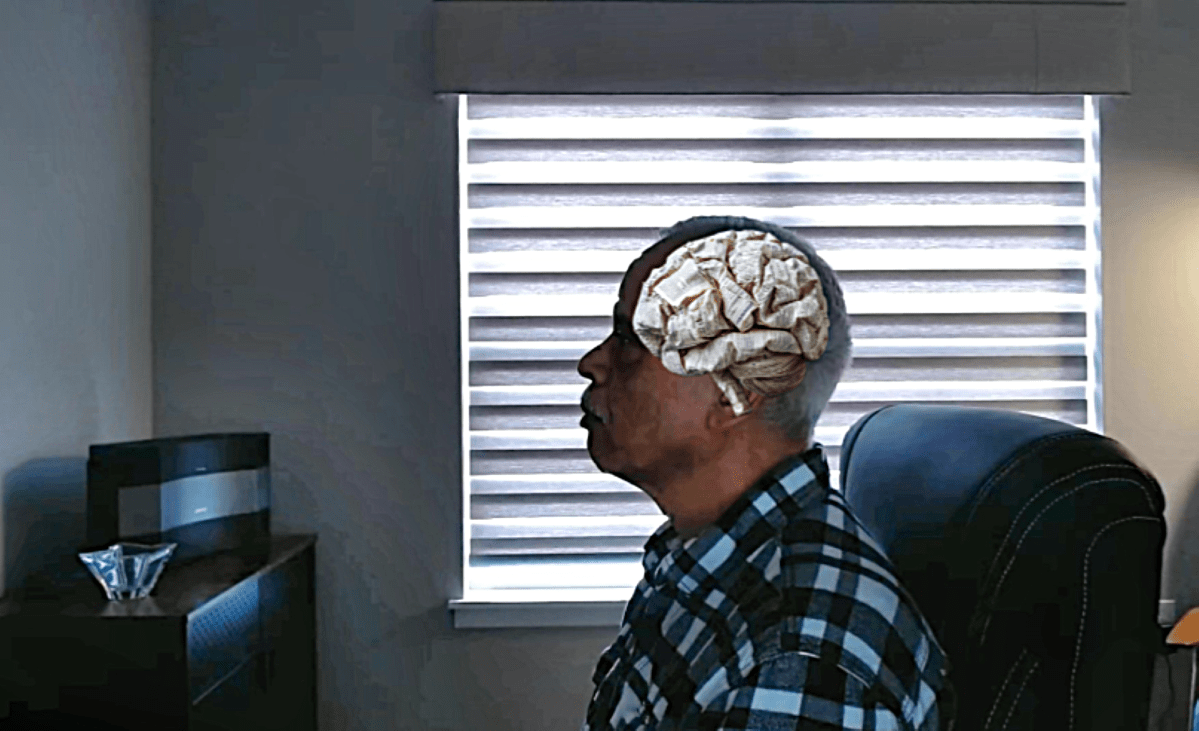
Profound Thoughts on Topological Brain Changes

I ran across this article in the news about topological changes that happen in our brains as we age. You can try to read the original open access paper published by the author Alexa Mousley.

The topological changes in the brain that occur in the brain are linked to the structural connections that are made or not in human development and roughly correspond to the main epochs of brain structure in our lives: childhood (transition to adolescence around 9 years old), adolescence lasts until around 32 years old when we finally reach adulthood, then at age 66 we reach the early ageing stage and that finally changes into late ageing or old farthood around age 83. It’s a good thing I retired 5 years ago.

What this says, of course, is that nobody should be getting married or driving until they hit age 32. There are buses, you know, although we do have self-driving cars which explode on impact so thank goodness we don’t need to worry about that.

Also, it implies that you shouldn’t be drafted into military service until you’re presumably old enough to know that war doesn’t solve any problems.

Furthermore, this could lead to earlier retirements, reducing the need for awkward discussions with tenured professors who are apparently unaware they often arrive at the office with their pants on backwards. Just boot them out the door!

Why didn’t we think of this topology thing a long time ago?

For an interesting topology discussion, see the Wikipedia article, which has an interesting photo of something called homeomorphic topology, an amusing example of which is the picture of continuous transformation of a coffee mug into a donut, or as many Iowa City people would prefer, a bagel (something that looks like a doughnut but is so tasteless you have to slather it with a pound of cream cheese).

If you have any questions, call the author of the study. You’re welcome!

Mousley, A., Bethlehem, R.A.I., Yeh, FC. et al. Topological turning points across the human lifespan. Nat Commun 16, 10055 (2025). https://doi.org/10.1038/s41467-025-65974-8

Tango Boxing a New Hybrid Sport?

Here’s how I got off on a tangent about Tango Boxing, which honestly did sound like a hybrid sport combining dancing the Tango and boxing, you know, like chess boxing, in a ring with gloves and sustaining head injuries and dancing the Tango. I was amazed when I at first misread something in an article in Medical News Today about how to live to be 100 after age 80.

In the article some fitness person actually said: “From tango to boxing and everything in between….” I read it too quickly and thought she said “From tango boxing and everything in between.” You’re not going to give me a hard time about misreading that are you? It could happen to anybody, no matter how old you are.

Anyway, it set me down the rabbit hole and I even managed to confuse the AI assistant Gemini (give me a break, I never ask for this joker to help me; it just pokes its nose into all my internet searches) yet here’s what it said on one of my searches for Tango Boxing (my question was “is tango boxing about a combination of boxing and dancing the tango?”):

“Yes, “tango boxing” is a form of fitness class or exercise that combines elements from both tango dancing and boxing techniques

It is not a traditional martial art or a specific, established combat sport. Instead, it is a workout designed to provide a low-impact, full-body fitness experience, leveraging the unique aspects of each discipline for exercise and well-being. 

Key Aspects of Tango Boxing

  • Combination Workout: It blends the core elements of boxing (punches, jabs, crosses, hooks) with basic tango dance movements (box steps, pivots, coordination drills).
  • Focus on Fitness: The primary goals are to improve physical fitness, including cardiovascular endurance, strength, flexibility, balance, and coordination.
  • Rhythm and Timing: Both boxing and tango require a strong sense of rhythm and timing, and the workout emphasizes developing these skills for effective movement and body control.
  • Mind-Body Connection: The class format is designed to engage both the body and mind, as learning the routines and movements requires focus and quick thinking.
  • Improvisation and Expression: Much like traditional tango and individual boxing styles, the fitness class allows for personal expression and improvisation within a structured format. 

This type of class, sometimes marketed as “Tango Fitness,” is a creative way to stay active and healthy, offering a unique alternative to standard gym routines.”

That’s the danger of AI and it could not be clearer why it’s answers should not be appearing at the top of any web search result. And you can’t turn it off.

Here all I was doing was chasing down my mistake and you see how easily AI gets misled. Some would call this an example of an AI “hallucination” although I prefer to think of it as confabulation.

I found out later that the Tango involves doing something called a “box step.” Those of you who know the Tango know what I’m talking about, even if I and AI don’t. Actually, let me correct that; AI could describe the Tango box step, which involves a dance pattern that forms a square on the floor.

So far am I OK? There’s no such hybrid sport as Tango Boxing? On the other hand, who can forget Muhammad Ali dancing around his opponents in the ring? He actually did sort of dance.

When all is said and done, the main point is how to live to be 100 years old and still be cool, strong, graceful, and joyful.

A Few Thoughts on Calvinball Cribbage

OK, so Sena and I have been experimenting with a few cribbage variants in the last few days and I ran into this Calvinball comment on a Reddit cribbage thread about 10-card cribbage. Yes, people play that! I’m afraid to look on the web for 11-card cribbage although Sena asked about it.

Briefly, 10-card cribbage is usually a two-player game. Deal 10 cards each; 2 cards from each player go to the dealer’s crib; each player divides the remaining 8 cards into 2 four card hands, one for pegging and either one or both for the show.

As an aside, the Reddit thread person who started the thread about 10 card cribbage asked if anyone else ever played it. One commenter facetiously replied “Yes, there have been many many posts of Calvinball crib.”

You have to know where that term “Calvinball” comes from. I’m pretty sure it’s from another social media forum which plays a game called Calvinball—which is a whimsical, forever evolving game which has nothing to do with playing cards, is based on the comic Calvin & Hobbes and has no real rules whatsoever. Participants make it up as they go along. So, I think what the commenter might have meant was that 10-card cribbage is yet another of the many proliferating variants (some better than others) of the more well-established game, usually identified as 6-card cribbage.

Anyway, we found out later that there are two sets of rules for 10-card cribbage. The intent is to make the game play faster and yield higher scores.

 Given that context, we played it both ways to 121. In the one set according to AI, you deal each player 10 cards and both throw 2 cards to the dealer’s crib. Each player divides the remaining cards into hands of 4 cards each. You play one hand only during the pegging phase and the other for the show (scoring the hand). It was pretty slow and didn’t yield high scores, partly because we used only the four card hand for the show.

And then there’s a Wikipedia article which says you peg with one hand and score both for the show. We got higher scores all around, the game was faster, and we both enjoyed it much more.

As a reminder follow up to the post about the 9-card and 8-card cribbage games, Sena still likes the 9-card variant but doesn’t care for the 8-card (neither do I) because it seems clunkier, probably because you need to bury cards under the deck. The 9-card variant has an on-line scorer which didn’t work consistently. We seemed to fare pretty well without it for the most part. The suggestion to play to 323 (up, back, and there again on a 121-hole board) seems like overkill. I’m retired but not that retired.

Thoughts on Retirement, MIB Style

Sena alerted me to an article about the 28th anniversary of when the first Men in Black movie hit the theaters in 1997. The author praises it and says it’s still pretty good.

I can’t remember the first time I saw it, but it was probably not in 1997. I was in my second year of being an assistant professor of psychiatry at the University of Iowa Hospitals & Clinics (now called University of Iowa Health Care). I was too busy to do much of anything except run around the hospital responding to requests for psychiatry consultations from medicine and surgery. I did that a long time.

I’ve been blogging since 2010. I cancelled my first blog which was called The Practical Psychosomaticist. I then restarted blogging, calling it Go Retire Psychiatrist. One blog that pays homage to my career and to the Men in Black films is “The Last White Coat I’ll Ever Wear.”

It’s part reminiscence and part comedy in the style of Men in Black dialogue and jokes. Since I retired, I have not been back to the hospital except for scheduled appointments in the eye and dentistry clinics. I don’t know if I’ve ever reconciled myself to being retired. If someone were to tell me “We have a situation and we need your help” (think Men in Black II), I would probably say something like “There is a free mental health clinic on the corner of Lilac and East Valley.”

I Made a New YouTube Channel Trailer!

I made a new YouTube Channel trailer today since it’s been a couple of years since I made the previous one. Thanks for watching!

James Amos, MD (who prefers to be called Jim but his YouTube handle is @JamesAmosMD) is a retired psychiatrist who graduated from the University of Iowa College of Medicine, did his residency, practiced and taught at University of Iowa Health Care (UIHC) in Iowa City, Iowa for about 24 years. Since retirement in 2020, he’s enjoyed bird-watching, taught himself to juggle, and plays cribbage. He co-edited and published a book with former UIHC psychiatry chair Bob Robinson, “Psychosomatic Medicine: An Introduction to Consultation-Liaison Psychiatry” in 2010 which is still available for purchase. Bob passed away in 2024 and all who knew and learned from him remember him fondly. Jim and his wife have made Iowa City their home for over 3 decades. Jim’s been blogging since about 2011 and you can read his current blog at Go Retire Psychiatrist. He’s mainly a humorist and has a certificate from Dad-joke University of Humour (DUH), even though he’s never been a dad and doesn’t really tell jokes per se.

Rambling About the Clear Creek Trail

I put 2.5 miles on the step counter today walking on the Clear Creek Trail, so my feet are complaining a bit more.

Sena didn’t come with me on the walk today because of some gardening she had to do. She deals with foot issues and has been trying shoe inserts lately. Trimming them is an inexact science, but she got it right. The thing was, her feet hurt even worse with the inserts.

That’s because they were upside down. There are raised gel contours around the bottom for extra support, which have to face downwards in the shoe. They were a lot more comfortable for her once they were in right side up.

I didn’t get any shoe inserts because my new shoes fit pretty well. I walked a little further than usual, moving east on the part of the trail which has a fair number of ups and downs. It feels more like a nature walk (which is on the Make It OK Calendar for May Mental Health Awareness Month).

The trail is paved, but the trees and other vegetation are thick and tend to crowd around both sides. The trees sometime bend in archways across the path.

It was tempting to park my butt on the bench, but just sitting might have invited more flying bugs to buzz around my ears—despite applying enough OFF to defend me and a few other people.

We’ve walked this trail many times, but I saw something a little unusual today. There’s a big old dead tree that looks like a tuning fork.

I set a goal to reach a familiar place that’s high enough and cleared of foliage to see the creek from high above. That’s where I saw the 3 ducksateers: mallards in a line swimming up and down the stream in a sort of aimless way, yet determined to make good time.

After I returned to the trailhead, I heard the camera-shy gray catbird I always hear in a tall shrub right next to the trail. I sat in a bench close by with my camera out. It made the typical catbird noises, which sounds like a collection of whistles, creaks, and meows. But it hid in the leaves and when it burst onto the paved trail, it moved too quickly for me to get a shot.

I think the catbird hides in the trees right next to other birds, like robins, just to misdirect you. And that fooled me today–again. I thought I got a video clip of the catbird—but it turned out to be a robin, hamming it up for the camera like robins always do.

So, I included an old picture of a real catbird I took about a year and half ago.

Writing is Dope

I learned a new slang word from Houston White, the guy who makes that specialty coffee in Minneapolis I blogged about yesterday: Brown Sugar Banana (I’m not a fan, but I admire him just the same). The word is “dope.” That used to be an insult or an illicit drug when I was growing up. Now it means “very good.”

I guess writing, at least for me, is dope.

The further I get in time away from the day I retired from practicing consultation psychiatry, the more I reflect about how I became a psychiatrist. I’m a first-generation doctor in my family, so what follows is one way to write about it.

What has helped me get through life was this writing habit along with a sense of humor. When I was little, I wrote short stories for my mother. I was the “number one son” in the words of my father, which meant only that I was the first born. My younger brother came second only in order of birth. He was the track star. I was the paperboy. Our parents separated early on. Sena and I have been married for 47 years.

I have been writing my whole life. I used a very old typewriter. I wrote poetry for a while, eons ago. Like many aspiring writers, I tried to sell them to publishers. The only publisher I remember ever responding sent me a hand-scrawled note on a small sheet of paper. He told this really short, nearly incoherent story about his son, who had apparently died shortly before. His son had a “tough road.” It wasn’t clear exactly how he died, but I remember wondering whether it was suicide. It was very sad.

In the 1970s, while I was a student at one of the Historically Black Colleges and Universities (Huston-Tillotson College, now a university) in Austin, Texas, I submitted a poem to the school’s annual contest and for entry into the college’s collection, called Habari Gabani (which means “what’s going on” in Swahili). It was rejected. Years later, I finally was able to track down a digital copy of Habari Gani.

Habari Gani from Huston-Tillotson College

Eventually, thank goodness for everyone’s sake, I gave up writing poetry. It was as bad as Vogon poetry. You’ll have to read Douglas Adam’s book “A Hitchhiker’s Guide to the Galaxy,” for background on that. The Vogons were extraterrestrials who destroyed Earth in order to build an intergalactic bypass for a hyperspace expressway. Vogon poetry is frightfully bad; it’s the waterboarding torture of literature.

I wrote a short Halloween story for my hometown newspaper contest once. It got honorable mention, but I can’t recall what it was about, thank goodness.

I wrote a feature story in a journalism class taught by a nice old guy who made a long speech to the class about the unfortunate tendency for young writers to use flowery, polysyllabic words in their prose. He made it clear that journalists shouldn’t write like that. Although I didn’t consciously do the opposite to annoy him, I did it anyway. I even tossed the word “Brobdingnagian” in it, which might have referred to some high bluffs somewhere in Iowa. Despite being infested with Vogonisms, my teacher tolerated it, sparing my feelings. I must have passed the course although how I did it remains a mystery. 

I wrote and co-edited a book with the chairman of the University of Iowa Healthcare Dept of Psychiatry, Dr. Robert G. Robinson, MD. It was “Psychosomatic Medicine: An Introduction to Consultation-Liaison Psychiatry”. There were several contributors. Many of them were my colleagues. It was published in 2010, and prior to that, I’d written an unpublished manual that I wrote for the residents.

There wasn’t any humor in either book, because they were supposed to be evidence of scholarly productivity from a clinical track academic psychiatrist. But I used humor and non-scientific verbiage in my lectures, albeit sparingly. I remember one visiting scientist remarked after one of my Grand Rounds presentations, “You are so—poetic” and I detected a faint disparaging note in his tone…probably a reaction to a latent Vogonism. It’s not impossible to monkey-wrench those into a PowerPoint slide or two.

I used to write a former blog called The Practical Psychosomaticist, later changed to The Practical CL Psychiatrist when The Academy of Psychosomatic Medicine changed their name back to The Academy of Consult-Liaison Psychiatry back in 2017. I wrote The Practical CL Psychiatrist for a little over 7 years. I stopped, but then missed blogging so much I went back to it in 2019 after only 8 months. I guess I was in withdrawal from writing.

That’s because writing is dope.